Report Overview
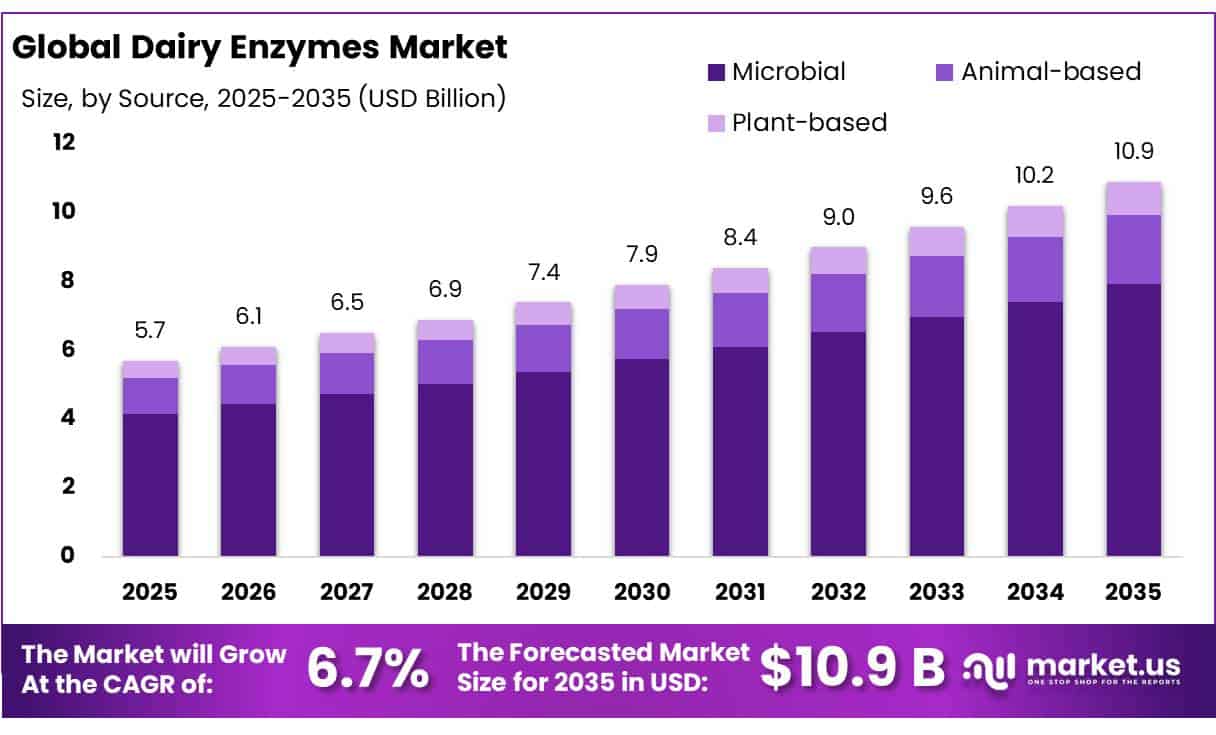
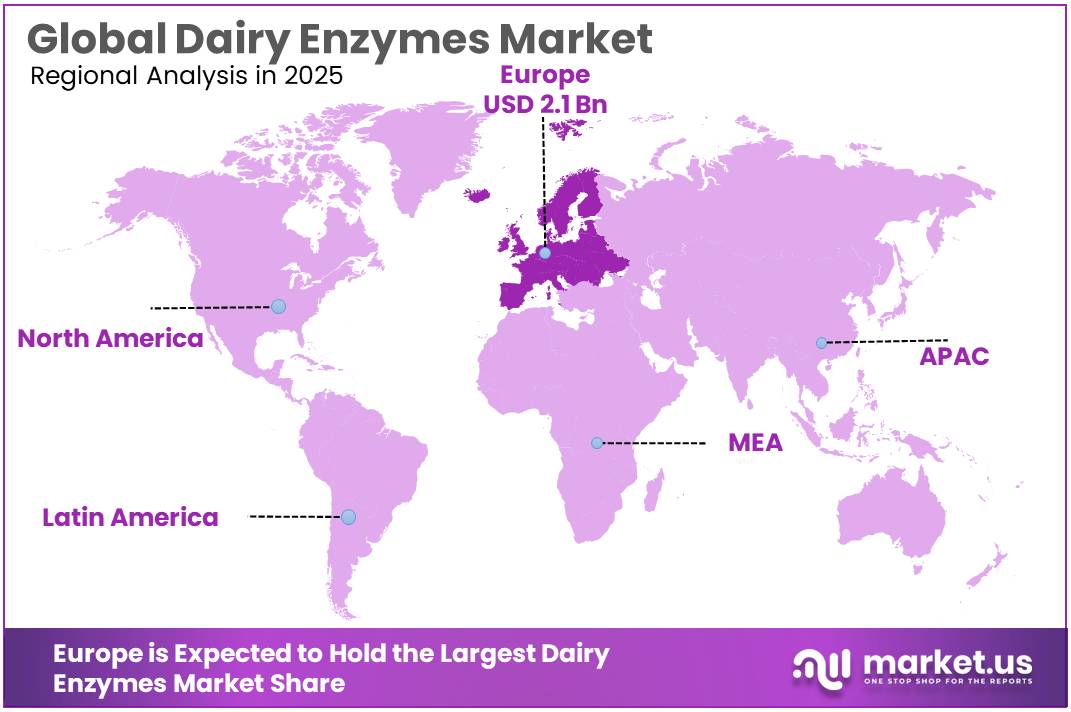
The Global Dairy Enzymes Market size is expected to be worth around USD 10.9 Billion by 2035, from USD 5.7 Billion in 2025, growing at a CAGR of 6.7% during the forecast period from 2026 to 2035. In 2025, Europe held a dominant market position, capturing more than a 37.00% share, holding USD 2.1 Billion revenue.
The dairy enzymes industry plays an important role in modern dairy processing by improving milk coagulation, lactose digestion, cheese yield, flavour development, texture, and product consistency. Enzymes such as rennet, lactase, lipase, and protease are used in cheese, lactose-free milk, yoghurt, whey processing, and other dairy applications. Their use helps manufacturers improve production efficiency, develop specialised dairy products, and manage processing costs.
- According to the OECD-FAO Agricultural Outlook 2025–2034, global milk production increased by 1.1% in 2024 to approximately 950 million tonnes. This large processing base creates opportunities for enzymes used in cheese manufacturing, lactose reduction, whey processing, and fermented dairy production. The United States Department of Agriculture also reported that global cheese production reached approximately 22.3 million tonnes in 2023–2024, with production projected to increase to 22.52 million tonnes in 2024–2025.
Regulatory oversight and food safety requirements also influence product development. The United States Food and Drug Administration (FDA) lists enzyme preparations used in food, including lactase derived from Kluyveromyces lactis and chymosin preparations used in cheese production. This provides manufacturers with established regulatory references when evaluating suitable enzyme preparations and their intended uses. Enzyme suppliers must continue to address product purity, consistent activity, processing stability, and compliance with applicable food regulations.
Future growth opportunities are likely to emerge from specialised enzyme formulations, microbial fermentation, improved whey utilisation, and more efficient production of high-protein dairy ingredients. According to Eurostat, the European Union produced 161.8 million tonnes of raw milk in 2024, while average milk yield reached 8,120 kilograms per cow. This substantial processing base supports continued opportunities for enzyme applications across cheese, yoghurt, milk powders, and other dairy products.
Suppliers that improve enzyme performance at different processing temperatures, reduce production losses, and support cleaner-label product development may strengthen their competitive position. Overall, the dairy enzymes industry is positioned to benefit from increasing dairy processing requirements, demand for specialised nutrition, and investment in efficient food manufacturing technologies.
Key Takeaways
- Dairy Enzymes Market size is expected to be worth around USD 10.9 Billion by 2035, from USD 5.7 Billion in 2025, growing at a CAGR of 6.7%.
- Lactase held a dominant market position, capturing more than a 33.60% share of the Dairy Enzymes Market.
- Microbial held a dominant market position, capturing more than a 72.80% share
- Liquid held a dominant market position, capturing more than a 58.00% share of the Dairy Enzymes Market.
- Yogurt held a dominant market position, capturing more than a 31.00% share of the Dairy Enzymes Market.
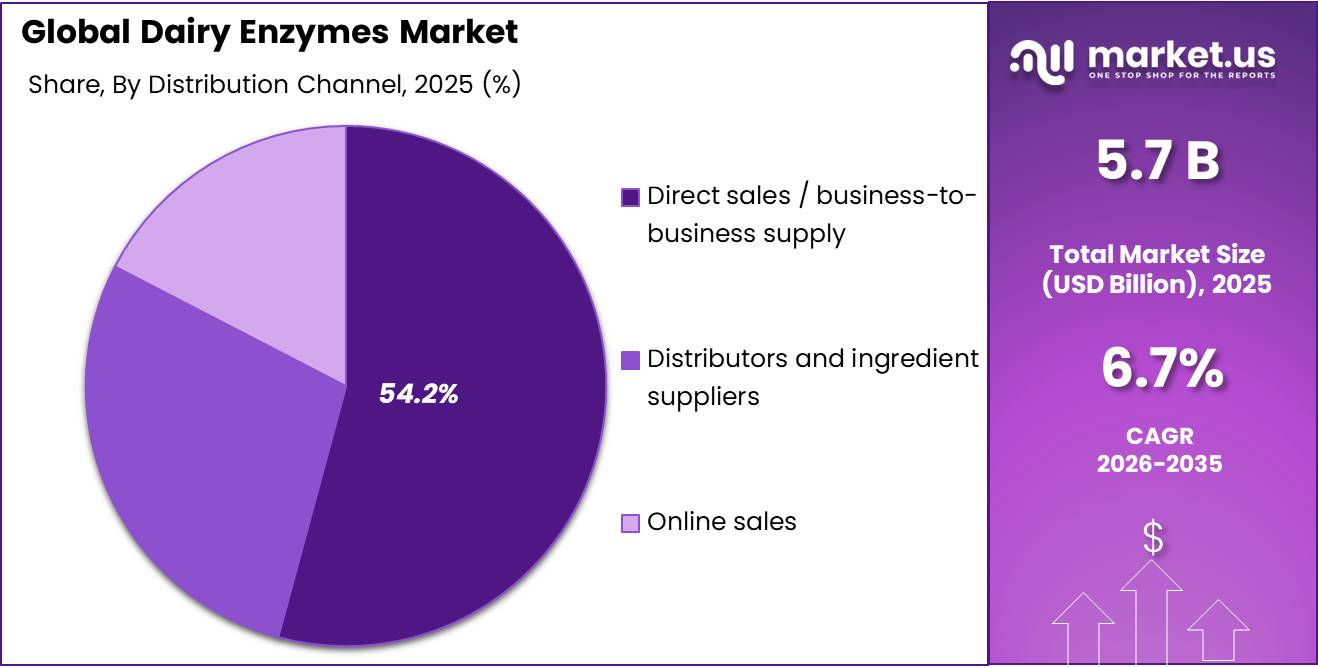
- Direct sales / business-to-business supply held a dominant market position, capturing more than a 54.00% share.
- Europe held a dominant position in the Dairy Enzymes Market, accounting for a supplied market share of 37.00% and a market value of USD 2.1 billion.
By Enzyme Type Analysis
Lactase dominates due to rising demand for lactose-free dairy products
In 2025, “Lactase” held a dominant market position, capturing more than a 33.60% share of the Dairy Enzymes Market by Enzyme Type. Lactase is widely used to break down lactose in milk and other dairy products, supporting the production of lactose-free milk, yoghurt, and specialised dairy ingredients. Its role in improving product accessibility for consumers who have difficulty digesting lactose supports its use by dairy processors. Manufacturers also benefit from using lactase to expand their product ranges and meet demand for convenient dairy alternatives.
Microbial rennet is used in cheese manufacturing to coagulate milk and help separate curds from whey. It provides dairy processors with an alternative to animal-derived rennet and supports cheese production across different product types. In 2025, the United States Food and Drug Administration (FDA) listed chymosin preparations produced using microorganisms, including Aspergillus niger and Kluyveromyces species, for coagulating milk in cheese and other dairy products.
The FDA also closed a review of a chymosin enzyme preparation in March 2025, with a corrected letter issued in July 2025, for its intended use in cheese and whey powder production at up to 0.97 milligrams of total organic solids per kilogram of milk. These regulatory references support the use of microbial enzyme technology in commercial dairy processing. Growing cheese production and demand for reliable coagulation performance create opportunities for microbial rennet suppliers to serve dairy manufacturers seeking consistent product quality and efficient processing.
By Source Analysis
Microbial enzymes dominate due to consistent production and reliable supply
In 2025, “Microbial” held a dominant market position, capturing more than a 72.80% share of the Dairy Enzymes Market by Source. Microbial enzymes are widely used in dairy processing because they can be produced through controlled fermentation, supporting consistent enzyme quality and large-scale manufacturing. They are suitable for applications such as cheese coagulation, lactose breakdown, and dairy protein processing.
Their production can also reduce dependence on animal-derived raw materials, giving manufacturers greater flexibility in sourcing enzyme preparations. The US Food and Drug Administration provides information on microorganisms and microbial-derived ingredients used in food, supporting regulatory evaluation of these technologies.
Animal-based enzymes are used in dairy processing, particularly in traditional cheese production, where animal-derived rennet helps coagulate milk and develop the required curd structure. These enzymes remain relevant for cheese varieties that depend on established production methods and specific taste and texture characteristics. However, their supply can depend on the availability of suitable animal-derived raw materials, while microbial alternatives offer manufacturers additional sourcing flexibility.
In 2025, the United States produced 14.8 billion pounds of cheese, an increase of 4.0% compared with 2024, according to the USDA National Agricultural Statistics Service. This production volume demonstrates the scale of cheese manufacturing that supports demand for milk-coagulating enzymes from both microbial and animal-based sources.
By Form Analysis
Liquid enzymes lead due to easy handling and efficient processing
In 2025, “Liquid” held a dominant market position, capturing more than a 58.00% share of the Dairy Enzymes Market by Form. Liquid enzymes are widely used in dairy processing because they can be measured, blended, and added directly to milk during manufacturing. This makes them suitable for cheese production, lactose hydrolysis, and other applications that require accurate enzyme dosing. Their use helps processors maintain consistent product quality and manage production steps efficiently.
Powder enzymes are valued for their suitability in applications that require dry formulations, convenient storage, and controlled dosing. They can be useful for dairy manufacturers seeking longer storage stability and easier transportation, depending on the enzyme formulation and packaging conditions. In 2025, the United States produced 1.66 billion pounds of nonfat dry milk for human consumption, while total dry whey production reached 845 million pounds, according to the United States Department of Agriculture (USDA).
These figures highlight the scale of dry dairy ingredient processing where enzyme technologies can support production and ingredient development. Powder formulations may offer opportunities in specialised dairy processing, although their suitability depends on enzyme activity, moisture sensitivity, and the requirements of the final product.
By Application Analysis
Yogurt leads as enzyme use supports texture, consistency, and product quality
In 2025, “Yogurt” held a dominant market position, capturing more than a 31.00% share of the Dairy Enzymes Market by Application. Enzymes support yoghurt manufacturing by helping control texture, protein properties, and product consistency. Lactase is also used to produce lactose-free yoghurt, allowing dairy processors to serve consumers seeking products with reduced lactose content. As manufacturers expand their ranges of fermented dairy foods, enzyme solutions can help improve processing efficiency and maintain consistent product characteristics.
Milk is a major application for dairy enzymes because it serves as the primary raw material for drinking milk, lactose-free milk, cheese, and other dairy products. Enzymes such as lactase help manufacturers break down lactose, while proteolytic enzymes support selected milk-protein processing applications. In 2025, the United States produced approximately 232 billion pounds of milk, representing a 2.6% increase from 2024, according to the United States Department of Agriculture (USDA).
By Distribution Channel Analysis
Direct sales lead through close customer relationships and tailored supply
In 2025, “Direct sales / business-to-business supply” held a dominant market position, capturing more than a 54.00% share of the Dairy Enzymes Market by Distribution Channel. Direct sales allow enzyme manufacturers to work closely with dairy processors, understand their production needs, and provide suitable enzyme formulations and technical support. This channel is useful for large dairy plants that require consistent supplies, reliable product performance, and assistance with enzyme dosing and process optimisation. Direct relationships can also help suppliers develop customised solutions for cheese, milk, and yoghurt manufacturing.
Distributors and ingredient suppliers help dairy enzyme manufacturers reach small and medium-sized processors, regional dairy businesses, and specialised food producers. They support product availability through local supply networks, inventory management, technical guidance, and access to complementary food ingredients. In 2025, the European Union produced 161.8 million tonnes of raw milk, of which 150.8 million tonnes was delivered to dairies for processing, according to Eurostat.
This large processing base illustrates the scale of the dairy industry served by ingredient supply networks. Distributors can create further opportunities by supplying suitable enzyme formulations for cheese, milk, yoghurt, and whey processing while helping customers manage procurement and delivery requirements. The 54.00% direct-sales share is the supplied market figure; Eurostat does not publish a comparable government statistic for dairy enzyme distribution-channel shares.
Key Market Segments
By Enzyme Type
- Lactase
- Microbial rennet
- Lipase
- Protease
- Transglutaminase
- Other enzymes
By Source
- Microbial
- Animal-based
- Plant-based
By Form
- Liquid
- Powder
- Granules
By Application
- Milk
- Cheese
- Yogurt
- Ice cream and frozen desserts
- Whey and whey-based products
- Butter and cream
- Other dairy products
By Distribution Channel
- Direct sales / business-to-business supply
- Distributors and ingredient suppliers
- Online sales
Driver Analysis
Lactose-Free Product Penetration
Lactose-free portfolio expansion supports recurring lactase demand because enzyme consumption follows commercial production batches rather than a one-time equipment purchase. Novonesis states that Saphera can achieve residual lactose below 0.01%, equivalent to less than 0.1 g/kg, providing a quantitative performance benchmark for processors developing lactose-free milk and yogurt; this supplier specification should not be interpreted as a universal statutory labeling threshold. Lactase converts lactose into glucose and galactose, enabling processors to offer differentiated dairy products without removing the underlying dairy protein and fat.
The competitive significance of this application was demonstrated during 2024: the European Commission’s approval of the Novozymes–Chr. Hansen combination required divestment of part of the combined lactase business, with the carve-out transferred to Kerry on November 26, 2024, for consideration of €145.4 million. This establishes lactase as a commercially distinct processing-enzyme business, although the transaction value is not evidence of total market size.
For the 2026–2031 forecast, the +1.1 pp contribution assumes that new product penetration generates a 5.5% annual revenue-growth uplift across an illustrative 20% revenue exposure. Value capture shifts toward application support, residual-lactose verification and reliable performance across milk and fermented products, rather than enzyme activity alone; however, technically addressable demand converts into revenue only when processors can sustain consumer uptake and economically viable retail positioning.
Drivers Impact Analysis
| Driver | (~) % Impact on CAGR Forecast | Geographic Relevance | Impact Timeline |
|---|---|---|---|
| Lactose-free product penetration | +1.1 pp | US, Canada, EU, China, India | Medium term (2–4 years) |
| Higher-yield cheese coagulants | +0.9 pp | EU, US, New Zealand | Short term (≤ 2 years) |
| Sugar-reduced dairy reformulation | +0.7 pp | EU, UK, US, China | Medium term (2–4 years) |
| Organized dairy-processing expansion | +0.6 pp | India core; Pakistan secondary | Long term (≥ 4 years) |
| Faster enzymatic processing | +0.5 pp | EU, US, Canada, China | Short term (≤ 2 years) |
Restraint Analysis
Dairy-Price Volatility
Dairy commodity volatility constrains enzyme adoption when uncertain milk procurement costs and finished-product realizations weaken processors’ willingness to fund reformulation, inventory and production trials. The FAO Dairy Price Index averaged 129.8 points in 2024, increasing 4.9% from 2023; by September 2026, it stood at 119.1 points, 19.1% below September 2025, while skim milk powder quotations remained 33.1% above their year-earlier level. These divergent movements demonstrate product-specific margin uncertainty rather than a uniform inflationary environment; the international index is also not a direct measure of every processor’s local raw-milk cost.
Structurally, less than 7% of global milk production enters international trade, yet approximately 50% of whole and skim milk powder production is traded, exposing export-oriented processors disproportionately to changes in external demand and realizations. In an illustrative processor scenario, raw milk representing 60% of sales and increasing 10% in cost would create a six-percentage-point operating-margin headwind before selling-price adjustments, procurement changes or efficiency savings; this calculation is a sensitivity assumption, not an observed industry cost structure.
The resulting commercial response can include postponement of premium dairy launches, tighter supplier price negotiations and reduced willingness to absorb trial-related production losses. The modeled −0.5 pp contribution assumes 25% revenue exposure to financially sensitive customers and a 2.0% incremental annual growth shortfall. Enzymes with demonstrable near-term yield benefits may remain resilient, making the restraint stronger for discretionary product-development applications than for established, economically essential coagulant usage.
Restraint Impact Analysis
| Restraint | (~) % Impact on CAGR Forecast | Geographic Relevance | Impact Timeline |
|---|---|---|---|
| Dairy-price volatility | −0.5 pp | EU, US, New Zealand, China | Short term (≤ 2 years) |
| Regulatory fragmentation | −0.4 pp | EU core; exporting suppliers | Medium term (2–4 years) |
| Low enzyme-addressable processing | −0.5 pp | India, Pakistan, Sub-Saharan Africa | Long term (≥ 4 years) |
| Dosage-led revenue dilution | −0.3 pp | EU, US, Canada, China | Medium term (2–4 years) |
| Process-validation friction | −0.3 pp | EU, US, India, Southeast Asia | Short term (≤ 2 years) |
Opportunity Analysis
Whey-to-GOS Platforms
Technical feasibility predates 2026: a 2022 study investigated a concentrated whey-permeate route, while a US patent application published in 2024 describes recovering whey protein by ultrafiltration, concentrating lactose through nanofiltration and using the resulting stream for enzymatic GOS synthesis; September 2026 research continues to address cost-effective GOS production from whey permeate. These sources establish a technical pathway, not an unserved market size or proven freedom to operate.
The strategic white space is the supplier’s role as process orchestrator—combining substrate characterization, enzyme selection, reaction control and downstream specifications under a repeatable commercial package. In an illustrative project, 10,000 tonnes/year of lactose-equivalent feedstock converted at an assumed 30% recoverable GOS yield would produce 3,000 tonnes/year of GOS before product-specific dilution; these are planning assumptions, not reported industrial yields. An incremental enzyme-and-license fee of €40–€80 per tonne of lactose feedstock would generate €0.4–€0.8 million annually for the platform provider, with purification, utilities, quality assurance and ingredient-distribution economics assessed separately.
Commercial entry should therefore prioritize processors with existing concentration infrastructure and committed ingredient offtake rather than build speculative standalone capacity. The +0.5 pp upside assumes that newly contracted platforms add enzyme-related revenue equivalent to 2.5% of the baseline market’s 2031 revenue; existing GOS enzyme sales remain in the baseline, and neither the GOS ingredient selling price nor total ingredient turnover is counted as dairy-enzyme market revenue.
Opportunity Impact Analysis
| Opportunity | (~) % Potential CAGR Upside | Geographic Relevance | Execution Window |
|---|---|---|---|
| Whey-to-GOS platforms | +0.5 pp | EU, US, New Zealand | Medium term (2–4 years) |
| Specialty peptide applications | +0.4 pp | EU, US, Japan | Long term (≥ 4 years) |
| Outcome-based contracts | +0.4 pp | EU, US, New Zealand | Short term (≤ 2 years) |
| Cooperative service platforms | +0.3 pp | India core | Medium term (2–4 years) |
| Reusable enzyme systems | +0.2 pp | EU, US, Japan | Long term (≥ 4 years) |
Challenges Analysis
Fermentation Scale-Up Consistency
Translating laboratory enzyme performance into reproducible commercial fermentation remains an ongoing execution challenge because biological productivity, recovery efficiency and formulation potency jointly determine saleable activity—not simply fermentation volume. EFSA’s April 2025 assessment of β-galactosidase from Kluyveromyces lactis strain LAC-01 identifies a defined production strain and manufacturing process, illustrating the product-specific biological foundation of commercial lactase supply; separately, Novonesis reported that products launched within the preceding five years represented 25% of group sales in 2025, demonstrating the continuing importance of industrializing innovation, although that percentage is not dairy-enzyme-specific.
If half of planned conversion cost is fixed per batch, unchanged variable spending and the same batch schedule would increase total cost per unit of recovered activity by approximately 17%; actual results depend on feedstock consumption, utilities and process adjustments. These are engineering scenarios, not observed industry loss rates. Sales can continue through rescheduling and inventory drawdown, but repeated deviations consume capacity, weaken delivery reliability and reduce the commercial return on new formulations.
Companies therefore need strain-specific scale-up protocols, activity-based capacity planning, statistical process control and qualified alternative manufacturing routes rather than relying only on nominal vessel capacity. The −0.4 pp friction assumption combines 20% revenue exposure to new or transferred production processes with a 2.0% incremental annual growth shortfall; it excludes production-strain safety testing addressed separately below.
Challenges Impact Analysis
| Challenge | (~) % CAGR Friction Drag | Geographic Relevance | Mitigation Horizon |
|---|---|---|---|
| Fermentation scale-up consistency | −0.4 pp | EU, US, China | Medium term (2–4 years) |
| Climate-driven milk variability | −0.4 pp | India, China, US, Southern EU | Long term (≥ 4 years) |
| Logistics and inventory resilience | −0.3 pp | EU–Asia, EU–Africa corridors | Medium term (2–4 years) |
| Production-strain quality assurance | −0.3 pp | EU, US, Asian manufacturing hubs | Medium term (2–4 years) |
| Performance attribution and verification | −0.3 pp | EU, US, New Zealand | Long term (≥ 4 years) |
Geopolitical Impact Analysis
Impact of Ongoing Middle East and Russia-Ukraine Wars on the Dairy Enzymes Market
The ongoing conflicts in the Middle East and Russia-Ukraine continue to create risks for the global dairy enzymes market by increasing energy costs, disrupting shipping routes, and raising pressure on food manufacturing supply chains. Dairy enzyme production depends on fermentation facilities, electricity, specialised ingredients, packaging, and temperature-controlled transportation. Higher fuel prices and freight charges can increase manufacturing and distribution costs for lactase, microbial rennet, and other enzyme preparations.
According to the United Nations Food and Agriculture Organization (FAO), the Food Price Index reached 136.0 points in September 2026, rising 1.5% from August, partly due to transportation disruptions and commodity supply concerns. The organisation also reported that disruptions around the Strait of Hormuz and the Black Sea were adding pressure to energy and food markets.
These pressures may encourage dairy enzyme suppliers to diversify sourcing, maintain additional inventories, and establish alternative shipping routes. However, the impact varies by region and supplier, and direct shortages of dairy enzymes cannot be assumed from wider trade disruptions alone. Companies with flexible procurement, reliable fermentation capacity, and regional distribution networks may be better positioned to manage cost volatility and maintain deliveries to dairy processors.
Regional Insights
Europe: Dominating Region
Europe held a dominant position in the Dairy Enzymes Market, accounting for a supplied market share of 37.00% and a market value of USD 2.1 billion. The region benefits from its established dairy-processing industry, strong cheese production, and demand for specialised dairy ingredients. According to Eurostat, European Union farms produced 161.8 million tonnes of raw milk in 2024, of which 150.8 million tonnes was delivered to dairies for processing.
The European Union also produced 10.8 million tonnes of cheese in 2024. This large processing base supports demand for enzymes such as lactase, microbial rennet, proteases, and lipases used in cheese, yoghurt, lactose-free milk, and whey applications. Germany and France are important contributors to regional dairy manufacturing, while established food ingredient suppliers and enzyme producers support industrial adoption.
Asia-Pacific represents an important growth opportunity for the dairy enzymes market, supported by expanding dairy consumption, rising demand for processed foods, and the development of modern food manufacturing facilities. The OECD-FAO Agricultural Outlook 2025–2034 identifies Asia as a major source of future growth in fresh dairy consumption, driven by population growth and rising incomes.
The same report projects global milk production to increase by 1.8% annually over the next decade, mainly through improved milk yields. Demand for cheese, fermented dairy products, lactose-free milk, and specialised dairy ingredients can encourage processors to adopt lactase, microbial rennet, and other enzyme solutions. Investments in processing technology and product innovation may further support enzyme adoption across regional dairy manufacturers.
Key Regions and Countries Insights
- North America
- US
- Canada
- Europe
- Germany
- France
- The UK
- Spain
- Italy
- Rest of Europe
- Asia Pacific
- China
- Japan
- South Korea
- India
- Australia
- Rest of APAC
- Latin America
- Brazil
- Mexico
- Rest of Latin America
- Middle East & Africa
- GCC
- South Africa
- Rest of MEA
Key Players Analysis
Novonesis Group is a major biosolutions company offering enzymes and microbial technologies for food and beverage processing, including dairy applications. Its solutions help manufacturers improve cheese production, milk processing, flavour, and product consistency. In 2025, the company reported 7% organic sales growth and an adjusted EBITDA margin of 37.1%. It launched 33 new products, while solutions developed during the previous 5 years contributed 25% of revenue. Its continued investment in innovation and fermentation-based technologies supports its position in the dairy enzymes industry.
dsm-firmenich supplies food ingredients and specialised solutions that support dairy product development, flavour, texture, and processing. Its capabilities across nutrition and food ingredients help dairy manufacturers develop products for changing consumer needs. In 2025, the company reported EUR 9.034 billion in sales from continuing operations, with 3% organic sales growth. Its Taste, Texture & Health business achieved 4% organic sales growth, reflecting demand for specialised ingredient solutions. These capabilities provide a foundation for serving dairy processors, although the reported financial figures cover broader business activities rather than dairy enzymes alone.
International Flavors & Fragrances Inc. (IFF) supplies food ingredients, cultures, enzymes, and bioscience solutions to food manufacturers, including dairy producers. Its technologies support applications such as yoghurt, cheese, and other fermented foods. In 2025, IFF recorded USD 10.890 billion in total sales and served approximately 20,000 customers. Its 25 largest customers accounted for approximately 32% of sales, while small and medium-sized companies contributed approximately 69% of sales. Its broad customer network and food ingredient capabilities support its competitive position, although these figures represent the wider company rather than dairy enzyme sales alone.
Top Key Players Outlook
- Novonesis Group
- dsm-firmenich
- International Flavors & Fragrances Inc. (IFF)
- Kerry Group plc
- AB Enzymes GmbH
- Amano Enzyme Inc.
- Advanced Enzyme Technologies Ltd.
- Biocatalysts Ltd.
- Enzyme Development Corporation (EDC)
- SternEnzym GmbH & Co. KG
- Neogen Corporation / Megazyme
- Lesaffre
- Lallemand Inc.
- Fytozimus Biotech / Phytozymes Biotech Pvt. Ltd.
- Enmex S.A. de C.V.
Recent Developments
- In November 2025, Amano co-hosted the 8th Sino-Japan Joint Symposium on Enzyme Technology with Jiangnan University and Jiaxing Future Food Research Institute, bringing together 113 participants and 8 speakers to discuss enzyme research, food processing, and safety.
- In February 2025, Biocatalysts Ltd. reorganised its food, baking, and beverage operations into a dedicated business unit and combined its 2 US entities under the Biocatalysts brand to improve customer service and operational efficiency.
Report Scope
| Report Features | Description |
|---|---|
| Market Value (2025) | USD 5.7 Bn |
| Forecast Revenue (2035) | USD 10.9 Bn |
| CAGR (2026-2035) | 6.7% |
| Base Year for Estimation | 2025 |
| Historic Period | 2020-2024 |
| Forecast Period | 2026-2035 |
| Report Coverage | Revenue Forecast, Market Dynamics, Competitive Landscape, Recent Developments |
| Segments Covered | By Enzyme Type (Lactase, Microbial rennet, Lipase, Protease, Transglutaminase, Other enzymes), By Source (Microbial, Animal-based, Plant-based), By Form (Liquid, Powder, Granules), By Application (Milk, Cheese, Yogurt, Ice cream and frozen desserts, Whey and whey-based products, Butter and cream, Other dairy products), By Distribution Channel (Direct sales / business-to-business supply, Distributors and ingredient suppliers, Online sales) |
| Regional Analysis | North America – US, Canada; Europe – Germany, France, The UK, Spain, Italy, Rest of Europe; Asia Pacific – China, Japan, South Korea, India, Australia, Singapore, Rest of APAC; Latin America – Brazil, Mexico, Rest of Latin America; Middle East & Africa – GCC, South Africa, Rest of MEA |
| Competitive Landscape | Novonesis Group, dsm-firmenich, International Flavors & Fragrances Inc. (IFF), Kerry Group plc, AB Enzymes GmbH, Amano Enzyme Inc., Advanced Enzyme Technologies Ltd., Biocatalysts Ltd., Enzyme Development Corporation (EDC), SternEnzym GmbH & Co. KG, Neogen Corporation / Megazyme, Lesaffre, Lallemand Inc., Fytozimus Biotech / Phytozymes Biotech Pvt. Ltd., Enmex S.A. de C.V. |
| Customization Scope | Customization for segments, region/country-level will be provided. Moreover, additional customization can be done based on the requirements. |
| Purchase Options | We have three licenses to opt for: Single User License, Multi-User License (Up to 5 Users), Corporate Use License (Unlimited User and Printable PDF) |