Report Overview
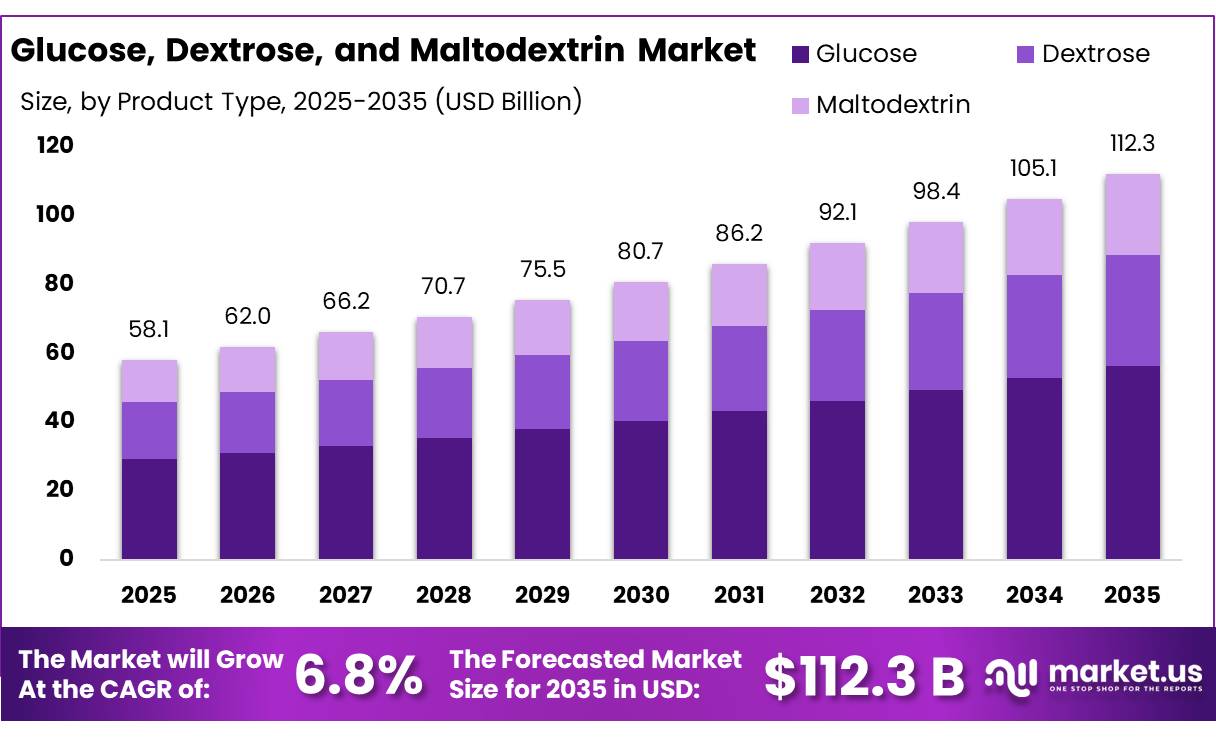
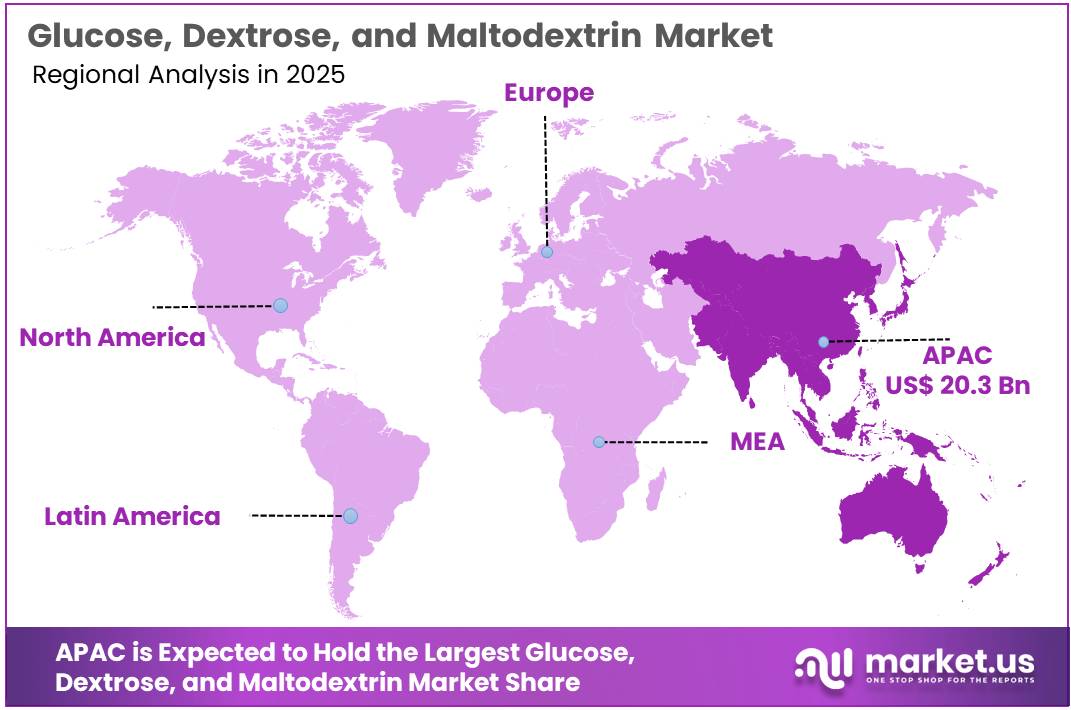
The Global Glucose, Dextrose, and Maltodextrin Market size is expected to be worth around USD 112.3 Billion by 2035, from USD 58.1 Billion in 2025, growing at a CAGR of 6.8% during the forecast period from 2026 to 2035. In 2025, Asia-Pacific held a dominant market position, capturing more than a 35.00% share, holding USD 20.3 Billion revenue.
The glucose, dextrose, and maltodextrin industry forms an important part of the global food ingredient, pharmaceutical, beverage, and industrial processing sectors. These ingredients are mainly produced through the processing and controlled breakdown of starch obtained from corn, wheat, potatoes, rice, and other plant-based raw materials.
- According to the European Commission’s Joint Research Centre, starch hydrolysis produces glucose-based syrups used in confectionery, beverages, dairy products, baked goods, and other food applications. This production process allows manufacturers to adjust sweetness, viscosity, and functional properties according to customer requirements.
The industrial scenario is supported by an established agricultural processing network that converts grain and other starch-rich materials into multiple value-added ingredients. According to Starch Europe, the European starch industry operates 70 production facilities across 18 European Union member states and produces approximately 9.8 million tonnes of starch and starch derivatives annually, based on its reported 2024 industry figures. The sector processes around 22 million tonnes of agricultural raw materials, including wheat, maize, and starch potatoes.
These figures demonstrate the scale of the industrial infrastructure supporting starch-derived ingredients, although they do not represent glucose, dextrose, and maltodextrin production alone. Producers supply food manufacturers, beverage companies, pharmaceutical businesses, animal nutrition suppliers, and industrial customers, with product specifications varying according to purity, moisture content, sweetness, and application requirements.
Demand is primarily driven by the expansion of packaged foods, convenience beverages, confectionery, bakery products, dairy formulations, and pharmaceutical preparations. These ingredients help manufacturers manage sweetness, moisture retention, product consistency, fermentation, and processing efficiency. The pharmaceutical sector provides an additional growth avenue for high-purity dextrose used in intravenous solutions, hydration products, and tablets.
- According to Ingredion’s 2025 annual report filed with the United States Securities and Exchange Commission, the company recorded approximately USD 7.219 billion in net sales during 2025, demonstrating the scale of a major ingredient supplier serving food, beverage, nutrition, and industrial markets. These sales cover its wider business and should not be interpreted as revenue from glucose, dextrose, and maltodextrin alone.
Raw material availability and processing costs remain important factors influencing industrial performance. The United States Department of Agriculture’s 2025 Crop Production Summary estimated United States corn production at a record 17.0 billion bushels in 2025, an increase of 14% from the 2024 estimate. Large corn supplies can support starch-processing operations, although actual ingredient costs also depend on crop quality, energy prices, transportation, water use, and processing efficiency.
Manufacturers must also manage competition from alternative sweeteners, changing food formulations, and demand for products with reduced added sugar. Regulatory compliance, ingredient traceability, and consistent quality are essential, particularly for pharmaceutical and food-grade applications. The United States Food and Drug Administration identifies maltodextrin’s permitted technical functions, including its use as a stabilizer, thickener, texturizer, and nutritive sweetener, under its food-substances database.
Future growth opportunities are likely to emerge from specialized pharmaceutical-grade dextrose, customized maltodextrin grades, fermentation ingredients, sports and clinical nutrition formulations, and improved starch-conversion technologies. Manufacturers can also expand through enzyme-assisted processing, better energy recovery, water recycling, and the development of ingredients from alternative starch sources.
The European starch industry’s reported output of 9.8 million tonnes of starch and derivatives in 2024 provides evidence of an established processing base from which manufacturers can develop higher-value ingredients. However, future performance will depend on customer demand, regulatory requirements, agricultural supply stability, and manufacturers’ ability to deliver consistent quality at competitive costs.
Key Takeaways
- Glucose, Dextrose, and Maltodextrin Market size is expected to be worth around USD 112.3 Billion by 2035, from USD 58.1 Billion in 2025, growing at a CAGR of 6.8%.
- Glucose held a dominant market position, capturing more than a 50.00% share.
- Corn held a dominant market position, capturing more than a 65.00% share.
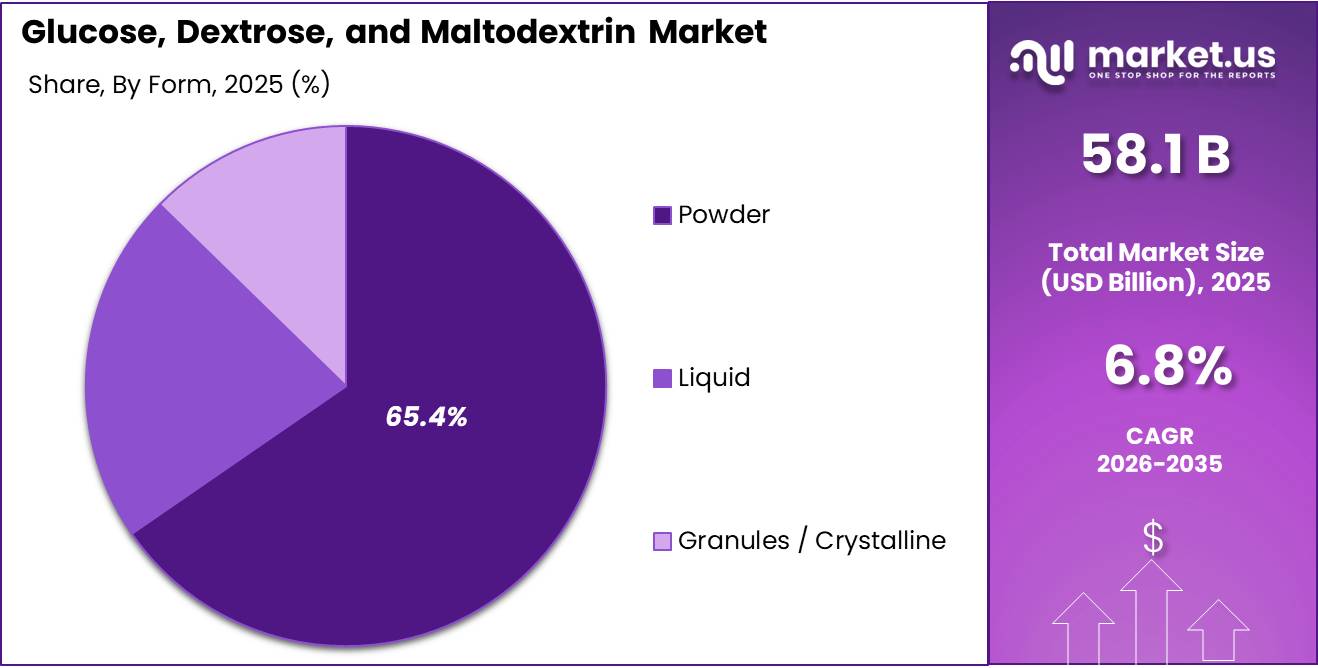
- Powder held a dominant market position, capturing more than a 65.00% share.
- Food grade held a dominant market position, capturing more than a 62.00% share.
- Food & beverages held a dominant market position, capturing more than a 58.00% share.
- Bakery and confectionery held a dominant market position, capturing more than a 30.00% share.
- Direct sales / business-to-business supply held a dominant market position, capturing more than a 60.00% share.
- Asia-Pacific held a dominant market position, accounting for 35.00% of the market, valued at USD 20.3 billion.
By Product Type Analysis
Glucose dominates due to its wide use in food processing, beverages, confectionery, and pharmaceutical applications.
In 2025, “Glucose” held a dominant market position, capturing more than a 50.00% share. Its position is supported by its use as a sweetener, a fermentation ingredient, and a functional component in processed foods and beverages. Glucose also helps manufacturers control texture, moisture retention, and product consistency.
According to the United States Department of Agriculture’s 2025 Crop Production Summary, United States corn production reached approximately 17.0 billion bushels in 2025, providing a substantial agricultural raw-material base for starch-processing industries. This figure supports the broader production environment for starch-derived ingredients but does not measure glucose output directly. Demand is expected to benefit from continued use in food manufacturing, fermentation, and industrial formulations.
Dextrose is widely used because it provides a readily available carbohydrate source and supports fermentation and formulation requirements. In food manufacturing, it is used in bakery products, confectionery, beverages, and processed foods. Pharmaceutical applications include dextrose-based solutions and other preparations requiring specific quality standards.
The United States Food and Drug Administration’s food ingredient resources provide regulatory information relevant to ingredients used in food products. However, no government statistic establishing a specific dextrose market share or confirming it as the dominant product segment was identified in the information available here. Therefore, a numerical share for dextrose cannot be stated reliably without a verified source.
By Source Analysis
Corn dominates as a raw material due to its large-scale availability and suitability for starch-based ingredient production.
In 2025, “Corn” held a dominant market position, capturing more than a 65.00% share. Corn is widely used to produce glucose, dextrose, and maltodextrin because its starch can be processed into different carbohydrate ingredients for food, beverage, pharmaceutical, and industrial applications.
According to the United States Department of Agriculture (USDA), 2025 Crop Production Summary, United States corn production reached a record 17.0 billion bushels in 2025, increasing 14% from the 2024 estimate. This strong agricultural supply supports the raw-material base for starch-processing industries. Although this production figure does not measure the ingredient market directly, it highlights the scale of corn availability for industrial processing. Corn’s established supply chain and suitability for large-scale starch extraction continue to support its importance in the market.
According to the USDA Economic Research Service, United States farmers produced an estimated 1.98 billion bushels of wheat in the 2025/26 marketing year, harvested from 37.2 million acres. This supply provides a raw-material base for wheat-based starch processing. Wheat-derived ingredients can help manufacturers diversify sourcing and manage changes in corn availability and prices. However, the available government data does not establish wheat’s specific share of the glucose, dextrose, and maltodextrin market.
By Form Analysis
Powder dominates due to its longer storage stability, convenient handling, and suitability for dry food and pharmaceutical formulations.
In 2025, “Powder” held a dominant market position, capturing more than a 65.00% share. Powdered glucose, dextrose, and maltodextrin are widely used in bakery products, confectionery, instant beverages, nutritional products, and pharmaceutical preparations. Their dry form supports easier storage, transportation, accurate dosing, and blending with other ingredients. Powdered ingredients also allow manufacturers to maintain consistent product formulations while reducing the need to handle liquid materials.
According to the United States Department of Agriculture’s 2025 Crop Production Summary, United States corn production reached 17.0 billion bushels in 2025, providing a substantial agricultural raw-material base for starch-derived ingredients. Although this figure does not measure powdered ingredient production directly, it highlights the scale of raw materials available to support processing operations.
Liquid glucose and maltodextrin-based preparations are used in confectionery, beverages, bakery products, and large-scale food manufacturing. Their ability to blend directly into formulations can reduce the need for dissolving dry ingredients and support continuous production processes. Liquid forms are particularly useful where manufacturers handle large ingredient volumes and need consistent viscosity and concentration.
According to the United States Food and Drug Administration’s food ingredient resources, food ingredients are subject to applicable safety and regulatory requirements based on their intended use. However, the available government sources do not provide a verified numerical market share or production figure specifically for liquid glucose, dextrose, and maltodextrin in 2025 or 2026. Therefore, a numerical share for the liquid segment cannot be stated reliably without a directly relevant source.
By Grade Analysis
Food grade leads due to its wide use in packaged foods, beverages, bakery products, and confectionery manufacturing.
In 2025, “Food grade” held a dominant market position, capturing more than a 62.00% share. Food-grade glucose, dextrose, and maltodextrin are used to improve sweetness, texture, moisture retention, and product consistency across food and beverage applications. These ingredients also support blending and processing in products such as dairy foods, sauces, snacks, and nutritional preparations. Their established use in large-scale food manufacturing supports demand from ingredient suppliers and food processors.
According to the United States Department of Agriculture’s 2025 Crop Production Summary, United States corn production reached 17.0 billion bushels in 2025, providing a substantial raw-material base for starch-derived food ingredients. This agricultural figure supports the broader supply chain but does not directly measure food-grade ingredient production or market share.
Pharmaceutical-grade glucose, dextrose, and maltodextrin are used in selected medicinal preparations, nutritional formulations, and other healthcare-related products, depending on the ingredient’s approved function and specification. Dextrose is particularly important in medical solutions and formulations that require a reliable carbohydrate source. Manufacturers must maintain appropriate quality controls, ingredient traceability, and production standards to meet applicable regulatory requirements.
The United States Food and Drug Administration’s Current Good Manufacturing Practice regulations establish requirements for pharmaceutical manufacturing, including controls that help ensure product quality. However, these regulations do not provide a specific market share or production figure for pharmaceutical-grade glucose, dextrose, and maltodextrin in 2025 or 2026. Consequently, a numerical share for this segment cannot be stated reliably without a directly relevant government source.
By Application Analysis
Food and beverages lead due to the widespread use of starch-based ingredients in everyday food processing and drink production.
In 2025, “Food & beverages” held a dominant market position, capturing more than a 58.00% share. Glucose, dextrose, and maltodextrin are used in confectionery, bakery products, dairy foods, processed snacks, and beverages to support sweetness, texture, moisture retention, and product stability. Maltodextrin also serves as a bulking agent and carrier for flavours, while glucose supports fermentation and formulation requirements.
The United States Department of Agriculture’s 2025 Crop Production Summary reported record United States corn production of 17.0 billion bushels in 2025, supporting the agricultural supply base for starch-derived ingredients. Although this figure does not measure food-grade glucose or maltodextrin consumption directly, it highlights the scale of a key raw material used by ingredient manufacturers.
Pharmaceuticals use glucose and dextrose in formulations that require a controlled carbohydrate source, while maltodextrin may serve as an excipient or carrier in suitable products. Dextrose injection is used to provide water and calories and can also serve as a diluent for certain medicines. According to the United States Food and Drug Administration’s official drug label, 5% dextrose injection contains 5 grams of dextrose per 100 millilitres.
This demonstrates its established role in pharmaceutical formulations. Demand in this application depends on medicine production, product quality requirements, and compliance with pharmaceutical manufacturing standards. The FDA’s current good manufacturing practice guidance outlines quality controls for pharmaceutical manufacturing. However, a verified government statistic establishing the pharmaceutical segment’s market share in 2025 or 2026 is not available in these sources.
By Food & Beverage Application Analysis
Bakery and confectionery lead due to the role of starch-based ingredients in sweetness, texture, moisture control, and product consistency.
In 2025, “Bakery and confectionery” held a dominant market position, capturing more than a 30.00% share. Glucose, dextrose, and maltodextrin are used in cakes, biscuits, pastries, candies, chocolates, and other sweet products. Glucose syrup helps control crystallization and supports the desired texture in confectionery, while dextrose contributes sweetness and can support fermentation in bakery products. Maltodextrin is used to improve bulk and manage texture in selected formulations.
According to the United States Department of Agriculture’s 2025 Crop Production Summary, United States corn production reached 17.0 billion bushels in 2025, providing a large raw-material base for starch-derived ingredients. This figure reflects agricultural supply rather than direct consumption by bakeries or confectionery manufacturers.
“Dairy and frozen desserts” represent an important application for glucose, dextrose, and maltodextrin because these ingredients can help control sweetness, improve body, and support a smooth texture in ice cream, frozen desserts, yogurt, and dairy-based preparations. Glucose syrup can help manage sugar crystallization, while maltodextrin can contribute bulk and texture in selected formulations.
According to the United States Department of Agriculture’s 2025 Dairy Products Summary, United States production of regular hard ice cream reached 63.484 million gallons in April 2025. This official production figure demonstrates the scale of one relevant end-use category, although it does not measure consumption of glucose, dextrose, or maltodextrin directly. Demand from dairy processors will depend on frozen dessert production, formulation needs, ingredient costs, and consumer preferences for different product textures and sweetness levels.
By Distribution Channel Analysis
Direct sales dominate through bulk purchasing, long-term supplier relationships, and reliable deliveries to industrial customers.
In 2025, “Direct sales / business-to-business supply” held a dominant market position, capturing more than a 60.00% share. This channel allows glucose, dextrose, and maltodextrin manufacturers to supply food processors, beverage producers, pharmaceutical companies, and other industrial users directly. Bulk orders, customized product specifications, and regular supply agreements make direct sales suitable for businesses that require consistent ingredient quality and dependable delivery schedules.
Direct supply can also improve communication between manufacturers and customers regarding purity, packaging, technical requirements, and order volumes. According to the United States Census Bureau’s 2025 manufacturing data resources, the Annual Survey of Manufactures provides official information on manufacturing activity, including shipments and industry operations. However, this source does not establish a specific market share for direct sales of glucose, dextrose, and maltodextrin.
Distributors and wholesalers play an important role by connecting glucose, dextrose, and maltodextrin producers with small and medium-sized food manufacturers, regional processors, bakeries, and other commercial buyers. They can maintain local inventory, combine products from different suppliers, and provide flexible order quantities for customers that do not purchase directly from large manufacturers. Their regional networks can also help reduce procurement complexity and improve access to ingredients.
According to the United States Census Bureau’s 2025 wholesale trade statistics, official wholesale trade data track sales, inventories, and business activity across wholesale distribution. These statistics provide context for the wider distribution sector but do not report a specific market share for distributors and wholesalers in the glucose, dextrose, and maltodextrin market.
Key Market Segments
By Product Type
- Glucose
- Dextrose
- Maltodextrin
By Source
- Corn
- Wheat
- Potato
- Tapioca / Cassava
- Rice
- Other starch sources
By Form
- Powder
- Liquid
- Granules / Crystalline
By Grade
- Food grade
- Pharmaceutical grade
- Industrial grade
- Feed grade
By Application
- Food & beverages
- Pharmaceuticals
- Nutritional supplements / nutraceuticals
- Sports nutrition
- Textile
- Other industrial applications
By Food & Beverage Application
- Bakery and confectionery
- Dairy and frozen desserts
- Beverages
- Processed and convenience foods
- Dietary and functional foods
By Distribution Channel
- Direct sales / business-to-business supply
- Distributors and wholesalers
- Online sales
- Retail
Driver Analysis
Processed-food manufacturing expansion
Expanding industrial food production increases the recurring procurement base for glucose syrup, dextrose and maltodextrin, particularly where manufacturing is moving toward standardized recipes and larger distribution networks. India’s food-processing gross value added increased from ₹1.34 lakh crore in 2014–2015 to ₹2.24 lakh crore in 2023–2024, while the government reported a 6.55% average annual sector growth rate over nine years; processed food’s share of agricultural exports rose from 13.7% to 20.4% by 2024–2025, and the sector attracted US$7.33 billion of foreign direct investment over 2014–2015 to 2024–2025.
These are food-sector indicators, not carbohydrate-ingredient sales measurements. Glucose syrups and maltodextrins serve established bakery, confectionery, beverage, sauce and dry-mix applications, connecting higher manufacturing throughput to ingredient demand without requiring a new end-use category. In an illustrative procurement model, an additional 1 million tonnes of eligible processed-food production at a 3% dry-basis inclusion rate requires 30,000 tonnes of these ingredients; actual inclusion varies substantially by recipe, and the calculation is not an estimate of India’s annual incremental consumption.
Suppliers capture value through reliable bulk delivery, application-specific specifications and recurring manufacturing contracts rather than consumer branding. The +0.9-point contribution is the largest because this mechanism expands the addressable production base, although it is moderated for substitution among sweeteners, differences in recipe intensity and the absence of equally strong country-level evidence across Southeast Asia.
Drivers Impact Analysis
| Driver | (~) % Impact on CAGR Forecast | Geographic Relevance | Impact Timeline |
|---|---|---|---|
| Processed-food manufacturing expansion | +0.9 pp | India; Southeast Asia | Short term (≤ 2 years) |
| Functional formulation demand | +0.6 pp | North America; EU; East Asia | Short term (≤ 2 years) |
| Specialized nutrition applications | +0.5 pp | EU; North America; China | Medium term (2–4 years) |
| Pharmaceutical carbohydrate demand | +0.3 pp | India; EU; North America | Medium term (2–4 years) |
| Fermentation feedstock consumption | +0.5 pp | China; North America; EU | Medium term (2–4 years) |
| Powdered ingredient delivery | +0.2 pp | EU; North America; Southeast Asia | Short term (≤ 2 years) |
Restraint Analysis
Sugar-reduction reformulation
Public-health guidance and manufacturers’ nutrition targets constrain glucose-syrup and dextrose inclusion where their principal contribution is added sugar, reducing ingredient demand per unit of finished product even when food output grows. WHO recommends free sugars below 10% of total energy intake and conditionally recommends below 5%; for a 2,000-kilocalorie diet, these correspond to approximately 50 and 25 grams daily. Its definition includes added monosaccharides and disaccharides, meaning dextrose is directly exposed, while conventional maltodextrin must not be treated as entirely equivalent to free sugar merely because it is a digestible carbohydrate.
In an analyst sensitivity, a manufacturer producing 100 million litres annually and reducing added carbohydrate sweetener from 8 to 6 grams per 100 millilitres would remove 2,000 tonnes of sugar solids from annual procurement; the share attributable to glucose or dextrose depends on the original recipe, so the entire reduction cannot automatically be assigned to this market. Commercially, reformulation lowers sweetener intensity, shifts research budgets toward lower-sugar systems and weakens the relationship between finished-food growth and carbohydrate volumes.
Ingredion explicitly identifies reduced-calorie and sugar-free customer demand as a reason for using alternatives to full-calorie sweeteners. The modeled −0.5-point contribution applies principally to glucose and dextrose in discretionary foods and beverages, with a smaller indirect exposure for maltodextrin through calorie-reduction targets; therapeutic glucose, fermentation feedstocks and functionally necessary ingredients are not assumed to face identical pressure.
Restraint Impact Analysis
| Restraint | (~) % Impact on CAGR Forecast | Geographic Relevance | Impact Timeline |
|---|---|---|---|
| Sugar-reduction reformulation | −0.5 pp | North America; EU; UK | Medium term (2–4 years) |
| Beverage levy expansion | −0.2 pp | UK; tax-exposed beverage markets | Short term (≤ 2 years) |
| Commodity overcapacity | −0.4 pp | Europe; India | Medium term (2–4 years) |
| Feedstock-cost mismatch | −0.3 pp | North America; EU; Southeast Asia | Short term (≤ 2 years) |
| Alternative ingredient substitution | −0.3 pp | North America; EU | Medium term (2–4 years) |
| Beverage affordability pressure | −0.3 pp | United States; Canada | Short term (≤ 2 years) |
Opportunity Analysis
Biopharma qualification platforms
The opportunity is to commercialize customer-specific qualification, documentation and supply-assurance packages around high-purity dextrose for new biologics manufacturing programs, rather than simply crediting existing pharmaceutical demand again. Roquette already markets low-endotoxin dextrose monohydrate for upstream cell culture as an energy and carbon source and for final formulation as a bulking agent and stabilizer; its biologics portfolio also includes anhydrous dextrose. These existing products establish technical feasibility, but not an unoccupied market or automatic customer access.
The remaining commercial space is a broader qualified-supply offering combining manufacturing-change notification, application-specific impurity characterization, batch consistency and reserved capacity for customers not yet served. In an illustrative program, 20 new manufacturing accounts purchasing 100 tonnes annually would generate 2,000 tonnes of incremental demand; an assumed US$1,000-per-tonne qualification-and-quality premium would produce US$2 million of annual incremental revenue above the standard-grade reference price, before testing, inventory and support costs.
If maintaining the premium required US$0.8 million annually in additional quality and account-support expense, the residual contribution would be US$1.2 million before capital costs. The +0.4-point allocation reflects replication across qualified customers and suppliers, not those example accounts alone. Execution requires customer acceptance of the actual grade, validated traceability and disciplined change control; general food-grade capacity cannot be relabeled as biopharmaceutical supply without the necessary qualification.
Opportunity Impact Analysis
| Opportunity | (~) % Potential CAGR Upside | Geographic Relevance | Execution Window |
|---|---|---|---|
| Biopharma qualification platforms | +0.4 pp | US; EU; India; South Korea | Medium term (2–4 years) |
| Encapsulation development services | +0.3 pp | EU; US; Japan | Short term (≤ 2 years) |
| Verified low-carbon grades | +0.3 pp | EU; North America | Medium term (2–4 years) |
| Emerging biomanufacturing supply | +0.3 pp | North America; EU; India | Medium term (2–4 years) |
| Application-led specialty acquisitions | +0.3 pp | India; Southeast Asia; EU | Medium term (2–4 years) |
| Regional formulation hubs | +0.2 pp | India; Southeast Asia | Short term (≤ 2 years) |
Challenges Analysis
Hydrolysis consistency across feedstocks
Maintaining consistent carbohydrate functionality across feedstock lots and manufacturing campaigns requires control of enzymatic conversion and the resulting molecular distribution—not simply achievement of an average dextrose-equivalent specification. DE measures reducing power expressed as dextrose on a dry-weight basis; commercial maltodextrins fall below DE 20, whereas more extensively hydrolyzed materials enter glucose-syrup classifications.
Roquette’s technical guidance connects DE with sweetness, viscosity, glass-transition behavior and moisture sorption, showing why variation can affect customer performance even when the ingredient remains chemically recognizable. In an analyst scenario, a 100,000-tonne annual line experiencing a 2% off-specification rate must reprocess or downgrade 2,000 tonnes; reducing that rate to 0.5% restores 1,500 tonnes of first-pass output. At an assumed US$100-per-tonne reprocessing or downgrade penalty, the improvement protects US$150,000 annually before accounting for occupied equipment time, additional utilities and delivery disruption. This is a process sensitivity, not an observed industry rejection rate.
The strategic response is feedstock characterization, enzyme-activity verification, closed-loop residence-time and temperature control, and testing of application-relevant properties alongside DE. The −0.3-point allocation captures slower scale-up and inconsistent saleable yield; it is distinct from the restraint of higher agricultural input prices because it concerns technical conversion consistency even when raw materials remain available and affordable.
Challenges Impact Analysis
| Challenge | (~) % CAGR Friction Drag | Geographic Relevance | Mitigation Horizon |
|---|---|---|---|
| Hydrolysis consistency across feedstocks | −0.3 pp | US; EU; India; Thailand | Medium term (2–4 years) |
| Drying and powder performance | −0.3 pp | EU; US; Southeast Asia | Medium term (2–4 years) |
| Water and effluent management | −0.3 pp | India; China; European sites | Long term (≥ 4 years) |
| Pharmaceutical grade assurance complexity | −0.2 pp | EU; US; India | Long term (≥ 4 years) |
| Moisture sensitive distribution reliability | −0.2 pp | Southeast Asia; India; EU | Short term (≤ 2 years) |
| Combustible dust risk management | −0.2 pp | US; EU; Asian powder plants | Long term (≥ 4 years) |
Geopolitical Impact Analysis
Geopolitical Impact of Ongoing Wars on the Glucose, Dextrose, and Maltodextrin Market
Ongoing conflicts, particularly the Russia-Ukraine war and instability in the Middle East, can affect the glucose, dextrose, and maltodextrin market through higher energy costs, shipping delays, and changes in agricultural commodity prices. These ingredients depend on starch-rich crops such as corn and wheat, while their production requires energy, water, processing chemicals, and reliable transport.
Disruptions to Black Sea grain shipments can increase uncertainty in global grain trade, while instability around the Red Sea can force cargo vessels to take longer routes, raising freight and insurance costs. Such pressures can increase manufacturers’ operating expenses and affect ingredient prices, especially for companies dependent on imported raw materials or international distribution.
The impact is relevant to the industry because raw-material supply and transport costs influence starch processors’ production expenses. The United Nations World Food Programme reported in October 2026 that shipping disruptions across the Black Sea, Red Sea, and Strait of Hormuz were increasing delivery times and supply-chain costs.
Separately, the United States Department of Agriculture estimated corn production at a record 17.0 billion bushels in 2025, which provides some supply support for corn-based ingredients. In response, manufacturers may diversify grain suppliers, secure longer-term purchasing contracts, maintain safety stocks, and improve logistics planning. Prolonged conflict could continue to create price volatility, while stable harvests and alternative shipping routes may help limit shortages.
Regional Insights
Asia-Pacific: Dominating Region
In 2025, Asia-Pacific held a dominant market position, accounting for 35.00% of the market, valued at USD 20.3 billion. The region benefits from its large food-processing industry, growing demand for packaged foods and beverages, and established starch-processing capacity. China is an important production hub for corn-based ingredients, while Japan, South Korea, and Southeast Asian countries contribute demand through processed foods, confectionery, dairy products, and pharmaceutical applications.
According to the United States Department of Agriculture’s 2026 report on China’s grain and feed sector, China’s corn deep-processing industry consumed more than 80 million metric tonnes of corn in 2025, demonstrating the scale of its industrial raw-material base. This consumption covers multiple starch-based applications and is not limited to glucose, dextrose, or maltodextrin. Regional demand is supported by food manufacturing, industrial investment, and the availability of agricultural feedstocks.
North America offers opportunities through established food ingredient manufacturing, pharmaceutical applications, and demand for convenient and processed foods. The United States has a strong corn-processing industry, which supports the production of glucose, dextrose, and maltodextrin for food, beverage, and industrial customers.
According to the United States Department of Agriculture’s 2025 Crop Production Summary, US corn production reached a record 17.0 billion bushels in 2025, increasing 14% from 2024. This substantial supply supports the raw-material base for starch processing. Manufacturers in the region can pursue growth through specialized carbohydrate ingredients, improved production efficiency, and pharmaceutical-grade products.
Key Regions and Countries Insights
- North America
- US
- Canada
- Europe
- Germany
- France
- The UK
- Spain
- Italy
- Rest of Europe
- Asia Pacific
- China
- Japan
- South Korea
- India
- Australia
- Rest of APAC
- Latin America
- Brazil
- Mexico
- Rest of Latin America
- Middle East & Africa
- GCC
- South Africa
- Rest of MEA
Key Players Analysis
Cargill, Incorporated is a major agricultural processing and food ingredient supplier, with operations covering starches, sweeteners, and carbohydrate-based ingredients. Its business supports food and beverage manufacturers that require consistent ingredient quality and dependable bulk supply. In 2025, Cargill continued to serve global food and agricultural markets through its integrated supply chain. Its 2025 Annual Report provides information about its business operations and priorities.
Archer Daniels Midland Company (ADM) supplies glucose, dextrose, starches, and sweeteners through its Carbohydrate Solutions business. In 2025, the company reported USD 80.269 billion in total revenue, while its Carbohydrate Solutions segment generated USD 10.737 billion. Its starches and sweeteners business recorded USD 7.982 billion in revenue. ADM processes corn and wheat into ingredients used in food, beverages, and fermentation. Its agricultural sourcing network and processing infrastructure support its position in the carbohydrate ingredients industry. Source: ADM 2025 Annual Report.
Ingredion Incorporated develops starches, sweeteners, glucose syrups, dextrose, and maltodextrins for food, beverage, pharmaceutical, and industrial applications. In 2025, the company reported USD 7.219 billion in net sales, with operating income of USD 1.016 billion. Its starch products accounted for approximately 50% of net sales, while sweetener products represented 34%. Ingredion serves customers in more than 120 countries and operates a network of 41 active manufacturing facilities and joint venture partnerships.
Top Key Players Outlook
- Cargill, Incorporated
- Archer Daniels Midland Company (ADM)
- Ingredion Incorporated
- Tate & Lyle PLC
- Roquette Frères
- Tereos S.A.
- Grain Processing Corporation (GPC)
- AGRANA Beteiligungs-AG
- Avebe U.A.
- Matsutani Chemical Industry Co., Ltd.
- Emsland Group
- Südzucker AG
- Gulshan Polyols Ltd.
- Xiwang Group / Shandong Xiwang Sugar Industry Co., Ltd.
- Zhucheng Xingmao Corn Developing Co., Ltd.
Recent Developments
- In September 2026, Tate & Lyle updated its science-based environmental targets, committing to reduce absolute Scope 1 and 2 greenhouse gas emissions by 63% by 2036, compared with its 2022 baseline, and Scope 3 emissions by 63% over the same period.
- In March 2026, Roquette inaugurated a new starch and polyol pilot center at Lianyungang, China, covering more than 1,000 square metres. The facility supports laboratory testing, prototype development, and industrial scale-up, helping customers develop ingredients more quickly.
- In May 2026, AGRANA reported €982.4 million in revenue for its starch segment for the 2025/26 financial year, down 3.1% year on year, while segment operating profit fell 26.6% to €23.5 million. For 2026/27, the company plans starch-segment investment of approximately €21 million, with a focus on specialty products, efficiency, and cost reduction.
Report Scope
| Report Features | Description |
|---|---|
| Market Value (2025) | USD 58.1 Bn |
| Forecast Revenue (2035) | USD 112.3 Bn |
| CAGR (2026-2035) | 6.8% |
| Base Year for Estimation | 2025 |
| Historic Period | 2020-2024 |
| Forecast Period | 2026-2035 |
| Report Coverage | Revenue Forecast, Market Dynamics, Competitive Landscape, Recent Developments |
| Segments Covered | By Product Type (Glucose, Dextrose, Maltodextrin), By Source (Corn, Wheat, Potato, Tapioca / Cassava, Rice, Other starch sources), By Form (Powder, Liquid, Granules / Crystalline), By Grade (Food grade, Pharmaceutical grade, Industrial grade, Feed grade), By Application (Food & beverages, Pharmaceuticals, Nutritional supplements / nutraceuticals, Sports nutrition, Textile, Other industrial applications), By Food & Beverage Application ( Bakery and confectionery, Dairy and frozen desserts, Beverages, Processed and convenience foods, Dietary and functional foods), By Distribution Channel (Direct sales / business-to-business supply, Distributors and wholesalers, Online sales, Retail) |
| Regional Analysis | North America – US, Canada; Europe – Germany, France, The UK, Spain, Italy, Rest of Europe; Asia Pacific – China, Japan, South Korea, India, Australia, Singapore, Rest of APAC; Latin America – Brazil, Mexico, Rest of Latin America; Middle East & Africa – GCC, South Africa, Rest of MEA |
| Competitive Landscape | Cargill, Incorporated, Archer Daniels Midland Company (ADM), Ingredion Incorporated, Tate & Lyle PLC, Roquette Frères, Tereos S.A., Grain Processing Corporation (GPC), AGRANA Beteiligungs-AG, Avebe U.A., Matsutani Chemical Industry Co., Ltd., Emsland Group, Südzucker AG, Gulshan Polyols Ltd., Xiwang Group / Shandong Xiwang Sugar Industry Co., Ltd., Zhucheng Xingmao Corn Developing Co., Ltd. |
| Customization Scope | Customization for segments, region/country-level will be provided. Moreover, additional customization can be done based on the requirements. |
| Purchase Options | We have three licenses to opt for: Single User License, Multi-User License (Up to 5 Users), Corporate Use License (Unlimited User and Printable PDF) |