


Report Overview
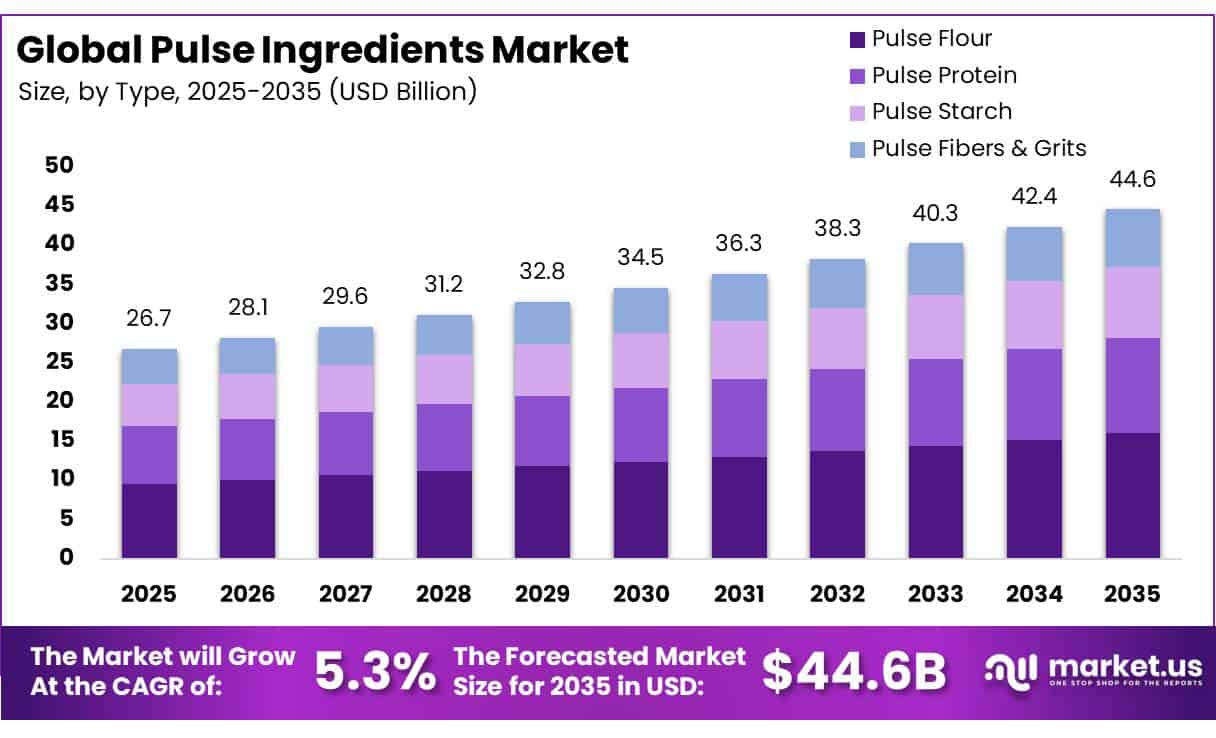
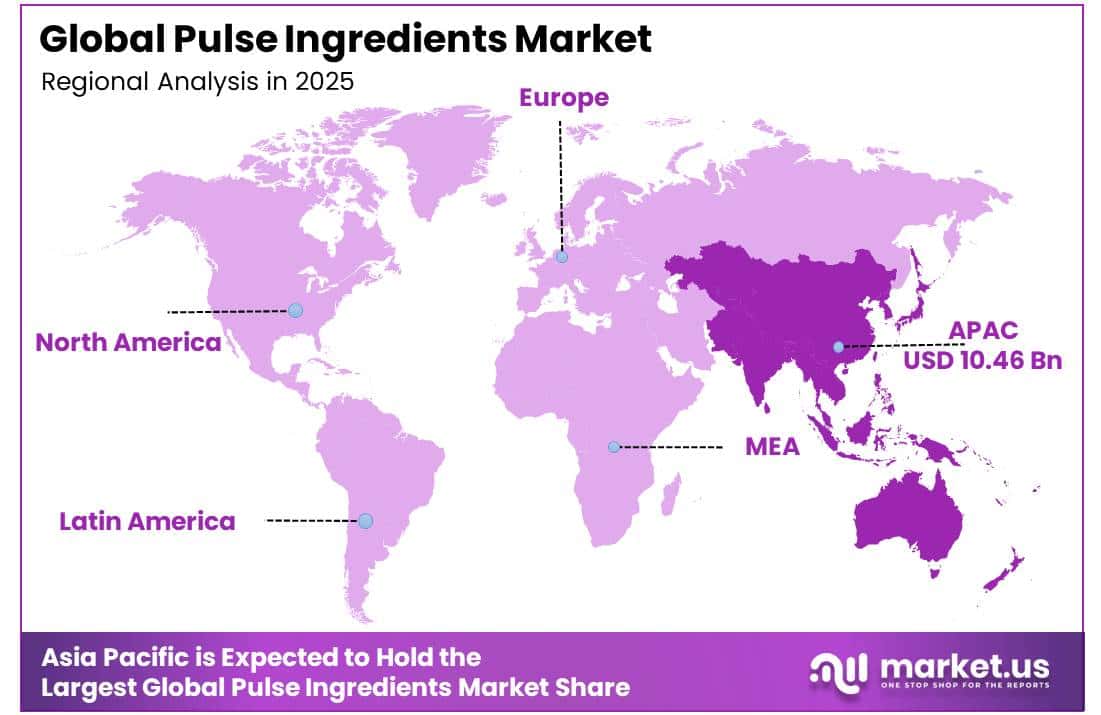
In 2025, the Global Pulse Ingredients Market was valued at USD 26.7 billion, and between 2026 and 2035, this market is estimated to register a CAGR of 5.3%, reaching about USD 44.6 billion by 2035. Asia Pacific held a dominant market position, capturing more than a 39.1% share, holding USD 10.46 billion in revenue.
The Pulse Ingredients Market is supported by the growing use of pulse flour, protein, starch, fibre, and grits across food, beverage, nutrition, and feed applications.
- In February 2026, Statistics Canada reported that Canada produced 3.9 million tonnes of dry peas in 2025, while lentil production reached 3.4 million tonnes and chickpea output reached 481,589 tonnes. This sizeable crop base strengthens ingredient processing opportunities for milling, fractionation, protein concentration, and value-added food manufacturing.
Key Takeaways
- The global Pulse Ingredients Market was valued at US$26.7 billion in 2025.
- The global Pulse Ingredients Market is projected to grow at a CAGR of 5.3% and is estimated to reach US$44.6 billion by 2035.
- On the basis of type, pulse flour dominated the market, constituting 35.9% of the total market share.
- Based on the source, peas dominated the Pulse Ingredients Market, with a substantial market share of around 34.7%.
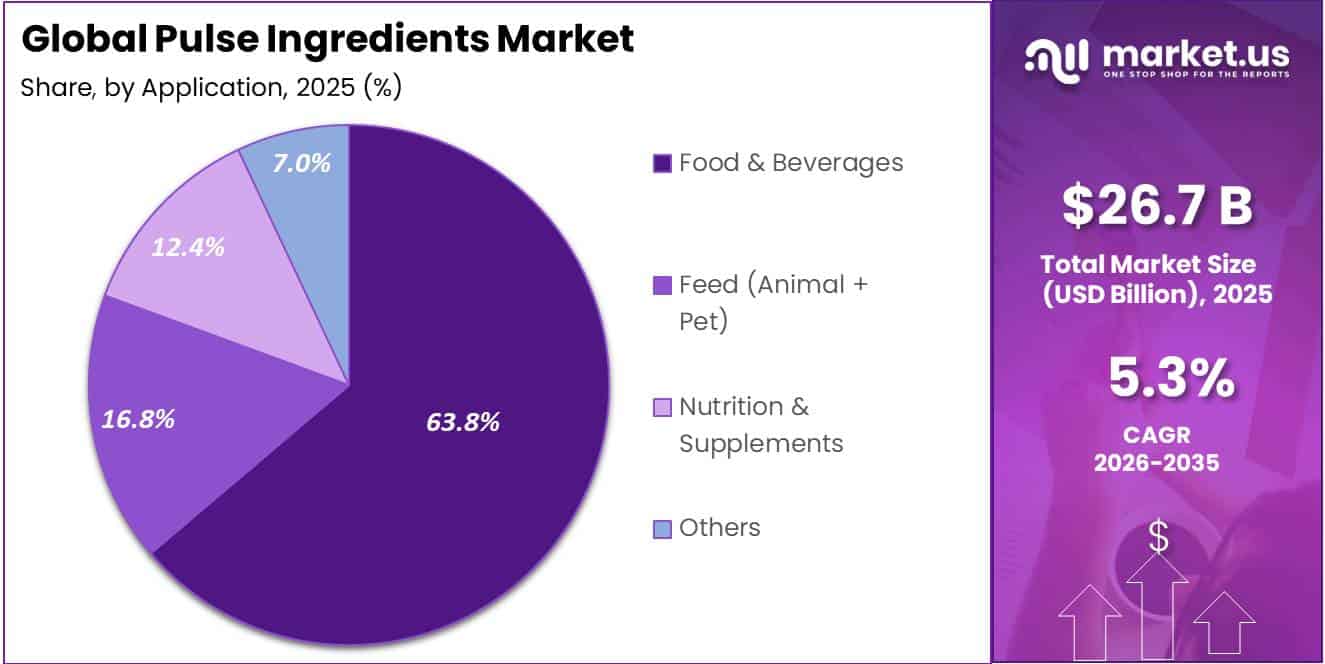
- Based on the application, food & beverages led the market, comprising 63.8% of the total market.
- In 2025, Asia Pacific was the most dominant region in the Pulse Ingredients Market, accounting for 39.1% of the total market.
The industrial scenario is also benefiting from stronger pulse availability in developed food markets. In April 2026, the United States Department of Agriculture Economic Research Service reported that dry pulse availability increased 13.4% during 2025 to 12.6 pounds per person, while dry beans accounted for 6.6 pounds per person. Higher availability supports wider use of pulse ingredients in bakery products, snacks, prepared foods, plant-based formulations, supplements, and animal nutrition applications.
- In December 2025, the United States Department of Agriculture Economic Research Service forecast dry pea production to increase 23%, lentil production 22%, and chickpea production 32% during 2025. Expanding output can support greater production of pulse flours, isolates, concentrates, starches, and fibres while helping manufacturers diversify protein sources and develop clean-label products for food and nutrition markets.
Government initiatives are also strengthening the long-term position of protein crops. In July 2026, the European Commission introduced a Protein Action Plan that aims to increase the share of European Union-produced oilseed and protein crops used in animal feed from 25.8% to 35% by 2035. The Commission also reported that 67% of high-protein feed materials currently originate outside the European Union. These measures encourage local pulse production, processing infrastructure, supply resilience, and broader ingredient utilization across regional food, feed, and specialty nutrition value chains globally.
Type Analysis
Pulse Flour dominates with 35.9% due to broad food applications, while Pulse Protein expands through high-protein product development
In 2025, Pulse Flour held a dominant market position, capturing more than a 35.9% share in the Pulse Ingredients Market. Its lead reflects broad use in bakery products, snacks, soups, sauces, meat alternatives, and gluten-free formulations. Pulse flour offers protein, fibre, starch, and functional properties in a single ingredient, helping manufacturers improve texture, nutrition, and product structure while using familiar pea, chickpea, lentil, and bean sources.
- In October 2025, according to PURIS, its ClearP hydrolyzed pea protein delivered up to 90% protein content, combining high protein concentration with clear solubility and acid stability for food and beverage formulation.
Pulse Protein is the fastest-growing type as manufacturers expand high-protein foods, beverages, sports nutrition, and plant-based products. Pea and other pulse proteins provide a concentrated protein source while supporting formulation goals related to nutrition, texture, and ingredient simplicity. Improved processing is helping reduce issues involving taste, solubility, and dispersibility, making pulse proteins suitable for a wider range of applications. Their growing use in ready-to-drink beverages, nutritional products, bakery goods, and alternative proteins is strengthening demand across food manufacturing and specialty nutrition channels.
Source Analysis
Peas dominate with 34.7% due to broad ingredient versatility, while Chickpeas expand through diversified food applications
In 2025, Peas held a dominant market position, capturing more than a 34.7% share in the Pulse Ingredients Market. Their leadership reflects broad use in flour, protein concentrates, isolates, starch, fibre, snacks, bakery products, and plant-based foods. Peas provide a versatile processing base because different fractions can be separated and used across food applications requiring nutrition, texture, binding, and formulation flexibility.
- In March 2026, according to Statistics Canada, chickpea area was estimated at 575 thousand acres, up 6.3% from 2025, while dry field pea area was estimated at 3.078 million acres, down 12.3%.
Chickpeas are the fastest-growing source segment as processors expand their use in flour, protein, fibre, pasta, snacks, dips, and bakery formulations. Their mild flavour and suitability for gluten-free foods support wider product development, while milling and fractionation technologies are improving ingredient consistency. Food manufacturers are also using chickpea ingredients to diversify plant-protein sources and create products with familiar pulse positioning. Growing interest in clean-label formulations, alternative proteins, and differentiated pulse ingredients is strengthening chickpea adoption across food and nutrition manufacturing and supporting broader ingredient innovation across categories.
Application Analysis
Food & Beverages dominates with 63.8% due to broad formulation use, while Feed (Animal + Pet) gains through ingredient diversification
In 2025, Food & Beverages held a dominant market position, capturing more than a 63.8% share in the Pulse Ingredients Market. Their leadership reflects broad use of pulse flour, protein, starch, and fibre across bakery, snacks, dairy alternatives, meat substitutes, soups, sauces, and beverages. These ingredients help manufacturers improve protein content, texture, binding, water retention, and formulation flexibility while supporting plant-based and clean-label product development.
- In May 2026, according to the European Feed Manufacturers’ Federation, total European Union industrial compound feed production was forecast at 152 million tonnes, including 51.588 million tonnes of poultry feed and 48.520 million tonnes of pig feed.
Feed (Animal + Pet) is the fastest-growing application segment as producers seek alternative protein and fibre sources for livestock and companion-animal nutrition. Pulse ingredients can be incorporated into feed formulations to diversify raw materials and support nutritional balance. Their availability in flour, protein, starch, and fibre formats gives formulators flexibility across different animal categories. Growing attention to feed efficiency, ingredient diversification, and resilient sourcing is encouraging wider consideration of pulse-based inputs in commercial animal and pet food production.
Key Market Segments
By Type
- Pulse Flour
- Pulse Protein
- Pulse Starch
- Pulse Fibers & Grits
By Source
- Peas
- Chickpeas
- Lentils
- Beans
- Others
By Application
- Food & Beverages
- Feed (Animal + Pet)
- Nutrition & Supplements
- Others
Driver Analysis
Clean-label protein reformulation
Pea seeds typically contain 20%–40% protein, 45%–55% starch, and 10%–15% dietary fiber, enabling a single crop to support protein fortification, texture, water binding, viscosity, gluten-free structure, fiber claims, and cost optimization across baked goods, snacks, soups, sauces, pasta, nutrition bars, cereal products, beverages, and meat alternatives.
Novel physical-processing techniques are improving formulation economics: high-pressure homogenization at 70–100 MPa over three passes can reduce pea-protein particle size and improve solubility, while ultrasound can prevent separation in pea-and-dairy blended beverages without synthetic stabilizers. For a 10,000-tonne annual food line, replacing 2%–5% of modified starches, gums, dairy solids, or egg-derived functionality with pulse flour, fiber, or protein can create 200–500 tonnes of ingredient demand and support premium product claims, even where direct protein replacement is not the objective.
The value-capture shift is toward application-specific ingredients with controlled particle size, flavor, color, dispersibility, and hydration rather than commodity pulse flour, allowing suppliers to sell technical support and tailored blends at margins estimated 10–25 percentage points above bulk whole-pulse trading.
Drivers Impact Analysis
| Driver | (~) % Impact on CAGR | Geographic Relevance | Impact Timeline |
|---|---|---|---|
| Protein diversification policies | +2.0 pp | EU, North America, China, India | Medium term (2-4 years) |
| Clean-label protein reformulation | +1.7 pp | North America, EU, Japan, Australia | Short term (≤ 2 years) |
| Pulse fractionation capacity | +1.5 pp | Canada, U.S., EU, India, Australia | Medium term (2-4 years) |
| Plant-protein food expansion | +1.3 pp | North America, EU, APAC urban markets | Medium term (2-4 years) |
| Allergen-friendly ingredient demand | +1.1 pp | North America, EU, Japan, GCC | Short term (≤ 2 years) |
| Regenerative crop economics | +0.9 pp | Canada, EU, India, Australia, LATAM | Long term (≥ 4 years) |
Restraint Analysis
Flavor and solubility limits
Research confirms that pea proteins often have poor solubility and emulsification under acidic conditions and that characteristic pea-like bitterness limits consumer acceptance; pH-shifting with ultrasound for 20–30 minutes, microfluidization at 100–150 MPa, or chemical modification can improve performance, but each adds formulation complexity, energy consumption, clean-label risk, or regulatory review.
A beverage manufacturer using 3%–6% pulse protein can require 30–60 kg per 1,000 L, so an 80% soluble product versus a 95% soluble system may leave 6–12 kg of added sediment-prone solids per 1,000 L, generating texture complaints and retailer returns. Flavor masking, fermentation, deodorization, enzymatic treatment, sweeteners, hydrocolloids, and stabilizer systems can add $0.10–0.40 per finished kilogram, weakening the cost advantage over dairy or soy.
The strategic consequence is slower penetration outside bakery, snacks, dry blends, and extruded products, forcing ingredient suppliers to spend 5%–10% of revenue on application labs, pilot processing, and customer-specific formulation support before converting technical interest into recurring volume.
Restraint Impact Analysis
| Restraint | (~) % Impact on CAGR | Geographic Relevance | Impact Timeline |
|---|---|---|---|
| Flavor and solubility limits | -1.8 pp | North America, EU, APAC premium foods | Medium term (2-4 years) |
| Trade-policy disruption | -1.5 pp | Canada, China, India, EU corridors | Short term (≤ 2 years) |
| Fractionation cost intensity | -1.3 pp | Canada, U.S., EU, Australia, India | Medium term (2-4 years) |
| Crop-supply price volatility | -1.1 pp | Canada, Australia, India, Russia | Short term (≤ 2 years) |
| Soy and dairy competition | -1.0 pp | Global protein markets | Medium term (2-4 years) |
| Limited consumer price tolerance | -0.8 pp | Emerging APAC, LATAM, Africa | Short term (≤ 2 years) |
Opportunity Analysis
Pulse biorefinery platforms
LDC’s Yorkton facility, commissioned in March 2026, is designed to process around 75,000 tonnes of yellow peas per year and sell pea protein isolate, fibre, and proprietary starch to nutrition drinks, meat alternatives, bakery, pet food, paper, and building-material applications, demonstrating the commercial viability of diversified co-product design.
With peas containing roughly 20%–40% protein, 45%–55% starch, and 10%–15% fibre, a 100,000-tonne input stream can generate about 20,000–25,000 tonnes of protein-rich product, 40,000–50,000 tonnes of starch-rich material, and 8,000–15,000 tonnes of fibre/hull fractions; improving average realization on just 15,000 tonnes of co-products by $100–250 per tonne adds $1.5–3.75 million of annual revenue without additional crop procurement.
This is not a baseline driver because it requires plant redesign, separate quality systems, multiple sales channels, and application-development capabilities, but it can improve capacity utilization from 65%–75% toward 85%–90%, reduce protein-price dependency, and raise EBITDA margins by an estimated 3–8 percentage points where co-product offtake is secured.
Opportunity Impact Analysis
| Opportunity | (~) % Potential CAGR Upside | Geographic Relevance | Execution Window |
|---|---|---|---|
| Pulse biorefinery platforms | +2.1 pp | Canada, U.S., EU, India, Australia | Medium term (2-4 years) |
| Fermented pulse proteins | +1.8 pp | North America, EU, Japan, South Korea | Medium term (2-4 years) |
| Hybrid-food formulation systems | +1.5 pp | North America, EU, China, India, ASEAN | Short term (≤ 2 years) |
| Traceable regenerative sourcing | +1.3 pp | EU, Canada, Australia, India, LATAM | Medium term (2-4 years) |
| Pet-food and aquafeed fractions | +1.2 pp | North America, EU, China, ASEAN, Chile | Medium term (2-4 years) |
| Regional fractionation roll-ups | +1.0 pp | India, ASEAN, Africa, LATAM | Long term (≥ 4 years) |
Challenges Analysis
Fractionation water-energy intensity
A 100,000-tonne-per-year wet-extraction facility can consume approximately 200,000–600,000 m³ of process water and 20–50 million kWh of electricity annually, with spray drying and evaporation often accounting for 40%–60% of energy use; at $0.08–0.15/kWh, energy alone can represent $1.6–7.5 million of annual operating expense. Ultrafiltration and water recirculation can reduce total water use by up to 60% while maintaining more than 85% protein recovery, but membranes foul, require cleaning chemicals, and add capital, maintenance, and skilled-operator requirements.
An increase of $0.03/kWh in electricity price can add $0.6–1.5 million to annual cost at this scale, while water restrictions or wastewater fees can delay permits and constrain plant expansion in drought-prone regions. The industry must adopt closed-loop water systems, membrane optimization, heat recovery, renewable power procurement, real-time energy management, and co-location with low-carbon utilities, yet these measures can require $10–30 million in incremental capital and 3–7-year payback periods, challenging smaller processors competing against low-cost soy and commodity pulse mills.
Challenges Impact Analysis
| Challenge | (~) % CAGR Friction Drag | Geographic Relevance | Mitigation Horizon |
|---|---|---|---|
| Protein functionality optimization | -1.4 pp | North America, EU, APAC food markets | Medium term (2-4 years) |
| Fractionation water-energy intensity | -1.2 pp | Canada, U.S., EU, India, Australia | Medium term (2-4 years) |
| Crop-quality variability management | -1.1 pp | Canada, Australia, India, Russia | Long term (≥ 4 years) |
| Trade-route reconfiguration | -1.0 pp | Canada–China–India corridors | Medium term (2-4 years) |
| Co-product offtake balancing | -0.9 pp | Global fractionation hubs | Medium term (2-4 years) |
| Application-science talent gaps | -0.7 pp | North America, EU, APAC | Long term (≥ 4 years) |
Geopolitical Impact Analysis
Trade Tariffs and Supply Chain Realignment Reshaping Pulse Ingredient Flows
Current geopolitical tensions are reshaping the Pulse Ingredients Market through agricultural tariffs, changing export access, and pressure to diversify pea sourcing. In March 2025, Agriculture and Agri-Food Canada reported that China imposed a 100% tariff on Canadian peas. The measure affected a pulse-export channel and increased uncertainty for processors dependent on internationally traded pea raw materials.
Government responses have attempted to protect agricultural supply chains from trade disruption. In March 2025, Canada proposed increasing the AgriStability compensation rate from 80% to 90%, doubling the payment cap to $6 million, and allowing interim payments of up to 75% of estimated final payments. These measures supported producers facing tariff-related market disruption.
Trade conditions shifted again in March 2026, when Global Affairs Canada confirmed that China suspended anti-discrimination tariffs on Canadian peas until the end of 2026. The reversal restored market access and shows how geopolitical negotiations can alter pulse flows, ingredient availability, procurement strategies, and pricing conditions for pea flour, protein, starch, and fibre processors.
Transport risks remain important for the industry. In March 2026, the World Trade Organization estimated that a durable Middle East oil shock could reduce world merchandise trade growth from 1.9% to 1.4%, while around 20% of worldwide liquid petroleum consumption normally moves through the Persian Gulf. Higher transport costs can encourage regional processing, multiple sourcing, and inventories.
Regional Analysis
Asia Pacific dominates with 39.1% and USD 10.46 Billion, supported by strong pulse production and food-processing demand
In 2025, Asia Pacific held a dominant position in the Pulse Ingredients Market, capturing 39.1% of the global share and generating USD 10.46 billion. The region benefits from a large food-processing base, expanding pulse cultivation, and strong demand for flour, protein, starch, and fibre ingredients across packaged foods, snacks, beverages, and nutrition products.
In June 2026, the Australian Bureau of Agricultural and Resource Economics and Sciences forecast lentil production at 2.2 million tonnes for 2026–27, up 3%, while chickpea production was projected at 1.1 million tonnes. China also provides a large downstream consumption base.
In June 2026, the National Bureau of Statistics of China reported that online retail sales of food increased 15.5% from January to May, while grain, oil, and food retail sales by enterprises above the designated size increased 7.4%. These conditions support ingredient processing, product innovation, and wider commercial use of pulse-based formulations across the region steadily.
Key Regions and Countries Covered
- North America
- The US
- Canada
- Europe
- Germany
- France
- The UK
- Spain
- Italy
- Russia & CIS
- Rest of Europe
- APAC
- China
- Japan
- South Korea
- India
- ASEAN
- Rest of APAC
- Latin America
- Brazil
- Mexico
- Rest of Latin America
- Middle East & Africa
- GCC
- South Africa
- Rest of MEA
Key Players Analysis
Pulse ingredient manufacturers are strengthening competitiveness through protein innovation, diversified pulse sourcing, processing efficiency, and application-specific functionality. In 2026, Roquette expanded its NUTRALYS portfolio with NUTRALYS Pea 850F, a clean-tasting pea protein isolate developed for beverages, dairy alternatives, and specialized nutrition. ADM also launched eight new protein products across North America and Europe, including pea flour for bakery, cereal, batters, and breading applications. These developments highlight increasing competition around taste improvement, protein enrichment, clean-label positioning, and broader formulation flexibility.
Vertical integration and global sourcing networks also strengthen market positioning. AGT Food and Ingredients operates 39 manufacturing facilities across 5 continents and supplies products to 127 countries, while processing pulses into flours, proteins, starches, and fibres. Companies such as Ingredion, Cargill, Roquette, ADM, and AGT Foods therefore compete through raw-material access, processing scale, technical support, product customization, and regional supply reliability. Continued investment in fractionation, protein functionality, and customer-focused formulation capabilities is helping leading suppliers strengthen relationships across food, beverage, nutrition, and feed applications.
Market Key Players
- Ingredion Incorporated
- Roquette Frères S.A.
- Archer Daniels Midland Company
- Cargill, Incorporated
- AGT Food and Ingredients Inc.
- Emsland Group
- The Scoular Company
- Cosucra Groupe Warcoing S.A.
- PURIS Holdings, LLC
- Axiom Foods, Inc.
- Vestkorn Milling AS
- Batory Foods, Inc.
- Anchor Ingredients Co., LLC
- BENEO GmbH
- Avena Foods Limited
- Others
Key Development
- In April 2026, Emsland Group entered the wet pet food segment with the launch of Empet® SmartBind, a new starch-based texturizing solution developed for wet dog and cat food applications, expanding the company’s ingredient portfolio into specialized pet nutrition.
- In July 2026, Axiom Foods formed a strategic partnership with NNB Nutrition to develop functional “Protein+” plant-based nutrition products across Asia and North America. The collaboration combines Axiom’s pea, fava bean, chickpea, and other plant proteins with NNB Nutrition’s functional ingredients for beverages, powders, and active nutrition formulations.
- In July 2026, Avena Foods advanced its pulse ingredient research through its Customer and Farmer Appreciation Day 2026 program, featuring experimental field plots involving high-protein chickpeas, peas, beans, and lentils alongside regenerative agriculture practices such as intercropping, cover cropping, and pollinator strips.
Report Scope
| Report Features | Description |
|---|---|
| Market Value (2025) | US$26.7 Bn |
| Forecast Revenue (2035) | US$44.6 Bn |
| CAGR (2026-2035) | 5.3% |
| Base Year for Estimation | 2025 |
| Historic Period | 2020-2024 |
| Forecast Period | 2026-2035 |
| Report Coverage | Revenue Forecast, Market Dynamics, Competitive Landscape, Recent Developments |
| Segments Covered | By Type (Pulse Flour, Pulse Protein, Pulse Starch, and Pulse Fibers & Grits), By Source (Peas, Chickpeas, Lentils, Beans, and Others), By Application (Food & Beverages, Feed (Animal + Pet), Nutrition & Supplements, and Others) |
| Regional Analysis | North America – The US & Canada; Europe – Germany, France, The UK, Spain, Italy, Russia & CIS, Rest of Europe; APAC– China, Japan, South Korea, India, ASEAN & Rest of APAC; Latin America– Brazil, Mexico & Rest of Latin America; Middle East & Africa– GCC, South Africa, & Rest of MEA |
| Competitive Landscape | Ingredion Incorporated, Roquette Frères S.A., Archer Daniels Midland Company, Cargill, Incorporated, AGT Food and Ingredients Inc., Emsland Group, The Scoular Company, Cosucra Groupe Warcoing S.A., PURIS Holdings, LLC, Axiom Foods, Inc., Vestkorn Milling AS, Batory Foods, Inc., Anchor Ingredients Co., LLC, BENEO GmbH, Avena Foods Limited, and Others. |
| Customization Scope | Customization for segments, region/country-level will be provided. Moreover, additional customization can be done based on the requirements. |
| Purchase Options | We have three licenses to opt for: Single User License, Multi-User License (Up to 5 Users), Corporate Use License (Unlimited Users and Printable PDF) |





































