


Report Overview
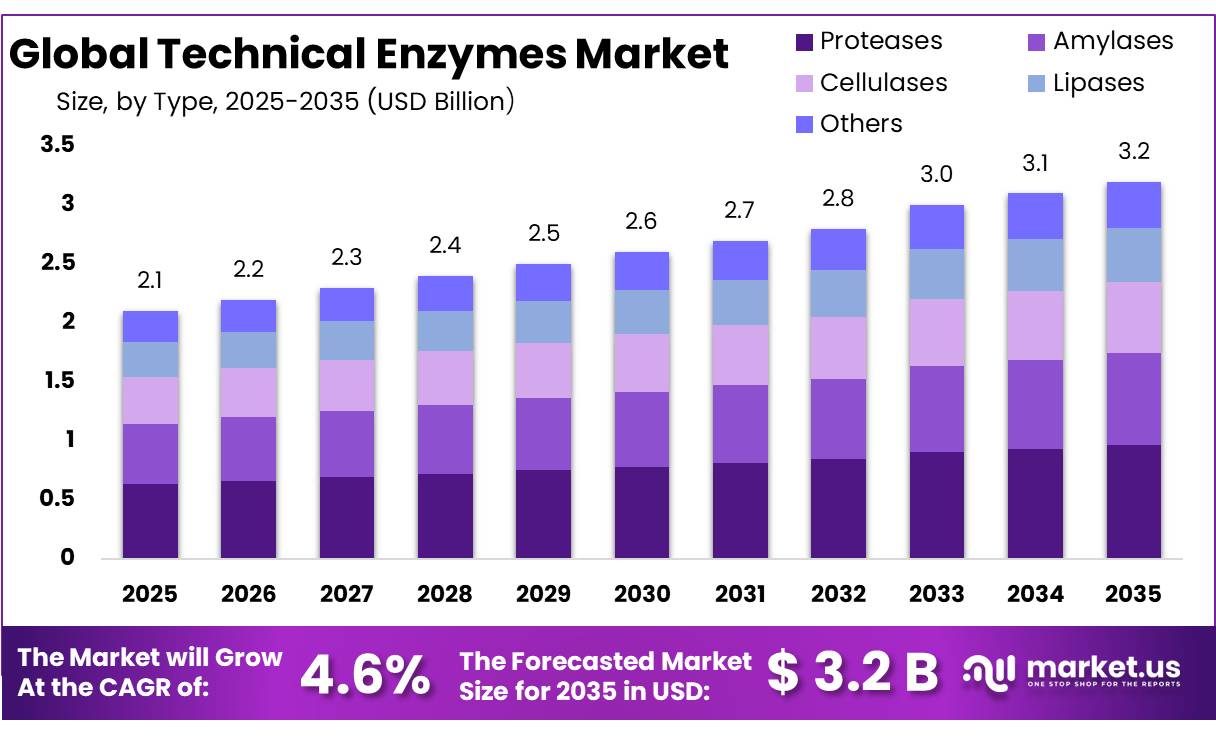
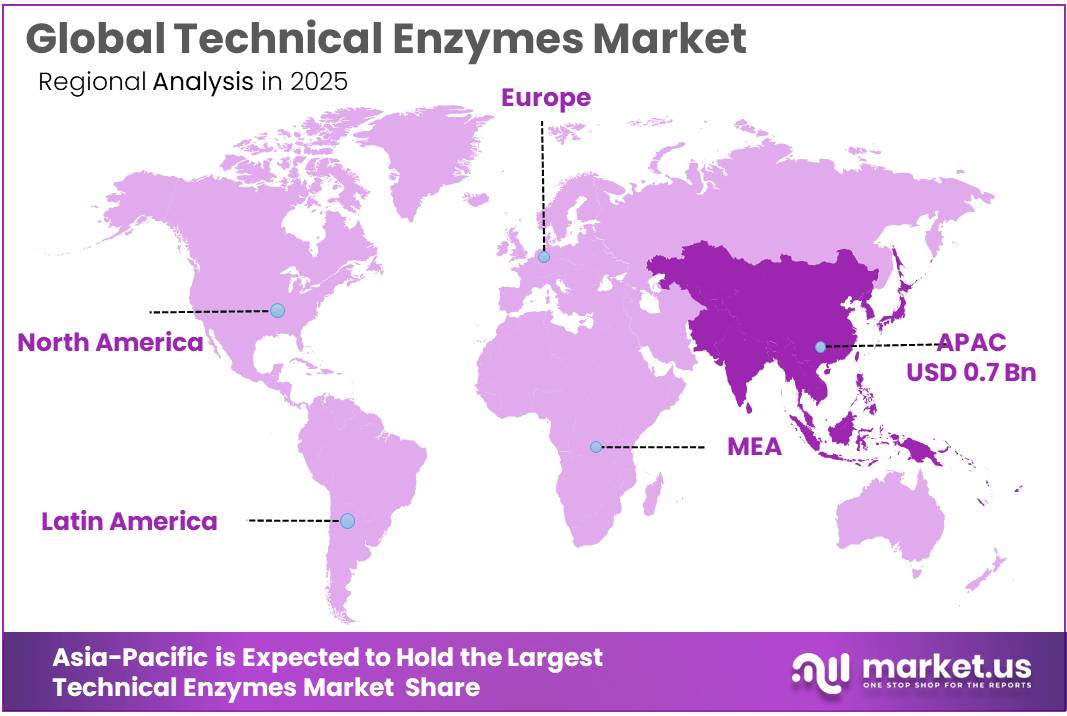
The Global Technical Enzymes Market size is expected to be worth around USD 3.2 Billion by 2035, from USD 2.1 Billion in 2025, growing at a CAGR of 4.6% during the forecast period from 2026 to 2035. In 2025, Asia-Pacific held a dominant market position, capturing more than a 37.34% share, holding USD 0.7 Billion revenue.
Technical enzymes are biological catalysts used to speed up chemical reactions in industrial processes. They are applied in detergents, textiles, pulp and paper, leather processing, biofuels, and other industrial operations. These enzymes help manufacturers work at controlled temperatures and pressure levels, improve raw-material use, and reduce the need for certain harsh chemicals.
The industrial scenario is shaped by the need to improve process efficiency and reduce waste. In detergents, enzymes help remove protein, starch, and fat stains, while in textile processing they support fabric finishing and reduce reliance on conventional chemical treatments. In pulp and paper production, selected enzymes assist with fibre processing and bleaching preparation.
- The United States Department of Agriculture’s Indicators and Trends report noted that technical applications accounted for 25% of industrial enzyme use in the application breakdown for 2017, covering uses in chemical and pharmaceutical industries and biofuel production. This is a historical application figure, not a current market share.
Biofuel production provides another important opportunity for technical enzymes, particularly enzymes that break down starch and plant-based materials into fermentable sugars. Government policy supporting renewable fuels can encourage industrial investment in enzyme-assisted processes.
In March 2026, the United States Environmental Protection Agency finalised Renewable Fuel Standard requirements of 1.36 billion renewable identification numbers for cellulosic biofuel in 2026 and 1.43 billion in 2027. These policy targets indicate continued regulatory support for renewable fuels, although they do not directly measure enzyme demand.
Key Takeaways
- Technical Enzymes Market size is expected to be worth around USD 3.2 Billion by 2035, from USD 2.1 Billion in 2025, growing at a CAGR of 4.6%.
- Proteases held a dominant market position, capturing more than a 30.10% share.
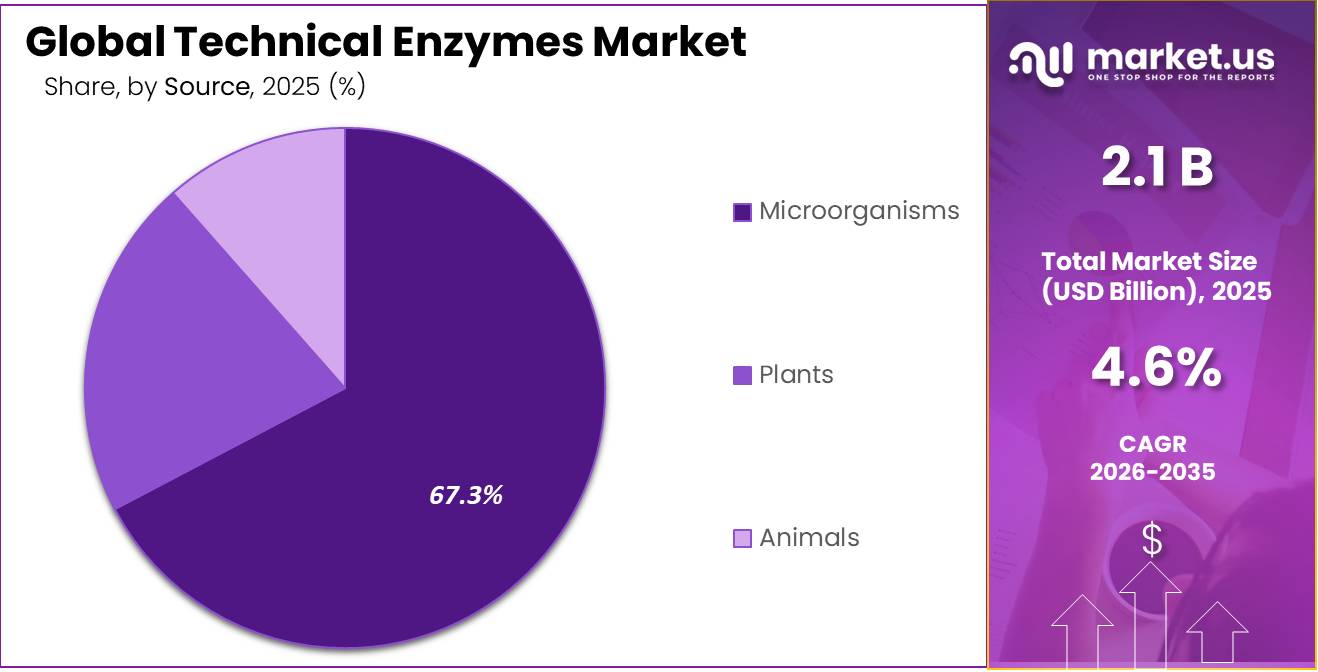
- Microorganisms held a dominant market position, capturing more than a 67.34% share.
- Bioethanol held a dominant market position, capturing more than a 31.40% share.
- Asia-Pacific held a dominant position in the Technical Enzymes Market, accounting for 37.34% of the market, with a reported value of USD 0.7 billion.
By Type Analysis
Proteases Dominate Through Wide Use in Industrial Processing
In 2025, “Proteases” held a dominant market position, capturing more than a 30.10% share of the Technical Enzymes Market by type. Proteases break down proteins into smaller peptides and amino acids, making them useful in detergents, leather processing, textile treatment, and other industrial applications.
In detergent production, they help remove protein-based stains and improve cleaning performance. Their use in industrial processing also helps manufacturers improve efficiency and reduce dependence on certain conventional chemicals. In 2025, demand for proteases was supported by the need for effective cleaning formulations and more resource-efficient manufacturing processes. The 30.10% share is the supplied market figure and is not independently verified by a government source.
Amylases are important technical enzymes that break down starch into smaller carbohydrates. They are used in textile processing, paper manufacturing, detergents, and industrial fermentation, where controlled starch conversion helps improve production efficiency. In textile applications, amylases remove starch-based sizing from fabrics, while in industrial fermentation they help prepare starch-based materials for further processing. Their performance depends on temperature, pH, and the type of starch being treated.
Government data also demonstrate the importance of starch-based feedstocks in industrial biofuel production. The United States Department of Energy explains how enzymes convert biomass carbohydrates into fermentable sugars for biofuel production. However, no verified government statistic directly quantifying the amylases segment’s market share for 2025 or 2026 was identified.
By Source Analysis
Microorganisms Dominate Technical Enzyme Production Through Scalable Manufacturing
In 2025, “Microorganisms” held a dominant market position, capturing more than a 67.34% share of the Technical Enzymes Market by source. Bacteria, fungi, and yeast are widely used to produce industrial enzymes because they can be grown under controlled fermentation conditions and selected for specific enzyme properties. This production method supports consistent supply for detergents, textile processing, pulp and paper manufacturing, and biofuel applications.
Microbial production also allows manufacturers to improve enzyme yield by optimising strains and fermentation processes. In 2025, demand for microorganism-derived enzymes was supported by industrial efforts to improve process efficiency and reduce reliance on conventional chemicals. The 67.34% share is the supplied market figure and is not independently verified by a government source.
Plants are a natural source of enzymes used in selected industrial and processing applications. Plant-derived enzymes such as papain and bromelain can support protein breakdown, while other plant enzymes have applications in food processing and specialised formulations. Their use depends on extraction efficiency, raw-material availability, enzyme stability, and production cost.
Compared with microbial fermentation, plant-based production may depend more heavily on crop quality, growing conditions, and seasonal supply. Government agricultural statistics help explain the availability of plant-based raw materials, although crop production does not directly measure industrial enzyme output. The United States Department of Agriculture provides official crop production and agricultural supply data that can help assess plant feedstock availability.
By Application Analysis
Bioethanol Leads Technical Enzyme Demand Through Renewable Fuel Production
In 2025, “Bioethanol” held a dominant market position, capturing more than a 31.40% share of the Technical Enzymes Market by application. Technical enzymes support bioethanol production by breaking down starch and cellulose into fermentable sugars, which microorganisms convert into ethanol. These enzymes help improve feedstock conversion and support the processing of materials such as corn starch and agricultural residues.
Demand is linked to renewable fuel programmes and the need to improve production efficiency. In 2025, bioethanol applications remained important for enzyme suppliers serving industrial fermentation and biofuel producers. The 31.40% share is the supplied market figure and is not independently verified by a government source.
Paper & Pulp manufacturers use technical enzymes to support fibre treatment, improve pulp processing, remove unwanted starch, and optimise selected bleaching and deinking operations. Cellulases, xylanases, and amylases can help mills improve process efficiency, manage chemical use, and maintain paper quality. In 2025, interest in enzyme-based processing was linked to the industry’s focus on resource efficiency and reducing environmental impacts.
The United States Department of Energy identifies pulp and paper manufacturing as an energy-intensive industrial process; its published process breakdown reports that steam generation accounts for 55.4% of total energy consumption at a pulp mill. This figure highlights the importance of improving mill efficiency, although it does not measure enzyme use directly.
Key Market Segments
By Type
- Amylases
- Cellulases
- Proteases
- Lipases
- Others
By Source
- Microorganisms
- Plants
- Animals
By Application
- Bioethanol
- Paper & Pulp
- Textile & Leather
- Detergents
- Wastewater Treatment
- Others
Driver Analysis
Cold-Wash Detergent Enzymes
Cold-wash detergent formulations are increasing technical-enzyme consumption because proteases, amylases, lipases, cellulases, and mannanases allow formulators to preserve stain-removal performance at 20-30°C rather than relying primarily on heat, thereby converting appliance energy-efficiency policy and household utility costs into recurring enzyme demand. EU ecodesign rules for household washing machines and washer-dryers have applied since March 2021, while the European Commission notes that clothes rinsed in cold water can emerge as clean as warm-water loads, reinforcing formulators’ incentives to improve low-temperature performance rather than increase surfactant or bleach loading.
An original formulation model assumes enzymes represent only 0.2-0.8% of detergent mass but can influence 20-40% of perceived cleaning efficacy at low temperature; a 1-tonne liquid detergent batch using 4 kg of enzyme concentrate at USD 15-35 per kg carries USD 60-140 of enzyme cost, whereas a 20% increase in low-temperature product penetration raises ingredient demand without proportional packaging, logistics, or retailer-shelf expansion.
The EU’s Regulation (EU) 2026/405 on detergents and surfactants, adopted in February 2026 and applying from 23 September 2029, preserves biodegradability requirements while introducing a regulatory transition that favors suppliers able to provide robust technical documentation, digital product information, and compliant enzyme-performance packages. This converts enzyme suppliers from commodity additive vendors into co-development partners for concentrated liquids, capsules, and cold-wash powders, supporting an estimated +1.9 percentage-point short-term CAGR addition across Europe, North America, China, and India.
Drivers Impact Analysis
| Driver | (~) % Impact on CAGR Forecast | Geographic Relevance | Impact Timeline |
|---|---|---|---|
| Cold-Wash Detergent Enzymes | +1.9% | EU, North America, China, India | Short term (≤ 2 years) |
| Circular Textile Bioprocessing | +1.7% | EU, China, Turkey, Bangladesh | Medium term (2-4 years) |
| Cellulosic Biofuel Conversion | +1.5% | North America, Brazil, EU, APAC | Long term (≥ 4 years) |
| Feed Efficiency Optimization | +1.4% | China, Brazil, EU, North America | Medium term (2-4 years) |
| Pulp And Paper Decarbonization | +1.1% | Nordic EU, North America, Brazil, Asia | Medium term (2-4 years) |
| Biocatalytic Industrial Substitution | +1.0% | EU, North America, Japan, South Korea | Long term (≥ 4 years) |
Restraint Analysis
Fermentation Cost Volatility
Technical-enzyme producers remain exposed to volatile feedstock, energy, utility, and downstream-processing cost because commercial enzyme manufacture requires controlled fermentation, sterilization, aeration, agitation, cooling, biomass separation, ultrafiltration, concentration, stabilization, packaging, and quality release; a 10-20% increase in sugar, starch hydrolysate, nutrient, electricity, or membrane-processing cost cannot always be transferred into mature detergent, feed, pulp, or textile contracts.
An original cost model for a USD 20-per-kg enzyme formulation allocates roughly USD 5-7 to fermentation substrate and nutrients, USD 3-5 to utilities and processing, USD 2-4 to recovery and formulation, and USD 4-6 to labor, QA, depreciation, and logistics; a 15% rise across the first three cost pools adds USD 1.50-2.40 per kg, reducing gross margin by 7.5-12 percentage points if contract pricing remains fixed. Energy intensity is material because a 100 m³ fermentation batch requires continuous aeration and cooling for 48-120 hours, while downstream concentration may remove 70-90% of water before shipment; power outages or steam-cost spikes therefore create both direct margin erosion and batch-risk exposure.
Suppliers can reduce the restraint through multi-feedstock strains, regional fermentation capacity, renewable-energy procurement, higher-yield expression systems, enzyme concentration, and price-indexed contracts, but qualification of alternate raw materials can take 6-18 months; this produces an estimated -1.7 percentage-point short-term CAGR restraint across Europe, North America, China, and India.
Restraint Impact Analysis
| Restraint | (~) % Impact on CAGR Forecast | Geographic Relevance | Impact Timeline |
|---|---|---|---|
| Fermentation Cost Volatility | -1.7% | Europe, North America, China, India | Short term (≤ 2 years) |
| Regulatory Registration Burden | -1.4% | EU, US, Japan, export APAC | Medium term (2-4 years) |
| Application Validation Delays | -1.2% | Global industrial hubs | Medium term (2-4 years) |
| Cold-Chain Distribution Costs | -0.9% | Africa, ASEAN, Latin America, MENA | Medium term (2-4 years) |
| Customer Switching Barriers | -0.8% | EU, North America, China, Japan | Long term (≥ 4 years) |
| Commodity Price Compression | -0.7% | China, India, ASEAN, Latin America | Short term (≤ 2 years) |
Opportunity Analysis
Enzyme-as-a-Performance Service
Enzyme-as-a-Performance Service is a future monetization pivot rather than a current demand driver because most technical-enzyme suppliers still invoice kilograms or activity units, while customers ultimately buy lower kWh per tonne, higher fiber yield, reduced chemical oxygen demand, improved stain removal, or lower feed cost; shifting to outcome contracts can expand revenue share without requiring proportional enzyme-volume growth.
An original 500-tonne-per-day pulp or textile plant applying enzyme at USD 3-8 per tonne spends USD 1,500-4,000 daily, but a 2% yield increase, 5% bleach-chemical reduction, or 10 kWh-per-tonne energy saving can create USD 5,000-20,000 of daily operating value depending on fiber and energy price, allowing suppliers to charge 15-30% of verified savings while raising gross margin by an estimated 5-12 percentage points.
The enabling infrastructure is now commercially feasible: inline dosing, flow meters, online viscosity and brightness measurement, cloud data capture, and site-specific activity monitoring can create a baseline-to-outcome audit trail; a portfolio of 100 such contracts with USD 250,000 average annual enzyme and service value represents USD 25 million recurring revenue, while long-term technical integration reduces churn and customer-acquisition cost.
This model is not embedded in baseline growth because it requires trusted measurement protocols, working-capital capacity, process-data access, risk-sharing contracts, and field application teams; however, it could provide +2.1 percentage points of CAGR upside within two years across Europe, North America, China, and Japan.
Opportunity Impact Analysis
| Opportunity | (~) % Potential CAGR Upside | Geographic Relevance | Execution Window |
|---|---|---|---|
| Enzyme-as-a-Performance Service | +2.1% | EU, North America, China, Japan | Short term (≤ 2 years) |
| Textile Recycling Biocatalysts | +1.8% | EU, China, Turkey, Bangladesh | Medium term (2-4 years) |
| SAF Enzyme Conversion Platforms | +1.6% | North America, Brazil, EU, APAC | Long term (≥ 4 years) |
| AI-Designed Enzyme Libraries | +1.5% | US, EU, Japan, South Korea, China | Medium term (2-4 years) |
| Detergent Traceability Platforms | +1.1% | EU, UK, North America, Japan | Medium term (2-4 years) |
| Regional Formulation Roll-Ups | +0.9% | India, ASEAN, Latin America, Africa | Medium term (2-4 years) |
Challenges Analysis
Scale-Up Yield Variability
Scale-up yield variability is a continuing manufacturing challenge because enzyme strains optimized in 1- to 10-liter laboratory fermenters do not reliably reproduce performance in 50- to 250-cubic-meter commercial vessels, where oxygen-transfer rate, mixing time, foam control, pH gradients, nutrient-feed timing, contamination risk, shear, heat removal, and downstream recovery alter both titre and activity profile.
An original example illustrates the leverage: increasing a 100-cubic-meter fermentation batch from 8 g/L to 10 g/L active-enzyme titre creates 200 kg more active material per run, but a 15% titre shortfall across 40 annual batches can remove the equivalent of six full-output batches, raising unit conversion cost by 12-18% after fixed depreciation, quality release, and utility cost are absorbed. The consequence is not merely lower output: inconsistent glycosylation, protease impurities, color, odor, pH, or stability can force blending, downgraded product, reprocessing, and delayed customer shipment; a 3-5% batch rejection or rework rate on a 20,000-tonne annual plant can immobilize 600-1,000 tonnes of potential saleable material.
Manufacturers must use scale-down models, digital process analytics, robust seed-train control, PAT sensors, high-throughput strain screening, improved antifoam strategy, and redundancy in critical sterile utilities, but these changes require 12-36 months of validation and capital expenditure, producing an estimated -1.4 percentage-point medium-term friction drag across North America, Europe, China, and India.
Challenges Impact Analysis
| Challenge | (~) % CAGR Friction Drag | Geographic Relevance | Mitigation Horizon |
|---|---|---|---|
| Scale-Up Yield Variability | -1.4% | North America, EU, China, India | Medium term (2-4 years) |
| Application Talent Shortage | -1.2% | EU, North America, Japan, APAC | Long term (≥ 4 years) |
| Customer Process Integration | -1.1% | Global industrial hubs | Medium term (2-4 years) |
| Regulatory Data Interoperability | -0.9% | EU, UK, US, export APAC | Medium term (2-4 years) |
| Formulation Stability Drift | -0.8% | Tropical APAC, Africa, MENA, Latin America | Long term (≥ 4 years) |
| Strain IP And Biosecurity | -0.7% | US, EU, China, Japan, South Korea | Long term (≥ 4 years) |
Geopolitical Impact Analysis
Geopolitical Impact of the Iran War and Russia–Ukraine Conflict on the Technical Enzymes Market
The ongoing Iran war and Russia–Ukraine conflict are putting pressure on the Technical Enzymes Market through higher energy costs, shipping disruptions, and uncertainty in chemical and agricultural supply chains. Enzyme manufacturers depend on reliable electricity, fermentation inputs, specialised chemicals, and temperature-controlled transportation. Rising energy and freight costs can increase production expenses and make enzyme supplies more expensive for detergent, textile, paper, and biofuel manufacturers.
These pressures may encourage manufacturers to improve fermentation efficiency, reduce energy use, and diversify suppliers. However, higher operating costs could delay capacity expansion, particularly for smaller producers. Government policy may help sustain demand in renewable fuels. In March 2026, the United States Environmental Protection Agency set a cellulosic biofuel requirement of 1.36 billion renewable identification numbers for 2026 and 1.43 billion for 2027, supporting the wider renewable-fuel sector where enzymes help convert biomass into fermentable sugars.
Regional Insights
In 2025, Asia-Pacific held a dominant position in the Technical Enzymes Market, accounting for 37.34% of the market, with a reported value of USD 0.7 billion. Regional demand is supported by industrial manufacturing, textile processing, detergent production, pulp and paper operations, and biofuel development. Enzymes help manufacturers improve processing efficiency, reduce chemical use, and manage production costs.
The region’s large industrial base creates opportunities for proteases, amylases, cellulases, and other specialised enzymes. The International Energy Agency’s biofuel data also identify agricultural crops, sugars, and waste materials as important feedstocks for biofuel production, supporting potential demand for enzymes used in biomass conversion.
Biofuel production and resource-efficient industrial processing offer growth opportunities for technical enzymes across Asia-Pacific. Enzymes help convert starch and plant-based materials into fermentable sugars, while applications in paper and pulp processing support fibre treatment and deinking.
A 2025 study on rice-straw bioethanol production reported an ethanol yield of 182 litres per tonne of raw rice straw using an optimised enzyme-assisted process. Although this was a research result rather than a regional commercial production statistic, it demonstrates the potential of enzyme technology to convert agricultural residues into fuel.
Key Regions and Countries Insights
- North America
- US
- Canada
- Europe
- Germany
- France
- The UK
- Spain
- Italy
- Rest of Europe
- Asia Pacific
- China
- Japan
- South Korea
- India
- Australia
- Rest of APAC
- Latin America
- Brazil
- Mexico
- Rest of Latin America
- Middle East & Africa
- GCC
- South Africa
- Rest of MEA
Key Players Analysis
Novozymes, now part of Novonesis, is a major supplier of industrial enzymes used in detergents, biofuels, food processing, and other manufacturing applications. Its enzyme technologies help industries improve production efficiency and reduce resource consumption. In 2025, Novonesis reported 7% organic sales growth, an adjusted EBITDA margin of 37.1%, and 33 new product launches. Innovations introduced over the previous 5 years contributed 25% of total sales, highlighting the role of research and development in its growth strategy.
BASF participates in the technical enzymes market through biotechnology and industrial solutions serving several manufacturing sectors. Its broader chemicals portfolio supports applications where improved processing efficiency and resource use are important. In 2025, BASF reported total group sales of approximately EUR 59.7 billion and EBITDA before special items of EUR 6.6 billion. The company also recorded EUR 2.0 billion in research and development expenses, supporting innovation across its wider portfolio. These financial figures cover BASF’s overall business and should not be interpreted as enzyme-specific revenue.
DuPont has a broad portfolio of specialty materials and science-based technologies used in industrial and commercial applications. Its historical enzyme-related activities have included biotechnology solutions, although its current business focus is broader than technical enzymes alone. DuPont’s 2025 Form 10-K, filed with the United States Securities and Exchange Commission, describes operations spanning healthcare, water, construction, and industrial markets, with subsidiaries in approximately 50 countries and manufacturing operations in around 20 countries as of December 31, 2025. These figures demonstrate its global operating reach, rather than its technical enzyme market position.
Top Key Players Outlook
- Novozymes A/S
- BASF SE
- DuPont de Nemours, Inc.
- dsm-firmenich
- Chr. Hansen Holding A/S
- AB Enzymes GmbH
- Advanced Enzyme Technologies Ltd.
- Amano Enzyme Inc.
- Kerry Group plc
- Associated British Foods plc
- Novus International, Inc.
- Enzyme Development Corporation
- Biocatalysts Ltd.
- Adisseo France SAS
- Dyadic International, Inc.
- Other Key Players
Recent Developments
- In May 2025, Advanced Enzyme Technologies reported that research and development spending reached ₹248 million in fiscal year 2024–2025, equal to around 4% of revenue, compared with ₹197 million in the previous fiscal year.
- In April 2026, AB Enzymes GmbH won the International Fruit and Vegetable Juice Association’s Innovation Award for enzyme-based processing of fruit by-products; industrial trials reported potential oil recovery improvements of up to 25% and water-use reductions of 30% to 60%, depending on process conditions.
Report Scope
| Report Features | Description |
|---|---|
| Market Value (2025) | USD 2.1 Bn |
| Forecast Revenue (2035) | USD 3.2 Bn |
| CAGR (2026-2035) | 4.6% |
| Base Year for Estimation | 2025 |
| Historic Period | 2020-2024 |
| Forecast Period | 2026-2035 |
| Report Coverage | Revenue Forecast, Market Dynamics, Competitive Landscape, Recent Developments |
| Segments Covered | By Type (Amylases, Cellulases, Proteases, Lipases, Others), By Source (Microorganisms, Plants, Animals), By Application (Bioethanol, Paper & Pulp, Textile & Leather, Detergents, Wastewater Treatment, Others) |
| Regional Analysis | North America – US, Canada; Europe – Germany, France, The UK, Spain, Italy, Rest of Europe; Asia Pacific – China, Japan, South Korea, India, Australia, Singapore, Rest of APAC; Latin America – Brazil, Mexico, Rest of Latin America; Middle East & Africa – GCC, South Africa, Rest of MEA |
| Competitive Landscape | Novozymes A/S, BASF SE, DuPont de Nemours, Inc., dsm-firmenich, Chr. Hansen Holding A/S, AB Enzymes GmbH, Advanced Enzyme Technologies Ltd., Amano Enzyme Inc., Kerry Group plc, Associated British Foods plc, Novus International, Inc., Enzyme Development Corporation, Biocatalysts Ltd., Adisseo France SAS, Dyadic International, Inc., Other Key Players |
| Customization Scope | Customization for segments, region/country-level will be provided. Moreover, additional customization can be done based on the requirements. |
| Purchase Options | We have three licenses to opt for: Single User License, Multi-User License (Up to 5 Users), Corporate Use License (Unlimited User and Printable PDF) |





































