Report Overview
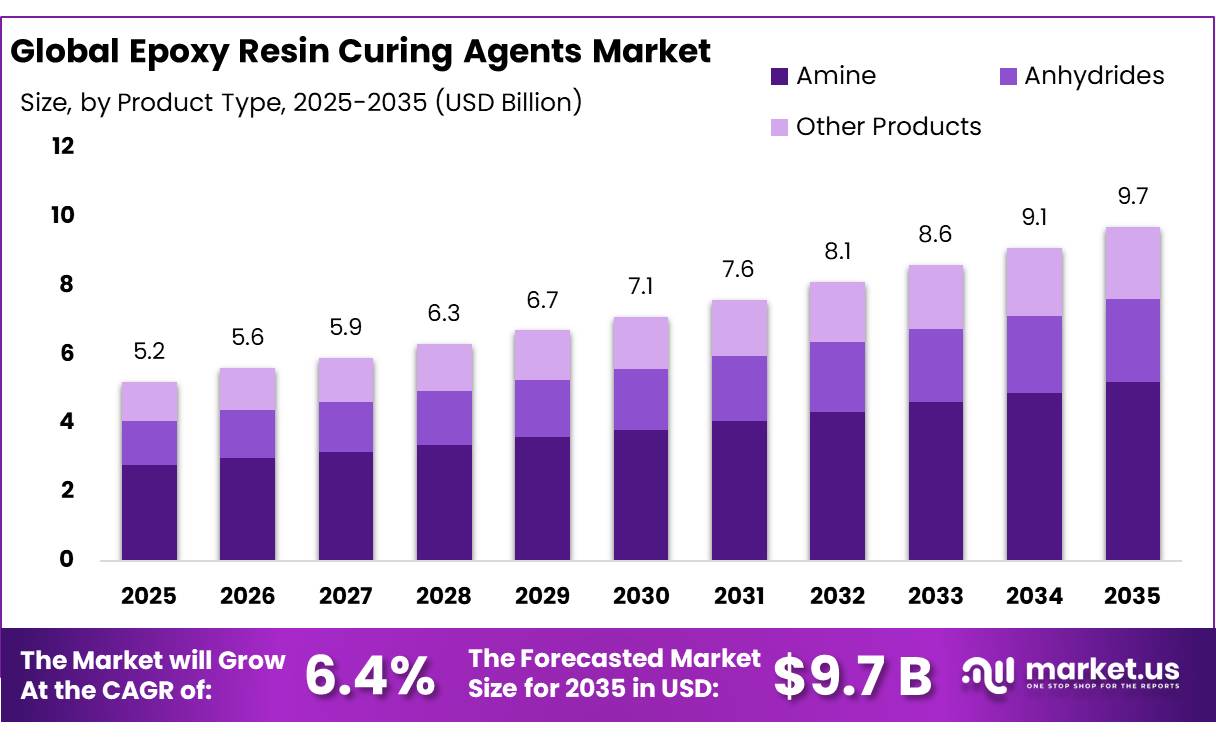
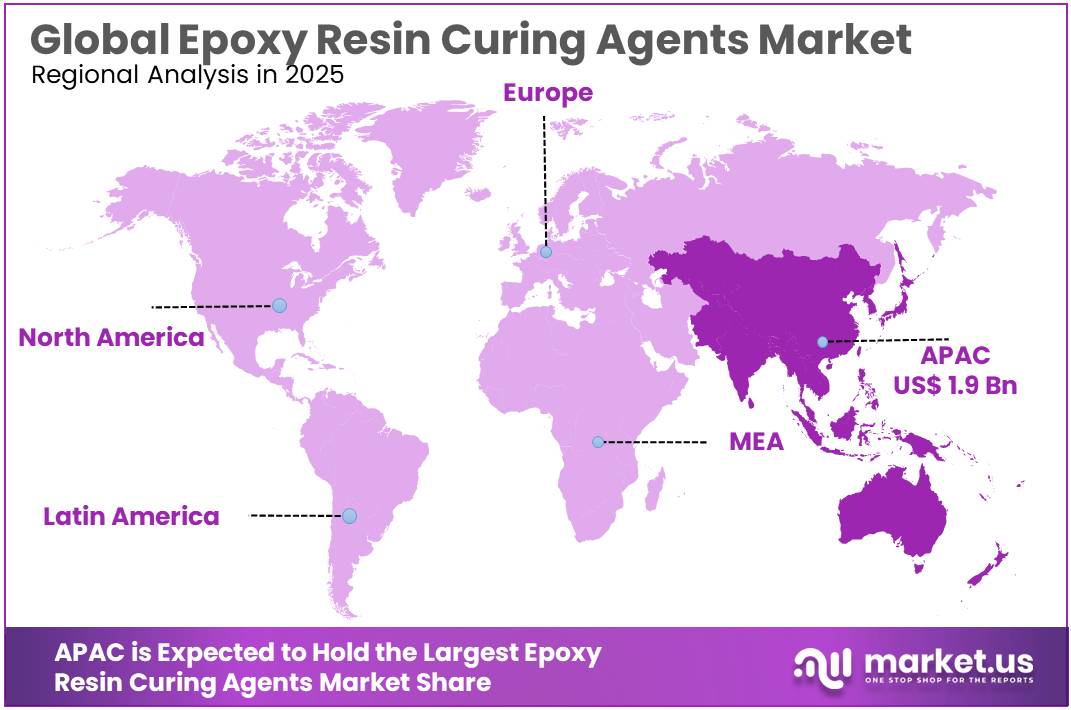
The Global Epoxy Resin Curing Agents Market size is expected to be worth around USD 9.7 Billion by 2035, from USD 5.2 Billion in 2025, growing at a CAGR of 6.4% during the forecast period from 2026 to 2035. In 2025, Asia-Pacific held a dominant market position, capturing more than a 37.00% share, holding USD 1.9 Billion revenue.
Epoxy resin curing agents are essential chemical components used to convert liquid or semi-solid epoxy resins into hard, durable and chemically resistant materials. These agents, also known as hardeners, initiate the chemical reaction that forms a strong three-dimensional polymer structure. Common categories include aliphatic amines, aromatic amines, cycloaliphatic amines, polyamides, anhydrides, phenolic curing agents and latent curing agents.
- According to the European Union’s technical documentation, epoxy resins provide strong adhesion, corrosion resistance, mechanical strength and electrical insulation after curing. They are widely used in protective coatings, adhesives, composite materials, electrical insulation and electronic components.
In automotive and aerospace manufacturing, epoxy-based systems support lightweight composite components, strong bonding and improved durability. Electrical and electronics manufacturers use specialized curing agents in circuit boards, transformers, electrical laminates and insulation materials. The industry also includes established chemical manufacturers such as Olin, Westlake and Huntsman, which supply epoxy resins, curing agents and related specialty chemical products.
- Westlake reported an annual production capacity of approximately 580 million pounds of epoxy specialty resins, supported by manufacturing facilities in the United States, Germany, Spain and South Korea.
Epoxy curing agents are important in manufacturing wind turbine components because they provide structural strength, resistance to environmental exposure and long-term durability. According to the Global Wind Energy Council (GWEC), the global wind industry installed a record 117 gigawatts (GW) of new capacity in 2024. The organization also projected almost 1 terawatt (TW) of additional wind installations by 2030.
Future growth opportunities are expected from the development of sustainable and high-performance curing technologies. Chemical manufacturers are increasingly exploring bio-based curing agents, low-emission formulations, waterborne epoxy systems and faster-curing technologies. Research published in the Chemical Engineering Journal in January 2026 demonstrated an amine-functionalized lignin-based curing agent, achieving 13.84 megapascals (MPa) of shear strength in wood bonding applications.
Key Takeaways
- Epoxy Resin Curing Agents Market size is expected to be worth around USD 9.7 Billion by 2035, from USD 5.2 Billion in 2025, growing at a CAGR of 6.4%.
- Amine held a dominant market position, capturing more than a 53.66% share of the Epoxy Resin Curing Agents Market.
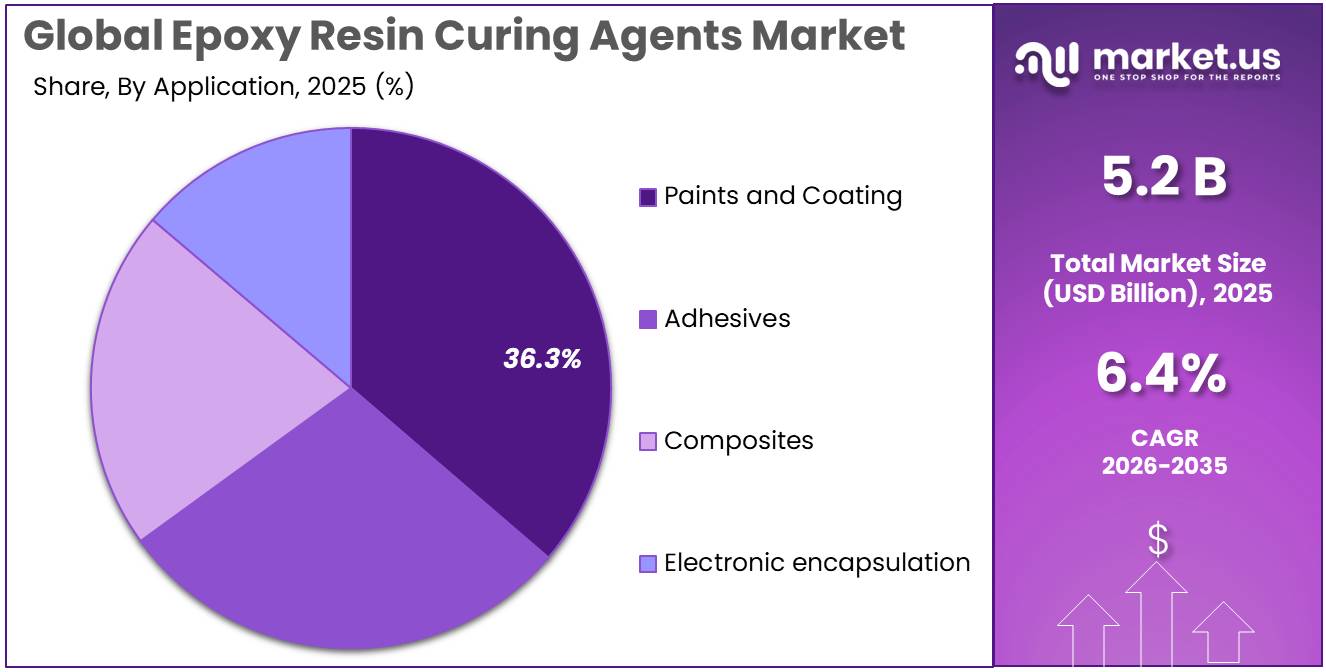
- Paints and Coating held a dominant market position, capturing more than a 36.32% share.
- Organic Compounds held a dominant market position, capturing more than a 66.34% share.
- Building and construction held a dominant market position, capturing more than a 30.67% share.
- Asia-Pacific held the dominant position in the Epoxy Resin Curing Agents Market in 2025, accounting for 37.00% of the global market, with a value of USD 1.9 billion.
By Product Type Analysis
Amine dominates the market due to its strong curing performance, excellent adhesion and wide industrial application.
In 2025, “Amine” held a dominant market position, capturing more than a 53.66% share of the Epoxy Resin Curing Agents Market. Amine-based curing agents are widely preferred because they provide strong mechanical properties, chemical resistance, good bonding strength and flexibility in formulation. These agents are used in protective coatings, industrial flooring, construction adhesives, marine coatings, automotive components and electrical insulation.
Their ability to cure at different temperatures and support both industrial and room-temperature applications makes them suitable for a wide range of manufacturing requirements. Demand is further supported by infrastructure maintenance, industrial equipment protection and the growing use of epoxy-based composite materials. Manufacturers are also focusing on improved amine formulations with lower emissions, better processing characteristics and enhanced durability.
Anhydrides are an important product category in the Epoxy Resin Curing Agents Market, particularly in applications requiring high-temperature resistance, low shrinkage and strong electrical insulation. They are commonly used in electrical laminates, transformers, motors, casting compounds, electronic components and industrial composite materials. Anhydride-based curing agents are preferred in applications where consistent curing, dimensional stability and long-term thermal performance are important.
According to the US Environmental Protection Agency (EPA), annual US production volumes of phthalic anhydride were reported at 250–500 million pounds during 2016–2019, with preliminary data indicating similar production levels during 2020–2023. This figure represents phthalic anhydride production, not epoxy curing-agent production, but indicates the industrial scale of anhydride-related chemical manufacturing.
By Application Analysis
Paints and Coating dominate the market due to their strong demand for corrosion protection, surface durability and industrial maintenance applications.
In 2025, “Paints and Coating” held a dominant market position, capturing more than a 36.32% share of the Epoxy Resin Curing Agents Market. Epoxy curing agents are widely used in paints and coatings because they improve adhesion, hardness, chemical resistance and protection against moisture and corrosion.
Demand is supported by the need to extend equipment life and reduce maintenance requirements across industrial facilities. In 2025, the US industrial maintenance and protective coatings segment recorded 63.6 million gallons in volume and USD 2.67 billion in sales, reflecting the importance of protective coating applications.
Adhesives represent an important application segment in the Epoxy Resin Curing Agents Market. Epoxy-based adhesives are widely used because they provide strong bonding, mechanical strength, chemical resistance and long-term durability. These materials are used in automotive assembly, aerospace components, construction materials, electrical equipment, machinery and metal bonding applications.
In 2026, the US Environmental Protection Agency (EPA) published updated Chemical Data Reporting information covering chemicals manufactured or imported between 2020 and 2023. Its industrial-use records include adhesive manufacturing as a recognized chemical processing application. This regulatory reporting supports the importance of chemical inputs and formulation activities in adhesive production.
By Raw Material Analysis
Organic Compounds dominate the market due to their essential role in epoxy curing reactions and their wide use in high-performance chemical formulations.
In 2025, “Organic Compounds” held a dominant market position, capturing more than a 66.34% share of the Epoxy Resin Curing Agents Market. Organic compounds are widely used in curing-agent formulations because they provide the chemical reactivity required to transform epoxy resins into strong and durable materials. These compounds include amines, polyamides, anhydrides and other carbon-based chemical intermediates.
Their applications extend across protective coatings, industrial adhesives, construction materials, automotive components and electrical insulation. Demand is supported by the need for improved bonding strength, chemical resistance, flexibility and long-term material performance. Manufacturers continue to focus on developing improved organic formulations that offer better curing efficiency, lower emissions and suitability for demanding industrial applications.
Inorganic Compounds are used in selected epoxy curing systems and related formulations where specific thermal, mechanical and chemical properties are required. They include mineral-based compounds, metal-containing materials and inorganic chemical additives that can support curing performance and improve the characteristics of finished epoxy products. Their use is relevant in industrial coatings, electrical insulation, construction materials and specialized composite applications.
According to the US Federal Reserve’s industrial production data, the US basic inorganic chemicals manufacturing index reached 87.7029 in 2025, compared with 90.5838 in 2024 (2017 = 100). This reflects the scale of inorganic chemical manufacturing activity and provides an indication of the industrial supply environment supporting downstream chemical applications.
By End User Analysis
Building and construction dominates the market due to increasing demand for durable flooring, protective coatings, structural adhesives and infrastructure maintenance.
In 2025, “Building and construction” held a dominant market position, capturing more than a 30.67% share of the Epoxy Resin Curing Agents Market. Epoxy curing agents are widely used in construction applications because they improve bonding strength, surface hardness, moisture resistance and durability. They are commonly applied in industrial flooring, concrete repair, protective coatings, bridge structures, commercial buildings and waterproofing systems.
According to the US Census Bureau, the total value of construction put in place in the United States reached approximately USD 2.17 trillion in 2025, including USD 1.25 trillion in nonresidential construction. This large construction base supports demand for durable coating and bonding materials used across building and infrastructure projects.
Transportation is an important end-user segment of the Epoxy Resin Curing Agents Market because epoxy-based materials are used in automotive components, aircraft structures, railway equipment, marine vessels and commercial vehicles. These curing agents provide strong adhesion, mechanical strength, chemical resistance and protection against environmental exposure.
The expansion of electric vehicles also creates opportunities for specialized epoxy formulations in battery components, electrical insulation and protective applications. Manufacturers are increasingly focusing on faster-curing systems, improved thermal performance and lightweight composite bonding solutions to meet changing transportation requirements.
Key Market Segments
By Product Type
- Amine
- Anhydrides
- Other Products
By Application
- Paints and Coating
- Adhesives
- Composites
- Electronic encapsulation and Others
By Raw Material
- Organic Compounds
- Inorganic Compounds
By End User
- Building and construction
- Transportation
- General Industrial
- Wind Power
- Aerospace
- Marine and Others
Driver Analysis
Wind-Composite Production
Wind-turbine manufacturing supports curing-agent demand where epoxy systems are selected for blade infusion, structural bonding and other qualified composite applications, with revenue linked to actual material consumption rather than installed electrical capacity alone. GWEC reports that 178 GW of turbine capacity was mechanically installed in 2025, while approximately 165 GW was grid-connected; the distinction matters because blade-material consumption precedes commissioning. Grid-connected additions included 120.5 GW in China, 6.9 GW in the US, 6.3 GW in India and 5.7 GW in Germany, establishing substantial manufacturing-linked demand exposure without specifying where every blade or hardener was produced.
Huntsman’s portfolio confirms established commercial use of amine and other hardener chemistries in epoxy composites, but neither every blade nor every composite structure uses an identical epoxy formulation. In an illustrative 1-GW turbine program averaging 5 MW per turbine, 200 turbines require 600 blades. Assuming 8 tonnes of epoxy resin-plus-curing-agent binder per blade and 25% curing-agent content by binder mass, demand equals 1,200 tonnes of curing agent.
At USD 4/kg, attributable revenue is USD 4.8 million; a 10% reduction in binder consumption lowers it by USD 480,000 unless offset by additional output or higher-value chemistry. These are sensitivity inputs, not measured industry material intensities. Suppliers compete on infusion viscosity, working time, cure control and qualification stability, supporting program-level supply relationships. The +0.9 pp contribution assumes 18% revenue exposure grows 5.0 percentage points faster through realized wind-composite consumption, excluding unbuilt projects, resin revenue and material-efficiency offsets.
Drivers Impact Analysis
| Driver | (~) % Impact on CAGR Forecast | Geographic Relevance | Impact Timeline |
|---|---|---|---|
| Wind-composite production | +0.9 pp | China, India, US, Germany | Short term (≤ 2 years) |
| Low-emission coating conversion | +0.8 pp | EU, US | Short term (≤ 2 years) |
| Electronic encapsulation demand | +0.7 pp | China, Taiwan, South Korea, Japan | Short term (≤ 2 years) |
| Concrete repair and protection | +0.7 pp | US, Germany, France, India | Short term (≤ 2 years) |
| Faster industrial adhesive curing | +0.5 pp | Germany, US, China, Japan | Medium term (2–4 years) |
Restraint Analysis
Construction-Linked Demand Weakness
Reduced building activity constrains curing-agent consumption in new flooring, concrete primers, protective coatings and construction adhesives, even where maintenance work remains resilient. US Census estimates show private residential construction spending at a USD 848.8 billion seasonally adjusted annual rate in September 2026, down 8.9% from a year earlier. This is nominal construction expenditure—not an epoxy-material volume measure—and should not be applied directly to curing-agent sales because application intensity, renovation demand and competing materials differ.
Evonik’s product documentation nevertheless confirms the transmission mechanism: modified amine hardeners are used in industrial flooring, concrete primers, coatings and linings, exposing part of demand to the timing of construction and refurbishment activity. In an illustrative supplier portfolio generating USD 20 million annually from construction-related hardeners, assume 60% serves new projects and 40% serves maintenance. An 8% decline in new-project consumption reduces revenue by USD 960,000; 3% maintenance growth adds USD 240,000, leaving a net USD 720,000 decline, or 3.6%, before mix changes.
These are scenario sensitivities, not a measured relationship between construction spending and hardener demand. Suppliers may redirect sales toward repair applications, but displaced project volumes cannot automatically be recovered through product premiumization. The −0.50 pp contribution assumes 20% revenue exposure grows 2.5 percentage points more slowly through construction-linked order weakness, excluding repair growth already counted as a driver and crediting work completed later within the forecast period.
Restraint Impact Analysis
| Restraint | (~) % Impact on CAGR Forecast | Geographic Relevance | Impact Timeline |
|---|---|---|---|
| Construction-linked demand weakness | −0.50 pp | US | Short term (≤ 2 years) |
| Alternative binder substitution | −0.40 pp | China, Germany, US, UK | Medium term (2–4 years) |
| Uneconomic formulation conversion | −0.35 pp | EU, US, India | Short term (≤ 2 years) |
| Sensitizer-related customer exclusions | −0.30 pp | EU, EEA | Medium term (2–4 years) |
| Application qualification limits | −0.25 pp | Germany, US, China, Japan | Medium term (2–4 years) |
Opportunity Analysis
Recyclable Composite Hardeners
Suppliers could commercialize cleavage-enabled curing-agent systems through new composite design programs that include a credible collection and recycling route, making recyclability a specified purchasing requirement rather than an unsupported environmental claim. Aditya Birla’s August 2026 update describes Recyclamine deployment in prototype blades for Leitwind’s LTW42 turbine, with validation and certification preceding expansion to larger platforms; it also describes a proposed recycling collaboration with Catack-H spanning Asia-Pacific, Europe and the US.
The upside is incremental adoption or a justified specialty-hardener premium beyond ordinary wind-composite production; replacing conventional epoxy hardener does not make the entire new formulation’s sales additional market revenue. In an illustrative program producing 10,000 tonnes of resin-plus-hardener binder annually, a 25% hardener share represents 2,500 tonnes. Converting 20% to a recyclable hardener at USD 6/kg instead of USD 4/kg creates USD 1 million of incremental annual curing-agent revenue, assuming unchanged dosage.
If conversion requires USD 600,000 of qualification expenditure and incremental contribution is 35%, simple recovery takes approximately 1.7 years after full adoption, before overhead. Suppliers must validate mechanical performance and end-of-life processing economics together. The +0.40 pp coefficient assumes 8% revenue exposure grows 5.0 percentage points faster through new qualified programs and net mix uplift, excluding recovered-material sales, recycling fees and conventional wind demand already in the baseline.
Opportunity Impact Analysis
| Opportunity | (~) % Potential CAGR Upside | Geographic Relevance | Execution Window |
|---|---|---|---|
| Recyclable composite hardeners | +0.40 pp | Germany, Denmark, US, India | Medium term (2–4 years) |
| Epoxy battery-enclosure conversion | +0.35 pp | China, Germany, US, South Korea | Medium term (2–4 years) |
| Verified bio-based formulations | +0.30 pp | EU, US, Japan | Medium term (2–4 years) |
| Customer-specific hardener platforms | +0.25 pp | US, Germany, India, China | Short term (≤ 2 years) |
| Lower-sensitizer application conversion | +0.20 pp | EU, EEA | Medium term (2–4 years) |
Challenges Analysis
Specialty Feedstock Supply Variability
Curing-agent manufacturers must coordinate commodity-derived inputs with lower-volume specialty materials whose supplier availability and qualification requirements differ, creating recurring procurement, inventory and repricing friction without necessarily stopping production. Evonik’s 2025 Financial and Sustainability Report distinguishes widely available high-volume raw materials from low-volume specialties sourced from a limited supplier base, and identifies geopolitical developments, legislation, logistics disruption and weather as procurement risks; it describes multiple sourcing and long-term contracts as mitigation measures.
In an illustrative manufacturer with USD 100 million of annual curing-agent sales and USD 45 million of raw-material expenditure, a 10% cost increase affecting 40% of purchases adds USD 1.8 million annually. A three-month repricing lag creates USD 450,000 of unoffset cost exposure before inventory effects. Increasing stock cover on that affected USD 18 million purchasing stream from 45 to 60 days ties up approximately USD 740,000 at the original cost level. Neither amount is itself lost constant-price revenue; the growth effect arises where cash absorption, allocation or substitute qualification delays deliveries or expansion.
Manufacturers need technically approved alternatives, input-specific safety stocks and contracts reflecting qualification lead times rather than blanket inventory increases. The −0.30 pp contribution assumes 15% revenue exposure grows 2.0 percentage points more slowly through residual supply-related delivery losses and constrained expansion, excluding nominal price changes, complete supply prohibitions and demand rejection already assigned to restraints.
Challenges Impact Analysis
| Challenge | (~) % CAGR Friction Drag | Geographic Relevance | Mitigation Horizon |
|---|---|---|---|
| Specialty feedstock supply variability | −0.30 pp | China, EU, US, India | Medium term (2–4 years) |
| Stoichiometry and batch consistency | −0.25 pp | China, Germany, US, Japan | Long term (≥ 4 years) |
| Cure-window and exotherm control | −0.25 pp | China, US, Germany, India | Long term (≥ 4 years) |
| Humidity-sensitive field application | −0.20 pp | India, Southeast Asia, US, EU | Long term (≥ 4 years) |
| Storage and portfolio complexity | −0.20 pp | US, EU, China, India | Medium term (2–4 years) |
Geopolitical Impact Analysis
Impact of the Middle East War on the Epoxy Resin Curing Agents Market
The ongoing Middle East conflict in 2026 is creating cost and supply-chain challenges for the Epoxy Resin Curing Agents Market. Military tensions involving Iran and disruptions around the Strait of Hormuz have affected energy supplies, petrochemical transportation and international chemical trade. These developments are increasing procurement and logistics costs for manufacturers dependent on petroleum-based raw materials, including amines and other chemical intermediates.
According to the United Nations Trade and Development (UNCTAD), approximately 25% of global seaborne oil trade passes through the Strait of Hormuz. In March 2026, Brent crude prices also moved above USD 90 per barrel following military escalation.
Higher crude oil and energy costs can increase chemical production expenses, while shipping delays and rising insurance premiums create additional pressure on international suppliers. Manufacturers of epoxy curing agents may face longer delivery schedules, fluctuating input prices and difficulties maintaining stable inventory levels.
The conflict is also encouraging chemical companies to diversify sourcing, strengthen regional inventories and identify alternative suppliers. In the coming years, companies with flexible procurement networks, local production capabilities and efficient supply-chain management are likely to maintain better operational stability.
Regional Insights
Asia-Pacific – Dominating Region (37.00%, USD 1.9 Billion)
Asia-Pacific held the dominant position in the Epoxy Resin Curing Agents Market in 2025, accounting for 37.00% of the global market, with a value of USD 1.9 billion. The region’s leadership is supported by strong chemical manufacturing capabilities and demand from construction, automotive, electronics, marine and industrial coating industries. China, Japan and South Korea remain important manufacturing centers for epoxy-based materials and specialty chemicals.
According to the International Energy Agency, China continues to play a leading role in global clean energy manufacturing, supporting demand for advanced materials used in electrical equipment and renewable energy infrastructure.
Renewable energy and electronics are emerging as important growth areas for epoxy resin curing agents across Asia-Pacific. The expansion of wind power, solar installations, electric vehicles and electronic component manufacturing is creating demand for specialized curing formulations. China reported 130.8 GW of newly installed wind power capacity in 2025, while its cumulative wind capacity reached 691.7 GW. This expansion supports opportunities for epoxy curing agents used in wind turbine blades, electrical insulation and protective coatings.
In addition, China’s chemical raw materials and chemical products manufacturing value added increased by 7.8% in 2025, indicating continued industrial activity and a supportive manufacturing environment. These developments are encouraging suppliers to expand production capabilities and develop high-performance, thermally stable and low-emission curing solutions.
Key Regions and Countries Insights
- North America
- US
- Canada
- Europe
- Germany
- France
- The UK
- Spain
- Italy
- Rest of Europe
- Asia Pacific
- China
- Japan
- South Korea
- India
- Australia
- Rest of APAC
- Latin America
- Brazil
- Mexico
- Rest of Latin America
- Middle East & Africa
- GCC
- South Africa
- Rest of MEA
Key Players Analysis
Atul Limited maintains a presence in the epoxy resin curing agents market through its Polymers and Performance Materials business. In FY 2024–25, the company reported ₹1,445 crore in sales from this business, representing a 21% increase over the previous year. Its portfolio includes approximately 50 synthetic products and 276 formulations, covering epoxy resins, curing agents, reactive diluents, accelerators and catalysts. The company serves customers across construction, automotive, aerospace, electrical and coatings industries.
BASF SE strengthens its position in specialty chemicals through its extensive manufacturing network and advanced material technologies. In 2025, the company operated 234 production sites across 93 countries, supporting its global chemical supply operations. Its Materials segment generated EUR 12,742 million in sales, while the Industrial Solutions segment recorded EUR 8,594 million. Its industrial solutions and chemical technologies support applications involving coatings, adhesives and performance materials. Its global production infrastructure provides opportunities to serve manufacturers requiring specialized epoxy-related chemical solutions.
Cardolite Corporation focuses on specialty epoxy curing agents developed from cashew nutshell liquid (CNSL)-based chemistry. Its portfolio includes phenalkamines, phenalkamine adducts, phenalkamides, polyamides and modified cycloaliphatic amines. The company offers products for protective coatings, industrial flooring, construction adhesives and transportation applications. Its product portfolio includes more than 25 listed curing-agent formulations, with selected products offering solvent-free and low-viscosity properties. The company focuses on faster curing, corrosion protection, adhesion and improved performance under demanding application conditions.
Top Key Players Outlook
- Atul Limited
- BASF SE
- Cardolite Corporation
- Evonik Industries
- Grasim Industries Limited
- Westlake
- Huntsman Corporation
- Kukdo Chemical Co., Ltd.
- Mitsubishi Chemical Corporation
- Olin Corporation
- Other Key Players
Recent Developments
- Evonik reported EUR 14.1 billion in sales and EUR 1.9 billion in adjusted EBITDA for 2025, with operations in more than 100 countries and approximately 31,000 employees. No specific 2025–2026 merger or acquisition involving its epoxy curing-agent business was identified in the reviewed company announcements.
- In January 2026, Westlake also completed the acquisition of the ACI/Perplastic Group for approximately EUR 92.4 million, expanding its specialty compounding business for wire and cable applications.
Report Scope
| Report Features | Description |
|---|---|
| Market Value (2025) | USD 5.2 Bn |
| Forecast Revenue (2035) | USD 9.7 Bn |
| CAGR (2026-2035) | 6.4% |
| Base Year for Estimation | 2025 |
| Historic Period | 2020-2024 |
| Forecast Period | 2026-2035 |
| Report Coverage | Revenue Forecast, Market Dynamics, Competitive Landscape, Recent Developments |
| Segments Covered | By Product Type (Amine, Anhydrides, Other Products), By Application (Paints and Coating, Adhesives, Composites, Electronic encapsulation and Others), By Raw Material (Organic Compounds, Inorganic Compounds), By End User (Building and construction, Transportation, General Industrial, Wind Power, Aerospace, Marine and Others) |
| Regional Analysis | North America – US, Canada; Europe – Germany, France, The UK, Spain, Italy, Rest of Europe; Asia Pacific – China, Japan, South Korea, India, Australia, Singapore, Rest of APAC; Latin America – Brazil, Mexico, Rest of Latin America; Middle East & Africa – GCC, South Africa, Rest of MEA |
| Competitive Landscape | Atul Limited, BASF SE, Cardolite Corporation, Evonik Industries, Grasim Industries Limited, Westlake, Huntsman Corporation, Kukdo Chemical Co., Ltd., Mitsubishi Chemical Corporation, Olin Corporation, Other Key Players |
| Customization Scope | Customization for segments, region/country-level will be provided. Moreover, additional customization can be done based on the requirements. |
| Purchase Options | We have three licenses to opt for: Single User License, Multi-User License (Up to 5 Users), Corporate Use License (Unlimited User and Printable PDF) |