Report Overview
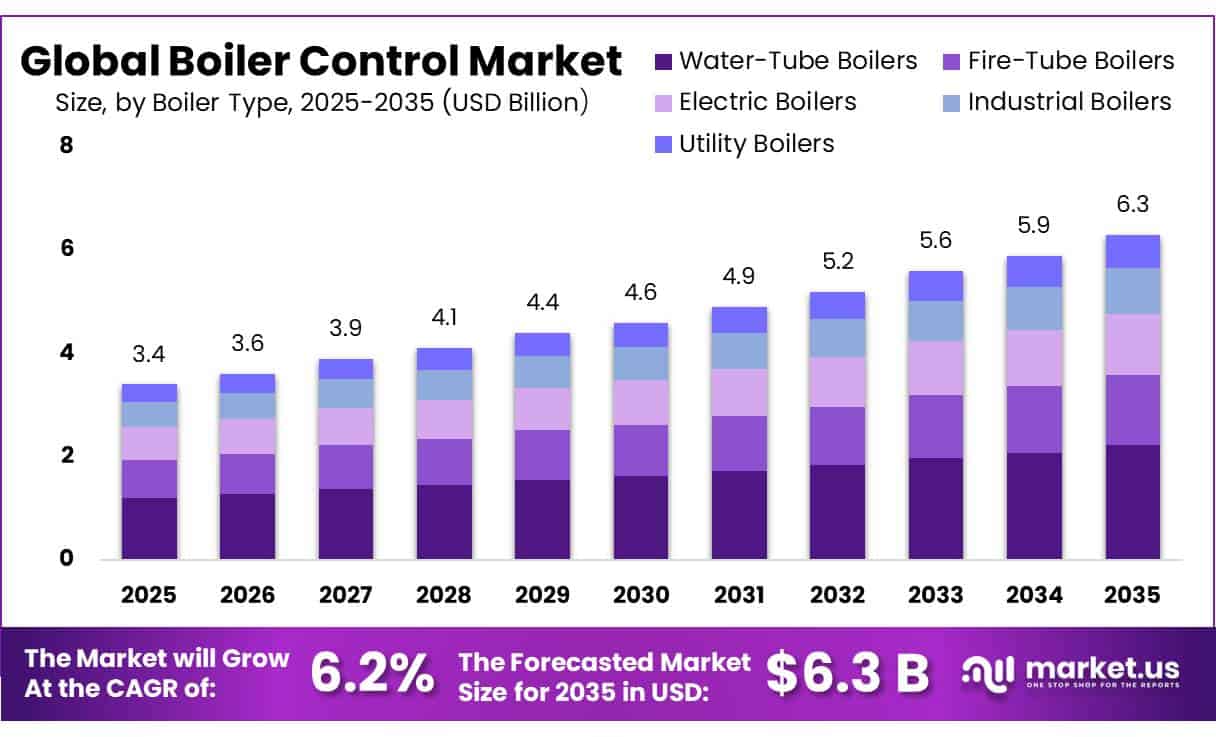
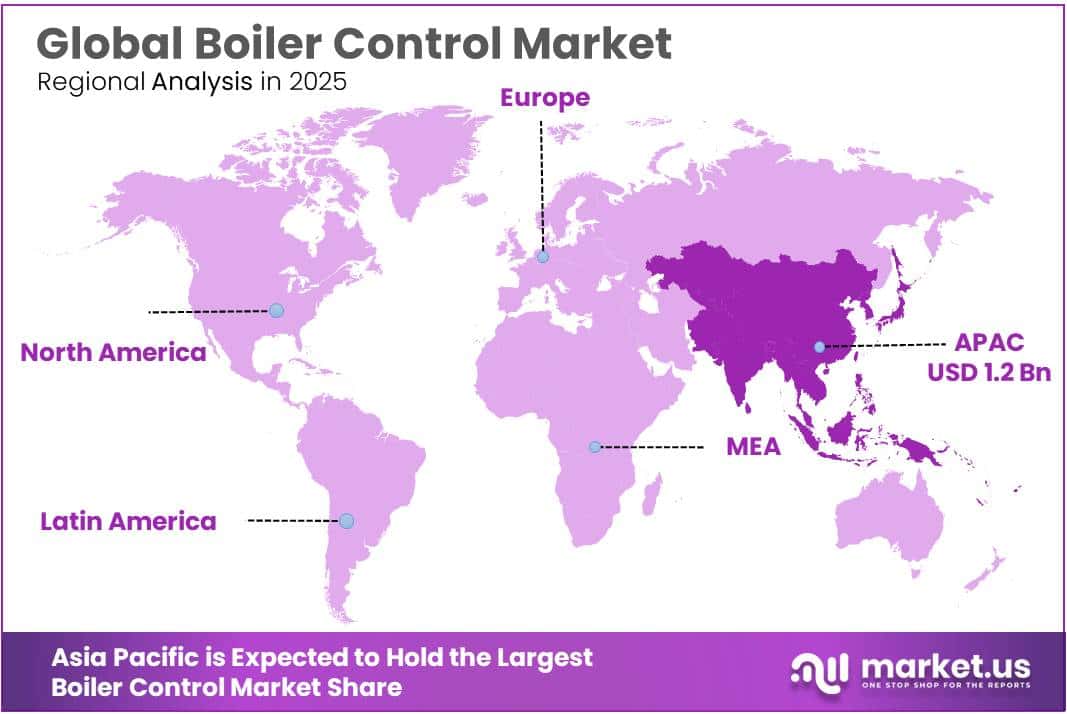
The Global Boiler Control Market size is expected to be worth around USD 6.3 Billion by 2035, from USD 3.4 Billion in 2025, growing at a CAGR of 6.2% during the forecast period from 2026 to 2035. In 2025, Asia Pacific held a dominant market position, capturing more than a 36.00% share, holding USD 1.2 Billion revenue.
Boiler control systems play an important role in industrial operations by regulating steam generation, combustion, temperature, pressure, fuel supply, and water levels. These systems help industries maintain stable boiler performance, improve energy efficiency, reduce fuel consumption, and ensure safe operations. Boiler control technologies include programmable logic controllers (PLCs), distributed control systems (DCS), sensors, automated combustion controls, and supervisory control and data acquisition (SCADA) systems.
- According to the U.S. Department of Energy, the United States has more than 45,000 industrial and commercial boilers above 10 million British thermal units per hour (MMBtu/hr), with a combined fuel input capacity of 2.7 million MMBtu/hr. This installed equipment base creates considerable opportunities for automation, control upgrades, and efficiency improvements.
Modern industries are increasingly moving from manual boiler operation toward digital and automated systems. Advanced controls allow operators to monitor fuel-to-air ratios, combustion conditions, steam pressure, oxygen levels, and emissions in real time. The U.S. Department of Energy demonstrated a combustion monitoring system on a 25 MMBtu/hr steam boiler, achieving 4% fuel savings during a one-year test. The system also reduced operating costs by 3.6% compared with baseline operations.
- Growing industrial energy efficiency requirements are a major factor supporting boiler control adoption. The International Energy Agency (IEA) reports that energy management programs can deliver more than 10% energy savings within the first three years of implementation. Industries are therefore investing in automation and intelligent control systems to reduce energy costs, improve productivity, and strengthen operational performance.
Emission control and environmental compliance are also increasing demand. Industrial boilers produce nitrogen oxides (NOx), carbon monoxide, and other emissions that require monitoring and control. Canada’s government identifies approximately 820 existing boilers and heaters subject to its Multi-Sector Air Pollutants Regulations, highlighting the importance of emission-compliant industrial combustion systems.
- Government energy-efficiency programs are encouraging industries to modernize heating equipment and adopt improved control technologies. The U.S. Department of Energy’s Federal Energy Management Program establishes efficiency requirements for eligible commercial boilers, including minimum combustion efficiency of 96% for large gas-fired hot-water boilers and 83.7% thermal efficiency for gas-fired steam boilers. Such standards encourage manufacturers and industrial users to consider advanced controls and efficient boiler operation.
The IEA reports that more than 130 countries had at least one energy-efficiency or fuel-switching regulation in place by 2025. These regulatory developments are increasing the importance of automated monitoring, energy optimization, and efficient industrial heating technologies.
Electrification of industrial heating is another emerging opportunity. The IEA highlights electric boilers as an option for low-temperature industrial heat and steam production. For example, UPM installed 50 MW and 60 MW electric boilers at its Finnish and German paper mills in 2023. Alunorte in Brazil also installed electric boilers capable of producing 270 tonnes of steam per hour. These developments create opportunities for control systems designed for electric boilers and hybrid heating operations.
Key Takeaways
- Boiler Control Market size is expected to be worth around USD 6.3 Billion by 2035, from USD 3.4 Billion in 2025, growing at a CAGR of 6.2%.
- Hardware held a dominant market position, capturing more than a 42.00% share.
- Water-Tube Boilers held a dominant market position, capturing more than a 35.00% share.
- Modulating Control held a dominant market position, capturing more than a 31.00% share.
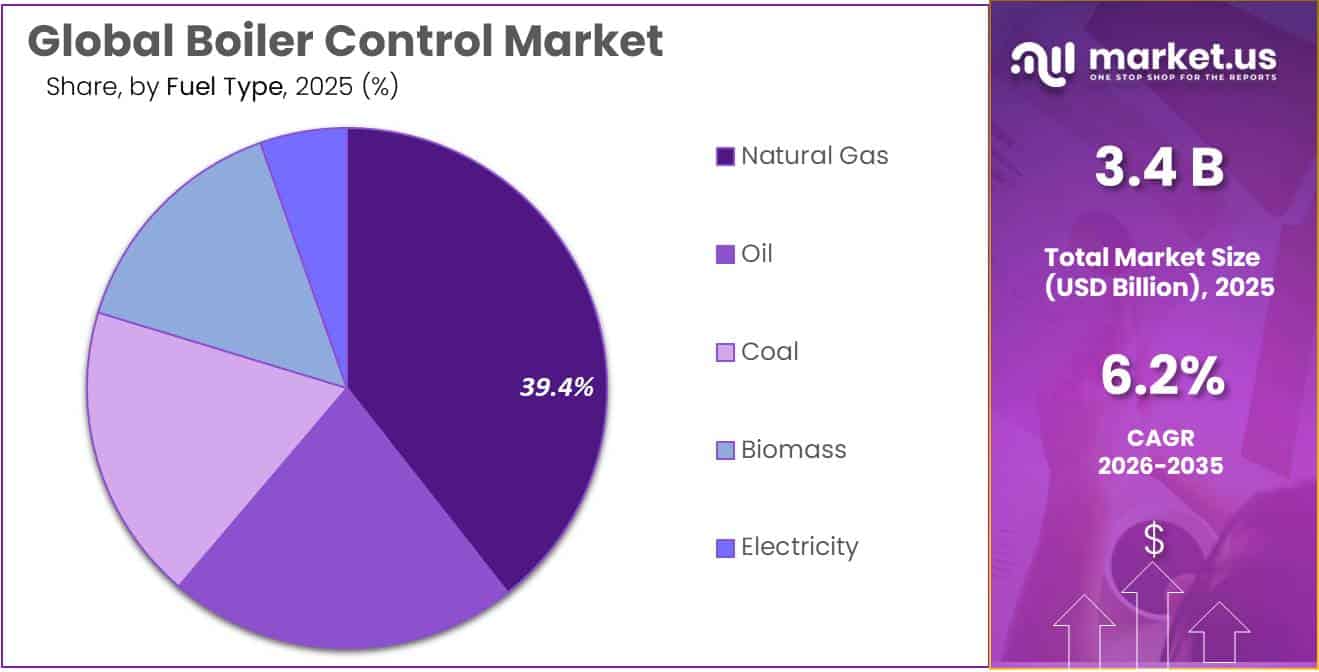
- Natural Gas held a dominant market position, capturing more than a 39.00% share.
- Commercial held a dominant market position, capturing more than a 24.00% share.
- Oil & Gas held a dominant market position, capturing more than a 17.00% share.
- Asia Pacific held the leading position in the Boiler Control Market in 2025, accounting for 36.00% of the global market, valued at approximately USD 1.2 billion.
By Component Analysis
Hardware Segment: Hardware Leads the Boiler Control Market with a 42.00% Share in 2025
In 2025, “Hardware” held a dominant market position, capturing more than a 42.00% share of the Boiler Control Market by component. The segment is supported by the essential role of physical control equipment in maintaining safe and efficient boiler operations. Hardware includes sensors, controllers, transmitters, actuators, control panels, valves, and combustion monitoring devices.
These components help industrial operators monitor steam pressure, temperature, fuel flow, oxygen levels, and water levels in real time. Demand is particularly strong across power generation, chemical processing, food manufacturing, and oil and gas facilities, where stable steam supply is important. According to the U.S. Department of Energy, the United States has more than 45,000 industrial and commercial boilers with capacities above 10 million British thermal units per hour.
The software segment of the Boiler Control Market is gaining importance as industries increasingly adopt digital monitoring, automated operations, and predictive maintenance solutions. Boiler control software helps operators manage combustion settings, monitor equipment performance, regulate fuel-to-air ratios, and identify operating problems before they cause equipment failure.
In 2025 and 2026, the growing use of industrial automation and real-time performance monitoring supported demand for advanced software platforms. The U.S. Department of Energy’s industrial energy management software program, MEASUR, provides manufacturers with more than 70 calculators and software tools to assess industrial energy performance and identify potential savings. These digital capabilities support better boiler efficiency, lower operating costs, and improved process reliability.
By Boiler Type Analysis
Water-Tube Boilers: Water-Tube Boilers Lead the Market with a 35.00% Share in 2025
In 2025, “Water-Tube Boilers” held a dominant market position, capturing more than a 35.00% share of the Boiler Control Market by boiler type. The segment benefits from its ability to generate high-pressure steam and support large-scale industrial operations. Water-tube boilers are widely used in power generation, chemical processing, oil and gas, and heavy manufacturing, where continuous steam supply and precise temperature control are essential. Their design allows water to circulate inside tubes while hot combustion gases transfer heat around them, supporting faster heat transfer and operation under demanding pressure conditions.
The U.S. Environmental Protection Agency identifies water-tube boilers as suitable for a broad industrial capacity range of 0.4 to 1,500 million British thermal units per hour (MMBtu/hr). In 2025, demand for advanced boiler controls remained supported by the need to regulate pressure, combustion, water levels, and operating safety in high-capacity installations.
The fire-tube boiler segment continues to serve industries requiring reliable steam generation at low and medium pressure levels. These boilers operate by passing hot combustion gases through tubes surrounded by water, allowing heat to transfer efficiently to the surrounding water. Their relatively simple construction, compact design, and ease of maintenance make them suitable for food processing, chemical manufacturing, textile production, commercial facilities, and smaller industrial plants.
In 2025, demand for fire-tube boiler control systems was supported by the need for reliable steam pressure regulation, temperature monitoring, fuel management, and combustion safety. According to the Government of Canada’s boiler classification, industrial fire-tube boilers generally operate within a capacity range of 2.9–29 MW, equivalent to 10–100 MMBtu/hr, while commercial and institutional applications cover 0.1–2.9 MW. In 2026, the adoption of automated controls and digital monitoring is expected to support modernization of existing fire-tube installations.
By Control Type Analysis
Modulating Control: Modulating Control Leads the Market with a 31.00% Share in 2025
In 2025, “Modulating Control” held a dominant market position, capturing more than a 31.00% share of the Boiler Control Market by control type. The segment benefits from its ability to adjust fuel input and air supply according to changing steam demand rather than operating only at full or reduced capacity. This allows industrial facilities to maintain stable boiler pressure, improve combustion efficiency, and avoid unnecessary fuel consumption. Modulating controls are widely used in chemical plants, power generation facilities, food processing units, and other industries that require continuous steam supply.
In 2025, the demand for these systems was supported by rising energy costs and the need for better operational control. The U.S. Department of Energy highlights combustion optimization and proper fuel-to-air adjustment as important measures for improving boiler performance and reducing energy waste. Modulating control therefore remains an important choice for facilities seeking consistent output, lower operating costs, and improved boiler safety.
In 2025, “Modulating Control” held a dominant market position, capturing more than a 31.00% share of the Boiler Control Market by control type. The segment benefits from its ability to adjust boiler firing rates according to changing steam and heat requirements. Unlike basic switching systems, modulating controls continuously regulate fuel and air supply, helping industrial facilities maintain stable pressure, improve combustion, and reduce unnecessary fuel consumption.
These systems are widely used in chemical plants, power stations, food processing facilities, and manufacturing units where heating demand changes throughout the production cycle. The U.S. Department of Energy explains that industrial burners commonly operate with turndown ratios of 10:1 or 12:1, while some gas-fired burners offer ratios of up to 35:1. Such flexibility supports efficient operation under varying load conditions.
By Fuel Type Analysis
Natural Gas: Natural Gas Leads the Boiler Control Market with a 39.00% Share in 2025
In 2025, “Natural Gas” held a dominant market position, capturing more than a 39.00% share of the Boiler Control Market by fuel type. The segment’s leading position is supported by the wide use of natural gas in industrial boilers because of its reliable heat output, convenient fuel supply, and relatively clean combustion compared with heavier fossil fuels. Natural gas-fired boilers are widely used in chemical processing, food manufacturing, pharmaceuticals, paper production, and power generation. Their operation requires accurate control of fuel flow, air supply, combustion temperature, and steam pressure to maintain efficiency and safe performance.
According to the U.S. Energy Information Administration (EIA), industrial natural gas consumption averaged a record 23.6 billion cubic feet per day (Bcf/d) in 2025, representing a 1% increase compared with the previous record in 2023. The EIA forecast industrial consumption to rise by 1.2% in 2026, reaching further record levels. This industrial demand supports the need for automated boiler controls, combustion monitoring, and fuel-management systems.
The oil segment remains relevant in the Boiler Control Market, particularly in industrial facilities that require dependable heat generation and operate in locations where natural gas infrastructure is limited. Oil-fired boilers are used in manufacturing plants, refineries, chemical processing facilities, marine applications, and backup heating systems. These boilers require accurate fuel-flow regulation, burner management, temperature monitoring, and combustion control to maintain safe and stable operations.
In 2025, the U.S. Energy Information Administration reported residual fuel oil consumption of approximately 322,000 barrels per day, compared with 293,000 barrels per day in 2024, reflecting an increase of around 9.9%. This broader consumption figure includes multiple end-use sectors and is not limited to boilers. Demand for oil-based boiler control systems is supported by existing equipment installations, fuel flexibility requirements, and backup heating needs.
By Application Analysis
Commercial: Commercial Applications Lead the Boiler Control Market with a 24.00% Share in 2025
In 2025, “Commercial” held a dominant market position, capturing more than a 24.00% share of the Boiler Control Market by application. The segment is supported by the widespread use of boilers in office buildings, hospitals, hotels, educational institutions, shopping centers, and other commercial facilities. These establishments depend on boilers for space heating, hot water supply, laundry operations, and other heating requirements. Commercial boiler control systems help operators maintain consistent temperatures, regulate steam pressure, manage fuel consumption, and improve equipment safety.
According to the U.S. Department of Energy, approximately 703,000 commercial buildings in the United States use boilers for space heating, representing around 12% of commercial buildings. These boilers serve approximately 30% of total commercial building floor space and account for about 32% of commercial building energy consumption. This installed base supports demand for automated controls, monitoring equipment, and energy-efficient boiler upgrades.
The residential segment is supported by the use of boiler systems for household space heating, hot water supply, and indoor temperature management. Residential boiler controls help homeowners regulate heating schedules, maintain comfortable indoor temperatures, and manage fuel consumption. These systems are commonly used in properties with hydronic heating, radiator-based systems, and central hot-water heating arrangements. In 2025, demand was supported by the modernization of existing heating equipment and growing interest in smart thermostats, programmable controls, and energy-efficient home heating.
According to the U.S. Energy Information Administration, natural gas was the primary heating fuel for 46% of U.S. homes in 2024, while electricity accounted for 43%. These figures indicate the continued importance of fuel-based heating infrastructure, although they cover all heating systems rather than boilers alone. In 2026, smart heating controls and boiler automation are expected to create further opportunities in residential energy management.
By End-Use Industry Analysis
Oil & Gas: Oil & Gas Leads the Boiler Control Market with a 17.00% Share in 2025
In 2025, “Oil & Gas” held a dominant market position, capturing more than a 17.00% share of the Boiler Control Market by end-use industry. The segment is supported by extensive boiler applications in refineries, petrochemical facilities, gas processing plants, and offshore operations. Boilers provide essential steam for distillation, process heating, equipment cleaning, and other continuous industrial activities.
According to the U.S. Energy Information Administration (EIA), U.S. refineries consumed approximately 1,055,352 million cubic feet of natural gas in 2025 and purchased 84,770 million pounds of steam. These figures highlight the scale of energy and steam requirements in refining operations, supporting demand for reliable boiler control and monitoring systems.
The chemicals segment represents an important application area for the Boiler Control Market because chemical manufacturing depends heavily on steam and controlled heating for distillation, evaporation, drying, reaction processing, and material treatment. Boiler control systems help chemical manufacturers maintain consistent temperature and pressure, regulate fuel consumption, and prevent operational interruptions. In 2025–2026, demand for automated boiler controls continued to be supported by industrial energy-efficiency requirements and the need for reliable process heating.
According to the U.S. Energy Information Administration’s 2022 Manufacturing Energy Consumption Survey, released in August 2025, the chemicals subsector accounted for 56% of purchased manufacturing steam, with total purchased manufacturing steam reaching 494,318 billion British thermal units. Chemicals also represented 42% of purchased manufacturing natural gas. These figures demonstrate the industry’s substantial dependence on thermal energy and create opportunities for advanced boiler automation and monitoring technologies.
Key Market Segments
By Component
- Hardware
- Software
- Services
By Boiler Type
- Fire-Tube Boilers
- Water-Tube Boilers
- Electric Boilers
- Industrial Boilers
- Utility Boilers
By Control Type
- Modulating Control
- On/Off Control
- Automatic Combustion Control
- Boiler Sequencing Control
- Burner Management Control
By Fuel Type
- Natural Gas
- Oil
- Coal
- Biomass
- Electricity
By Application
- Residential
- Commercia
- Industrial
- Power Generation
By End-Use Industry
- Chemicals
- Food & Beverage
- Oil & Gas
- Pharmaceutical
- Pulp & Paper
- Metals & Mining
- Power Generation
- Others
Driver Analysis
Combustion-Efficiency Retrofits — +0.7 Percentage Points
Combustion-efficiency improvements support control purchases because excess air, inconsistent fuel–air ratios and changing load can waste fuel even when the boiler itself remains serviceable. DOE’s engineering guidance states that well-designed natural-gas systems can achieve approximately 10% excess air and recommends considering oxygen trim where fuel composition or steam flow varies substantially; its burner guidance identifies approximately 2–3% excess oxygen as an attainable operating range for suitable gas burners while cautioning against excessive carbon monoxide. These are engineering reference conditions—not universal setpoints for every fuel or boiler.
In a constructed 20 MW useful-output boiler operating 6,000 hours annually, useful heat is 120,000 MWh. Increasing thermal efficiency from 82% to 84% reduces fuel input from approximately 146,341 to 142,857 MWh, saving 3,484 MWh annually. At an assumed USD 40/MWh of fuel, gross savings are approximately USD 139,000; subtracting USD 15,000 in incremental analyzer maintenance and calibration leaves USD 124,000. A USD 250,000 installed control package therefore has approximately two-year simple payback before financing and tax, provided the efficiency gain is verified.
The +0.7-point sensitivity assumes 30% of terminal counterfactual revenue is exposed to combustion retrofits and achieves 11.3% cumulative outperformance, adding approximately 3.4% terminal market revenue. Suppliers shift toward oxygen-trim packages, independent actuators and measured commissioning outcomes, while burner hardware and heat-recovery equipment outside the defined scope remain excluded.
Drivers Impact Analysis
| Driver | (~) % Impact on CAGR Forecast | Geographic Relevance | Impact Timeline |
|---|---|---|---|
| Combustion-efficiency retrofits | +0.7 pp | US, EU, UK, Japan, India | Short term (≤ 2 years) |
| Emissions-compliance investment | +0.5 pp | US; EU, UK industrial sites | Medium term (2–4 years) |
| Multi-boiler load optimization | +0.5 pp | US, EU, China, India | Medium term (2–4 years) |
| Water and blowdown optimization | +0.5 pp | India, Middle East, China, US | Short term (≤ 2 years) |
| Safety-system renewal | +0.5 pp | US, EU, Japan, South Korea | Long term (≥ 4 years) |
| Connected boiler supervision | +0.4 pp | US, EU, Japan, Australia | Medium term (2–4 years) |
Restraint Analysis
Low-Utilization Retrofit Economics — −0.5 Percentage Points
Low annual operating hours and limited remaining efficiency headroom can prevent an otherwise functional control upgrade from meeting an owner’s investment threshold. DOE’s boiler-purchasing guidance states that efficiency premiums are justified when lifetime energy savings exceed upfront costs and recommends oxygen trim particularly for larger boilers; an older DOE technology-screening assessment identifies potential oxygen-trim gains of approximately 1–2 efficiency percentage points, not a guaranteed result for every installation.
In a constructed 5 MW useful-output boiler operating 2,000 hours annually, increasing efficiency from 84% to 85% reduces annual fuel input from approximately 11,905 to 11,765 MWh, saving about 140 MWh. At USD 35/MWh of fuel, gross savings are approximately USD 4,900; subtracting USD 2,000 of incremental annual analyzer maintenance leaves USD 2,900. A USD 60,000 installed upgrade therefore has roughly twenty-one-year simple payback before financing and tax. At 6,000 hours, net annual savings rise to approximately USD 12,700 and payback falls to about 4.7 years, illustrating why utilization matters more than a generalized efficiency claim.
The −0.5-point sensitivity assumes 30% of terminal counterfactual revenue is exposed to low-utilization or already-efficient boilers and experiences an 8% realization shortfall, producing approximately 2.4% market-wide terminal erosion. Suppliers consequently face smaller standalone instrument purchases, deferred oxygen-trim projects and pressure to document baseline performance before quoting; the deduction reflects rejected investment, not the routine work of tuning an approved system.
Restraint Impact Analysis
| Restraint | (~) % Impact on CAGR Forecast | Geographic Relevance | Impact Timeline |
|---|---|---|---|
| Low-utilization retrofit economics | −0.5 pp | US, EU, India, ASEAN | Medium term (2–4 years) |
| Brownfield conversion costs | −0.4 pp | US, EU, Japan, India | Long term (≥ 4 years) |
| Hardware-limited efficiency gains | −0.4 pp | China, India, EU, US | Long term (≥ 4 years) |
| Heat-pump substitution | −0.3 pp | EU, UK, Japan, China | Long term (≥ 4 years) |
| Limited regulatory purchase triggers | −0.3 pp | US area-source boiler segment | Medium term (2–4 years) |
| Small-fleet digital payback | −0.3 pp | India, ASEAN, Brazil; US, EU SMEs | Medium term (2–4 years) |
Opportunity Analysis
Hybrid Boiler-House Orchestration — +0.5 Percentage Points
The opportunity is to supply supervisory systems that coordinate existing combustion boilers with electric boilers and other heat sources, rather than merely improve sequencing among conventional boilers. Spirax Sarco’s July 2025 boiler-house guidance identifies hybrid or electric generation alongside digital performance monitoring, establishing a commercial transition pathway but not proving that every mixed-technology installation requires a new third-party control platform.
In a constructed plant requiring 10 MW of useful heat, an 85%-efficient gas boiler operating with USD 40/MWh fuel produces heat at approximately USD 47.06/MWh before nonfuel costs; a 98%-efficient electric boiler reaches fuel-cost parity at an electricity price of approximately USD 46.12/MWh. If 2,000 MWh of annual heat can be shifted to electricity priced at USD 30/MWh, gross energy savings are approximately USD 32,900, before network charges and operating constraints. That alone would recover a USD 200,000 orchestration package in roughly 6.1 years before support and financing, demonstrating why tariff access, operating hours and flexibility value must be verified rather than presumed.
Twenty qualified projects at that package price create USD 4 million of supplier revenue, excluding the boilers and other heat-generating equipment. The +0.5-point sensitivity requires approximately 2.4% incremental terminal market revenue from genuinely new coordination scope, net of existing sequencing controls displaced. Suppliers need source-specific operating envelopes, minimum-run constraints and reliable fallback; the white space is cross-technology dispatch and integration, not the broader heat-electrification trend already affecting boiler demand.
Opportunity Impact Analysis
| Opportunity | (~) % Potential CAGR Upside | Geographic Relevance | Execution Window |
|---|---|---|---|
| Hybrid boiler-house orchestration | +0.5 pp | EU, UK, Japan, China | Medium term (2–4 years) |
| Verified-savings control contracts | +0.4 pp | US, EU, UK, India | Medium term (2–4 years) |
| Standardized SME retrofit kits | +0.4 pp | India, ASEAN, Brazil, US | Short term (≤ 2 years) |
| Multi-site supervision subscriptions | +0.3 pp | US, EU, Japan, Australia | Medium term (2–4 years) |
| Alternative-fuel conversion controls | +0.3 pp | EU, UK, Japan, Middle East | Long term (≥ 4 years) |
| Capability-led acquisition platforms | +0.3 pp | US, Germany, UK, India | Short term (≤ 2 years) |
Challenges Analysis
Dynamic Loop Interaction Management — −0.4 Percentage Points
The technical challenge is coordinating combustion, steam pressure, drum level, feedwater flow and boiler sequencing as demand changes, rather than assuming that individually functional controllers produce stable boiler-house behavior. Spirax Sarco explains that a rapid pressure reduction can create apparent drum-level “swell,” prompting a simple level controller to reduce feedwater when more is actually required; subsequent collapse can cause a low-level shutdown. Its guidance identifies three-element control—level, steam flow and feedwater flow—as a means of accounting for changing demand and feedwater-header pressure.
This is an engineering mechanism, not evidence that every boiler requires three-element control. In a constructed thirty-project integration portfolio, two additional tuning iterations per project at eighty engineering-hours each create 4,800 hours of work; at USD 110 per hour, incremental delivery expense is USD 528,000. If six projects also require USD 20,000 of additional instruments or test arrangements, total unplanned cost reaches USD 648,000. Across USD 12 million of fixed-price contracts initially budgeted at a 25% gross margin, absorbing that expenditure reduces margin to approximately 19.6% before other overruns.
The −0.4-point sensitivity assumes 20% of terminal opportunity-enabled revenue is interaction-sensitive and experiences a 9.5% realization shortfall, producing approximately 1.9% aggregate terminal friction through slower acceptance and constrained engineering capacity. Mitigation requires demand-profile testing, documented loop priorities and coordinated tuning; paid additional scope offsets supplier losses, and the deduction excludes hardware limitations already assessed as restraints.
Challenges Impact Analysis
| Challenge | (~) % CAGR Friction Drag | Geographic Relevance | Mitigation Horizon |
|---|---|---|---|
| Dynamic Loop Interaction Management | −0.4 pp | US, EU, China, India | Long term (≥ 4 years) |
| Sensor Calibration and Fouling | −0.3 pp | India, China, Middle East, US | Medium term (2–4 years) |
| Safety Configuration Change Control | −0.3 pp | US, EU, Japan, South Korea | Long term (≥ 4 years) |
| Specialist Commissioning Workforce Development | −0.3 pp | US, EU, India, ASEAN | Long term (≥ 4 years) |
| Connected-System Lifecycle Security | −0.3 pp | US, EU, UK, Japan | Medium term (2–4 years) |
| Savings Attribution and Verification | −0.2 pp | US, EU, UK, India | Medium term (2–4 years) |
Geopolitical Impact Analysis
Geopolitical Impact of Ongoing Wars on the Boiler Control Market
The ongoing Russia-Ukraine war and tensions in the Middle East continue to affect the Boiler Control Market through energy price volatility, fuel supply uncertainty, and higher industrial operating costs. Disruptions to natural gas and oil trade have encouraged manufacturers, power plants, refineries, and commercial facilities to improve boiler efficiency and reduce unnecessary fuel consumption. As a result, demand for advanced boiler controls, including automated combustion systems, modulating controls, and remote monitoring solutions, is gaining importance. These technologies help operators manage fuel use, maintain stable steam production, and reduce avoidable energy losses.
The International Energy Agency reported that the conflict disrupted nearly 20% of global liquefied natural gas (LNG) supply through the Strait of Hormuz in 2026, pushing gas prices in Asia and Europe to their highest levels since the 2022–2023 energy crisis. This pressure can increase operating expenses for boiler-dependent industries and delay investment in new equipment. However, it also strengthens the case for energy-efficient boiler systems that can optimise combustion and support fuel flexibility.
Regional Insights
Dominating Region: Asia Pacific
Asia Pacific held the leading position in the Boiler Control Market in 2025, accounting for 36.00% of the global market, valued at approximately USD 1.2 billion. Regional demand is supported by the extensive use of industrial boilers across chemicals, oil and gas, food processing, power generation, and manufacturing. China, Japan, South Korea, and Southeast Asian economies continue to invest in industrial automation, energy efficiency, and modern production facilities.
China’s large manufacturing base and continued industrial activity support demand for automated combustion management, pressure regulation, temperature monitoring, and boiler safety systems. Japan and South Korea also contribute through their focus on high-efficiency industrial equipment and advanced process controls. These factors strengthen the region’s position as a major market for boiler control technologies.
Southeast Asia is emerging as an important growth area for boiler control solutions, supported by industrial expansion, manufacturing investment, and rising energy-efficiency requirements. Countries such as Vietnam, Indonesia, Thailand, and Malaysia are strengthening their manufacturing and processing industries, creating opportunities for modern boiler automation and monitoring systems. The International Energy Agency reported that global industrial energy consumption exceeded 450 exajoules in 2024, representing nearly 40% of total final energy consumption.
The ASEAN Centre for Energy’s 2026 statistical yearbook also provides regional energy data through 2024, reflecting the growing focus on energy efficiency and industrial energy management across member countries. Demand for advanced boiler controls is likely to benefit as manufacturers seek to improve fuel efficiency, maintain operating safety, and reduce production costs. China’s industrial value added increased by 5.7% in 2024, while manufacturing value added rose by 6.1%, further supporting the regional need for reliable process-control equipment.
Key Regions and Countries Insights
- North America
- US
- Canada
- Europe
- Germany
- France
- The UK
- Spain
- Italy
- Rest of Europe
- Asia Pacific
- China
- Japan
- South Korea
- India
- Australia
- Rest of APAC
- Latin America
- Brazil
- Mexico
- Rest of Latin America
- Middle East & Africa
- GCC
- South Africa
- Rest of MEA
Key Players Analysis
Siemens AG strengthens its position in the Boiler Control Market through industrial automation, process control, instrumentation, and digitalisation solutions. Its automation technologies support monitoring and control of industrial processes, including boiler operations, where temperature, pressure, and combustion parameters require accurate management. In fiscal 2025, Siemens reported group revenue of €78.9 billion and net income of €10.4 billion. Its broad industrial technology portfolio and global customer base support its participation in the market for advanced boiler control and automation systems.
ABB Ltd. competes in the Boiler Control Market through its process automation, measurement, control, and instrumentation technologies. Its solutions help industrial operators monitor process conditions, improve operational reliability, and manage energy-intensive operations. In 2025, ABB recorded total revenue of USD 33.22 billion, while its Automation business generated USD 8.084 billion in revenue and received USD 9.928 billion in orders. Its presence across energy, chemicals, and process industries supports demand for its automation solutions in boiler-related applications.
Emerson Electric Co. offers automation technologies, process control systems, measurement instruments, and industrial software used across energy and manufacturing operations. These capabilities are relevant to boiler applications requiring precise process monitoring, control, and operational safety. In fiscal 2025, Emerson reported net sales of approximately USD 18.016 billion, representing 3% growth over 2024. Its Software and Control business recorded 5% sales growth, reflecting continued demand for industrial automation and control solutions.
Top Key Players Outlook
- Siemens AG
- ABB Ltd.
- Emerson Electric Co.
- Honeywell International Inc.
- Schneider Electric SE
- Yokogawa Electric Corporation
- Cleaver-Brooks, Inc.
- Spirax Sarco Engineering plc
- Bosch Industriekessel GmbH
- HBX Control Systems Inc.
- Burnham Commercial Boilers
- Forbes Marshall Pvt. Ltd.
- Babcock & Wilcox Enterprises, Inc.
- Miura Co., Ltd.
- Azbil Corporation
Recent Developments
- In February 2026, Honeywell launched its Hybrid Heating Solution, allowing manufacturers to switch between natural gas and electricity for industrial heating, with up to 30% electric heating capacity and remote monitoring capabilities.
- In October 2026, Schneider Electric signed an agreement to acquire PTC for approximately USD 22.6 billion, strengthening its industrial software and artificial intelligence capabilities.
Report Scope
| Report Features | Description |
|---|---|
| Market Value (2025) | USD 3.4 Bn |
| Forecast Revenue (2035) | USD 6.3 Bn |
| CAGR (2026-2035) | 6.2% |
| Base Year for Estimation | 2025 |
| Historic Period | 2020-2024 |
| Forecast Period | 2026-2035 |
| Report Coverage | Revenue Forecast, Market Dynamics, Competitive Landscape, Recent Developments |
| Segments Covered | By Component (Hardware, Software, Services), By Boiler Type (Fire-Tube Boilers, Water-Tube Boilers, Electric Boilers, Industrial Boilers, Utility Boilers), By Control Type (Modulating Control, On/Off Control, Automatic Combustion Control, Boiler Sequencing Control, Burner Management Control), By Fuel Type (Natural Gas, Oil, Coal, Biomass, Electricity), By Application (Residential, Commercia, Industrial, Power Generation), By End-Use Industry (Chemicals, Food & Beverage, Oil & Gas, Pharmaceutical, Pulp & Paper, Metals & Mining, Power Generation, Others) |
| Regional Analysis | North America – US, Canada; Europe – Germany, France, The UK, Spain, Italy, Rest of Europe; Asia Pacific – China, Japan, South Korea, India, Australia, Singapore, Rest of APAC; Latin America – Brazil, Mexico, Rest of Latin America; Middle East & Africa – GCC, South Africa, Rest of MEA |
| Competitive Landscape | Siemens AG, ABB Ltd., Emerson Electric Co., Honeywell International Inc., Schneider Electric SE, Yokogawa Electric Corporation, Cleaver-Brooks, Inc., Spirax Sarco Engineering plc, Bosch Industriekessel GmbH, HBX Control Systems Inc., Burnham Commercial Boilers, Forbes Marshall Pvt. Ltd., Babcock & Wilcox Enterprises, Inc., Miura Co., Ltd., Azbil Corporation |
| Customization Scope | Customization for segments, region/country-level will be provided. Moreover, additional customization can be done based on the requirements. |
| Purchase Options | We have three licenses to opt for: Single User License, Multi-User License (Up to 5 Users), Corporate Use License (Unlimited User and Printable PDF) |