Report Overview
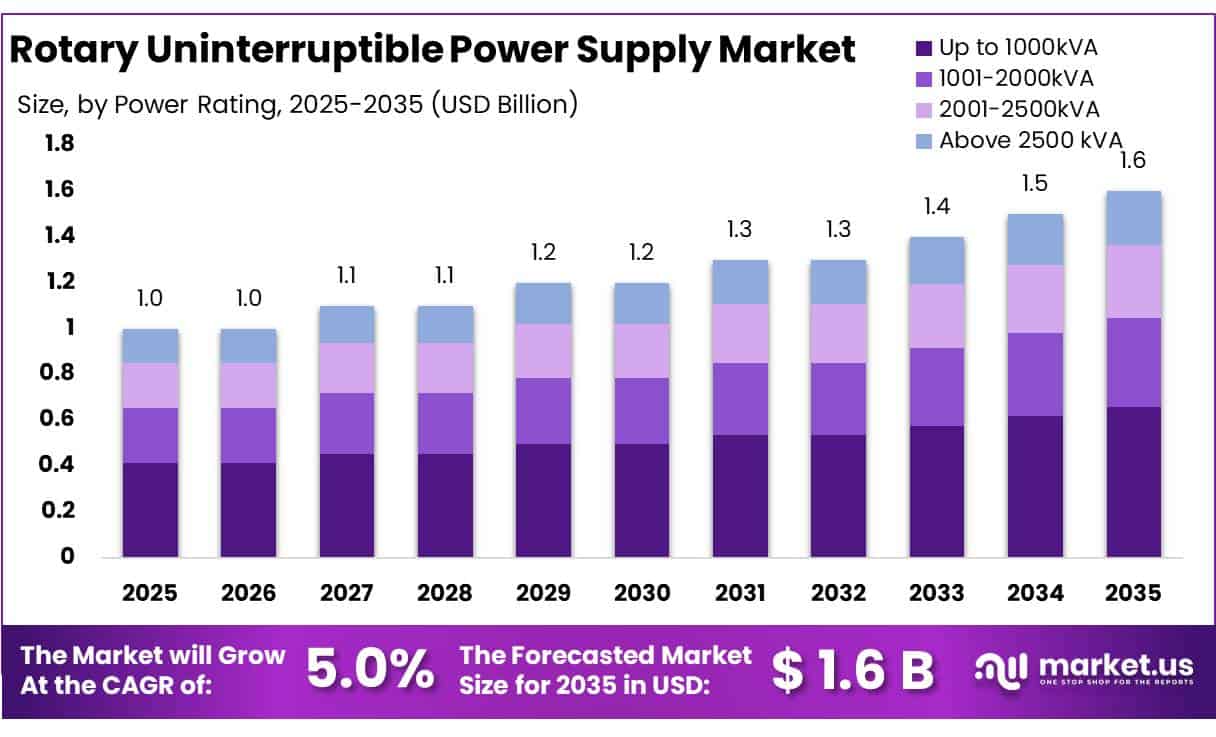
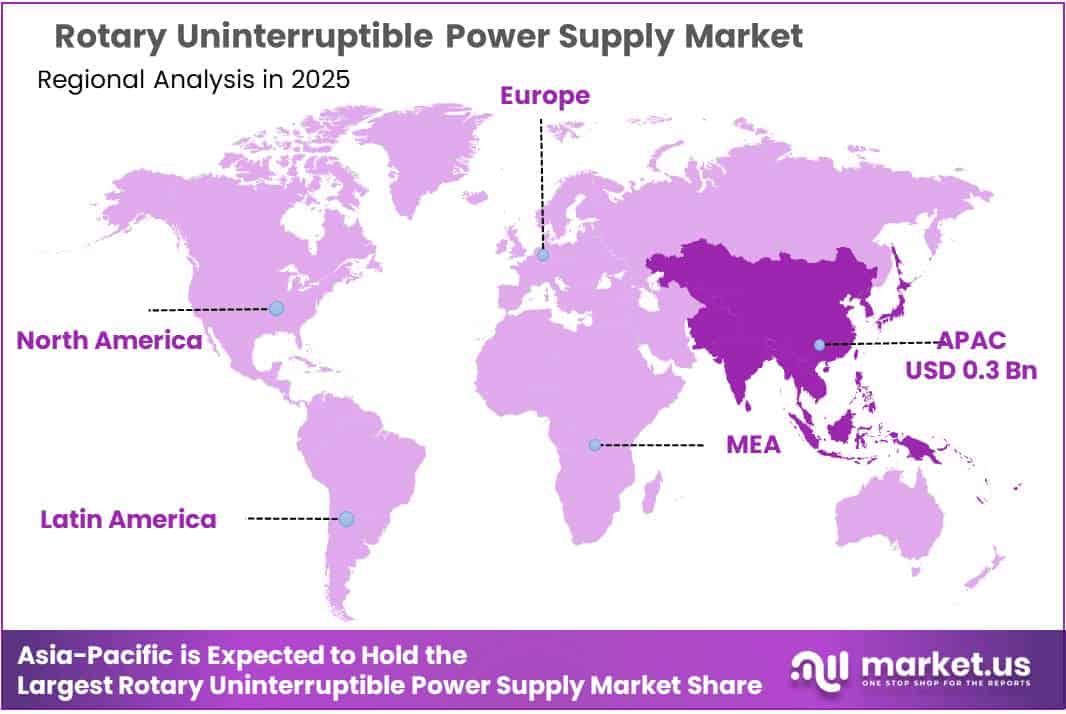
The Global Rotary Uninterruptible Power Supply Market size is expected to be worth around USD 1.6 Billion by 2035, from USD 1.0 Billion in 2025, growing at a CAGR of 5.0% during the forecast period from 2026 to 2035. In 2025, Asia-Pacific held a dominant market position, capturing more than a 34.32% share, holding USD 0.3 Billion revenue.
The Rotary Uninterruptible Power Supply (RUPS) industry is an important part of the global power protection and electrical infrastructure sector. Rotary UPS systems are designed to provide continuous, stable, and reliable electricity to critical industrial equipment during power outages, voltage fluctuations, frequency disturbances, and other electrical failures. Unlike conventional static UPS systems, rotary UPS technology uses rotating electrical machinery, such as motor-generator sets, alternators, and flywheels, to maintain power continuity.
- These systems are particularly suitable for high-capacity applications requiring strong electrical protection, operational stability, and long-term reliability. According to the UK Government’s Energy Technology List, rotary UPS systems generally operate within a capacity range of 200 kVA to 2.2 MVA per unit, while multiple units can support critical loads reaching 50 MVA.
The industrial scenario for rotary UPS systems is expanding across data centers, manufacturing facilities, oil and gas installations, healthcare infrastructure, telecommunications, transportation, and power generation. Industries increasingly depend on uninterrupted electricity to maintain automated processes, protect sensitive equipment, and prevent production losses. The International Energy Agency (IEA) reported that global data center electricity consumption reached approximately 415 terawatt-hours (TWh) in 2024, equivalent to around 1.5% of global electricity consumption.
- Electricity demand from data centers increased at an annual rate of 12% over the preceding five years, highlighting the growing importance of reliable power infrastructure. This expansion supports demand for high-capacity rotary UPS solutions, particularly in facilities requiring continuous operation and protection against electrical disturbances.
One of the major driving factors for the rotary UPS industry is the rising need for power quality, electrical reliability, and operational continuity. Industrial automation, digital manufacturing, advanced computing, and critical process equipment require stable voltage and frequency to operate efficiently. Rotary UPS systems offer mechanical energy storage, electrical isolation, and strong filtering capabilities that help protect equipment from voltage sags, surges, and harmonic disturbances.
- According to the US Environmental Protection Agency’s ENERGY STAR guidance, certified UPS systems can reduce energy losses by approximately 30% to 55% compared with standard UPS systems. The US Department of Energy also emphasizes efficiency improvements, proper capacity sizing, modular system design, and lifecycle cost savings in UPS procurement.
Future growth opportunities are emerging through the expansion of artificial intelligence infrastructure, hyperscale data centers, industrial electrification, and critical infrastructure modernization. The IEA projects that data center electricity consumption will increase by approximately 15% annually between 2024 and 2030, driven partly by accelerated computing and artificial intelligence applications. This growing electricity demand creates opportunities for rotary UPS manufacturers to introduce high-capacity, modular, hybrid, and digitally monitored systems.
Key Takeaways
- Rotary Uninterruptible Power Supply Market size is expected to be worth around USD 1.6 Billion by 2035, from USD 1.0 Billion in 2025, growing at a CAGR of 5.0%.
- Diesel held a dominant market position, capturing more than a 61.23% share.
- Up to 1000 kVA held a dominant market position, capturing more than a 41.23% share.
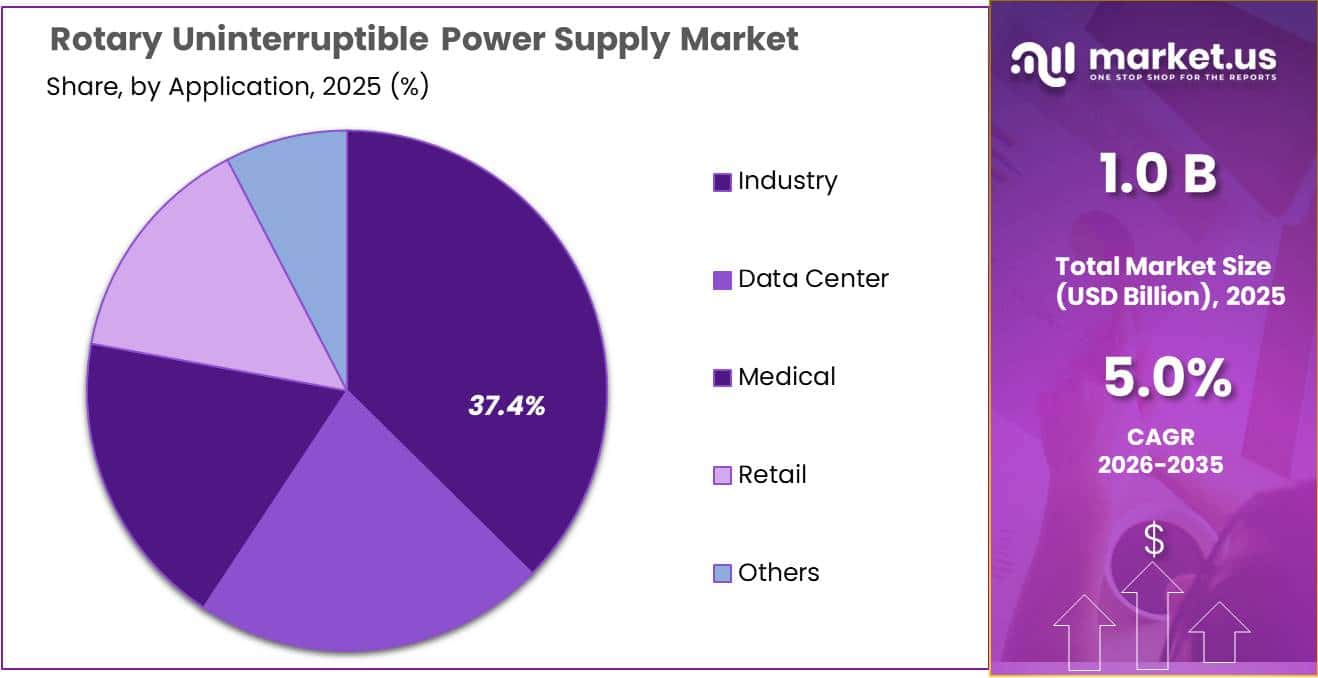
- Industry held a dominant market position, capturing more than a 37.42% share.
- Asia-Pacific dominated the Rotary Uninterruptible Power Supply Market, accounting for 34.32% of the market, valued at USD 0.3 billion.
By Type Analysis
Diesel dominates with strong backup capabilities and reliable power continuity
In 2025, “Diesel” held a dominant market position, capturing more than a 61.23% share. Diesel-based rotary uninterruptible power supply systems remain widely used because of their ability to deliver reliable backup power during extended electricity interruptions. These systems combine a diesel engine, motor-generator, and flywheel to maintain continuous power for critical industrial operations. Their strong load-handling capacity and suitability for large facilities make them a preferred choice across data centers, manufacturing plants, and other power-intensive industries.
Hybrid rotary UPS systems are gaining attention in 2025 as industries increasingly require dependable power protection, improved efficiency, and uninterrupted electricity for critical operations. These systems combine static UPS technology, flywheels, and motor-generator sets to maintain stable power during electrical disturbances. Their ability to provide short-term energy support and switch to alternative power sources makes them suitable for data centers, industrial facilities, and critical infrastructure.
By Power Rating Analysis
Up to 1000 kVA dominates due to broad industrial applications and reliable power protection
In 2025, “Up to 1000 kVA” held a dominant market position, capturing more than a 41.23% share. Rotary UPS systems within this power rating are widely preferred by medium-sized data centers, manufacturing facilities, healthcare institutions, and commercial infrastructure because they provide reliable backup power without requiring extensive system capacity. Their suitability for protecting essential equipment, maintaining operational continuity, and managing electrical disturbances supports their adoption across different industries.
The 1001–2000 kVA segment is gaining importance in 2025 as large industrial facilities, data centers, and critical infrastructure require higher power capacity and dependable electricity protection. Rotary UPS systems in this range support demanding electrical loads while providing stable power during outages, voltage fluctuations, and frequency disturbances. Their ability to handle heavy industrial equipment and maintain continuous operations makes them suitable for applications where power interruptions can result in significant operational losses.
By Application Analysis
Industry dominates with increasing demand for dependable power and operational continuity
In 2025, “Industry” held a dominant market position, capturing more than a 37.42% share. Industrial facilities rely on rotary uninterruptible power supply systems to maintain stable electricity, protect heavy machinery, and prevent unexpected production interruptions. These systems are suitable for manufacturing plants and processing facilities where continuous power is essential for operational efficiency and equipment safety. In 2025, increasing industrial automation and the growing use of electrically powered equipment supported demand for reliable power backup solutions.
Data Center applications are gaining importance in 2025 as digital infrastructure requires continuous electricity to support servers, networking equipment, storage systems, and computing operations. Rotary uninterruptible power supply systems provide reliable backup power, protect sensitive equipment, and reduce the risk of unexpected downtime.
According to the International Energy Agency (IEA), global data center electricity consumption reached approximately 415 TWh in 2024, accounting for around 1.5% of global electricity consumption. This increasing demand for electricity supports the adoption of advanced power backup and protection solutions in data center infrastructure.
Key Market Segments
By Type
- Diesel
- Hybrid
By Power Rating
- Up to 1000kVA
- 1001-2000kVA
- 2001-2500kVA
- Above 2500 kVA
By Application
- Data Center
- Medical
- Industry
- Retail
- Others
Driver Analysis
High-Density Data-Center Buildout — +0.7 Percentage Points
Large data-center projects expand the addressable requirement for uninterrupted power, while increasing electrical-block sizes create applications in which multi-megawatt rotary UPS architectures can compete. IEA’s 2026 assessment examines accelerating data-center demand and associated grid and supply-chain constraints; its earlier Energy and AI report projected approximately 945 TWh of data-center electricity use by 2030, but that historical projection should not be treated as a rotary UPS sales forecast.
The product-side connection is more direct: Piller’s current UB-V offering spans approximately 1.0–3.24 MW per module, while HITEC identifies a 2026 PowerPRO3 launch rated up to 3,000 kVA, demonstrating commercially relevant large-block configurations without making kVA interchangeable with kW.
In a constructed 24 MW protected-load installation, ten 3 MW units provide 30 MW of nameplate capacity and permit eight units to carry the load with two units unavailable, subject to the actual electrical topology and operating limits. At an assumed USD 600–900 per kW of UPS equipment capacity, this represents USD 18–27 million of equipment opportunity, excluding generators, buildings and unrelated distribution equipment.
The − or upside attribution does not assume all data centers select rotary systems: the +0.7-point sensitivity assumes 25% of terminal counterfactual market revenue is data-center-sensitive and realizes 13.6% cumulative outperformance, producing approximately 3.4% terminal upside. Suppliers increasingly compete through standardized power blocks, phased capacity additions and demonstrable load-response performance; announcements of campus capacity count only when they convert into rotary-specific procurement.
Drivers Impact Analysis
| Driver | (~) % Impact on CAGR Forecast | Geographic Relevance | Impact Timeline |
|---|---|---|---|
| High-density data-center buildout | +0.7 pp | US, EU, Singapore, Japan | Medium term (2–4 years) |
| Process-interruption cost avoidance | +0.6 pp | Taiwan, South Korea, China, India, ASEAN | Short term (≤ 2 years) |
| Kinetic-storage lifecycle economics | +0.5 pp | US, EU, Middle East, India | Medium term (2–4 years) |
| Operating-efficiency procurement | +0.5 pp | EU, UK, Japan, Singapore | Medium term (2–4 years) |
| Medium-voltage protection demand | +0.4 pp | US, Germany, India, Indonesia | Long term (≥ 4 years) |
| Condition-monitored equipment renewal | +0.4 pp | US, EU, Japan, Middle East | Medium term (2–4 years) |
Restraint Analysis
Small-Load Ownership Economics — −0.5 Percentage Points
The first restraint is insufficient recoverable benefit at smaller or lightly utilized sites, where a rotary system’s installed cost and fixed maintenance obligations may exceed the value of avoided interruptions. Piller’s current UB-V data-center range extends to 3.24 MW per module, while smaller static alternatives can expand in 50 kW increments; this establishes a material architectural choice, not a universal claim that every rotary offering starts at megawatt scale. In a constructed 500 kW facility, assume a rotary proposal costs USD 650,000 versus USD 400,000 for a static alternative with an equivalent defined protection boundary.
The USD 250,000 premium requires approximately USD 58,600 of annual incremental net benefit over seven years at a 10% discount rate, assuming level year-end benefits and no residual-value difference. If superior event handling and avoided battery expenditure deliver only USD 35,000 annually after maintenance differences, the premium’s net present value remains approximately negative USD 80,000. The conclusion changes if interruption costs, operating hours or lifecycle savings are substantially higher, so no universal technology winner is asserted.
The −0.5-point sensitivity assumes 25% of terminal counterfactual revenue is exposed to price-sensitive or smaller-load purchasing decisions and experiences a 9.2% realization shortfall, equivalent to approximately 2.3% market-wide terminal erosion. Suppliers consequently face pressure to narrow target applications, offer financing or redesign configurations; financing changes payment timing but does not eliminate an economically unjustified ownership premium.
Restraint Impact Analysis
| Restraint | (~) % Impact on CAGR Forecast | Geographic Relevance | Impact Timeline |
|---|---|---|---|
| Small-load ownership economics | −0.5 pp | India, ASEAN, Brazil; US, EU SMEs | Medium term (2–4 years) |
| Modular static-UPS substitution | −0.5 pp | US, EU, Japan, Singapore | Long term (≥ 4 years) |
| Kinetic-autonomy limitations | −0.4 pp | US, EU, India, Middle East | Long term (≥ 4 years) |
| Efficiency-case sensitivity | −0.3 pp | US, EU, Japan, Singapore | Medium term (2–4 years) |
| Redundancy-driven capacity oversizing | −0.3 pp | US, EU, Singapore, Japan | Medium term (2–4 years) |
| Diesel-use compliance restrictions | −0.2 pp | US; site-specific DRUPS projects | Long term (≥ 4 years) |
Opportunity Analysis
Mobile Rotary-UPS Fleets — +0.5 Percentage Points
The white space is temporary uninterrupted-power protection during facility upgrades, equipment replacement and maintenance not another permanent installation justified by general continuity demand. HITEC’s November 2025 Luminus Solutions reference demonstrates a commercially deployed 1,600 kVA mobile rotary UPS installation that can be connected to reach 3,200 kVA, with hospitals, data centers and airports identified as applications; those apparent-power ratings must not be treated as equivalent kW without the applicable power factor and equipment limits. In a constructed rental operator’s case, six mobile units costing USD 900,000 each require USD 5.4 million of initial equipment investment.
At 120 billable days annually and USD 2,000 per day, fleet revenue reaches USD 1.44 million; subtracting an assumed USD 540,000 for transport, testing, insurance, maintenance and administration leaves USD 900,000 before depreciation and financing, implying six-year simple investment recovery. At 180 billable days, revenue increases to USD 2.16 million and contribution to USD 1.62 million if that expense assumption holds, reducing recovery to approximately 3.3 years.
These are fleet-underwriting scenarios, not observed rental rates. The +0.5-point sensitivity requires approximately 2.4% incremental terminal equipment revenue from newly established fleets and replacements, net of permanent installations displaced. Execution depends on route density, connection engineering, site access and dependable readiness; rental revenue itself is outside the equipment-market forecast, and a small highly utilized fleet can serve substantial temporary demand without creating proportionate equipment sales.
Opportunity Impact Analysis
| Opportunity | (~) % Potential CAGR Upside | Geographic Relevance | Execution Window |
|---|---|---|---|
| Mobile rotary-UPS fleets | +0.5 pp | EU, UK, US, Gulf states | Short term (≤ 2 years) |
| Existing-generator integration retrofits | +0.4 pp | US, EU, India, ASEAN | Medium term (2–4 years) |
| Selective medium-voltage protection | +0.4 pp | India, Indonesia, Taiwan, Germany | Medium term (2–4 years) |
| Factory-integrated power blocks | +0.3 pp | US, EU, Japan, Singapore | Medium term (2–4 years) |
| Availability-financed equipment deployment | +0.3 pp | US, UK, Germany, India | Medium term (2–4 years) |
| Capability-led acquisition platforms | +0.3 pp | US, Germany, UK, Singapore | Short term (≤ 2 years) |
Challenges Analysis
Multi-System Transient Coordination — −0.4 Percentage Points
The engineering challenge is coordinating the rotary machine, energy storage, generator controls, protection and load behavior through disturbances and recovery, rather than merely providing sufficient nominal stored energy. Piller’s DeRUPS architecture allows external generators to be physically separated from the UPS and selected independently, demonstrating configuration flexibility but also creating interfaces that require project-specific validation. In a constructed 6 MW installation operating at 4.8 MW, four parallel units carry 1.2 MW each; loss of one unit raises the remaining share to 1.6 MW, a 33.3% step increase per surviving unit before transient redistribution.
Even if the remaining nameplate capacity is adequate, the design must establish acceptable voltage, frequency, protection and generator-response behavior. Across twenty projects, three additional coordination iterations requiring 200 engineer-hours each create 12,000 hours of work; at USD 120 per hour, incremental engineering expense is USD 1.44 million. Adding USD 60,000 of supplementary testing on five projects raises total unplanned cost to USD 1.74 million, reducing gross margin on a USD 40 million fixed-price portfolio from an assumed 25% to approximately 20.7%.
The −0.4-point sensitivity assumes 20% of terminal opportunity-enabled revenue is coordination-sensitive and suffers a 9.5% realization shortfall, producing approximately 1.9% aggregate terminal friction through delayed acceptance and weaker follow-on conversion. Mitigation requires defined control ownership, validated load-step sequences and integrated testing; additional engineering revenue must offset the deduction where customers pay for it, and this challenge does not duplicate the underlying kinetic-autonomy restraint.
Challenges Impact Analysis
| Challenge | (~) % CAGR Friction Drag | Geographic Relevance | Mitigation Horizon |
|---|---|---|---|
| Multi-System Transient Coordination | −0.4 pp | US, EU, India, ASEAN | Long term (≥ 4 years) |
| Live-Site Commissioning Coordination | −0.3 pp | US, EU, Singapore, Japan | Medium term (2–4 years) |
| Specialist Service Workforce Development | −0.3 pp | US, EU, India, Gulf states | Long term (≥ 4 years) |
| Condition-Monitoring Decision Validation | −0.3 pp | US, EU, Japan, Singapore | Medium term (2–4 years) |
| Critical-Spare Logistics Synchronization | −0.3 pp | Europe–Asia, Europe–Middle East, US–Asia | Medium term (2–4 years) |
| Mobile-Fleet Readiness Management | −0.2 pp | EU, UK, US, Gulf states | Medium term (2–4 years) |
Geopolitical Impact Analysis
Geopolitical Impact of Ongoing Wars on the Rotary Uninterruptible Power Supply Market
The ongoing Russia-Ukraine war and escalating Middle East conflict are significantly influencing the Rotary Uninterruptible Power Supply (RUPS) market by increasing concerns about energy security, fuel availability, and industrial power reliability. Attacks on energy infrastructure and disruptions to international shipping routes have increased uncertainty in global electricity and fuel supply chains. According to the International Energy Agency (IEA), the Middle East conflict caused global oil supply disruptions exceeding 10 million barrels per day in 2026, highlighting the scale of energy market instability.
These developments are affecting diesel-based rotary UPS systems through rising fuel prices, transportation costs, and supply chain delays. The IEA reported that combined diesel export losses from the Middle East and Russia reached 1.3 million barrels per day in September 2026, equivalent to approximately 4.5% of projected global demand. Higher diesel prices can increase operating expenses for industries relying on diesel-powered backup systems, potentially influencing purchasing and maintenance decisions.
At the same time, ongoing conflicts are increasing demand for reliable backup power across industrial facilities, data centers, defense infrastructure, and critical services. The IEA highlights that attacks on Ukraine’s energy infrastructure have damaged generation facilities and substations, increasing the need for emergency power solutions. Consequently, the market is experiencing both cost-related challenges and growth opportunities, encouraging industries to invest in resilient power infrastructure, energy storage, and advanced rotary UPS technologies.
Regional Insights
Dominating Region: Asia-Pacific (34.32%, USD 0.3 Billion)
In 2025, Asia-Pacific dominated the Rotary Uninterruptible Power Supply Market, accounting for 34.32% of the market, valued at USD 0.3 billion. The region’s leadership is supported by industrial development, expanding manufacturing facilities, growing data center infrastructure, and increasing demand for reliable electricity. China, Japan, South Korea, and Australia contribute to regional demand through investments in electronics, industrial automation, and critical power infrastructure.
According to the International Energy Agency (IEA), Asia-Pacific electricity demand increased by 6% in 2024, reflecting strong industrial activity and rising electricity consumption. The IEA further reported that the region’s electricity demand is expected to grow by an average of 4.7% annually between 2026 and 2030, creating favorable conditions for rotary UPS adoption. The expansion of power-intensive industries and digital infrastructure continues to strengthen regional demand for uninterrupted power systems.
Asia-Pacific is also positioned as a promising growth region for rotary UPS systems, driven by increasing investments in data centers, industrial modernization, and digital infrastructure. The expansion of cloud computing, artificial intelligence, and advanced manufacturing is increasing the need for reliable and continuous electricity supply.
According to the IEA, electricity consumption in data centers across Asia-Pacific was estimated at 105–180 TWh in 2023, demonstrating the region’s substantial digital infrastructure requirements. Furthermore, the agency indicates that electricity demand from data centers in Southeast Asia is expected to more than double by 2030, supported by growing infrastructure development and digital services.
Key Regions and Countries Insights
- North America
- US
- Canada
- Europe
- Germany
- France
- The UK
- Spain
- Italy
- Rest of Europe
- Asia Pacific
- China
- Japan
- South Korea
- India
- Australia
- Rest of APAC
- Latin America
- Brazil
- Mexico
- Rest of Latin America
- Middle East & Africa
- GCC
- South Africa
- Rest of MEA
Key Players Analysis
Piller UK Limited, established in 1975, is a subsidiary of Piller Group, specializing in high-performance rotary and static uninterruptible power supply systems. The company supports data centers, industrial facilities, aviation, and other critical infrastructure requiring continuous power protection. Piller employs approximately 1,000 people worldwide and operates across 50+ countries. Its manufacturing and testing facilities support rotary UPS systems with capacities of up to 3,000 kVA. In 2016, Piller acquired Active Power, strengthening its flywheel energy storage and power protection capabilities.
Rolls-Royce plc is a major engineering company with operations in power generation, aerospace, defense, and industrial energy systems. Its Power Systems division supplies advanced energy solutions under the mtu brand for data centers and critical infrastructure. In 2025, the Power Systems division reported underlying revenue of £4,892 million, representing 19% growth, while underlying operating profit reached £852 million. The company recorded a £6.1 billion order backlog in Power Systems, reflecting strong demand for power generation and mission-critical applications. Data centers represent more than 80% of its power generation revenue.
Hitzinger UK Ltd is the UK subsidiary of Hitzinger GmbH, an Austrian power engineering company established in 1946. The company specializes in frequency converters, alternators, power generation equipment, and customized electrical solutions for critical applications. Hitzinger UK provides customer support, project planning, system design, and commissioning services. Its operations span 4 countries, supporting customers in logistics, automotive, manufacturing, and other industrial sectors. The company continues to focus on developing advanced power technologies, including specialist generator sets, airport ground power systems, and energy storage solutions.
Top Key Players Outlook
- Piller UK Limited
- Rolls-Royce plc
- Hitzinger UK Ltd
- Power Systems & Controls Inc.
- ABB Ltd.
- Thycon Pty Ltd.
- POWERTHRU
- Schneider Electric SE
- Ausonia S.r.l.
- Emerson Electric Co.
- Other Key Players
Recent Developments
- In March 2026, ABB announced a global investment of approximately USD 75 million in India to expand manufacturing and research and development capabilities for critical electrification technologies. This investment follows more than USD 35 million spent in 2025.
- In October 2026, Thycon Services Pty Ltd. received a contract from Australia’s Bureau of Meteorology for servicing the Hillston radar UPS system. The contract was valued at AUD 11,387.20 and runs until March 31, 2027.
Report Scope
| Report Features | Description |
|---|---|
| Market Value (2025) | USD 1.0 Bn |
| Forecast Revenue (2035) | USD 1.6 Bn |
| CAGR (2026-2035) | 5.0% |
| Base Year for Estimation | 2025 |
| Historic Period | 2020-2024 |
| Forecast Period | 2026-2035 |
| Report Coverage | Revenue Forecast, Market Dynamics, Competitive Landscape, Recent Developments |
| Segments Covered | By Type (Diesel, Hybrid), By Power Rating (Up to 1000kVA, 1001-2000kVA, 2001-2500kVA, Above 2500 kVA), By Application (Data Center, Medical, Industry, Retail, Others) |
| Regional Analysis | North America – US, Canada; Europe – Germany, France, The UK, Spain, Italy, Rest of Europe; Asia Pacific – China, Japan, South Korea, India, Australia, Singapore, Rest of APAC; Latin America – Brazil, Mexico, Rest of Latin America; Middle East & Africa – GCC, South Africa, Rest of MEA |
| Competitive Landscape | Piller UK Limited, Rolls-Royce plc, Hitzinger UK Ltd, Power Systems & Controls Inc., ABB Ltd., Thycon Pty Ltd., POWERTHRU, Schneider Electric SE, Ausonia S.r.l., Emerson Electric Co., Other Key Players |
| Customization Scope | Customization for segments, region/country-level will be provided. Moreover, additional customization can be done based on the requirements. |
| Purchase Options | We have three licenses to opt for: Single User License, Multi-User License (Up to 5 Users), Corporate Use License (Unlimited User and Printable PDF) |