


Report Overview
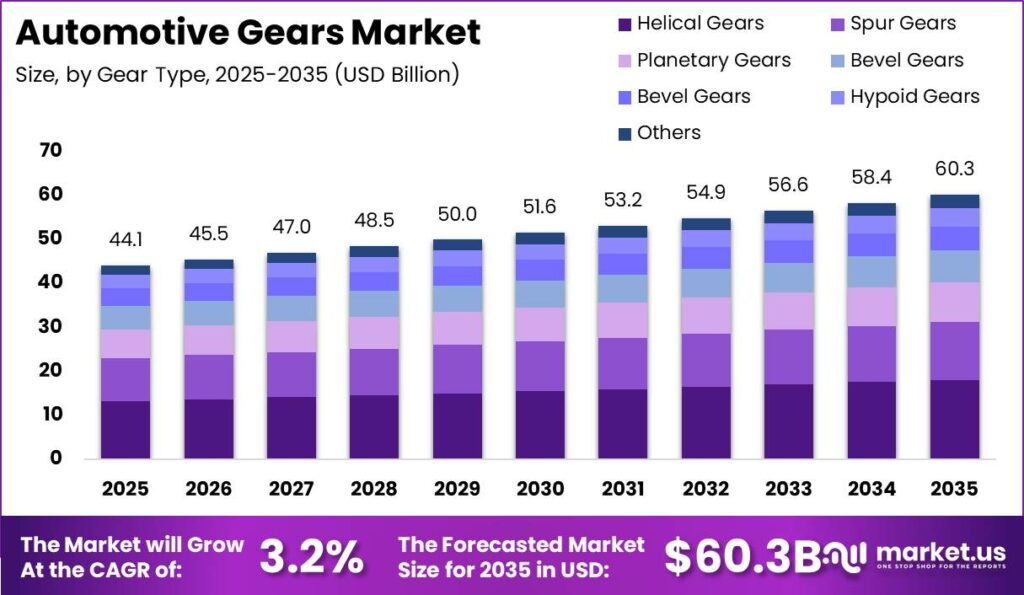
Global Automotive Gears Market size is expected to be worth around USD 60.30 Billion by 2035 from USD 44.10 Billion in 2025, growing at a CAGR of 3.2% during the forecast period 2026 to 2035. This steady expansion reflects the market’s transition from high-volume ICE gear production toward precision-engineered sets serving electrified and hybrid drivetrains across all vehicle classes.
The automotive gears market covers all mechanical gear types used in vehicle powertrains, steering, and differential systems. The market spans helical, spur, planetary, bevel, worm, hypoid, and rack and pinion designs manufactured from ferrous metals, non-ferrous metals, plastics, and composites. Gears serve transmission, steering, and differential applications across passenger vehicles, light commercial vehicles, and heavy transport platforms globally.
Key Takeaways
- The global Automotive Gears Market was valued at USD 44.10 Billion in 2025 and is forecast to reach USD 60.30 Billion by 2035, growing at a CAGR of 3.2%.
- By Gear Type, Helical Gears dominate with a 30.00% share.
- By Material, Ferrous Metals lead with a 74.20% share.
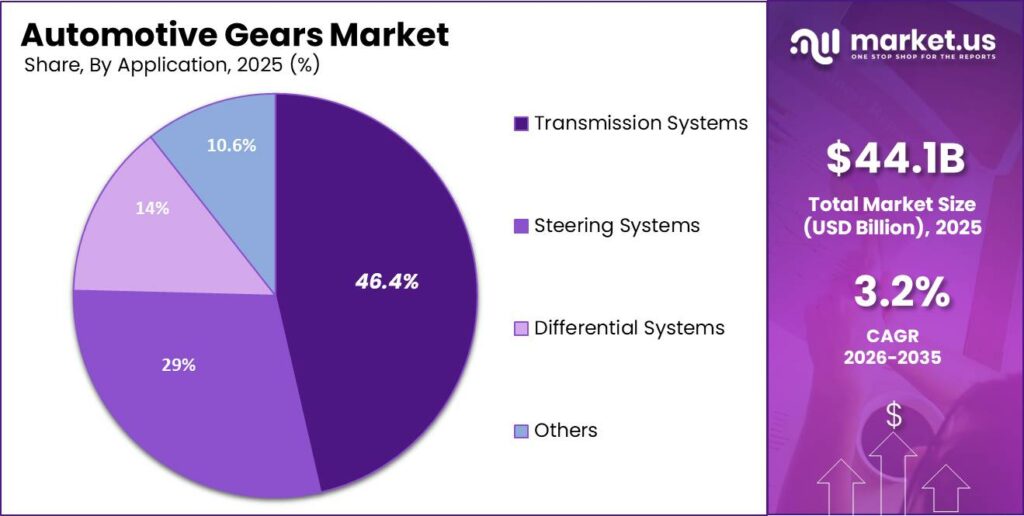
- By Application, Transmission Systems hold the largest share at 46.40%.
- By Vehicle Type, Passenger Vehicles dominate with a 64.10% share.
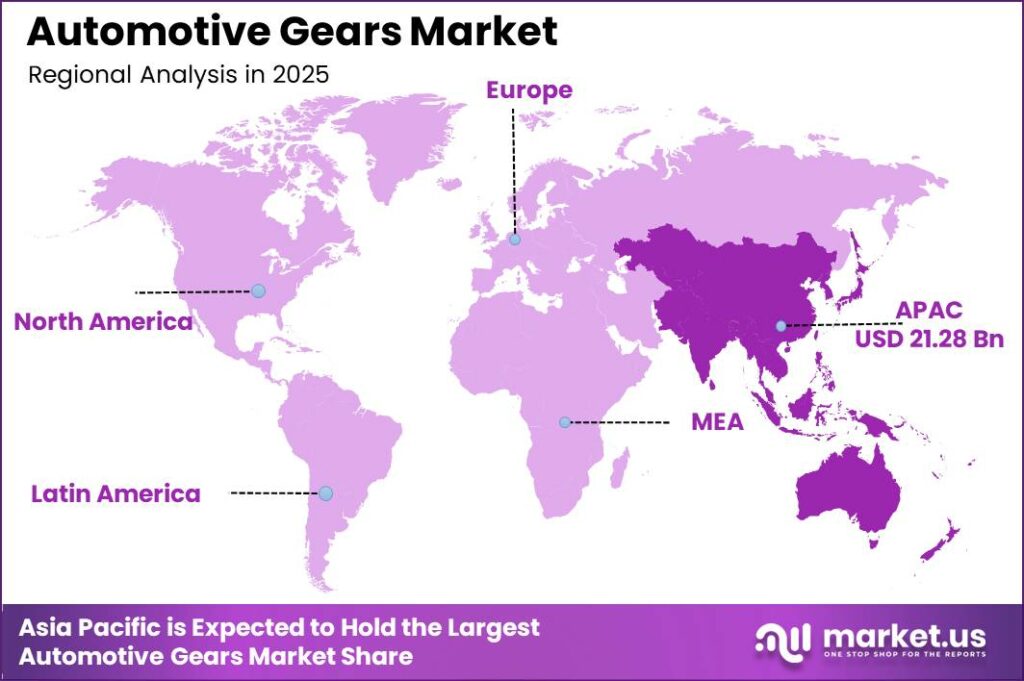
- Asia Pacific is the dominant region with a 48.20% market share, valued at USD 21.28 Billion in 2025.
Honda’s Super-ONE compact EV prototype, unveiled in October 2025 for a planned 2026 production launch, uses a simulated 7-speed transmission that calculates virtual gear position in real time from accelerator input, vehicle speed, and cornering behavior. This virtual-ratio approach eliminates mechanical gear steps while preserving driver experience. Suppliers able to deliver the precision reduction gearsets underpinning such systems will capture content on next-generation EV platforms where mechanical complexity concentrates into fewer but far more critical components.
Toyota’s GR GT prototype, unveiled in December 2025, integrates a newly developed 8-speed automatic transmission with a single motor-generator, a mechanical limited-slip differential, and a wet-start clutch in a single rear transaxle. This architecture achieves a 45:55 front-to-rear weight distribution, demonstrating how gear system design now directly determines vehicle dynamics outcomes. Gear manufacturers that co-develop integrated transaxle assemblies with OEMs gain program-level design authority that loose-piece commodity suppliers cannot access.
Gear Type Analysis
Helical Gears dominate with 30.00% due to low noise output in high-speed transmissions.
In 2025, Helical Gears held a dominant market position in the By Gear Type segment of the Automotive Gears Market, with a 30.00% share. UNIDO manufacturing output data confirms helical gears represent the default specification for passenger-car automatic and dual-clutch transmissions globally, driven by their superior load distribution across angled tooth contact. This performance advantage over spur alternatives makes helical gears the mandatory choice wherever NVH targets are binding. OEMs tightening noise specifications on electric drivetrains are further entrenching helical dominance as the only geometry that meets sub-40 dB in-cabin targets at motor speeds above 15,000 rpm.
Spur gears serve applications where axial load is structurally problematic and manufacturing simplicity takes priority over NVH performance. Corporate annual report disclosures from major Asian gear manufacturers confirm spur gears remain the volume staple in motorcycle transmissions, agricultural equipment, and low-speed commercial auxiliary drives. This structural positioning limits spur gear demand growth in passenger-car programs but protects a stable revenue base in non-automotive segments. Suppliers with dual automotive and industrial gear capabilities hedge against passenger-car platform transitions by maintaining spur production lines that serve industrial replacement demand with minimal retooling investment.
Planetary gears deliver the highest torque density per unit volume of any parallel-axis architecture, making them the standard choice in automatic transmissions, hybrid power-split devices, and EV reduction units. IEA global EV data shows battery-electric and plug-in hybrid vehicles now represent approximately 1 in 5 new light-vehicle registrations globally, and each electrified drivetrain requires at least one planetary reduction stage. This mandatory fitment creates a structural demand floor for planetary sets that grows proportionally with EV registration volume. Bevel gears, worm gears, hypoid gears, rack and pinion gears, and other variants hold the remaining share collectively, serving differential, steering, and specialty driveline positions across all vehicle classes.
Material Analysis
Ferrous Metals dominate with 74.20% due to carburized steel’s unmatched fatigue resistance.
In 2025, Ferrous Metals held a dominant market position in the By Material segment of the Automotive Gears Market, with a 74.20% share. World Steel Association production data confirms automotive-grade case-hardening steel alloys account for the largest single end-use category within specialty long-product steel globally. Carburized and ground steel gears achieve surface hardness levels above 60 HRC with core toughness retained, a combination no competing material currently replicates at production volumes. This performance ceiling anchors ferrous metals in every high-torque gear position and ensures procurement switching costs remain prohibitively high for OEMs on active programs.
Non-ferrous metals, principally aluminium and copper-based alloys, serve gear applications where weight reduction or corrosion resistance outweigh absolute strength requirements. Customs database shipment records for aluminium precision components confirm non-ferrous automotive gear volumes are concentrated in steering system worm wheels, oil pump gears, and low-load ancillary drives. The weight-saving case for non-ferrous gears strengthens as OEMs push vehicle mass reduction across electrified platforms to extend battery range. Suppliers holding both ferrous and non-ferrous gear capability capture nominations across a wider application range than single-material specialists.
Plastics and composites serve the lowest-load gear positions including instrument cluster drives, HVAC blower gears, and window regulator actuators. OICA vehicle production data shows global light-vehicle output exceeded 90 million units in 2024, each containing multiple plastic gear sub-assemblies in body and interior systems. This volume base provides consistent demand independent of powertrain electrification trends. Other material variants including powder-metal sintered gears and ceramic composites hold the remaining share and represent an emerging substitution path for mid-load planetary positions as densification processes mature.
Application Analysis
Transmission Systems dominate with 46.40% due to multi-ratio gearsets mandatory per vehicle.
In 2025, Transmission Systems held a dominant market position in the By Application segment of the Automotive Gears Market, with a 46.40% share. OICA global vehicle production data shows more than 90 million light and commercial vehicles were built in 2024, each requiring a full transmission gearset regardless of powertrain type. This one-to-one production linkage makes transmission gear demand the most volume-stable segment in the entire market. Suppliers with multi-ratio automatic and dual-clutch transmission gear capabilities hold structural sourcing priority as OEMs standardize 8-speed and above configurations across premium and mainstream segments.
Steering systems represent the second largest application segment, with rack and pinion and worm gear assemblies fitted across virtually every passenger vehicle produced globally. UN Comtrade trade flow data for steering system components confirms consistent bilateral trade volumes between Germany, Japan, South Korea, and major vehicle assembly markets, reflecting the concentration of steering gear manufacturing in precision-machining clusters. Electric power steering adoption has shifted gear load cycles but not eliminated the mechanical gear requirement. Suppliers transitioning from hydraulic to electric power steering gear designs capture higher average unit content per vehicle as column-mounted actuators replace bulkier rack assemblies.
Differential systems complete the primary application structure, with hypoid and bevel gear sets serving the final drive on both conventional and electrified platforms. IEA road transport data confirms all-wheel-drive and four-wheel-drive vehicle penetration continues to rise across SUV and crossover segments globally, adding differential content per vehicle beyond the single rear-axle baseline. This content-per-vehicle expansion partially offsets the torque-path gear count reduction in BEV architectures. Other applications including oil pump gears, timing system gears, and power take-off units hold the remaining application share collectively.
Vehicle Type Analysis
Passenger Vehicles dominate with 64.10% due to highest global production volume concentration.
In 2025, Passenger Vehicles held a dominant market position in the By Vehicle Type segment of the Automotive Gears Market, with a 64.10% share. OICA production statistics confirm passenger cars and light SUVs account for approximately 75 million of the roughly 90 million vehicles built globally in 2024, generating the largest aggregate gear demand of any vehicle class. This volume concentration means passenger-car platform nominations drive capacity planning decisions for the majority of Tier-1 gear suppliers. Suppliers that lose a single high-volume passenger-car program face utilization shortfalls that fixed-cost structures cannot absorb through commercial vehicle replacement volume alone.
Commercial vehicles hold the remaining vehicle-type share and deliver materially higher gear content per unit than passenger cars. Heavy truck transmissions typically contain 10 to 18 forward gear ratios compared with 6 to 10 in passenger-car automatics, lifting transmission gear count per vehicle by a factor of 1.5x to 2x. US Census Bureau Class 5 to 8 truck registration data shows North American commercial vehicle demand remained at structurally elevated levels through 2024, supporting sustained replacement gear demand. Gear suppliers with validated heavy-commercial transmission capability command selling prices per set that are 3x to 5x passenger-car equivalents, providing margin insulation against passenger-car price-down pressure. Medium and heavy-duty trucks, buses, coaches, and off-highway equipment hold the full commercial vehicle share collectively.
Key Market Segments
By Gear Type
- Helical Gears
- Spur Gears
- Planetary Gears
- Bevel Gears
- Worm Gears
- Hypoid Gears
- Rack and Pinion Gears
- Pinion Gears
- Others
By Material
- Ferrous Metals
- Non-Ferrous Metals
- Plastics and Composites
- Others
By Application
- Transmission Systems
- Steering Systems
- Differential Systems
- Others
By Vehicle Type
- Passenger Vehicles
- Commercial Vehicles
Regional Analysis
Asia Pacific Dominates the Automotive Gears Market with a Market Share of 48.20%, Valued at USD 21.28 Billion
Asia Pacific commands nearly half of global automotive gear revenue, anchored by China’s position as the world’s largest vehicle production market and Japan’s concentration of precision gear manufacturing capability. OICA production data shows China alone assembled more than 30 million vehicles in 2024, generating a proportional domestic gear demand that no other single market approaches. This production density creates a self-reinforcing supply chain where gear manufacturers, heat-treatment specialists, and grinding machine builders cluster within short logistics distance of assembly plants. Suppliers with established Asia Pacific manufacturing footprints hold a structural cost and lead-time advantage over importers on every major OEM nomination.
Europe is the second largest regional market and the primary geography for high-precision, high-margin gear development work. Germany’s concentration of premium OEM engineering centers drives specification of tighter gear quality grades that generate higher content value per vehicle. North America represents a critical growth region for commercial vehicle gear demand, with ZF ramping annual production capacity to 200,000 PowerLine 8-speed automatic transmissions supporting Class 4 to 7 vehicles, per ZF’s own March 2025 disclosure. This capacity investment signals that North American commercial drivetrain demand justifies dedicated gear manufacturing commitment at scale.
Latin America, the Middle East, and Africa collectively represent emerging demand regions where vehicle production is expanding from a lower base. Brazil and Mexico serve as the primary Latin American production hubs under USMCA and Mercosur trade frameworks, attracting gear supplier localization investment ahead of rising domestic vehicle assembly volumes. These markets currently depend heavily on imported gear assemblies from Asia Pacific and European suppliers, creating a first-mover localization opportunity for suppliers willing to establish in-region machining capacity before competitive intensity increases.
Key Regions and Countries
North America
- US
- Canada
Europe
- Germany
- France
- The UK
- Spain
- Italy
- Rest of Europe
Asia Pacific
- China
- Japan
- South Korea
- India
- Australia
- Rest of APAC
Latin America
- Brazil
- Mexico
- Rest of Latin America
Middle East and Africa
- GCC
- South Africa
- Rest of MEA
Market Dynamics
Market Opportunity Analysis - Commercial vehicle, powder-metal substitution, and emerging-market localization gaps offer targeted entry points for disciplined suppliers.
Commercial vehicle gear programs remain the most structurally underexploited revenue opportunity relative to current supplier focus. As established in the Vehicle Type analysis, heavy truck transmissions contain 10 to 18 forward gear ratios versus 6 to 10 in passenger cars, lifting gear set value per vehicle by 1.5x to 2x. Suppliers concentrated on passenger-car programs face intense price-down pressure that commercial vehicle contracts do not impose at equivalent volumes. This margin differential is directly accessible to suppliers willing to invest in the heavy-duty heat-treatment and inspection infrastructure that Class 5 to 8 OEM qualification requires.
Powder-metal gear substitution represents a conversion opportunity within existing program relationships rather than requiring new customer acquisition. As established in the Material analysis, plastics and composites already serve low-load gear positions across more than 90 million annual vehicle builds. Densified powder-metal routes extend this substitution logic into mid-load planetary and ancillary positions where wrought steel currently dominates by default. Suppliers that fund the 24 to 36 month OEM qualification cycle now will face no direct competition in a cost-sensitive segment where the economics of material efficiency and duty savings align simultaneously.
Latin America represents the clearest geographic localization gap in the global gear supply chain. As established in the Regional Analysis, Brazil and Mexico currently absorb gear assemblies primarily through imports from Asia Pacific and European suppliers. USMCA content rules are pushing North American OEMs to increase regional sourcing of powertrain components, creating a pull-through demand for in-region gear machining that does not yet have sufficient local supply to meet. Suppliers that establish USMCA-compliant gear manufacturing capacity in Mexico ahead of the next major platform nomination cycle position themselves for sourcing wins that geography-constrained Asian rivals cannot contest.
The remanufactured gearset and e-axle aftermarket channel is a revenue stream with no dominant incumbent yet established. As confirmed in the Application analysis, transmission systems hold a 46.40% application share and are fitted to every vehicle in the global parc. The accumulated installed base of electrified vehicles now entering their first major service interval creates predictable replacement gear demand that OEM new-production programs do not address. Suppliers that build aftermarket distribution infrastructure for remanufactured gear assemblies today will capture recurring revenue with lower price-down pressure than OEM supply agreements impose on equivalent production volumes.
Technology and Innovation Landscape - Virtual transmission architecture, integrated e-drive gearsets, and powder-metal process gains are redefining gear content value per vehicle.
BMW’s Gen6 electric powertrain, reported in February 2025, integrates an optimized two-stage helical transmission that reduces energy losses by 40%, costs by 20%, and weight by 10% compared with the Gen5 xDrive powertrain. These simultaneous improvements across three performance dimensions confirm that helical transmission optimization has not plateaued. OEMs willing to co-develop proprietary reduction architectures with their gear suppliers gain regulatory cycle-test advantages that catalog-sourced transmission designs cannot deliver at equivalent vehicle program investment levels.
Stellantis’ 2025 eDCT integrates a 21 kW electric motor directly into the dual-clutch transmission housing, enabling ICE-off operation for 50% of an urban driving cycle. This motor-in-gearbox architecture eliminates the separate P2 hybrid module and reduces system mass and packaging volume simultaneously. Gear suppliers that qualify their helical and planetary sets for this tighter operating envelope, where electric motor vibration excites gear mesh frequencies continuously rather than intermittently, gain a validation advantage on every future eDCT platform nomination in Europe and North America.
Honda’s S+ Shift system in the September 2025 Prelude emulates an 8-speed transmission in a two-motor hybrid system with no conventional mechanical stepped gearbox. The Toyota GR GT prototype, unveiled in December 2025, achieves a 45:55 front-to-rear weight distribution through its rear-mounted 8-speed automatic transaxle and battery arrangement, demonstrating that gear system layout now directly determines vehicle dynamics. These architectures signal a premium segment shift toward integrated transaxle design authority, where gear suppliers that co-own the packaging solution displace those offering only machined components.
The BMW 228 xDrive Gran Coupe’s 2025 7-speed dual-clutch transmission transfers 295 lb-ft of torque and accelerates the vehicle from 0 to 60 mph in 5.8 seconds, demonstrating that DCT gear geometry must now deliver both performance responsiveness and electrified-mode NVH compliance within a single platform specification. ZF’s report at IAA Mobility 2025 that its 8HP Gen4 PHEV transmission reduces total-system CO₂ emissions by more than 70% under WLTC versus a conventional transmission confirms that gear design is now a primary emissions compliance tool. Suppliers that integrate electrification and NVH validation into their gear development process will replace those offering transmission gears as isolated mechanical components.
Drivers
Multi-speed EV reduction gear integration is converting what appeared to be a content-deletion trend into a precision-upgrade cycle. Every production BEV runs at least one fixed reduction stage in the 7:1 to 10:1 ratio band, with motor speeds approaching 20,000 rpm forcing ISO gear quality grades one to two steps tighter than legacy ICE practice. This raises realized content value per gear even as gear count per vehicle falls. Suppliers that own NVH validation for integrated e-axle assemblies capture margin premiums of 300 to 600 basis points over loose-piece transmission gear contracts.
Dedicated hybrid transmission architecture revival and step-automatic penetration in emerging fleet markets add two parallel demand vectors to the precision gear upgrade cycle. Per IEA global EV outlook tracking, electric and plug-in models now absorb approximately 1 in 5 new light-vehicle registrations worldwide, confirming the hybrid and PHEV transition is drawing in new transmission gear platforms rather than retiring existing ones. Commercial vehicle drivetrain replacement cycles in North America, the Middle East, and Africa provide a further floor of demand that insulates gear suppliers from passenger-car platform transition risk across the forecast period.
| Driver | (~) % Impact on CAGR Forecast | Geographic Relevance | Impact Timeline |
|---|---|---|---|
| Multi-speed EV reduction gear integration | +0.9% | China, Europe, North America | Short term (2 years or less) |
| Dedicated hybrid transmission architecture revival | +0.8% | Japan, North America, India | Short term (2 years or less) |
| Step-automatic penetration in emerging fleets | +0.7% | Asia Pacific, Latin America | Medium term (2 to 4 years) |
| Commercial vehicle drivetrain replacement cycle | +0.6% | North America, Middle East, Africa | Medium term (2 to 4 years) |
| NVH-driven precision grade tightening | +0.5% | Europe, South Korea, Japan | Medium term (2 to 4 years) |
| Regional content localization of gear machining | +0.4% | USMCA bloc, ASEAN | Long term (4 years or more) |
Restraints
US Section 232 duties of 25% on imported passenger vehicles, light trucks, and covered powertrain components including transmissions took effect from April and May 2025 respectively under the presidential proclamation issued March 26, 2025. This duty stacks on top of the separate 50% Section 232 rate applied to steel and aluminium since June 2025. A gear machined offshore from imported alloy bar absorbs compounding duty on both the raw material input and the finished article. For Tier-2 gear houses running typical 8% to 12% EBIT margins, a 25% landed-cost shock is unabsorbable without full OEM price pass-through.
ICE gear content deletion per vehicle and export-led gear price deflation from Asia Pacific compound the duty pressure on Western suppliers. OEM purchasing conventions of 2% to 3% annual price reductions make duty pass-through a multi-year negotiation rather than an immediate adjustment, as confirmed by US Census trade data and supplier earnings commentary. The observed market response is order deferral, resourcing to USMCA-compliant plants, and postponement of grinder and heat-treat line capital expenditure by 12 to 24 months. Alloy bar and forging input volatility and legacy hobbing capacity write-downs in Germany, Japan, and the UK add further structural margin compression for suppliers that delay localization decisions.
| Restraint | (~) % Impact on CAGR Forecast | Geographic Relevance | Impact Timeline |
|---|---|---|---|
| Section 232 auto-parts duty stack | -0.6% | North America, exporters to US | Short term (2 years or less) |
| ICE gear content deletion per vehicle | -0.5% | Europe, China | Medium term (2 to 4 years) |
| Export-led gear price deflation | -0.4% | Asia Pacific, Europe | Short term (2 years or less) |
| Elevated policy rates freezing tooling CapEx | -0.4% | Latin America, Europe, Turkey | Short term (2 years or less) |
| Alloy bar and forging input volatility | -0.3% | Global | Medium term (2 to 4 years) |
| Legacy hobbing capacity write-downs | -0.3% | Germany, Japan, United Kingdom | Long term (4 years or more) |
Challenges
Gear grinding talent deficits are converting a skills shortage into a measurable production bottleneck. The National Association of Manufacturers has warned of a US manufacturing workforce shortfall approaching 1.9 million workers by 2033, with approximately 3.8 million positions opening and close to half at risk of going unfilled. Bureau of Labor Statistics job-opening data shows US manufacturing vacancies persistently above 400,000, with CNC machinists among the hardest roles to fill. Single-shift utilization on multi-axis grinders instead of the standard 3-shift pattern erodes the fixed-cost recovery that precision gear economics require.
High-speed NVH qualification bottlenecks and gear machine tool lead times compound the workforce constraint at the program execution level. Overtime premiums of 15% to 25% on skilled hours and first-pass yield losses of 2 to 4 percentage points on tight-tolerance e-drive sets compress conversion margin even on full order books. Eurostat and OECD labor-force projections confirm the same aging profile across German and Japanese precision-machining regions. Suppliers that invest in closed-loop in-process gear metrology and automated part handling to cut setter-touch time by 30% to 50% convert this challenge into a competitive moat against rivals that defer automation investment.
| Challenge | (~) % CAGR Friction Drag | Geographic Relevance | Mitigation Horizon |
|---|---|---|---|
| Gear grinding talent deficit | -0.5% | North America, Western Europe | Long term (4 years or more) |
| High-speed NVH qualification bottleneck | -0.4% | Global | Medium term (2 to 4 years) |
| Carburizing energy compliance burden | -0.3% | Europe, Japan | Medium term (2 to 4 years) |
| Gear machine tool lead times | -0.3% | Global | Medium term (2 to 4 years) |
| Tier-2 requalification and audit friction | -0.2% | India, Mexico, ASEAN | Short term (2 years or less) |
| Lubricant and bearing co-development dependency | -0.2% | Europe, North America, China | Long term (4 years or more) |
Opportunities
Net-shape powder metal gear substitution represents the largest underexploited margin improvement opportunity in the automotive gears supply chain. Industry association process benchmarks place material utilization for powder-metal routes above 90% against roughly 50% to 60% for machined blanks from wrought bar. This efficiency gap translates into a landed cost-per-gear reduction in the 15% to 25% band and a machining cycle-time reduction of 30% or more once grinding is reduced to a final finishing pass. Section 232 duties of 50% on imported steel and aluminium make every kilogram of removed chip a direct duty saving, further strengthening the unit-economic case.
Remanufactured gearset and e-axle channels, robotics and eVTOL precision gear crossover, and gear health prognostics monetization collectively offer long-horizon revenue diversification for suppliers committed to moving beyond OEM loose-piece contracts. A supplier converting even a modest share of its mid-load gear mix to powder-metal can lift gross margin by 400 to 800 basis points while pricing 5% to 10% below wrought-steel competitors simultaneously. Qualification cycles of 24 to 36 months preceding platform awards mean first-movers capture a protected share of cost-sensitive segments where volume is otherwise won purely on tender price. Roll-up of sub-scale gear job shops in Germany, Italy, and Japan adds a consolidation path that converts fragmented capacity into defensible scale.
| Opportunity | (~) % Potential CAGR Upside | Geographic Relevance | Execution Window |
|---|---|---|---|
| Net-shape powder metal gear substitution | +0.7% | Global | Medium term (2 to 4 years) |
| Remanufactured gearset and e-axle channel | +0.6% | North America, Europe | Medium term (2 to 4 years) |
| Robotics and eVTOL precision gear crossover | +0.5% | United States, China, Japan | Long term (4 years or more) |
| Hybrid polymer-metal ancillary gearing | +0.5% | Asia Pacific | Long term (4 years or more) |
| Roll-up of sub-scale gear job shops | +0.4% | Germany, Italy, Japan | Medium term (2 to 4 years) |
| Gear health prognostics monetization | +0.3% | North America, Europe, Gulf states | Long term (4 years or more) |
Key Company Insights
American Axle & Manufacturing Holdings Inc. agreed in January 2025 to acquire Dowlais Group, including GKN Automotive and GKN Powder Metallurgy, in a USD 1.44 billion cash-and-stock transaction. This combination directly merges automotive driveline, gear, and powder-metal component businesses under one ownership structure. The deal gives American Axle vertical integration from raw powder-metal production through finished driveline assembly, a capability combination that competing pure-play gear suppliers cannot replicate without equivalent consolidation moves of their own.
Dana Incorporated received a 2025 Automotive News PACE Award for its Graziano modular high-performance hybrid 8-speed dual-clutch transmission in April 2025. This recognition confirms Dana’s Graziano unit has crossed from development into industry-validated production readiness. The modular architecture allows Dana to address multiple vehicle segments from a single platform investment, reducing per-program engineering amortization. However, dual-clutch transmissions carry higher warranty exposure than torque-converter automatics under high-frequency urban stop-start duty, a risk that Dana’s service network depth and gear quality standards must absorb across the product’s commercial life.
Key Players
- American Axle & Manufacturing Holdings Inc.
- AmTech International
- GKN Powder Metallurgy / GKN plc
- Robert Bosch GmbH
- Showa Corporation
- Bharat Gears Ltd.
- JTEKT Corporation
- ZF Friedrichshafen AG
- Eaton Corporation plc
- Dana Incorporated
- Linamar Corporation
- NSK Ltd.
- Neapco Holdings LLC
- Mitsubishi Group
- IMS Gear SE & Co. KGaA
Recent Developments
- January 2025: American Axle & Manufacturing announced a USD 1.44 billion cash-and-stock agreement to acquire Dowlais Group, including GKN Automotive and GKN Powder Metallurgy, directly combining automotive driveline, gear, and powder-metal component businesses.
- September 2025: ZF Friedrichshafen introduced the 8HP evo 8-speed automatic transmission for 48-volt mild-hybrid and 400-volt plug-in-hybrid vehicles at IAA Mobility 2025, extending its 8HP platform to cover a broader electrified powertrain voltage range.
Geopolitical Impact Analysis
Trade policy escalation is creating direct cost inflation across the automotive gear supply chain. As reported by WTO tariff monitoring data, US Section 232 duties of 25% on imported vehicles and covered powertrain components, combined with a separate 50% duty on steel and aluminium effective June 2025, compound on offshore-machined gear assemblies sourced from imported alloy bar. Based on World Bank commodity price tracking, steel alloy bar prices rose approximately 12% between 2023 and 2025, adding raw material cost pressure on top of the statutory duty burden. Tier-2 gear houses operating on 8% to 12% EBIT margins face mathematically unabsorbable landed-cost shocks without full price pass-through.
Rare-earth and specialty alloy supply chain concentration is introducing lead time risk into precision gear material procurement. According to IEA critical minerals supply tracking, China controls dominant shares of rare-earth processing and specialty steel alloying element refining, including the dysprosium and neodymium used in the permanent-magnet motors that e-axle gearsets serve. UNCTAD trade flow data confirms that supply chain rerouting through third-country intermediaries adds 6 to 12 weeks of additional transit time compared with direct sourcing routes. Gear suppliers without pre-qualified alternative alloy sources face program delivery risk that OEM sourcing evaluations now score explicitly in Tier-1 nomination criteria.
Report Scope
| Report Features | Description |
|---|---|
| Market Value (2025) | USD 44.10 Billion |
| Forecast Revenue (2035) | USD 60.30 Billion |
| CAGR (2026-2035) | 3.2% |
| Base Year for Estimation | 2025 |
| Historic Period | 2020-2024 |
| Forecast Period | 2026-2035 |
| Report Coverage | Revenue Forecast, Market Dynamics, Market Opportunity Analysis, Technology and Innovation Landscape, Competitive Landscape, Recent Developments |
| Segments Covered | By Gear Type (Helical Gears, Spur Gears, Planetary Gears, Bevel Gears, Worm Gears, Hypoid Gears, Rack and Pinion Gears, Pinion Gears, Others), By Material (Ferrous Metals, Non-Ferrous Metals, Plastics and Composites, Others), By Application (Transmission Systems, Steering Systems, Differential Systems, Others), By Vehicle Type (Passenger Vehicles, Commercial Vehicles) |
| Regional Analysis | North America (US and Canada), Europe (Germany, France, The UK, Spain, Italy, and Rest of Europe), Asia Pacific (China, Japan, South Korea, India, Australia, and Rest of APAC), Latin America (Brazil, Mexico, and Rest of Latin America), Middle East and Africa (GCC, South Africa, and Rest of MEA) |
| Competitive Landscape | American Axle & Manufacturing Holdings Inc., AmTech International, GKN Powder Metallurgy / GKN plc, Robert Bosch GmbH, Showa Corporation, Bharat Gears Ltd., JTEKT Corporation, ZF Friedrichshafen AG, Eaton Corporation plc, Dana Incorporated, Linamar Corporation, NSK Ltd., Neapco Holdings LLC, Mitsubishi Group, IMS Gear SE & Co. KGaA |
| Customization Scope | Customization for segments, region / country-level will be provided. Additional customization can be done based on requirements. |
| Purchase Options | We have three licenses to opt for: Single User License | Multi-User License (Up to 5 Users) | Corporate Use License (Unlimited User and Printable PDF) |





































