


Report Overview
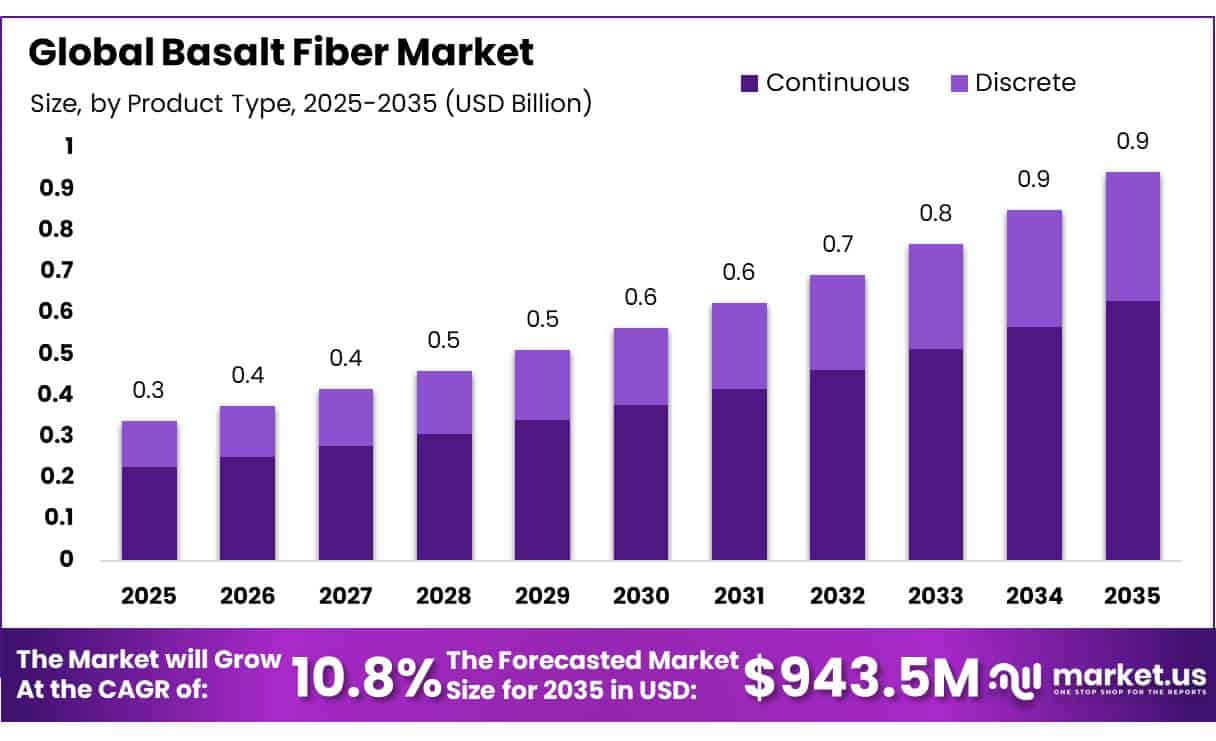
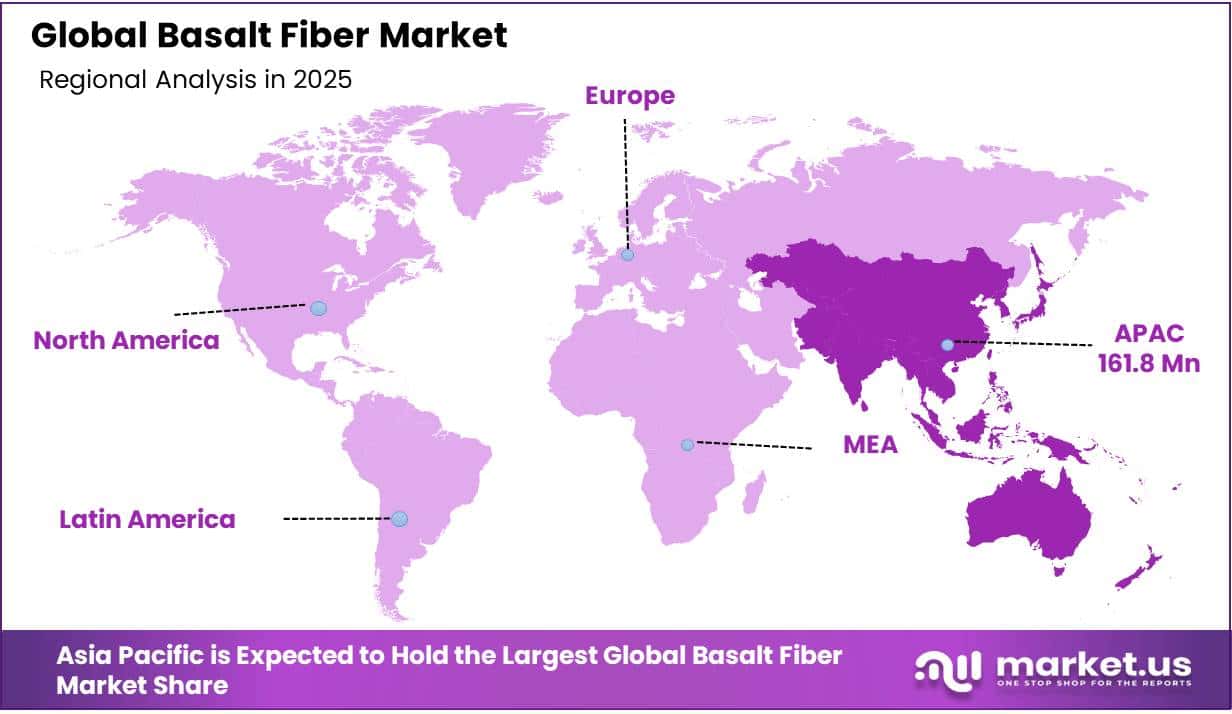
In 2025, the Global Basalt Fiber Market was valued at USD 339.5 million, and between 2026 and 2035, this market is estimated to register a CAGR of 10.8%, reaching about USD 943.5 million by 2035. Asia Pacific held a dominant market position, capturing more than a 47.6% share, holding USD 0.95 billion in revenue.
Basalt fiber is an advanced inorganic reinforcement produced from naturally occurring basalt rock and increasingly used in construction, automotive components, pipes, pressure vessels, wind-energy structures, marine applications, and thermal insulation. The material combines high mechanical strength with corrosion, chemical, and temperature resistance. Basalt Fiber Tech reports tensile strength of approximately 2,900–3,200 MPa and tensile modulus of about 86–94 GPa for its continuous basalt roving grades. These properties allow basalt fiber to compete with conventional glass reinforcement in demanding composite applications.
- Basalt Fiber Tech states that its fiber can operate permanently from approximately -260°C to +400°C, while short-term exposure can reach around +850°C. Its basalt monofilament tensile strength can reach approximately 4,300 MPa depending on filament diameter. Such performance supports applications where conventional steel faces corrosion problems or where glass fiber has limitations under heat and aggressive chemicals.
Key Takeaways
- The global basalt fiber market was valued at USD 339.5 million in 2025.
- The global market is projected to grow at a CAGR of 10.8% and is estimated to reach USD 943.5 million by 2035.
- On the basis of form, continuous basalt fiber dominated the market, constituting 66.7% of the total market share.
- Among the usage types, composites held a major share in the basalt fiber market, 72.43% of the market share.
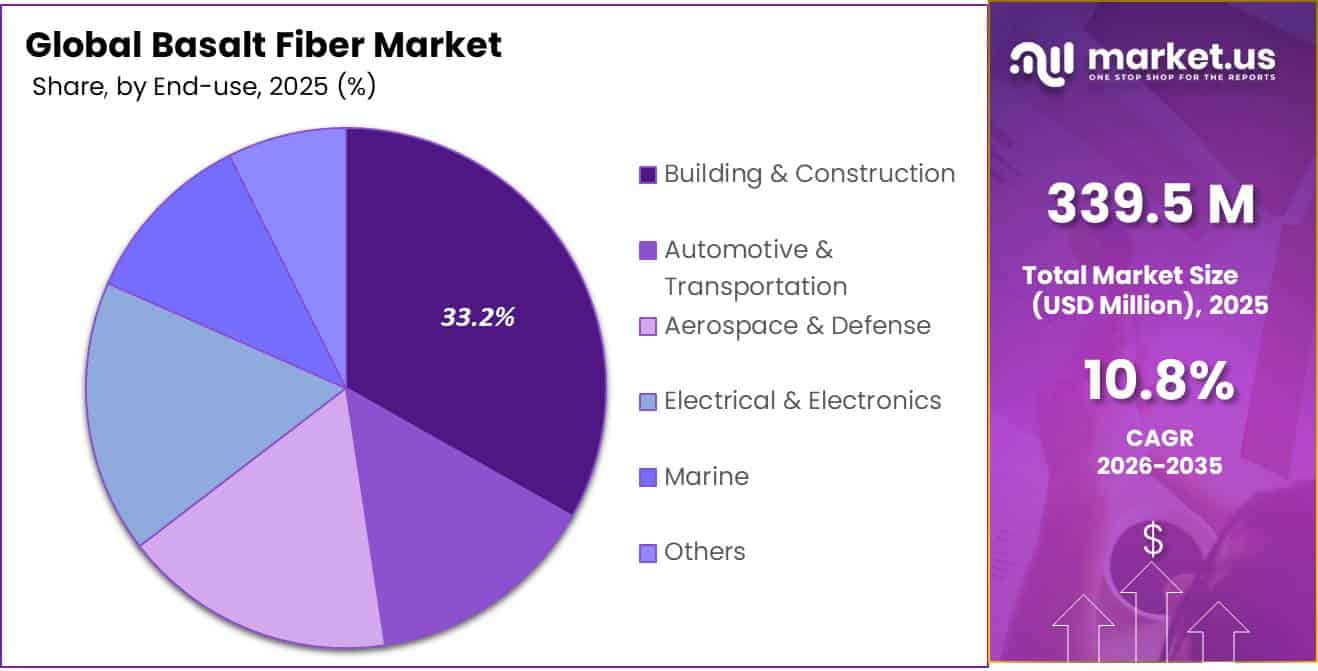
- Among the end-use industries, the building & construction sector is the most considerable within the market, accounting for around 33.2% of the revenue.
- In 2025, the Asia Pacific was the most dominant region in the basalt fiber market, accounting for 47.6% of the total global consumption.
Infrastructure renewal is an important demand driver. Basalt-fiber-reinforced polymer rebar does not rust like conventional steel reinforcement, making it attractive for bridges, marine structures, roads, tunnels, and chemically exposed concrete. The U.S. Federal Highway Administration allocated USD 2.52 billion to its Bridge Investment Program for FY2025 to support bridge replacement, rehabilitation, preservation, and protection. Large public infrastructure programs create opportunities for longer-life reinforcement materials that can reduce corrosion-related maintenance requirements.
Lightweight transportation provides another growth avenue. The U.S. Department of Energy states that reducing vehicle weight by 10% can improve fuel economy by around 6%–8%, while advanced lightweight materials can substantially reduce body and chassis weight. Basalt fiber offers automakers an additional composite reinforcement option for interior panels, underbody parts, brake components, structural profiles, and heat-resistant applications where weight, durability, and cost must be balanced.
Form Analysis
Continuous Basalt Fiber is a Prominent Segment in the Market.
Continuous basalt fiber represents the dominant segment, accounting for 66.7% of total market usage. Its high adoption is attributed to superior mechanical properties, including consistent tensile strength, thermal resistance up to 800°C, and excellent durability under prolonged exposure to environmental stressors. These characteristics make it particularly suitable for high-performance applications in construction, automotive, aerospace, and industrial sectors, where structural integrity and long service life are critical.
Continuous fibers are integral to the production of reinforced composites, enabling uniform load distribution and enhanced material performance. Advances in fiberization technology and process optimization have further improved uniformity and reduced defects, reinforcing its preference over discrete fibers. The segment’s dominance reflects the growing demand for reliable, high-strength reinforcement solutions that can withstand mechanical and thermal stresses across diverse industrial applications.
Usage Type Analysis
Composites Held a Major Share of the Basalt Fiber Market.
The composites segment dominates the basalt fiber market, accounting for 72.3% of total usage. Its prominence is driven by the material’s ability to reinforce polymer, metal, and cement matrices, resulting in enhanced tensile strength, thermal stability, and corrosion resistance. These properties make basalt fiber composites particularly valuable in construction, automotive, aerospace, and marine applications, where high structural integrity and long-term durability are critical. Continuous basalt fibers are widely used in composite production to ensure uniform load distribution and superior mechanical performance.
Additionally, the integration of basalt fibers with glass, carbon, or polymer fibers in hybrid composites allows for tailored performance characteristics to meet specialized application requirements. The composites segment’s leadership reflects a growing preference for high-performance, lightweight, and environmentally resilient materials that deliver efficiency and longevity across multiple industrial sectors.
End-Use Industry Analysis
Basalt Fiber Are Mostly Utilized in the Building & Construction Sector.
The building and construction segment holds a dominant position, accounting for 33.2% of basalt fiber consumption. Its prominence is attributed to the material’s superior mechanical strength, thermal resistance, and durability, which make it an effective alternative to traditional steel and glass reinforcements. Basalt fibers are increasingly used in reinforced concrete, bridge decks, prefabricated panels, and fire-resistant construction materials, enhancing structural integrity and extending service life while reducing maintenance requirements.
The adoption is further supported by government initiatives promoting sustainable and energy-efficient construction practices. Continuous basalt fibers in particular facilitate uniform reinforcement, minimizing cracking and improving load distribution. The segment’s leadership reflects the growing need for high-performance, eco-friendly materials capable of meeting the stringent safety, durability, and environmental standards of modern infrastructure development.
Key Market Segments
By Form
- Continuous
- Discrete
By Usage Type
- Composites
- Non-Composites
By End-Use Industry
- Building & Construction
- Automotive & Transportation
- Aerospace & Defense
- Electrical & Electronics
- Marine
- Others
Driver Analysis
Corrosion-Proof Infrastructure Reinforcement
Basalt-fiber-reinforced polymer (BFRP) rebar, mesh, geogrids, and chopped-fiber concrete additives are gaining traction because conventional steel reinforcement remains vulnerable to chloride ingress, carbonation, freeze-thaw damage, de-icing salts, moisture, and chemical attack, whereas basalt composites are electrically non-conductive, non-magnetic, lightweight, and highly corrosion resistant. Basalt fiber typically delivers tensile strength of about 2.6-4.8 GPa and an elastic modulus of roughly 80-115 GPa, while BFRP reinforcement can achieve tensile strengths in the approximate 1.1-1.15 GPa range; this makes it suitable for bridges, tunnel linings, coastal structures, wastewater facilities, rail infrastructure, pavements, and chemically aggressive industrial foundations.
The economic driver is lifecycle rather than initial purchase cost: the US has more than 42,000 structurally deficient bridges, and corrosion-proof FRP systems can reduce rehabilitation frequency by avoiding rust-driven concrete spalling and rebar replacement, even where initial material cost is higher than steel. Basalt fiber has a further material-fit advantage in cementitious systems because basalt ore shares elemental similarities with cement and fly ash, improving compatibility in concrete applications and supporting durable crack-control performance.
This shifts supplier value capture from commodity fiber sales to qualified reinforcement systems, including pultruded rebar, mesh, anchoring hardware, design support, contractor training, and lifecycle warranties; adoption will be strongest in salt-exposed bridges, ports, seawalls, metro tunnels, wastewater assets, and electrified rail corridors across North America, Europe, India, China, and Southeast Asia.
Drivers Impact Analysis
| Driver | (~) % Impact on CAGR Forecast | Geographic Relevance | Impact Timeline |
|---|---|---|---|
| Corrosion-proof infrastructure reinforcement | +1.8% | North America, EU, India, APAC | Long term (≥4 years) |
| Wind-composite material demand | +1.4% | EU, China, North America | Medium term (2-4 years) |
| EV fire-barrier adoption | +1.2% | China, EU, North America | Medium term (2-4 years) |
| India infrastructure capex | +1.3% | India, South Asia | Medium term (2-4 years) |
| Fire-resistant industrial insulation | +0.9% | EU, North America, Middle East | Long term (≥4 years) |
| Marine and chemical durability | +0.8% | APAC, Middle East, Europe | Long term (≥4 years) |
Restraint Analysis
High Melting-Energy Costs
Basalt fiber production requires melting crushed volcanic basalt at approximately 1,400°C before extrusion through platinum-rhodium bushings, a process that makes electricity and natural-gas cost a direct determinant of unit economics despite the underlying rock feedstock being comparatively abundant and low cost. Furnace operations must remain highly stable because repeated heating and cooling damages refractory linings, disrupts filament consistency, and increases start-up scrap, meaning producers cannot simply reduce output during high-energy-price periods without absorbing utilization and maintenance penalties; a 15-25% increase in electricity or gas cost can realistically add 5-10% to conversion cost per kilogram for a continuous-melt plant, particularly in Europe where industrial electricity remains structurally more expensive than in the US, China, or the Gulf.
Basalt’s economic positioning is therefore difficult: it is generally less costly than carbon fiber but priced between commodity E-glass and premium S-glass, limiting its ability to displace E-glass in price-sensitive construction and consumer applications. This margin pressure delays furnace-capacity investment, reinforces reliance on imported fiber in regions without established melt capacity, and forces manufacturers to pursue higher-value fire-resistant, corrosion-resistant, or specialty composite applications where performance premiums can offset energy-intensive production costs; until renewable power contracts, waste-heat recovery, or larger continuous production runs reduce conversion costs, energy intensity will remain a material short-term cap on broader volume adoption.
Restraint Impact Analysis
| Restraint | (~) % Impact on CAGR Forecast | Geographic Relevance | Impact Timeline |
|---|---|---|---|
| High melting-energy costs | -1.2% | Europe, North America, APAC | Short term (≤2 years) |
| Limited standards acceptance | -1.1% | North America, EU, India | Medium term (2-4 years) |
| Small-scale supply capacity | -1.0% | North America, EU, APAC importers | Medium term (2-4 years) |
| Glass-fiber cost advantage | -0.9% | Global construction markets | Long term (≥4 years) |
| Alkali durability uncertainty | -0.8% | Infrastructure, concrete markets | Medium term (2-4 years) |
| Composite recycling limits | -0.5% | EU, North America, Japan | Long term (≥4 years) |
Opportunity Analysis
Recyclable Thermoplastic Composites
Basalt-fiber-reinforced thermoplastic composites represent a future value-capture opportunity rather than a current driver because most basalt fiber today is still monetized through thermoset-based rebar, fabrics, insulation, and structural laminates, whereas thermoplastic systems can introduce recycling, welding, rapid processing, and end-of-life recovery capabilities that have not yet been broadly commercialized across the basalt value chain. Research confirms that basalt fibers have already been processed with polypropylene and polycarbonate matrices, and thermoplastic composites can be recycled and welded, enabling large-format structures and potentially supporting a more circular composite model.
The strategic prize is significant: thermoplastic PP, PA6, PA66, PC, ABS, PLA, PBS, and POM matrices can support injection molding, compression molding, overmolding, pultrusion, thermoforming, and automated tape placement, allowing suppliers to move from selling commodity roving into higher-value compounds, organosheets, unidirectional tapes, and pre-qualified semi-finished products.
Compared with thermoset composite scrap, which often becomes low-value filler after grinding, recyclable basalt-thermoplastic systems can enable repair, welding, component reuse, and closed-loop recycling; a supplier that captures even 10-15% recycled-content incorporation without degrading mechanical performance can reduce virgin-material exposure, improve sustainability scoring, and lower customer lifecycle cost.
Opportunity Impact Analysis
| Opportunity | (~) % Potential CAGR Upside | Geographic Relevance | Execution Window |
|---|---|---|---|
| Recyclable thermoplastic composites | +1.4% | EU, North America, Japan, China | Medium term (2-4 years) |
| Hydrogen pressure-vessel hybrids | +1.1% | EU, North America, China, Korea | Long term (≥4 years) |
| Continuous-fiber 3D printing | +1.0% | North America, EU, Japan, India | Medium term (2-4 years) |
| EV battery-enclosure platforms | +1.3% | China, EU, North America, India | Medium term (2-4 years) |
| Local basalt rebar conversion | +1.2% | India, Middle East, APAC, LATAM | Long term (≥4 years) |
| Composite-converter M&A roll-ups | +0.8% | North America, EU, India | Short term (≤2 years) |
Challenges Analysis
Fiber-Property Batch Variability
Basalt fiber is manufactured from a natural mineral feedstock rather than a tightly synthesized chemical recipe, so even economically viable quarries can exhibit variation in silica, alumina, iron oxides, calcium, magnesium, titanium, and alkali-metal oxides that alters melt viscosity, liquidus temperature, filament drawability, diameter uniformity, tensile strength, elastic modulus, and corrosion behavior; in practice, continuous filaments are generally drawn at 10-20 µm from basalt melted at roughly 1,400-1,450°C, leaving little process tolerance when feedstock chemistry or furnace temperature shifts.
This is an ongoing operational challenge—not a current restraint—because producers can continue to sell fiber, but lot-to-lot variability raises composite-converter scrap, increases incoming inspection, complicates structural design assumptions, and weakens customer confidence in high-spec applications; published comparative analysis identifies greater mechanical-property variability in basalt than established glass-fiber processes, with fluctuations in filament diameter, tensile strength, and modulus tied to raw-material composition and processing conditions. For a pultruder, fabricator, or compounder, a 5-10% shift in fiber strength or linear density can necessitate resin-adjustment, altered draw tension, lower line speed, or additional safety factors, potentially reducing usable output by 3-7% and increasing quality-control cost per tonne.
The long-term mitigation path requires quarry-level chemical mapping, ore blending, online viscosity monitoring, furnace digital twins, statistically controlled draw parameters, and individual coil traceability from rock batch to finished roving; producers such as BasFiberPro cite furnace capacities of up to 4,500 tonnes per year, but repeatability rather than nameplate tonnage will determine whether such capacity becomes acceptable for automotive, wind, aerospace, and civil-infrastructure programs.
Challenges Impact Analysis
| Challenge | (~) % CAGR Friction Drag | Geographic Relevance | Mitigation Horizon |
|---|---|---|---|
| Fiber-property batch variability | -0.9% | Global supply base | Medium term (2-4 years) |
| Sizing–resin compatibility | -0.8% | Automotive, wind, construction | Medium term (2-4 years) |
| Furnace uptime management | -0.7% | Europe, North America, APAC | Long term (≥4 years) |
| Converter skills shortage | -0.6% | India, Middle East, APAC | Long term (≥4 years) |
| Long-term field validation | -0.8% | Infrastructure, marine, wind | Long term (≥4 years) |
| Project-specification inertia | -0.7% | North America, EU, India | Medium term (2-4 years) |
Geopolitical Impact Analysis
Geopolitical Volatility and Its Implications for Basalt Fiber Supply Chains.
Recent geopolitical tensions have affected the supply chains and material sourcing for basalt fiber production. Basalt rocks, the primary raw material, are concentrated in regions such as Russia, China, and certain parts of Europe, which has made international trade susceptible to political restrictions. The U.S. Geological Survey noted that Russia holds significant basalt reserves used for fiber production, and export limitations or sanctions on industrial minerals could disrupt raw material availability for downstream industries.
The European Commission has reported that transportation and infrastructure projects relying on imported construction materials, including basalt fiber-reinforced composites, have experienced delays due to border restrictions and logistics bottlenecks. The U.S. Department of Transportation highlights that global freight cost indices increased by over 20% in 2022, driven partly by geopolitical disruptions affecting maritime and overland transport routes.
Furthermore, the Ministry of Industry and Information Technology of China has emphasized the importance of securing domestic supply chains for critical industrial minerals to reduce exposure to international conflicts. These factors collectively underscore how geopolitical volatility can constrain production continuity, limit cross-border material flows, and necessitate strategic sourcing and stockpiling measures in the basalt fiber sector.
Regional Analysis
Asia Pacific Held the Largest Share of the Global Basalt Fiber Market.
In 2025, the Asia Pacific dominated the global basalt fiber market, holding about 47.6% of the total global consumption. Asia-Pacific has emerged as a leading hub for basalt fiber production and consumption, driven by extensive construction, infrastructure, and transportation activities. According to the Ministry of Industry and Information Technology of China, the country operates multiple large-scale basalt fiber manufacturing facilities, producing continuous and chopped fibers for civil engineering, automotive, and marine applications.
Government initiatives, including China’s 13th Five-Year Plan for the Development of Building Materials, emphasize the adoption of durable, fire-resistant, and eco-friendly materials, supporting widespread use of basalt fiber-reinforced composites in bridge decks, high-rise buildings, and prefabricated panels. India’s Ministry of Road Transport and Highways has recorded experimental use of basalt fiber-reinforced polymer (BFRP) bars in highway and bridge projects, noting improved corrosion resistance and longer service life compared to traditional steel reinforcement.
Key Regions and Countries
- North America
- The US
- Canada
- Europe
- Germany
- France
- The UK
- Spain
- Italy
- Russia & CIS
- Rest of Europe
- APAC
- China
- Japan
- South Korea
- India
- ASEAN
- Rest of APAC
- Latin America
- Brazil
- Mexico
- Rest of Latin America
- Middle East & Africa
- GCC
- South Africa
- Rest of MEA
Key Players Analysis
Manufacturers of basalt fiber focus on several strategic activities to strengthen their competitive positioning and expand market presence. Technological innovation is central, with investments in advanced melting and fiberization equipment to improve fiber uniformity, tensile strength, and thermal stability. Many companies prioritize developing hybrid composites, combining basalt fibers with glass, carbon, or polymer fibers to address specialized application requirements.
Firms further emphasize sustainability initiatives, such as energy-efficient production processes and recyclable materials, aligning with regulatory and environmental standards. Strategic partnerships with infrastructure, automotive, and aerospace firms facilitate co-development of application-specific solutions, enhancing adoption rates and securing long-term contracts that reinforce market share.
The Major Players in The Industry
- ARMBAS
- BASTECH
- Deutsche Basalt Faser GmbH
- Galen Ltd.
- INCOTELOGY GmbH
- ISOMATEX SA
- Kamenny Vek
- Shanxi Basalt Fiber Technology Co., Ltd.
- Sudaglass Fiber Technology
- Technobasalt-Invest LLC
- Zhejiang GBF Basalt Fiber Co.
- Kamenny Vek
- Basalt Fiber & Composite Materials Technology Development Co., Ltd
- PIONEER
- Rock Fiber Inc.
- Other Key Players
Key Development
- In January 2026, vertically integrated Arab Basalt Fiber Co. (Fujairah, UAE) formed a strategic partnership with Orlimex (Osík, Czechia), part of the U.K.-based Orlitech Group, to collaborate on engineered composite systems using continuous basalt fiber reinforcement.
- In November 2025, precast concrete company Roman Stone partnered with Rock Fiber Inc. (Houston, Texas) to launch MiniBars, a basalt fiber-reinforced macro-fiber reinforcement product, targeting applications in the U.S. precast concrete industry.
Report Scope
| Report Features | Description |
|---|---|
| Market Value (2025) | US$339.5 Mn |
| Forecast Revenue (2035) | US$943.5 Mn |
| CAGR (2026-2035) | 10.8% |
| Base Year for Estimation | 2025 |
| Historic Period | 2020-2024 |
| Forecast Period | 2026-2035 |
| Report Coverage | Revenue Forecast, Market Dynamics, Competitive Landscape, Recent Developments |
| Segments Covered | By Form (Continuous and Discrete), By Usage Type (Composites and Non-Composites), By End-Use (Building & Construction, Automotive & Transportation, Aerospace & Defense, Electrical & Electronics, Marine, and Others) |
| Regional Analysis | North America – The US & Canada; Europe – Germany, France, The UK, Spain, Italy, Russia & CIS, Rest of Europe; APAC– China, Japan, South Korea, India, ASEAN & Rest of APAC; Latin America– Brazil, Mexico & Rest of Latin America; Middle East & Africa– GCC, South Africa, & Rest of MEA |
| Competitive Landscape | ARMBAS, BASTECH, Deutsche Basalt Faser GmbH, Galen Ltd., INCOTELOGY GmbH, ISOMATEX SA, Kamenny Vek, Shanxi Basalt Fiber Technology Co., Ltd., Sudaglass Fiber Technology, Technobasalt-Invest LLC, Zhejiang GBF Basalt Fiber Co., Kamenny Vek, Basalt Fiber & Composite Materials Technology Development Co., Ltd, PIONEER, Rock Fiber Inc., and Other Players. |
| Customization Scope | Customization for segments, region/country-level will be provided. Moreover, additional customization can be done based on the requirements. |
| Purchase Options | We have three licenses to opt for: Single User License, Multi-User License (Up to 5 Users), Corporate Use License (Unlimited Users and Printable PDF) |





































