


Report Overview
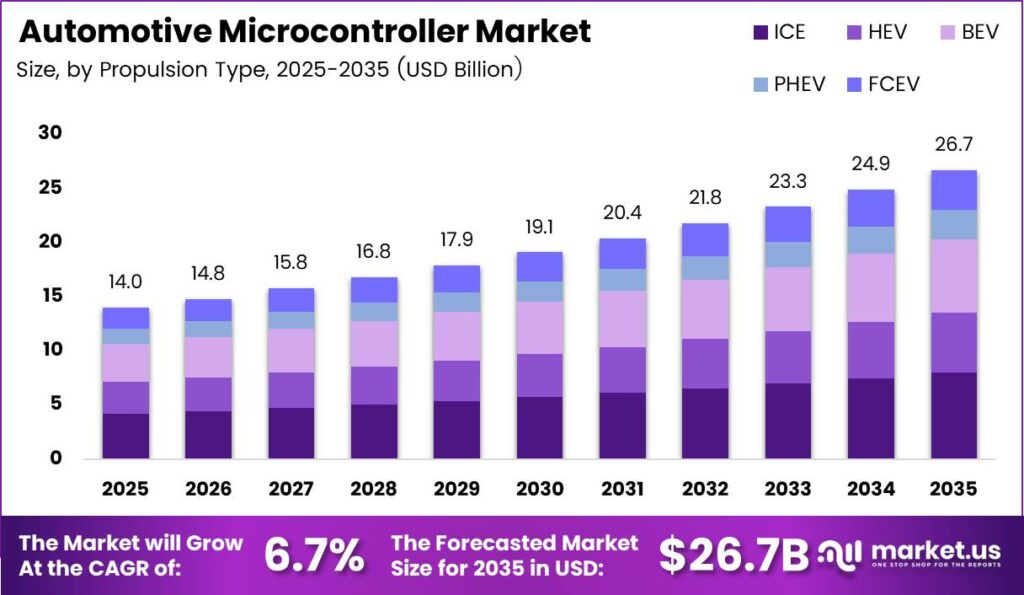
Global Automotive Microcontroller Market size is expected to be worth around USD 26.7 Billion by 2035 from USD 14.0 Billion in 2025, growing at a CAGR of 6.7% during the forecast period 2026 to 2035.
The automotive microcontroller market covers semiconductor devices that manage electronic functions inside passenger vehicles, commercial vehicles, and specialty platforms. These controllers govern powertrain management, chassis stability, body electronics, safety systems, and telematics. This reflects growing electronic content per vehicle, where each new platform requires more embedded compute to meet safety, emissions, and connectivity mandates.
Key Takeaways
- Market size reaches USD 14.0 Billion in 2025 and USD 26.7 Billion by 2035.
- The market grows at a CAGR of 6.7% from 2026 to 2035.
- By Bit Size, 8-bit microcontrollers hold a dominant 40.11% market share.
- By Propulsion Type, ICE vehicles hold a 38.78% share and remain the largest segment.
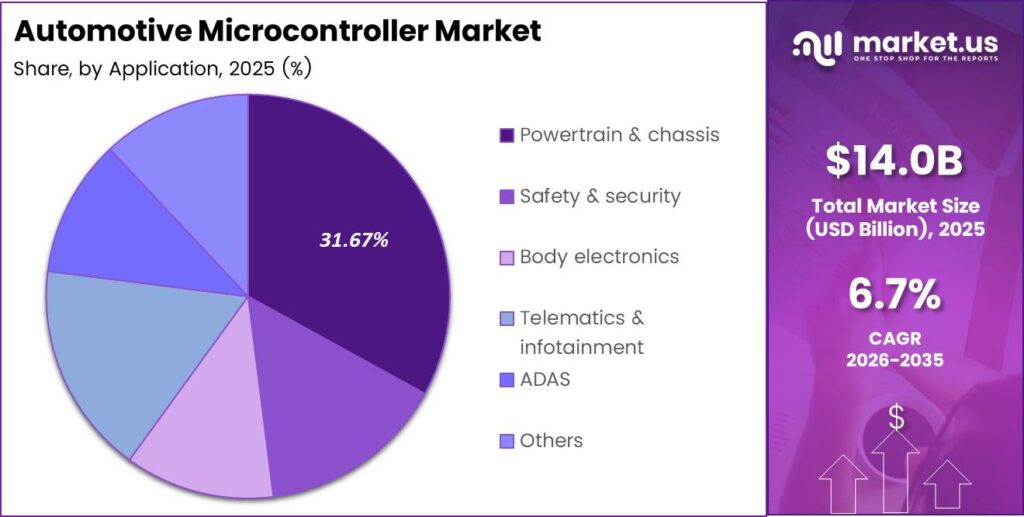
- By Application, Powertrain & chassis leads with a 31.67% share.
- By End User, OEMs dominate with a 62.12% share of total demand.
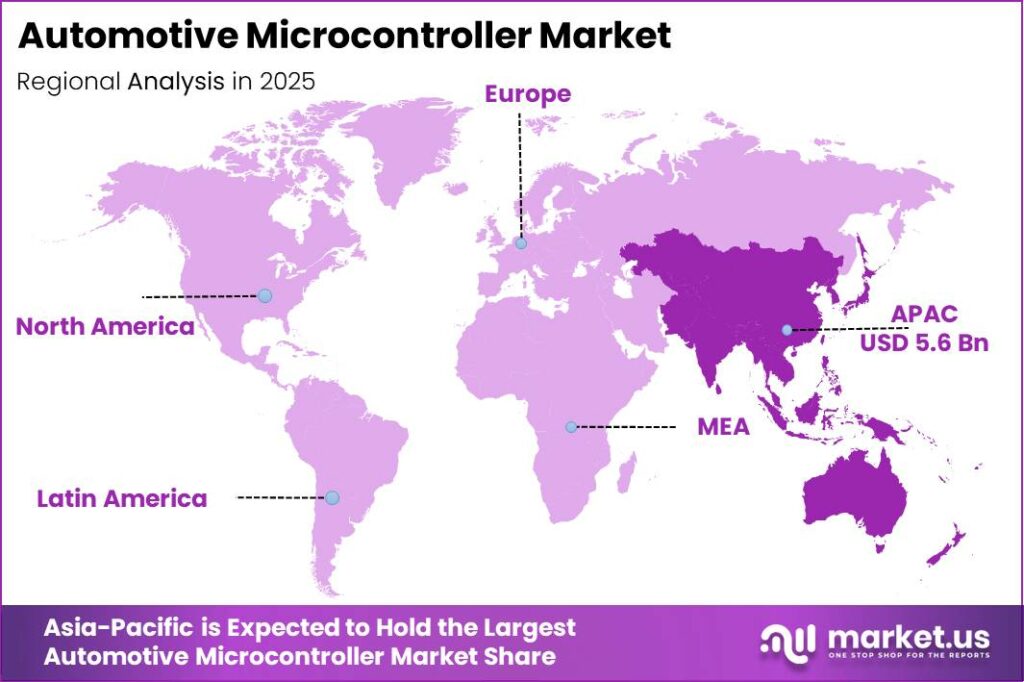
- Asia-Pacific dominates the regional landscape, holding a 40.00% market share valued at USD 5.6 Billion.
Government mandates are accelerating MCU content per vehicle. Mandatory EU driver-assistance systems are expected to save more than 25,000 lives and prevent at least 140,000 serious injuries by 2038, according to the European Commission. Each mandated system requires dedicated controller hardware. This creates durable, regulation-backed demand that suppliers can plan around with multi-year design cycles.
Global electric-car sales exceeded 20 million units in 2025, growing approximately 20% year over year and reaching 25% of all new-car sales worldwide, as reported by the International Energy Agency. EU hybrid-electric cars held a 34.6% registration share through October 2025, based on ACEA data. These platforms consume significantly more MCU content per vehicle than conventional models, directly expanding the addressable unit per vehicle opportunity for suppliers.
Trade conditions add near-term pressure. The United States imposed a 25% tariff on imported automobiles and parts in 2025, and world merchandise-trade volume was forecast to grow just 1.9% in 2026 under the WTO baseline. Maritime-trade growth slowed from 2.2% in 2024 to 0.5% in 2025. As per our research, December 2025 saw STMicroelectronics and the European Investment Bank sign a EUR 500 million financing agreement under an approved EUR 1 billion credit line, signaling that major suppliers are securing long-term capital to sustain R&D through the cycle.
Bit Size Analysis
8-bit microcontrollers dominate with 40.11% due to cost efficiency and high-volume body electronics adoption.
In 2025, 8-bit microcontrollers held a dominant market position in the By Bit Size segment of the Automotive Microcontroller Market, with a 40.11% share. Infineon’s XC22xxU body-control MCUs, offering 64 KB flash memory and 40 MHz performance, represent this category’s prevailing specification. Their low unit cost and proven reliability make them the default choice for non-safety-critical body functions. Cost-focused OEMs prioritize these controllers where processing demand remains low.
16-bit microcontrollers serve mid-tier applications where 8-bit throughput falls short but 32-bit cost is not justified. Microchip’s automotive PIC24F family operates at 16 MHz, a specification that covers sensor interfacing, low-latency I/O, and simple diagnostics. This tier retains a stable role in existing vehicle architectures. As per our research, platform consolidation toward 32-bit is gradual, leaving 16-bit controllers relevant for another full product cycle.
32-bit microcontrollers are the fastest-growing tier, driven by ADAS, zonal architecture, and electrified powertrain requirements. On March 11, 2025, Microchip introduced the 200 MHz PIC32A 32-bit MCU family, targeting automotive safety and motor-control applications. Higher clock speeds and integrated analog peripherals allow one controller to replace multiple lower-bit devices. This consolidation raises revenue per socket and expands average selling prices for suppliers competing in safety-critical tiers.
Propulsion Type Analysis
ICE vehicles dominate with 38.78% due to the large existing global vehicle parc and production volumes.
In 2025, ICE vehicles held a dominant market position in the By Propulsion Type segment of the Automotive Microcontroller Market, with a 38.78% share. The EU had 285.6 million motor vehicles in use in 2023, according to ACEA, the vast majority of which are ICE-powered. This installed base sustains demand for replacement and upgrade MCUs across engine management, transmission, and emissions control. Aftermarket channels benefit directly from this volume.
Hybrid electric vehicles represent the fastest-growing propulsion segment within this market. Each HEV platform requires coordinated MCU sets covering both conventional powertrain management and electric motor control. As per our research, dual-system architectures increase the average MCU count per vehicle above ICE-only levels. Suppliers with scalable 32-bit platforms position themselves to serve both ICE and HEV content from a single architecture, reducing qualification cost across two segments.
BEV and PHEV platforms carry the highest MCU content per vehicle, covering battery management, traction inverters, onboard charging, and thermal management. The United States imposed a 25% tariff on imported automobiles and parts in 2025, shifting some EV assembly economics toward domestic production. This creates a near-term procurement advantage for MCU suppliers with US-based or US-allied manufacturing. FCEV vehicles hold the smallest current share but require specialized fuel-cell management controllers that command premium average selling prices.
Application Analysis
Powertrain & chassis dominates with 31.67% due to high processor demand across engine and stability control systems.
In 2025, Powertrain & chassis held a dominant market position in the By Application segment of the Automotive Microcontroller Market, with a 31.67% share. Engine management, transmission control, and electronic stability programs each require dedicated, high-reliability MCUs operating under strict thermal and vibration constraints. Global economic growth projected to slow to 2.5% in 2026, per the World Bank, creates pressure on OEM capital budgets. This reinforces preference for proven, cost-efficient controller platforms in high-volume powertrain applications.
Safety & security is the fastest-growing application segment, driven by ADAS mandates, cybersecurity requirements, and automatic emergency braking regulations advancing across key markets. MCU content per vehicle in this category is rising as each new safety function requires its own certified processor with hardware security modules and real-time response capability. Suppliers delivering integrated safety MCU platforms with reusable certified software stacks hold a cost and time-to-market advantage over competitors supplying standalone silicon.
Body electronics, telematics & infotainment, and ADAS together represent the remaining application base. Body electronics relies heavily on cost-efficient 8-bit and 16-bit controllers for lighting, climate, and window management. Telematics & infotainment demands connectivity-capable MCUs with integrated communication stacks. ADAS requires the highest processing density of any application outside powertrain. These three segments collectively hold the share not captured by powertrain and safety, presenting a diversified opportunity for multi-product suppliers.
End User Analysis
OEMs dominate with 62.12% due to direct design-win relationships and high-volume production integration.
In 2025, OEMs held a dominant market position in the By End User segment of the Automotive Microcontroller Market, with a 62.12% share. OEM procurement decisions lock in controller specifications for model lifetimes spanning five to seven years, giving winning suppliers predictable, high-volume revenue with strong switching cost protection. Tier-1 suppliers serving OEMs must meet AEC-Q100 qualification, ISO 26262 functional safety, and cybersecurity standards, creating durable barriers that exclude smaller or less-certified competitors.
The Aftermarket segment is the fastest-growing End User category. Replacement ECU demand rises as vehicles age and original components require servicing or software updates. As per our research, aftermarket MCU volumes are growing as the average age of vehicles in key markets extends beyond ten years. Suppliers that offer backward-compatible controller replacements and flash-reprogrammable devices can capture aftermarket share without competing directly on OEM design-win cycles.
Key Market Segments
By Bit Size
- 8-bit Microcontrollers
- 16-bit Microcontrollers
- 32-bit Microcontrollers
By Propulsion Type
- ICE
- HEV
- BEV
- PHEV
- FCEV
By Application
- Powertrain & Chassis
- Safety & Security
- Body Electronics
- Telematics & Infotainment
- ADAS
- Others
By End User
- OEMs
- Aftermarket
Regional Analysis
Asia-Pacific Dominates the Automotive Microcontroller Market with a Market Share of 40.00%, Valued at USD 5.6 Billion
Asia-Pacific holds a 40.00% share of the Automotive Microcontroller Market, valued at USD 5.6 Billion in 2025. China drives this dominance through its position as the world’s largest vehicle production base and the leading market for electric vehicles. Japan and South Korea contribute through globally competitive Tier-1 automotive supply chains and established semiconductor manufacturing capacity. This concentration of vehicle production and component sourcing in one region creates both scale advantages and supply-chain concentration risk for global buyers.
Asia-Pacific is also the fastest-growing regional market. On September 4, 2024, VIS and NXP established the VSMC joint venture for a USD 7.8 billion 300 mm wafer fab with expected output of 55,000 wafers per month by 2029, directly expanding semiconductor supply capacity within the region. On January 15, 2025, NXP secured a EUR 1 billion European Investment Bank loan for semiconductor research, development, and innovation. This combination of in-region fab investment and external capital signals that suppliers are building structural supply-chain depth in Asia-Pacific ahead of projected demand growth.
Key Regions and Countries
North America
- US
- Canada
Europe
- Germany
- France
- The UK
- Spain
- Italy
- Rest of Europe
Asia Pacific
- China
- Japan
- South Korea
- India
- Australia
- Rest of APAC
Latin America
- Brazil
- Mexico
- Rest of Latin America
Middle East and Africa
- GCC
- South Africa
- Rest of MEA
Market Dynamics
Market Opportunity Analysis - Underserved propulsion tiers and aftermarket channels offer entry points for focused suppliers
The Aftermarket End User segment is the fastest-growing buyer category, yet it captures the smallest share of current MCU supplier attention. As per our research, vehicles aged beyond ten years increasingly require replacement controllers compatible with older architectures. Suppliers offering flash-reprogrammable, backward-compatible MCUs can build aftermarket revenue without competing on OEM design-win cycles, which carry higher qualification cost and longer timelines.
HEV and PHEV propulsion platforms represent an underexploited MCU opportunity relative to their share trajectory. These vehicles require dual-system controller sets covering both conventional powertrain management and electric motor control. By contrast, most supplier product roadmaps have concentrated on pure BEV and ICE tiers. Suppliers that certify scalable 32-bit platforms for hybrid architectures gain a foothold across two growing propulsion categories from a single qualification investment.
The Safety & Security application segment is the fastest-growing application category and remains underpenetrated by smaller MCU suppliers. Mandatory AEB compliance requirements in the United States carry a September 1, 2029 deadline, and ADAS mandates in the EU continue to expand the regulatory baseline. Suppliers that develop certified reference platforms ahead of the deadline position themselves for design-win selection before incumbent suppliers lock in multi-platform agreements.
Asia-Pacific holds a 40.00% regional share but contains fast-growing sub-markets in India and Southeast Asia that remain underpenetrated by established MCU vendors. These markets are expanding their domestic vehicle assembly capacity. Suppliers that qualify local Tier-1 partners and establish regional engineering support ahead of peak production ramp will be better positioned to convert early engagement into long-term supply agreements before more capitalized competitors enter.
Technology and Innovation Landscape - High-frequency multi-core architectures and advanced power semiconductors redefine MCU competitive positioning
The shift to multi-core, high-frequency MCU architectures is the defining technology trend in this market. Renesas introduced the 28 nm RH850/U2C in March 2026 with 4 CPU cores operating at up to 320 MHz. STMicroelectronics introduced the Stellar P3E in February 2026 with 6 Cortex-R52+ cores at up to 500 MHz. These architectures allow one controller to replace multiple prior-generation devices, raising per-socket revenue and reducing vehicle-level wiring complexity.
Integrated high-performance analog peripherals are expanding the functional scope of 32-bit MCU platforms. Microchip’s PIC32A 32-bit MCU family, introduced in March 2025, operates at 200 MHz and includes 40 Msps 12-bit ADCs, enabling analog-to-digital conversion at speeds relevant to motor control and power management applications. This integration reduces the need for companion analog ICs, lowers bill-of-materials cost, and simplifies board layout for Tier-1 developers.
Silicon-carbide semiconductor manufacturing is expanding to support next-generation automotive power applications. Infineon opened the first phase of its 200 mm SiC fab in Kulim, Malaysia, in August 2024. STMicroelectronics announced a EUR 5 billion integrated 200 mm SiC facility targeting up to 15,000 wafers per week. SiC devices improve efficiency in high-voltage EV drivetrains, and suppliers with in-house SiC capacity gain vertical integration advantages in fast-growing EV powertrain controller content.
Edge-AI inference capability is entering production MCU designs. STMicroelectronics reported 20 to 30 times higher inference performance in the Stellar P3E versus its predecessor. Infineon’s AURIX TC4x collaboration with Subaru targets up to 6 cores at 500 MHz for complex vehicle-level compute. On-device inference enables real-time object classification and adaptive motor control without cloud dependency. Suppliers embedding AI acceleration into safety-rated MCUs convert this capability into a qualification differentiator that generic compute platforms cannot replicate under automotive standards.
Drivers
Battery-electric and hybrid platforms are increasing controller demand across battery management, traction inverters, onboard charging, thermal management, and coordinated braking. Global electric-car sales exceeded 17 million in 2024, growing by more than 25%, and surpassed 20 million in 2025, up approximately 20% year over year. EU battery-electric, hybrid-electric, and plug-in-hybrid vehicles captured 17.4%, 34.5%, and 9.4% of registrations in 2025, broadening MCU demand beyond pure BEV models.
Suppliers are shifting from isolated low-bit controllers toward scalable 32-bit platforms, reusable software stacks, reference designs, and longer supply agreements. This increases qualification depth and software-linked revenue. The estimated +1.4% CAGR contribution assumes an 8 to 12% annual increase in electrified-platform MCU shipments, accompanied by a 2 to 4 percentage-point mix uplift from higher-specification safety and motor-control devices.
| Driver | (~) % Impact on CAGR Forecast | Geographic Relevance | Impact Timeline |
|---|---|---|---|
| Electrified Powertrain Proliferation | +1.4% | Global; China, Europe, North America | Short term (≤ 2 years) |
| Global Vehicle Output Recovery | +0.7% | Asia-Pacific, North America | Short term (≤ 2 years) |
| 32-bit Controller Migration | +0.6% | Global; Japan, Europe, China | Medium term (2–4 years) |
| Digital Cockpit Feature Density | +0.5% | China, South Korea, Europe, North America | Medium term (2–4 years) |
| Fleet Telematics Standardization | +0.4% | North America, Europe, China | Medium term (2–4 years) |
Restraints
Excess orders accumulated during the semiconductor shortage collided with cautious vehicle demand in 2024 and 2025, prompting automakers and component suppliers to reduce buffer inventories before issuing replenishment orders. One major Japanese automotive-chip supplier reported a 14.0% year-over-year decline in automotive revenue in the first half of 2025. A leading European supplier recorded an approximately 8% automotive revenue decline and a segment margin contraction from 27.1% to 18.9% in its first fiscal quarter of 2025.
Management at the European supplier explicitly identified customer inventory adjustment as a major near-term revenue drag. The resulting order gaps reduce fab utilization, intensify pricing concessions, and defer mature-node capacity expenditure. This destocking cycle supports an estimated -1.0% deduction from the 6.7% baseline CAGR through approximately 2027, with customers remaining capable of lowering inventory targets further under financial pressure.
| Restraint | (~) % Impact on CAGR Forecast | Geographic Relevance | Impact Timeline |
|---|---|---|---|
| OEM Inventory Destocking | -1.0% | Global; Europe, Japan, North America | Short term (≤ 2 years) |
| Mature-node Price Erosion | -0.6% | Global; China and East Asia | Short term (≤ 2 years) |
| Qualification Entry Barriers | -0.5% | Global | Long term (≥ 4 years) |
| Export-control Access Limits | -0.4% | United States, China, Europe | Medium term (2–4 years) |
| Extended Customer Payment Cycles | -0.3% | Emerging automotive manufacturing hubs | Short term (≤ 2 years) |
Challenges
As MCUs take on more safety, connectivity, and update-management functions, suppliers must validate interacting hardware, firmware, and vehicle-level software across a growing number of configurations. UN cybersecurity requirements apply to vehicle categories fitted with at least 1 electronic control unit and require manufacturers to demonstrate an operating cybersecurity-management system. An analysis of US recall data identified 153 software-related campaigns affecting 13.4 million vehicles in 2024, with campaign volume rising 35% from 2023.
Late specification changes can add 3 to 6 months to validation and raise program-level engineering and test expenditure by approximately 15 to 25%. The estimated -0.7% ceiling drag reflects this complexity. Mitigation requires reusable safety libraries, hardware security modules, digital-twin testing, continuous integration, traceable software bills of materials, and multiyear investment in functional-safety and cybersecurity engineering. Suppliers that build these capabilities early convert a cost burden into a competitive qualification barrier.
| Challenge | (~) % CAGR Friction Drag | Geographic Relevance | Mitigation Horizon |
|---|---|---|---|
| Software-validation Complexity | -0.7% | Global; Europe, Japan, South Korea | Long term (≥ 4 years) |
| Zero-defect Yield Scaling | -0.5% | Global manufacturing clusters | Medium term (2–4 years) |
| Legacy Equipment Scarcity | -0.4% | United States, Europe, Japan | Medium term (2–4 years) |
| Multi-tier Forecast Volatility | -0.3% | Global | Short term (≤ 2 years) |
| Engineering Talent Deficit | -0.2% | United States, Europe, Japan, India | Long term (≥ 4 years) |
Opportunities
Automatic emergency braking represents an untapped design-win opportunity because the US compliance deadline is September 1, 2029, leaving a sizable portion of the addressable vehicle fleet open to controller redesign. The standard covers nearly all light vehicles rated at no more than 10,000 pounds and requires collision avoidance at speeds up to 62 miles per hour and pedestrian response up to 45 miles per hour. Regulators estimate at least 360 lives and 24,000 injuries could be saved annually.
Suppliers that combine an automotive-safety MCU, secure processing, sensor-fusion acceleration, and certified software into one reference platform could capture an estimated USD 8 to 15 of additional controller content per equipped vehicle. Program gross margin could improve by approximately 3 to 5 percentage points through software and validation reuse. Full execution could add approximately +0.9% above the 6.7% baseline CAGR, producing a focused scenario near 7.6%.
| Opportunity | (~) % Potential CAGR Upside | Geographic Relevance | Execution Window |
|---|---|---|---|
| Mandatory AEB Control Upgrade | +0.9% | United States; transferable globally | Medium term (2–4 years) |
| Zonal Controller Platforms | +0.7% | China, Europe, North America, Japan | Long term (≥ 4 years) |
| Edge-AI Motor Control | +0.6% | Global premium and electric platforms | Long term (≥ 4 years) |
| Secure Firmware Services | +0.4% | Europe, Japan, South Korea, China | Medium term (2–4 years) |
| Off-highway Electrification | +0.3% | North America, Europe, India, China | Long term (≥ 4 years) |
Key Company Insights
Infineon Technologies AG generated EUR 7.402 billion in Automotive segment revenue in fiscal 2025, accounting for 50% of group revenue. This concentration creates deep customer integration and long-term design-win protection. However, it also exposes Infineon fully to OEM destocking cycles. Their AEC-Q101-qualified 100 V GaN transistor, introduced in October 2025, signals active investment in next-generation power platforms alongside MCUs.
NXP Semiconductors generated USD 7.116 billion in Automotive revenue in 2025 from USD 12.269 billion total. NXP completed acquisitions of TTTech Auto, Aviva Links, and Kinara across 2025, collectively deploying USD 1.175 billion. These deals expand NXP’s zonal architecture software, high-speed networking, and edge-AI inference capabilities. This positions NXP to address the full vehicle compute stack rather than competing on MCU silicon alone.
Texas Instruments began production at its new 300 mm fab in Sherman, Texas, in December 2025, and in June 2025 announced plans to invest more than USD 60 billion across seven US semiconductor fabs. This domestic supply build gives North American OEMs a tariff-insulated sourcing option. Honda’s recall of 294,612 vehicles for improperly programmed fuel-injection ECUs, with 674 warranty claims filed by January 16, 2025, illustrates the downstream cost of software integration failures that MCU suppliers must help OEMs prevent.
Renesas generated JPY 639.7 billion in non-GAAP Automotive Business revenue in 2025, down JPY 63.1 billion or 9.0% year over year. This decline reflects the broader OEM destocking cycle. FCA’s recall of 1,076,999 Jeep vehicles tied to an electrical-connection issue linked to 51 fires reinforces why safety validation depth has become a commercial differentiator. Suppliers that can demonstrate audit-ready compliance processes gain selection advantages at the OEM design-win stage.
Key Players
- Analog Devices, Inc.
- Infineon Technologies AG
- Microchip Technology Inc.
- NXP Semiconductors
- STMicroelectronics
- Renesas Electronics Corporation
- Rohm Semiconductor
- Texas Instruments Incorporated
- Toshiba Corporation
- Silicon Laboratories
- Other Key Players
Recent Developments
- March 3, 2026 – Infineon introduced a 400 MHz AURIX TC3x automotive MCU option, providing up to one-third higher CPU frequency than prior variants.
- March 9, 2026 – Infineon and Subaru announced collaboration using AURIX TC4x MCUs with up to 6 cores operating at 500 MHz each.
- March 4, 2026 – Renesas introduced the 28 nm RH850/U2C automotive MCU with 4 CPU cores operating at up to 320 MHz and up to 8 MB flash memory.
- February 10, 2026 – STMicroelectronics introduced the Stellar P3E automotive MCU with 6 Cortex-R52+ cores operating at up to 500 MHz and 20 to 30 times higher inference performance than its predecessor.
- February 5, 2026 – Renesas agreed to transfer its timing business to SiTime for USD 3 billion, comprising USD 1.5 billion in cash and 4.13 million SiTime shares.
- July 1, 2026 – Renesas completed the transfer of its timing business to SiTime and estimated a JPY 443.3 billion transfer gain.
- October 15, 2025 – Infineon introduced its first AEC-Q101-qualified 100 V GaN transistor family for automotive applications.
- August 8, 2024 – Infineon opened the first phase of its 200 mm silicon-carbide semiconductor fab in Kulim, Malaysia.
- May 31, 2024 – STMicroelectronics announced a EUR 5 billion integrated 200 mm silicon-carbide facility targeting production of up to 15,000 wafers per week.
Report Scope
| Report Features | Description |
|---|---|
| Market Value (2025) | USD 14.0 Billion |
| Forecast Revenue (2035) | USD 26.7 Billion |
| CAGR (2026-2035) | 6.7% |
| Base Year for Estimation | 2025 |
| Historic Period | 2020-2024 |
| Forecast Period | 2026-2035 |
| Report Coverage | Revenue Forecast, Market Dynamics, Market Opportunity Analysis, Technology and Innovation Landscape, Competitive Landscape, Recent Developments |
| Segments Covered | By Bit Size (8-bit Microcontrollers, 16-bit Microcontrollers, 32-bit Microcontrollers), By Propulsion Type (ICE, HEV, BEV, PHEV, FCEV), By Application (Powertrain & Chassis, Safety & Security, Body Electronics, Telematics & Infotainment, ADAS, Others), By End User (OEMs, Aftermarket) |
| Regional Analysis | North America (US and Canada), Europe (Germany, France, The UK, Spain, Italy, and Rest of Europe), Asia Pacific (China, Japan, South Korea, India, Australia, and Rest of APAC), Latin America (Brazil, Mexico, and Rest of Latin America), Middle East and Africa (GCC, South Africa, and Rest of MEA) |
| Competitive Landscape | Analog Devices, Inc., Infineon Technologies AG, Microchip Technology Inc., NXP Semiconductors, STMicroelectronics, Renesas Electronics Corporation, Rohm Semiconductor, Texas Instruments Incorporated, Toshiba Corporation, Silicon Laboratories, Other Key Players |
| Customization Scope | Customization for segments, region/country-level will be provided. Additional customization can be done based on requirements. |
| Purchase Options | We have three licenses to opt for: Single User License, Multi-User License (Up to 5 Users), Corporate Use License (Unlimited User and Printable PDF) |





































