


Report Overview
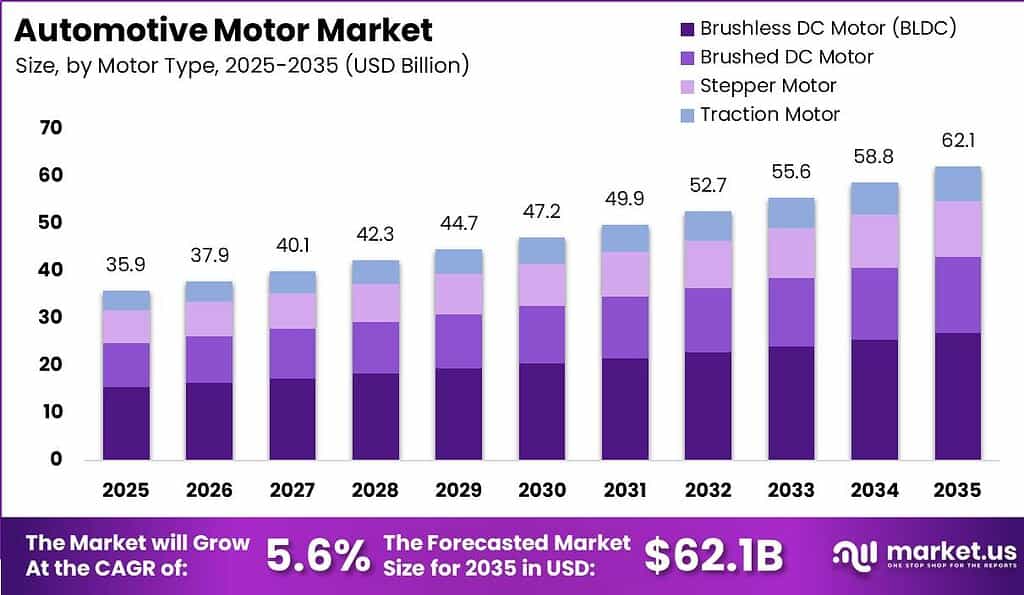
Global Automotive Motor Market size is expected to be worth around USD 62.1 Billion by 2035 from USD 35.9 Billion in 2025, growing at a CAGR of 5.6% during the forecast period 2026 to 2035. This trajectory reflects sustained electrification across vehicle categories and rising motor content per vehicle across both propulsion and auxiliary systems.
The automotive motor market covers electric motors used across vehicle propulsion, steering, braking, thermal management, and comfort systems. Segments span motor type, application, power output, vehicle type, and sales channel. Products range from small brushed DC units in body applications to high-voltage traction motors powering full-electric drivetrains in passenger and commercial vehicles.
Key Takeaways
- The global Automotive Motor Market is valued at USD 35.9 Billion in 2025 and is forecast to reach USD 62.1 Billion by 2035.
- The market grows at a CAGR of 5.6% during the forecast period 2026 to 2035.
- Brushless DC Motor (BLDC) dominates the By Motor Type segment with a 43.30% share.
- Thermal Management Motors dominate the By Application segment with a 26.00% share.
- The Up to 15 kW category dominates the By Power Output segment with a 48.00% share.
- Passenger Cars dominate the By Vehicle Type segment with a 62.00% share.
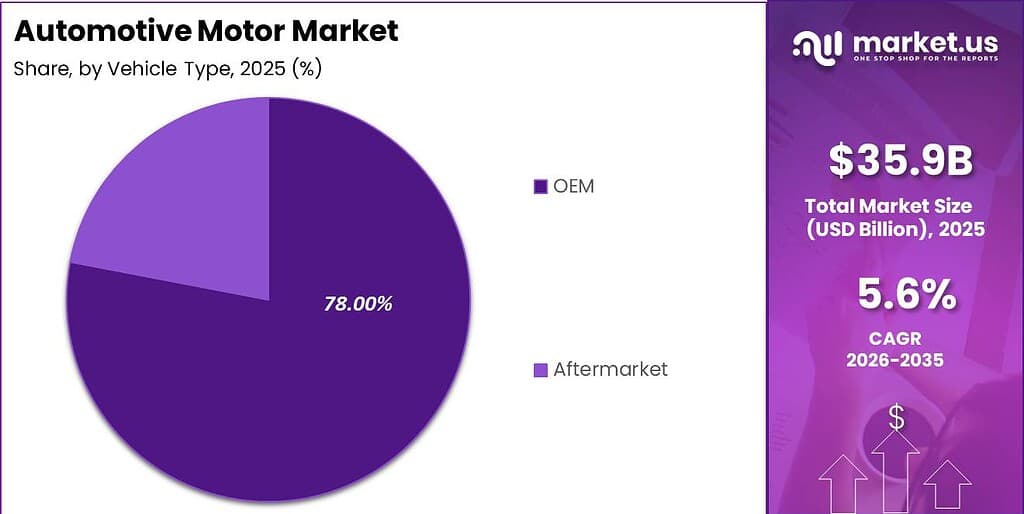
- OEM dominates the By Sales Channel segment with a 78.00% share.
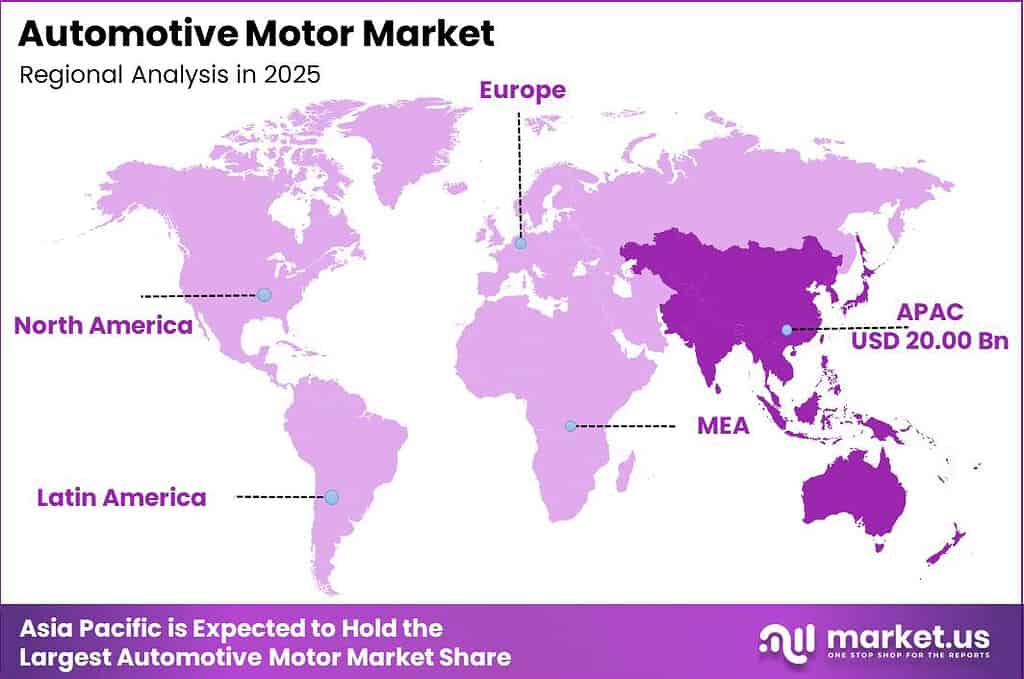
- Asia Pacific leads all regions with a 55.70% share, valued at USD 20.00 Billion.
Continental AG announced in March 2025 that series production of its high-speed inductive e-motor Rotor Position Sensor would begin by end of 2025. This move signals accelerating OEM demand for precise rotor feedback in high-speed motor systems. BorgWarner’s Ultra-Short High-Voltage Hairpin technology supports both 400 V and 800 V platforms, reducing winding-end size by more than 5 mm versus traditional hairpin winding. This positions multi-voltage compatibility as a baseline design requirement rather than a premium feature.
As per our research, OEM supply agreements account for 78% of channel revenue, concentrating market power in a small number of platform-level contracts. Suppliers that secure multi-model supply agreements insulate themselves from single-program volume risk. This channel concentration also raises the barrier for new entrants, as aftermarket-only strategies limit addressable volume to the remaining 22% of the market.
Type Analysis
Brushless DC Motor (BLDC) dominates with 43.30% due to superior efficiency and lower maintenance needs.
In 2025, Brushless DC Motor (BLDC) held a dominant market position in the By Motor Type segment of the Automotive Motor Market, with a 43.30% share. BLDC motors eliminate mechanical commutation, which reduces friction losses and extends service life across high-cycle applications. OEMs integrating BLDC units across electric power steering, thermal management, and traction systems gain measurable system-level efficiency advantages over brushed alternatives.
Brushed DC Motors retain share in low-cost body and comfort applications where switching cost outweighs efficiency gains. Their straightforward control electronics and low unit cost keep them competitive in entry-level vehicles and cost-sensitive markets. Suppliers serving price-sensitive platforms in India, ASEAN, and Latin America continue to source brushed units for window lifts, seat adjusters, and mirror actuators.
Stepper Motors serve precise angular positioning applications including HVAC blend doors, headlamp leveling, and throttle body control. Their deterministic step response makes them preferred where position accuracy matters more than speed. In 2025, BorgWarner secured four new electric-motor projects from three Chinese automakers, including motors for a 200 kW hybrid rear-drive platform and a 150 kW battery-electric platform, reflecting accelerating OEM demand for high-performance motor solutions.
Traction Motors anchor the electrification value chain as the highest-value motor category per vehicle. Their adoption scales directly with EV and hybrid program volumes. As passenger and commercial vehicle electrification expands, traction motor content per platform rises, creating a structural revenue shift toward this sub-segment regardless of total vehicle production volume.
Application Analysis
Thermal Management Motors dominate with 26.00% due to universal fitment across combustion and electric platforms.
In 2025, Thermal Management Motors held a dominant market position in the By Application segment of the Automotive Motor Market, with a 26.00% share. Cooling fans, pumps, and blowers are mandatory across every powertrain type, making this sub-segment structurally volume-stable. Electrified powertrains require more precise thermal regulation than combustion engines, which drives up motor count and specification per vehicle.
Traction and Propulsion Motors represent the highest revenue growth pathway within the application mix. Their unit value far exceeds auxiliary motor categories, and their proliferation scales with EV penetration rates across passenger and commercial segments. Suppliers with validated high-voltage traction platforms hold a sourcing advantage as OEMs accelerate multi-model EV rollouts.
Electric Power Steering Motors replaced hydraulic systems across the majority of new passenger car platforms, delivering fuel and energy savings that satisfy both consumer cost expectations and regulatory efficiency targets. Their fitment rate in new passenger cars approaches near-universal levels in premium and mid-range segments, creating a stable, high-volume demand floor for motor suppliers.
Starter Motors and Alternators remain relevant in mild-hybrid and conventional combustion architectures. Their installed base is large, their replacement cycle is predictable, and aftermarket demand adds a secondary revenue channel. Others, including seat, window, mirror, and sunroof motors, hold the residual share and depend on vehicle feature content decisions made during platform development.
Power Output Analysis
Up to 15 kW dominates with 48.00% due to broad fitment across body and auxiliary systems.
In 2025, Up to 15 kW held a dominant market position in the By Power Output segment of the Automotive Motor Market, with a 48.00% share. This range covers the majority of body, thermal, steering, and comfort motor applications across all vehicle types. High unit volumes and cross-platform standardization make this power band the most commercially accessible for tier-one suppliers.
The 15 to 60 kW band serves light-hybrid traction, integrated starter-generators, and low-power electric-drive applications. As mild-hybrid adoption expands in cost-sensitive markets, demand in this band grows ahead of the full-EV transition. Suppliers positioned here capture hybrid program volume without the high-voltage validation cost burden of full traction-motor platforms.
The 60 to 120 kW and Above 120 kW bands together address pure-electric and high-performance hybrid traction systems. Their revenue contribution per unit is the highest in the segment, though volume remains smaller than the sub-15 kW tier. Above 120 kW motors, including commercial-vehicle traction units, carry premium pricing and require specialized manufacturing and validation capability, limiting the competitive field.
Vehicle Type Analysis
Passenger Cars dominate with 62.00% due to highest global production volumes and motor content per unit.
In 2025, Passenger Cars held a dominant market position in the By Vehicle Type segment of the Automotive Motor Market, with a 62.00% share. Passenger cars carry the broadest range of motor applications per platform, from traction and steering to dozens of comfort and body-control units. Their production volume and increasing electrification rate make them the primary revenue anchor for automotive motor suppliers.
Light Commercial Vehicles represent a growing secondary segment as fleet operators adopt electric and hybrid vans for urban logistics. Their higher utilization rates require more durable motor specifications than passenger car equivalents. This durability requirement creates a differentiated product opportunity for suppliers able to validate motors against commercial-duty cycles without full heavy-truck engineering cost.
Heavy Commercial Vehicles and Two and Three-Wheelers hold the remaining share. HCVs carry the highest per-unit motor value in traction applications, while two and three-wheelers drive volume in Asia Pacific electrification programs. Collectively, these segments sustain diversified demand across the motor supply chain, reducing OEM concentration risk for suppliers with multi-segment product coverage.
Sales Channel Analysis
OEM dominates with 78.00% due to platform-level supply contracts covering full production runs.
In 2025, OEM held a dominant market position in the By Sales Channel segment of the Automotive Motor Market, with a 78.00% share. OEM contracts lock in multi-year volume commitments tied to platform lifecycles, providing revenue predictability absent in spot markets. Suppliers that secure design-in status at platform definition stage effectively exclude competitors for the life of that vehicle program.
The Aftermarket segment accounts for the remaining 22% of channel revenue and grows as the installed base of electrified and feature-rich vehicles ages. Replacement demand for BLDC steering motors, thermal management pumps, and traction-motor components creates a margin-accretive secondary revenue stream. Suppliers that build OEM relationships today position themselves to capture aftermarket volume from those same platforms five to ten years forward.
Key Market Segments
By Motor Type
- Brushed DC Motor
- Brushless DC Motor (BLDC)
- Stepper Motor
- Traction Motor
By Application
- Traction / Propulsion Motors
- Electric Power Steering Motors
- Starter Motors & Alternators
- Thermal Management Motors (Fans, Pumps, Blowers)
- Others
By Power Output
- Up to 15 kW
- 15–60 kW
- 60–120 kW
- Above 120 kW
By Vehicle Type
- Passenger Cars
- Light Commercial Vehicles (LCVs)
- Heavy Commercial Vehicles (HCVs)
- Two & Three-Wheelers
By Sales Channel
- OEM
- Aftermarket
Regional Analysis
Asia Pacific Dominates the Automotive Motor Market with a Market Share of 55.70%, Valued at USD 20.00 Billion
Asia Pacific commands 55.70% of global automotive motor revenue, valued at USD 20.00 Billion in 2025. China anchors this dominance through the world’s largest EV production base and a dense domestic supply chain covering magnets, windings, and motor assemblies. Japan and South Korea add precision motor manufacturing capacity that feeds both domestic OEMs and global platform programs.
Europe is the fastest-growing region outside Asia Pacific, driven by binding fleet CO2 targets that force OEM electrification timelines regardless of near-term consumer demand. Regulatory pressure converts electrification from a commercial choice into a compliance requirement. In September 2025, ZF Friedrichshafen AG introduced its modular SELECT e-drive platform incorporating electric motors, inverters, converters, reduction gears, and control software, signaling the shift toward integrated system supply in European programs.
North America represents a structurally significant market where OEM reshoring incentives and expanding EV program pipelines support motor demand despite near-term production headwinds. Latin America and the Middle East and Africa regions contribute smaller but growing shares, sustained by two and three-wheeler electrification and fleet modernization programs that expand the addressable motor population beyond passenger cars.
Key Regions and Countries
North America
- US
- Canada
Europe
- Germany
- France
- The UK
- Spain
- Italy
- Rest of Europe
Asia Pacific
- China
- Japan
- South Korea
- India
- Australia
- Rest of APAC
Latin America
- Brazil
- Mexico
- Rest of Latin America
Middle East and Africa
- GCC
- South Africa
- Rest of MEA
Drivers
Powertrain electrification is the single largest structural driver in this market. More than 1 in 5 cars sold globally in 2024 was electric, and electric-car sales exceeded 17 million units that year. Each electrified vehicle carries substantially more motor content than its combustion equivalent, shifting supplier revenue from high-volume, low-value components toward integrated motor-inverter assemblies with longer engineering lead times.
This transition contributes an estimated +1.6% to the 5.6% baseline CAGR, making it the dominant positive force in the forecast. Vehicle feature proliferation adds a further +1.2%, and ADAS actuator demand contributes +0.9% over the medium term. Suppliers that build high-voltage validation capability and secure platform-level supply agreements now will be structurally positioned before competitors close that gap.
| Driver | (~) % Impact on CAGR Forecast | Geographic Relevance | Impact Timeline |
|---|---|---|---|
| Powertrain Electrification | +1.6% | China, Europe, North America | Short term (≤ 2 years) |
| Vehicle Feature Proliferation | +1.2% | Global | Short term (≤ 2 years) |
| ADAS Actuator Demand | +0.9% | Europe, North America, China, Japan | Medium term (2–4 years) |
| Hybrid Powertrain Expansion | +0.8% | China, Japan, North America, Europe | Short term (≤ 2 years) |
| Thermal-System Electrification | +0.7% | Global | Medium term (2–4 years) |
| Premium Comfort Content | +0.5% | China, North America, Europe, Gulf markets | Short term (≤ 2 years) |
Restraints
Vehicle production contraction is the sharpest near-term headwind for automotive motor suppliers. Global motor-vehicle and parts production is projected to decline by 0.2% in 2026 after expanding by 2.9% in the prior year. United States automotive output faces a 2.8% contraction following an earlier 1.3% decline, reducing order releases across every motor application regardless of technology roadmap.
This production decline generates an estimated -1.4% deduction from the baseline CAGR. Lower factory utilization weakens supplier absorption of fixed tooling, engineering, and test costs, intensifying annual price-down pressure. Tariff-driven cost inflation adds a further -1.1% drag, and EV incentive withdrawal in North America and selected European markets contributes -0.8%, compressing the near-term electrification volume that suppliers counted on to offset combustion decline.
| Restraint | (~) % Impact on CAGR Forecast | Geographic Relevance | Impact Timeline |
|---|---|---|---|
| Vehicle Production Contraction | -1.4% | Europe, North America, global exports | Short term (≤ 2 years) |
| Tariff-Driven Cost Inflation | -1.1% | North America, Europe, China-linked supply chains | Short term (≤ 2 years) |
| Entry-Vehicle Decontenting | -0.9% | India, ASEAN, Latin America, Europe | Short term (≤ 2 years) |
| EV Incentive Withdrawal | -0.8% | North America, selected European markets | Short term (≤ 2 years) |
| Legacy Capacity Underutilization | -0.7% | Europe, Japan, North America | Medium term (2–4 years) |
| Consumer Affordability Pressure | -0.6% | North America, Europe, emerging markets | Short term (≤ 2 years) |
Challenges
Rare-earth supply concentration creates a structural vulnerability across multiyear vehicle programs. Redesigning a permanent-magnet traction motor for an alternate material source requires approximately 12 to 24 months of material, motor, inverter, vehicle, and durability validation. This qualification timeline means supply disruptions cannot be resolved quickly, forcing suppliers to carry costly buffer inventory and invest in dual-source qualification programs.
The estimated friction drag of -1.2% reflects buffer-inventory carrying costs, price volatility, and ongoing investment in lower-rare-earth motor topologies, recycling programs, and induction or externally excited alternatives. High-voltage validation burden adds a further -1.0% drag as 800 V architecture adoption demands new test infrastructure across the supply chain. Suppliers that resolve rare-earth dependency early through magnet-free motor designs gain a durable cost and supply-chain advantage over competitors still dependent on concentrated sources.
| Challenge | (~) % CAGR Friction Drag | Geographic Relevance | Mitigation Horizon |
|---|---|---|---|
| Rare-Earth Supply Concentration | -1.2% | China-linked supply chain, Europe, North America, Japan | Long term (≥ 4 years) |
| High-Voltage Validation Burden | -1.0% | China, Europe, North America, Japan | Medium term (2–4 years) |
| Motor Control Software | -0.8% | Global | Medium term (2–4 years) |
| Thermal Derating Management | -0.7% | Global, highest in hot-climate markets | Long term (≥ 4 years) |
| Electromagnetic Compatibility Testing | -0.6% | Global | Medium term (2–4 years) |
| Specialist Engineering Scarcity | -0.5% | Europe, North America, Japan, South Korea | Long term (≥ 4 years) |
Opportunities
Commercial fleet electrification represents the largest near-term upside in the automotive motor market. Medium- and heavy-duty fleet applications require sustained duty ratings approximately 20% to 40% above comparable passenger-car usage profiles. This creates a premium for robust insulation, liquid cooling, redundant control, and predictive-maintenance capability that standard passenger-car motor designs do not deliver.
Suppliers that standardize fleet motor modules and secure service contracts could capture roughly 5% to 10% higher gross-margin potential than transactional component sales. This margin advantage comes from lower field-failure rates, parts reuse, and lifecycle support. The opportunity carries a modeled +1.3% upside above the 5.6% baseline CAGR, contingent on charging infrastructure, fleet procurement cycles, and centralized service networks scaling at pace with motor deployment.
| Opportunity | (~) % Potential CAGR Upside | Geographic Relevance | Execution Window |
|---|---|---|---|
| Commercial Fleet Electrification | +1.3% | China, Europe, North America | Medium term (2–4 years) |
| Motor Remanufacturing Networks | +1.0% | Europe, North America, China, Japan | Medium term (2–4 years) |
| Off-Highway Electrification | +0.9% | Europe, North America, China | Long term (≥ 4 years) |
| Axial-Flux Motor Adoption | +0.8% | Europe, North America, China, Japan | Long term (≥ 4 years) |
| Integrated e-Axle Platforms | +0.7% | China, Europe, North America, South Korea | Medium term (2–4 years) |
| Industrial Mobility Adjacent Sales | +0.6% | Global | Long term (≥ 4 years) |
Key Company Insights
MAHLE GmbH is advancing magnet-free motor architecture across both passenger and commercial vehicle segments. Its heavy-commercial-vehicle motor produces 370 kW of peak power and more than 900 Nm at 3,900 rpm, with approximately 95% motor efficiency over the EU VECTO cycle. In January 2025, MAHLE launched a new electric-motor technology kit combining its SCT and MCT motor concepts at CES 2025, signaling an accelerated commercialization timeline for its magnet-independent platform.
Valeo SA has built a differentiated position through permanent-magnet-free motor design and high-efficiency axial-flux technology. Its partnership with PanGood delivers an axial-flux generator system that achieves up to 50% reduction in size and weight at equivalent power output and reaches up to 97% efficiency across its principal operating-speed range. This combination of size efficiency and carbon footprint reduction addresses both OEM cost targets and regulatory compliance requirements in a single system architecture.
Key Players
- Nidec Corporation
- DENSO Corporation
- Robert Bosch GmbH
- Valeo SA
- Continental AG
- Johnson Electric Holdings Ltd.
- Mitsuba Corporation
- Mabuchi Motor Co., Ltd.
- Brose Fahrzeugteile GmbH & Co. KG
- ZF Friedrichshafen AG
- Mitsubishi Electric Corporation
- BorgWarner Inc.
- MAHLE GmbH
- Hyundai Mobis
- Minebea Mitsumi Inc.
Recent Developments
- June 2025 – ZF Friedrichshafen AG started series production in China of an asynchronous electric motor for its SELECT automotive electric-drive platform, establishing its first high-volume production footprint for the SELECT system in the world’s largest EV market.
- July 2025 – Mabuchi Motor Co., Ltd. completed the acquisition of Oki Micro Engineering’s small-motor business and renamed the acquired company Mabuchi Motor Micro Tech Co., Ltd., expanding its precision small-motor portfolio and manufacturing base.
Report Scope
| Report Features | Description |
|---|---|
| Market Value (2025) | USD 35.9 Billion |
| Forecast Revenue (2035) | USD 62.1 Billion |
| CAGR (2026-2035) | 5.6% |
| Base Year for Estimation | 2025 |
| Historic Period | 2020-2024 |
| Forecast Period | 2026-2035 |
| Report Coverage | Revenue Forecast, Market Dynamics, Market Opportunity Analysis, Technology and Innovation Landscape, Competitive Landscape, Recent Developments |
| Segments Covered | By Motor Type (Brushed DC Motor, Brushless DC Motor (BLDC), Stepper Motor, Traction Motor), By Application (Traction / Propulsion Motors, Electric Power Steering Motors, Starter Motors & Alternators, Thermal Management Motors, Others), By Power Output (Up to 15 kW, 15–60 kW, 60–120 kW, Above 120 kW), By Vehicle Type (Passenger Cars, Light Commercial Vehicles, Heavy Commercial Vehicles, Two & Three-Wheelers), By Sales Channel (OEM, Aftermarket) |
| Regional Analysis | North America (US and Canada), Europe (Germany, France, The UK, Spain, Italy, and Rest of Europe), Asia Pacific (China, Japan, South Korea, India, Australia, and Rest of APAC), Latin America (Brazil, Mexico, and Rest of Latin America), Middle East and Africa (GCC, South Africa, and Rest of MEA) |
| Competitive Landscape | Nidec Corporation, DENSO Corporation, Robert Bosch GmbH, Valeo SA, Continental AG, Johnson Electric Holdings Ltd., Mitsuba Corporation, Mabuchi Motor Co., Ltd., Brose Fahrzeugteile GmbH & Co. KG, ZF Friedrichshafen AG, Mitsubishi Electric Corporation, BorgWarner Inc., MAHLE GmbH, Hyundai Mobis, Minebea Mitsumi Inc. |
| Customization Scope | Customization for segments, region/country-level will be provided. Additional customization can be done based on requirements. |
| Purchase Options | We have three licenses to opt for: Single User License, Multi-User License (Up to 5 Users), Corporate Use License (Unlimited User and Printable PDF) |





































