


Report Overview
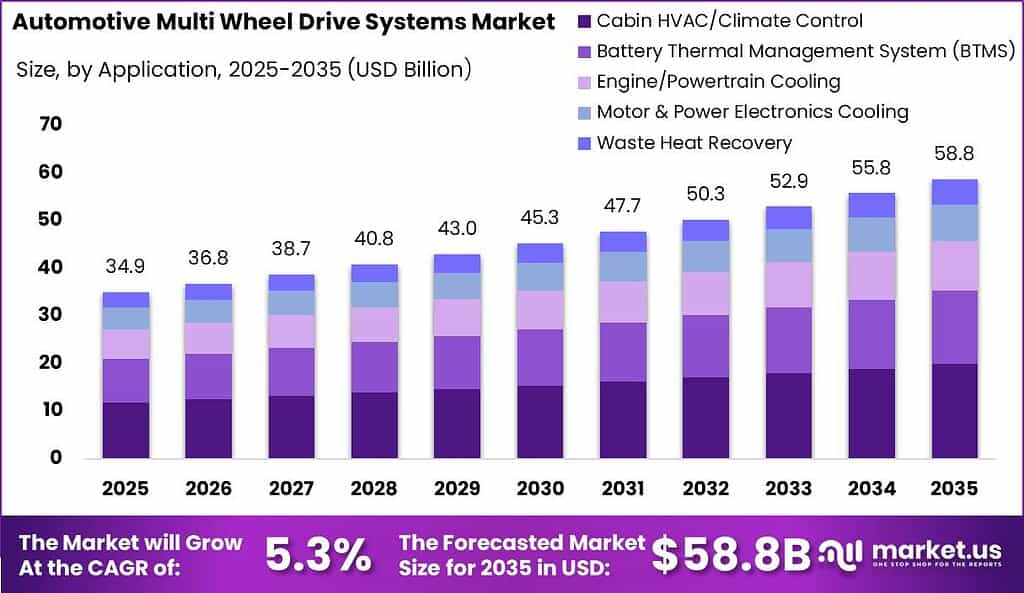
Global Automotive Multi Wheel Drive Systems Market size is expected to be worth around USD 58.8 Billion by 2035 from USD 34.9 Billion in 2025, growing at a CAGR of 5.3% during the forecast period 2026 to 2035.
The automotive multi wheel drive systems market covers mechanical, electronic, and software-integrated driveline technologies that distribute torque across two or more axles or individual wheels. This market spans transfer cases, electronically controlled couplings, torque-vectoring modules, and associated control units. It serves passenger cars, light commercial vehicles, trucks, and buses across all major powertrain architectures.
Key Takeaways
- The global Automotive Multi Wheel Drive Systems Market is valued at USD 34.9 Billion in 2025 and is forecast to reach USD 58.8 Billion by 2035.
- The market grows at a CAGR of 5.3% from 2026 to 2035.
- By Application, Cabin HVAC/Climate Control dominates with a 34.00% share.
- By Technology, Liquid-based Coolant Systems leads with a 42.00% share.
- By Component, Heat Exchangers hold the largest share at 46.00%.
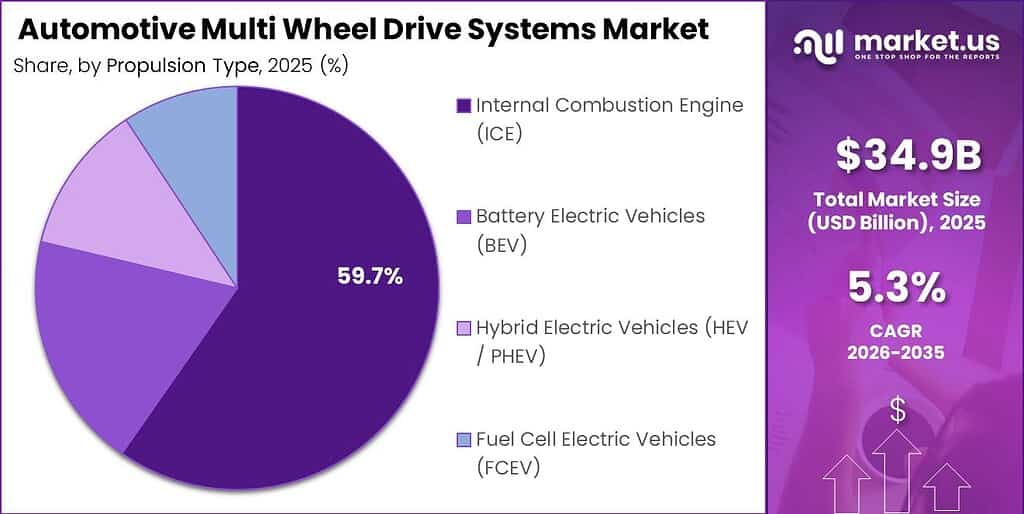
- By Propulsion Type, Internal Combustion Engine vehicles account for 59.70% of the market.
- By Vehicle Type, Passenger Cars dominate with a 60.20% share.
- Asia Pacific is the dominant region with a 36.50% market share, valued at USD 12.74 Billion.
Asia Pacific commands the largest regional share at 36.50%, reflecting the region’s high-volume SUV and crossover production base in China, Japan, and South Korea. This concentration signals that suppliers without a strong Asia Pacific manufacturing or partnership footprint face structural disadvantage in competing for high-volume AWD program awards.
In March 2026, Magna International unveiled its DHD REX dedicated hybrid drive for range-extended electric vehicles, targeting B- through E-segment AWD layouts including SUVs. This move reflects supplier recognition that hybrid AWD architectures represent the next high-volume fitment wave. OEMs sourcing AWD systems for hybrid platforms now have a modular, scalable supplier option that reduces development risk.
As per our research, Toyota’s updated AWD bZ4X, scheduled for European launch in the second half of 2025, targets a 252 kW output, a 520 km range, and 0–100 km/h acceleration of 5.1 seconds, with its longer-range battery extending range by approximately 70 km over the previous model. This performance uplift shows that battery-electric AWD platforms are closing the range gap with ICE alternatives. Tier 1 suppliers who align their electric rear-axle and coupling roadmaps to these performance benchmarks will capture more program awards as EV AWD volumes scale.
As reported by BMW Group press data, the 2026 BMW M2 with M xDrive reaches 0–100 km/h in 3.7 seconds, 0.3 seconds faster than its rear-wheel-drive equivalent, and hits 200 km/h in 12.8 seconds. This performance gap reinforces OEM investment in multi-wheel-drive as a measurable differentiator in the performance segment, creating sustained demand for precision torque-management hardware and calibration software.
Type Analysis
Cabin HVAC/Climate Control dominates with 34.00% due to cabin comfort integration across all vehicle segments.
In 2025, Cabin HVAC/Climate Control held a dominant market position in the By Application segment of the Automotive Multi Wheel Drive Systems Market, with a 34.00% share. This segment leads because climate management directly impacts driver comfort and is treated as a non-negotiable fitment across passenger cars, SUVs, and commercial vehicles. Suppliers serving this application benefit from high fitment rates and relatively stable demand regardless of powertrain type.
Engine/Powertrain Cooling ranks as the second largest application because every internal combustion, hybrid, and fuel cell vehicle requires dedicated thermal management to sustain performance under load. As ICE and hybrid volumes remain high through the forecast period, powertrain cooling demand provides a reliable revenue base for heat exchanger and pump suppliers. This stability allows suppliers to plan long-cycle capital expenditures with lower demand risk.
Battery Thermal Management Systems represent the fastest-shifting application as battery electric vehicle adoption increases across all major markets. Precision thermal control directly affects battery longevity, range, and charge speed, making it a high-value engineering content area. Suppliers that invest in integrated BTMS module development now are positioned to capture a disproportionate share of BEV program awards in the medium term.
Motor and Power Electronics Cooling and Waste Heat Recovery collectively address the remaining application demand. Both serve electrified powertrains and become more relevant as BEV and HEV/PHEV vehicle volumes expand. Waste Heat Recovery in particular offers a pathway for suppliers to add energy efficiency value to existing thermal system contracts, supporting content-per-vehicle growth without requiring entirely new product categories.
Technology Analysis
Liquid-based Coolant Systems dominates with 42.00% due to superior heat transfer efficiency across all powertrain types.
In 2025, Liquid-based Coolant Systems held a dominant market position in the By Technology segment of the Automotive Multi Wheel Drive Systems Market, with a 42.00% share. Liquid cooling delivers higher thermal conductivity than air-based alternatives, making it the default choice for high-load powertrain and battery applications. This structural advantage ensures continued supplier investment in liquid cooling component development and manufacturing capacity.
Air-based Thermal Management retains relevance in lower-cost vehicle segments and specific auxiliary applications where system weight, cost, and packaging simplicity outweigh raw thermal performance. This technology supports demand in emerging markets where cost sensitivity shapes fitment decisions. Suppliers serving these regions with air-based solutions maintain volume even as electrification shifts premium applications toward liquid and refrigerant systems.
Refrigerant-based Systems serve applications requiring both heating and cooling, particularly cabin climate control and battery conditioning in BEV platforms. Their dual-function capability makes them a natural fit for integrated thermal architectures that manage multiple vehicle systems through a single refrigerant loop. This integration potential creates upsell opportunities for suppliers capable of delivering full-system thermal solutions rather than isolated components.
Phase Change Material systems remain a lower-volume but technically differentiated technology, suited to peak-load buffering in battery and power electronics applications. As thermal duty cycles in BEVs intensify with faster charging rates, PCM solutions offer a passive thermal buffer that complements active liquid and refrigerant systems. Suppliers with PCM capabilities can position these solutions as cost-effective performance enhancers in next-generation battery thermal architectures.
Component Analysis
Heat Exchangers dominates with 46.00% due to universal fitment across all thermal management applications.
In 2025, Heat Exchangers held a dominant market position in the By Component segment of the Automotive Multi Wheel Drive Systems Market, with a 46.00% share. Every vehicle thermal management system requires at least one heat exchange surface, giving this component category the broadest addressable base across ICE, HEV, PHEV, BEV, and FCEV platforms. This universality provides suppliers with cross-platform volume and reduces exposure to single-powertrain demand cycles.
Compressors and Pumps are the active fluid-moving components in both liquid and refrigerant-based thermal systems, and their performance directly determines system efficiency. Rising electrification increases demand for electrically driven pumps and compressors rather than belt-driven alternatives, creating a product transition opportunity for suppliers already present in the ICE thermal supply chain. Firms that complete this transition early secure incumbency in high-volume BEV programs.
Valves and Manifolds control fluid routing across increasingly complex multi-circuit thermal architectures, particularly in vehicles managing simultaneous cabin, battery, and powertrain thermal loads. Their functional complexity grows with system integration requirements, raising the engineering content and value per unit. Suppliers with software-integrated valve control capabilities are better positioned to capture integrated thermal module contracts.
Thermal Modules and Control Units represent the intelligence layer of thermal management, coordinating multiple components into a unified system response. As OEMs shift toward software-defined thermal strategies, control unit suppliers gain leverage in the value chain. Compressors and Pumps, Valves and Manifolds, and Thermal Modules together hold the remaining market share, with control unit suppliers particularly well-placed as system complexity increases.
Propulsion Type Analysis
Internal Combustion Engine (ICE) dominates with 59.70% due to its entrenched installed base across global vehicle production.
In 2025, Internal Combustion Engine vehicles held a dominant market position in the By Propulsion Type segment of the Automotive Multi Wheel Drive Systems Market, with a 59.70% share. ICE platforms require comprehensive thermal management across engine cooling, transmission, cabin HVAC, and exhaust systems, supporting broad component demand per vehicle. This multi-application footprint sustains supplier revenue even as individual powertrain volumes gradually shift toward electrification.
Battery Electric Vehicles represent the highest-growth propulsion segment as OEMs expand their electric lineups with performance-oriented AWD configurations. The 2026 Cadillac LYRIQ-V’s dual-motor AWD system delivers an estimated 615 hp and 650 lb-ft of torque, with a manufacturer-estimated 0–60 mph time of 3.3 seconds in Velocity Max mode. This performance benchmark demonstrates that BEV thermal management must support sustained high-output operation, raising the engineering value of BTMS and power electronics cooling solutions.
Hybrid Electric Vehicles, including HEV and PHEV architectures, occupy a structural middle position that requires simultaneous ICE and electric thermal management, increasing per-vehicle component count. Market.us data shows Toyota’s AWD C-HR+ targets a development output of 252 kW, a 525 km cruising range, and 0–100 km/h acceleration of 5.2 seconds for its European launch. This positions hybrid AWD platforms as a sustained demand bridge for suppliers serving both ICE and electric thermal system architectures. Fuel Cell Electric Vehicles hold the smallest propulsion share but represent a long-cycle technology investment for suppliers willing to develop hydrogen-compatible thermal solutions ahead of broader commercialization.
Vehicle Type Analysis
Passenger Cars dominates with 60.20% due to their largest production volume across all global markets.
In 2025, Passenger Cars held a dominant market position in the By Vehicle Type segment of the Automotive Multi Wheel Drive Systems Market, with a 60.20% share. The segment’s scale reflects the global primacy of the passenger car as the baseline personal mobility platform, ensuring consistent thermal management system demand across all powertrain types. BMW Group press data confirms that the 2026 BMW iX xDrive60’s dual-motor AWD system produces 536 hp and achieves an expected range of up to 547 km, approximately 10% above its predecessor. This range improvement illustrates that thermal efficiency gains directly expand the performance envelope of premium electric passenger cars.
Light Commercial Vehicles represent the second largest vehicle type segment and carry unique thermal management requirements driven by variable load cycles, extended operating hours, and multi-climate deployment. The 2026 Subaru Trailseeker’s revised dual-motor Symmetrical AWD system produces 375 hp and accelerates from 0–60 mph in 4.4 seconds, with a 74.7-kWh battery capable of charging to 80% in as little as 28 minutes at up to 150 kW. This fast-charge capability highlights the thermal load management demands placed on BTMS in electrified light commercial and utility platforms, creating a high-value engineering opportunity for thermal system suppliers.
Heavy Trucks and Buses hold the remaining vehicle type share and present distinct thermal management challenges due to high sustained power outputs, long duty cycles, and increasingly stringent emissions requirements. Electrification of commercial vehicles in this category is at an earlier stage than passenger cars but carries higher per-unit thermal content value. Suppliers who develop scalable heavy-duty thermal module solutions now will be structurally advantaged as fleet electrification mandates tighten in Europe and China.
Key Market Segments
By Application
- Engine/Powertrain Cooling
- Battery Thermal Management System (BTMS)
- Cabin HVAC/Climate Control
- Motor & Power Electronics Cooling
- Waste Heat Recovery
By Technology
- Liquid-based Coolant Systems
- Air-based Thermal Management
- Refrigerant-based Systems
- Phase Change Material (PCM)
By Component
- Heat Exchangers
- Radiators
- Condensers
- Evaporators
- Chillers
- Heater Cores
- Compressors & Pumps
- Valves & Manifolds
- Thermal Modules & Control Units
By Propulsion Type
- Internal Combustion Engine (ICE)
- Battery Electric Vehicles (BEV)
- Hybrid Electric Vehicles (HEV / PHEV)
- Fuel Cell Electric Vehicles (FCEV)
By Vehicle Type
- Passenger Cars
- Light Commercial Vehicles (LCVs)
- Heavy Trucks & Buses (HCVs)
Regional Analysis
Asia Pacific Dominates the Automotive Multi Wheel Drive Systems Market with a Market Share of 36.50%, Valued at USD 12.74 Billion
Asia Pacific leads the global market with a 36.50% share valued at USD 12.74 Billion, driven by China’s dominance in both ICE and BEV vehicle production and Japan’s and South Korea’s strength in hybrid platforms. This regional concentration means that suppliers without localized manufacturing or joint ventures in China face significant cost and lead-time disadvantages when competing for high-volume OEM thermal system contracts.
North America functions as the fastest-growing premium and performance AWD market, where electrified AWD configurations command higher thermal content per vehicle than in any other region. The 2026 Subaru Outback reduced lateral body sway by 42% versus its predecessor and cut wind noise by 10% while retaining 8.7 inches of ground clearance, illustrating how NVH and structural refinement accompany AWD upgrades in this market. Suppliers serving North American OEMs must deliver thermal solutions that support both performance and refinement targets simultaneously.
Europe remains a structurally important market for multi-wheel-drive thermal systems, with regulatory pressure accelerating the transition from ICE to hybrid and electric AWD platforms. The region’s emissions compliance targets create near-term demand for refrigerant-based and integrated thermal module solutions across passenger car and commercial vehicle segments. Suppliers with established European OEM relationships are positioned to convert ICE thermal supply contracts into electrified platform awards as OEM product cycles renew.
Key Regions and Countries
North America
- US
- Canada
Europe
- Germany
- France
- The UK
- Spain
- Italy
- Rest of Europe
Asia Pacific
- China
- Japan
- South Korea
- India
- Australia
- Rest of APAC
Latin America
- Brazil
- Mexico
- Rest of Latin America
Middle East and Africa
- GCC
- South Africa
- Rest of MEA
Drivers
Consumer and fleet migration toward sport-utility vehicles and crossovers raises the AWD fitment rate across driveline, coupling, and torque-management systems because these vehicle architectures carry higher traction and all-weather expectations than conventional passenger cars. A multi-wheel-drive package can add approximately 50–120 kilograms of mechanical and electronic content in a conventional configuration, supporting an estimated +1.4% contribution to the 5.3% baseline CAGR. Suppliers benefit through higher-value module sales, but must increasingly deliver integrated rear-drive modules and calibrated control software rather than standalone mechanical components.
| Driver | (~) % Impact on CAGR Forecast | Geographic Relevance | Impact Timeline |
|---|---|---|---|
| SUV and Crossover Mix | +1.4% | China, North America, Europe | Short term (≤ 2 years) |
| Electrified AWD Architectures | +1.2% | China, Europe, North America, Japan | Medium term (2–4 years) |
| Traction Safety Demand | +0.9% | North America, Europe, Japan, South Korea | Short term (≤ 2 years) |
| Premium Vehicle Content | +0.7% | China, North America, Europe, Gulf markets | Short term (≤ 2 years) |
| Pickup and Utility Demand | +0.6% | North America, Australia, Middle East | Short term (≤ 2 years) |
| Climate Resilience Features | +0.5% | North America, Europe, Northeast Asia | Medium term (2–4 years) |
Restraints
Multi-wheel-drive systems remain structurally constrained in lower-price vehicle segments because they require additional gears, shafts, clutches, bearings, control modules, sensors, and assembly operations relative to front-wheel-drive alternatives. A conventional mechanical system can add roughly 8%–15% to drivetrain bill-of-material cost and introduce approximately 50–120 kilograms of additional mass. This cost gap creates an immediate exclusion risk for entry trims, deducts an estimated -1.3% from the baseline CAGR, and compresses supplier margins through price-down negotiations.
| Restraint | (~) % Impact on CAGR Forecast | Geographic Relevance | Impact Timeline |
|---|---|---|---|
| System Cost Premium | -1.3% | Global, highest in price-sensitive markets | Short term (≤ 2 years) |
| Efficiency Compliance Pressure | -1.0% | Europe, China, North America | Short term (≤ 2 years) |
| Entry-Trim Decontenting | -0.8% | India, ASEAN, Latin America, Europe | Short term (≤ 2 years) |
| Vehicle Affordability Constraints | -0.7% | North America, Europe, emerging markets | Short term (≤ 2 years) |
| Legacy Driveline Overcapacity | -0.6% | Europe, Japan, North America | Medium term (2–4 years) |
| Maintenance Cost Concern | -0.5% | Global | Short term (≤ 2 years) |
Challenges
Effective multi-wheel drive requires continuous torque allocation among axles and, in advanced systems, individual wheels under changing traction, speed, steering angle, load transfer, and powertrain conditions. A calibrated controller may process inputs from more than 10 vehicle signals and execute torque commands in milliseconds, while validating multiple terrain and fault modes across numerous vehicle derivatives. This complexity produces an estimated -1.1% friction drag through longer simulation cycles, higher software costs, and repeated hardware-in-the-loop validation, requiring suppliers to invest in reusable control libraries and digital-twin models.
| Challenge | (~) % CAGR Friction Drag | Geographic Relevance | Mitigation Horizon |
|---|---|---|---|
| Torque Control Calibration | -1.1% | Global | Medium term (2–4 years) |
| Software Validation Complexity | -0.9% | China, Europe, North America, Japan | Medium term (2–4 years) |
| Driveline NVH Management | -0.8% | Global, highest in premium segments | Long term (≥ 4 years) |
| Thermal Load Durability | -0.7% | Global, highest in hot-climate markets | Long term (≥ 4 years) |
| Electromagnetic Compatibility Testing | -0.6% | Global | Medium term (2–4 years) |
| Specialist Talent Scarcity | -0.5% | Europe, North America, Japan, South Korea | Long term (≥ 4 years) |
Opportunities
Software-defined torque services represent a structural revenue expansion opportunity because most multi-wheel-drive systems are still monetized as fixed-calibration hardware, leaving paid drive modes, terrain packages, and fleet analytics largely unmonetized. A common control platform can enable activation of towing, snow, trail, or performance modes without replacing physical driveline hardware, potentially raising lifetime revenue per vehicle by approximately 8%–20%. Successful execution could add +1.2% above the 5.3% baseline CAGR through recurring gross-margin expansion for suppliers and OEMs who structure these agreements early.
| Opportunity | (~) % Potential CAGR Upside | Geographic Relevance | Execution Window |
|---|---|---|---|
| Software-Defined Torque Services | +1.2% | China, North America, Europe, Japan | Medium term (2–4 years) |
| Electric Rear-Axle Retrofits | +1.0% | Europe, North America, China | Long term (≥ 4 years) |
| Commercial Off-Road Platforms | +0.9% | North America, Europe, China, Australia | Medium term (2–4 years) |
| Predictive Terrain Management | +0.8% | North America, Europe, China, Japan | Long term (≥ 4 years) |
| Fleet Uptime Contracts | +0.7% | North America, Europe, China | Medium term (2–4 years) |
| Modular Driveline Consolidation | +0.6% | Global | Medium term (2–4 years) |
Key Company Insights
BorgWarner Inc. holds a competitive advantage in electrified AWD through its Gen VI Cross Wheel Drive system featuring an electronic limited-slip differential and its torque-on-demand transfer case for pickup trucks. In January 2025, American Axle & Manufacturing agreed to acquire Dowlais Group, including GKN Automotive, for approximately USD 1.44 billion, adding a major AWD and driveline specialist to its portfolio and creating a combined entity with significantly broader program coverage.
Magna International Inc. competes across AWD system design and integration, with its March 2026 DHD REX hybrid drive announcement expanding its addressable market into range-extended EV platforms for B- through E-segment vehicles. General Motors’ 2026 Corvette ZR1X demonstrates the performance ceiling that AWD hardware suppliers must now engineer to, with its electrified front drive unit generating 186 hp and 145 lb-ft and total system output reaching 1,250 hp. This performance bar sets a new benchmark for thermal and torque management durability in high-output AWD applications.
Key Players
- BorgWarner Inc.
- Magna International Inc.
- GKN Automotive
- ZF Friedrichshafen AG
- Continental AG
- JTEKT Corporation
- Dana Incorporated
- American Axle & Manufacturing (AAM)
- Aisin Corporation
- Schaeffler AG
- Oerlikon AG (Graziano)
- Eaton Corporation plc
- Toyota Motor Corporation
- Ford Motor Company
- General Motors Company
Recent Developments
- October 2025 – BorgWarner Inc. secured multiple Chery contracts to supply a torque-on-demand transfer case with mechanical lock for pickup trucks and its Gen VI Cross Wheel Drive system with electronic limited-slip differential for SUVs, with mass production scheduled for 2027.
- October 2025 – AISIN Corporation, BluE Nexus, and DENSO launched a newly developed high-efficiency eAxle for Toyota’s new bZ4X, comprising a 167 kW front unit and an 88 kW rear unit applicable to its multi-axle electric drivetrain.
- February 2026 – American Axle & Manufacturing, operating as Dauch Corporation, completed its acquisition of Dowlais Group and its GKN Automotive and GKN Powder Metallurgy subsidiaries, formally consolidating one of the largest AWD driveline portfolios in the industry.
Report Scope
| Report Features | Description |
|---|---|
| Market Value (2025) | USD 34.9 Billion |
| Forecast Revenue (2035) | USD 58.8 Billion |
| CAGR (2026-2035) | 5.3% |
| Base Year for Estimation | 2025 |
| Historic Period | 2020-2024 |
| Forecast Period | 2026-2035 |
| Report Coverage | Revenue Forecast, Market Dynamics, Market Opportunity Analysis, Technology and Innovation Landscape, Competitive Landscape, Recent Developments |
| Segments Covered | By Application (Engine/Powertrain Cooling, Battery Thermal Management System (BTMS), Cabin HVAC/Climate Control, Motor & Power Electronics Cooling, Waste Heat Recovery), By Technology (Liquid-based Coolant Systems, Air-based Thermal Management, Refrigerant-based Systems, Phase Change Material (PCM)), By Component (Heat Exchangers (Radiators, Condensers, Evaporators, Chillers, Heater Cores), Compressors & Pumps, Valves & Manifolds, Thermal Modules & Control Units), By Propulsion Type (Internal Combustion Engine (ICE), Battery Electric Vehicles (BEV), Hybrid Electric Vehicles (HEV / PHEV), Fuel Cell Electric Vehicles (FCEV)), By Vehicle Type (Passenger Cars, Light Commercial Vehicles (LCVs), Heavy Trucks & Buses (HCVs)) |
| Regional Analysis | North America (US and Canada), Europe (Germany, France, The UK, Spain, Italy, and Rest of Europe), Asia Pacific (China, Japan, South Korea, India, Australia, and Rest of APAC), Latin America (Brazil, Mexico, and Rest of Latin America), Middle East and Africa (GCC, South Africa, and Rest of MEA) |
| Competitive Landscape | BorgWarner Inc., Magna International Inc., GKN Automotive, ZF Friedrichshafen AG, Continental AG, JTEKT Corporation, Dana Incorporated, American Axle & Manufacturing (AAM), Aisin Corporation, Schaeffler AG, Oerlikon AG (Graziano), Eaton Corporation plc, Toyota Motor Corporation, Ford Motor Company, General Motors Company |
| Customization Scope | Customization for segments, region/country-level will be provided. Additional customization can be done based on requirements. |
| Purchase Options | We have three licenses to opt for: Single User License, Multi-User License (Up to 5 Users), Corporate Use License (Unlimited User and Printable PDF) |





































