


Report Overview
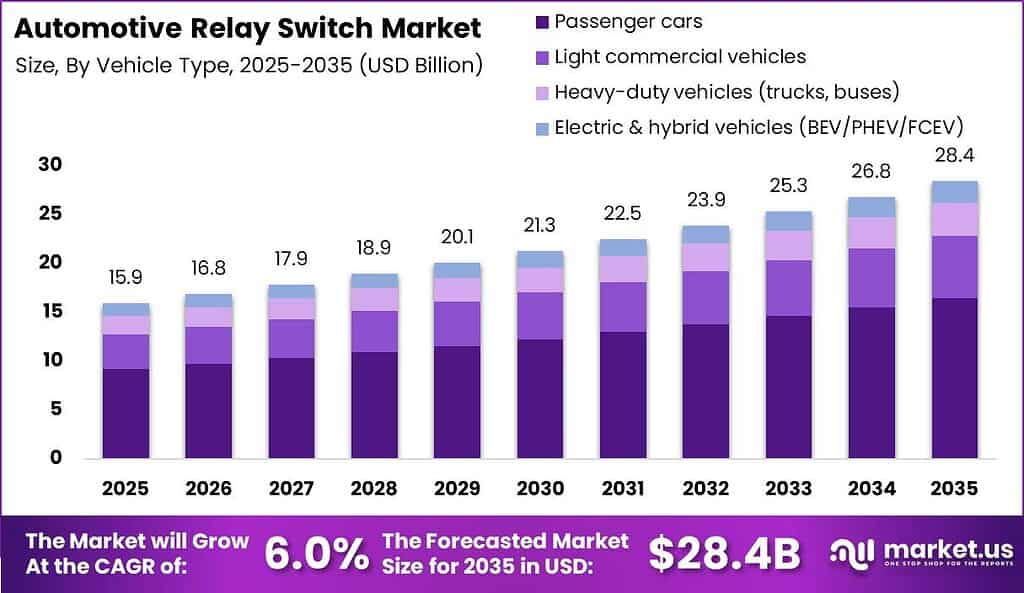
Global Automotive Relay Switch Market size is expected to be worth around USD 28.40 Billion by 2035 from USD 15.90 Billion in 2025, growing at a CAGR of 6.0% during the forecast period 2026 to 2035. This trajectory rewards suppliers that convert platform design wins into multi-year content growth. Investors should treat relay switching as a rising share of vehicle electrical bill of materials rather than a static commodity line.
However, the market covers electromechanical and related devices that open and close current paths across body, powertrain, convenience, and safety circuits. Type, application, vehicle class, and load rating define how buyers qualify parts and set price bands. This structure creates clear entry gates for high-voltage specialists and volume PCB suppliers alike.
Key Takeaways
- The Automotive Relay Switch market reaches USD 15.90 Billion in 2025 and USD 28.40 Billion by 2035 at a 6.0% CAGR.
- PCB relays lead By Type with a 62.2% share.
- Body and chassis lead By Application with a 32.2% share.
- Passenger cars lead By Vehicle Type with a 57.7% share.
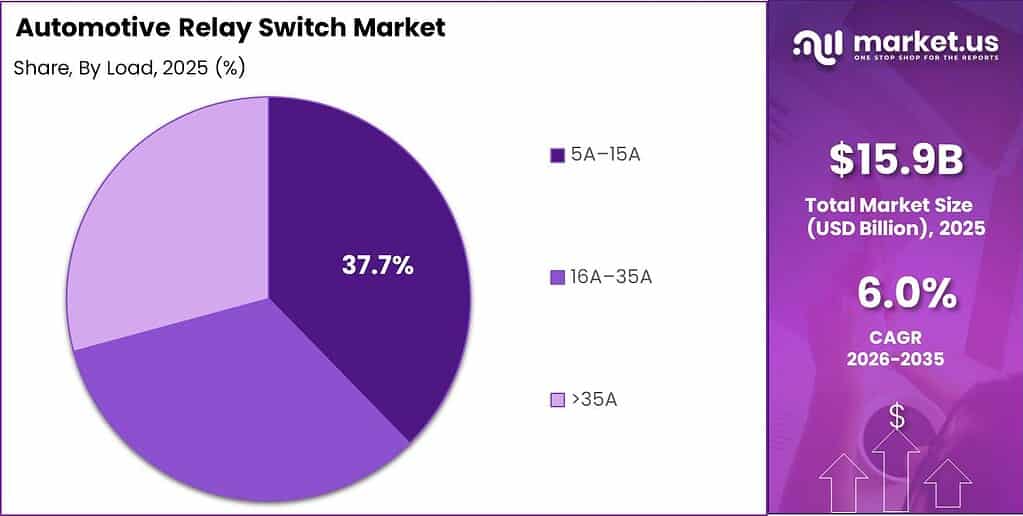
- The 5A to 15A class leads By Load with a 37.7% share and is the fastest growing load band.
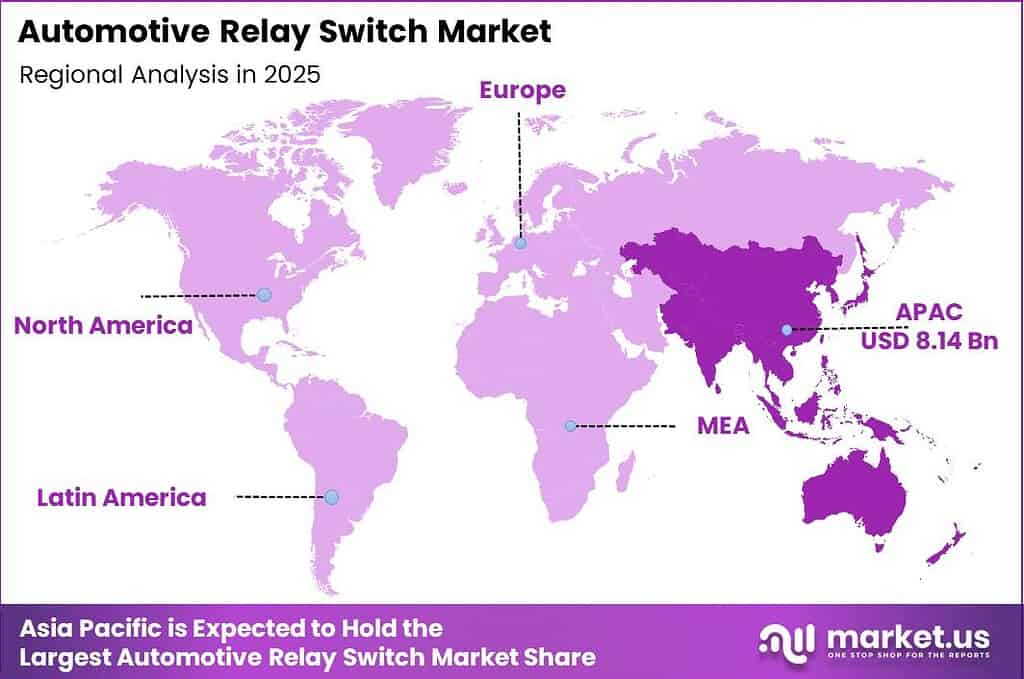
- Asia Pacific leads regionally with a 51.2% share valued at USD 8.14 Billion.
- High-voltage relays, safety and security / ADAS, and electric and hybrid vehicles are the fastest growing sub-segments in their groups.
As per our research, common automotive relays serve 12 V, 24 V, and even 48 V vehicle power systems as architectures diversify. This voltage spread forces dual qualification programs and multi-rating inventories. OEMs that lock suppliers able to cover all three rails reduce redesign risk on next-cycle platforms. In June 2024, Panasonic introduced the HE-A Series and LQ Series power relays, strengthening high-power switching for electrification programs.
Therefore, coil behavior becomes a direct design constraint for body control and power distribution modules. Based on Farnell datasheet data, a representative CMA56H unit lists 180 ohm coil resistance, 6.5 V operate voltage, 1.2 V release voltage, and about 0.8 W coil power. These thresholds guide pull-in margins in noisy 12 V nets. Vendors who publish tight coil windows win faster electrical architecture sign-off.
As a result, growth in electrified and feature-rich vehicles raises relay count per platform rather than only unit vehicle sales. Higher circuit density in windows, HVAC, ADAS actuators, and battery disconnect paths multiplies switch points. This means content-per-vehicle gains can outpace soft production years for suppliers already tooled for high-reliability automotive grades.
Type Analysis
PCB relays dominate with 62.2% due to compact board-level integration density.
In 2025, PCB relays held a dominant market position in the By Type segment of Automotive Relay Switch Market, with a 62.2% share. According to Panasonic catalog data, the TB Series ACTBPDR4V switches 30 A at 14 V DC in a 1 Form A PCB layout for 12 V systems. This rating fits dense body control boards where harness space is scarce. Suppliers who pair ampacity with low board footprint secure the largest OEM module sockets.
Plug-in relays remain the serviceable backbone for under-hood and cabin power distribution where field replacement matters. Figures from a Farnell CMA56H datasheet show 25 A inrush at 14 V DC for motor loads, 20 A resistive at 14 V DC, and 10 A at 24 V DC. These dual-voltage ratings support both light passenger and commercial electrical nets. Fleets that standardize plug-in footprints cut downtime and parts complexity.
High-voltage relays are the fastest growing type as battery packs move well above legacy low-voltage rails. Data from the IEA Global EV Outlook shows electric car sales exceeded 20 million in 2025 and reached about one-quarter of new cars sold. In November 2025, Panasonic introduced the EV-B Series automotive relay and DC contactor with a 2,000A cut-off capacity at 500V DC. This signals premium ASP capture for qualified high-voltage lines. Other relays hold the remaining share collectively for niche and legacy sockets.
Application Analysis
Body and chassis dominates with 32.2% due to high circuit count per vehicle.
In 2025, Body and chassis held a dominant market position in the By Application segment of Automotive Relay Switch Market, with a 32.2% share. As reported by Kynix technical comparison data, the A9 Series reaches 40 A switching, 420 W maximum switching power, 10,000,000 mechanical operations, and contact resistance under 50 mOhm. These durability marks matter for door, lighting, and chassis loads that cycle daily. Vendors who prove low contact resistance reduce warranty heat and voltage-drop complaints.
Powertrain system relays switch cooling fans, fuel pumps, and related actuators under sustained electrical stress. TE Connectivity F4 mini ISO data specifies maximum switching of 40 A at 14 V DC and 20 A at 28 V DC on single contacts, plus up to 2 x 25 A at 14 V DC on double contacts, with uses in ABS control, cooling fans, electric power steering, and fuel pumps. This duty mix favors parts with proven thermal derating curves. Powertrain buyers will pay for validated continuous ratings over brochure peak claims.
Convenience loads covering windows, seats, and HVAC add many medium-current switched paths as trim levels rise. IEA data shows Chinese automakers supplied 60% of global electric car sales in 2025, concentrating module demand in Asia-linked supply chains. Higher convenience content still multiplies relay sockets even when powertrain type varies. Tier-ones that modularize comfort relay packs scale across ICE and EV trims with one validated family.
Safety and security / ADAS is the fastest growing application as assisted driving raises actuator and power-path counts. IEA figures show Europe lifted electric car sales more than 30% to a 28% sales share in 2025, reinforcing premium electrical architectures. This creates pull for safety-qualified switching with strict failure-mode documentation. Other applications hold the remaining share collectively across residual vehicle functions.
Vehicle Type Analysis
Passenger cars dominate with 57.7% due to global volume production scale.
In 2025, Passenger cars held a dominant market position in the By Vehicle Type segment of Automotive Relay Switch Market, with a 57.7% share. OICA-linked 2025 production tallies place China near 30.3 million passenger cars, anchoring global relay unit demand. High car output multiplies standardized PCB and plug-in sockets at the lowest tooling cost per unit. Suppliers aligned to Chinese and broader Asia car platforms capture the densest order books.
Light commercial vehicles need durable switching for stop-start delivery cycles and accessory power take-off. IEA data shows electric car sales in Southeast Asia reached a share near 20% in 2025 as emerging fleets electrify. Fleet buyers prize long mechanical life and simple plug-in service over ultra-compact PCB layouts. Relay makers who offer commercial-grade temperature screens win municipal and logistics tenders.
Heavy-duty vehicles including trucks and buses stress contacts with higher continuous loads and harsher vibration. IEA reporting shows electric truck sales reached 9% of global truck sales in 2025, while one in four trucks sold in China was electric. This mix lifts demand for high-current and high-voltage contactors on commercial platforms. Early heavy-duty qualifications open multi-year program revenue above passenger ASP norms.
Electric and hybrid vehicles spanning BEV, PHEV, and FCEV are the fastest growing vehicle class for relay content. IEA data records almost 22 million electric cars produced globally in 2025, with China near 75% of that output. Each electrified platform adds battery disconnect and distribution switching that legacy ICE packs never required. This means EV mix gains raise relay value per vehicle faster than unit production alone.
Load Analysis
5A to 15A dominates with 37.7% due to widespread low-to-mid circuit demand.
In 2025, 5A to 15A held a dominant market position in the By Load segment of Automotive Relay Switch Market, with a 37.7% share, and it is also the fastest growing load band. An FCL Components guide lists a compact 40 A class device rated from -40 C to +125 C with nominal coil power about 0.477 W to 1.045 W, showing how automotive parts span wide thermal and coil budgets. Lower load bands still dominate socket count across signal and accessory paths. Vendors who optimize coil watts reduce module thermal load and standby drain.
The 16A to 35A band serves many motor and resistive loads in mainstream body and power distribution. Another Farnell automotive relay datasheet rates 35 A normally open and 20 A normally closed at 14 V DC, with maximum operating voltage of 16 V DC and coil resistance of 72 ohm +/- 15%. These numbers define a common high-current changeover class for 12 V nets. Platform teams use such bands to consolidate SKUs without jumping to contactor-class hardware.
Loads above 35A concentrate in power-hungry actuators and electrified distribution nodes. IEA analysis notes the global EV fleet avoided about 1.7 million barrels of oil per day in 2025, underscoring how electrified road transport scales high-power electrical hardware. Higher amp classes command stricter arc control and thermal design. Suppliers with proven greater-than-35 A families capture the richest content on EV and performance platforms.
Key Market Segments
By Type
- PCB relays
- Plug-in relays
- High-voltage relays
- Other relays
By Application
- Body and chassis
- Powertrain system
- Convenience (windows, seats, HVAC, etc.)
- Safety and security / ADAS
- Other applications
By Vehicle Type
- Passenger cars
- Light commercial vehicles
- Heavy-duty vehicles (trucks, buses)
- Electric and hybrid vehicles (BEV/PHEV/FCEV)
By Load
- 5A to 15A
- 16A to 35A
- Greater than 35A
Regional Analysis
Asia Pacific Dominates the Automotive Relay Switch Market with a Market Share of 51.2%, Valued at USD 8.14 Billion
Asia Pacific leads with 51.2% share and USD 8.14 Billion value on the back of concentrated vehicle assembly and electronics manufacturing. Regional scale lets relay plants sit close to body control and power distribution module lines. This proximity shortens logistics cycles and supports faster PPAP iterations for local OEMs. In December 2025, Hongfa automotive electronics plant in Haicang reached the topping-out stage, expanding regional relay manufacturing capacity.
Consequently, Asia Pacific also sets the pace for electrified content growth that lifts high-voltage and safety-related switching demand. Export-oriented module makers in the region feed both domestic brands and global platforms. This creates a dual revenue path for qualified relay suppliers inside Asia Pacific clusters. Outside the region, North America and Europe still matter for premium ADAS and architecture redesign programs that pull specialized high-reliability parts.
Key Regions and Countries
North America
- US
- Canada
Europe
- Germany
- France
- The UK
- Spain
- Italy
- Rest of Europe
Asia Pacific
- China
- Japan
- South Korea
- India
- Australia
- Rest of APAC
Latin America
- Brazil
- Mexico
- Rest of Latin America
Middle East and Africa
- GCC
- South Africa
- Rest of MEA
Market Dynamics
Market Opportunity Analysis - Fastest growing sub-segments and regional scale create focused entry points
High-voltage relays remain the clearest product white space inside Type, even while PCB units hold 62.2% share. Most installed base still sits on low-voltage PCB and plug-in form factors. New entrants that qualify only high-voltage contact materials can avoid head-on price wars in mature PCB catalogs. This path suits specialists targeting EV battery disconnect and distribution sockets.
Safety and security / ADAS applications grow faster than body and chassis leadership at 32.2% share implies. Body circuits are crowded with incumbent module designs and long-running dual sources. ADAS-linked switching still has open slots for parts with stronger functional-safety documentation packages. Challengers who bundle diagnostic-friendly contacts can displace older comfort-grade relays on facelift programs.
Electric and hybrid vehicles expand faster than the passenger car core that holds 57.7% share. Passenger car ICE platforms already host entrenched relay bills of materials. BEV, PHEV, and FCEV architectures add new high-power nodes that reset supplier shortlists. Early EV program wins compound because electrical architectures often carry across multiple derivatives.
However, the 5A to 15A load band at 37.7% share is both large and the fastest growing load class. Many competitors chase only greater-than-35 A headlines and under-serve dense low-to-mid circuits. Asia Pacific scale at 51.2% and USD 8.14 Billion further concentrates volume near local module plants. Regional specialists who tool 5A to 15A automotive grades close to Asia assembly hubs can undercut distant exporters on lead time.
Technology and Innovation Landscape - Contact design, thermal rating, and durability benchmarks reset supplier shortlists
Double-make contact geometry is reshaping high-load capability inside compact automotive envelopes. Panasonic TL Series ACTL3CR3V data shows a 1 Form U double-make structure rated to switch 40 A at 14 V DC with continuous energization when make-fixed contacts connect. This structure supports heavier 12 V accessory and actuator loads without jumping to contactor hardware. Manufacturers that standardize double-make families reduce SKU count while raising continuous ratings.
Therefore, published operating envelopes now decide RFQ survival as much as unit price. A 2026 automotive relay guide places typical high-current circuit ratings between 25 A and 40 A, with coil draw often 150 to 200 mA and coil resistance near 60 to 80 ohm. Buyers use these bands to screen thermal and control-circuit compatibility early. Suppliers outside the band face automatic exclusion from mainstream power distribution modules.
Harsh-environment durability metrics separate premium automotive grades from industrial transplants. Kynix comparison data on the A2S Series lists 630 W maximum switching power, shock resistance of 147 m/s2, and vibration resistance of 1.5 mm at 10 to 40 Hz, alongside 40 A switching and 10,000,000 mechanical operations. These figures matter for chassis-mounted and commercial vehicle duty. Investors should treat shock and vibration proofs as gating items for heavy-duty content gains.
As a result, innovation spend is shifting toward contact life, arc control, and wide-temperature coils rather than cosmetic package changes. Platform electrical teams now demand numeric life and resistance data before tooling kickoff. Vendors that only market form factor without durability tables lose multi-year module awards. This reflects a market where engineering transparency is becoming a commercial weapon.
Drivers
Powertrain electrification moves platforms from legacy 12V nets toward 400V and 800V battery systems. IEA and ICCT-linked fleet data show electrified models above 18% of new global light-vehicle registrations by 2025. Each high-voltage relay can price about five to twenty times a conventional 12V unit because of arc control and ISO 26262 qualification. Suppliers that retool contact materials and certification lines capture mid-to-high single-digit margin expansion while legacy volumes flatten.
This means CapEx now favors high-voltage qualification over pure low-voltage scale. Rising ADAS electrical content and safety certification rules add more switched paths per vehicle in North America, Europe, and China. Smart vehicle architectures and Asia-Pacific vehicle output growth further lift unit demand. Investors should track high-voltage mix, not only total relay shipments, when scoring supplier quality.
| Driver | (~) % Impact on CAGR Forecast | Geographic Relevance | Impact Timeline |
|---|---|---|---|
| High-voltage relay adoption from powertrain electrification | +1.8% | Global | Short term (2 years or less) |
| Rising ADAS and safety-system electrical content per vehicle | +1.4% | North America, Europe, China | Short term (2 years or less) |
| Statutory vehicle safety and electrical certification mandates | +1.0% | Global | Medium term (2 to 4 years) |
| Smart and connected vehicle architecture proliferation | +0.9% | Asia-Pacific | Short term (2 years or less) |
| Volume growth from rising vehicle output in Asia-Pacific | +0.9% | China, India, ASEAN | Short term (2 years or less) |
Restraints
Relay output still depends on silver and copper contact alloys plus automotive-grade control semiconductors. USGS-linked summaries flagged silver tightness with price swings above 15% year on year through 2025, while automotive-node chip capacity stayed constrained. Control-driver IC lead times ran 8 to 14 weeks beyond pre-pandemic norms, with backlogs extending into 2026. Assemblers absorbing spot premiums face about 150 to 250 basis points of margin pressure and delayed OEM releases.
By contrast, dual-source AEC-Q200 qualification often needs 6 to 9 months, so buyers cannot switch vendors quickly. Elevated interest rates slow OEM electrical-architecture CapEx in North America and Europe. Tariff swings disrupt US-China component flows, and EV price sensitivity cools uptake in India, Southeast Asia, and Latin America. Homologation delays freeze legacy platform redesigns and stretch revenue recognition for new relay families.
| Restraint | (~) % Impact on CAGR Forecast | Geographic Relevance | Impact Timeline |
|---|---|---|---|
| Semiconductor and contact-metal supply shortages | -1.2% | Global | Short term (2 years or less) |
| Elevated interest rates delaying OEM electrical-architecture CapEx | -0.8% | North America, Europe | Short term (2 years or less) |
| Tariff volatility disrupting cross-border component sourcing | -0.7% | United States, China | Short term (2 years or less) |
| EV price sensitivity suppressing unit uptake in cost-constrained markets | -0.5% | India, Southeast Asia, Latin America | Short term (2 years or less) |
| Homologation delays freezing legacy platform electrical redesigns | -0.4% | Global | Short term (2 years or less) |
Challenges
Electromechanical contacts still arc and heat as currents climb on high-voltage architectures. Field-failure and warranty rates for high-current relays run about 2 to 3 times those of low-voltage signal parts in AEC-Q200-linked durability benchmarks. Accelerated-life testing can add 4 to 6 months to design validation on each new platform. This friction opens a paid upgrade path into hybrid solid-state contacts and advanced heat-dissipation housings.
This creates a materials-science revenue stream even while it strains legacy lines. Solid-state hybrid designs can lift unit bill-of-materials cost by roughly 10 to 18% versus stamped-contact relays, yet they protect qualification on 800V programs. Talent gaps in power electronics and slow form-factor standardization extend changeover timelines. Suppliers that sell durability upgrades convert a technical challenge into higher-ASP replacement cycles.
| Challenge | (~) % CAGR Friction Drag | Geographic Relevance | Mitigation Horizon |
|---|---|---|---|
| Thermal and contact-durability limits | -0.9% | Global | Medium term (2 to 4 years) |
| Power-electronics talent shortfall | -0.7% | Global | Medium term (2 to 4 years) |
| Relay form-factor standardization gaps | -0.6% | Global | Medium term (2 to 4 years) |
| Extended automotive qualification cycles | -0.5% | Global | Medium term (2 to 4 years) |
| Rising R&D burden from software-defined architectures | -0.4% | Global | Long term (4 years or more) |
Opportunities
Solid-state and hybrid semiconductor relays remain early in OEM sourcing, still centered on pilots rather than mainstream lines. Removing moving contacts can cut warranty-return costs by an estimated 30 to 40% and extend switching life more than 10 times versus conventional contacts. Mature yields could support gross margins 5 to 8 percentage points above electromechanical lines after silicon-carbide and gallium-nitride costs. Early movers that book wafer-level packaging capacity before broad specification freezes will own the next design wave.
This signals a multi-year shift rather than a one-cycle option package. Vehicle-to-grid bidirectional charging, legacy fleet retrofit kits, and reshored plants under regional incentives widen the addressable base in Europe, North America, and emerging Asia. Mid-tier consolidation and electrified micro-mobility add further sockets for compact high-cycle parts. Investors should underwrite solid-state roadmaps and V2G-ready contactors as the clearest upside levers.
| Opportunity | (~) % Potential CAGR Upside | Geographic Relevance | Execution Window |
|---|---|---|---|
| Solid-state relay technology transition | +1.5% | Global | Medium term (2 to 4 years) |
| Vehicle-to-grid bidirectional charging relay demand | +1.2% | Europe, North America | Medium term (2 to 4 years) |
| Retrofit relay upgrades for legacy fleet electrification | +1.0% | India, Southeast Asia, Latin America | Long term (4 years or more) |
| Reshored relay manufacturing under regional incentive programs | +0.8% | North America, Europe | Medium term (2 to 4 years) |
| Consolidation among mid-tier relay and power-module makers | +0.7% | Global | Long term (4 years or more) |
| Adjacent electrified micro-mobility relay demand | +0.6% | Asia-Pacific | Medium term (2 to 4 years) |
Key Company Insights
TE Connectivity Ltd anchors high-current plug-in designs used across demanding vehicle power paths. Its F4 mini ISO line lists limiting continuous current of 60 A at 23 C, 40 A at 85 C, and 17 A at 125 C on normally open contacts. This thermal derating transparency helps OEMs size under-hood duty without hidden fade. The approach strengthens TE on programs that refuse ambient-only amp claims.
OMRON Corporation competes through high-capacity power switching recognition that supports electrification roadmaps. In February 2024, OMRON G9KA-E high-capacity power relay received the Electronic Products 2023 Product of the Year Award for high-current switching performance. Award-level validation shortens buyer risk reviews on elevated continuous loads. This positioning favors OMRON where OEM electrical teams need proven high-current credibility fast.
Key Players
- TE Connectivity Ltd
- OMRON Corporation
- Robert Bosch GmbH
- DENSO Corporation
- Panasonic Corporation
- HELLA GmbH & Co. KGaA
- Fujitsu
- Littelfuse, Inc.
- Mitsuba Corporation
- Hongfa (Xiamen Hongfa Electroacoustic Co., Ltd.)
- Song Chuan Precision Co., Ltd.
- Goodsky Electric Co., Ltd.
- LS Automotive
- C&K Components
- Xiamen Level King Keep Electronics
Recent Developments
- October 2024: Durakool launched the DG82M Micro-ISO automotive plug-in relay, alongside the DE40 PCB relay and DHVC300 high-voltage contactor for EV applications.
- April 2025: Durakool launched the DG86M high-current automotive relay, incorporating magnetic arc blowout technology for electrified heavy-duty vehicles.
- December 2025: Hongfa was selected for the Top 50 Supply Chain list for new-energy and intelligent connected vehicles, strengthening its automotive relay market position.
- April 2026: Hongfa released its 2025 annual report while continuing to expand its automotive relay, high-voltage DC relay and automotive electronics businesses.
Geopolitical Impact Analysis
According to UNCTAD, global maritime trade growth slowed to about 0.5% in 2025 after 2.2% in 2024, while Suez Canal tonnage remained roughly 70% below 2023 levels by May 2025. Longer Cape routes raised ton-miles about 6% in 2024 and kept container freights elevated, with the Shanghai Containerized Freight Index averaging 2,496 points in 2024, up 149% year on year. These logistics shocks lift landed cost for cross-border relay contacts, coils, and finished modules. Automotive buyers respond by dual-sourcing Asia and near-shore finishing to protect line rates.
Data from the World Bank shows metals and minerals prices rose about 3% in 2025, with copper up roughly 6% as EV and grid investment supported demand. WTO trade monitoring also warned that tariff escalation would weigh more heavily on 2026 merchandise flows after front-loaded 2025 shipments. Copper and silver-bearing contact stacks sit at the center of relay bill-of-materials inflation under these pressures. This means geopolitical freight and tariff noise translates directly into relay ASP renegotiations and inventory buffers.
Report Scope
| Report Features | Description |
|---|---|
| Market Value (2025) | USD 15.90 Billion |
| Forecast Revenue (2035) | USD 28.40 Billion |
| CAGR (2026-2035) | 6.0% |
| Base Year for Estimation | 2025 |
| Historic Period | 2020-2024 |
| Forecast Period | 2026-2035 |
| Report Coverage | Revenue Forecast, Market Dynamics, Market Opportunity Analysis, Technology and Innovation Landscape, Competitive Landscape, Recent Developments |
| Segments Covered | By Type (PCB relays, Plug-in relays, High-voltage relays, Other relays), By Application (Body and chassis, Powertrain system, Convenience (windows, seats, HVAC, etc.), Safety and security / ADAS, Other applications), By Vehicle Type (Passenger cars, Light commercial vehicles, Heavy-duty vehicles (trucks, buses), Electric and hybrid vehicles (BEV/PHEV/FCEV)), By Load (5A to 15A, 16A to 35A, Greater than 35A) |
| Regional Analysis | North America (US and Canada), Europe (Germany, France, The UK, Spain, Italy, and Rest of Europe), Asia Pacific (China, Japan, South Korea, India, Australia, and Rest of APAC), Latin America (Brazil, Mexico, and Rest of Latin America), Middle East and Africa (GCC, South Africa, and Rest of MEA) |
| Competitive Landscape | TE Connectivity Ltd, OMRON Corporation, Robert Bosch GmbH, DENSO Corporation, Panasonic Corporation, HELLA GmbH & Co. KGaA, Fujitsu, Littelfuse, Inc., Mitsuba Corporation, Hongfa (Xiamen Hongfa Electroacoustic Co., Ltd.), Song Chuan Precision Co., Ltd., Goodsky Electric Co., Ltd., LS Automotive, C&K Components, Xiamen Level King Keep Electronics |
| Customization Scope | Customization for segments, region / country-level will be provided. Additional customization can be done based on requirements. |
| Purchase Options | We have three licenses to opt for: Single User License | Multi-User License (Up to 5 Users) | Corporate Use License (Unlimited User and Printable PDF) |





































