


Report Overview
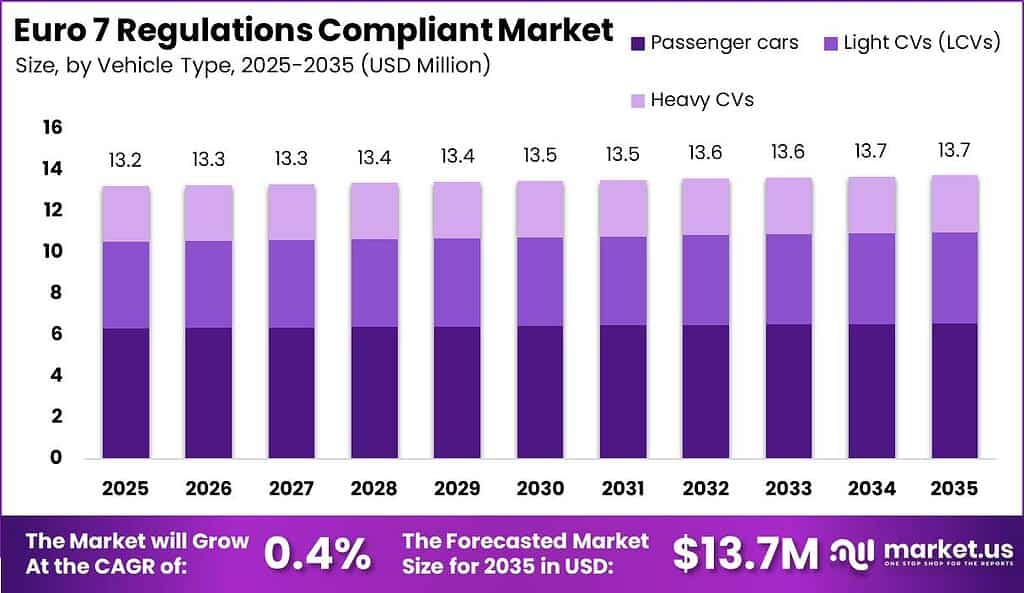
Global Euro 7 Regulations Compliant Market size is expected to be worth around USD 13.7 Million by 2035 from USD 13.2 Million in 2025, growing at a CAGR of 0.4% during the forecast period 2026 to 2035. This narrow expansion path rewards suppliers who lock multi-year compliance contracts early. Platforms that miss the first approval wave face delayed volume and higher unit certification cost.
Therefore, the market covers vehicles, after-treatment hardware, and sensors built to meet Euro 7 pollutant rules across light-duty and heavy-duty fleets. Structure splits demand by vehicle type, after-treatment architecture, sensor package, and powertrain compliance path. Buyers treat compliance as a gate to registration rather than an optional upgrade, which concentrates spend with proven system integrators.
Key Takeaways
- The market reaches USD 13.2 Million in 2025 and USD 13.7 Million by 2035 at a 0.4% CAGR.
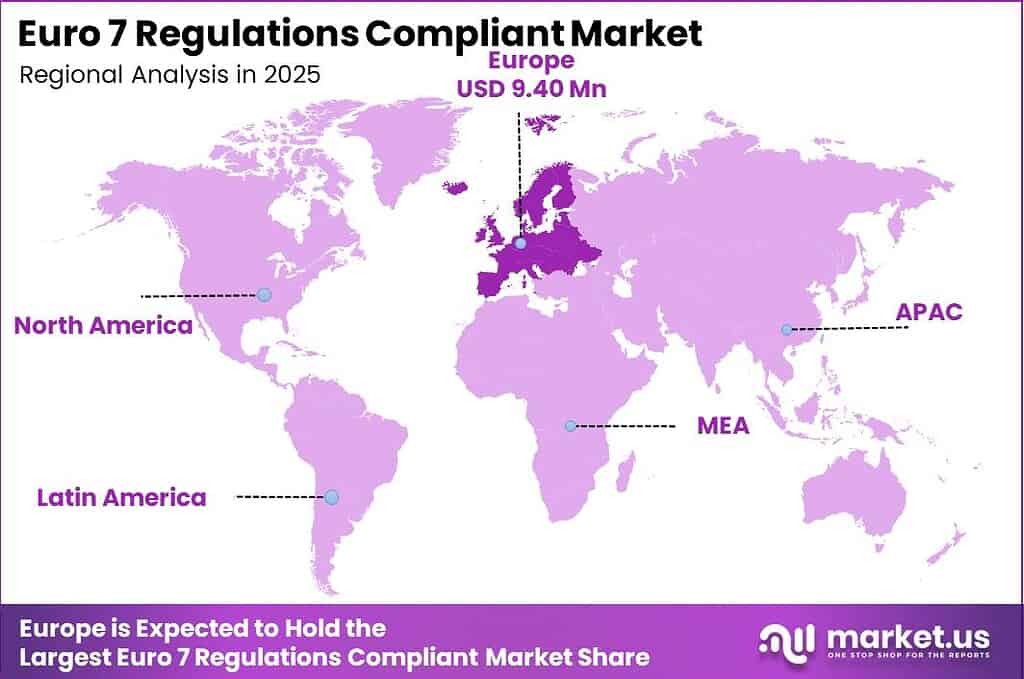
- Europe leads with a 71.1% share, valued at USD 9.40 Million.
- Passenger cars lead vehicle type with a 47.8% share.
- EGR systems lead after-treatment with a 28.3% share.
- MAP/MAF sensors lead sensor type with a 30.4% share and rank as the fastest growing sensor line.
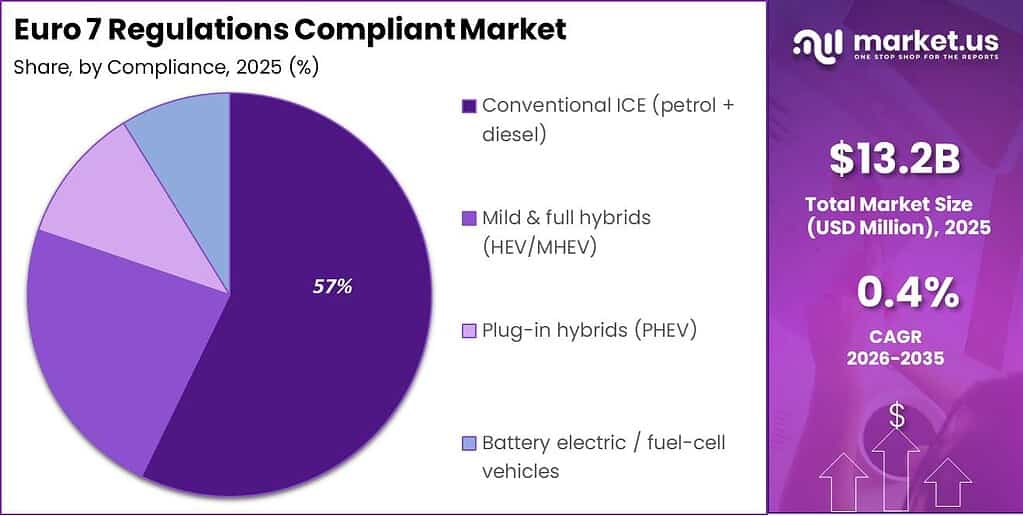
- Conventional ICE leads compliance paths with a 57% share.
- Heavy CVs, DPF/GPF filters, and battery electric / fuel-cell vehicles rank as the fastest growing lines in their groups.
According to the UK Department for Transport, Euro 7 applies to new EU light-duty vehicle types from 29 November 2026, and the UK proposes the same start date. This calendar freezes late platform redesigns and pulls calibration spend into current model cycles. OEMs that finish family testing before the gate protect launch slots in the largest regulated volume pool.
As reported by DieselNet, the Euro 7 gasoline particulate-mass limit is 0.0045 g/km from 29 November 2026, which is 10% below the Euro 6 mark of 0.005 g/km. This tighter mass cap raises filter and sensor content per petrol car. Suppliers with validated low-mass filter packs gain preferred-status on high-volume passenger platforms.
This signals rising end-use pressure from light-duty fleets that must register under the new limit set. In February 2026, Continental presented tire-wear emission and Euro 7 technology work at Tire Technology Expo, highlighting non-exhaust compliance. Non-exhaust control opens a second bill of materials beyond classic exhaust after-treatment and rewards vendors who already sit on brake and tire programs.
Vehicle Type Analysis
Passenger cars dominates with 47.8% due to high EU registration volumes.
In 2025, Passenger cars held a dominant market position in the By Vehicle Type segment of Euro 7 Regulations Compliant Market, with a 47.8% share. ACEA data show new EU car registrations rose 1.8% to 10.82 million units in 2025. This volume base keeps passenger platforms as the first wave of Euro 7 type-approval spend. Vendors who clear passenger car families first secure the densest certification reference list for later commercial variants.
Light CVs sit behind cars yet remain diesel-heavy in daily fleet duty. ACEA reports diesel still took 80.7% of new EU van registrations in 2025, equal to 1,168,561 diesel units even after a 12.8% volume drop. This diesel share sustains demand for compact NOx and particle packages on delivery vans. Fleet buyers will favor suppliers who cut package mass without raising payload penalties.
Heavy CVs form the fastest growing vehicle line as duty cycles stress thermal windows and durability clocks. ACEA counted 307,460 new EU truck registrations in 2025, with diesel still at 93.2% of heavy- and medium-duty demand. This diesel concentration keeps multi-brick after-treatment mandatory on long-haul platforms. Investors should track heavy-duty calibration houses that already hold Euro VI field data reusable for Euro 7 maps.
After-Treatment Analysis
EGR systems dominates with 28.3% due to engine-out NOx cut role.
In 2025, EGR systems held a dominant market position in the By After-Treatment segment of Euro 7 Regulations Compliant Market, with a 28.3% share. The ICCT estimates incremental Euro VII emissions-control cost versus Euro VI at €1,500 to €4,700 in 2025 for heavy applications. This cost band pushes OEMs to keep EGR as the first NOx lever before upsizing catalyst volume. Suppliers who pair cooled EGR with compact coolers protect margin inside that budget ceiling.
SCR systems carry the main chemical NOx conversion load on larger diesel engines once EGR alone cannot hold the limit. ICCT work shows raising after-treatment full useful life from 700,000 km toward 970,000 km adds about €700 in 2025 system cost. This durability step favors SCR brick and dosing vendors with proven aging models. Buyers will dual-source urea dosing hardware to avoid single-plant risk on long-life fleets.
DPF/GPF particle filters form the fastest growing after-treatment line as mass and number limits tighten together. CSIR-NIScPR technology reviews place DPF as the core soot path while larger engines stack DOC, DPF, and SCR in series. This stacked layout multiplies canning, substrate, and coating content per engine. Filter specialists who cut backpressure will win on fuel-economy-sensitive truck bids. DOC, ASC, LNT, and EHC hold the remaining after-treatment share collectively.
Sensor Type Analysis
MAP/MAF sensors dominates with 30.4% due to air-path control needs.
In 2025, MAP/MAF sensors held a dominant market position in the By Sensor Type segment of Euro 7 Regulations Compliant Market, with a 30.4% share. OICA-linked production tallies put world motor vehicle output near 92.5 million units in 2024 and about 96.4 million in 2025. This build rate multiplies air-mass and manifold-pressure sensing sockets on every compliant ICE and hybrid. Sensor makers with automotive-grade airflow lines scale fastest against that unit base.
Exhaust gas pressure and temperature sensors guide filter loading and thermal protection during regeneration. Eurostat records more than 256 million passenger cars already registered across the EU, a 6.5% rise versus 2018. This large parc keeps replacement and in-service monitoring demand alive beyond new-type approval. Tier-1s that offer combined pressure-temperature probes reduce harness complexity for OEMs.
Oxygen / lambda sensors close the fuel-air loop that feeds catalyst efficiency models under real driving. ACEA figures show petrol still held 26.6% of new EU car registrations in 2025 at 2.88 million units. This petrol base sustains wideband lambda fitment on high-volume engines. Vendors who stabilize sensor light-off time improve cold-start conformity margins for carmakers.
NOx sensors and PM sensors close the control and diagnostics chain for SCR and filter health. ACEA data put diesel cars at 960,024 new EU units in 2025, an 8.9% share after a 24.2% drop. Even as diesel cars shrink, remaining diesel and hybrid diesels still need tailpipe NOx and particle feedback. Suppliers who cut sensor cross-sensitivity reduce false inducement events that anger fleets.
Compliance Analysis
Conventional ICE dominates with 57% due to residual petrol diesel mix.
In 2025, Conventional ICE (petrol + diesel) held a dominant market position in the By Compliance segment of Euro 7 Regulations Compliant Market, with a 57% share. ACEA reports the combined petrol and diesel share of new EU cars still stood at 35.5% in 2025 after falling from 45.2% in 2024. This residual ICE mix keeps full Euro 7 exhaust stacks relevant through the decade. Compliance houses that serve pure ICE programs retain a large near-term book even as electrification rises.
Mild and full hybrids (HEV/MHEV) add start-stop and load-point shifts that complicate catalyst heat management. ACEA counted 3.74 million new EU hybrid-electric car registrations in 2025, a 13.7% rise and a 34.5% market share. This hybrid scale forces after-treatment designs that survive frequent cool-down events. Suppliers with electrically heated catalyst options gain a clear hybrid-specific bid edge.
Plug-in hybrids (PHEV) alternate long electric runs with sudden engine restarts, stressing cold-start emission control. ACEA logged 1.05 million new EU PHEV registrations in 2025, up 33.4% to a 9.4% share. This restart pattern raises the value of fast light-off hardware and richer OBD logic. Engineering partners who validate PHEV-specific RDE routes will win dual-powertrain platform awards.
Battery electric / fuel-cell vehicles form the fastest growing compliance path as tailpipe limits give way to non-exhaust rules. ACEA shows battery-electric cars at 1.58 million EU registrations in 2025, up 29.9% to a 17.4% share. This shift moves compliance spend toward brake and tire particle control rather than SCR bricks. Early movers in non-exhaust measurement gear capture the next regulatory wallet inside EV programs.
Key Market Segments
By Vehicle Type
- Passenger cars
- Light CVs (LCVs)
- Heavy CVs
By After-Treatment
- EGR systems
- SCR systems
- DPF/GPF (particle filters)
- DOC, ASC, LNT, EHC (others combined)
By Sensor Type
- MAP/MAF sensors
- Exhaust gas pressure and temperature
- Oxygen / lambda sensors
- NOx sensors
- PM sensors
By Compliance
- Conventional ICE (petrol + diesel)
- Mild and full hybrids (HEV/MHEV)
- Plug-in hybrids (PHEV)
- Battery electric / fuel-cell vehicles
Regional Analysis
Europe Dominates the Euro 7 Regulations Compliant Market with a Market Share of 71.1%, Valued at USD 9.40 Million
Europe concentrates legal force and fleet volume for Euro 7 hardware. Figures from Automotive IQ show newly launched cars and vans need Euro 7 conformity for EU type approval from 29 November 2026, with the all-new-registration duty following on 29 November 2027. This one-year phase-in interval compresses homologation queues across the region. Suppliers with spare bench capacity in Germany, France, and the UK capture overflow test demand.
Based on UNECE documentation, the principal Euro 7 emissions-durability obligation for light-duty vehicles extends to 160,000 km or 8 years, whichever comes first. This durability clock raises warranty exposure for after-treatment and sensor packs sold into European fleets. Investors should prefer vendors with field-aging datasets that already cover that distance band.
Data from the UK Department for Transport shows manufacturers must run in-service conformity testing once more than 5,000 vehicles from an ISC family are sold in Great Britain, while authorities normally verify 5% of each maker’s ISC families or at least 2 families each year. This sampling rule turns compliance into a recurring operating cost, not a single lab event. Service providers that package ISC logistics with spare parts forecasting gain sticky multi-year revenue in Europe.
Key Regions and Countries
North America
- US
- Canada
Europe
- Germany
- France
- The UK
- Spain
- Italy
- Rest of Europe
Asia Pacific
- China
- Japan
- South Korea
- India
- Australia
- Rest of APAC
Latin America
- Brazil
- Mexico
- Rest of Latin America
Middle East and Africa
- GCC
- South Africa
- Rest of MEA
Market Dynamics
Market Opportunity Analysis - Heavy CVs, particle filters, MAP/MAF growth, and EV non-exhaust rules open white space
Heavy CVs remain the fastest growing vehicle line while still diesel-led in Europe. That mix keeps high-content after-treatment and durability engineering under-served relative to passenger car programs. New entrants that specialize in long-haul thermal management and ISC logistics can win fleets that passenger-focused Tier 1s treat as secondary.
DPF/GPF particle filters are the fastest growing after-treatment line as mass and number limits tighten together. Many mid-tier canning shops still lack 10 nm-ready designs and aging models. This gap lets niche filter coaters and substrate makers take share on petrol GPF and diesel DPF refresh cycles.
MAP/MAF sensors already lead sensor type and also rank as the fastest growing sensor line. Air-path sensing is still often sourced as a commodity rather than as a compliance-critical control input. Sensor firms that bundle airflow accuracy with onboard diagnostics software can raise average selling price without leaving the air-intake socket.
By contrast, battery electric and fuel-cell paths grow fastest inside compliance yet shift spend to brake and tire particle control. Exhaust specialists who ignore non-exhaust hardware cede the EV wallet to friction and tire vendors. Early investors in combined exhaust and non-exhaust test benches secure dual-track revenue as powertrain mix changes.
Technology and Innovation Landscape - Finer particles, longer durability, and tighter RDE routes redefine hardware
DieselNet states that Euro 7 diesel passenger cars face a particulate-number limit of 6.0 × 10¹¹ particles/km from 29 November 2026, with counting from 10 nm rather than the older 23 nm cut-off. This finer threshold forces filter media and PM sensor redesigns. Manufacturers who clear 10 nm benches first reduce late-stage calibration risk on diesel cars.
DieselNet also details Euro 7 real-driving-emissions routes lasting 90 to 120 minutes, with urban, rural, and motorway portions each near one-third of the trip and each segment at least 16 km. This route geometry stresses cold-start and high-load edges in one script. Labs that automate mixed-route RDE scheduling sell higher utilization to OEM queues before 2026.
UNECE materials set the light-duty evaporative-emissions requirement at 1.5 g per test, equal to 0.75 g/day on the sealed-housing evaporative determination test. This limit keeps canister, seal, and purge-valve innovation active on petrol and hybrid tanks. Component makers with low-permeation materials gain a direct path into evaporative conformity packages.
UNECE rules add an extended durability window to 200,000 km or 10 years, applying a 1.2 deterioration multiplier on relevant gaseous limits. This multiplier raises the performance bar that catalysts and sensors must hold late in life. Coating and sensor vendors who prove margin under the 1.2 factor win long-warranty OEM nominations.
Drivers
UN Regulation No. 155 ended its transitional grace period on 7 July 2024 and now extends Cybersecurity Management System duties to every new vehicle across 64 UNECE contracting parties. Remaining small-series carve-outs lapse on 7 July 2026. This change converts one-time safety validation budgets into recurring compliance spend and compresses platform engineering margins by an estimated 3 to 5 percentage points.
As a result, OEMs shift toward mandatory compliance-as-a-service contracts with Tier 1 suppliers. China enforces GB 44495 as a market-entry gate for new vehicle types from 1 January 2026. Non-compliant connected vehicles lose access to the world’s largest single automotive market, which locks multi-year security tooling into sourcing RFPs.
| Driver | (~) % Impact on CAGR Forecast | Geographic Relevance | Impact Timeline |
|---|---|---|---|
| UNECE R155/R156 Mandatory Type-Approval Enforcement | +5.8% | European Union, Japan, South Korea, Australia | Short term (2 years or less) |
| China GB 44495 Mandatory Compliance Gate | +3.4% | China | Short term (2 years or less) |
| Connected and Software-Defined Vehicle Proliferation | +4.2% | Global | Medium term (2 to 4 years) |
| Rising Connected-Vehicle Attack Frequency Driving VSOC Spend | +2.6% | North America, Europe | Short term (2 years or less) |
| ISO/SAE 21434 Secure-by-Design Engineering Spend | +2.1% | Global | Medium term (2 to 4 years) |
| V2X/5GAA Connectivity Security Requirements | +1.3% | Europe, North America, China | Medium term (2 to 4 years) |
Restraints
Threat Analysis and Risk Assessment files, penetration-test evidence, and CSMS audit fees under ISO/SAE 21434 and UN R155 flow from OEMs to Tier 1 suppliers and then to Tier 2/3 makers. Those smaller firms often run on EBITDA margins of only 5% to 8%. Certification lead times stretch 9 to 12 months per component family, and audit costs cannot be spread across low-volume runs.
Consequently, weaker suppliers exit OEM panels rather than bid slowly. Platform CapEx slips while makers re-qualify alternate sources, and non-compliant component lines face near-term sales freezes. This pattern accelerates consolidation toward larger Tier 1 groups and raises switching cost for every downstream buyer.
| Restraint | (~) % Impact on CAGR Forecast | Geographic Relevance | Impact Timeline |
|---|---|---|---|
| Tier 2/3 Supplier Compliance-Cost Exclusion | -3.2% | Global (concentrated in emerging-market supply bases) | Short term (2 years or less) |
| Elevated Interest-Rate Cost of Capital for OEM Cybersecurity CapEx | -2.1% | North America, Europe | Short term (2 years or less) |
| Secure Hardware (HSM/TPM) Component Shortage | -1.7% | Global | Short term (2 years or less) |
| Absence of Unified US Federal Cybersecurity Mandate | -1.9% | United States | Medium term (2 to 4 years) |
| Fragmented Multi-Region Certification Duplication | -1.4% | Global | Medium term (2 to 4 years) |
Challenges
The global cybersecurity professional shortfall stands near 4.8 million unfilled roles, a 19% year-over-year widening per the ISC2 workforce study. The World Economic Forum Global Cybersecurity Outlook 2026 finds that 56% of surveyed CEOs name skills shortage as a top barrier to cyber resilience. Automotive TARA, embedded-ECU, and secure-boot roles sit among the scarcest specialties, which extends threat-modeling and certification cycles.
This creates a paid opening for managed detection, offshore embedded-security squads, and automation-assisted vulnerability triage. OEMs and Tier 1s already redirect SOC staffing gaps toward outsourced models rather than pure in-house build-outs. Firms that productize automotive-specific security operations capture recurring revenue while the talent gap persists into the early 2030s.
| Challenge | (~) % CAGR Friction Drag | Geographic Relevance | Mitigation Horizon |
|---|---|---|---|
| Automotive Cybersecurity Talent Shortage | -2.4% | Global | Long term (4 years or more) |
| Post-Quantum Cryptography Migration Complexity | -1.6% | Global | Long term (4 years or more) |
| SBOM and Open-Source Vulnerability Patch Burden | -1.3% | Global | Medium term (2 to 4 years) |
| Legacy Fleet Retrofit Limitations | -1.1% | Global | Long term (4 years or more) |
| Cross-Border Data Localization Fragmentation | -0.9% | Europe, China | Medium term (2 to 4 years) |
| Development-Cycle Versus Threat-Landscape Mismatch | -1.2% | Global | Medium term (2 to 4 years) |
Opportunities
Most cybersecurity cost still sits as a one-time bill-of-materials charge inside vehicle production. Converting over-the-air protection, intrusion-detection telemetry, and post-sale patching into a per-vehicle-per-year subscription needs new billing, consent, and telematics CRM tools. Hardware-embedded margins near 15% to 20% can move toward recurring software-service margins of 40% to 60% once spread across the installed parc.
This means early movers who stand up subscription infrastructure before rivals can reprice compliance as an annuity. Industry connectivity frameworks from the 5G Automotive Association and SAE connected-service standards already supply the technical scaffolding. Capturing the upside still demands deliberate go-to-market spend beyond the compliance baseline already in forecasts.
| Opportunity | (~) % Potential CAGR Upside | Geographic Relevance | Execution Window |
|---|---|---|---|
| Subscription-Based SDV Security-as-a-Service Monetization | +2.4% | Global | Medium term (2 to 4 years) |
| Installed-Base Aftermarket Retrofit Security Services | +2.3% | Global | Medium term (2 to 4 years) |
| Emerging-Market Regulatory Catch-Up Expansion | +2.1% | India, Southeast Asia, Latin America | Medium term (2 to 4 years) |
| Autonomous/Robotaxi Fleet Bespoke Security Architecture | +1.7% | North America, China, Europe | Medium term (2 to 4 years) |
| Crypto-Agility and PQC Early-Mover Licensing | +1.9% | Global | Long term (4 years or more) |
| Platform Roll-Up M&A Consolidation | +1.6% | North America, Europe | Short term (2 years or less) |
Key Company Insights
Volkswagen Group anchors European light-duty volume that must clear Euro 7 type approval on passenger and van families first. Scale across multiple brands spreads certification fixed cost over large unit runs and protects launch timing. However, multi-brand powertrain variety raises calibration complexity and can stretch scarce emissions-engineering capacity before the 2026 gate.
Daimler Truck concentrates on heavy-duty platforms where diesel still dominates new EU truck mix and after-treatment content per vehicle is highest. That positioning ties revenue to long-life SCR, EGR, and sensor stacks with multi-year fleet contracts. In June 2024, Umicore accelerated restructuring of its automotive-catalysts business after final Euro 7 rules proved less strict than first drafted, which resets catalyst pricing power for truck OEM partners.
Key Players
- Volkswagen Group
- Daimler Truck
- BMW Group
- Stellantis
- Renault Group
- Ford Motor Company
- Toyota Motor Corporation
- Honda Motor Co., Ltd.
- Hyundai Motor Group (Hyundai, Kia)
- Forvia (Faurecia)
- Tenneco Inc.
- Eberspächer
- Johnson Matthey
- Cummins
- Bosch
Recent Developments
- April 2025: Tenneco introduced Low Emission Brake technology designed to meet Euro 7 and China 7 brake particulate-emission requirements.
- May 2026: BorgWarner won a Euro 7-compliant heavy-duty engine program involving VTG turbochargers and EGR coolers for a major European commercial-vehicle OEM.
- September 2024: Continental launched ATE New Original brake products featuring coatings and friction materials developed for future Euro 7 particulate limits.
Geopolitical Impact Analysis
According to UNCTAD, seaborne trade growth is set to slow to just 0.5% in 2025 after 2.2% growth in 2024, while ton-miles rose about 6% on longer rerouted paths. The Shanghai Containerized Freight Index averaged 2,496 points in 2024, up 149% from 2023. These freight swings raise landed cost for catalysts, sensors, and filter substrates moved between Asia and European OEM plants.
IEA analysis shows catalytic converters already represent around 40% of global platinum demand and dominate palladium and rhodium use as well. Trade-policy shocks that lift steel, aluminum, and auto-parts duties near 25% on selected lanes inflate housing and canning costs around those PGM bricks. This means Euro 7 bill-of-materials inflation tracks geopolitics as closely as lab limits, so dual-sourcing PGM-coated parts becomes a board-level hedge.
Report Scope
| Report Features | Description |
|---|---|
| Market Value (2025) | USD 13.20 Million |
| Forecast Revenue (2035) | USD 13.70 Million |
| CAGR (2026-2035) | 0.4% |
| Base Year for Estimation | 2025 |
| Historic Period | 2020-2024 |
| Forecast Period | 2026-2035 |
| Report Coverage | Revenue Forecast, Market Dynamics, Market Opportunity Analysis, Technology and Innovation Landscape, Competitive Landscape, Recent Developments |
| Segments Covered | By Vehicle Type (Passenger cars, Light CVs (LCVs), Heavy CVs), By After-Treatment (EGR systems, SCR systems, DPF/GPF (particle filters), DOC, ASC, LNT, EHC (others combined)), By Sensor Type (MAP/MAF sensors, Exhaust gas pressure and temperature, Oxygen / lambda sensors, NOx sensors, PM sensors), By Compliance (Conventional ICE (petrol + diesel), Mild and full hybrids (HEV/MHEV), Plug-in hybrids (PHEV), Battery electric / fuel-cell vehicles) |
| Regional Analysis | North America (US and Canada), Europe (Germany, France, The UK, Spain, Italy, and Rest of Europe), Asia Pacific (China, Japan, South Korea, India, Australia, and Rest of APAC), Latin America (Brazil, Mexico, and Rest of Latin America), Middle East and Africa (GCC, South Africa, and Rest of MEA) |
| Competitive Landscape | Volkswagen Group, Daimler Truck, BMW Group, Stellantis, Renault Group, Ford Motor Company, Toyota Motor Corporation, Honda Motor Co., Ltd., Hyundai Motor Group (Hyundai, Kia), Forvia (Faurecia), Tenneco Inc., Eberspächer, Johnson Matthey, Cummins, Bosch |
| Customization Scope | Customization for segments, region / country-level will be provided. Additional customization can be done based on requirements. |
| Purchase Options | We have three licenses to opt for: Single User License | Multi-User License (Up to 5 Users) | Corporate Use License (Unlimited User and Printable PDF) |





































