


Report Overview
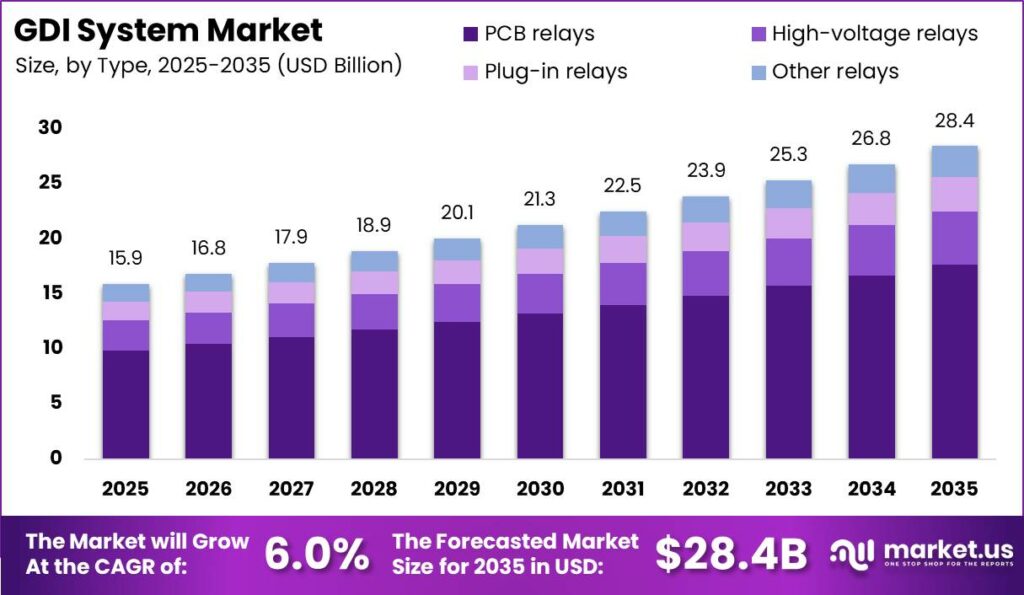
Global Gasoline direct injection (GDI) system market size is expected to be worth around USD 15.90 Billion by 2035 from USD 28.40 Billion in 2025, growing at a CAGR of 6.0% during the forecast period 2026 to 2035. Capital now concentrates on high-pressure hardware that clears stricter particle rules. Suppliers who lock multi-year injector and pump awards before 2027 model freezes will protect volume longer than pure commodity vendors.
Therefore, the Gasoline direct injection (GDI) system market covers gasoline direct injection hardware and related switching architectures used across modern vehicle platforms. Structure splits by type, application, vehicle type, and load rating. This layout shows where precision machining spend and calibration software attach to each buyer use case.
Key Takeaways
- The market reaches USD 15.90 Billion in 2025 and USD 28.40 Billion by 2035 at a 6.0% CAGR.
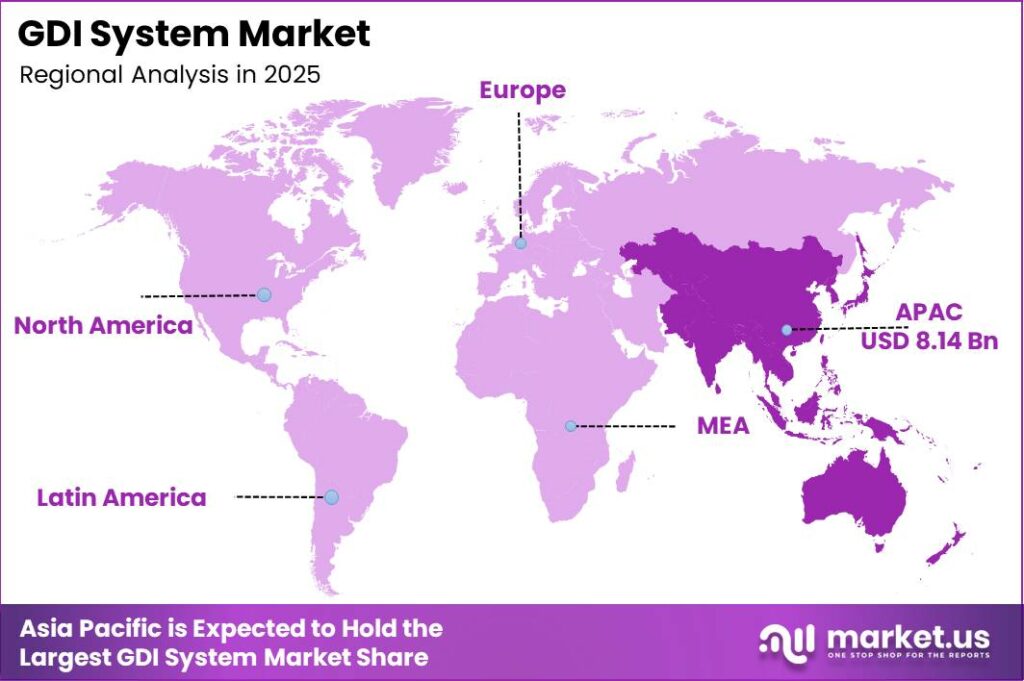
- Asia Pacific leads with a 51.2% share valued at USD 8.14 Billion.
- PCB relays lead the type mix with a 62.2% share.
- Body and chassis applications hold a 32.2% share.
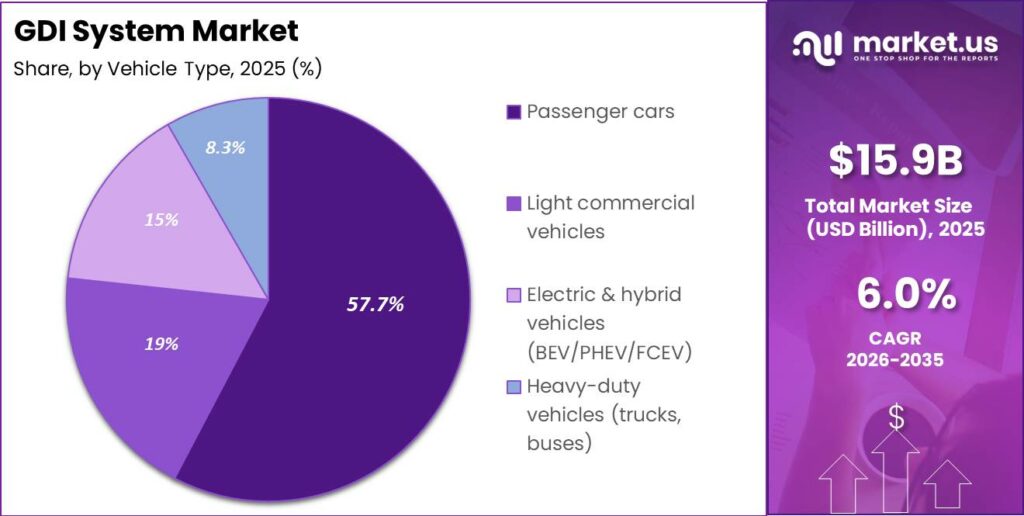
- Passenger cars anchor vehicle demand with a 57.7% share.
- The 5A–15A load band leads with a 37.7% share and ranks as the fastest growing load class.
- High-voltage relays, safety and security including ADAS, and electric and hybrid vehicles rank as the fastest growing cuts inside their groups.
According to the US EPA, gasoline direct injection alone accounted for 52.0% of preliminary model-year 2025 US light-duty production. That installed base keeps GDI content mandatory on most gasoline platforms still entering fleets. Vendors who align rail pressure and spray targeting to this majority mix secure repeat OEM program wins. As a result, end-use passenger production growth continues to pull injector, pump, and control hardware in lockstep.
Based on Regulation (EU) 2024/1257, Euro 7 sets a 6×10^11 PN10 particle limit per kilometre for new M1 positive-ignition types from 29 November 2026. This rule forces higher rail pressure and finer spray control on every new GDI family sold in Europe. Calibration houses that sell compliance packages with hardware will capture multi-year service revenue. In April 2026, PHINIA won a direct-injection fuel-rail assembly contract for a major Chinese OEM luxury SUV dual-fuel V8 platform, tying Asia volume to premium injection content.
Type Analysis
PCB relays dominates with 62.2% due to compact board-level switching density.
In 2025, PCB relays held a dominant market position in the By Type segment of Gasoline direct injection (GDI) system market, with a 62.2% share. OICA data show global vehicle output reached about 96.4 million units in 2025, so board-mounted switching scales with every new electronic module. This density cuts harness mass and assembly time on high-volume lines. Suppliers who qualify PCB packs early win socket share before platform freezes close.
Plug-in relays serve higher current loops that need field replacement inside power distribution boxes. Asia-Pacific plants built around 59.2 million vehicles in 2025 per OICA, and many of those lines still specify serviceable plug-in sockets for pumps and fans. This design keeps aftermarket pull-through alive for fleets. Vendors offering drop-in rated parts capture service revenue that sealed PCB units cannot reach.
High-voltage relays are the fastest growing type as battery and hybrid packs spread. IEA figures show electric car sales topped 20 million units in 2025, or about 25% of global car sales. That shift raises demand for arc-safe isolation hardware on traction circuits. Early movers who certify high-voltage contactors now lock design-ins on multi-year EV platforms. Other relays hold the remaining collective share across specialty switching duties.
Application Analysis
Body and chassis dominates with 32.2% due to high-volume body circuit density.
In 2025, Body and chassis held a dominant market position in the By Application segment of Gasoline direct injection (GDI) system market, with a 32.2% share. OICA reports China alone produced about 30.3 million passenger cars in 2025, each carrying dense body control loads. This volume multiplies low-current switching sockets per vehicle. Suppliers tied to body control modules secure the steadiest unit run rates in the stack.
Powertrain system applications link injectors, pumps, and engine management loads to combustion control. Global production rose 3.9% to 96.4 million vehicles in 2025 according to OICA, keeping powertrain electrical content on every ICE and hybrid build. This link makes powertrain awards strategic for margin, not only volume. Firms that co-develop injector drivers with ECU makers raise switching barriers for late entrants.
Convenience functions cover windows, seats, and HVAC circuits that add comfort load counts per trim. Safety and security plus ADAS is the fastest growing application cut as sensing and actuation expand. IEA notes hybrid model availability rose over 10% to more than 200 models in 2025, lifting electronic safety content. Other applications hold residual share. Vendors who bundle ADAS-ready switching with diagnostics will outgrow pure comfort suppliers.
Vehicle Type Analysis
Passenger cars dominates with 57.7% due to large global production volumes.
In 2025, Passenger cars held a dominant market position in the By Vehicle Type segment of Gasoline direct injection (GDI) system market, with a 57.7% share. Historical OICA structure shows passenger cars near 68 million units, or roughly 72% of world vehicle output in recent peak years. This base keeps GDI and related switching demand centered on car platforms. Investors should weight passenger programs first when sizing addressable injector and relay content.
Light commercial vehicles add delivery and urban fleet duty cycles that stress electrical durability. India produced about 6.49 million total vehicles in 2025 per OICA, with strong commercial mix growth beside cars. This mix supports ruggedized GDI and switching SKUs for higher annual mileage. Suppliers who rate parts for stop-start fleet abuse win LCV tenders that car-only lines miss.
Heavy-duty vehicles including trucks and buses need higher continuous current and longer service intervals. Electric and hybrid vehicles are the fastest growing vehicle cut. IEA data put global electric car sales above 20 million in 2025 with a 25% sales share, while BEV units were about 65% of that electric mix. Hybrid-compatible GDI and high-voltage isolation therefore set the growth edge for new awards.
Load Analysis
5A–15A dominates with 37.7% due to mainstream low-current vehicle loads.
In 2025, 5A–15A held a dominant market position in the By Load segment of Gasoline direct injection (GDI) system market, with a 37.7% share, and it is also the fastest growing load band. Most body, convenience, and control circuits sit inside this current window on volume cars. OICA counted about 99.8 million global vehicle sales in 2025, multiplying low-current sockets at scale. Cost leaders who automate 5A–15A lines will defend share as content per car rises.
The 16A–35A band covers mid-power actuators such as fans, pumps, and selected powertrain auxiliaries. Europe built about 17.2 million vehicles in 2025 while output slipped 0.8%, per OICA, so European plants still need reliable mid-load parts on remaining ICE and hybrid builds. This band rewards thermal design quality over pure price. Suppliers with proven contact life data win quality-sensitive OEM scorecards.
Loads above 35A serve starter, glow, and high-power distribution paths where contact erosion risk is highest. Americas production was about 18.74 million vehicles in 2025 according to OICA, sustaining demand for heavy-load switching on trucks and large platforms. This creates a smaller unit pool with higher average selling prices. Specialists who certify arc performance above 35A protect premium niches that mass 5A–15A vendors rarely enter.
Key Market Segments
By Type
- PCB relays
- Plug-in relays
- High-voltage relays
- Other relays
By Application
- Body & chassis
- Powertrain system
- Convenience (windows, seats, HVAC, etc.)
- Safety & security / ADAS
- Other applications
By Vehicle Type
- Passenger cars
- Light commercial vehicles
- Heavy-duty vehicles (trucks, buses)
- Electric & hybrid vehicles (BEV/PHEV/FCEV)
By Load
- 5A–15A
- 16A–35A
- >35A
Regional Analysis
Asia Pacific Dominates the Gasoline direct injection (GDI) system market with a Market Share of 51.2%, Valued at USD 8.14 Billion
Asia Pacific concentrates more than half of global Gasoline direct injection (GDI) system market value at USD 8.14 Billion and a 51.2% share. OICA shows Asia-Pacific vehicle production near 59.2 million units in 2025, over 61% of world output. This manufacturing density pulls injector, pump, and switching localization into China, Japan, India, and Korea. Investors gain the deepest OEM pipeline coverage by basing application engineering inside this production belt.
China added roughly 3.25 million vehicles of annual output to reach 34.53 million units in 2025, per OICA, while new-energy vehicle production hit 16.626 million. This dual track keeps hybrid GDI content alive beside pure battery growth. Regional buyers still award high-pressure fuel hardware on luxury and performance gasoline platforms. Consequently, Asia remains both the volume core and the proving ground for next pressure steps.
Europe produced about 17.2 million vehicles and the Americas about 18.74 million in 2025, based on OICA continental totals. These regions keep premium calibration and compliance demand even as unit growth trails Asia. Suppliers who hold Euro-focused particle control IP retain pricing power outside the Asia share lead. Cross-region dual-sourcing now matters more as trade rules fragment component lanes.
Key Regions and Countries
North America
- US
- Canada
Europe
- Germany
- France
- The UK
- Spain
- Italy
- Rest of Europe
Asia Pacific
- China
- Japan
- South Korea
- India
- Australia
- Rest of APAC
Latin America
- Brazil
- Mexico
- Rest of Latin America
Middle East and Africa
- GCC
- South Africa
- Rest of MEA
Market Dynamics
Market Opportunity Analysis - Fastest growing cuts outside the share leaders still leave open entry lanes
High-voltage relays remain the fastest growing type while PCB units hold most revenue share. Electrified platforms need isolation parts that legacy low-voltage lines do not supply at scale. New entrants can specialize in arc-safe contactors without fighting PCB price wars. This path suits investors who want growth exposure without buying the crowded board-mount center.
Safety and security including ADAS is the fastest growing application while body and chassis still lead share. ADAS actuation and redundant switching are not fully penetrated on volume trims in many plants. Challengers who qualify functional-safety rated parts can leapfrog comfort-only vendors. This creates a clearer specification moat than competing inside body control commodity sockets.
Electric and hybrid vehicles are the fastest growing vehicle group while passenger cars dominate absolute share. Hybrid architectures still require GDI content that pure battery programs drop. Suppliers who tune injectors for P2 and power-split duty capture a bridge market. This segment rewards dual-path engineering more than pure ICE or pure BEV specialists.
By contrast, the 16A–35A and above 35A load bands sit below the leading 5A–15A class yet serve higher power actuators. Fewer suppliers master thermal and arc limits at these currents. Niche players can price for reliability on commercial and performance builds. This leaves room for premium SKUs even when low-current volumes stay larger.
Technology and Innovation Landscape - Higher rail pressure and tighter sensing redefine GDI hardware value
Figures from PHINIA show its high-efficiency GDI pump entered start of production in 2025 at 500 bar or more, up from its earlier 350 bar platform. Within the same family, the M16e supports up to 400 bar while the M16 supports 500 bar or more. This step raises spray energy and cuts particulate formation risk. OEMs that adopt these pumps earlier reduce late Euro 7 recalibration cost.
As reported by PHINIA in April 2026, its next-generation GDI system was in development for peak injection pressures above 500 bar. That roadmap signals another pressure climb beyond current production pumps. Suppliers lagging below 350 bar face exclusion from premium gasoline programs. Investors should treat sub-500 bar roadmaps as stranded technology risk inside five-year plans.
Stanadyne’s 2026 high-pressure GDI injector supports an operating range of 30 to 1,000 bar on one architecture. At 100 bar it delivers static fuel flow up to 20 g/s, with static-flow tolerance of ±4% and dynamic-flow tolerance of ±6% at a 1.5 ms injection time. Wide pressure coverage lowers SKU count for OEMs. Precision flow control also supports cleaner cold-start strategies without separate injector families.
Data from a 2025 GDI technical source indicates pressure sensors in modern direct-injection systems typically hold measurement accuracy near ±2%. Tight rail-pressure feedback stabilizes multiple injection events per cycle. This accuracy becomes a gating item as particle number limits tighten. Sensor vendors tied into closed-loop GDI controls gain stickier content than stand-alone gauge suppliers.
Drivers
Euro 7 finalization in 2024, the US EPA multi-pollutant light-duty rule in 2024, and draft China 7 limits in 2025 push compliance into model years 2027 onward. Rail pressures are moving from about 200 bar toward 350 to 500 bar architectures to meet sub-4.5 mg/km particulate targets. This shift raises precision machining cost per unit. Tier-1 suppliers now bundle hardware with calibration IP, trimming hardware margins by about 150 to 250 basis points while opening recurring software revenue.
Engine downsizing with turbocharged GDI, hybrid P2 and power-split integration, and Asia Pacific passenger production add further pull. High-pressure piezoelectric injector upgrades support Europe and North America medium-term programs. Buyers gain cleaner combustion and better fuel use on smaller engines. Sellers who own both injector hardware and calibration toolchains will convert one-time awards into multi-year software attach.
| Driver | (~) % Impact on CAGR Forecast | Geographic Relevance | Impact Timeline |
|---|---|---|---|
| Emission Regulation Compliance (Euro 7, EPA Tier 3, China 7) | +2.2% | Global (EU, North America, China) | Short term (2 years or less) |
| Engine Downsizing & Turbocharged GDI Adoption | +1.3% | Global | Short term (2 years or less) |
| Hybrid Powertrain Integration (P2/Power-Split Architectures) | +1.0% | Asia Pacific, Europe | Medium term (2 to 4 years) |
| Passenger Vehicle Production Growth in Asia Pacific | +0.8% | Asia Pacific (China, India) | Short term (2 years or less) |
| High-Pressure Piezoelectric Injector Upgrades | +0.7% | Europe, North America | Medium term (2 to 4 years) |
Restraints
EU Fit for 55 rules under Regulation (EU) 2023/851 target a 100% CO2 cut for new passenger cars by 2035. Norway already saw battery-electric share above 90% of new registrations through 2025, removing that pool from GDI demand early. European ICE platform output is contracting on a multi-year path. Tier-1 fuel-system suppliers face margin pressure on legacy injector lines and delay CapEx on new high-pressure pump plants.
Capital scarcity, higher interest rates, alloy and rare-earth cost swings, semiconductor gaps for injector electronics, and Euro 7 testing bottlenecks slow fresh tooling. OEMs reallocate spend toward electrified architectures first. This freezes some next-generation GDI programs before launch. Participants who pivot capacity toward hybrid-ready and e-fuel-ready injectors can keep plants utilized while pure ICE awards shrink.
| Restraint | (~) % Impact on CAGR Forecast | Geographic Relevance | Impact Timeline |
|---|---|---|---|
| ICE Phase-Out Mandates & Battery-Electric Substitution | -2.3% | Europe (EU, Norway), China | Medium term (2 to 4 years) |
| Capital Scarcity & Elevated Interest Rates Delaying OEM Tooling CapEx | -1.1% | Global, acute in Europe and North America | Short term (2 years or less) |
| Specialty Alloy & Rare-Earth Input Cost Volatility (Tariffs) | -0.6% | Global, US-China trade corridor | Short term (2 years or less) |
| Semiconductor/ECU Shortages for Injector Electronics | -0.5% | Global | Short term (2 years or less) |
| Euro 7 Homologation & Type-Approval Testing Bottlenecks | -0.4% | Europe | Short term (2 years or less) |
Challenges
GDI leaves intake valves dry because fuel no longer washes port surfaces, so oil vapor and combustion residue build deposits. SAE-linked evidence points to power and torque losses of 2% to 4% over long drive cycles, plus higher warranty flags in OEM risk disclosures. Validation cycles stretch about 12 to 18 months when nozzle geometry and additive specs change together. This durability drag raises total cost of ownership for fleets and retail buyers.
Precision injection talent shortages, Tier-1 concentration risk, cross-border lead-time delays, and fuel quality recalibration in emerging regions add further friction. Each issue slows launch timing and raises engineering burn. This creates space for deposit-resistant nozzle designs and additive-linked service contracts as paid upgrades. Suppliers who sell anti-fouling hardware with predictive maintenance can turn a reliability problem into a recurring revenue line.
| Challenge | (~) % CAGR Friction Drag | Geographic Relevance | Mitigation Horizon |
|---|---|---|---|
| Carbon Deposit & Valve Fouling | -0.5% | Global | Medium term (2 to 4 years) |
| Precision Injection Talent Shortage | -0.4% | North America, Europe | Long term (4 years or more) |
| Tier-1 Supplier Concentration Risk | -0.4% | Global | Medium term (2 to 4 years) |
| Cross-Border Component Lead-Time Delays | -0.3% | Asia Pacific-Europe corridor | Short term (2 years or less) |
| Fuel Quality Recalibration Burden | -0.3% | Southeast Asia, Africa, Latin America | Medium term (2 to 4 years) |
Opportunities
Two- and three-wheeler fleets across India, Vietnam, and Indonesia still run mainly on carburetion or basic port injection, with GDI penetration under 5% in tracked shipment views. ASEAN two-wheeler volumes run in the tens of millions of units each year. Shared tooling with car injector lines could cut small-bore unit cost by about 20% to 30%. Early entrants who clear the sub-150 cc cost threshold can open a largely uncaptured serviceable market.
Localization incentives such as India-type PLI schemes, marine and off-road adjacency, AI sensor and OTA calibration subscriptions, and aftermarket anti-fouling services extend the upside map. Bharat Stage and peer norms keep tightening emissions on small engines. This path favors firms that localize machining near South and Southeast Asia demand. First movers who pair low-cost injectors with subscription calibration will hold pricing power after hardware margins compress.
| Opportunity | (~) % Potential CAGR Upside | Geographic Relevance | Execution Window |
|---|---|---|---|
| GDI Adoption in Two/Three-Wheeler & Small-Displacement Engines | +1.5% | South and Southeast Asia | Medium term (2 to 4 years) |
| Localization Incentives for Injector Manufacturing (India-Type PLI Schemes) | +0.9% | India, Southeast Asia | Medium term (2 to 4 years) |
| Adjacent Vertical Expansion into Marine & Off-Road Small Engines | +0.8% | North America, Europe | Long term (4 years or more) |
| AI-Enabled Sensor Data & OTA Calibration Subscriptions | +0.7% | North America, Europe | Long term (4 years or more) |
| Aftermarket Anti-Fouling Service & Predictive Maintenance Monetization | +0.6% | Global | Medium term (2 to 4 years) |
Key Company Insights
TE Connectivity Ltd sits among the listed leaders with broad interconnect and switching depth across vehicle electrical architectures. That breadth supports GDI-adjacent control and power distribution content on shared platforms. The portfolio risk is slower pure injector specialty versus focused fuel-system houses. Buyers still value TE when harness, relay, and sensor content must integrate under one sourcing umbrella.
OMRON Corporation brings precision relay and control heritage into automotive qualification pipelines. This focus fits PCB and load-rated switching where reliability scoring decides awards. The risk is narrower fuel-system depth if OEMs demand full rail and pump packages from one Tier-1. OMRON strengthens bids where electronic control quality outweighs full-system bundling.
Key Players
- TE Connectivity Ltd
- OMRON Corporation
- Robert Bosch GmbH
- DENSO Corporation
- Panasonic Corporation
- HELLA GmbH & Co. KGaA
- Fujitsu
- Littelfuse, Inc.
- Mitsuba Corporation
- Hongfa (Xiamen Hongfa Electroacoustic Co., Ltd.)
- Song Chuan Precision Co., Ltd.
- Goodsky Electric Co., Ltd.
- LS Automotive
- C&K Components
- Xiamen Level King Keep Electronics
Recent Developments
- June 2025: PHINIA agreed to acquire Swedish Electromagnet Invest AB for $47 million, adding injector stators, ignition systems, and related alternative-fuel technologies to its fuel-system portfolio.
- December 2025: Stanadyne launched its GX Series gasoline direct-injection performance fuel pumps for high-performance street and racing vehicles.
Geopolitical Impact Analysis
Data from UNCTAD shows the trade-weighted average applied tariff on global manufacturing rose from 1.9% in 2024 to 4.7% in 2025 as protectionist measures widened. Nearly two thirds of world trade runs through value chains now being redrawn by industrial policy. GDI pumps, injectors, and precision alloys move inside those manufacturing lanes. Higher duties raise landed cost for cross-Pacific fuel-system kits and push dual-sourcing near major OEM plants.
Consequently, UNCTAD also projects global growth near 2.6% in 2026 while noting about 18,000 new discriminatory trade measures recorded since 2020. Technical rules already touch roughly two thirds of world trade. Injector electronics and specialty metals face both tariff and standards friction on Asia-Europe corridors. Manufacturers that localize machining and ECU pairing inside end markets cut delay risk and protect program timing.
Report Scope
| Report Features | Description |
|---|---|
| Market Value (2025) | USD 15.90 Billion |
| Forecast Revenue (2035) | USD 28.40 Billion |
| CAGR (2026-2035) | 6.0% |
| Base Year for Estimation | 2025 |
| Historic Period | 2020-2024 |
| Forecast Period | 2026-2035 |
| Report Coverage | Revenue Forecast, Market Dynamics, Market Opportunity Analysis, Technology and Innovation Landscape, Competitive Landscape, Recent Developments |
| Segments Covered | By Type (PCB relays, Plug-in relays, High-voltage relays, Other relays), By Application (Body & chassis, Powertrain system, Convenience (windows, seats, HVAC, etc.), Safety & security / ADAS, Other applications), By Vehicle Type (Passenger cars, Light commercial vehicles, Heavy-duty vehicles (trucks, buses), Electric & hybrid vehicles (BEV/PHEV/FCEV)), By Load (5A–15A, 16A–35A, >35A) |
| Regional Analysis | North America (US and Canada), Europe (Germany, France, The UK, Spain, Italy, and Rest of Europe), Asia Pacific (China, Japan, South Korea, India, Australia, and Rest of APAC), Latin America (Brazil, Mexico, and Rest of Latin America), Middle East and Africa (GCC, South Africa, and Rest of MEA) |
| Competitive Landscape | TE Connectivity Ltd, OMRON Corporation, Robert Bosch GmbH, DENSO Corporation, Panasonic Corporation, HELLA GmbH & Co. KGaA, Fujitsu, Littelfuse, Inc., Mitsuba Corporation, Hongfa (Xiamen Hongfa Electroacoustic Co., Ltd.), Song Chuan Precision Co., Ltd., Goodsky Electric Co., Ltd., LS Automotive, C&K Components, Xiamen Level King Keep Electronics |
| Customization Scope | Customization for segments, region / country-level will be provided. Additional customization can be done based on requirements. |
| Purchase Options | We have three licenses to opt for: Single User License | Multi-User License (Up to 5 Users) | Corporate Use License (Unlimited User and Printable PDF) |





































