


Report Overview
The Global Function Generators Market size is expected to be worth around USD 2.9 Billion by 2035, from USD 1.5 Billion in 2025, growing at a CAGR of 6.7% during the forecast period from 2026 to 2035. In 2025, North America held a dominant market position, capturing more than a 32.0% share, holding USD 0.48 Billion revenue.
Function generators are essential electronic test and measurement instruments used to create controlled sine, square, pulse, ramp, and arbitrary waveforms for testing circuits, components, sensors, communication equipment, automotive electronics, industrial controls, and research systems. Their industrial importance is increasing as electronic products become more complex and require accurate signal simulation during design, validation, production, and maintenance.
- This environment is supported by a global semiconductor industry that generated USD 791.7 billion in sales in 2025, representing an increase of 25.6% from USD 630.5 billion in 2024, according to the Semiconductor Industry Association.
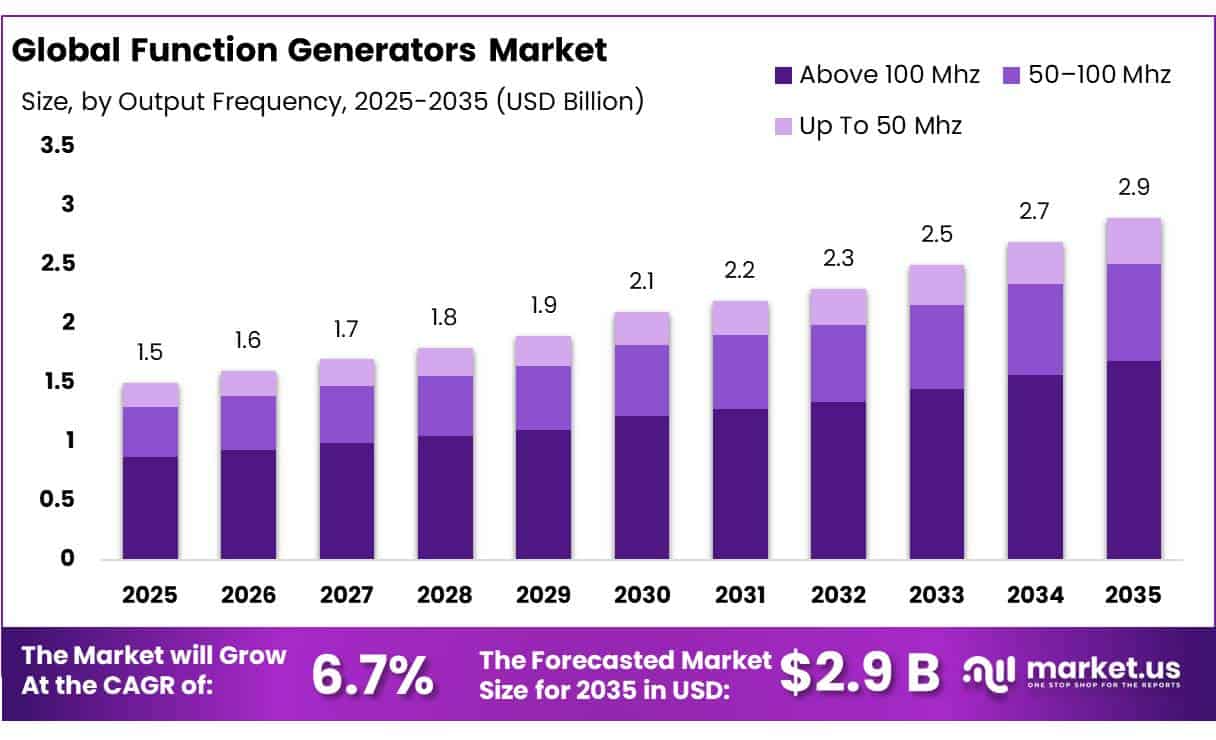
SEMI reported that worldwide semiconductor manufacturing equipment sales reached USD 135.1 billion in 2025, increasing 15% from USD 117.1 billion in 2024. Semiconductor test-equipment billings increased by 55%, while assembly and packaging equipment sales expanded by 21%, reflecting growing testing requirements associated with AI devices, high-bandwidth memory, and advanced packaging.
- According to the International Telecommunication Union, 5G networks covered 55% of the global population in 2025, while approximately 3 billion 5G subscriptions represented around one-third of worldwide mobile-broadband subscriptions. High-income economies had 84% 5G population coverage, demonstrating the increasing requirement for sophisticated electronic testing infrastructure.
Automotive electrification is similarly creating opportunities for advanced waveform-generation equipment across battery electronics, power converters, control units, sensors, charging systems, and vehicle communication platforms. The International Energy Agency reported that global electric-car sales exceeded 20 million units in 2025, increasing by around 20% from 2024 and accounting for 25% of worldwide new-car sales. Around 5% of the global passenger-car stock was electric by 2025.
Industrial automation is further strengthening the testing environment. The International Federation of Robotics recorded 542,000 new industrial robot installations worldwide in 2024, while the operational robot stock reached approximately 4.664 million units, increasing 9% year over year. Annual installations remained above 500,000 units for the fourth consecutive year, indicating a large installed base of motors, drives, controllers, power electronics, sensors, and communication modules requiring signal generation and diagnostic testing.
- Government semiconductor programs are also expanding long-term testing and laboratory infrastructure. The U.S. Department of Commerce allocated USD 39 billion toward semiconductor manufacturing under the CHIPS program, with approximately USD 34 billion awarded across negotiated projects and nearly USD 450 billion in planned semiconductor-related private investment reported by early 2025. Separately, USD 1.4 billion was finalized for advanced semiconductor packaging initiatives.
Europe is creating another long-term opportunity through the European Chips Act. The European Commission expects more than EUR 100 billion of policy-driven public and private semiconductor investment through 2030, including more than EUR 43 billion in public investment. Four semiconductor pilot lines received combined funding of EUR 3.3 billion, supporting research, prototyping, manufacturing, and testing capabilities.
Key Takeaways
- Function Generators Market size is expected to be worth around USD 2.9 Billion by 2035, from USD 1.5 Billion in 2025, growing at a CAGR of 6.7%.
- Digital held a dominant market position, capturing more than a 57.00% share.
- Above 100 Mhz held a dominant market position, capturing more than a 58.00% share.
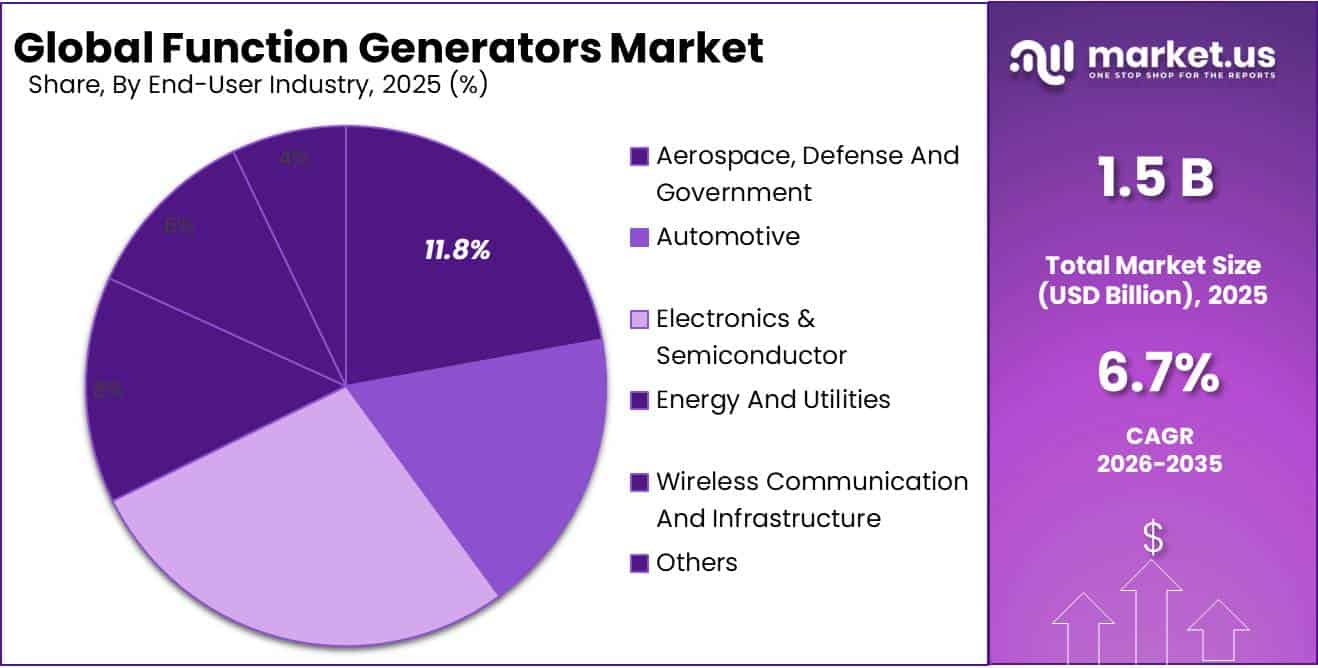
- Electronics & Semiconductor held a dominant market position, capturing more than a 14.80% share.
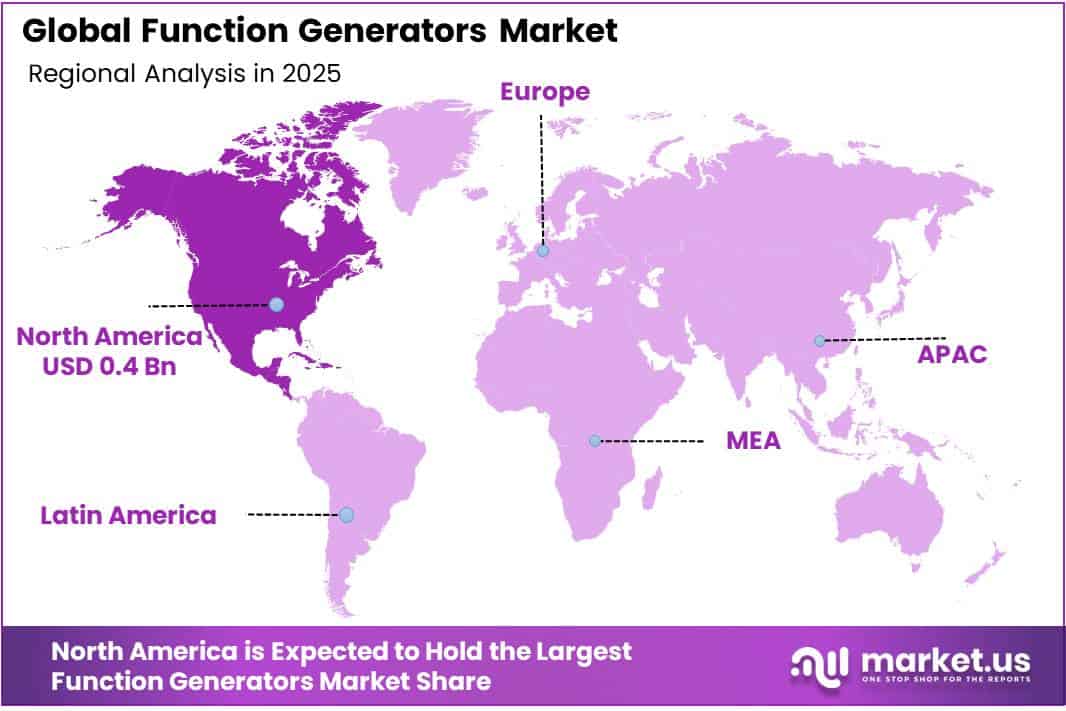
- North America held a dominant market position, capturing more than a 32.00% share and generating approximately USD 0.48 billion in revenue.
By Type Analysis
Digital dominates with more than 57.00% share as programmable testing becomes standard across advanced electronics
In 2025, “Digital” held a dominant market position, capturing more than a 57.00% share. Digital function generators remained widely preferred because they offer programmable waveform control, better frequency stability, waveform storage, and easier integration with automated test systems. Their use is particularly important in semiconductor testing, communication equipment, embedded electronics, and advanced R&D laboratories. In 2025, worldwide semiconductor manufacturing equipment sales reached USD 135.1 billion, while semiconductor test-equipment billings increased by 55% as AI chips and high-bandwidth memory raised testing requirements.
Government-backed semiconductor expansion also supports the Digital segment. In 2025, the U.S. Department of Commerce reported USD 39 billion under the CHIPS manufacturing incentive program, with approximately USD 34 billion already awarded and nearly USD 450 billion in planned semiconductor-related private investment. This growing manufacturing and laboratory infrastructure creates a larger requirement for digitally controlled signal-generation, validation, and automated electronic testing systems.
Analog function generators continue to maintain an important position in the Function Generators Market because they provide straightforward waveform generation, simple controls, continuous signal adjustment, and relatively easy operation. They are commonly suited to basic circuit development, amplifier testing, power-electronics work, sensor evaluation, maintenance activities, educational laboratories, and applications where highly complex programmable waveforms are not required.
By Output Frequency Analysis
Above 100 MHz dominates with more than 58.00% share as high-speed electronic testing becomes more important
In 2025, “Above 100 Mhz” held a dominant market position, capturing more than a 58.00% share. The segment benefits from growing testing requirements in high-speed semiconductors, wireless communication systems, RF components, advanced computing hardware, and communication equipment. Above 100 MHz function generators allow engineers to reproduce faster signals and evaluate circuits working at higher frequencies, making them useful in product development and laboratory validation.
Up To 50 Mhz continues to hold an important position in the Function Generators Market because this frequency range is suitable for routine circuit testing, sensor development, power electronics, control systems, educational laboratories, maintenance work, and general-purpose electronic troubleshooting. These instruments are practical where engineers require stable sine, square, pulse, or ramp signals without the additional capability of very high-frequency equipment.
U.S. Bureau of Labor Statistics data showed that navigational, measuring, electromedical, and control-instrument manufacturing employed about 414,400 workers in May 2026. Within this industry, manufacturing of instruments used for measuring and testing electricity and electrical signals accounted for around 34,800 workers. This established U.S. measurement and testing equipment base supports continued use of general-purpose function generators across production, servicing, calibration, engineering laboratories, and industrial electronic systems.
By End-User Industry Analysis
Electronics & Semiconductor dominates with more than 14.80% share as chip development increases electronic testing needs
In 2025, “Electronics & Semiconductor” held a dominant market position, capturing more than a 14.80% share. The segment remained the leading end user because function generators are widely required for semiconductor design, circuit validation, component testing, production testing, and troubleshooting. Demand is becoming stronger as AI processors, memory products, power electronics, and advanced packaging require more accurate signal generation. Global semiconductor sales reached USD 791.7 billion in 2025, increasing 25.6% from the previous year, while logic semiconductor sales reached USD 301.9 billion.
- Testing intensity is also rising directly within semiconductor manufacturing. SEMI reported that worldwide semiconductor manufacturing equipment sales reached USD 135.1 billion in 2025, up 15%, while semiconductor test-equipment billings increased by 55%. Growth was linked to AI devices, high-bandwidth memory, advanced logic, and more demanding performance testing.
Aerospace, Defense And Government continues to represent an important end-user segment of the Function Generators Market. Function generators are used during the development and testing of radar systems, avionics, satellite electronics, navigation equipment, electronic warfare systems, communication devices, sensors, and military power electronics.
The U.S. Department of Defense requested USD 179.1 billion for Research, Development, Test and Evaluation in FY2026, while combined procurement and RDT&E investment reached USD 384.3 billion. This large technology-development budget supports continued laboratory testing and validation of advanced electronic systems, creating a strong application base for high-performance function generators.
Key Market Segments
By Type
- Analog
- Digital
By Output Frequency
- Up To 50 Mhz
- 50–100 Mhz
- Above 100 Mhz
By End-User Industry
- Aerospace, Defense And Government
- Automotive
- Electronics & Semiconductor
- Energy And Utilities
- Wireless Communication And Infrastructure
- Others
Driver Analysis
Semiconductor Test Capacity Expansion
Major foundry capacity additions announced through 2024–2026, including new fabs in Arizona, Texas, Japan, and expanded capacity in Taiwan and South Korea, each require dedicated characterization and reliability-test laboratories that typically deploy function generators alongside oscilloscopes, spectrum analyzers, and parametric test systems, with a single advanced-node characterization lab commonly requiring 15–40 waveform-generation instruments across multiple test benches.
Function generators used in semiconductor validation increasingly require bandwidth specifications exceeding 500 MHz to 1 GHz with sample rates above 1 GSa/s to accurately stimulate high speed digital and RF test structures, pushing customers toward premium instrument tiers priced at USD 8,000–35,000 per unit rather than entry-level bench models priced under USD 2,000.
The semiconductor industry’s transition toward advanced packaging techniques such as chiplets and 3D stacking, which require additional signal-integrity and timing-characterization steps per package, is increasing the number of test points per device by an estimated 20–35% compared with monolithic-die testing, directly expanding the per-fab instrument requirement.
The semiconductor test-capacity expansion driver is estimated to add approximately +1.7 percentage points to baseline CAGR across the United States, Taiwan, South Korea, Japan, and the EU over the medium term as fab capacity additions ramp through 2027–2029.
Drivers Impact Analysis
| Driver | (~) % Impact on CAGR Forecast | Geographic Relevance | Impact Timeline |
|---|---|---|---|
| Semiconductor Test Capacity Expansion | +1.7 pp | U.S., Taiwan, South Korea, Japan, EU | Medium term (2–4 years) |
| 5G/6G and RF Validation Growth | +1.5 pp | North America, China, EU, South Korea, Japan | Medium term (2–4 years) |
| EV and Power Electronics Testing | +1.4 pp | China, EU, U.S., South Korea, Japan | Short term (≤ 2 years) |
| Aerospace and Defense RF Modernization | +1.2 pp | U.S., EU, India, Japan, South Korea | Long term (≥ 4 years) |
| Education and R&D Lab Modernization | +1.0 pp | North America, EU, India, China, ASEAN | Short term (≤ 2 years) |
| PC-Based Modular Instrumentation Shift | +1.1 pp | North America, EU, China, Japan | Medium term (2–4 years) |
Restraint Analysis
Precision Analog Component Shortages
Lead times for high-speed DAC components used in premium arbitrary waveform generators have fluctuated between 20 and 45 weeks during periods of semiconductor tightness over 2024–2026, compared with a historical norm of 8–14 weeks, forcing instrument manufacturers to carry higher safety-stock inventory levels, often 25–40% above pre-shortage baseline, which increases working-capital burden and inventory-carrying cost by an estimated 300–600 basis points relative to revenue.
When allocation constraints tighten, component distributors and brokers have periodically charged spot-market premiums of 50–200% over standard contracted pricing for critical DAC and clock-synthesis parts, and a manufacturer unable to secure allocated volume may be forced to either absorb these premiums, compressing gross margin by an estimated 400–900 basis points on affected product lines, or delay shipments, risking contract penalties on time-sensitive defense and semiconductor-test customer orders governed by firm delivery deadlines.
Manufacturers are responding through dual-sourcing qualification programs, redesigned circuit architectures accommodating alternative DAC families, and longer-term take-or-pay supply agreements with key semiconductor vendors, but requalification of an alternate DAC typically requires six to twelve months of engineering validation before production deployment. This component-availability constraint is estimated to reduce baseline CAGR by approximately -1.4 percentage points globally, with concentrated exposure across the United States, the EU, Taiwan, and Japan over the short term.
Restraint Impact Analysis
| Restraint | (~) % Impact on CAGR Forecast | Geographic Relevance | Impact Timeline |
|---|---|---|---|
| Precision Analog Component Shortages | -1.4 pp | Global; U.S., EU, Taiwan, Japan | Short term (≤ 2 years) |
| Extended Instrument Replacement Cycles | -1.3 pp | North America, EU, Japan | Long term (≥ 4 years) |
| Low-Cost Asian Price Competition | -1.5 pp | Global; APAC, LATAM, Eastern Europe | Medium term (2–4 years) |
| Export Control Compliance Burden | -1.1 pp | U.S., EU, China, South Korea, Taiwan | Medium term (2–4 years) |
| Academic and SME CapEx Deferral | -1.0 pp | North America, EU, India, ASEAN | Short term (≤ 2 years) |
| Calibration and Certification Cost Inflation | -0.8 pp | Global; North America, EU, APAC | Medium term (2–4 years) |
Opportunity Analysis
Instrument-as-a-Service Subscriptions
Instrument-as-a-service subscription models represent a substantial untapped monetization opportunity because the function generator industry has historically operated almost entirely on one-time capital-purchase transactions, leaving a large addressable pool of budget-constrained academic, SME, and startup customers unable to justify upfront purchases of USD 2,000–20,000 per unit despite ongoing test-capability needs; this differs fundamentally from current baseline demand drivers, which assume continued conventional purchasing behavior rather than a structural shift in how instruments are financed and accessed.
Under a subscription framework, a manufacturer or specialized leasing partner could offer mid-tier arbitrary waveform generators for USD 80–250 per month inclusive of calibration, firmware updates, and technical support, converting a customer’s total three-year cost from a single USD 5,000–8,000 capital outlay into a recurring operating expense that avoids capital-budget approval thresholds common in academic procurement processes, where purchases above USD 3,000–5,000 frequently require multi-level administrative sign-off extending procurement timelines by two to six months.
For manufacturers, the shift from hardware-only sales to subscription bundling can increase lifetime revenue per unit by an estimated 40–70% over a five-year instrument lifespan compared with a single hardware sale plus optional extended warranty, while also creating predictable recurring-revenue visibility that improves enterprise valuation multiples relative to cyclical hardware-transaction revenue.
Early successful subscription-model deployment by even a modest share of the addressable base, an estimated 8–15% of mid-tier instrument buyers within three years, could meaningfully accelerate realized market revenue beyond baseline unit-volume assumptions, contributing approximately +1.6 percentage points of CAGR upside across North America, the EU, India, and ASEAN over the short term.
Opportunity Impact Analysis
| Opportunity | (~) % Potential CAGR Upside | Geographic Relevance | Execution Window |
|---|---|---|---|
| Instrument-as-a-Service Subscriptions | +1.6 pp | North America, EU, India, ASEAN | Short term (≤ 2 years) |
| Remote Lab-as-a-Service Platforms | +1.3 pp | India, ASEAN, Africa, LATAM | Medium term (2–4 years) |
| Edge-AI Embedded Waveform Systems | +1.5 pp | U.S., China, EU, South Korea, Japan | Medium term (2–4 years) |
| Emerging Market Localized Manufacturing | +1.2 pp | India, ASEAN, LATAM, Africa | Medium term (2–4 years) |
| Fragmented Regional Player Roll-Up | +1.4 pp | Global; EU, APAC, LATAM | Long term (≥ 4 years) |
| Calibration-Data-as-a-Service Platforms | +1.0 pp | North America, EU, APAC | Short term (≤ 2 years) |
Challenges Analysis
RF Engineering Talent Scarcity
This talent scarcity is particularly acute in the United States, the EU, Japan, South Korea, and Taiwan, where semiconductor and telecommunications-infrastructure investment booms through 2024–2026 have absorbed a substantial share of available RF-engineering graduates and mid-career specialists, leaving instrument manufacturers competing against better-funded semiconductor and telecom-equipment employers offering compensation packages 15–30% above typical test-and-measurement-industry benchmarks for comparable experience levels.
Manufacturers are responding through expanded university-partnership recruitment pipelines, internal training-academy programs requiring 12–24 months to develop junior engineers to full productivity, and selective outsourcing of specific design subtasks to specialized RF-engineering consultancies, though this outsourcing approach typically increases per-project design cost by 20–35% compared with fully in-house development while introducing intellectual-property-protection considerations that require careful contractual structuring. This persistent capability constraint is estimated to impose a -1.2 percentage-point long-term CAGR friction drag on the market’s ability to sustain premium-product innovation velocity across the United States, the EU, Japan, South Korea, and Taiwan.
Challenges Impact Analysis
| Challenge | (~) % CAGR Friction Drag | Geographic Relevance | Mitigation Horizon |
|---|---|---|---|
| RF Engineering Talent Scarcity | -1.2 pp | U.S., EU, Japan, South Korea, Taiwan | Long term (≥ 4 years) |
| Firmware Cybersecurity Maintenance | -1.0 pp | North America, EU, APAC | Medium term (2–4 years) |
| Multi-Standard Calibration Traceability | -0.9 pp | Global; North America, EU, APAC | Medium term (2–4 years) |
| Software Interoperability Fragmentation | -1.1 pp | North America, EU, China, Japan | Medium term (2–4 years) |
| Channel Technical Support Scaling | -0.8 pp | APAC, LATAM, Africa, Eastern Europe | Long term (≥ 4 years) |
| Cross-Border Component Sourcing Complexity | -0.9 pp | U.S., EU, Taiwan, China, South Korea | Medium term (2–4 years) |
Geopolitical Impact Analysis
Ongoing Wars Raise Defense Testing Demand While Disrupting Function Generator Supply Chains
The ongoing Russia–Ukraine war and renewed Middle East conflict are reshaping the Function Generators Market through both stronger defense demand and greater supply-chain risk. Function generators are widely used to test radar, communication, electronic-warfare, drone, avionics, and semiconductor systems, so higher military electronics activity supports demand for high-frequency and programmable instruments.
In July 2026, the European Union added 51 entities to tighter export restrictions on dual-use goods and technologies, including microelectronics and semiconductor-processing equipment, while 37 new listings were directly linked to long-range drones. These controls can limit sales into restricted markets and increase compliance costs for test-equipment suppliers.
At the same time, conflict-related shipping disruption is raising logistics uncertainty for electronic components and finished instruments. The International Maritime Organization reported in August 2026 that up to 400 ships carrying around 6,000 seafarers had been unable to leave the Persian Gulf safely, while at least 70 attacks on international shipping had been verified since the Middle East conflict began.
Regional Insights
North America dominates with 32.00% share and USD 0.48 billion, while Asia Pacific shows the strongest growth momentum
In 2025, North America held a dominant market position, capturing more than a 32.00% share and generating approximately USD 0.48 billion in revenue. The region benefits from strong demand across semiconductor, aerospace, telecommunications, automotive electronics, and government laboratories. Semiconductor Industry Association data showed that semiconductor sales in the Americas increased by 30.5% in 2025.
In addition, the U.S. Department of Commerce reported USD 39 billion for semiconductor manufacturing incentives, while semiconductor and electronics companies announced nearly USD 450 billion in planned private investment. This expanding manufacturing and R&D base supports steady demand for advanced signal-generation and electronic test equipment.
Asia Pacific is expected to remain the fastest-growing region as semiconductor capacity and advanced-electronics production expand rapidly. In 2025, semiconductor sales across Asia Pacific and other markets increased 45.0%. Semiconductor equipment spending remained heavily concentrated in China, Taiwan, and South Korea, which together represented 79% of worldwide equipment spending.
Taiwan’s semiconductor equipment investment increased 90% to USD 31.5 billion, while South Korea recorded 26% growth to USD 25.8 billion. These large investments in AI chips, high-bandwidth memory, advanced logic, and production testing are creating a stronger requirement for high-speed waveform generation and precision electronic measurement systems.
Key Regions and Countries Insights
- North America
- US
- Canada
- Europe
- Germany
- France
- The UK
- Spain
- Italy
- Rest of Europe
- Asia Pacific
- China
- Japan
- South Korea
- India
- Australia
- Rest of APAC
- Latin America
- Brazil
- Mexico
- Rest of Latin America
- Middle East & Africa
- GCC
- South Africa
- Rest of MEA
Key Players Analysis
Keysight Technologies maintains a strong position in the Function Generators Market through its broad electronic design and test portfolio. In fiscal 2025, the company generated USD 5.375 billion in revenue and invested USD 954 million in research and development. It serves customers across more than 100 countries, including semiconductor, communications, automotive, aerospace, defense, and general electronics industries. Its 33600A Trueform waveform generator platform supports bandwidth up to 120 MHz, strengthening Keysight’s role in high-precision signal generation and automated testing.
Tektronix remains a major supplier of function generators for electronics, semiconductor, education, power-device, and research applications. In 2025, Ralliant’s Test and Measurement segment, which includes Tektronix, recorded USD 801.5 million in sales. Tektronix’s AFG31000 series offers frequencies up to 250 MHz, sample rates up to 2 GSa/s, 14-bit vertical resolution, and memory up to 128 Mpts per channel.
Rohde & Schwarz continues to support the Function Generators Market through its established test and measurement portfolio. In fiscal 2024/2025, the company reported EUR 3.16 billion in revenue, up 7.8%, while its global workforce exceeded 15,000 employees. Its HMF2525 and HMF2550 arbitrary function generators cover frequencies up to 25 MHz and 50 MHz, respectively, with 250 MSample/s operation and 14-bit resolution. This combination supports education, laboratory development, component testing, and general electronic signal-generation applications.
Top Key Players Outlook
- Keysight Technologies
- Tektronix
- Rohde & Schwarz
- National Instruments (Emerson)
- RIGOL Technologies
- SIGLENT Technologies
- Teledyne LeCroy
- Good Will Instrument (GW Instek)
- B&K Precision
Kikusui Electronics - Stanford Research Systems
- Tabor Electronics
- Anritsu Corporation
- Aim-TTi
- Berkeley Nucleonics Corporation
Recent Developments
- In March 2026, Teledyne LeCroy introduced the Frontline X700 wireless analyzer with 880 MHz of concurrent capture across 2.4 GHz, 5 GHz, and 6 GHz frequency bands.
- In April 2026, Kikusui expanded its laboratory equipment portfolio with the PMX-E series, offering 35 W to 105 W power ratings and voltage models from 18 V to 500 V, together with LAN, USB, and RS232C interfaces.
- In June 2026, Anritsu also completed the acquisition of a 20.0% stake in Aim-TTi Holdings, adding general-purpose electronic measurement instruments to its industrial measurement strategy.
Report Scope
| Report Features | Description |
|---|---|
| Market Value (2025) | USD 1.5 Bn |
| Forecast Revenue (2035) | USD 2.9 Bn |
| CAGR (2026-2035) | 6.7% |
| Base Year for Estimation | 2025 |
| Historic Period | 2020-2024 |
| Forecast Period | 2026-2035 |
| Report Coverage | Revenue Forecast, Market Dynamics, Competitive Landscape, Recent Developments |
| Segments Covered | By Type (Analog, Digital), By Output Frequency (Up To 50 Mhz, 50–100 Mhz, Above 100 Mhz), By End-User Industry (Aerospace, Defense And Government, Automotive, Electronics & Semiconductor, Energy And Utilities, Wireless Communication And Infrastructure, Others ) |
| Regional Analysis | North America – US, Canada; Europe – Germany, France, The UK, Spain, Italy, Rest of Europe; Asia Pacific – China, Japan, South Korea, India, Australia, Singapore, Rest of APAC; Latin America – Brazil, Mexico, Rest of Latin America; Middle East & Africa – GCC, South Africa, Rest of MEA |
| Competitive Landscape | Keysight Technologies, Tektronix, Rohde & Schwarz, National Instruments (Emerson), RIGOL Technologies, SIGLENT Technologies, Teledyne LeCroy, Good Will Instrument (GW Instek), B&K Precision, Kikusui Electronics, Stanford Research Systems, Tabor Electronics, Anritsu Corporation, Aim-TTi, Berkeley Nucleonics Corporation |
| Customization Scope | Customization for segments, region/country-level will be provided. Moreover, additional customization can be done based on the requirements. |
| Purchase Options | We have three licenses to opt for: Single User License, Multi-User License (Up to 5 Users), Corporate Use License (Unlimited User and Printable PDF) |





































