Report Overview
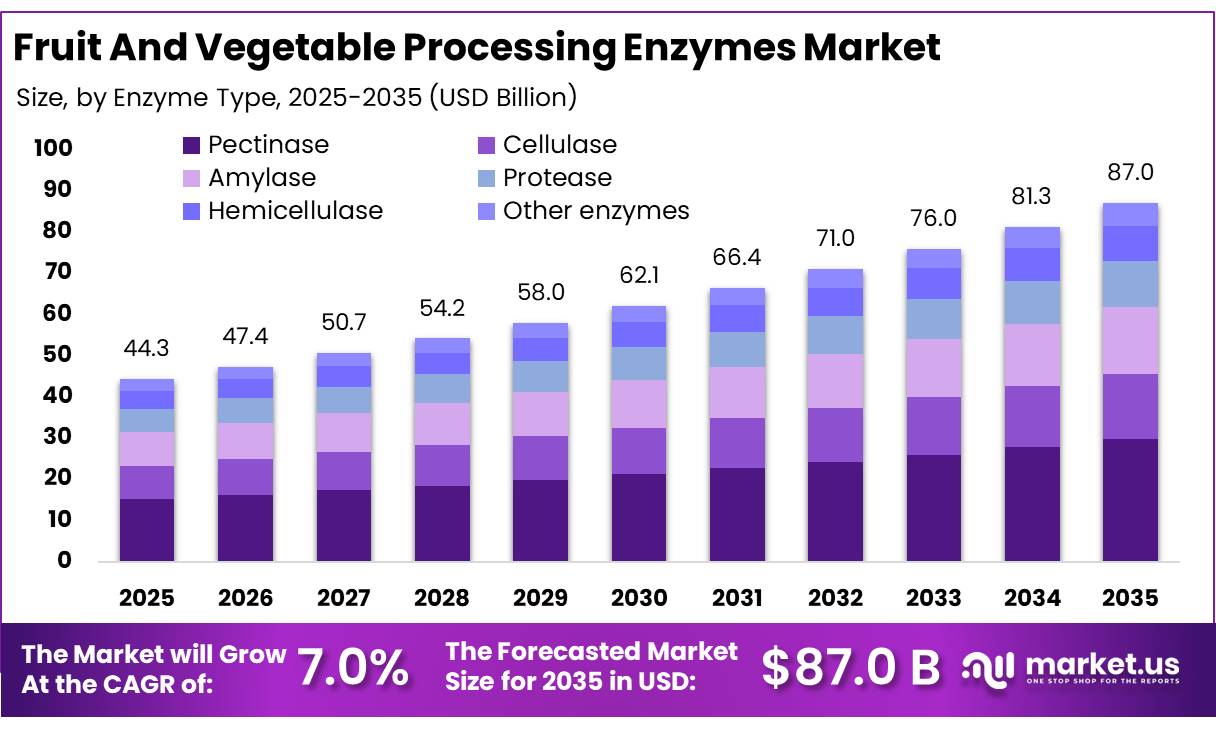
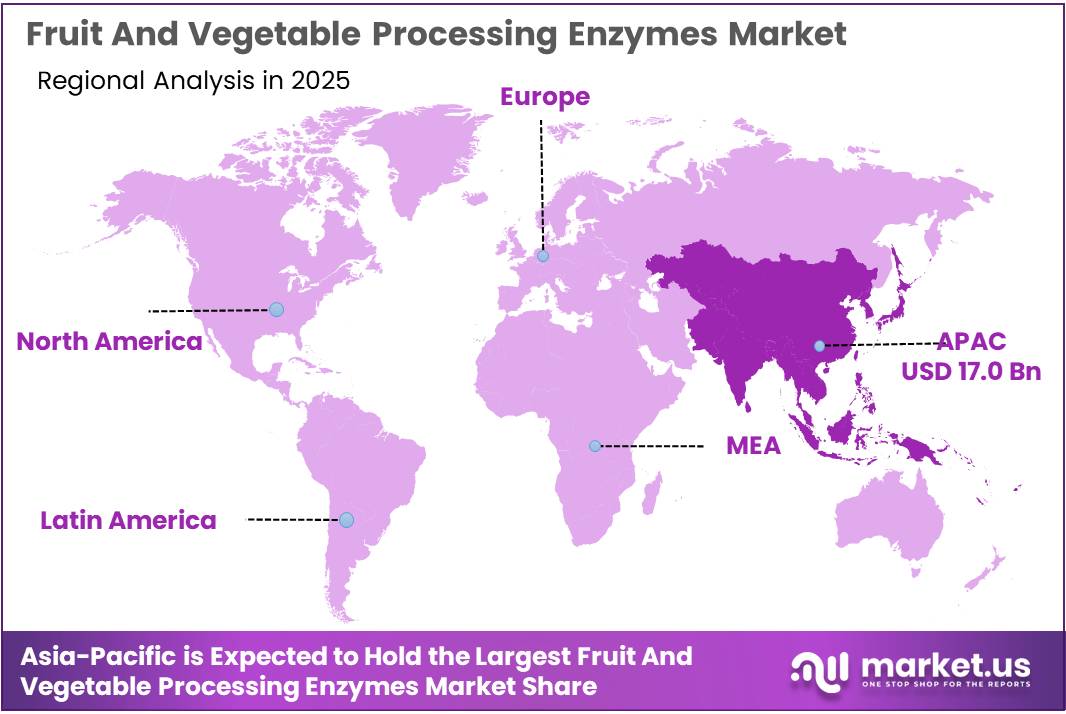
The Global Fruit And Vegetable Processing Enzymes Market size is expected to be worth around USD 87.0 Billion by 2035, from USD 44.3 Billion in 2025, growing at a CAGR of 7.0% during the forecast period from 2026 to 2035. In 2025, Asia-Pacific held a dominant market position, capturing more than a 38.40% share, holding USD 17.0 Billion revenue.
The fruit and vegetable processing enzymes industry plays an important role in converting fresh agricultural produce into juices, concentrates, purees, canned products, frozen foods and other value-added ingredients. These enzymes are biological catalysts that improve processing efficiency by breaking down specific components of plant tissues. Pectinase, cellulase, xylanase, amylase and related enzyme blends are widely used to support juice extraction, clarification, texture control and the breakdown of complex carbohydrates.
- The industrial scenario is supported by the large volume of agricultural produce entering global food supply chains. According to the Food and Agriculture Organization of the United Nations (FAO), global fruit and vegetable production reached approximately 2.1 billion tonnes in 2023, increasing by 1% compared with 2022. This large raw-material base creates demand for technologies that improve extraction, processing and product quality.
In the United States, the Economic Research Service of the Department of Agriculture estimated that processing vegetable availability reached 95.6 pounds per person in 2024, excluding mushrooms, potatoes and sweet potatoes. The US Census Bureau also reported USD 28.41 billion in sales, shipments or revenue for fruit and vegetable canning businesses in 2024. These figures illustrate the scale of downstream processing activity, although they do not represent enzyme sales.
Future growth opportunities are expected in customised enzyme formulations, low-temperature processing, improved extraction methods and the use of enzymes for by-product recovery. Fruit peels, pulp and vegetable residues may provide opportunities to recover useful fibres, sugars and other ingredients through controlled enzymatic treatment. Advances in enzyme engineering may also help manufacturers develop products with better stability and activity under specific processing conditions. However, food safety approval, enzyme purity, source traceability and consistent performance remain important commercial requirements.
In the European Union, Regulation (EC) No. 1332/2008 establishes the framework for food enzyme safety assessment and authorisation. In the United States, the Food and Drug Administration provides guidance on the chemical and technological information required for enzyme preparation petitions and Generally Recognized as Safe notices. These requirements make regulatory compliance and documented product quality important areas of investment for enzyme manufacturers.
Key Takeaways
- Fruit And Vegetable Processing Enzymes Market size is expected to be worth around USD 87.0 Billion by 2035, from USD 44.3 Billion in 2025, growing at a CAGR of 7.0%.
- Pectinase held a dominant market position, capturing more than a 34.20% share.
- Liquid held a dominant market position, capturing more than a 61.30% share.
- Fruit processing held a dominant market position, capturing more than a 30.00% share of the Fruit and Vegetable Processing Enzymes Market.
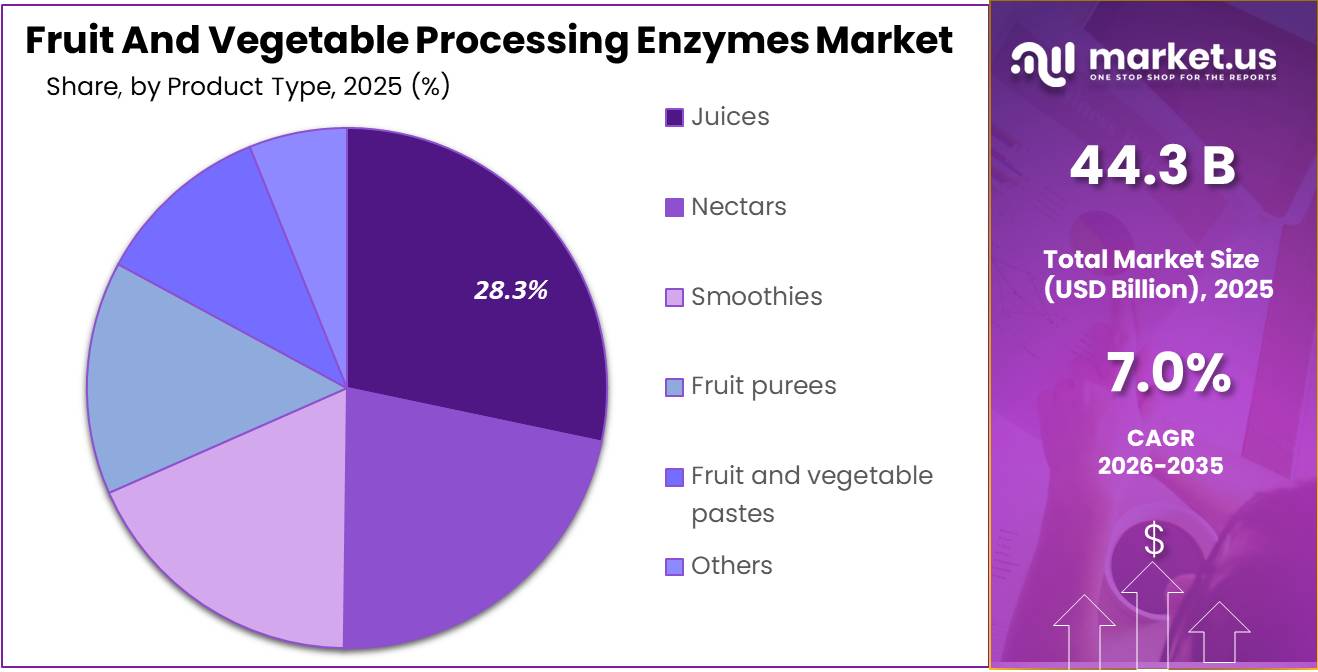
- Juices held a dominant market position, capturing more than a 28.00% share of the Fruit and Vegetable Processing Enzymes Market.
- Fruit juice and beverage manufacturers held a dominant market position, capturing more than a 37.00% share.
- Direct sales / B2B supply held a dominant market position, capturing more than a 65.00% share.
- Asia-Pacific held a dominant market position, accounting for 38.40% of the global market, valued at USD 17.0 billion.
By Enzyme Type Analysis
Pectinase leads the enzyme segment through its important role in fruit juice extraction, clarification and processing efficiency.
In 2025, “Pectinase” held a dominant market position, capturing more than a 34.20% share of the Fruit and Vegetable Processing Enzymes Market. Its leading position is supported by its ability to break down pectin present in fruit cell walls, helping processors improve juice extraction, reduce viscosity and achieve better clarification. Pectinase is widely used in the production of apple, grape and citrus juices, concentrates and fruit-based ingredients.
Cellulase is an important enzyme used to break down cellulose in plant cell walls during fruit and vegetable processing. In 2026, its industrial application remained relevant in juice production, particularly during peeling and crushing, where it helps release cell contents and makes pressing easier.
A scientific food-enzyme assessment published through Belgium’s official food safety assessment system describes cellulase use in fruit and vegetable juice processing and identifies a recommended use level of 2.0 mg total organic solids (TOS) per kg for the assessed enzyme preparation. This is a technical use-level figure, not a market share or a universal dosage for all cellulase products. The United States Department of Agriculture also reported processing vegetable availability of 95.6 pounds per person in 2024, providing an indication of the scale of the processed vegetable supply chain that supports demand for processing technologies.
By Form Analysis
Liquid enzymes lead the market due to their easy handling, faster mixing and suitability for large-scale fruit and vegetable processing.
In 2025, “Liquid” held a dominant market position, capturing more than a 61.30% share of the Fruit and Vegetable Processing Enzymes Market. Liquid enzyme preparations are widely used because they can be mixed directly into fruit pulp, juice and processing mixtures, allowing manufacturers to distribute enzyme activity more evenly during production. They are particularly suitable for juice extraction, clarification and viscosity reduction, where controlled enzyme treatment helps improve filtration and product consistency.
The Food and Agriculture Organization (FAO) confirms that enzyme preparations for fruit juice processing are available in both liquid and powder forms. Its technical guidance describes a hot treatment method at 54°C for 1 to 2 hours and a cold treatment method at 20°C for 6 to 8 hours, showing how processing conditions can be adjusted to suit production requirements. These applications support the use of liquid formulations in commercial juice and puree manufacturing.
Powder is another important form in the Fruit and Vegetable Processing Enzymes Market. Powder enzyme preparations are suitable for manufacturers that prefer dry ingredients for storage, transportation and controlled dosing. They can be added during selected processing stages and are used in applications such as juice extraction, fruit pulp treatment and vegetable processing.
In 2026, the United States Department of Agriculture’s National Agricultural Statistics Service continued to publish annual production data for fruit and vegetable crops, reflecting the scale of agricultural raw materials entering processing industries.
By Application Analysis
Fruit processing leads application demand as enzyme treatment improves juice extraction, clarification and the recovery of fruit-based ingredients.
In 2025, “Fruit processing” held a dominant market position, capturing more than a 30.00% share of the Fruit and Vegetable Processing Enzymes Market. Its leading position is supported by the widespread use of enzymes in juice, concentrate, puree and fruit ingredient production. Pectinase, cellulase and related enzyme preparations help break down fruit tissues, release juice, reduce pulp viscosity and improve filtration. These functions help manufacturers increase processing efficiency and maintain consistent product quality.
According to the Food and Agriculture Organization (FAO), global fruit production reached 952 million tonnes in 2023, providing a substantial raw-material base for fruit processing industries. The United States Department of Agriculture also maintains annual data covering processed fruit categories such as canned, frozen, dried and juice products. These established processing activities support continued demand for enzyme solutions in commercial fruit manufacturing.
Vegetable processing is an important application segment because enzymes help break down plant cell walls, improve extraction and support texture control in processed products. Cellulase, pectinase and hemicellulase are used in selected applications to improve juice release, reduce viscosity and support the processing of vegetable-based ingredients. In 2025, the United States produced 35.6 billion pounds of vegetables for processing, excluding potatoes, pulses and mushrooms, according to the USDA Economic Research Service.
Tomatoes accounted for 65% of this processing vegetable production, with approximately 11.6 million tons processed during the year. This large processing base supports demand for technologies that improve raw-material utilisation and product consistency. Enzyme suppliers can benefit from opportunities in vegetable juice extraction, puree production and recovery of useful ingredients from processing residues.
By Product Type Analysis
Juices lead the product segment as enzyme treatment improves juice extraction, clarification and processing efficiency.
In 2025, “Juices” held a dominant market position, capturing more than a 28.00% share of the Fruit and Vegetable Processing Enzymes Market. The segment benefits from the extensive use of pectinase, cellulase and other enzyme preparations in fruit juice manufacturing. These enzymes help break down fruit tissues, release more juice, reduce pulp thickness and improve filtration. They are particularly useful in the production of apple, orange, grape and mixed-fruit juices, where manufacturers require consistent clarity, texture and product quality.
According to the USDA Foreign Agricultural Service, global orange juice production for the 2025/26 marketing year was forecast at approximately 1.4 million metric tonnes, while global consumption was forecast to increase by 4% to 1.2 million metric tonnes. This government data highlights the scale of the juice industry and supports demand for processing technologies, including enzyme-based solutions.
Nectars are fruit-based beverages that generally contain fruit juice or puree combined with water and, depending on the product, other permitted ingredients. Enzymes are used during selected stages of fruit preparation to break down pectin and plant cell-wall materials, helping improve pulp handling, texture and processing efficiency. Pectinase and cellulase can support the preparation of fruit bases used in nectar production, particularly when manufacturers process thick-pulp fruits such as peaches, pears and apricots.
In 2025, the USDA reported commercial apple production of approximately 5.04 million metric tonnes in the United States, providing an example of the fruit supply available for fresh and processed applications. Although this figure is not specific to nectar manufacturing, it reflects the availability of fruit raw materials used across the processed fruit industry. Demand for suitable enzyme preparations depends on the fruit variety, pulp content and desired beverage texture.
By End User Analysis
Fruit juice and beverage manufacturers lead enzyme consumption through their extensive use of enzymes in juice extraction, clarification and beverage formulation.
In 2025, “Fruit juice and beverage manufacturers” held a dominant market position, capturing more than a 37.00% share of the Fruit and Vegetable Processing Enzymes Market. Their leading position is supported by the regular use of pectinase, cellulase and other enzyme preparations in juice and beverage production. These enzymes help break down fruit tissues, improve juice recovery, reduce viscosity and support filtration.
According to the United States Department of Agriculture (USDA), global orange juice production for the 2025/26 marketing year was forecast at approximately 1.4 million metric tonnes, while global consumption was projected to increase by 4% to 1.2 million metric tonnes. This production and consumption activity highlights the importance of commercial juice manufacturers and supports the need for efficient processing technologies, including enzyme-based solutions.
In 2025, the United States fruit and vegetable preserving and specialty food manufacturing industry recorded sectoral output of approximately USD 85.45 billion, according to data from the US Bureau of Labor Statistics published through the Federal Reserve Bank of St. Louis. This figure reflects the wider manufacturing industry’s output rather than enzyme-related sales. The scale of this processing activity creates opportunities for enzyme suppliers to serve manufacturers seeking better production yields, consistent product quality and improved use of fruit and vegetable raw materials.
By Distribution Channel Analysis
Direct sales and B2B supply lead distribution due to bulk purchasing, long-term supplier relationships and direct technical support for industrial customers.
In 2025, “Direct sales / B2B supply” held a dominant market position, capturing more than a 65.00% share of the Fruit and Vegetable Processing Enzymes Market. This channel is preferred by large juice manufacturers, food processors and ingredient producers that require regular enzyme supplies in bulk quantities. Direct relationships with manufacturers also allow buyers to receive product specifications, application guidance, technical assistance and customised enzyme formulations.
These services are important because enzyme selection depends on the type of fruit or vegetable, processing conditions and desired product quality. The US Census Bureau reported that merchant wholesalers recorded approximately USD 11.03 trillion in sales during 2024, while grocery and related product merchant wholesalers generated approximately USD 1.34 trillion. These figures demonstrate the scale of the wholesale business environment supporting food ingredient supply chains, although they are not specific to processing enzymes.
Distributors and ingredient suppliers play an important role in the Fruit and Vegetable Processing Enzymes Market by connecting enzyme manufacturers with food processing companies across different regions. They help customers access pectinase, cellulase and other enzyme preparations without having to maintain direct purchasing arrangements with multiple manufacturers. Their services may include inventory management, local delivery, product documentation and technical coordination.
In 2026, the US Department of Agriculture continued to identify food wholesalers as an important link between manufacturers, processors, retailers and other business customers. The US Census Bureau’s 2024 data recorded approximately 34,928 employer establishments in the grocery and related product merchant wholesaling industry, demonstrating the breadth of the distribution network. This established channel provides opportunities for enzyme suppliers to reach regional food processors and specialised ingredient buyers.
Key Market Segments
By Enzyme Type
- Pectinase
- Cellulase
- Amylase
- Protease
- Hemicellulase
- Other enzymes
By Form
- Liquid
- Powder
- Granules
- Others
By Application
- Fruit processing
- Vegetable processing
- Juice processing
- Juice extraction and clarification
- Fruit-puree production
- Paste and concentrate production
- Other applications
By Product Type
- Juices
- Nectars
- Smoothies
- Fruit purees
- Fruit and vegetable pastes
- Others
By End User
- Fruit juice and beverage manufacturers
- Fruit and vegetable processors
- Wine and cider producers
- Food and beverage manufacturers
- Others
By Distribution Channel
- Direct sales / B2B supply
- Distributors and ingredient suppliers
- Online sales
Driver Analysis
Extraction-Yield Optimization
Enzymatic breakdown of selected cell-wall components increases recoverable juice from an existing fruit intake, creating a measurable procurement incentive when raw-material expenditure dominates processing economics. Commercial apple and pear applications combine pectinase, hemicellulase and cellulase activities; Novonesis specifies first-mash dosing of 60–120 millilitres per 1,000 kg of fruit for Pectinex Yieldmash Plus and describes lower viscosity, faster free-run juice and improved pressing.
Raw-material variability reinforces the value of recovery efficiency: USDA’s 2025/26 EU citrus assessment projected 9.9 million tonnes of production against a revised 10.5 million tonnes in the previous season, although lower fruit availability can simultaneously reduce enzyme-treated throughput.
In an illustrative apple operation processing 100,000 tonnes annually, increasing saleable juice yield from 75% to 77% produces 2,000 additional tonnes—a two-percentage-point increase, not 2% relative growth. At an assumed incremental contribution of $250 per additional tonne, gross value is $500,000 before enzyme and additional processing costs. Applying the cited first-mash dosage to that intake implies 6,000–12,000 litres of formulated enzyme annually, demonstrating a physical consumption relationship without assuming a selling price.
Suppliers capture value through validated fruit-specific recipes, seasonal technical support and repeat purchasing tied to throughput. The +1.0 pp contribution assumes 25% revenue exposure grows 4 percentage points faster through greater primary-extraction adoption, excluding second-mash recovery and new citrus capacity allocated separately.
Drivers Impact Analysis
| Driver | (~) % Impact on CAGR Forecast | Geographic Relevance | Impact Timeline |
|---|---|---|---|
| Extraction-yield optimization | +1.0 pp | China, Poland, US, Brazil | Short term (≤ 2 years) |
| Filtration-capacity intensification | +0.8 pp | EU, China, Thailand, Philippines | Short term (≤ 2 years) |
| Citrus processing expansion | +0.7 pp | Egypt, Brazil, China | Medium term (2–4 years) |
| Tropical and vegetable applications | +0.6 pp | India, Southeast Asia, China | Medium term (2–4 years) |
| Secondary-stream juice recovery | +0.5 pp | EU, China, US, Brazil | Short term (≤ 2 years) |
Restraint Analysis
Juice-Demand Substitution
Enzyme consumption is constrained when consumers move away from enzyme-treated juices toward other beverages, because higher penetration or improved processing performance cannot indefinitely offset a shrinking eligible production base. USDA’s 2025/26 South Korea assessment reports continued orange-juice consumption decline as consumers shift toward low-sugar beverages; its EU assessment identifies elevated prices and weather-related quality issues as reasons consumers migrated to other products, although it forecasts a slight consumption recovery from the preceding season’s low level.
Australia’s assessment separately revised estimated 2024/25 orange-juice consumption down by 3,000 tonnes to 21,000 tonnes, while July–October 2025 imports fell 27% year on year; import movements are not equivalent to consumption changes, but the report links higher import costs to retail-price pressure and weaker demand.
In an illustrative enzyme-treated production segment initially processing 100 million litres annually, a 5% volume reduction removes five million litres from the dosing base. At an assumed application rate of 0.15 litres of formulated enzyme per 1,000 litres of juice, consumption falls by 750 litres before changes in penetration, dosage or price.
Switching to another enzyme-treated fruit beverage may preserve some demand, so this restraint applies only to net losses from the defined application base. Suppliers need customer forecasts segmented by beverage category rather than general population or packaged-food growth assumptions. The −0.5 pp contribution assumes 20% revenue exposure grows 2.5 percentage points more slowly through final-demand substitution, excluding production reductions caused by unavailable fruit.
Restraint Impact Analysis
| Restraint | (~) % Impact on CAGR Forecast | Geographic Relevance | Impact Timeline |
|---|---|---|---|
| Juice-demand substitution | −0.5 pp | EU, South Korea, Australia | Short term (≤ 2 years) |
| Reduced processing-fruit availability | −0.4 pp | EU, South Africa, Australia | Short term (≤ 2 years) |
| Uneconomic treatment adoption | −0.4 pp | India, Southeast Asia, Latin America | Medium term (2–4 years) |
| Product-specification exclusions | −0.3 pp | EU, US, Japan, China | Long term (≥ 4 years) |
| Market-access qualification limits | −0.3 pp | EU core; export-oriented processors | Medium term (2–4 years) |
Opportunity Analysis
Enzymatic Sugar Modification
A 2025 study quantitatively examines glucose oxidase/catalase treatment in acidic model solutions, while a contemporary review explains that glucose oxidase converts glucose into gluconic acid and generates hydrogen peroxide; catalase can address the peroxide coproduct, but oxygen transfer, acidity, residual enzyme activity and sensory changes remain engineering requirements.
The white space is a newly qualified enzyme application—not the existing consumer preference for reduced sugar or a claim that sucrose inversion itself reduces total sugars. In an illustrative beverage containing 10 g of total sugars per 100 mL, converting 20% of a glucose fraction comprising 30% of those sugars removes 0.6 g of glucose per 100 mL, only 6% of starting total sugars before analytical and regulatory assessment.
That distinction prevents laboratory glucose conversion from being marketed automatically as an equivalent total-sugar or calorie reduction. A hypothetical ten-million-litre launch at $0.01 of additional enzyme expenditure per litre creates $100,000 of annual enzyme revenue, excluding equipment, formulation services and finished-product sales.
Suppliers need pilot-scale mass balances, oxygen-management trials, sensory acceptance and market-specific clearance before positioning claims. The +0.35 pp contribution assumes 7% revenue exposure grows 5 percentage points faster through genuinely additional sugar-modification purchases; it is contingent on scalable economics and compliant product positioning.
Opportunity Impact Analysis
| Opportunity | (~) % Potential CAGR Upside | Geographic Relevance | Execution Window |
|---|---|---|---|
| Enzymatic sugar modification | +0.35 pp | EU, US, Japan, South Korea | Medium term (2–4 years) |
| High-value pomace extraction | +0.30 pp | EU, China, US, Brazil | Medium term (2–4 years) |
| Fruit-piece texture platforms | +0.25 pp | EU, US, China, Thailand | Medium term (2–4 years) |
| Aroma-release enzyme systems | +0.20 pp | EU, US, Japan, Brazil | Medium term (2–4 years) |
| Outcome-priced adoption programs | +0.20 pp | India, Southeast Asia, Latin America | Short term (≤ 2 years) |
Challenges Analysis
Raw-Material Recipe Variability
Changes in cultivar, maturity, storage history and fruit condition alter the substrate presented to an enzyme, requiring processors to recalibrate recipes rather than assume one formulation and dosage will perform identically throughout the season. Novonesis’s Pectinex Ultra Mash guidance distinguishes fresh-fruit dosing of 50–120 millilitres per 1,000 kg from stored-fruit dosing of 60–130 millilitres per 1,000 kg and identifies low pH and high tannin content as relevant application conditions. Its vegetable preparation separately specifies pH 3.0–4.5 and 50–55°C, illustrating why even products within a broad enzyme portfolio are not interchangeable operating recipes.
In an illustrative 100,000-tonne annual processing campaign, increasing formulated-enzyme dose from 80 to 100 millilitres/tonne raises consumption from 8,000 to 10,000 litres—a 25% increase without any increase in throughput. At an assumed $15/litre, that adds $30,000 of customer expenditure, but whether it preserves value depends on verified extraction and quality outcomes. Higher dosage can increase supplier sales, so expenditure inflation alone is not a market-growth penalty; friction arises when repeated trials, disputes and inconsistent results slow additional adoption.
Suppliers need incoming-fruit characterization, seasonal reference samples and recipe adjustments linked to measured outcomes. The −0.30 pp contribution assumes 15% revenue exposure grows 2 percentage points more slowly through unresolved recipe variability, excluding crop shortages and applications rejected because their finished-product specifications prohibit the intended treatment.
Challenges Impact Analysis
| Challenge | (~) % CAGR Friction Drag | Geographic Relevance | Mitigation Horizon |
|---|---|---|---|
| Raw-material recipe variability | −0.30 pp | China, EU, US, Brazil | Medium term (2–4 years) |
| Reaction-window process integration | −0.25 pp | India, Southeast Asia, China | Medium term (2–4 years) |
| Low-dose mixing consistency | −0.25 pp | EU, US, India, Latin America | Medium term (2–4 years) |
| Activity and inventory standardization | −0.20 pp | Global; tropical distribution corridors | Long term (≥ 4 years) |
| Occupational exposure management | −0.20 pp | EU, US, China, India | Medium term (2–4 years) |
Geopolitical Impact Analysis
Impact of Ongoing Wars on the Fruit and Vegetable Processing Enzymes Market
The ongoing conflicts in the Middle East and the Russia-Ukraine region are creating pressure on the Fruit and Vegetable Processing Enzymes Market through higher energy costs, shipping delays and supply chain uncertainty. Enzyme manufacturers depend on electricity, fermentation inputs, chemicals, packaging materials and temperature-controlled transportation. Rising fuel and freight costs can increase production and distribution expenses, while delays in international shipments may affect the timely supply of enzyme preparations to food processors.
According to the United Nations Conference on Trade and Development (UNCTAD), shipping activity through the Strait of Hormuz fell by more than 95% following the escalation of conflict in 2026, disrupting energy and fertilizer flows. The Food and Agriculture Organization (FAO) also reported a 20% to 25% decline in global fertilizer trade volumes between January and April 2026 compared with the same period in 2025.
These disruptions can indirectly increase agricultural input costs and affect the availability and price of fruits and vegetables. For enzyme suppliers, the situation may encourage local sourcing, diversified suppliers and improved inventory planning. However, higher operating costs could place pressure on profit margins and purchasing decisions among food processors.
Regional Insights
Asia-Pacific dominates the Fruit and Vegetable Processing Enzymes Market due to its large agricultural base, expanding food-processing industry and rising demand for packaged fruit and vegetable products.
In 2025, Asia-Pacific held a dominant market position, accounting for 38.40% of the global market, valued at USD 17.0 billion. The region benefits from strong fruit and vegetable production in China, Japan, Vietnam, Thailand and other Southeast Asian economies.
According to Agriculture and Agri-Food Canada, China produced approximately 552.67 million tonnes of fresh vegetables in 2024, representing 48.9% of global production. Vietnam produced approximately 18.23 million tonnes during the same year. This substantial agricultural supply supports demand for pectinase, cellulase and other enzymes used in juice extraction, clarification, puree production and food preservation.
The region benefits from developed food manufacturing infrastructure and demand for processed fruit and vegetable products. In the United States, vegetables grown for processing reached 35.6 billion pounds in 2025, excluding potatoes, pulses and mushrooms. Tomatoes represented 65% of this production, with processing tomato output reaching 11.6 million tons.
These figures demonstrate the scale of industrial processing activity and the potential demand for enzyme preparations that improve extraction, texture and product consistency. Manufacturers are also focusing on efficient raw-material utilisation and improved production quality, creating opportunities for specialised enzyme suppliers.
Key Regions and Countries Insights
- North America
- US
- Canada
- Europe
- Germany
- France
- The UK
- Spain
- Italy
- Rest of Europe
- Asia Pacific
- China
- Japan
- South Korea
- India
- Australia
- Rest of APAC
- Latin America
- Brazil
- Mexico
- Rest of Latin America
- Middle East & Africa
- GCC
- South Africa
- Rest of MEA
Key Players Analysis
Novonesis Group is a leading biosolutions company with a strong position in industrial and food enzyme technologies. Its portfolio supports food and beverage manufacturers through enzyme solutions that improve processing efficiency, product quality and raw-material utilisation. In 2025, the company reported net sales of EUR 4,157.6 million, with 7% organic sales growth and a 37.1% adjusted EBITDA margin. It launched 33 new products during the year, while Food and Beverage recorded 8% organic sales growth. These developments strengthen its position in food-processing enzyme applications.
International Flavors & Fragrances Inc. (IFF) supplies food ingredients, bioscience solutions, cultures and enzyme technologies for food and beverage manufacturers. Its Health and Biosciences business supports applications involving food processing, ingredient functionality and product quality. In 2025, IFF recorded total sales of USD 10.89 billion, while its Health and Biosciences segment generated approximately USD 2.28 billion. The company also reported USD 594 million in adjusted operating EBITDA for this segment. Its broad food technology portfolio supports its participation in enzyme-based food processing applications.
dsm-firmenich participates in the food ingredients industry through nutritional, functional and food-processing solutions. Its technologies support manufacturers seeking improved product quality, formulation performance and production efficiency. In 2025, the company reported EUR 9.034 billion in sales from continuing operations and EUR 1.772 billion in adjusted EBITDA, with a 19.6% adjusted EBITDA margin. Its Taste, Texture and Health business generated EUR 3.146 billion in sales. The company remains relevant to food ingredient innovation, although its current role in fruit and vegetable processing enzymes should be distinguished from its former animal nutrition enzyme activities.
Top Key Players Outlook
- Novonesis Group
- International Flavors & Fragrances Inc. (IFF)
- dsm-firmenich
- Kerry Group plc
- AB Enzymes GmbH
- Amano Enzyme Inc.
- Advanced Enzyme Technologies Ltd.
- Biocatalysts Ltd.
- Enzyme Development Corporation (EDC)
- BASF SE
- Sunson Industry Group Co., Ltd.
- Jiangsu Boli Bioproducts Co., Ltd.
- Group Soufflet / InVivo Group
- Enzyme Supplies Limited
- Maps Enzymes Ltd.
Recent Developments
- Kerry reported EUR 6.8 billion in revenue and EUR 1.21 billion in EBITDA. These developments strengthen its biotechnology and enzyme capabilities, although the disclosed Carrigaline expansion is focused on dairy enzymes rather than fruit and vegetable processing enzymes.
- In September 2025, BASF completed the sale of its Food and Health Performance Ingredients business to Louis Dreyfus Company (LDC). The transaction included 1 production facility in Illertissen, Germany, 3 application laboratories and approximately 300 employees.
Report Scope
| Report Features | Description |
|---|---|
| Market Value (2025) | USD 44.3 Bn |
| Forecast Revenue (2035) | USD 87.0 Bn |
| CAGR (2026-2035) | 7.0% |
| Base Year for Estimation | 2025 |
| Historic Period | 2020-2024 |
| Forecast Period | 2026-2035 |
| Report Coverage | Revenue Forecast, Market Dynamics, Competitive Landscape, Recent Developments |
| Segments Covered | By Enzyme Type (Pectinase, Cellulase, Amylase, Protease, Hemicellulase, Other enzymes), By Form (Liquid, Powder, Granules, Others), By Application (Fruit processing, Vegetable processing, Juice processing, Juice extraction and clarification, Fruit-puree production, Paste and concentrate production, Other applications), By Product Type (Juices, Nectars, Smoothies, Fruit purees, Fruit and vegetable pastes, Others), By End User (Fruit juice and beverage manufacturers, Fruit and vegetable processors, Wine and cider producers, Food and beverage manufacturers, Others), By Distribution Channel (Direct sales / B2B supply, Distributors and ingredient suppliers, Online sales) |
| Regional Analysis | North America – US, Canada; Europe – Germany, France, The UK, Spain, Italy, Rest of Europe; Asia Pacific – China, Japan, South Korea, India, Australia, Singapore, Rest of APAC; Latin America – Brazil, Mexico, Rest of Latin America; Middle East & Africa – GCC, South Africa, Rest of MEA |
| Competitive Landscape | Novonesis Group, International Flavors & Fragrances Inc. (IFF), dsm-firmenich, Kerry Group plc, AB Enzymes GmbH, Amano Enzyme Inc., Advanced Enzyme Technologies Ltd., Biocatalysts Ltd., Enzyme Development Corporation (EDC), BASF SE, Sunson Industry Group Co., Ltd., Jiangsu Boli Bioproducts Co., Ltd., Group Soufflet / InVivo Group, Enzyme Supplies Limited, Maps Enzymes Ltd. |
| Customization Scope | Customization for segments, region/country-level will be provided. Moreover, additional customization can be done based on the requirements. |
| Purchase Options | We have three licenses to opt for: Single User License, Multi-User License (Up to 5 Users), Corporate Use License (Unlimited User and Printable PDF) |