


Report Overview
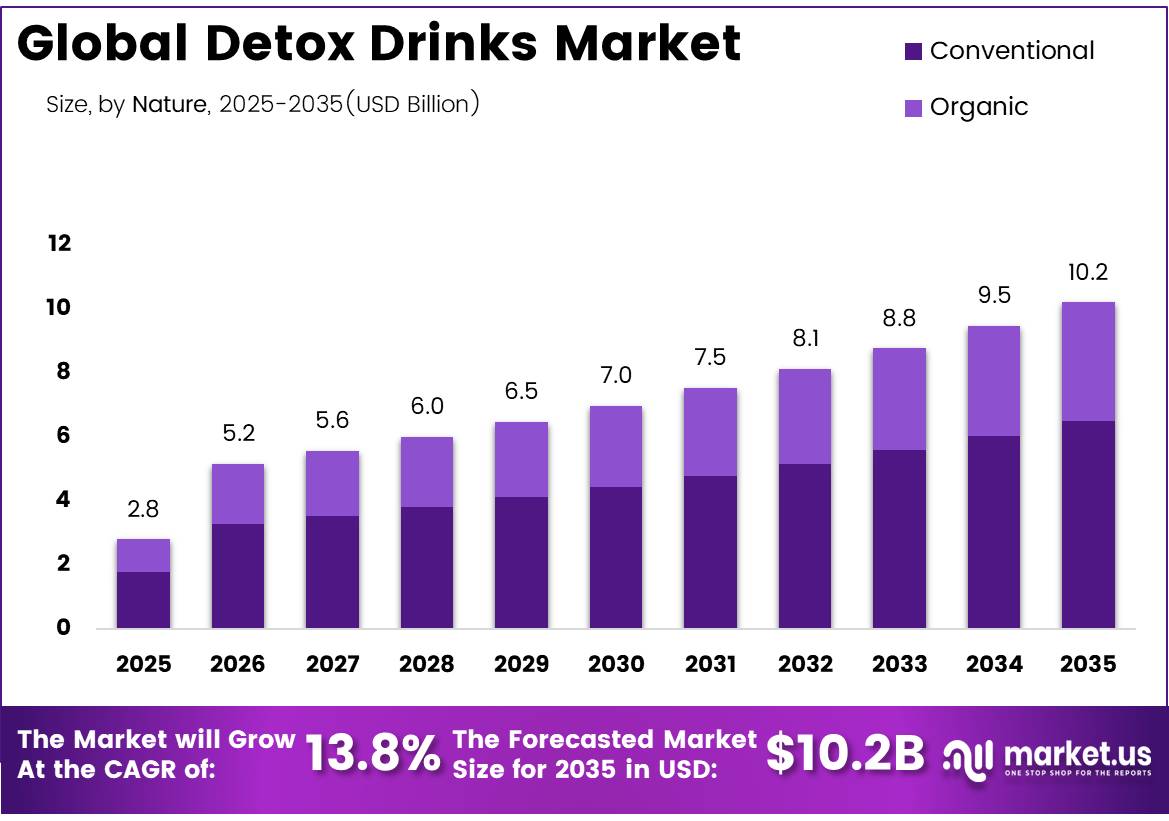
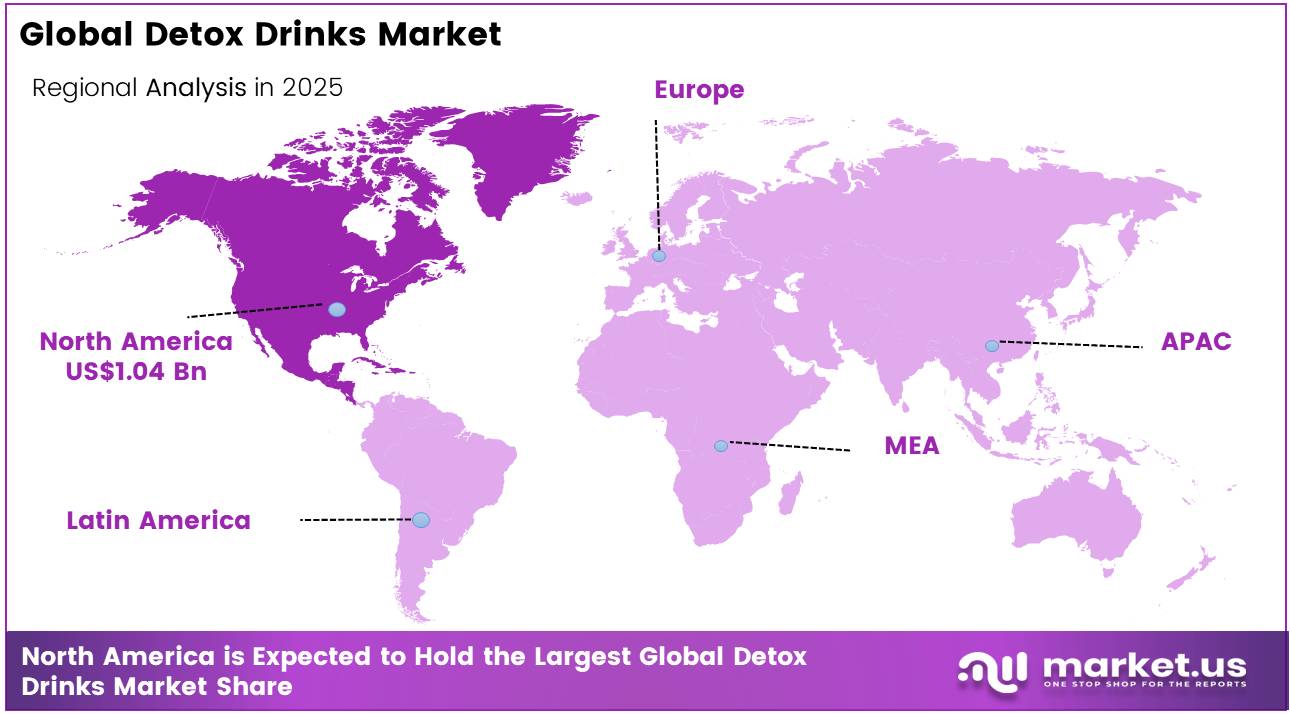
In 2025, the Global Detox Drinks Market was valued at US$2.8 billion, and between 2026 and 2035, this market is projected to grow at a CAGR of 13.8%, reaching about US$10.2 billion by 2035. In 2025, Europe held a dominant market position, capturing more than a 37.2% share, holding USD 1.04 Billion revenue.
- According to the World Health Organization (WHO), non-communicable diseases (NCDs), including cardiovascular diseases, diabetes, cancer, and chronic respiratory disorders, caused approximately 43 million deaths in 2021, accounting for 75% of all non-pandemic-related deaths globally.
The growing burden of obesity is further strengthening market expansion. WHO data indicates that 2.5 billion adults worldwide were overweight in 2022, including more than 890 million people living with obesity. This represents 43% of the global adult population, compared with 25% in 1990. As consumers become more focused on weight management and preventive health, demand for functional beverages such as detox drinks continues to rise.
Government policies are also supporting market growth. By July 2024, 116 countries had implemented national sugar-sweetened beverage (SSB) taxes, while more than 130 jurisdictions worldwide had adopted some form of SSB taxation. These measures are encouraging consumers to shift away from high-sugar beverages toward healthier alternatives. Europe accounted for 37.2% of the global market in 2025, generating approximately USD 1.04 billion in revenue, supported by strict regulatory standards for health claims and growing consumer preference for scientifically validated wellness beverages.
Key Takeaways
- The global Detox Drinks Market was valued at USD 2.8 billion in 2025.
- The global Market is projected to grow at a CAGR of 13.8% and is estimated to reach USD 10.2 billion by 2035.
- On the basis of product type, the Detox Tea dominated the market, constituting 24.5% of the total market share.
- Based on the nature, the conventional dominated the Detox Drinks Market, with a substantial market share of around 63.6%.
- Based on the distribution channel, offline retail led the market, comprising 71.5% of the total market.
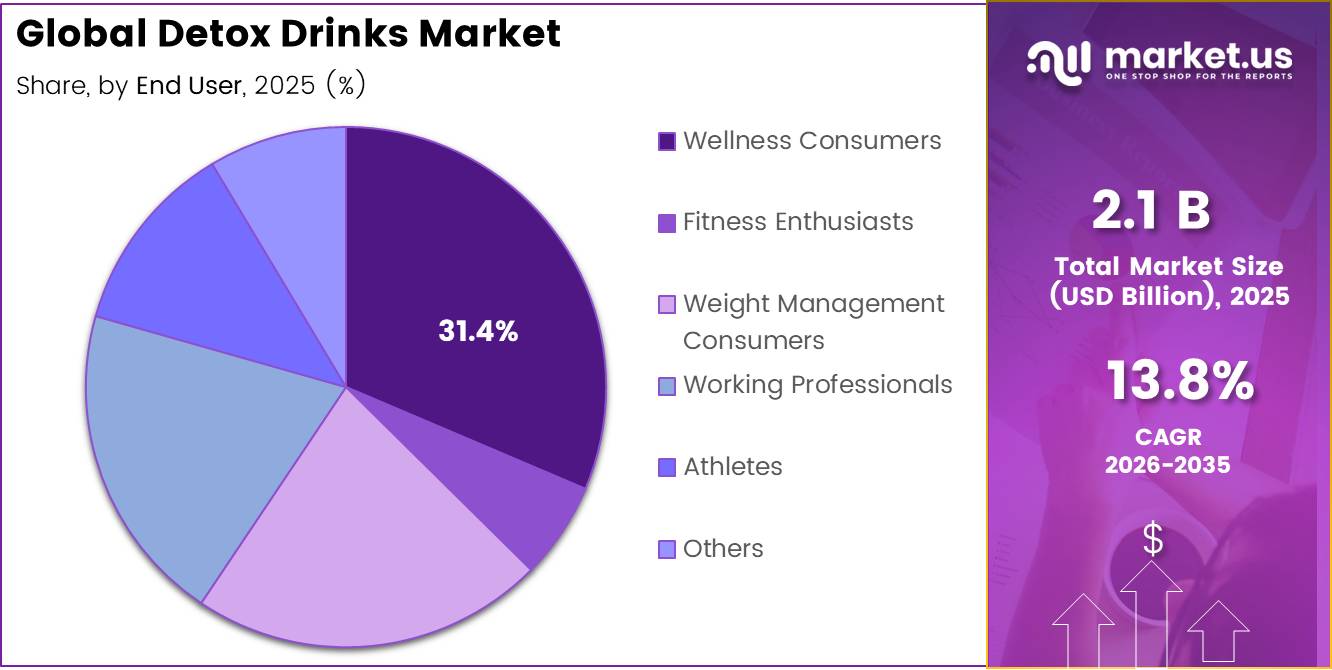
- Among the end-uses, the Wellness Consumers held a major share in the Detox Drinks Market, 31.4% of the market share.
- In 2025, the North America was the most dominant region in the Detox Drinks Market, accounting for 37.2% of the total global consumption.
Product Type Analysis
Detox Tea represents dominant Segment in the Market.
Detox Tea accounted for an estimated 24.5% share of the global detox drinks market, supported by the strong foundation of the worldwide tea industry and growing consumer preference for healthier beverage options.
According to the Food and Agriculture Organization (FAO), global tea production is valued at approximately USD 19.5 billion, with world output reaching around 7.3 million tonnes in 2025. This extensive production network, spanning more than 60 tea-producing countries, provides detox tea manufacturers with reliable raw material availability, established supply chains, and broad retail penetration.
In addition, global tea consumption has expanded steadily at an average annual rate of 3.3%, reaching 6.5 million tonnes in 2022. China remains the largest consumer, accounting for nearly 46% of global tea consumption (3 million tonnes), while India contributes about 18% (1.16 million tonnes). The widespread acceptance of tea across major markets creates a natural platform for detox tea products, supporting their leading position within the detox drinks industry.
Nature Analysis
Conventional a significant nature.
Conventional detox drinks held 63.6% of the global detox drinks market in 2025, primarily due to their cost advantages, large-scale raw material availability, and well-established agricultural supply chains.
According to the Food and Agriculture Organization (FAO), global primary crop production reached 9.9 billion tonnes in 2023, representing a 27% increase since 2010. This growth was largely supported by conventional farming practices, with global fruit and vegetable production exceeding 2.1 billion tonnes. FAO data further shows that global pesticide use increased by 70% between 2000 and 2022, helping farmers improve yields and maintain consistent crop supplies.
End User Analysis
Wellness Consumers are the most widely users.
Wellness Consumers account for the largest share of the global detox drinks market, representing 31.4% of total demand. This leadership is supported by the growing global burden of obesity and chronic health conditions.
According to the World Health Organization (WHO), 2.5 billion adults (43% of the global adult population) were overweight in 2022, including more than 890 million adults living with obesity. The WHO further reports that global obesity rates have more than doubled since 1990 and are expected to affect over 1 billion adults by 2030 if current trends continue. In parallel, non-communicable diseases (NCDs) caused 43 million deaths in 2021, accounting for 74% of all non-pandemic deaths worldwide.
These health concerns are encouraging consumers to adopt preventive wellness habits and healthier dietary choices. Detox drinks, often formulated with botanical ingredients, green tea extracts, antioxidants, and liver-supporting compounds, are increasingly viewed as convenient beverages that complement healthy lifestyles. This trend is further supported by the rapid expansion of the global wellness economy, which reached USD 6.8 trillion in 2024, reflecting strong consumer interest in disease prevention, healthy aging, and overall well-being.
Distribution Channel Analysis
Offline Retail Held a Major Share of the Distribution Channel.
Offline retail accounted for 71.5% of the global detox drinks market in 2025, maintaining its leading position due to the unique distribution and purchasing requirements of functional beverages. Many detox drinks contain cold-pressed juices, botanical extracts, probiotics, and other ingredients that require reliable cold-chain storage and transportation, making physical retail channels highly important.
Consumers also prefer purchasing these products in stores where they can directly examine ingredient labels, health claims, certifications, packaging quality, and product freshness before making a purchase decision. The broader global food and grocery retail market, valued at USD 14,425 billion in 2026, is projected to reach USD 22,259 billion by 2035, highlighting the continued importance of brick-and-mortar retail infrastructure in consumer goods distribution.
The U.S. Census Bureau reported that e-commerce sales reached USD 326.7 billion in Q1 2026, growing 9.8% year-over-year compared with total retail growth of 3.9%, with online channels accounting for 16.9% of total retail sales. This growth reflects increasing consumer adoption of digital wellness purchases, supported by subscription services, direct-to-consumer brands, and personalized health platforms.
At the global level, UNCTAD recorded USD 28 trillion in business e-commerce sales across 45 economies in 2024, up from USD 27 trillion in 2022. Additionally, NielsenIQ reported that the online consumer packaged beverage market reached USD 11.9 billion, expanding by 18.2% year-over-year, demonstrating strong demand for convenient digital access to health-focused beverage products.
Key Market Segments
By Product Type
- Detox Juices
- Detox Smoothies
- Herbal Detox Drinks
- Detox Tea
- Detox Water
- Vinegar-Based Detox Drinks
- Functional Detox Beverages
- Kombucha & Fermented Detox Drinks
- Others
By Nature
- Organic
- Conventional
By End User
- Wellness Consumers
- Fitness Enthusiasts
- Weight Management Consumers
- Working Professionals
- Athletes
- Others
By Distribution
- Online Retail
- E-commerce Platforms
- Brand-Owned Websites
- Offline Retail
- Supermarkets & Hypermarkets
- Convenience Stores
- Specialty Health Stores
- Pharmacies & Drug Stores
- Fitness Centers & Wellness Clinics
Driver Analysis
Regulatory support for non-alcoholic, low-sugar drinks
Regulatory support for non-alcoholic, low-sugar beverages contributes around +1.0 percentage point of CAGR uplift by gradually shifting policy and public-health incentives in favor of detox and functional drinks relative to high-sugar sodas and alcohol, even though detox formulations must still navigate labelling and claims rules.
This environment encourages hotels, bars, and QSR chains to extend non-alcoholic menus and “mocktail” offerings, where detox drinks can act as base or ready-to-serve products; simultaneously, workplace and institutional catering often prefer beverages that fit wellness narratives, further opening B2B channels for detox-based hydration solutions.
Drivers Impact Analysis
| Driver | (~) % Impact on CAGR Forecast | Geographic Relevance | Impact Timeline |
|---|---|---|---|
| Preventive health & detoxification positioning | +2.0% | North America core, EU wellness hubs, urban APAC corridors | Medium term (2-4 years) |
| Clean-label, plant-based detox formulations | +1.6% | EU, North America, Australia, premium APAC cities | Medium term (2-4 years) |
| RTD functional beverage channel expansion | +1.4% | North America, EU, Japan, South Korea, GCC modern retail | Short term (≤ 2 years) |
| Digital & influencer-led detox programs | +1.2% | Global, with focus on North America, EU, India | Short term (≤ 2 years) |
| Regulatory support for non-alcoholic, low-sugar drinks | +1.0% | EU regulatory hubs, UK, GCC, India metros | Long term (≥ 4 years) |
| Innovation in herbal, tea-based, and gut-health detox SKUs | +1.3% | North America, EU, China, India, SE Asia | Medium term (2-4 years) |
Restraint Analysis
Limited clinical evidence & health-claim scrutiny
Limited clinical evidence and tightening health-claim scrutiny impose an estimated -1.7 percentage-point drag on detox drinks CAGR because regulatory authorities increasingly examine wellness trends and functional claims, yet many products still rely on loosely defined notions of “detox”, “reset”, or “cleanse” without robust, peer‑reviewed data to support specific outcomes, as explicitly noted in market commentary that regulatory scrutiny may restrain demand and that low degrees of clinical verification hinder long-term forecasts.
In North America and the EU, food and beverage claims fall under frameworks such as FDA guidance and EFSA health-claim rules; this means a brand promising liver detoxification or toxin removal must either avoid explicit medical language or generate substantial evidence, which can cost millions in clinical studies and multi-year timelines, something only a handful of players can feasibly pursue.
Strategically, this restrains top-line growth because consumers who are increasingly literate about nutrition and skeptical of non-substantiated wellness promises may opt for better-evidenced categories, while companies channel CapEx into regulatory compliance and defensive R&D instead of pure expansion; together, these factors realistically shave around 1.7 percentage points from an unconstrained “story-driven” CAGR scenario, as some volume never materializes due to tightened claim frameworks and slower evidence generation.
Restraint Impact Analysis
| Restraint | (~) % Impact on CAGR Forecast | Geographic Relevance | Impact Timeline |
|---|---|---|---|
| Limited clinical evidence & health-claim scrutiny | -1.7% | North America core, EU regulatory hubs, UK | Long term (≥ 4 years) |
| High price points vs. mass beverages | -1.4% | North America, EU, urban APAC corridors | Medium term (2-4 years) |
| Seasonal & fragile raw-ingredient supply | -1.2% | EU, North America, India, SE Asia | Medium term (2-4 years) |
| Regulatory gray zone between beverage and quasi-wellness | -1.1% | North America, EU, GCC, India metros | Long term (≥ 4 years) |
| Inconsistent quality standards in emerging regions | -1.0% | APAC emerging markets, Africa, LATAM | Medium term (2-4 years) |
| Consumer skepticism and misinformation risk | -0.9% | Global, more acute in educated urban segments | Medium term (2-4 years) |
Opportunity Analysis
Personalized ritual-based detox programs
Personalized ritual-based detox programs represent an untapped opportunity rather than a current driver because most detox-drink consumption today remains episodic and campaign-driven, whereas broader functional beverage trends for 2026 highlight a shift from “rescue” to “ritual”—proactive, daily wellness routines integrated into lifestyles.
The white space lies in building structured, data-backed programs that treat detox drinks as components of multi-week protocols tailored to user profiles rather than generic 3‑day cleanses; this would combine app-based onboarding, basic health questionnaires, and dynamic product recommendations into subscription packs that deliver, for example, 20–30 units per month with clear time-of-day usage and stacking with other functional beverages.
If a brand can convert even 5–10% of occasional detox users into ritual users consuming one serving per day, ARPU could plausibly rise 3–4x for that cohort, with margin expansion of 200–300 basis points due to reduced promotional dependence and predictable demand; at category level, capturing a fraction of the broader functional beverage TAM—projected to exceed USD 160 billion with high-single-digit CAGR by mid-2020s—via ritualized detox offerings could add approximately 1.6 percentage points of CAGR upside above baseline by 2030–2035.
Opportunity Impact Analysis
| Opportunity | (~) % Potential CAGR Upside | Geographic Relevance | Execution Window |
|---|---|---|---|
| Personalized ritual-based detox programs | +1.6% | North America core, EU wellness hubs, urban APAC | Medium term (2-4 years) |
| Women-centric and life-stage detox portfolios | +1.4% | North America, EU, India metros, GCC | Medium term (2-4 years) |
| Gut-health and multi-function detox platforms | +1.5% | U.S., EU, China, Japan, SE Asia | Medium term (2-4 years) |
| Global flavor-curiosity & premium sensory lines | +1.2% | EU, North America, APAC emerging markets | Short term (≤ 2 years) |
| B2B, hospitality & workplace wellness integration | +1.1% | U.S., EU regulatory hubs, GCC, India | Long term (≥ 4 years) |
| Data-driven D2C, subscription & bundle ecosystems | +1.3% | U.S., UK, Germany, Australia, digital-first APAC | Medium term (2-4 years) |
Challenges Analysis
Competitive crowding in functional beverages
Competitive crowding in functional beverages is an ongoing challenge because detox drinks have to fight for shelf space and consumer mindshare against a fast-expanding universe of functional waters, probiotic shots, electrolyte drinks, adaptogenic teas, and women-focused wellness beverages, with 2026 trend reports emphasizing multiple parallel functionality themes rather than a single dominant narrative.
Shelf-level data in key markets show growing facings for ready-to-drink protein, energy-plus-hydration, and gut-health brands, which can outcompete detox drinks on clearer single-function promises and stronger clinical or quasi-clinical backing, pushing detox SKUs into smaller blocks or secondary placements and increasing the cost of maintaining or expanding facings via trade spend.
Strategically, brands must decide whether to double down on detox identity or reposition towards more specific functional benefits, each choice carrying portfolio and channel implications; this strategic noise slows clear brand architecture decisions and thus delays aggressive scaling moves, realistically dragging potential CAGR by around 0.7 percentage point compared with a scenario where detox faced fewer adjacent functional competitors.
Challenges Impact Analysis
| Challenge | (~) % CAGR Friction Drag | Geographic Relevance | Mitigation Horizon |
|---|---|---|---|
| Seasonal botanical supply volatility | -1.0% | North America, EU, India, SE Asia | Medium term (2-4 years) |
| Balancing scale with authenticity | -0.9% | U.S., EU natural retail hubs, urban APAC | Long term (≥ 4 years) |
| Evolving health-claim & labelling rules | -0.8% | North America core, EU regulatory hubs, UK | Long term (≥ 4 years) |
| Fragmented quality & sourcing transparency | -0.8% | APAC emerging, Africa, LATAM | Medium term (2-4 years) |
| Competitive crowding in functional beverages | -0.7% | Global, especially U.S., EU, Japan | Medium term (2-4 years) |
| Talent and capability gaps in R&D and compliance | -0.7% | Global multi-plant operators | Long term (≥ 4 years) |
Geopolitical Impact Analysis
Geopolitical Realignment and Supply Chain Fragmentation Reshaping Detox Drinks Market Manufacturing.
The global detox drinks market is facing increasing cost pressure due to trade tariffs, supply chain disruptions, and rising agricultural input costs. Detox beverages rely heavily on botanical ingredients such as turmeric, ashwagandha, ginger, green tea extract, elderberry, and ginkgo biloba, much of which is sourced from India and China.
Since April 2025, U.S. reciprocal tariffs have imposed a 27% duty on Indian herbal ingredients, while Chinese botanical extracts face a minimum combined tariff of 30%, in addition to existing trade measures. Industry sources indicate that imported Indian botanical extracts now carry a landed-cost increase of more than 25% in the U.S. market. A further 40% anti-circumvention penalty on transshipped goods has reduced alternative sourcing options, creating a more persistent cost burden for detox drink manufacturers that depend on Asian ingredient supply chains.
The World Bank reported a 46% month-on-month increase in urea prices during 2026, highlighting the growing cost burden on agricultural production. As a result, detox drink manufacturers are operating in a structurally elevated cost environment characterized by higher ingredient procurement costs, longer lead times, expensive freight transportation, and increased farming expenses, all of which are placing pressure on margins and product pricing.
Regional Analysis
Asia Pacific Held the Largest Share of the Global Detox Drinks Market.
North America tops the global detox drinks market, holding a strong 37.2% share. This is thanks to its solid wellness culture, high spending power, and serious obesity issues that keep people looking for solutions.
The U.S. Centers for Disease Control and Prevention recently released some eye-opening stats. During August 2021 to August 2023, 72.4% of American adults aged 20 and older were either overweight or obese. Obesity alone hit 40.3%, with severe cases growing from 7.7% to 9.7% since 2013-2014. With numbers like these, it’s clear why the market’s so big there. Add in top-notch retail systems and a real push for organic products, and you see why North America stays at the front.
Asia Pacific, meanwhile, owns the fastest-growing market. As cities grow and more folks become middle-class, they’re spending on health. The World Health Organization found in June 2024 that physical inactivity’s pretty high, especially in Asia Pacific’s richer countries. At 48%, many people are turning to preventive health measures, like detox drinks. So, places like China, Japan, India, and Australia are seeing huge growth too.
Key Regions and Countries Covered
- North America
- The US
- Canada
- Europe
- Germany
- France
- The UK
- Spain
- Italy
- Russia & CIS
- Rest of Europe
- APAC
- China
- Japan
- South Korea
- India
- ASEAN
- Rest of APAC
- Latin America
- Brazil
- Mexico
- Rest of Latin America
- Middle East & Africa
- GCC
- South Africa
- Rest of MEA
Key Players Analysis
Detox drink makers focus on standing out by innovating their formulas, using cleaner labels, and expanding distribution. A big part of their plan is coming up with new ingredients, like adding adaptogens, probiotics, and botanicals. These not only enhance gut health and metabolism but also bolster the immune system, all while meeting what consumers want in a detox product—stuff that actually works and isn’t just basic cleaning.
This fancy preservation helps position their products as top tier. To stay ahead of tighter regulations from groups like the FDA and WHO, companies are securing organic and non-GMO supplies, which keeps things running smoothly and ensures consistency. By building more production power, especially in North America and Asia Pacific, brands match local wellness trends and boost sales where the most folks are looking for such goods.
Vertical integration with botanical suppliers and co-manufacturers keeps sourcing steady and formulations consistent when scaling up. Long-term deals with big retailers, health food sellers, and online marketplaces lock in distribution and boost market position in profitable wellness sectors. Protecting IP on unique blends and processing techs shields top firms from price pressures in a more competitive market.
The Major Players In The Industry
- PepsiCo
- The Coca-Cola Company
- Suja Life
- RAW Generation
- Pressed Juicery
- BluePrint
- KeVita
- GT’s Living Foods
- Health-Ade
- Remedy Drinks
- The Hain Celestial Group
- Keurig Dr Pepper
- Nestlé
- The Kraft Heinz Company
- Unilever
- Other Key Players
Key Development
- In February 2025, The Coca-Cola Company moved further into functional and wellness beverages by launching Simply Pop, its first prebiotic soda. The product contains no added sugar, uses 25% to 30% real fruit juice from concentrate, and was introduced in 5 flavours in 12-ounce cans.
- In May 2025, PepsiCo strengthened its position in the functional and wellness beverage space by completing the USD 1.95 billion acquisition of poppi, including USD 300 million in expected tax benefits, which reduced the net purchase price to USD 1.65 billion.
- In June 2026, Pressed entered a strategic agreement with CloudKitchens to open 27 delivery-focused locations, increasing its overall reach to nearly 10,000 grocery, hospitality, foodservice and retail outlets.
- In fiscal 2025, Hain Celestial generated USD 1.56 billion in net sales, representing a 10% year-over-year decline, while organic beverage sales decreased by 3% and adjusted EBITDA reached USD 65 million.
Report Scope
| Report Features | Description |
|---|---|
| Market Value (2025) | USD 2.8 Bn |
| Forecast Revenue (2035) | USD 10.2 Bn |
| CAGR (2026-2035) | 13.8% |
| Base Year for Estimation | 2025 |
| Historic Period | 2020-2024 |
| Forecast Period | 2026-2035 |
| Report Coverage | Revenue Forecast, Market Dynamics, Competitive Landscape, Recent Developments |
| Segments Covered | By Product Type (Detox Juices, Detox Smoothies, Herbal Detox Drinks, Detox Tea, Detox Water, Vinegar-Based Detox Drinks, Functional Detox Beverages, Kombucha & Fermented Detox Drinks, Others), By Nature (Organic, Conventional), By End User (Fitness Enthusiasts, Wellness Consumers, Weight Management Consumers, Working Professionals, Athletes, Others), By Distribution Channel (Online retail, Offline retail) |
| Regional Analysis | North America – The US & Canada; Europe – Germany, France, The UK, Spain, Italy, Russia & CIS, Rest of Europe; APAC– China, Japan, South Korea, India, ASEAN & Rest of APAC; Latin America– Brazil, Mexico & Rest of Latin America; Middle East & Africa– GCC, South Africa, & Rest of MEA |
| Competitive Landscape | PepsiCo, The Coca-Cola Company, Suja Life, RAW Generation, Pressed Juicery, BluePrint, KeVita, GT’s Living Foods, Health-Ade, Remedy Drinks, The Hain Celestial Group, Keurig Dr Pepper, Nestlé, The Kraft Heinz Company, Unilever, Other Key Players. |
| Customization Scope | Customization for segments, region/country-level will be provided. Moreover, additional customization can be done based on the requirements. |
| Purchase Options | We have three licenses to opt for: Single User License, Multi-User License (Up to 5 Users), Corporate Use License (Unlimited Users and Printable PDF) |





































