Report Overview
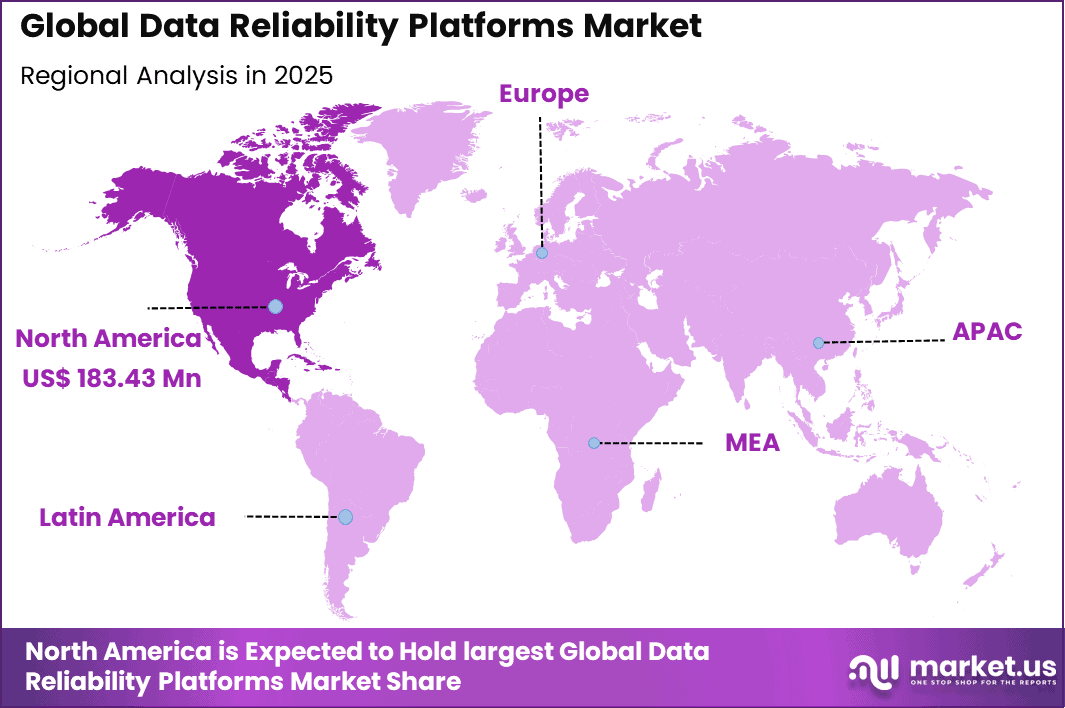
The Global Data Reliability Platforms Market generated USD 431.6 million in 2025 and is predicted to register growth from USD 511 million in 2026 to about USD 2,336.7 million by 2035, recording a CAGR of 18.4% throughout the forecast span. In 2025, North America held a dominant market position, capturing more than a 42.5% share, with USD 183.43 million in revenue.
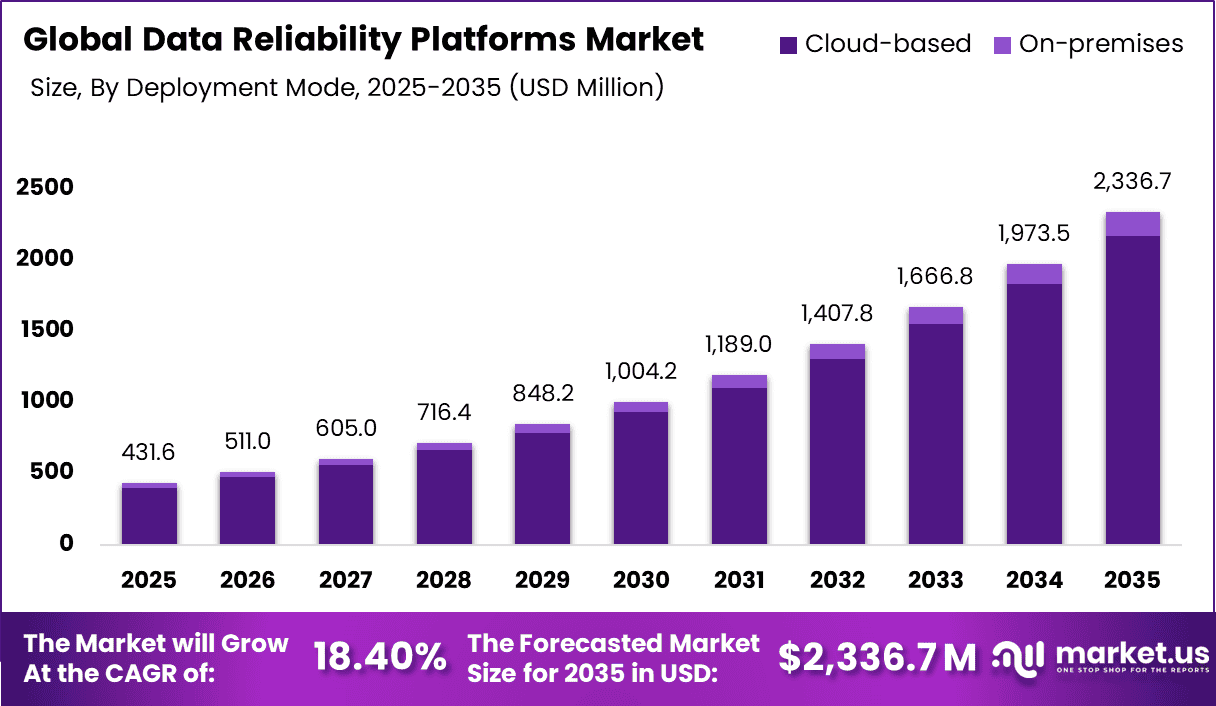
The data reliability platforms market focuses on technologies that ensure the accuracy, consistency, and availability of data across modern digital systems. These platforms monitor data pipelines, detect anomalies, and validate data quality as information moves between applications, databases, and analytics environments. Reliable data is essential for decision-making, reporting, and automated processes that depend on accurate inputs.
The rapid growth of data pipelines supports analytics, cloud applications, and machine learning systems. As organizations integrate multiple data sources, the risk of errors, missing values, or inconsistent records increases. Traditional monitoring tools often focus on infrastructure rather than the reliability of the data itself. Data reliability platforms address this gap by continuously validating data flows and alerting teams when irregular patterns appear.
Top Market Takeaways
- By Deployment Mode, cloud-based solutions capture 92.8% share, enabling scalable anomaly detection, automated lineage validation, and real-time freshness scoring across distributed pipelines.
- By Organization Size, large enterprises hold 78.4%, orchestrating enterprise-wide observability spanning petabyte lakes, streaming sources, and ML feature stores.
- By Application, proactive data quality monitoring leads at 51.3%, implementing statistical process control, drift detection, and self-healing remediation workflows.
- By End-User Industry, technology and internet services command 58.6%, securing recommendation engines, ad platforms, and customer analytics against silent data corruption.
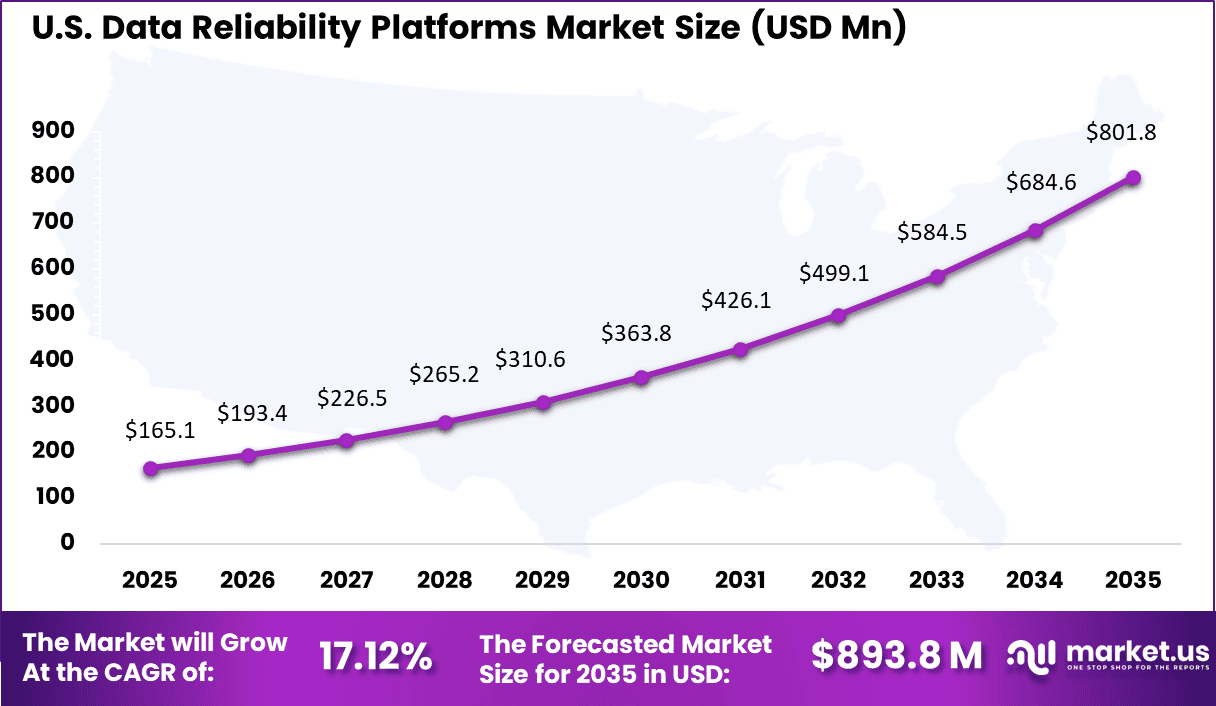
- Regionally, North America accounts for 42.5% global share, with the U.S. market valued at USD 165.1 million and a CAGR of 17.12%, fueled by hyperscaler mandates and regulatory data governance requirements.
By Deployment Mode
Cloud-based deployment accounts for 92.8% of adoption in the data reliability platforms market, as organizations increasingly manage data pipelines in distributed cloud environments. Modern enterprises process large volumes of information across cloud storage, analytics platforms, and data warehouses. Cloud-based reliability tools provide centralized monitoring and validation across these systems.
These platforms support automated anomaly detection and continuous pipeline health monitoring. Real-time alerts allow teams to identify broken data flows or schema changes quickly. The scalability and flexibility of cloud environments continue to strengthen adoption of cloud-based data reliability solutions.
By Organization Size
Large enterprises represent 78% of adoption due to the scale and complexity of their data ecosystems. These organizations manage multiple data pipelines that support analytics, machine learning, and operational systems. Ensuring data reliability is critical for maintaining decision accuracy and operational stability.
Enterprise-level platforms provide unified visibility across diverse data sources and workflows. Automated validation rules help maintain consistent data quality standards. This continues to drive strong adoption among enterprise-scale organizations.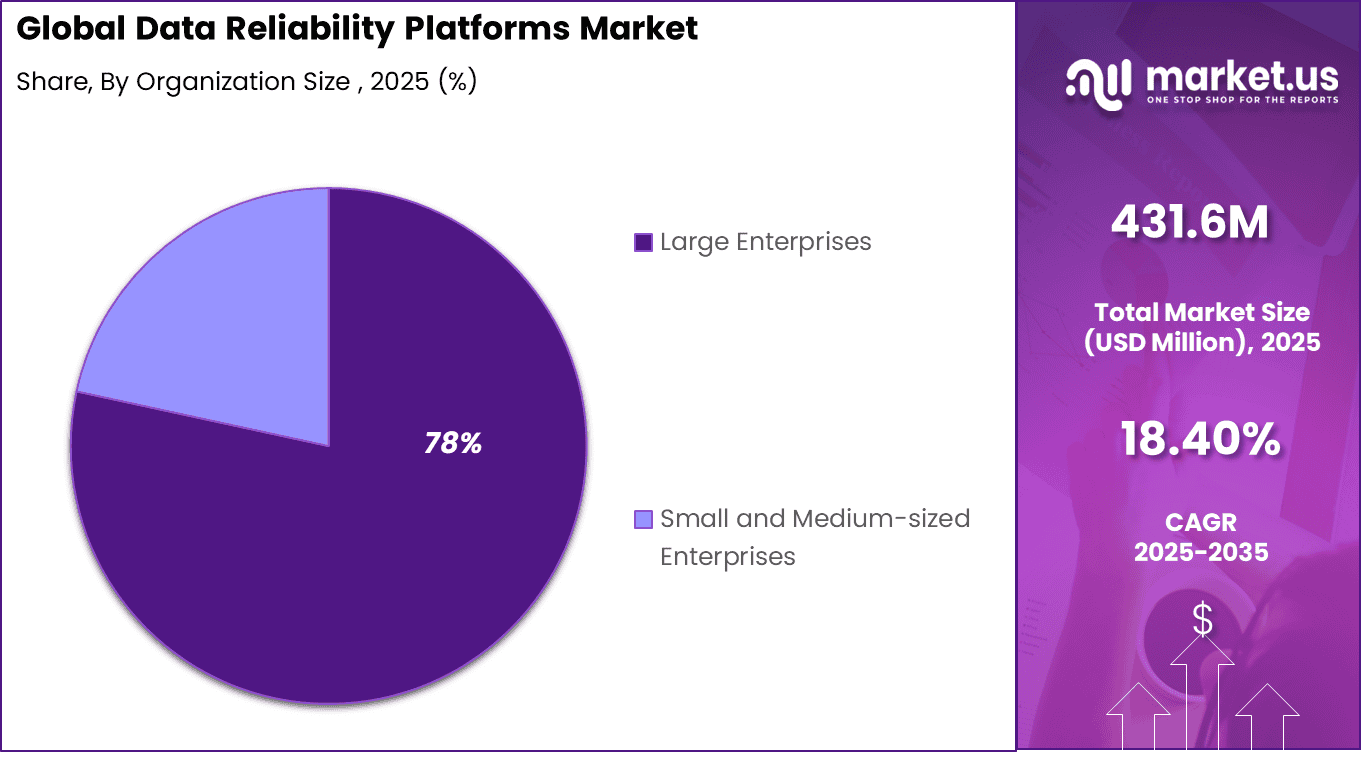
By Application
Proactive data quality monitoring accounts for 51.3% of application demand, as organizations seek to detect data errors before they affect analytics or business processes. Data reliability platforms continuously evaluate datasets for anomalies, missing values, and schema inconsistencies. Early detection reduces the risk of inaccurate insights.
Continuous monitoring also improves trust in business intelligence systems and machine learning models. Automated checks allow teams to address quality issues quickly. This positions proactive monitoring as the primary application area.
Key Market Segments
By Deployment Mode
- Cloud-based
- On-premises
By Organization Size
- Large Enterprises
- Small and Medium-sized Enterprises
By Application
- Proactive Data Quality Monitoring
- Automated Incident Detection and Response
- Data Pipeline Health and Performance
- Data Freshness and Completeness Assurance
- Others
By End-User Industry
- Technology and Internet Services
- Financial Services
- Retail and E-commerce
- Media and Entertainment
- Others
Regional Analysis
North America accounts for 42.5% of the data reliability platforms market, supported by strong enterprise adoption of data-driven operations and advanced analytics systems. Organizations in the region are deploying reliability platforms to ensure data accuracy, consistency, and availability across complex data pipelines. Demand is driven by the rapid growth of cloud data platforms, increasing dependence on real-time analytics, and the need to prevent data quality issues that can affect business decisions.
The United States market is valued at USD 165.1 Mn and is expanding at a CAGR of 17.12%, reflecting rising investment in data governance and monitoring solutions. Adoption is influenced by increasing volumes of enterprise data, integration of diverse data sources, and growing reliance on automated analytics environments. Growth is further supported by the use of reliability platforms to detect anomalies, maintain data pipeline stability, and improve trust in business intelligence and reporting systems.
Key Regions and Countries
- North America
- US
- Canada
- Europe
- Germany
- France
- The UK
- Spain
- Italy
- Russia
- Netherlands
- Rest of Europe
- Asia Pacific
- China
- Japan
- South Korea
- India
- Australia
- Singapore
- Thailand
- Vietnam
- Rest of APAC
- Latin America
- Brazil
- Mexico
- Rest of Latin America
- Middle East & Africa
- South Africa
- Saudi Arabia
- UAE
- Rest of MEA
Drivers Impact Analysis
| Key Drivers | CAGR (~%) | Geographic Relevance | Impact Timeline | Strategic Importance |
|---|---|---|---|---|
| Rising Complexity of Enterprise Data Pipelines | +3.8% | North America, Europe | Short to Long Term | Requires continuous data monitoring |
| Increasing Adoption of Data-driven Business Strategies | +3.2% | Global | Medium Term | Expands demand for reliable analytics |
| Growth in Cloud-based Data Platforms | +2.7% | North America, APAC | Medium Term | Increases need for automated reliability checks |
| Expansion of Real-time Analytics and Streaming Data | +2.3% | Global | Medium to Long Term | Requires constant data validation |
| Integration with Data Governance and Compliance Systems | +1.9% | Europe, North America | Medium Term | Ensures regulatory compliance |
Restraints Impact Analysis
| Key Restraints | Impact on CAGR Forecast (~%) | Geographic Relevance | Impact Timeline | Market Constraint Level |
|---|---|---|---|---|
| High Implementation Costs for Advanced Data Platforms | -2.3% | Emerging Markets | Short to Medium Term | Budget limitations for smaller organizations |
| Integration Complexity with Legacy Data Systems | -1.9% | Global | Medium Term | Slows deployment timelines |
| Limited Skilled Data Engineering Professionals | -1.6% | Global | Medium Term | Restricts platform optimization |
| Data Privacy and Governance Challenges | -1.3% | Europe, North America | Medium Term | Requires strict compliance controls |
Key Challenges
- Difficulty in monitoring data quality across multiple data pipelines and systems
- Integration challenges with existing data warehouses, lakes, and analytics tools
- High operational complexity when managing large volumes of data workflows
- Dependence on accurate metadata for reliable data monitoring
- Shortage of skilled data engineers to manage reliability platforms
Investor Type Impact Matrix
| Investor Type | Growth Sensitivity | Risk Exposure | Geographic Focus | Investment Outlook |
|---|---|---|---|---|
| Venture Capital | High | Medium to High | North America | Focus on data observability startups |
| Private Equity | Medium to High | Medium | North America, Europe | Attractive enterprise SaaS revenue models |
| Strategic Cloud and Data Platform Providers | High | Low to Medium | Global | Integration with analytics ecosystems |
| Institutional Investors | Medium | Medium | Developed Markets | Long-term enterprise data infrastructure allocation |
| Corporate Technology Investors | Medium | Low to Medium | Global | Expansion of data management portfolios |
Technology Enablement Analysis
| Technology Enabler | Impact on CAGR Forecast (~%) | Geographic Relevance | Impact Timeline | Adoption Momentum |
|---|---|---|---|---|
| AI-driven Data Observability Systems | +4.2% | North America, Europe | Medium to Long Term | Enables predictive anomaly detection |
| Automated Data Quality Monitoring Tools | +3.1% | Global | Short to Medium Term | Improves reliability of data pipelines |
| Cloud-native Data Reliability Platforms | +2.5% | APAC, North America | Medium Term | Supports scalable deployment |
| Metadata Management and Data Lineage Tools | +2.0% | Europe, North America | Medium to Long Term | Enhances governance and compliance |
| Real-time Data Validation Frameworks | +1.7% | Global | Medium Term | Ensures continuous data integrity |
Emerging Trends
In the Data Reliability Platforms market, a noticeable trend is the shift toward continuous monitoring of data pipelines to ensure information remains accurate and complete as it moves across systems. Organisations are implementing platforms that track data flows, detect unusual changes, and highlight potential quality issues before they affect reporting or operational decisions.
This approach allows teams to identify disruptions in data movement and respond quickly to maintain consistency. Another trend is the introduction of data health dashboards that provide clear views of pipeline performance, data freshness, and reliability status, helping technical and business teams understand the condition of their data environment.
Growth Factors
A key growth factor in this market is the increasing reliance on data-driven decision-making across organisations. Business functions such as finance, operations, and customer management depend on reliable data to guide planning and performance evaluation.
When data quality issues occur, they can lead to incorrect insights and delayed actions. Data reliability platforms help organisations monitor data quality continuously and maintain trust in the information used for everyday decisions.
Competitive Analysis
The Data Reliability Platforms market includes specialized data observability vendors such as Monte Carlo, Bigeye, Anomalo, Acceldata, Databand, Soda, Metaplane, and Validio. These companies compete on automated monitoring of data pipelines, anomaly detection, and early identification of data quality issues.
Their platforms are widely used by data-driven organizations that rely on analytics, machine learning, and cloud data warehouses, where reliable and consistent data flows are essential for decision-making.
Large cloud and monitoring providers including IBM, Amazon Web Services, Microsoft, Google, Datadog, Splunk, Observe, and others participate by integrating data reliability features within broader cloud and observability ecosystems.
Competition in this segment is driven by scalability, integration with modern data platforms, and real-time alerts that help teams respond quickly to pipeline failures or data inconsistencies. These vendors are often selected by enterprises seeking centralized visibility across complex data infrastructure.
Top Key Players in the Market
- Monte Carlo
- Bigeye
- Anomalo
- Acceldata
- Databand
- Soda
- Metaplane
- Validio
- IBM
- Amazon Web Services
- Microsoft
- Datadog
- Splunk
- Observe
- Others
Future Outlook
The future outlook for the Data Reliability Platforms Market is positive as organizations increasingly rely on accurate and consistent data for decision-making. Data reliability platforms help monitor data pipelines, detect errors, and ensure that data remains complete and trustworthy across systems. As businesses adopt advanced analytics, artificial intelligence, and cloud-based data environments, the need for reliable data monitoring tools is expected to grow. Overall, the market is likely to expand as organizations prioritize data quality, operational efficiency, and dependable data-driven insights.
Recent Developments
- In April 2025, Datadog acquired Metaplane, an AI-powered data observability startup, to accelerate its expansion into data observability by adding machine learning-driven monitoring and column-level lineage capabilities to its platform; Metaplane now operates as “Metaplane by Datadog”.
- In May 2025, Databricks acquired Neon for approximately $1 billion, entering the transactional database market with a serverless PostgreSQL offering that now powers its new Lakebase product.
- In June 2025, Collibra acquired Raito BV, a data access management startup, to strengthen its data security and governance capabilities within its broader data management platform.
Report Scope
| Report Features | Description |
|---|---|
| Market Value (2025) | USD 431.6 Million |
| Forecast Revenue (2035) | USD 2,336.7 Million |
| CAGR(2025-2035) | 18.4% |
| Base Year for Estimation | 2024 |
| Historic Period | 2020-2024 |
| Forecast Period | 2025-2035 |
| Report Coverage | Revenue forecast, AI impact on Market trends, Share Insights, Company ranking, competitive landscape, Recent Developments, Market Dynamics and Emerging Trends |
| Segments Covered | By Deployment Mode (Cloud-based, On-premises), By Organization Size (Large Enterprises, Small and Medium-sized Enterprises), By Application (Proactive Data Quality Monitoring, Automated Incident Detection and Response, Others), By End-User Industry (Technology and Internet Services, Financial Services, Others) |
| Regional Analysis | North America – US, Canada; Europe – Germany, France, The UK, Spain, Italy, Russia, Netherlands, Rest of Europe; Asia Pacific – China, Japan, South Korea, India, New Zealand, Singapore, Thailand, Vietnam, Rest of Latin America; Latin America – Brazil, Mexico, Rest of Latin America; Middle East & Africa – South Africa, Saudi Arabia, UAE, Rest of MEA |
| Competitive Landscape | Monte Carlo, Bigeye, Anomalo, Acceldata, Databand, Soda, Metaplane, Validio, IBM, Amazon Web Services, Microsoft, Google, Datadog, Splunk, Observe, Others |
| Customization Scope | Customization for segments, region/country-level will be provided. Moreover, additional customization can be done based on the requirements. |
| Purchase Options | We have three licenses to opt for: Single User License, Multi-User License (Up to 5 Users), Corporate Use License (Unlimited Users and Printable PDF) |