Report Overview
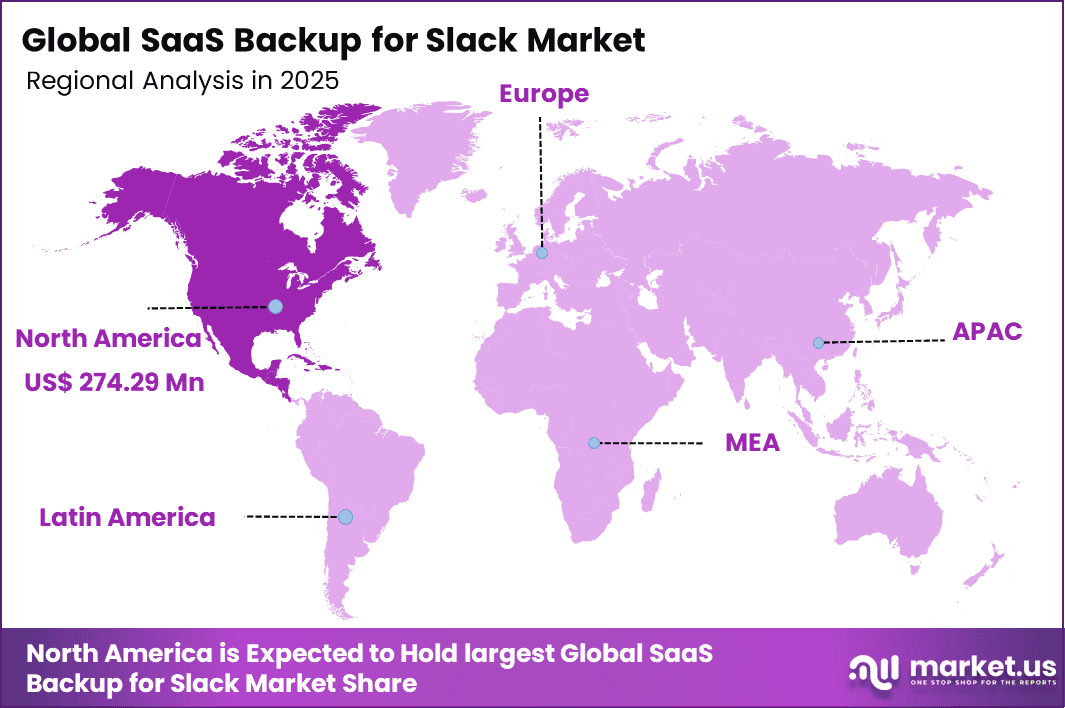
The Global SaaS Backup for Slack Market generated USD 441.7 million in 2025 and is predicted to register growth from USD 545.9 million in 2026 to about USD 3,675.5 million by 2035, recording a CAGR of 23.6% throughout the forecast span. In 2025, North America held a dominant market position, capturing more than a 62.1% share, with USD 274.29 million in revenue.
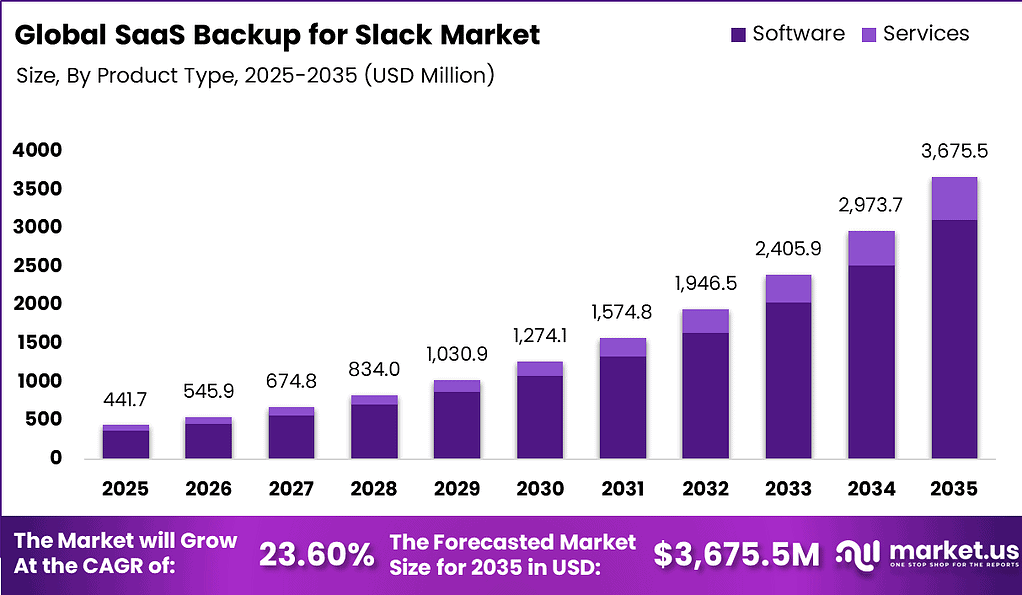
SaaS Backup for Slack market refers to cloud-based backup and recovery solutions designed to protect Slack messages, shared files, channel data, and conversation history outside the main Slack environment. These tools help organizations preserve important communication records, restore deleted content, and maintain long-term access to business discussions. The market is gaining importance as Slack becomes a core workplace communication platform and more companies treat collaboration data as an important business asset.
One of the main factors driving this market is the growing need to protect collaboration data from accidental deletion, retention policy changes, and operational disruptions. Many organizations use Slack for daily decisions, project discussions, and file sharing, which makes data loss a serious concern. Another important driver is the rising focus on compliance, audit readiness, and internal governance, as companies want stronger control over how communication records are stored and recovered.
Top Market Takeaways
- Software commands 84.7% market share, delivering automated message archiving, channel export, and retention policy enforcement for Slack workspaces.
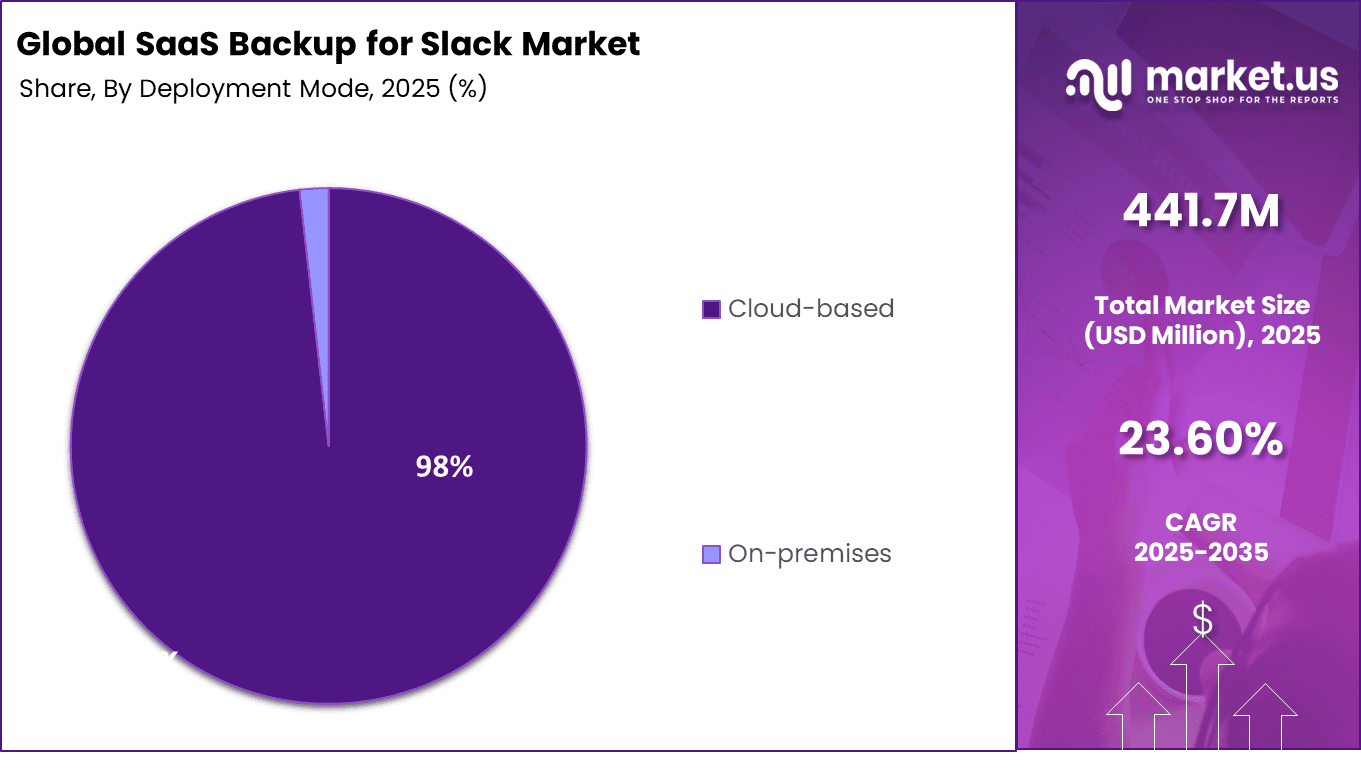
- Cloud-based deployment captures 98.2%, enabling seamless SaaS integration, geo-redundant storage, and instant recovery without on-premises infrastructure.
- Large enterprises hold 73.5%, utilizing comprehensive backups for audit trails, e-discovery, and ransomware recovery across global teams.
- BFSI sector represents 40.3%, powering regulatory compliance like SEC Rule 17a-4, FINRA records retention, and secure message recovery.
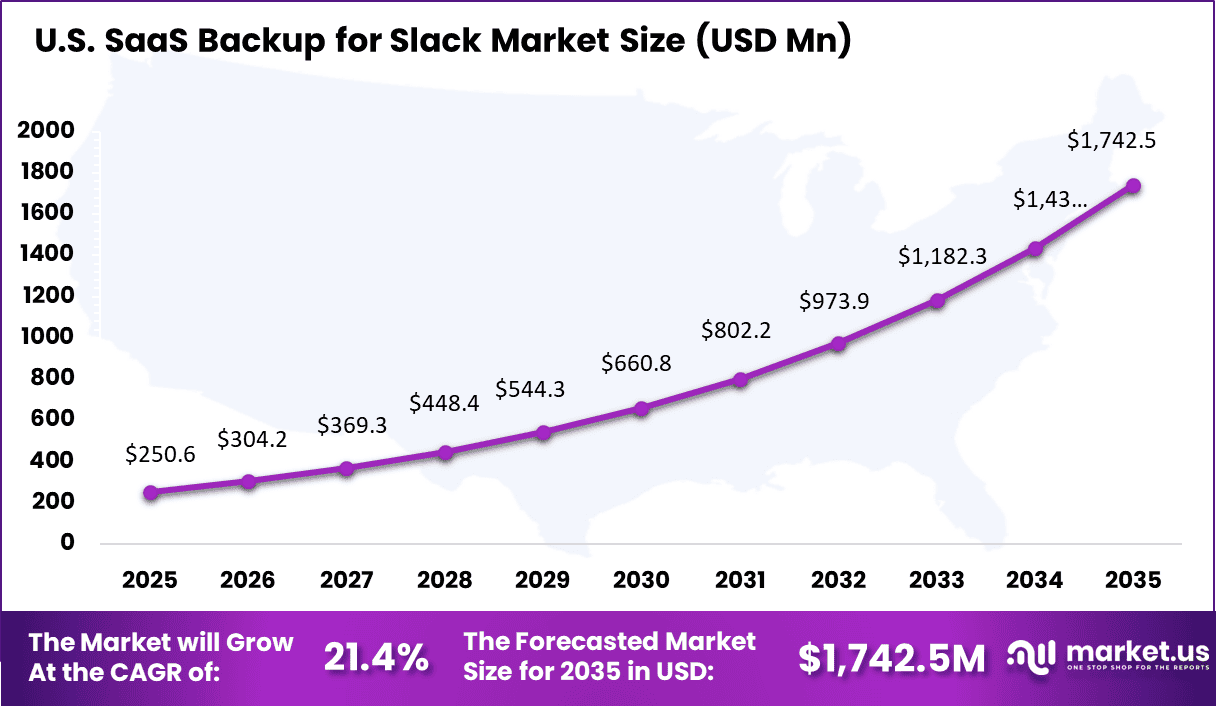
- North America drives 62.1% global value, with the U.S. market at USD 250.6 million and 21.4% CAGR, fueled by strict data sovereignty laws.
By Component Analysis
Software accounted for 84.7% of the SaaS Backup for Slack Market. This segment leads because organizations depend on dedicated backup tools to protect conversations, shared files, and collaboration data stored within Slack environments. These solutions ensure data recovery, compliance support, and protection against accidental deletion or internal misuse.
The segment is also supported by increasing reliance on collaboration platforms for daily operations. As businesses generate large volumes of communication data, software-based backup systems help maintain continuity and safeguard critical business information.
By Deployment Mode Analysis
Cloud-based deployment held 98% of the market. This segment dominates because SaaS backup solutions are inherently designed to operate within cloud environments. Organizations prefer cloud-based backup as it allows automatic data capture, remote accessibility, and seamless integration with existing SaaS ecosystems.
The segment is driven by the need for scalable and low-maintenance solutions. Cloud deployment enables continuous data protection without requiring internal infrastructure, which makes it highly suitable for modern digital workplaces that rely on cloud communication tools.
By Organization Size Analysis
Large enterprises accounted for 73.5% of the market. This segment leads because large organizations generate high volumes of Slack data across teams, projects, and departments. Managing and protecting this data requires advanced backup solutions that ensure security, compliance, and quick recovery.
The segment is also supported by stricter data governance requirements. Large enterprises prioritize backup systems to meet regulatory standards and maintain operational continuity, especially when handling sensitive internal and customer-related communications.
By End User Analysis
BFSI captured 40.3% of the market. This segment dominates because financial institutions rely heavily on secure communication platforms and must comply with strict data retention and audit requirements. Backup solutions help them preserve communication records and ensure data integrity.
The segment is also driven by the need to protect sensitive financial information and maintain transparency. BFSI organizations invest in backup tools to prevent data loss, support audits, and strengthen overall data management practices.
Key Market Segments
By Component
- Software
- Services
By Deployment Mode
- Cloud-based
- On-Premises
By Organization Size
- Small and Medium Enterprises (SMEs)
- Large Enterprises
By End-User
- BFSI
- IT and Telecom
- Healthcare
- Retail and E-commerce
- Education
- Government
- Others
Drivers Impact Analysis
| Key Driver | Impact on CAGR Forecast (~%) | Geographic Relevance | Impact Timeline | Strategic Effect |
|---|---|---|---|---|
| Increasing reliance on Slack for enterprise communication | +4.3% | North America, Europe, Asia Pacific | Short to Mid Term (2025–2031) | Drives need for data protection |
| Rising concerns over data loss and accidental deletion | +3.9% | Global | Short to Mid Term (2025–2030) | Increases adoption of backup solutions |
| Growing regulatory and compliance requirements for data retention | +3.6% | North America, Europe | Mid to Long Term (2026–2035) | Supports secure data archiving |
| Expansion of remote work and distributed teams | +3.2% | Global | Mid Term (2026–2032) | Expands reliance on SaaS platforms |
| Increasing adoption of SaaS based enterprise applications | +2.9% | Global | Mid to Long Term (2026–2035) | Strengthens backup solution demand |
Restraints Impact Analysis
| Key Restraint | Impact on CAGR Forecast (~%) | Geographic Relevance | Impact Timeline | Strategic Effect |
|---|---|---|---|---|
| Limited awareness of SaaS data backup risks | -2.4% | Global | Short to Mid Term (2025–2030) | Reduces adoption among smaller firms |
| Dependence on native platform security features | -2.1% | North America, Europe | Short to Mid Term (2025–2031) | Lowers demand for third-party backup |
| Data privacy and compliance complexities | -2.0% | Europe, North America | Mid to Long Term (2026–2035) | Creates regulatory challenges |
| Integration challenges with multi SaaS environments | -1.8% | Global | Mid Term (2026–2032) | Increases deployment complexity |
| Cost concerns for small and mid-sized enterprises | -1.6% | Global | Mid Term (2026–2032) | Limits adoption in budget-constrained firms |
Investor Type Impact Analysis
| Investor Type | Growth Sensitivity | Risk Exposure | Geographic Focus | Investment Outlook |
|---|---|---|---|---|
| Venture Capital Firms | Very High | High | US, Europe, Israel | Strong SaaS security opportunity |
| Private Equity Firms | High | Medium | North America, Europe | Expansion in data protection platforms |
| Strategic Technology Investors | Very High | Medium | US, Japan, South Korea | Strengthens SaaS ecosystem |
| Corporate Venture Arms | High | Medium | Global | Supports cloud platform integration |
| Government and Digital Security Funds | Medium | Low to Medium | North America, Europe, Asia Pacific | Supports data protection initiatives |
Technology Enablement Analysis
| Technology Enabler | Impact on CAGR Forecast (~%) | Geographic Relevance | Impact Timeline | Implementation Significance |
|---|---|---|---|---|
| Cloud-based backup and recovery solutions | +4.4% | Global | Short to Mid Term (2025–2031) | Enables scalable data protection |
| Automated backup and restore capabilities | +4.0% | Global | Short to Mid Term (2025–2030) | Reduces manual intervention |
| API integration with SaaS platforms like Slack | +3.7% | Global | Mid Term (2026–2032) | Ensures seamless data capture |
| Encryption and secure storage technologies | +3.3% | North America, Europe | Mid to Long Term (2026–2035) | Enhances data security |
| Multi SaaS backup management platforms | +3.0% | Global | Mid to Long Term (2026–2035) | Improves centralized control |
Key Challenges
- Capturing complete Slack data is a major challenge because export access can be limited by workspace plans, retention settings, and sharing permissions.
- Recovering deleted content is difficult because some data may only remain available for a limited time before it is permanently removed.
- File protection can be incomplete in some cases because shared files, links, and third-party content may not always be backed up in the same way.
- Compliance and privacy management are challenging because backing up private messages and sensitive workspace data often requires strict access control and careful governance.
- Recovery and migration can be complex because Slack backup data may be stored in technical formats that are not always easy to restore quickly into active workflows.
Emerging Trends
A key trend in the SaaS Backup for Slack market is the growing focus on protecting collaboration data generated across daily team interactions. Organizations increasingly recognize that conversations, shared files, and project discussions stored in collaboration platforms hold critical business value.
Backup solutions are evolving to capture this data in a structured manner, allowing easy retrieval and restoration when needed. These systems also support compliance requirements by maintaining records of communication activity, which helps organizations manage internal audits and data governance more effectively.
Growth Factors
The rising dependence on collaboration platforms for internal communication is supporting the growth of SaaS backup solutions for Slack. Businesses rely on these platforms to manage workflows, share information, and coordinate tasks across distributed teams. Loss of such data can disrupt operations and impact decision-making, which increases the need for reliable backup systems.
Organizations are also becoming more aware of risks related to accidental deletion, data retention policies, and access control, which encourages the adoption of solutions that ensure continuous data protection and recovery.
Regional Analysis
North America accounted for 62.1% of the SaaS Backup for Slack Market, reflecting strong adoption of cloud-based data protection solutions across enterprises. Organizations across the region increasingly rely on collaboration platforms for daily communication, which creates a need to secure conversations, files, and shared data.
Businesses continue to implement backup solutions to prevent data loss, ensure compliance, and maintain business continuity. The growing importance of protecting cloud-stored communication data continues to drive demand across North America.
The U.S. generated about USD 250.6 Mn within the regional market and is projected to expand at a CAGR of 21.4%. Companies across the country continue to strengthen their data protection strategies as reliance on digital collaboration tools increases.
SaaS backup solutions help organizations recover critical data, meet regulatory requirements, and protect against accidental deletion or cyber incidents. As remote and hybrid work models remain common, demand for reliable backup solutions for collaboration platforms continues to grow rapidly across the US market.
Key Regions and Countries
- North America
- US
- Canada
- Europe
- Germany
- France
- The UK
- Spain
- Italy
- Russia
- Netherlands
- Rest of Europe
- Asia Pacific
- China
- Japan
- South Korea
- India
- Australia
- Singapore
- Thailand
- Vietnam
- Rest of APAC
- Latin America
- Brazil
- Mexico
- Rest of Latin America
- Middle East & Africa
- South Africa
- Saudi Arabia
- UAE
- Rest of MEA
Competitive Analysis
The competitive landscape of the SaaS Backup for Slack market includes cloud data protection companies that focus on backup, recovery, and data retention for collaboration platforms. OwnBackup, Druva, Spanning Cloud Apps, Acronis, CloudAlly, Backupify, and Redstor compete by helping businesses protect Slack messages, files, shared records, and user data from accidental deletion, cyber risks, and compliance issues.
Competition in this market is shaped by backup speed, recovery flexibility, security features, retention controls, and ease of integration with wider SaaS environments. Some companies focus on multi-application backup platforms, while others offer stronger specialization in cloud collaboration and SaaS data protection.
Odaseva also adds strength through enterprise data management capabilities. Overall, the market remains competitive as organizations look for stronger protection of business communication data and better control over cloud-based collaboration records.
Top Key Players in the Market
- OwnBackup
- Druva
- Spanning Cloud Apps
- Acronis
- CloudAlly
- Backupify (Datto)
- SysCloud
- Odaseva
- Spin Technology (Spin.ai)
- AvePoint
- Barracuda Networks
- SkyKick
- Keepit
- Veeam
- HYCU
- Clumio
- Rewind
- Redstor
- Others
Future Outlook
The future outlook for the SaaS Backup for Slack Market looks positive as more businesses rely on Slack for daily communication, file sharing, and project coordination. Slack allows admins to manage retention settings, exports, and legal holds, which shows how important message and file preservation has become for governance and compliance. As organizations place more focus on data protection, audit readiness, and recovery from accidental deletion or cyber incidents, demand for dedicated Slack backup solutions is expected to grow steadily in the coming years.
Recent Developments
- In January 2026, Salesforce reported fourth-quarter and full fiscal year 2026 results showing current remaining performance obligation of USD 35.1 billion (up 16% year-over-year) and total FY26 revenue of USD 41.5 billion (up 10% year-over-year), with its Own-derived data protection unit continuing to operate as part of the Data Cloud and data-security portfolio that supports Slack and other SaaS workloads.
- In August 2025, EQT’s Swedish private equity fund (EQT X) completed its acquisition of a majority stake in Acronis in 2025, at a valuation of approximately USD 4 billion, with founders, CVC, Springcoast Capital Partners, and BlackRock retaining minority stakes.
Report Scope
| Report Features | Description |
|---|---|
| Market Value (2025) | USD 441.7 Million |
| Forecast Revenue (2035) | USD 3,675.5 Million |
| CAGR(2025-2035) | 23.6% |
| Base Year for Estimation | 2024 |
| Historic Period | 2020-2024 |
| Forecast Period | 2025-2035 |
| Report Coverage | Revenue forecast, AI impact on Market trends, Share Insights, Company ranking, competitive landscape, Recent Developments, Market Dynamics and Emerging Trends |
| Segments Covered | By Component (Software, Services), By Deployment Mode (Cloud-based, On-Premises), By Organization Size (Small and Medium Enterprises (SMEs), Large Enterprises), By End-User (BFSI, IT and Telecom, Healthcare, Retail and E-commerce, Education, Government, Others) |
| Regional Analysis | North America – US, Canada; Europe – Germany, France, The UK, Spain, Italy, Russia, Netherlands, Rest of Europe; Asia Pacific – China, Japan, South Korea, India, New Zealand, Singapore, Thailand, Vietnam, Rest of Latin America; Latin America – Brazil, Mexico, Rest of Latin America; Middle East & Africa – South Africa, Saudi Arabia, UAE, Rest of MEA |
| Competitive Landscape | OwnBackup, Druva, Spanning Cloud Apps, Acronis, CloudAlly, Backupify (Datto), SysCloud, Odaseva, Spin Technology (Spin.ai), AvePoint, Barracuda Networks, SkyKick, Keepit, Veeam, HYCU, Clumio, Rewind, Redstor, Others |
| Customization Scope | Customization for segments, region/country-level will be provided. Moreover, additional customization can be done based on the requirements. |
| Purchase Options | We have three licenses to opt for: Single User License, Multi-User License (Up to 5 Users), Corporate Use License (Unlimited Users and Printable PDF) |