


Report Overview
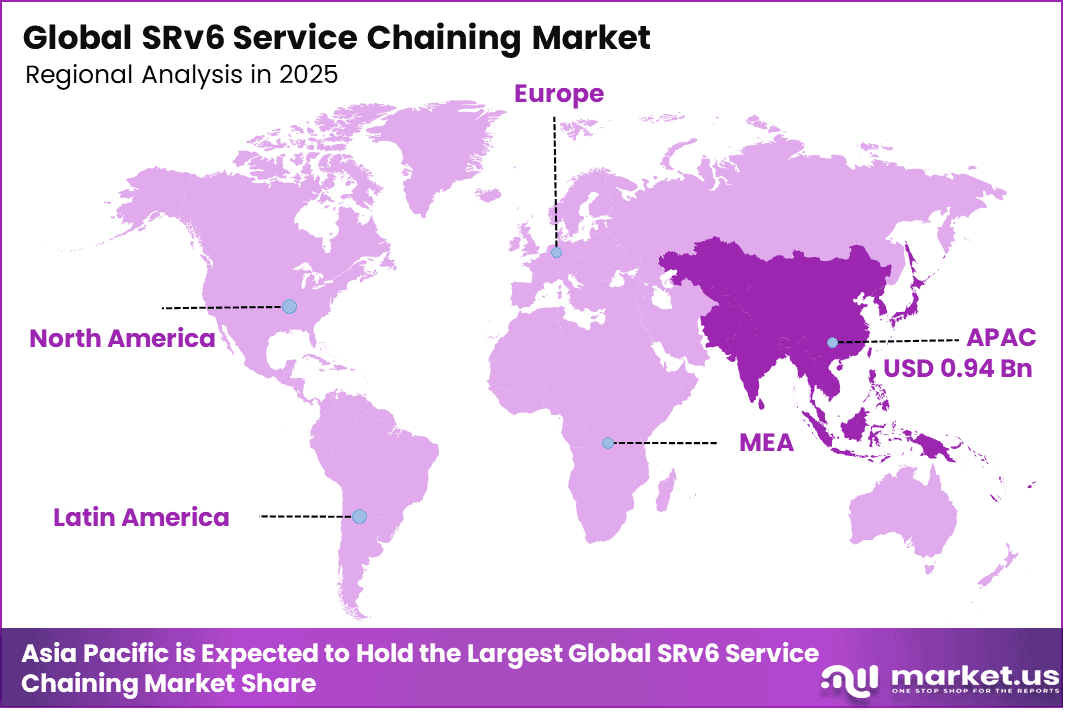
The Global SRv6 Service Chaining Market generated USD 2.4 billion in 2025 and is predicted to register growth from USD 3.1 billion in 2026 to about USD 32.6 billion by 2035, recording a CAGR of 29.8% throughout the forecast span. In 2025, Asia Pacific held a dominant market position, capturing more than a 39.2% share, with USD 0.94 billion in revenue.
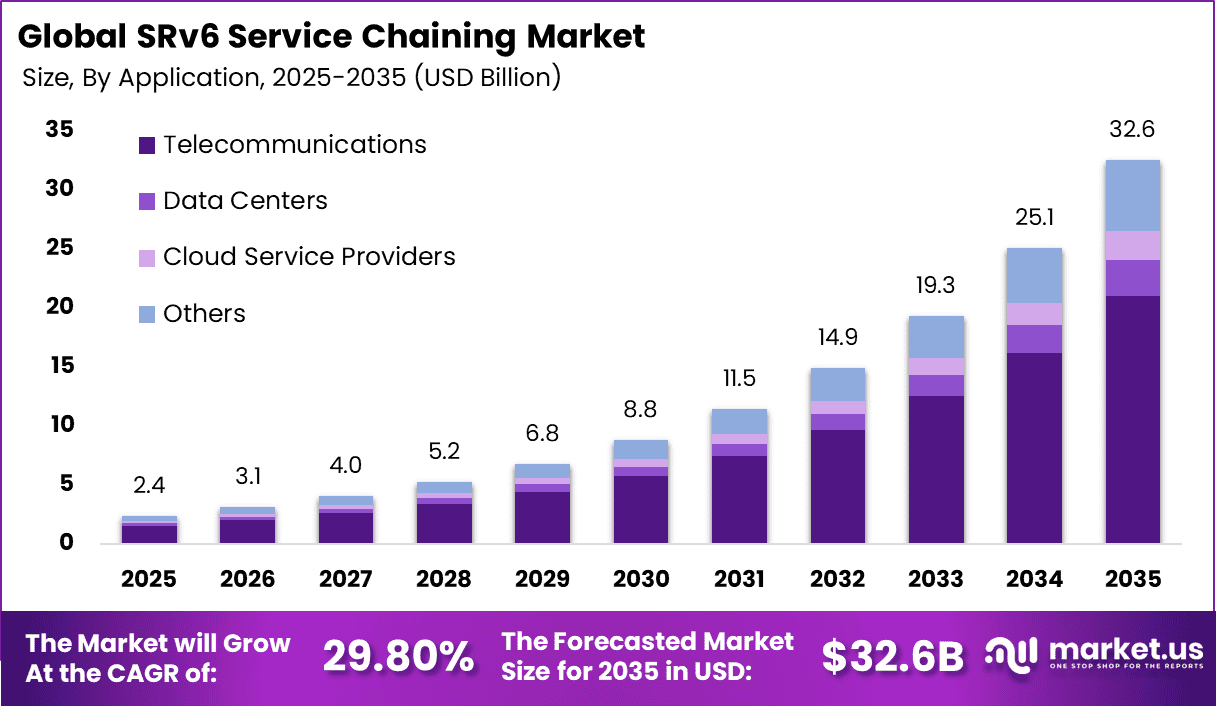
SRv6 Service Chaining market refers to networking solutions that use Segment Routing over IPv6 technology to direct traffic through a predefined sequence of network services such as firewalls, load balancers, security filters, and inspection systems. By embedding service path instructions within the IPv6 header, SRv6 enables more flexible and efficient traffic management compared with traditional service chaining approaches.
The market is growing due to the increasing demand for programmable, scalable, and software-driven network architectures across telecom-cloud, and enterprise environments. As network infrastructures become more distributed and traffic volumes continue to increase, operators are adopting SRv6 to simplify service delivery, improve traffic engineering, and reduce the complexity associated with managing multiple network functions.
Rising adoption among telecom carriers, data center operators, cloud service providers, and enterprises is further supporting market growth. Organizations are seeking advanced solutions that enable dynamic traffic steering, policy-based routing, service orchestration, and improved network agility, making SRv6 Service Chaining an important technology for next-generation IP networks.
Top Market Takeaways
- Hardware commands 52.4% market share, delivering specialized ASICs and network processors optimized for SRv6 header encapsulation, segment routing policies, and low-latency service function chaining.
- Telecommunications applications capture 64.7%, enabling dynamic network slicing, edge-to-cloud traffic steering, and automated service orchestration across 5G core and transport networks.
- On-premises deployment dominates at 90.5%, ensuring carrier-grade reliability, precise timing synchronization, and sovereign control over SRv6-enabled infrastructure.
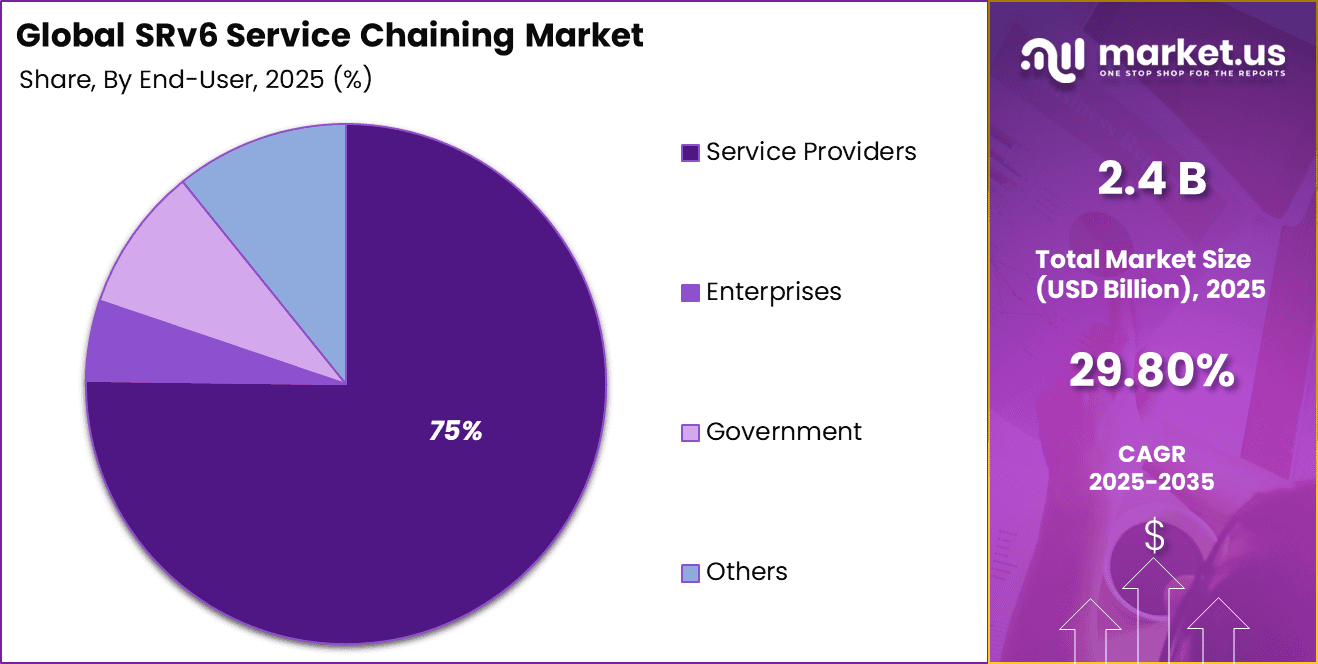
- Service providers hold 75.2%, leveraging SRv6 chaining for uCPE virtual network functions, SD-WAN optimization, and multi-tenancy isolation in telco data centers.
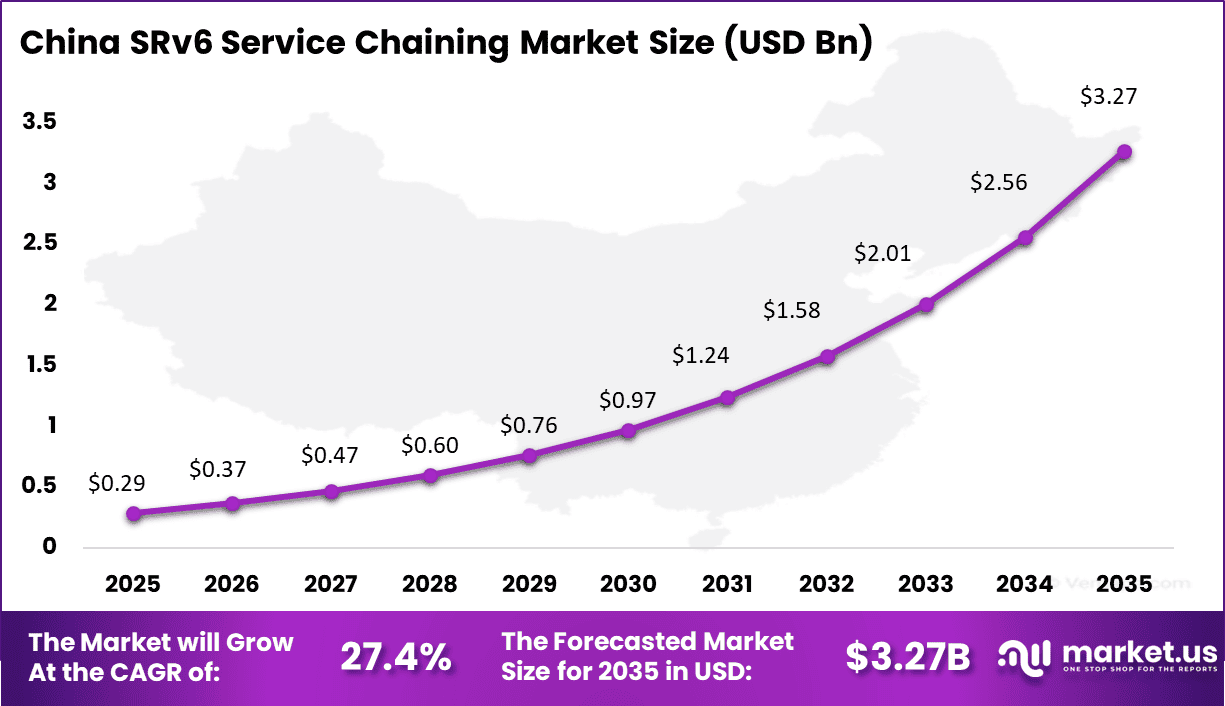
- Asia-Pacific drives 39.2% global value, with China’s market at USD 0.29 billion and 27.4% CAGR, propelled by state-backed 5G SA deployments and domestic equipment mandates.
By Component Analysis
Hardware accounted for 52.4% of the SRv6 Service Chaining Market. This segment leads because network routers, switches, and infrastructure devices are essential for enabling SRv6-based traffic routing and service chaining. These components handle high-speed data forwarding and support advanced network functions across telecom environments.
The segment is also supported by increasing upgrades in network infrastructure. Organizations invest in capable hardware to manage growing data traffic and ensure efficient packet routing, which strengthens the role of hardware in supporting SRv6 deployments.
By Application Analysis
Telecommunications represented 64.7% of the market. This segment dominates because telecom operators rely on SRv6 to manage network traffic, optimize routing paths, and enable flexible service delivery. It allows efficient handling of network functions such as traffic engineering and service chaining.
The segment is driven by rising demand for high-performance networks and advanced connectivity. Telecom providers adopt SRv6 to improve network efficiency, support evolving data requirements, and enhance service quality across modern communication systems.
By Deployment Mode Analysis
On-premises deployment held 90.5% of the market. This segment leads because telecom operators and service providers prefer to manage network infrastructure within their own environment. This allows better control over routing processes, security, and performance of critical network operations.
The segment is also supported by the need for low latency and high reliability in network services. On-premises deployment ensures consistent performance and direct management of network resources, which is essential for large-scale telecom operations.
By End User Analysis
Service providers accounted for 75% of the market. This segment dominates because service providers operate large-scale networks and require advanced routing technologies to manage traffic efficiently. SRv6 service chaining helps them deliver flexible and scalable network services.
The segment is driven by the need to support growing data consumption and complex network architectures. Service providers invest in SRv6 solutions to enhance network performance, improve service delivery, and manage multiple network functions more effectively.
Key Market Segments
By Component
- Hardware
- Software
- Services
By Application
- Telecommunications
- Data Centers
- Cloud Service Providers
- Others
By Deployment Mode
- On-Premises
- Cloud-Based
By End-User
- Service Providers
- Enterprises
- Government
- Others
Drivers Impact Analysis
| Key Driver | Impact on CAGR Forecast (~%) | Geographic Relevance | Impact Timeline | Strategic Effect |
|---|---|---|---|---|
| Rapid expansion of 5G and next-generation network infrastructure | +5.4% | Asia Pacific, North America, Europe | Short to Mid Term (2025–2031) | Enables advanced network programmability |
| Increasing adoption of software-defined networking and network virtualization | +5.0% | Global | Mid Term (2026–2032) | Improves network flexibility and control |
| Growing demand for efficient traffic engineering and service chaining | +4.6% | Asia Pacific, Europe | Mid to Long Term (2026–2035) | Optimizes network performance |
| Rising data traffic and cloud service usage | +4.2% | Global | Short to Mid Term (2025–2030) | Drives need for scalable routing solutions |
| Telecom operator focus on reducing operational complexity | +3.8% | Asia Pacific, North America | Mid to Long Term (2026–2035) | Enhances network efficiency |
Restraints Impact Analysis
| Key Restraint | Impact on CAGR Forecast (~%) | Geographic Relevance | Impact Timeline | Strategic Effect |
|---|---|---|---|---|
| Complexity in implementing SRv6 architecture | -3.4% | Global | Mid Term (2026–2032) | Increases deployment challenges |
| Lack of skilled networking professionals | -3.0% | Global | Mid Term (2026–2032) | Slows adoption |
| Interoperability issues with legacy network systems | -2.7% | North America, Europe | Mid Term (2026–2032) | Delays integration |
| High initial deployment and upgrade costs | -2.5% | Global | Mid Term (2026–2032) | Limits adoption among smaller operators |
| Limited awareness outside telecom sector | -2.2% | Emerging markets | Short to Mid Term (2025–2030) | Reduces early stage adoption |
Investor Type Impact Analysis
| Investor Type | Growth Sensitivity | Risk Exposure | Geographic Focus | Investment Outlook |
|---|---|---|---|---|
| Venture Capital Firms | Very High | High | Asia Pacific, US, Europe | Strong network innovation potential |
| Private Equity Firms | High | Medium | Asia Pacific, North America | Expansion in telecom infrastructure |
| Strategic Technology Investors | Very High | Medium | China, Japan, South Korea, US | Strengthens network ecosystem |
| Corporate Venture Arms | High | Medium | Global | Supports telecom partnerships |
| Government and Infrastructure Funds | Medium | Low to Medium | Asia Pacific, Europe | Supports digital network development |
Technology Enablement Analysis
| Technology Enabler | Impact on CAGR Forecast (~%) | Geographic Relevance | Impact Timeline | Implementation Significance |
|---|---|---|---|---|
| Segment routing over IPv6 technology | +5.5% | Global | Short to Mid Term (2025–2031) | Enables programmable routing |
| Integration with 5G and edge computing networks | +5.1% | Asia Pacific, North America, Europe | Mid Term (2026–2032) | Enhances network performance |
| Network automation and orchestration platforms | +4.7% | Global | Mid to Long Term (2026–2035) | Improves operational efficiency |
| Cloud native networking and virtualization tools | +4.3% | Global | Mid Term (2026–2032) | Supports scalable infrastructure |
| AI driven network traffic optimization | +3.9% | Global | Mid to Long Term (2026–2035) | Enhances routing intelligence |
Key Challenges
- Integrating older network functions is a major challenge because many service functions are not SRv6 aware and need extra support layers to work properly in the service chain.
- Header overhead can become a problem because SRv6 service chaining adds more routing information to packets, which can increase packet size and affect efficiency.
- Infrastructure readiness is another challenge because operators need IPv6-capable networks and hardware that can process SRv6 traffic smoothly.
- Monitoring and troubleshooting are difficult because fault detection, service visibility, and chain verification are still complex in SRv6-based deployments.
- Deployment across multiple network domains is hard because service chain mapping, coordination, and migration from older architectures can become difficult in large environments.
Emerging Trends
A key trend in the SRv6 Service Chaining market is the shift toward programmable network paths that allow traffic to be directed through multiple services in a flexible manner. Service chaining using SRv6 enables networks to define how data flows across functions such as security, load balancing, and optimization without relying on rigid configurations.
This approach gives network operators better control over traffic handling and allows faster adjustments based on application needs. The trend reflects a move toward more adaptive and software-driven network architectures.
Growth Factors
The increasing demand for efficient and scalable network management is supporting the growth of SRv6 service chaining solutions. As organizations handle growing volumes of data and diverse applications, they require networks that can route traffic intelligently across multiple services. SRv6 helps simplify network design while improving performance and control over data flows.
At the same time, the expansion of cloud services and distributed infrastructure encourages the adoption of technologies that can support dynamic and efficient service delivery across complex network environments.
Regional Analysis
Asia Pacific accounted for 39.2% of the SRv6 Service Chaining Market, reflecting strong adoption of next-generation networking technologies across telecom and cloud infrastructure providers. Operators across the region increasingly implement SRv6 to simplify network architecture, improve traffic engineering, and enable flexible service chaining across distributed networks.
The rapid expansion of 5G networks, data centers, and cloud services continues to drive demand for scalable and programmable network solutions, supporting the growth of SRv6-based service chaining across Asia Pacific.
China generated about USD 0.29 billion within the regional market and is projected to expand at a CAGR of 27.4%. Telecom operators and large-scale enterprises across the country continue to invest in advanced network transformation to support high-speed data traffic and complex service delivery.
SRv6 enables efficient routing, reduces dependency on traditional network protocols, and supports dynamic service deployment. As China accelerates its 5G rollout and cloud infrastructure development, demand for SRv6 service chaining solutions continues to grow rapidly.
Key Regions and Countries
- North America
- US
- Canada
- Europe
- Germany
- France
- The UK
- Spain
- Italy
- Russia
- Netherlands
- Rest of Europe
- Asia Pacific
- China
- Japan
- South Korea
- India
- Australia
- Singapore
- Thailand
- Vietnam
- Rest of APAC
- Latin America
- Brazil
- Mexico
- Rest of Latin America
- Middle East & Africa
- South Africa
- Saudi Arabia
- UAE
- Rest of MEA
Competitive Analysis
The competitive landscape of the SRv6 Service Chaining market includes major networking and telecom infrastructure companies that provide routing, switching, and network virtualization solutions. Cisco, Juniper Networks, Nokia, Huawei, Ericsson, Arista Networks, Ciena, VMware, Fujitsu. These companies compete through network performance, scalability, and strong integration with cloud and telecom environments.
Other players such as Hewlett Packard Enterprise, Ribbon Communications, Radisys, Mavenir, Metaswitch (Microsoft), A10 Networks, Fortinet, ZTE Corporation, and Dell Technologies add competition by supporting software-driven networking, security functions, and service orchestration.
The market is shaped by demand for flexible network architecture, lower operational complexity, and better control of service delivery across enterprise and telecom networks. Overall, competition remains strong as operators look for more programmable and efficient network service chaining solutions.
Top Key Players in the Market
- Cisco
- Juniper Networks
- Nokia
- Huawei
- Ericsson
- Arista Networks
- Hewlett Packard Enterprise (HPE)
- Ciena
- VMware
- Fujitsu
- NEC Corporation
- Ribbon Communications
- Radisys
- Mavenir
- Metaswitch (Microsoft)
- A10 Networks
- Fortinet
- ZTE Corporation
- Dell Technologies
- Others
Future Outlook
The future outlook for the SRv6 Service Chaining Market looks strong as telecom operators and large enterprises seek more programmable and efficient ways to steer traffic through network functions such as firewalls, load balancers, and security services. SRv6 is built to carry routing and processing instructions inside IPv6 packets, and current vendor guidance highlights its role in service function chaining without adding complex extra protocols. As networks become more cloud-based, distributed, and performance-sensitive, demand for SRv6 service chaining solutions is expected to grow steadily in the coming years.
Recent Developments
- In January 2026, Ericsson Router 6000 SRv6uT enabled dynamic network slicing across 50+ 5G operators processing 5Tbps+ traffic with 100μs end-to-end latency. ENM orchestration automated SFC insertion across 5GC/UPCF.
- In February 2026, Cisco IOS-XR 8.2 enhanced SRv6 uSID micro-segmentation supporting 16M+ service chains/sec across ASR9K routers deployed in 500+ tier-1 networks, enabling SONiC hyperscaler integration with native IPv6 steering. Deterministic AI workloads achieved <1μs latency via FlexAlgo path programming.
Report Scope
| Report Features | Description |
|---|---|
| Market Value (2025) | USD 2.4 Billion |
| Forecast Revenue (2035) | USD 32.6 Billion |
| CAGR(2025-2035) | 29.8% |
| Base Year for Estimation | 2024 |
| Historic Period | 2020-2024 |
| Forecast Period | 2025-2035 |
| Report Coverage | Revenue forecast, AI impact on Market trends, Share Insights, Company ranking, competitive landscape, Recent Developments, Market Dynamics and Emerging Trends |
| Segments Covered | By Component (Hardware, Software, Services), By Application (Telecommunications, Data Centers, Cloud Service Providers, Others), By Deployment Mode (On-Premises, Cloud-Based), By End-User (Service Providers, Enterprises, Government, Others) |
| Regional Analysis | North America – US, Canada; Europe – Germany, France, The UK, Spain, Italy, Russia, Netherlands, Rest of Europe; Asia Pacific – China, Japan, South Korea, India, New Zealand, Singapore, Thailand, Vietnam, Rest of Latin America; Latin America – Brazil, Mexico, Rest of Latin America; Middle East & Africa – South Africa, Saudi Arabia, UAE, Rest of MEA |
| Competitive Landscape | Cisco, Juniper Networks, Nokia, Huawei, Ericsson, Arista Networks, Hewlett Packard Enterprise (HPE), Ciena, VMware, Fujitsu, NEC Corporation, Ribbon Communications, Radisys, Mavenir, Metaswitch (Microsoft), A10 Networks, Fortinet, ZTE Corporation, Dell Technologies, Others |
| Customization Scope | Customization for segments, region/country-level will be provided. Moreover, additional customization can be done based on the requirements. |
| Purchase Options | We have three licenses to opt for: Single User License, Multi-User License (Up to 5 Users), Corporate Use License (Unlimited Users and Printable PDF) |





























