Report Overview
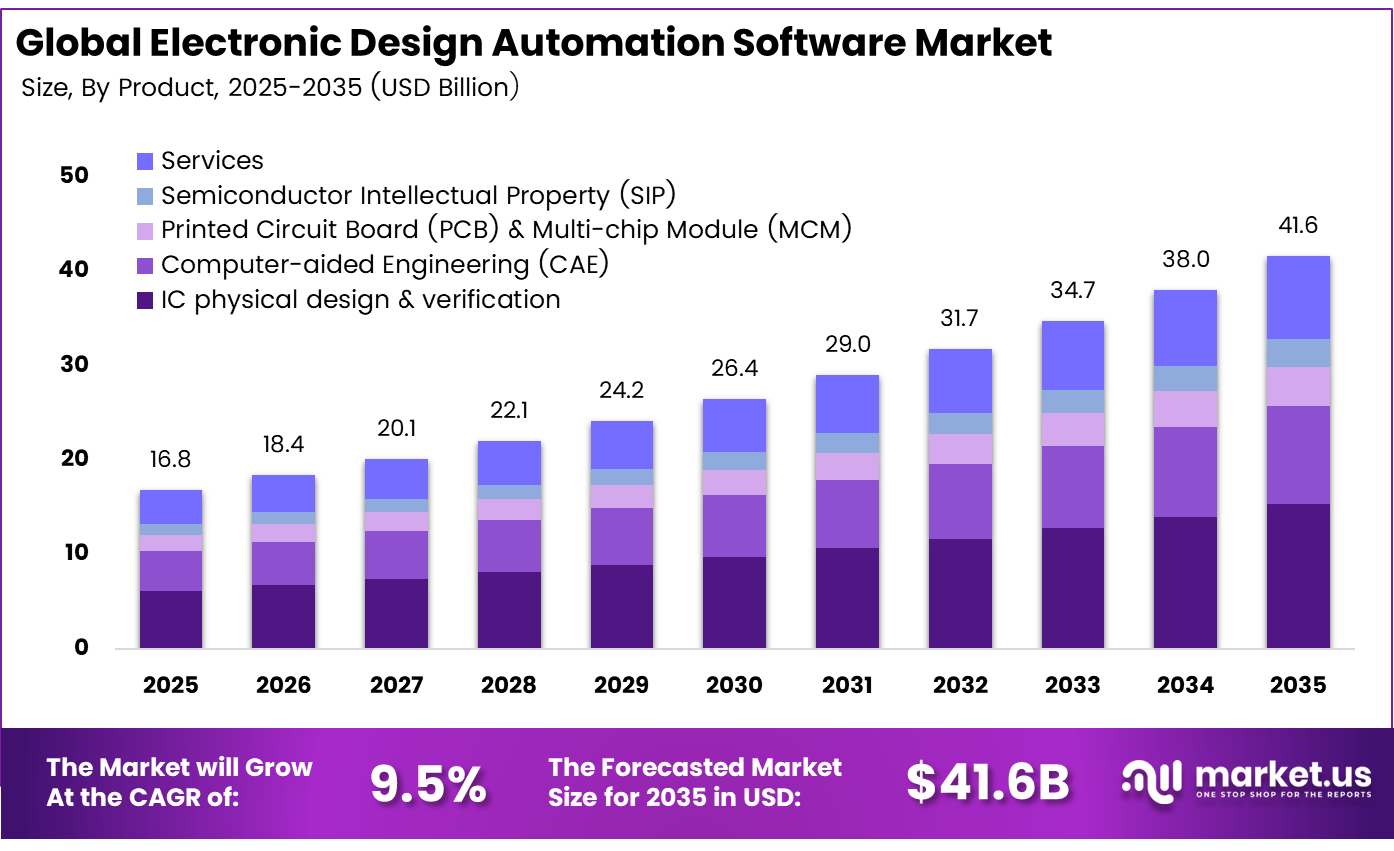
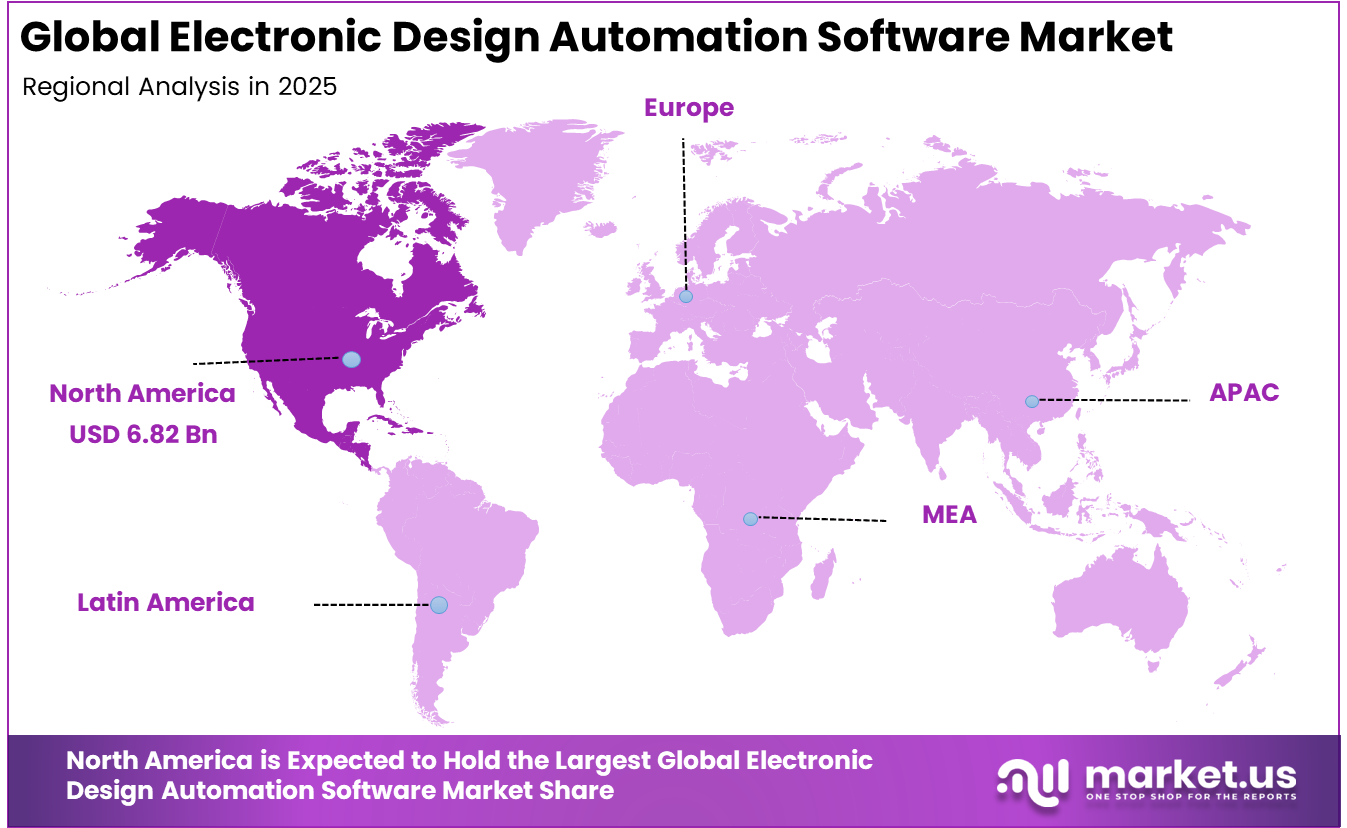
The Global Electronic Design Automation Software Market size is expected to be worth around USD 41.6 billion by 2035, from USD 16.8 billion in 2025, growing at a CAGR of 9.5% during the forecast period from 2025 to 2035. North America held a dominant market position, capturing more than a 40.6% share, holding USD 6.82 billion in revenue.
Electronic Design Automation (EDA) software helps engineers create complex electronic circuits and chips with ease. It automates tasks like drawing layouts, simulating performance, and checking for errors, turning months of manual work into days. Over 90% of modern semiconductors rely on it to pack billions of transistors into tiny spaces. From smartphones to cars, EDA ensures designs work right the first time, saving time and money while meeting tight deadlines in fast-moving tech fields.
Top driving factors shape the need for EDA software today. Engineers deal with chips that cram billions of transistors into tiny spaces, making designs far more complex than before. Smart devices in cars and homes demand flawless performance from the start. Time pressure hits hard, too, as teams race to release products fast without delays. Power use matters a lot, since smaller chips must run longer on less energy. These forces push firms to rely on EDA for handling tough tasks smoothly.
The market for Electronic Design Automation Software is driven by rising chip complexity and demand for advanced designs in AI, IoT, and connected devices. Engineers face tougher tasks as chips pack more features into tiny spaces, while new tech like smart wearables and fast networks calls for reliable tools to speed up work. This push helps teams create better products without endless fixes, keeping pace with real-world needs.
Demand analysis shows a strong pull from key areas. Car makers top the list, adding electronics for safer driving and real-time alerts that save lives. Phones and wearables come next, needing custom chips for quick apps and all-day battery. Factories want reliable circuits for machines that run nonstop. Over 75% of fresh gadgets now use tailored designs to stand out. Health tools join in, requiring precise signals for accurate readings. This mix keeps demand steady and growing across industries that shape our world.
For instance, in September 2025, Synopsys announced major expansions to its Synopsys.ai platform, introducing generative AI capabilities that cut design workflows from days to hours. The update includes the Ansys Engineering Copilot for simulation tasks, boosting productivity across EDA and analysis tools. This move comes post their massive $35 billion Ansys acquisition, positioning Synopsys as the clear frontrunner in AI-driven chip design.
Key Takeaway
- In 2025, the IC physical design & verification segment held a dominant market position, capturing a 36.8% share of the Global Electronic Design Automation Software Market.
- In 2025, the On-Premises segment held a dominant market position, capturing a 76.4% share of the Global Electronic Design Automation Software Market.
- In 2025, the Microprocessors & Microcontrollers segment held a dominant market position, capturing a 53.6% share of the Global Electronic Design Automation Software Market.
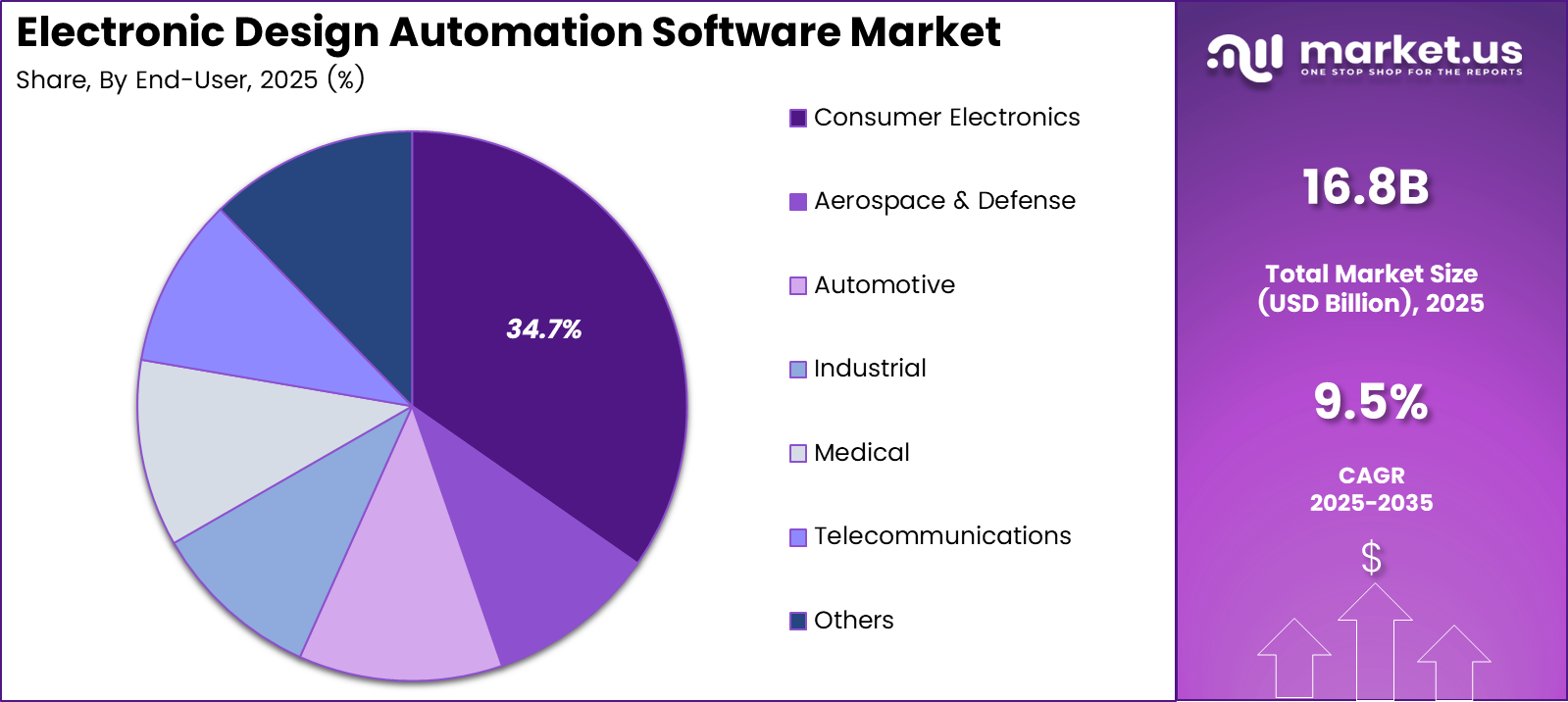
- In 2025, the Consumer Electronics segment held a dominant market position, capturing a 34.7% share of the Global Electronic Design Automation Software Market.
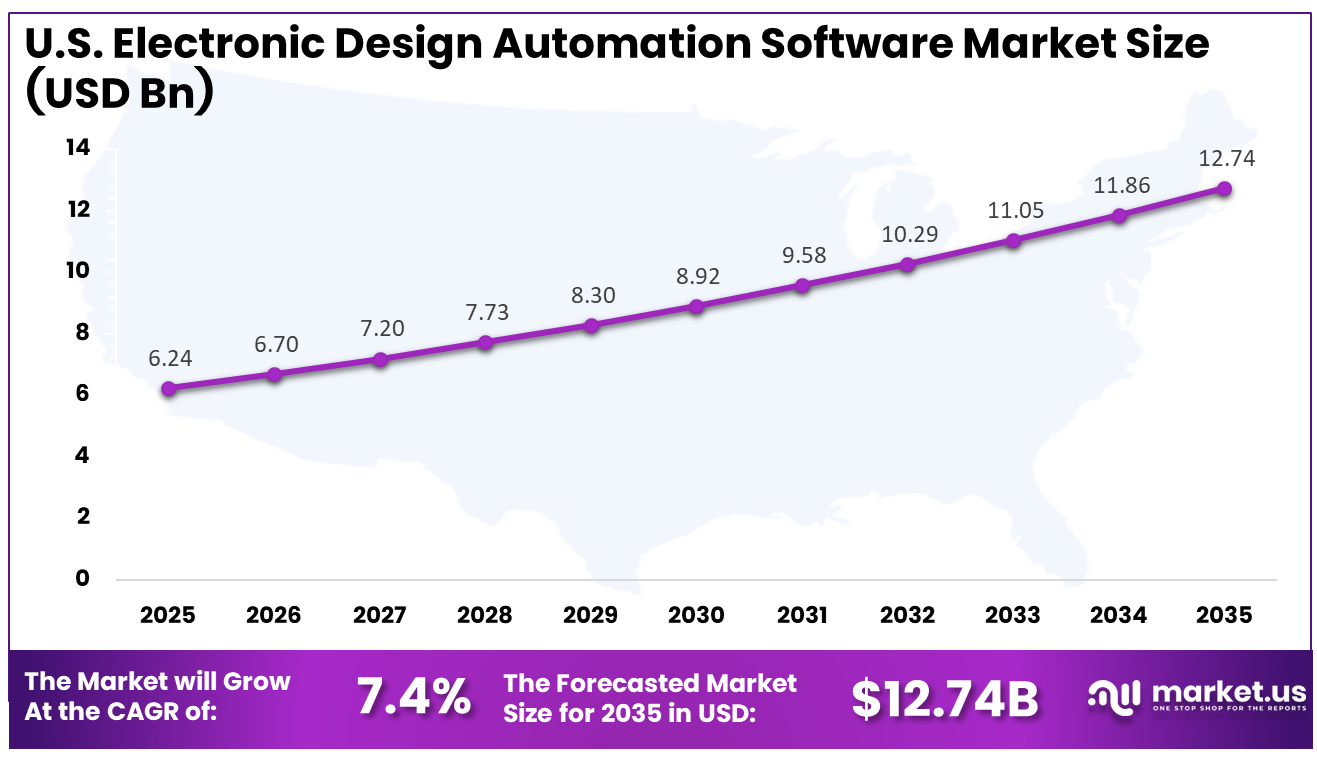
- The U.S. Electronic Design Automation Software Market was valued at USD 6.24 billion in 2025, with a robust CAGR of 7.4%.
- In 2025, North America held a dominant market position in the Global Electronic Design Automation Software Market, capturing more than a 40.6% share.
Role of Generative AI
Generative AI is transforming Electronic Design Automation (EDA) software by automating the creation of optimized chip layouts and circuit designs from high-level specifications. It explores vast design spaces rapidly, generating multiple viable architectures that engineers can refine, reducing manual iteration and enhancing creativity in complex semiconductor projects.
In verification and testing, generative AI produces diverse test scenarios and predicts potential failures, accelerating validation processes while uncovering edge cases overlooked by traditional methods. This integration fosters smarter, more efficient EDA workflows, enabling faster innovation in areas like AI hardware and advanced node technologies.
Investment and Business Benefits
Venture capital and strategic investors find strong prospects in Electronic Design Automation (EDA) software, particularly in high-potential segments such as AI-enhanced tools and cloud-based solutions. Regions like Asia-Pacific and Latin America present growth avenues as semiconductor clusters mature, complemented by collaborations with foundries and automotive leaders to deliver tailored innovations for IoT and self-driving technologies.
Businesses benefit from EDA through accelerated design cycles that cut time-to-market and reduce prototyping costs, enabling competitive edges in fast-evolving sectors like 5G and consumer electronics. Enhanced collaboration features and AI-driven automation improve team efficiency, foster innovation in complex chip architectures, and support scalable operations for global enterprises.
Regional Analysis
In 2025, North America held a dominant market position in the Global Electronic Design Automation Software Market, capturing more than a 40.6% share, holding USD 6.82 billion in revenue. This dominance is driven by the strong presence of advanced semiconductor design ecosystems, high R&D investments, and early adoption of cutting-edge chip design technologies. The region benefits from large-scale AI, HPC, and automotive chip development activities, along with strong collaboration between chip designers, foundries, and research institutions.
For instance, in February 2026, Synopsys Inc. announced expanded generative AI in its EDA portfolio via Synopsys.ai Copilot and Ansys integration. It enhances verification, system analysis, and multiphysics for multi-die packaging, delivering up to 35% productivity gains and solidifying North American leadership.
U.S. Electronic Design Automation Software Market Size
The market for Electronic Design Automation Software within the U.S. is growing tremendously and is currently valued at USD 6.24 billion; the market has a projected CAGR of 7.4%. The market is growing due to a rise in semiconductor innovation in AI chips, 5G networks, and autonomous vehicles. Tech hubs like Silicon Valley draw top talent and R&D funds, speeding complex IC designs. Rising demand from consumer gadgets and defense pushes firms to adopt advanced EDA for faster, more efficient chip creation. Government incentives for domestic manufacturing further fuel this steady rise.
For instance, in February 2026, Cadence Design Systems (San Jose, CA) unveiled ChipStack, the world’s first AI Super Agent automating chip design and verification. This agentic AI tool boosts designer productivity by 7x-10x, handles test environments, generates designs, and offers debugging, reinforcing U.S. dominance in AI-driven EDA amid hyperscaler demand.
Key Regions and Countries
North America
- US
- Canada
Europe
- Germany
- France
- The UK
- Spain
- Italy
- Russia
- Netherlands
- Rest of Europe
Asia Pacific
- China
- Japan
- South Korea
- India
- Australia
- Singapore
- Thailand
- Vietnam
- Rest of APAC
Latin America
- Brazil
- Mexico
- Rest of Latin America
Middle East & Africa
- South Africa
- Saudi Arabia
- UAE
- Rest of MEA
Product Analysis
In 2025, the IC physical design & verification segment held a dominant market position, capturing a 36.8% share of the Global Electronic Design Automation Software Market. This segment holds the largest share because every semiconductor chip must pass through detailed layout design, timing checks, and rule verification before fabrication. As transistor density increases and chip architectures become more complex, physical verification has become a critical step to prevent design flaws and costly manufacturing errors.
Engineers rely on these tools to optimize power consumption, performance efficiency, and chip area, especially in advanced nodes used for AI processors and high-performance computing. With the growing number of system-on-chip designs and multi-functional integrated circuits, physical design and verification remain essential across all major semiconductor projects. This structural dependency ensures steady demand for this segment.
For Instance, in February 2026, Siemens EDA won the Best of Show award at the Chiplet Summit for Innovator3D IC. Siemens’ Innovator3D IC solution advances physical verification for complex 3D packaging, handling layout checks, and sign-off for multi-die systems. This boosts efficiency in IC physical design amid shrinking nodes, aiding tape-out success for advanced chips.
Deployment Analysis
In 2025, the On-Premises segment held a dominant market position, capturing a 76.4% share of the Global Electronic Design Automation Software Market. The demand in this sector has been driven mainly by the strong preference of semiconductor companies for secure and controlled design environments. Chip development involves highly confidential intellectual property, and organizations prioritize internal servers to maintain strict data security and workflow control. High-performance simulations and verification workloads also require powerful computing infrastructure that is often better managed within dedicated facilities.
In addition, many semiconductor firms operate with established toolchains and customized integrations that function more efficiently in on-premise environments. While cloud adoption is gradually increasing for collaboration and scalability, core design activities continue to depend on internal infrastructure.
For instance, in September 2025, Synopsys expands Synopsys.ai Copilot for on-premises GenAI in EDA. Synopsys.ai Copilot now supports secure on-premises deployments with Microsoft Azure, accelerating workflows like verification from days to hours while keeping data local. This meets enterprise needs for IP protection and high-performance computing in sensitive designs.
Application Analysis
In 2025, the Microprocessors & Microcontrollers segment held a dominant market position, capturing a 53.6% share of the Global Electronic Design Automation Software Market. This dominance is due to these components, which power a wide range of electronic systems. From smartphones and laptops to automotive control units and industrial equipment, processors and controllers form the backbone of modern digital infrastructure. Their growing complexity directly increases reliance on advanced design and verification tools.
Modern processors now integrate AI capabilities, connectivity modules, and power management features on a single chip. This level of integration requires precise simulation, synthesis, and validation throughout the design cycle. As demand rises for faster, energy-efficient, and compact chips, EDA software continues to play a central role in processor development.
For Instance, in June 2025, Cadence and Synopsys update EDA flows for Intel 18A node microprocessors. Cadence delivers AI-enabled EMIB reference flow and IP libraries for Intel’s advanced process, optimizing microprocessor designs for AI and high-performance computing. This supports faster development of next-gen processors with 3D IC capabilities.
End-User Analysis
In 2025, the Consumer Electronics segment held a dominant market position, capturing a 34.7% share of the Global Electronic Design Automation Software Market. This dominance is due to rapid innovation cycles and high product volumes. Devices such as smartphones, wearables, smart TVs, and home automation systems require increasingly sophisticated semiconductor components. Manufacturers depend heavily on design automation tools to meet tight launch timelines and maintain product performance standards.
The continuous push for slimmer devices, longer battery life, and enhanced computing capabilities adds pressure on chip designers to achieve greater efficiency. Frequent product upgrades also shorten development cycles, increasing the need for reliable design verification and optimization tools.
For Instance, in November 2025, Altium licenses Keysight simulation tech for PCB in consumer gadgets. Altium integrates Keysight’s EDA software into its platform, enhancing signal integrity simulations for consumer electronics like wearables and smart devices. This speeds PCB design cycles for compact, high-speed consumer products.
Key Market Segments
By Product
- Computer-aided Engineering (CAE)
- IC physical design & verification
- Printed Circuit Board (PCB) & Multi-chip Module (MCM)
- Semiconductor Intellectual Property (SIP)
- Services
By Deployment
- On-Premises
- Cloud-based
By Application
- Microprocessors & Microcontrollers
- Memory Management Units
- Others
By End-User
- Consumer Electronics
- Aerospace & Defense
- Automotive
- Industrial
- Medical
- Telecommunications
- Others
Emerging trends
Electronic Design Automation (EDA) software is evolving with deeper integration of artificial intelligence and machine learning to automate complex design tasks like layout optimization and verification. Cloud-based platforms are gaining traction, enabling collaborative workflows and scalable access for distributed teams tackling intricate chip designs.
Another key shift involves system-level design approaches that simulate entire hardware-software ecosystems rather than isolated components. Emphasis on energy-efficient and secure designs is rising, addressing demands from sectors like automotive and telecommunications for sustainable, cyber-resilient electronics.
Growth Factors
Growth in Electronic Design Automation (EDA) software stems from the escalating complexity of semiconductor designs, driven by shrinking process nodes and the need for tools that handle multi-die systems efficiently. Rising demand for advanced chips in consumer electronics, automotive, and data centers pushes EDA providers to innovate in areas like high-level synthesis and parasitic extraction.
Additionally, the convergence of hardware and software in heterogeneous computing environments fuels EDA expansion, as designers require integrated platforms for co-verification and optimization. Industry-wide shifts toward agile development cycles and collaborative ecosystems further accelerate adoption, enabling faster time-to-market for next-generation electronics.
Market Dynamics
Drivers - Rising Chip Complexity
The growing complexity of semiconductor chips is a key factor driving the adoption of electronic design automation tools. Modern chips now integrate multiple functions such as AI processing, connectivity, and power management on a single architecture. This level of integration increases design difficulty and makes manual design processes inefficient, pushing engineers to depend on automated tools for accurate layout, simulation, and verification.
In addition, advanced manufacturing nodes and dense transistor structures require strict design validation and repeated testing. As industries demand faster and more energy-efficient chips, design teams must handle larger datasets and complex circuit behaviors. EDA software helps simplify these tasks by improving precision and reducing design errors, which makes it a core requirement in modern semiconductor development.
For instance, in May 2025, Synopsys and Ansys rolled out AI-driven EDA for chip-package co-design, cutting cycles from months to weeks on 2.5D/3D chips. The stack optimizes silicon and packaging together, handling thermal and signal issues in complex builds backed by AMD and MediaTek. It directly addresses the rising intricacy in advanced nodes.
Restraint - High Cost and Skilled Talent Requirement
The high cost of advanced design automation software acts as a major restraint, particularly for smaller design firms and startups. Licensing fees, infrastructure requirements, and maintenance expenses can significantly increase overall project budgets. Many organizations must invest in multiple toolsets within a single workflow, which further raises operational costs and limits accessibility for new entrants.
In addition, operating these tools requires highly trained engineers with expertise in VLSI design, verification methodologies, and system integration. There is a noticeable shortage of professionals who can effectively manage complex EDA environments. This talent gap increases training expenses and slows down project execution, creating challenges for companies trying to expand their design capabilities.
For instance, in September 2025, Altium announced subscription bundles for Altium 26 amid the Renesas acquisition, shifting from perpetual licenses with price hikes. Small teams face barriers to entering advanced PCB design due to layered costs and training needs for cloud features like managed libraries. This highlights ongoing access issues for less-funded users.
Opportunities - Expansion of AI, IoT, and 5G Chip Development
The rapid expansion of AI, IoT, and 5G technologies is creating strong growth opportunities for the EDA market. These technologies rely on highly customized chips that must be designed with precision, efficiency, and reliability. As connected devices and intelligent systems continue to increase globally, the need for advanced chip design and simulation tools becomes more important.
In addition, the shift toward smart electronics and edge computing is pushing semiconductor companies to develop more efficient and compact processors. EDA solutions help engineers accelerate design cycles and optimize chip performance for next-generation applications. This ongoing digital transformation across industries is expected to support sustained demand for design automation tools.
For instance, in December 2024, Keysight previewed EDA 2025 with AI workflows for RF/high-speed digital in 5G/IoT, adding Python APIs and 6x faster simulations. Tools like ADS now co-optimize chiplets via machine learning, easing complex interconnects for data centers. This opens paths for next-gen wireless chip growth.
Challenges - Verification Complexity and Data Security Concerns
Verification complexity has become a major challenge due to the increasing scale and functionality of modern semiconductor designs. Testing and validating large-scale integrated circuits now requires extensive simulation and debugging processes, which consume significant time and technical effort. Ensuring design accuracy across multiple functions and operating conditions adds further difficulty to the development process.
Additionally, data security concerns are rising as more design workflows adopt digital and cloud-based environments. Chip design files contain highly sensitive intellectual property, and any data breach can lead to serious technological and financial risks. Companies must balance collaboration and security by investing in secure infrastructure while maintaining efficient and reliable design operations.
For instance, in June 2025, Agnisys launched IDesignSpec Suite v9 and IDS-FPGA at DAC 2025, with AI enhancements to automate verification from specs to RTL and UVM models. These tools cut through verification hurdles in complex designs while stressing secure, standards-based flows like IP-XACT for data protection. It offers a practical fix for tangled checks and safety worries in advanced SoCs.
Key Players Analysis
One of the leading players in February 2026, Synopsys’ $35 billion acquisition of Ansys wrapped up successfully, creating a powerhouse for unified device-to-system EDA platforms. The merger enables co-optimization of silicon, packaging, and full-system performance, critical for AI chips and 5G. Analysts see $2 billion in annual cost synergies by 2027, despite geopolitical hurdles pushing parallel EDA ecosystems.
Top Key Players in the Market
- Agnisys Inc
- Altium Limited
- Ansys
- Autodesk Inc
- Cadence Design Systems, Inc
- Keysight Technologies Inc
- Siemens AG
- Synopsys Inc
- Aldec Inc
- Intercept Technology Inc
- Dolphin Design
- Labcenter Electronics Ltd
- Others
Recent Developments
- In December 2024, Keysight launched its EDA 2025 suite with workflow integration for high-speed digital designs like PCIe 6.0 and USB4v2. The release emphasizes simulation accuracy through RFIC, EM, and electro-thermal analysis, backed by partnerships with foundries and component makers for seamless PDK support.
- In July 2025, Siemens EDA continues to strengthen its position through ongoing investments in system-level verification tools, capitalizing on the broader industry consolidation wave. While specifics remain under wraps, their focus on AI-enhanced flows aligns with mega-mergers reshaping the $15 billion EDA landscape.
Report Scope
| Report Features | Description |
|---|---|
| Market Value (2025) | USD 16.8 Billion |
| Forecast Revenue (2035) | USD 41.6 Billion |
| CAGR (2026-2035) | 9.5% |
| Base Year for Estimation | 2025 |
| Historic Period | 2020-2024 |
| Forecast Period | 2026-2035 |
| Report Coverage | Revenue Forecast, Market Dynamics, Competitive Landscape, Recent Developments |
| Segments Covered | By Product (Computer-aided Engineering (CAE), IC physical design & verification, Printed Circuit Board (PCB) & Multi-chip Module (MCM), Semiconductor Intellectual Property (SIP), Services), By Deployment (On-Premises, Cloud-based), By End-Use Application (Microprocessors & Microcontrollers, Memory Management Units, Others), By End-User (Aerospace & Defense, Automotive, Consumer Electronics, Industrial, Medical, Telecommunications, Others) |
| Regional Analysis | North America (US and Canada), Europe (Germany, France, The UK, Spain, Italy, and Rest of Europe), Asia Pacific (China, Japan, South Korea, India, Australia, and Rest of APAC), Latin America (Brazil, Mexico, and Rest of Latin America), Middle East & Africa (GCC, South Africa, and Rest of MEA) |
| Competitive Landscape | Agnisys Inc, Altium Limited, Ansys, Autodesk Inc, Cadence Design Systems, Inc, Keysight Technologies Inc, Siemens AG, Synopsys Inc, Aldec Inc, Intercept Technology Inc, Dolphin Design, Labcenter Electronics Ltd, Others |
| Customization Scope | Customization for segments and region/country levels will be provided. Moreover, customization can be tailored to the requirements. |
| Purchase Options | We have three licenses to opt for: Single User License, Multi-User License (Up to 5 Users), Corporate Use License (Unlimited Users and Printable PDF) |