Report Overview
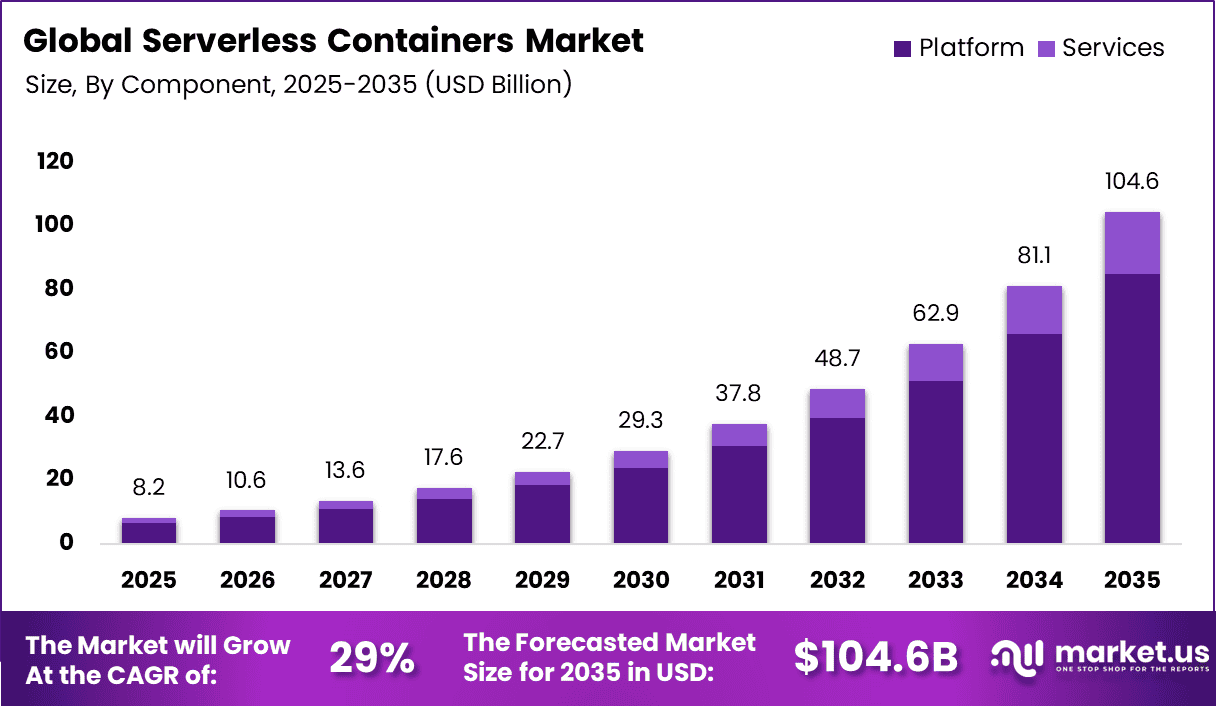
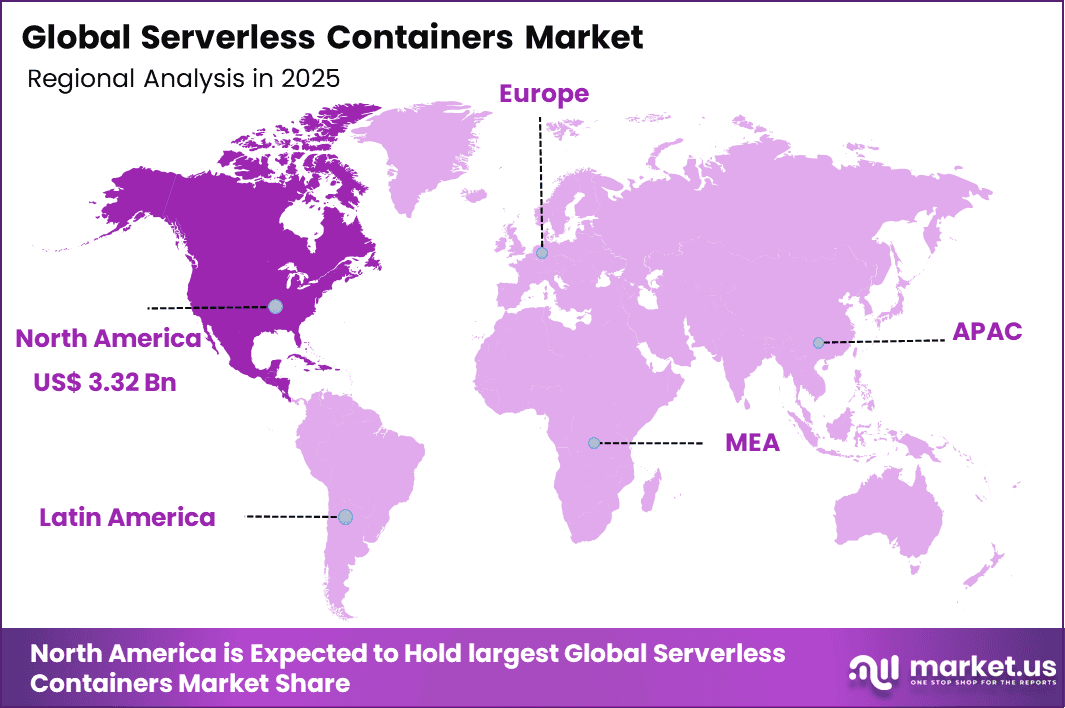
The Global Serverless Containers Market generated USD 8.2 billion in 2025 and is predicted to register growth from USD 10.6 billion in 2026 to about USD 104.6 billion by 2035, recording a CAGR of 29.0% throughout the forecast span. In 2025, North America held a dominant market position, capturing more than a 40.5% share, with USD 3.32 billion in revenue.
The serverless containers market refers to cloud-based services that enable applications packaged in containers to run without requiring users to manage servers, virtual machines, or full container clusters. These platforms automatically handle provisioning, scaling, runtime support, and resource allocation, which makes them useful for APIs, microservices, background jobs, and event-based applications.
Demand for serverless containers is increasing among enterprises building cloud native applications, digital platforms, internal business tools, and data processing services. These users want a practical option that offers the benefits of containerization without the management burden of traditional orchestration systems. Demand is also rising as more companies modernize legacy applications and adopt faster development cycles, which creates stronger interest in simplified container deployment models.
Top Market Takeaways
- Platforms command 81.4% market share, offering fully managed orchestration that auto-scales containerized workloads without infrastructure provisioning.
- Public cloud deployment captures 87.6%, enabling pay-per-invocation pricing, global replication, and seamless integration with FaaS ecosystems.
- Large enterprises hold 70.2%, leveraging serverless containers for mission-critical web apps with zero-downtime scaling and fault tolerance.
- Web applications claim 43.5%, powering dynamic APIs, microservices, and event-driven architectures with instant cold-start optimization.
- IT & telecom sectors represent 28.7%, deploying serverless containers for 5G edge services, network function virtualization, and low-latency telco apps.
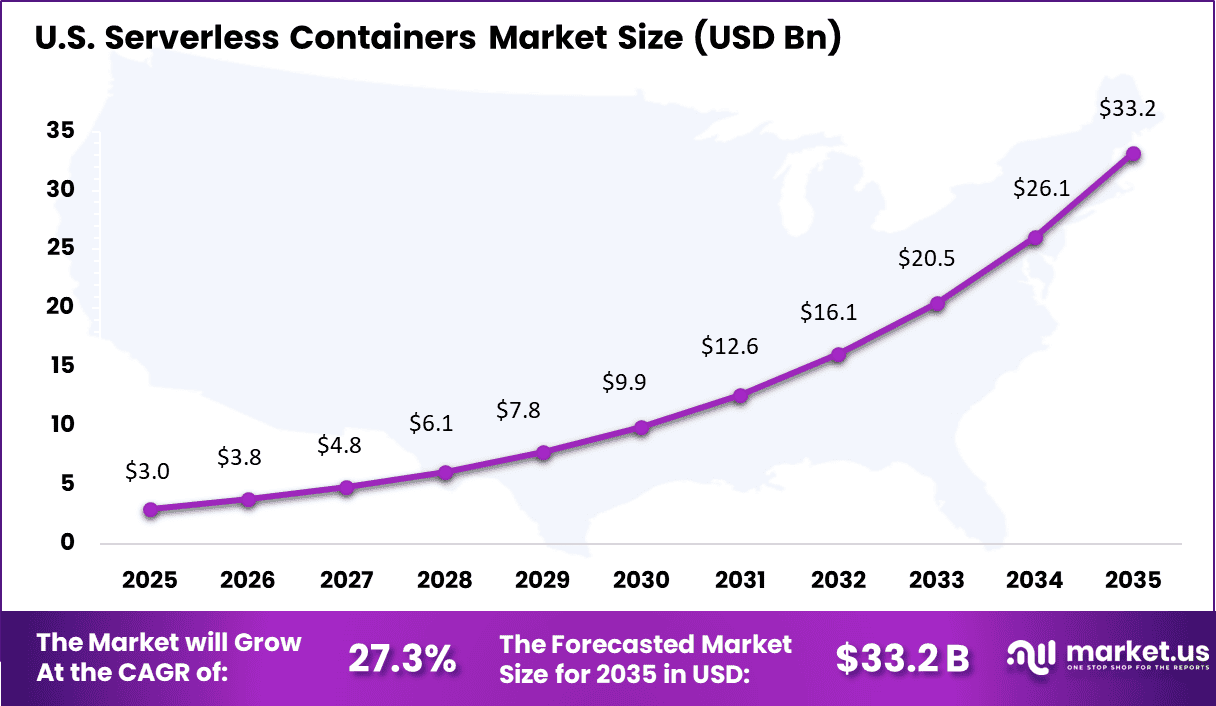
- North America drives 40.5% of global value, with the U.S. market valued at USD 2.97 billion and a 27.3% CAGR, fueled by hyperscaler advancements.
By Component Analysis
Platform accounted for 81.4% of the Serverless Containers Market. This segment leads because organizations rely on managed platforms that handle container orchestration, scaling, and runtime management without requiring infrastructure control. These platforms simplify deployment and allow developers to focus on application logic rather than system maintenance.
The segment is also supported by the growing need for faster development cycles and reduced operational complexity. Platform-based solutions provide automated scaling, efficient resource usage, and easier integration with cloud services, which strengthens their adoption across modern application environments.
By Deployment Analysis
Public cloud held 87.6% of the market. This segment dominates because serverless container services are primarily delivered through cloud providers that offer scalable and flexible environments. Public cloud platforms allow organizations to run applications without managing servers while paying only for actual usage.
The segment is driven by increasing adoption of cloud native architectures and digital transformation strategies. Public cloud deployment supports rapid application deployment, global accessibility, and efficient workload management, which keeps it as the preferred choice for serverless containers.
By Organization Size Analysis
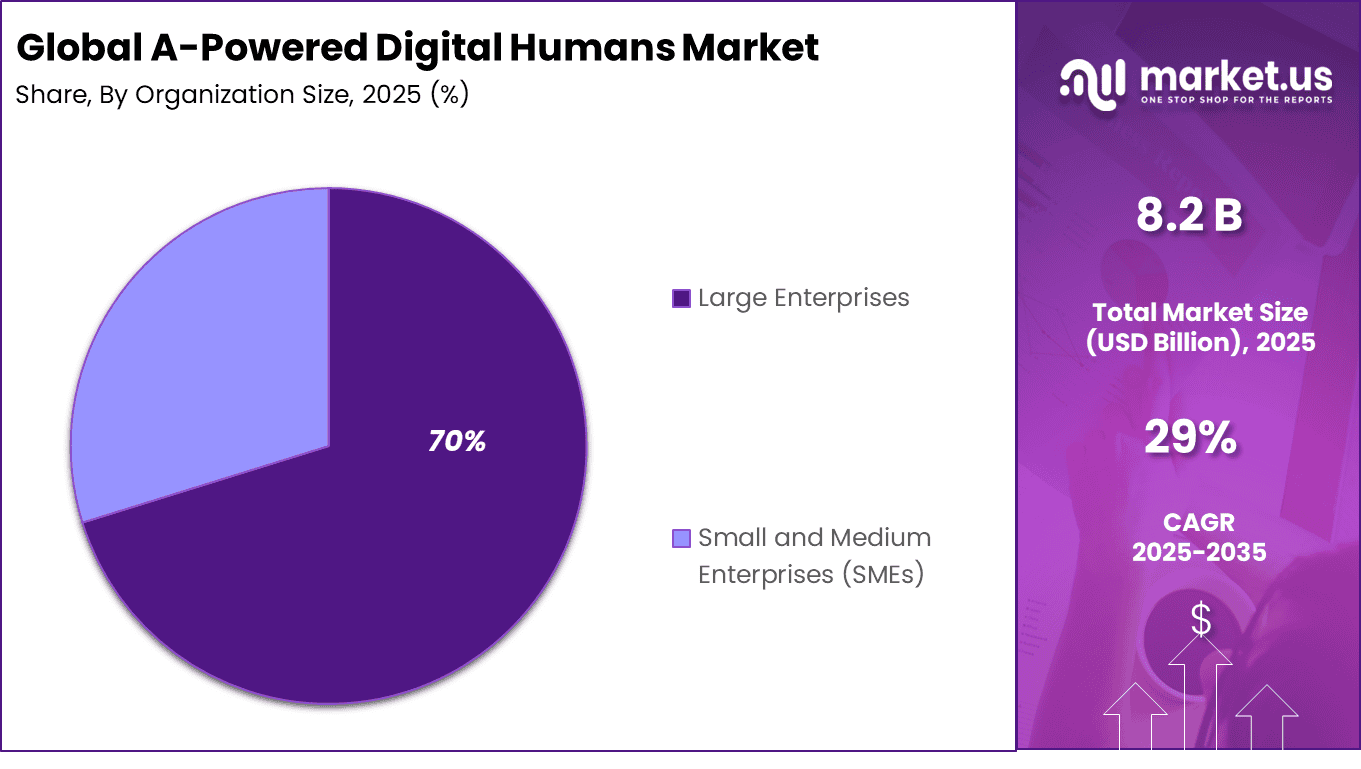
Large enterprises accounted for 70% of the market. This segment leads because large organizations manage complex applications and require scalable infrastructure to support high user demand. Serverless containers help them optimize resource usage and improve operational efficiency across multiple business functions.
The segment is supported by strong investment capacity and the need for modernization of legacy systems. Large enterprises adopt serverless platforms to enhance agility, reduce infrastructure overhead, and improve application performance across distributed environments.
By Application Analysis
Web applications represented 43.5% of the market. This segment dominates because many modern digital services are delivered through web-based platforms that require scalable and responsive infrastructure. Serverless containers support dynamic scaling based on user demand, which improves performance and user experience.
The segment continues to grow as businesses expand their online presence and digital services. Organizations use serverless containers to build, deploy, and manage web applications efficiently while maintaining flexibility and reducing operational complexity.
By End User Industry Analysis
IT and telecom captured 28.7% of the market. This segment leads because companies in this sector operate large-scale digital services and require flexible infrastructure to manage applications and network functions. Serverless containers help improve deployment speed and support continuous service delivery.
The segment is also driven by increasing demand for cloud-based services and network modernization. IT and telecom organizations adopt serverless container solutions to enhance scalability, optimize resource usage, and support evolving digital communication needs.
Key Market Segments
By Component
- Platform
- Services
By Deployment
- Public Cloud
- Private Cloud
- Hybrid Cloud
By Organization Size
- Small and Medium Enterprises (SMEs)
- Large Enterprises
By Application
- Web Applications
- Data Processing
- API Management
- Others
By End-User Industry
- IT & Telecom
- BFSI
- Retail & E-commerce
- Healthcare & Life Sciences
- Media & Entertainment
- Others
Drivers Impact Analysis
| Key Driver | CAGR (~%) | Geographic Relevance | Impact Timeline | Strategic Effect |
|---|---|---|---|---|
| Increasing adoption of cloud native application development | +5.2% | North America, Europe, Asia Pacific | Short to Mid Term (2025–2031) | Accelerates deployment of scalable applications |
| Rising demand for cost-efficient and scalable computing models | +4.8% | Global | Short to Mid Term (2025–2030) | Reduces infrastructure management overhead |
| Growth of microservices and containerization architectures | +4.5% | US, Europe, Asia Pacific | Mid Term (2026–2032) | Enhances modular application development |
| Expansion of DevOps and continuous delivery practices | +4.1% | Global | Mid Term (2026–2032) | Improves development and deployment efficiency |
| Increasing enterprise focus on reducing operational complexity | +3.7% | Global | Mid to Long Term (2026–2035) | Simplifies infrastructure management |
Restraints Impact Analysis
| Key Restraint | Impact on CAGR Forecast (~%) | Geographic Relevance | Impact Timeline | Strategic Effect |
|---|---|---|---|---|
| Complexity in managing distributed serverless environments | -3.2% | Global | Mid Term (2026–2032) | Increases operational challenges |
| Security and compliance concerns in serverless architectures | -2.9% | North America, Europe | Mid to Long Term (2026–2035) | Requires enhanced security controls |
| Limited visibility and debugging challenges | -2.6% | Global | Mid Term (2026–2032) | Affects performance monitoring |
| Vendor lock-in risks with cloud providers | -2.4% | Global | Mid to Long Term (2026–2035) | Reduces flexibility |
| Skill gap in cloud native and serverless technologies | -2.1% | Global | Mid Term (2026–2032) | Slows adoption |
Investor Type Impact Analysis
| Investor Type | Growth Sensitivity | Risk Exposure | Geographic Focus | Investment Outlook |
|---|---|---|---|---|
| Venture Capital Firms | Very High | High | US, Europe, Israel | Strong cloud native innovation |
| Private Equity Firms | High | Medium | North America, Europe | Expansion in cloud platforms |
| Strategic Technology Investors | Very High | Medium | US, China, Japan | Strengthens cloud ecosystem |
| Corporate Venture Arms | High | Medium | Global | Supports developer platform growth |
| Government and Digital Innovation Funds | Medium | Low to Medium | North America, Europe, Asia Pacific | Supports digital infrastructure |
Technology Enablement Analysis
| Technology Enabler | Impact on CAGR Forecast (~%) | Geographic Relevance | Impact Timeline | Implementation Significance |
|---|---|---|---|---|
| Container orchestration and serverless platforms | +5.3% | Global | Short to Mid Term (2025–2031) | Enables automated scaling |
| Kubernetes and cloud native infrastructure tools | +4.9% | Global | Mid Term (2026–2032) | Supports container management |
| Event-driven computing and function as a service models | +4.6% | Global | Short to Mid Term (2025–2030) | Improves application responsiveness |
| Integration with DevOps and CI CD pipelines | +4.2% | Global | Mid Term (2026–2032) | Enhances deployment automation |
| Multi-cloud and hybrid cloud environments | +3.9% | Global | Mid to Long Term (2026–2035) | Improves flexibility and scalability |
Key Challenges
- Cold start delays remain a major challenge because serverless containers may take extra time to launch when demand suddenly increases or when workloads stay idle for some time.
- Limited control over the underlying infrastructure can be difficult for enterprises that need deep customization, direct system access, or specific runtime settings.
- Cost management is not always simple because usage-based pricing can rise quickly when workloads scale frequently or run for longer durations.
- Monitoring and troubleshooting can be harder because serverless container environments are more abstract, which makes it difficult to track performance issues and root causes.
- Vendor lock-in is another challenge because many serverless container services use provider-specific tools, workflows, and configurations that are not easy to move across platforms.
Emerging Trends
A key trend in the Serverless Containers market is the growing shift toward fully managed container environments where developers can run applications without handling underlying infrastructure. These platforms automatically manage scaling, resource allocation, and execution, allowing teams to focus on building and deploying applications.
Organizations are combining container flexibility with serverless simplicity to support faster development cycles and more efficient deployment processes. This trend reflects a move toward streamlined cloud operations where infrastructure management is minimized and application performance remains consistent.
Growth Factors
The increasing demand for faster application development and efficient resource usage is supporting the growth of serverless container solutions. Businesses aim to reduce operational complexity and avoid maintaining dedicated infrastructure for workloads that vary over time.
Serverless containers help optimize resource consumption by running applications only when needed, which improves cost control and system efficiency. The expansion of cloud native development practices encourages organizations to adopt solutions that support scalable and flexible application deployment across dynamic environments.
Regional Analysis
North America accounted for 40.5% of the Serverless Containers Market, reflecting strong adoption of cloud native application development across enterprises. Organizations across the region increasingly use serverless container platforms to run applications without managing underlying infrastructure.
This approach helps development teams focus on code execution while improving scalability and resource efficiency. The growing use of microservices architectures and continuous deployment practices continues to support demand for serverless container solutions across North America.
The U.S. generated about USD 2.97 Bn within the regional market and is projected to expand at a CAGR of 27.3%. Technology companies and enterprises across the country continue to invest in platforms that simplify container management and reduce operational complexity. Serverless containers allow automatic scaling, faster deployment cycles, and cost optimization by running workloads only when needed. As businesses accelerate cloud adoption and modernize application environments, demand for serverless container solutions continues to grow rapidly across the US market.
Key Regions and Countries
- North America
- US
- Canada
- Europe
- Germany
- France
- The UK
- Spain
- Italy
- Russia
- Netherlands
- Rest of Europe
- Asia Pacific
- China
- Japan
- South Korea
- India
- Australia
- Singapore
- Thailand
- Vietnam
- Rest of APAC
- Latin America
- Brazil
- Mexico
- Rest of Latin America
- Middle East & Africa
- South Africa
- Saudi Arabia
- UAE
- Rest of MEA
Competitive Analysis
The Serverless Containers market is dominated by AWS, Microsoft Azure, Google Cloud, IBM, Oracle, Alibaba Cloud, and Tencent Cloud. These providers compete through scalable infrastructure, integrated developer tools, and faster container deployment with lower management requirements.
Other players such as Serverless Inc., VMware, SAP, Cisco Systems, Hewlett Packard Enterprise, Cloud Foundry Foundation, and DigitalOcean add competition through hybrid cloud support, enterprise software integration, developer-focused services, and platform flexibility.
The market is shaped by ease of deployment, pricing efficiency, portability, security, and support for modern application development. Overall, competition remains strong as enterprises look for simpler and more efficient ways to run cloud native workloads.
Top Key Players in the Market
- Amazon Web Services (AWS)
- Microsoft Azure
- Google Cloud Platform (GCP)
- IBM Corporation
- Oracle Cloud
- Alibaba Cloud
- Serverless Inc.
- VMware
- SAP
- Cisco Systems
- Hewlett Packard Enterprise (HPE)
- Tencent Cloud
- Cloud Foundry Foundation
- DigitalOcean
- Others
Future Outlook
The future outlook for the Serverless Containers Market looks strong as more businesses want to run containerized applications without managing servers or complex infrastructure. Major cloud platforms such as Google Cloud Run and AWS Fargate already offer fully managed, serverless container services that help teams scale faster, reduce operational work, and pay only for the resources they use. As companies continue to build cloud native apps, microservices, and AI-driven workloads, demand for serverless container solutions is expected to grow steadily in the coming years.
Recent Developments
- In January 2026, Google Cloud Run Containers introduced AlloyDB integration with sub-10ms cold start processing 50B+ requests monthly across global regions. Knative-based autoscaling handled 100K concurrent containers dynamically.
- In February 2026, AWS Fargate 1.4.0 mandatory upgrade completed across 1M+ ECS tasks featuring Graviton4 processors delivering 30% better price/performance for ML inference workloads with seamless platform version migration. ARM64v9 support enhanced GPU workloads running serverless Stable Diffusion models at 75% lower cost.
Report Scope
| Report Features | Description |
|---|---|
| Market Value (2025) | USD 8.2 Billion |
| Forecast Revenue (2035) | USD 104.6 Billion |
| CAGR(2025-2035) | 29% |
| Base Year for Estimation | 2024 |
| Historic Period | 2020-2024 |
| Forecast Period | 2025-2035 |
| Report Coverage | Revenue forecast, AI impact on Market trends, Share Insights, Company ranking, competitive landscape, Recent Developments, Market Dynamics and Emerging Trends |
| Segments Covered | By Component (Platform, Services), By Deployment (Public Cloud, Private Cloud, Hybrid Cloud), By Organization Size (Small and Medium Enterprises (SMEs), Large Enterprises), By Application (Web Applications, Data Processing, API Management, Others), By End-User Industry (IT & Telecom, BFSI, Retail & E-commerce, Healthcare & Life Sciences, Media & Entertainment, Others) |
| Regional Analysis | North America – US, Canada; Europe – Germany, France, The UK, Spain, Italy, Russia, Netherlands, Rest of Europe; Asia Pacific – China, Japan, South Korea, India, New Zealand, Singapore, Thailand, Vietnam, Rest of Latin America; Latin America – Brazil, Mexico, Rest of Latin America; Middle East & Africa – South Africa, Saudi Arabia, UAE, Rest of MEA |
| Competitive Landscape | Amazon Web Services (AWS), Microsoft Azure, Google Cloud Platform (GCP), IBM Corporation, Oracle Cloud, Alibaba Cloud, Serverless Inc., VMware, SAP, Cisco Systems, Hewlett Packard Enterprise (HPE), Tencent Cloud, Cloud Foundry Foundation, DigitalOcean, Others |
| Customization Scope | Customization for segments, region/country-level will be provided. Moreover, additional customization can be done based on the requirements. |
| Purchase Options | We have three licenses to opt for: Single User License, Multi-User License (Up to 5 Users), Corporate Use License (Unlimited Users and Printable PDF) |