Report Overview
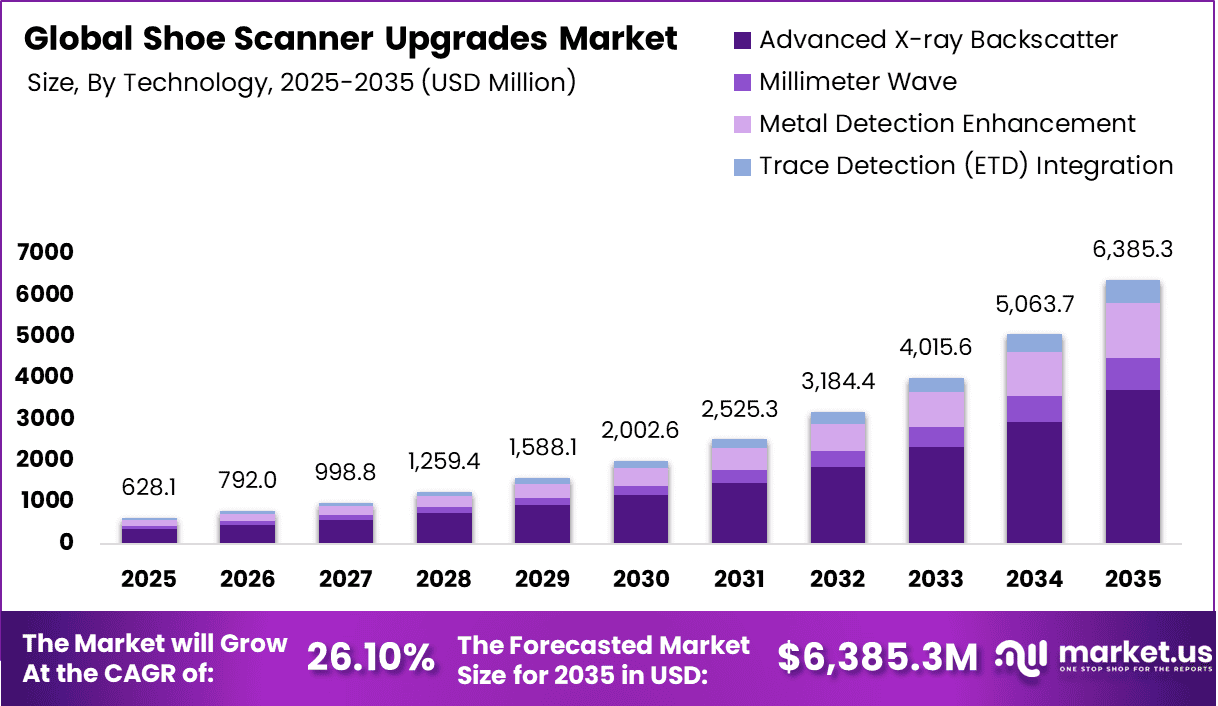
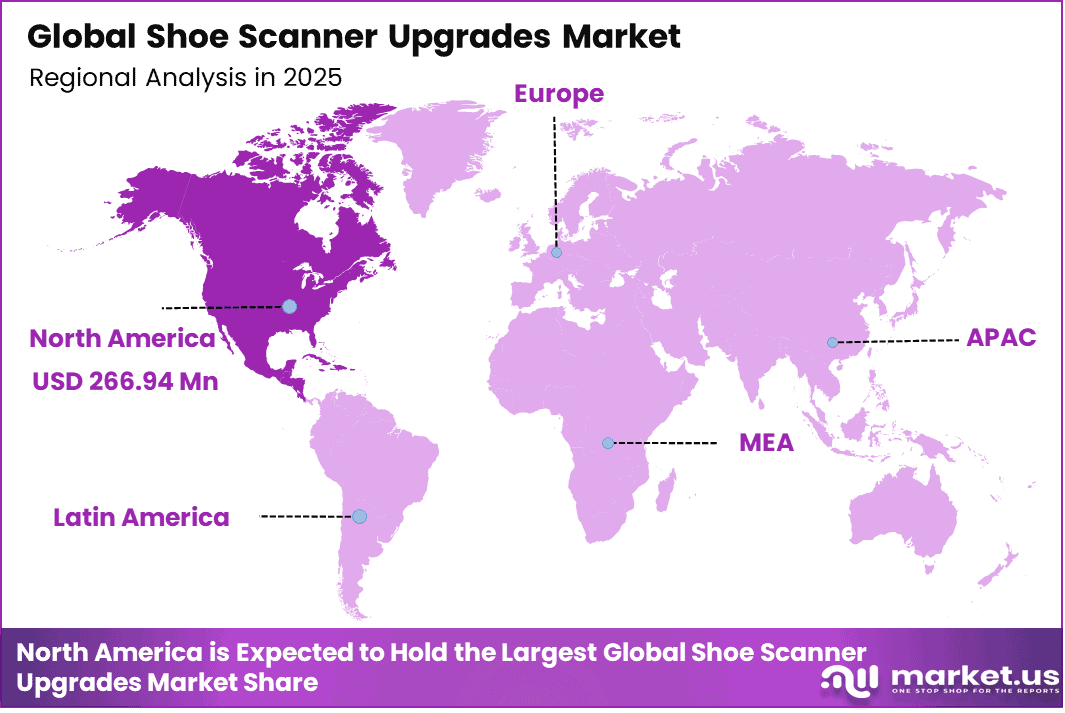
The Global Shoe Scanner Upgrades Market generated USD 628.1 million in 2025 and is predicted to grow from USD 792 million in 2026 to about USD 6,385.3 million by 2035, recording a CAGR of 26.10% throughout the forecast period. In 2025, North America held a dominant market position, capturing more than a 42.5% share, with USD 266.94 million in revenue.
Shoe Scanner Upgrades market refers to the hardware, software, and system enhancements added to existing shoe and foot scanning solutions used in footwear retail, fitting centers, and customized footwear services. These upgrades improve scan accuracy, measurement capabilities, fitting efficiency, customer interaction, and data processing, helping retailers deliver more precise shoe recommendations and better in-store digital experiences.
A key factor driving the market is the increasing need to minimize poor fit issues and reduce footwear returns. Retailers are adopting upgraded scanning technologies that provide detailed foot measurements and advanced analysis to improve shoe matching. The growing demand for personalized shopping experiences is also encouraging brands to use upgraded scanners to enhance customer engagement, offer premium fitting services, and improve sales conversions.
Top Market Takeaways
- By Technology, advanced X-ray backscatter dominates with a 58.4% share, enabling non-intrusive shoe imaging, explosive material discrimination, and concealed threat revelation without physical contact.
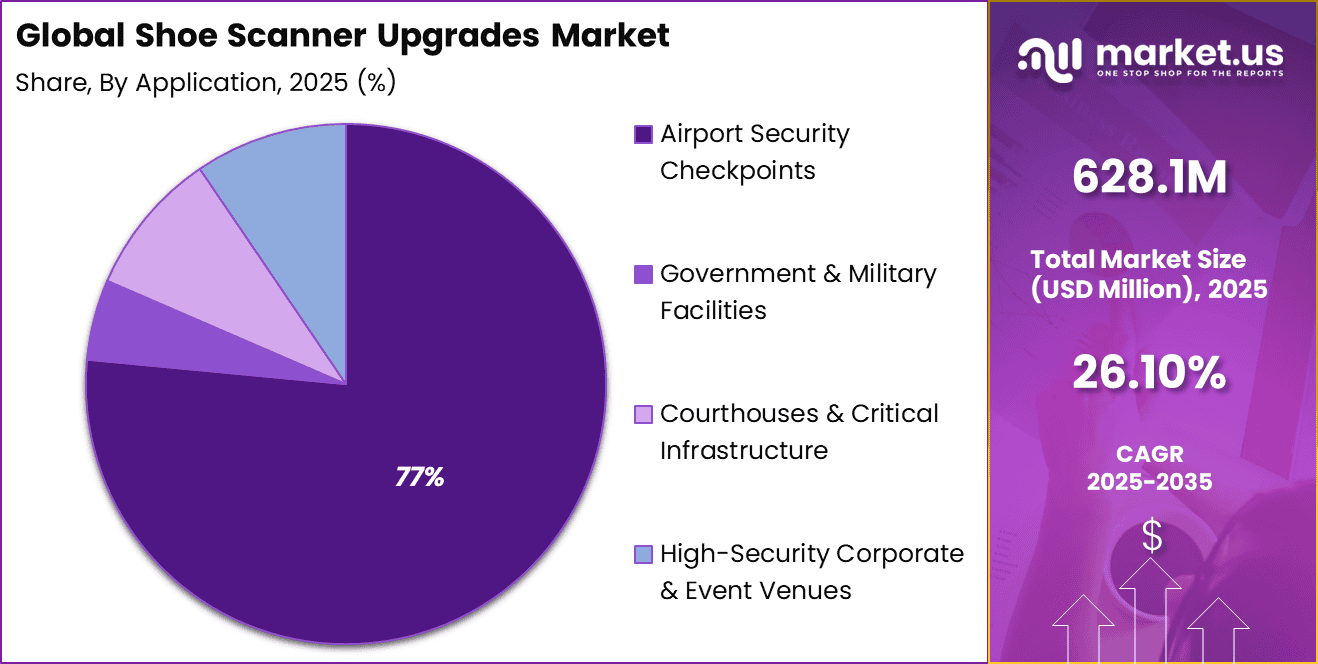
- By Application, airport security checkpoints capture 76.5%, streamlining passenger screening lanes with high-throughput automated detection and minimal false alarms.
- By End-User, transportation security administrations hold 68.9%, deploying standardized upgrades across national airport networks with centralized analytics and compliance reporting.
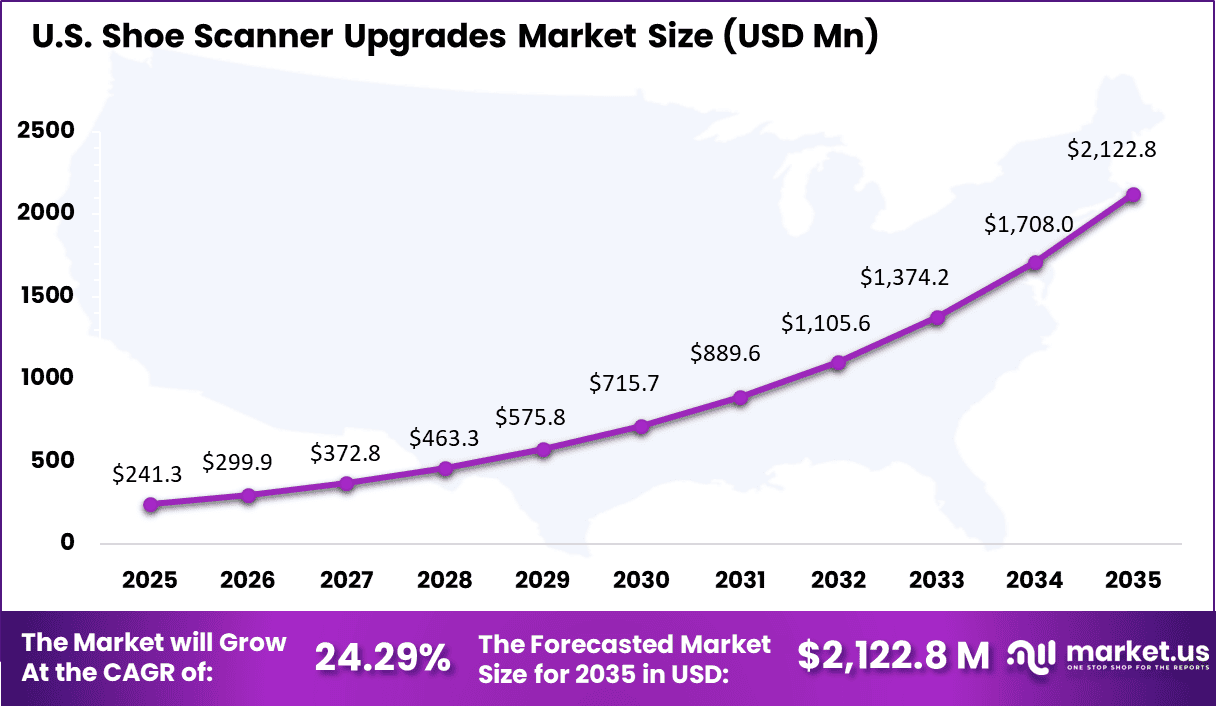
- Regionally, North America accounts for 42.5% global share, with the U.S. market valued at USD 241.3 million and a CAGR of 24.29%, driven by TSA modernization initiatives and next-generation screening mandates.
By Technology Analysis
Advanced X-ray backscatter accounted for 58.4% of the Shoe Scanner Upgrades Market. This segment leads because it provides high-resolution imaging capable of detecting concealed items within footwear without requiring physical inspection. Security agencies rely on this technology to improve threat detection accuracy while maintaining passenger flow.
The segment is also supported by the need for faster and more reliable screening systems. Advanced X-ray backscatter enables detailed scanning with minimal disruption, which helps security teams identify potential risks more efficiently and strengthens its adoption across high-security environments.
By Application Analysis
Airport security checkpoints represented 77% of the market. This segment dominates because airports handle large passenger volumes and require strict screening procedures to ensure safety. Shoe scanners play a key role in detecting hidden threats while reducing the need for manual shoe removal in some cases.
The segment continues to grow as airports invest in advanced screening technologies to improve efficiency and passenger experience. Faster scanning systems help reduce wait times while maintaining strong security standards, which supports high adoption at airport checkpoints.
By End User Analysis
Transportation security administrations held 68.9% of the market. This segment leads because government security agencies are responsible for implementing and managing screening infrastructure across transportation hubs. These organizations invest heavily in advanced detection technologies to meet safety regulations and evolving threat scenarios.
The segment is also driven by continuous upgrades in national security systems. Transportation authorities focus on improving screening accuracy, reducing false alarms, and enhancing operational efficiency, which keeps demand strong for upgraded shoe scanning solutions within this user group.
Key Market Segments
By Technology
- Advanced X-ray Backscatter
- Millimeter Wave
- Metal Detection Enhancement
- Trace Detection (ETD) Integration
By Application
- Airport Security Checkpoints
- Government & Military Facilities
- Courthouses & Critical Infrastructure
- High-Security Corporate & Event Venues
By End-User
- Transportation Security Administrations (TSA, etc.)
- Defense & Law Enforcement Agencies
- Private Security Contractors
Drivers Impact Analysis
| Key Drivers | Impact on CAGR Forecast (~%) | Geographic Relevance | Impact Timeline | Strategic Effect |
|---|---|---|---|---|
| Rising demand for personalized footwear and fit accuracy | +4.5% | North America, Europe, Asia Pacific | Short to Mid Term (2025–2031) | Enhances customer experience and reduces returns |
| Growth of e-commerce and virtual try-on solutions | +4.1% | Global | Short to Mid Term (2025–2030) | Supports online footwear purchasing decisions |
| Increasing adoption by retail stores for in-store digitization | +3.8% | US, Europe, China | Mid Term (2026–2032) | Improves retail engagement and conversion rates |
| Expansion of 3D scanning and AI-based measurement technologies | +3.5% | Global | Mid to Long Term (2026–2035) | Enables precise foot mapping |
| Rising focus on reducing product returns in footwear retail | +3.2% | North America, Europe | Mid Term (2026–2032) | Lowers logistics and operational costs |
Restraints Impact Analysis
| Key Restraint | Impact on CAGR Forecast (~%) | Geographic Relevance | Impact Timeline | Strategic Effect |
|---|---|---|---|---|
| High cost of advanced scanning hardware | -2.8% | Global | Mid Term (2026–2032) | Limits adoption among small retailers |
| Integration challenges with retail systems | -2.4% | North America, Europe | Mid Term (2026–2032) | Slows deployment in stores |
| Limited awareness among small footwear brands | -2.1% | Asia Pacific, Latin America | Short to Mid Term (2025–2030) | Reduces market penetration |
| Data privacy concerns related to biometric measurements | -2.0% | Europe, North America | Mid to Long Term (2026–2035) | Creates compliance barriers |
| Dependence on customer willingness to adopt scanning | -1.8% | Global | Short to Mid Term (2025–2031) | Affects usage frequency |
Investor Type Impact Analysis
| Investor Type | Growth Sensitivity | Risk Exposure | Geographic Focus | Investment Outlook |
|---|---|---|---|---|
| Venture Capital Firms | Very High | High | US, Europe, Israel | Strong retail tech innovation |
| Private Equity Firms | High | Medium | North America, Europe | Expansion in retail automation |
| Strategic Technology Investors | High | Medium | US, China, Japan | Supports AI and 3D scanning growth |
| Corporate Venture Arms | High | Medium | Global | Partnerships with retail brands |
| Government and Innovation Funds | Medium | Low to Medium | Europe, Asia Pacific | Supports digital retail transformation |
Technology Enablement Analysis
| Technology Enabler | Impact on CAGR Forecast (~%) | Geographic Relevance | Impact Timeline | Implementation Significance |
|---|---|---|---|---|
| 3D foot scanning and imaging technologies | +4.6% | Global | Short to Mid Term (2025–2031) | Enables precise foot measurement |
| AI-based size recommendation algorithms | +4.2% | North America, Europe, Asia Pacific | Mid Term (2026–2032) | Improves fit prediction accuracy |
| Integration with e-commerce and mobile apps | +3.8% | Global | Short to Mid Term (2025–2030) | Supports online shopping experience |
| Cloud-based data storage and analytics | +3.4% | Global | Mid Term (2026–2032) | Enables scalable data processing |
| Augmented reality for virtual fitting | +3.1% | US, Europe, Asia Pacific | Mid to Long Term (2026–2035) | Enhances customer engagement |
Key Challenges
- Upgrading shoe scanner systems is costly because retailers often need new hardware, software updates, calibration support, and staff training at the same time.
- Accuracy remains a major challenge because shoe scanning systems must capture precise foot shape, width, and size data to provide correct fit recommendations.
- Integration is difficult because upgraded scanners need to work smoothly with retail software, mobile applications, and product inventory systems.
- Customer adoption can be uneven because some users may not want to spend extra time on foot scanning, especially if the process feels slow or inconvenient.
- Data privacy is also a challenge because these systems collect detailed foot measurement information that must be stored and managed carefully.
Emerging Trends
A notable trend in the Shoe Scanner Upgrades market is the increasing shift toward advanced foot measurement technologies that provide precise sizing and fit analysis. Modern scanners are being upgraded with improved imaging, depth sensing, and data processing capabilities to capture detailed foot structure.
Retailers are integrating these systems into in-store and digital platforms to offer personalized footwear recommendations. This trend reflects a broader move toward customization in retail, where accurate fit assessment helps improve customer satisfaction and reduces product returns.
Growth Factors
The growing focus on customer experience and product accuracy is supporting the expansion of shoe scanner upgrade solutions. Footwear brands and retailers aim to reduce sizing issues that often lead to returns and customer dissatisfaction. Upgraded scanning systems help provide better fit recommendations, which improves purchase confidence for consumers.
At the same time, the rise of online footwear shopping is encouraging retailers to adopt technologies that bridge the gap between physical fitting and digital purchasing, strengthening demand for more accurate and reliable scanning solutions.
Regional Analysis
North America accounted for 42.5% of the Shoe Scanner Upgrades Market, reflecting strong adoption of advanced screening technologies across transportation hubs and high security facilities. Airports, government buildings, and event venues across the region continue to upgrade existing security systems with improved shoe scanning capabilities to enhance threat detection and passenger throughput.
The growing focus on faster and more accurate security checks has encouraged the use of upgraded scanners that integrate imaging technologies and automated detection features, supporting safer and more efficient screening processes.
The U.S. generated about USD 241.3 Mn within the regional market and is projected to expand at a CAGR of 24.29%. Security agencies and airport authorities across the country continue to invest in upgrading legacy screening equipment to meet evolving safety standards and handle increasing passenger traffic.
Shoe scanner upgrades help reduce manual inspections while improving detection accuracy and operational speed. As transportation infrastructure expands and security requirements become more stringent, demand for advanced and upgraded shoe scanning systems continues to grow rapidly across the US market.
Key Regions and Countries
- North America
- US
- Canada
- Europe
- Germany
- France
- The UK
- Spain
- Italy
- Russia
- Netherlands
- Rest of Europe
- Asia Pacific
- China
- Japan
- South Korea
- India
- Australia
- Singapore
- Thailand
- Vietnam
- Rest of APAC
- Latin America
- Brazil
- Mexico
- Rest of Latin America
- Middle East & Africa
- South Africa
- Saudi Arabia
- UAE
- Rest of MEA
Competitive Analysis
The competitive landscape of the Shoe Scanner Upgrades market includes established security screening and inspection technology providers that serve airports, government facilities, defense sites, and other high-security locations.
Smiths Detection Group, Ltd., Rapiscan Systems (OSI Systems, Inc.), Leidos Holdings, Inc., Nuctech Company, Ltd., L3Harris Technologies, Inc., Rohde & Schwarz GmbH & Co. KG, and Astrophysics, Inc. hold strong positions through their broad screening portfolios, technical expertise, and long-standing relationships with public security agencies. These companies compete by improving detection accuracy, system speed, and upgrade compatibility with existing checkpoint infrastructure.
Other players such as ADANI Systems, Inc., Autoclear, LLC, Tek84, Inc., Gilardoni S.p.A., Scanna MSC, Ltd., MinXray, Inc., VMI Security, Inc., and Todd Research, Ltd. strengthen the market by offering specialized imaging systems, compact screening solutions, and flexible upgrade options for different security environments.
Competition in this market is shaped by product reliability, image quality, ease of installation, compliance with screening standards, and after-sales support. Overall, the market remains competitive as operators look for faster, more accurate, and more efficient shoe scanning systems.
Top Key Players in the Market
- Smiths Detection Group, Ltd.
- Rapiscan Systems (OSI Systems, Inc.)
- Leidos Holdings, Inc.
- Nuctech Company, Ltd.
- L3Harris Technologies, Inc.
- ADANI Systems, Inc.
- Astrophysics, Inc.
- Rohde & Schwarz GmbH & Co. KG
- Autoclear, LLC
- Tek84, Inc.
- Gilardoni S.p.A.
- Scanna MSC, Ltd.
- MinXray, Inc.
- VMI Security, Inc.
- Todd Research, Ltd.
- Others
Future Outlook
The future outlook for the Shoe Scanner Upgrades Market looks positive as retailers and footwear brands continue to improve in-store and digital fitting experiences. Demand is expected to grow as businesses look for better accuracy in foot measurement, faster customer service, and lower product returns. Advances in scanning software, data integration, and personalized fitting tools are likely to support steady market growth as comfort, convenience, and custom shoe recommendations become more important.
Recent Developments
- In February 2026, Birkenstock introduced the Highwood Moc Lace Low, a closed‑shoe design aimed at expanding its presence beyond sandals, and positioned it within a broader push toward more structured footwear that benefits from precise fit measurement via advanced scanning tools in retail environments.
- In March 2025, Adidas launched its Nomad Pro collection, featuring modular soles and uppers made from lab‑grown leather and recycled ocean plastics, a concept that works best with accurate sizing and fitting enabled by modern in‑store foot and shoe scanners.
Report Scope
| Report Features | Description |
|---|---|
| Market Value (2025) | USD 628.1 Million |
| Forecast Revenue (2035) | USD 6,385.3 Million |
| CAGR(2025-2035) | 26.1% |
| Base Year for Estimation | 2024 |
| Historic Period | 2020-2024 |
| Forecast Period | 2025-2035 |
| Report Coverage | Revenue forecast, AI impact on Market trends, Share Insights, Company ranking, competitive landscape, Recent Developments, Market Dynamics and Emerging Trends |
| Segments Covered | By Technology (Advanced X-ray Backscatter, Millimeter Wave, Metal Detection Enhancement, Trace Detection (ETD) Integration), By Application (Airport Security Checkpoints, Government & Military Facilities, Courthouses & Critical Infrastructure, High-Security Corporate & Event Venues), By End-User (Transportation Security Administrations (TSA, etc.), Defense & Law Enforcement Agencies, Private Security Contractors) |
| Regional Analysis | North America – US, Canada; Europe – Germany, France, The UK, Spain, Italy, Russia, Netherlands, Rest of Europe; Asia Pacific – China, Japan, South Korea, India, New Zealand, Singapore, Thailand, Vietnam, Rest of Latin America; Latin America – Brazil, Mexico, Rest of Latin America; Middle East & Africa – South Africa, Saudi Arabia, UAE, Rest of MEA |
| Competitive Landscape | Smiths Detection Group, Ltd., Rapiscan Systems (OSI Systems, Inc.), Leidos Holdings, Inc., Nuctech Company, Ltd., L3Harris Technologies, Inc., ADANI Systems, Inc., Astrophysics, Inc., Rohde & Schwarz GmbH & Co. KG, Autoclear, LLC, Tek84, Inc., Gilardoni S.p.A., Scanna MSC, Ltd., MinXray, Inc., VMI Security, Inc., Todd Research, Ltd., Others |
| Customization Scope | Customization for segments, region/country-level will be provided. Moreover, additional customization can be done based on the requirements. |
| Purchase Options | We have three licenses to opt for: Single User License, Multi-User License (Up to 5 Users), Corporate Use License (Unlimited Users and Printable PDF) |