


Report Overview
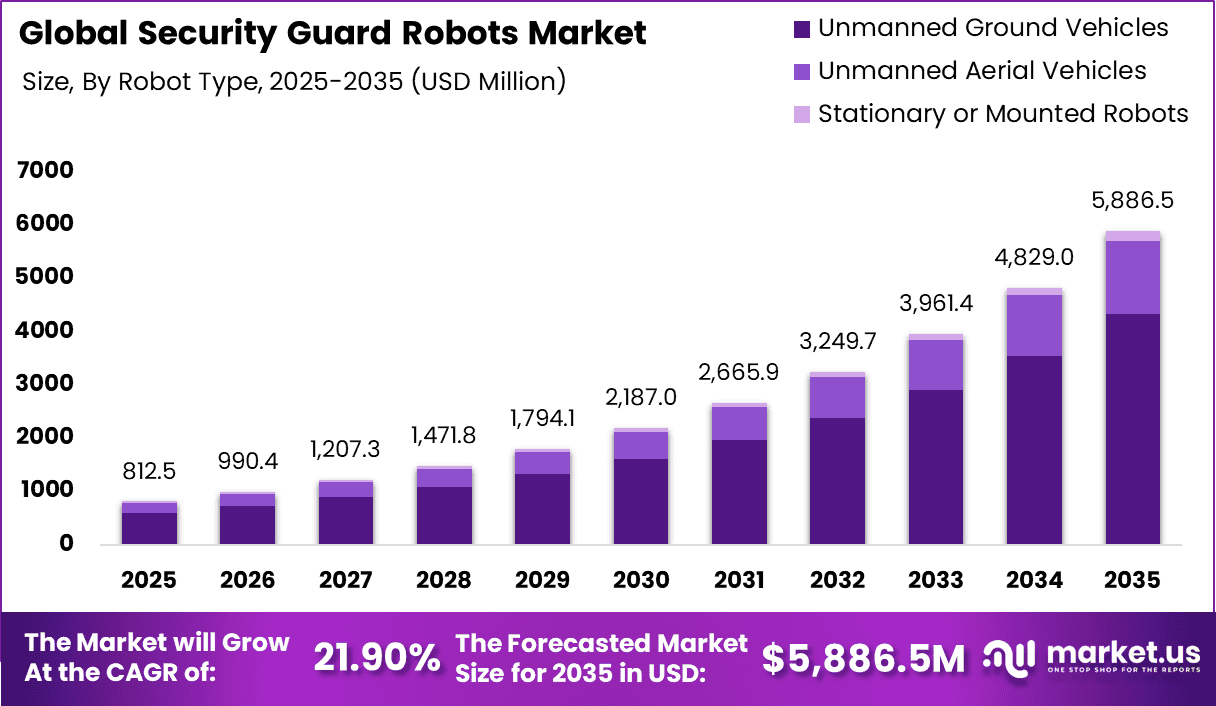
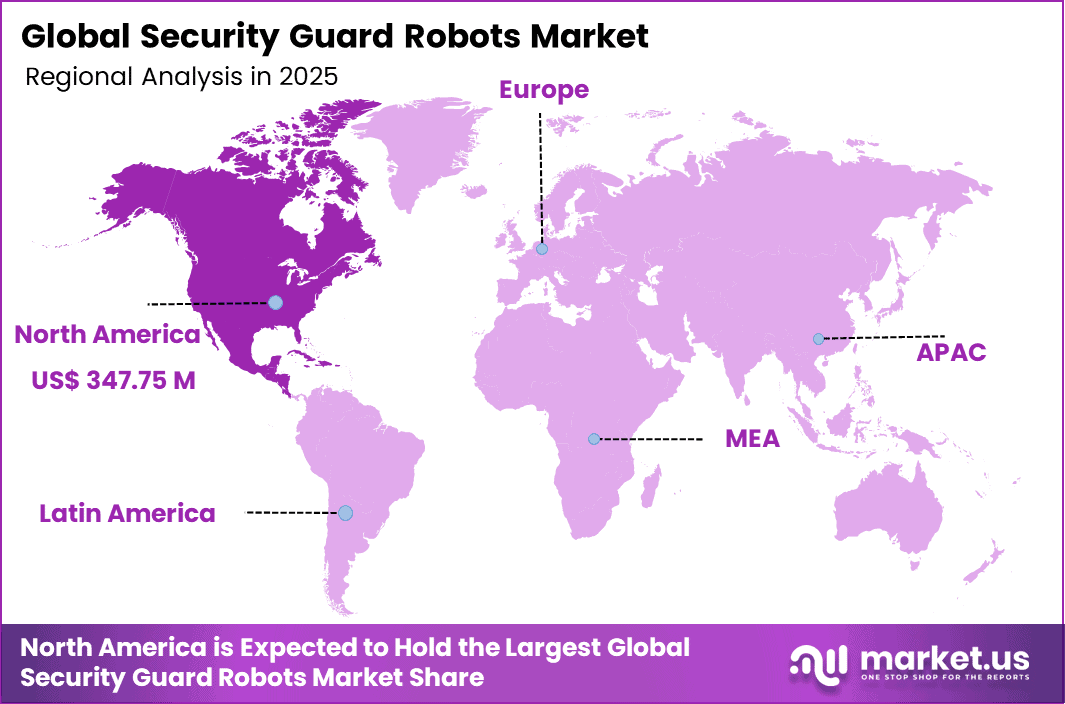
The Global Security Guard Robots Market generated USD 812.5 million in 2025 and is predicted to register growth from USD 990.4 million in 2026 to about USD 5,886.5 million by 2035, recording a CAGR of 21.9% throughout the forecast span. In 2025, North America held a dominant market position, capturing more than a 42.8% share, holding USD 347.75 million in revenue.
The Security Guard Robots market includes autonomous and semi-autonomous robots used for patrol, surveillance, threat detection, and incident reporting. These systems are deployed across commercial buildings, warehouses, campuses, public spaces, and industrial facilities.
Equipped with cameras, sensors, communication tools, and onboard software, these robots monitor surroundings, detect unusual activity, and send alerts to security teams. Market growth is supported by the need for continuous surveillance, stronger perimeter monitoring, and more consistent patrol coverage.
Demand is increasing across commercial real estate, manufacturing facilities, transport hubs, education campuses, and public infrastructure. Organizations are adopting these systems to reduce routine patrol work, improve real-time visibility, and combine physical presence, automated alerts, and continuous data collection in one security solution.
Top Market Takeaways
- By Robot Type, unmanned ground vehicles (UGVs) dominate with a 73.5% share, delivering mobile thermal imaging, license plate recognition, and perimeter deterrence across expansive properties.
- By Application, patrolling & surveillance capture 58.3%, enabling 24/7 autonomous routes, anomaly detection, and real-time video streaming to central command.
- By End-User, commercial & industrial sites claim 42.7%, securing warehouses, data centers, and manufacturing campuses against theft, vandalism, and unauthorized access.
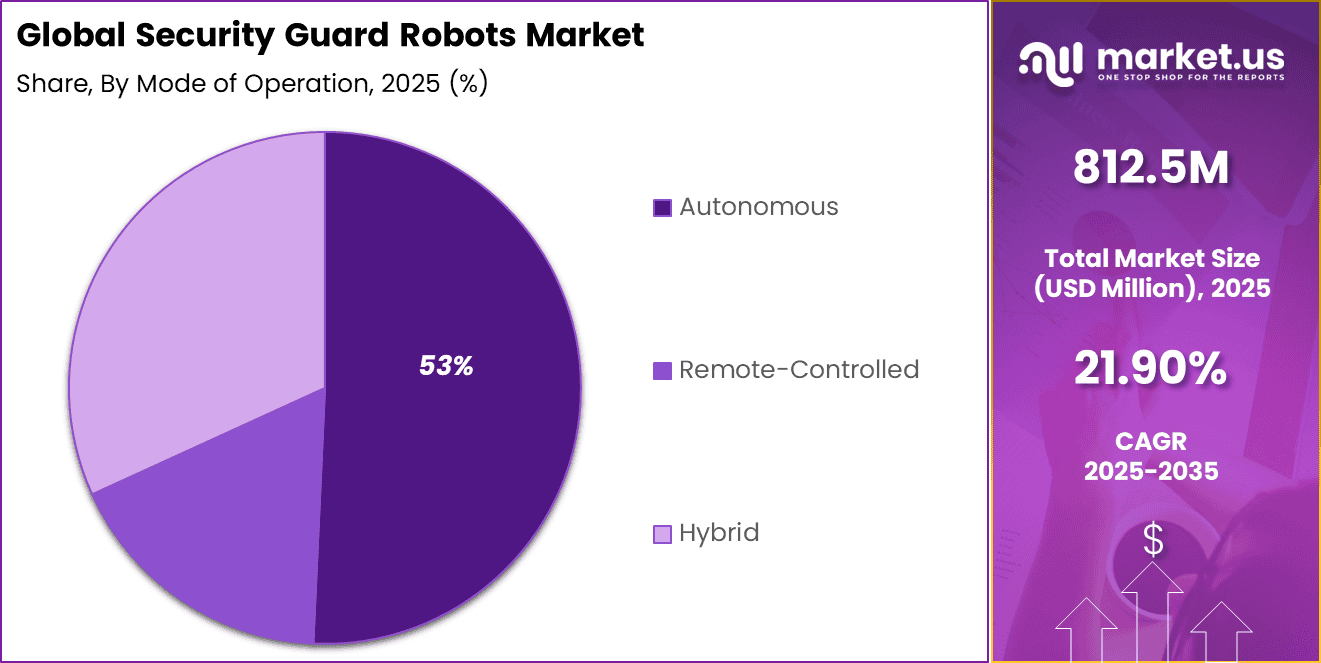
- By Mode of Operation, autonomous operation leads at 52.6%, featuring AI navigation, obstacle avoidance, and scheduled patrol programming without human intervention.
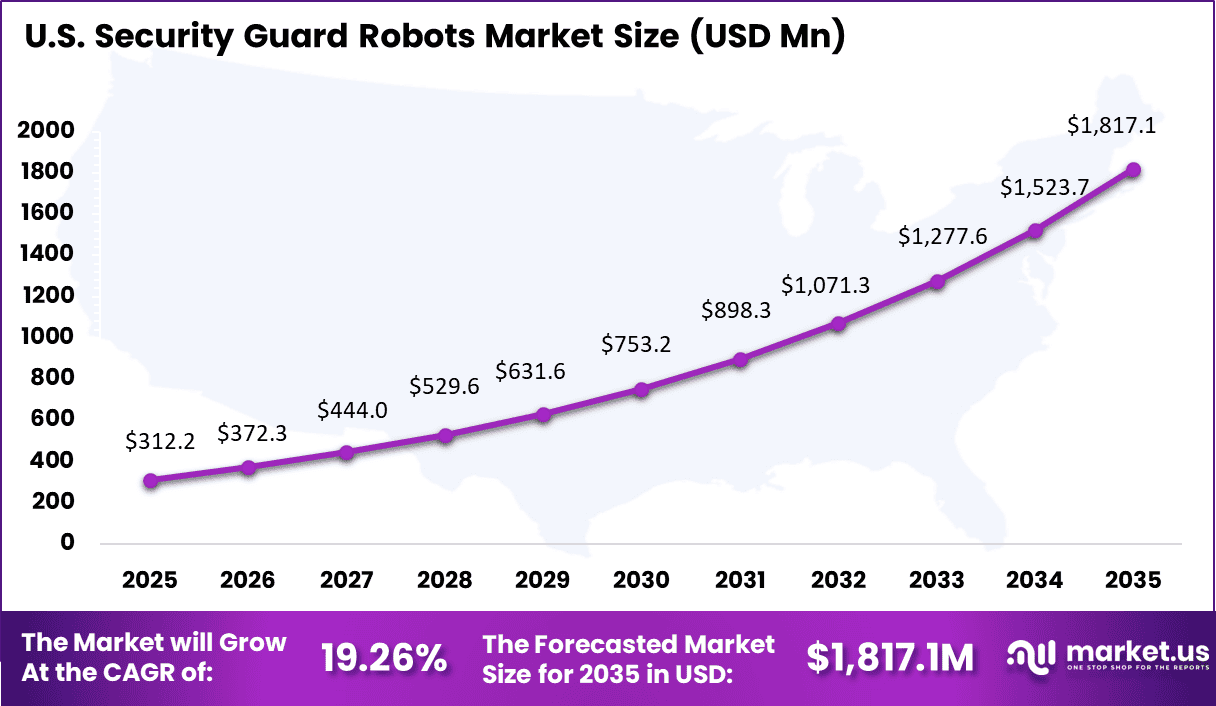
- North America accounts for 42.8% global share, with the U.S. market valued at USD 312.2 million and a CAGR of 19.26%, driven by critical infrastructure protection mandates and private security cost pressures.
By Robot Type Analysis
Unmanned ground vehicles UGVs accounted for 73.5% of the Security Guard Robots Market. This segment leads because ground-based robots are widely used for perimeter monitoring, facility patrol, and access control across different environments. Their mobility and ability to operate on predefined routes make them suitable for continuous security operations.
The segment is also supported by improvements in navigation systems, sensors, and onboard processing. UGVs can monitor large areas, capture real-time data, and support security teams with consistent surveillance, which strengthens their adoption across commercial and industrial locations.
By Application Analysis
Patrolling and surveillance represented 58.3% of the market. This segment dominates because security robots are primarily deployed to monitor premises, detect unusual activity, and provide real-time alerts. Continuous patrolling helps reduce reliance on manual guarding while improving coverage across large facilities.
The segment continues to grow as organizations focus on strengthening security operations with automated systems. Robots can operate for long hours without fatigue and provide consistent monitoring, which makes them effective for surveillance-driven applications.
By End User Analysis
Commercial and industrial sites accounted for 42.7% of the market. This segment leads because factories, warehouses, business parks, and office complexes require constant monitoring to protect assets and ensure operational safety. Security robots help these facilities manage risks and improve overall site security.
The segment is also driven by the need to reduce operational costs and enhance efficiency. Deploying robots allows organizations to supplement human guards, improve response time, and maintain round-the-clock surveillance in large and complex environments.
By Mode of Operation Analysis
Autonomous systems held 53% of the Security Guard Robots Market. This segment leads because autonomous robots can navigate environments, detect obstacles, and perform security tasks without continuous human control. This reduces the need for manual intervention and improves operational efficiency.
The segment is supported by advancements in artificial intelligence and sensor technology. Autonomous robots can analyze surroundings, identify potential threats, and send alerts in real time, which makes them valuable for modern security operations where continuous and reliable monitoring is required.
Key Market Segments
By Robot Type
- Unmanned Ground Vehicles (UGVs)
- Unmanned Aerial Vehicles (UAVs/Drones)
- Stationary or Mounted Robots
By Application
- Patrolling & Surveillance
- Intrusion Detection & Alarm Verification
- Access Control & Visitor Screening
- Hazardous Material & Threat Inspection
- Others
By End-User
- Commercial & Industrial Sites
- Transportation Hubs (Airports, Stations)
- Critical Infrastructure (Power Plants, Data Centers)
- Retail & Shopping Malls
- Government & Defense Facilities
- Others
By Mode of Operation
- Autonomous
- Remote-Controlled
- Hybrid
Regional Analysis
North America accounted for 42.8% of the Security Guard Robots Market, reflecting strong adoption of automated security solutions across commercial, industrial, and public infrastructure. Organizations across the region increasingly deploy security robots for surveillance, patrolling, and real-time monitoring to reduce dependence on manual security personnel.
These robots support continuous operation, improve coverage across large facilities, and enhance incident detection using sensors and AI-based analytics. As businesses focus on improving safety and operational efficiency, demand for robotic security systems continues to grow across North America.
The U.S. generated about USD 312.2 Mn within the regional market and is projected to expand at a CAGR of 19.26%. Enterprises across the country continue to integrate security robots into offices, warehouses, campuses, and retail spaces to strengthen monitoring capabilities.
These systems help detect unusual activities, support remote supervision, and reduce long-term labor costs. As organizations invest in smart security infrastructure and automation technologies, the adoption of security guard robots continues to increase rapidly across the US market.
Key Regions and Countries
- North America
- US
- Canada
- Europe
- Germany
- France
- The UK
- Spain
- Italy
- Russia
- Netherlands
- Rest of Europe
- Asia Pacific
- China
- Japan
- South Korea
- India
- Australia
- Singapore
- Thailand
- Vietnam
- Rest of APAC
- Latin America
- Brazil
- Mexico
- Rest of Latin America
- Middle East & Africa
- South Africa
- Saudi Arabia
- UAE
- Rest of MEA
Drivers Impact Analysis
| Key Driver | Impact on CAGR Forecast (~%) | Geographic Relevance | Impact Timeline | Strategic Effect |
|---|---|---|---|---|
| Rising demand for automated security solutions | +3.8% | North America, Europe, Asia Pacific | Short to Mid Term (2025–2031) | Reduces dependence on manual security |
| Increasing labor costs in security services | +3.5% | US, Europe, Japan | Mid Term (2026–2032) | Encourages shift toward robotic security |
| Growing adoption in commercial and industrial facilities | +3.2% | Global | Mid Term (2026–2032) | Expands use in large premises monitoring |
| Expansion of smart cities and public safety projects | +2.9% | Asia Pacific, Middle East, Europe | Mid to Long Term (2026–2035) | Drives deployment in public infrastructure |
| Advancements in AI, robotics, and surveillance technologies | +2.6% | Global | Mid to Long Term (2026–2035) | Enhances robot capabilities |
Restraints Impact Analysis
| Key Restraint | Impact on CAGR Forecast (~%) | Geographic Relevance | Impact Timeline | Strategic Effect |
|---|---|---|---|---|
| High initial cost of security robots | -2.7% | Global | Mid Term (2026–2032) | Limits adoption among smaller firms |
| Technical limitations in complex environments | -2.3% | Global | Mid Term (2026–2032) | Affects performance reliability |
| Regulatory and legal concerns around autonomous systems | -2.1% | North America, Europe | Mid to Long Term (2026–2035) | Slows deployment approvals |
| Cybersecurity risks in connected robotic systems | -2.0% | Global | Mid to Long Term (2026–2035) | Raises concerns over hacking |
| Public acceptance and trust issues | -1.8% | Global | Short to Mid Term (2025–2031) | Limits widespread adoption |
Investor Type Impact Analysis
| Investor Type | Growth Sensitivity | Risk Exposure | Geographic Focus | Investment Outlook |
|---|---|---|---|---|
| Venture Capital Firms | Very High | High | US, China, Israel | Strong robotics innovation |
| Private Equity Firms | High | Medium | North America, Europe | Expansion in security automation |
| Strategic Technology Investors | Very High | Medium | US, Japan, South Korea | Strengthens AI robotics ecosystem |
| Corporate Venture Arms | High | Medium | Global | Partnerships with security firms |
| Government and Public Safety Funds | Medium | Low to Medium | Asia Pacific, Europe | Supports smart security initiatives |
Technology Enablement Analysis
| Technology Enabler | Impact on CAGR Forecast (~%) | Geographic Relevance | Impact Timeline | Implementation Significance |
|---|---|---|---|---|
| AI-based video analytics and threat detection | +3.9% | North America, China, Europe | Mid Term (2026–2032) | Improves surveillance accuracy |
| Autonomous navigation and obstacle detection systems | +3.5% | Global | Mid Term (2026–2032) | Enables independent patrolling |
| Edge computing for real-time decision making | +3.2% | US, Europe, Asia Pacific | Mid to Long Term (2026–2035) | Reduces latency in operations |
| Integration with IoT and security infrastructure | +2.9% | Global | Mid to Long Term (2026–2035) | Enhances system connectivity |
| Advanced sensor technologies including LiDAR and thermal imaging | +2.7% | Global | Mid Term (2026–2032) | Improves detection capability |
Key Challenges
- High upfront cost remains a major challenge because security guard robots require advanced sensors, cameras, software, and regular maintenance, which can limit adoption for small and mid-sized users.
- Navigation and performance issues are common because robots may struggle in crowded areas, poor weather, uneven surfaces, or complex indoor and outdoor environments.
- Battery life and charging limitations can reduce operational efficiency, especially when robots are expected to patrol large areas for long hours without interruption.
- Cybersecurity and data privacy concerns remain serious because these robots collect video, location, and monitoring data that must be protected from hacking or misuse.
- Public trust and acceptance can be difficult to build because some users question the reliability of robots in handling real security threats, emergencies, and human interaction.
Emerging Trends
A clear trend in the Security Guard Robots market is the increasing use of autonomous patrol systems that combine surveillance, mobility, and real-time data analysis. These robots move across facilities such as campuses, warehouses, and public spaces while capturing video, detecting unusual activity, and sending alerts to control centers.
They are designed to operate continuously and support human security teams by covering large areas with consistent monitoring. This trend reflects a shift toward using intelligent machines to enhance physical security while improving visibility across complex environments.
Growth Factors
The rising need for continuous monitoring and improved security coverage is supporting the growth of security guard robots. Organizations seek solutions that can operate without fatigue and reduce dependence on manual patrol routines. These robots help improve safety by detecting potential risks early and providing timely alerts to security teams.
At the same time, increasing pressure to optimize operational costs encourages the adoption of automated security systems that can perform routine monitoring tasks while allowing human personnel to focus on more critical responsibilities.
Competitive Analysis
The competitive landscape of the Security Guard Robots market includes robotics companies, security technology firms, and autonomous systems providers. Knightscope, Inc., Boston Dynamics, Inc., SMP Robotics Systems Corp., Cobalt Robotics, Inc., Ascento Robotics AG. These companies compete through mobility, surveillance quality, AI capabilities, and reliability in real-world security operations.
Other players such as AOS Group, Sunell Security (Guangdong) Co., Ltd., SuperDroid Robots, Inc., Dalu RoboTech Co., Ltd., UVeye, Ltd., Enova Robotics, Robots4U, and GeckoSystems International Corporation add competition by focusing on specialized security use cases and flexible deployment models.
The market is shaped by demand for automated patrolling, lower dependence on manual guarding, and better real-time incident response. Overall, competition remains strong as vendors work on smarter navigation, improved sensing, and easier integration with wider security systems.
Top Key Players in the Market
- Knightscope, Inc.
- Boston Dynamics, Inc. (a Hyundai Motor Group company)
- SMP Robotics Systems Corp.
- Cobalt Robotics, Inc.
- Ascento Robotics AG
- AOS Group
- Azur Drones
- Sunell Security (Guangdong) Co., Ltd.
- Secom Co., Ltd.
- SuperDroid Robots, Inc.
- Dalu RoboTech Co., Ltd.
- UVeye, Ltd.
- Enova Robotics
- Robots4U
- GeckoSystems International Corporation
- Others
Future Outlook
The future outlook for the Security Guard Robots Market appears strong as businesses, warehouses, public facilities, and industrial sites increasingly look for automated security support. Demand is expected to grow because these robots can help with continuous monitoring, patrol tasks, threat detection, and reducing pressure on human security teams. Improvements in AI, sensors, navigation systems, and real-time reporting are likely to support wider adoption of security guard robots in the coming years.
Recent Developments
-
In February 2026, Knightscope completed the acquisition of Event Risk LLC, a nationwide provider of armed and unarmed guarding services and executive protection, integrating it as Knightscope Security Force to pair robots with human guards at scale.
-
In November 2025, Knightscope entered into a partnership with Allied Universal to deploy K5 autonomous security robots across about 50 corporate campuses and malls in the United States under a bundled subscription model
Report Scope
| Report Features | Description |
|---|---|
| Market Value (2025) | USD 812.5 Million |
| Forecast Revenue (2035) | USD 5,886.5 Million |
| CAGR(2025-2035) | 21.9% |
| Base Year for Estimation | 2024 |
| Historic Period | 2020-2024 |
| Forecast Period | 2025-2035 |
| Report Coverage | Revenue forecast, AI impact on Market trends, Share Insights, Company ranking, competitive landscape, Recent Developments, Market Dynamics and Emerging Trends |
| Segments Covered | By Robot Type (Unmanned Ground Vehicles (UGVs), Unmanned Aerial Vehicles (UAVs/Drones), Stationary or Mounted Robots), By Application (Patrolling & Surveillance, Intrusion Detection & Alarm Verification, Others), By End-User (Commercial & Industrial Sites, Transportation Hubs (Airports, Stations), Others), By Mode of Operation (Autonomous, Remote-Controlled, Hybrid) |
| Regional Analysis | North America – US, Canada; Europe – Germany, France, The UK, Spain, Italy, Russia, Netherlands, Rest of Europe; Asia Pacific – China, Japan, South Korea, India, New Zealand, Singapore, Thailand, Vietnam, Rest of Latin America; Latin America – Brazil, Mexico, Rest of Latin America; Middle East & Africa – South Africa, Saudi Arabia, UAE, Rest of MEA |
| Competitive Landscape | Knightscope, Inc., Boston Dynamics, Inc. (a Hyundai Motor Group company), SMP Robotics Systems Corp., Cobalt Robotics, Inc., Ascento Robotics AG, AOS Group, Azur Drones, Sunell Security (Guangdong) Co., Ltd., Secom Co., Ltd., SuperDroid Robots, Inc., Dalu RoboTech Co., Ltd., UVeye, Ltd., Enova Robotics, Robots4U, GeckoSystems International Corporation, Others |
| Customization Scope | Customization for segments, region/country-level will be provided. Moreover, additional customization can be done based on the requirements. |
| Purchase Options | We have three licenses to opt for: Single User License, Multi-User License (Up to 5 Users), Corporate Use License (Unlimited Users and Printable PDF) |





























