Report Overview
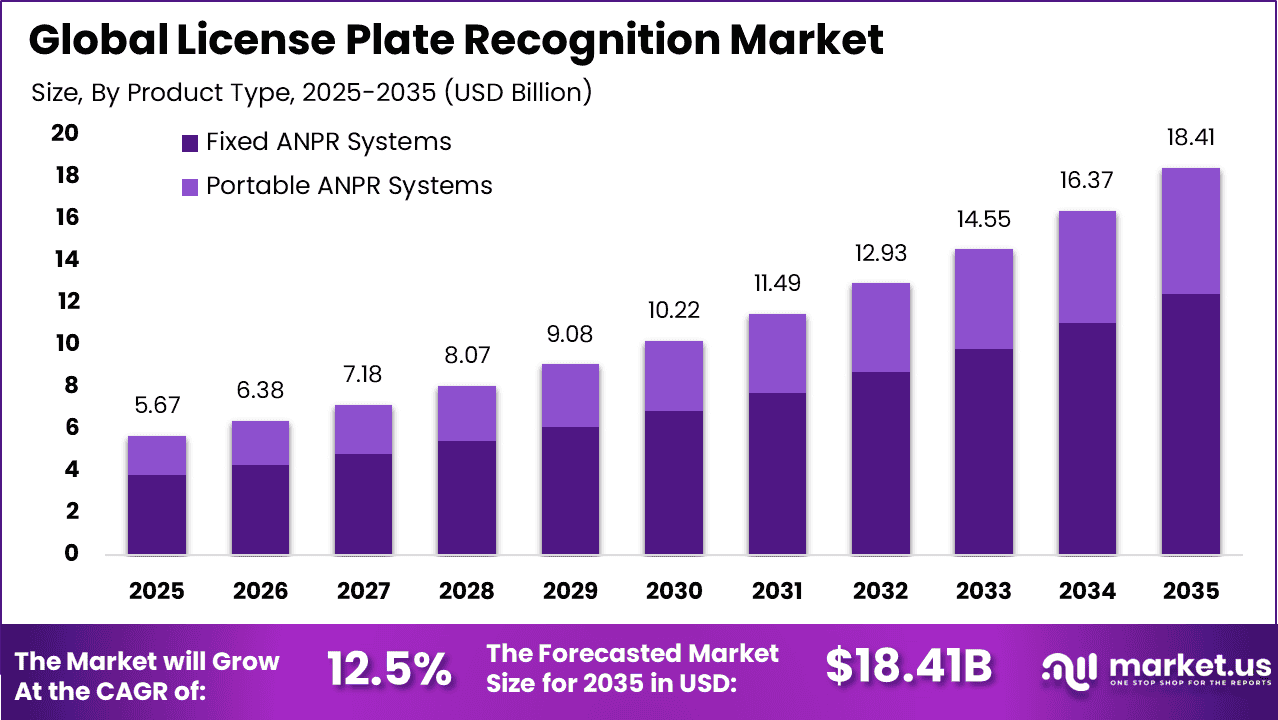
The Global License Plate Recognition Market size is expected to be worth around USD 18.41 billion by 2035, from USD 5.67 billion in 2025, growing at a CAGR of 12.5% during the forecast period from 2025 to 2035. North America held a dominant market position, capturing more than a 39.2% share, holding USD 2.22 billion in revenue.
The License Plate Recognition (LPR) market refers to the global industry of technologies, systems, and services that automatically detect and read vehicle license plates using cameras and software. LPR systems employ optical character recognition and advanced image processing to convert plate images into digital data that can be analysed in real time. These systems are widely used in traffic management, law enforcement, parking access control, tolling operations, and security monitoring to automate vehicle identification and enhance operational efficiency.
The integration of LPR capabilities into intelligent transportation systems and urban infrastructure is driving broader awareness and deployment across both public and private sectors. Rising traffic pressure and growing vehicle volumes are increasing the need for LPR systems across cities. Nearly 70% of large cities face daily congestion, which delays emergency response and disrupts road movement. At the same time, theft and vehicle-related crime support adoption, as LPR identifies stolen vehicles quickly. Governments also value their role in reducing road violations by 40%.
Top driving factors for the LPR market include the increasing need for efficient traffic management, growing public safety concerns, and expanding smart city initiatives. Rapid urbanisation and rising vehicle density have increased demand for systems that can automate and improve the monitoring of vehicle movements and enforce regulations with precision. Adoption of advanced imaging technologies, artificial intelligence, and machine learning has further enhanced the reliability and accuracy of LPR solutions, making them more attractive for applications that require real‑time decision making.
Public safety priorities and the need to detect and deter vehicle‑related crime have also contributed to accelerating market momentum. Demand is rising as cities deal with parking shortages and toll congestion. In crowded urban areas, more than 60% of drivers spend extra time searching for parking, increasing fuel use and frustration. LPR improves this by detecting availability and speeding vehicle access. Police agencies also benefit, with some regions reporting 50% faster progress in solving hit and run incidents.
For instance, in July 2025, Vaxtor launched a cloud‑connected LPR analytics platform tailored for logistics yards and gated facilities, bringing its OCR engine closer to edge devices. The platform automates vehicle logging and freight‑tracking at border crossings and warehouse gates, helping North American operators cut manual paperwork and speed up gate‑throughput times.
Key Takeaway
- Fixed ANPR systems accounted for 67.4% of the market, driven by their efficiency in high-traffic environments.
- Hardware dominated the components segment with a 54.6% share, reflecting its critical role in system functionality.
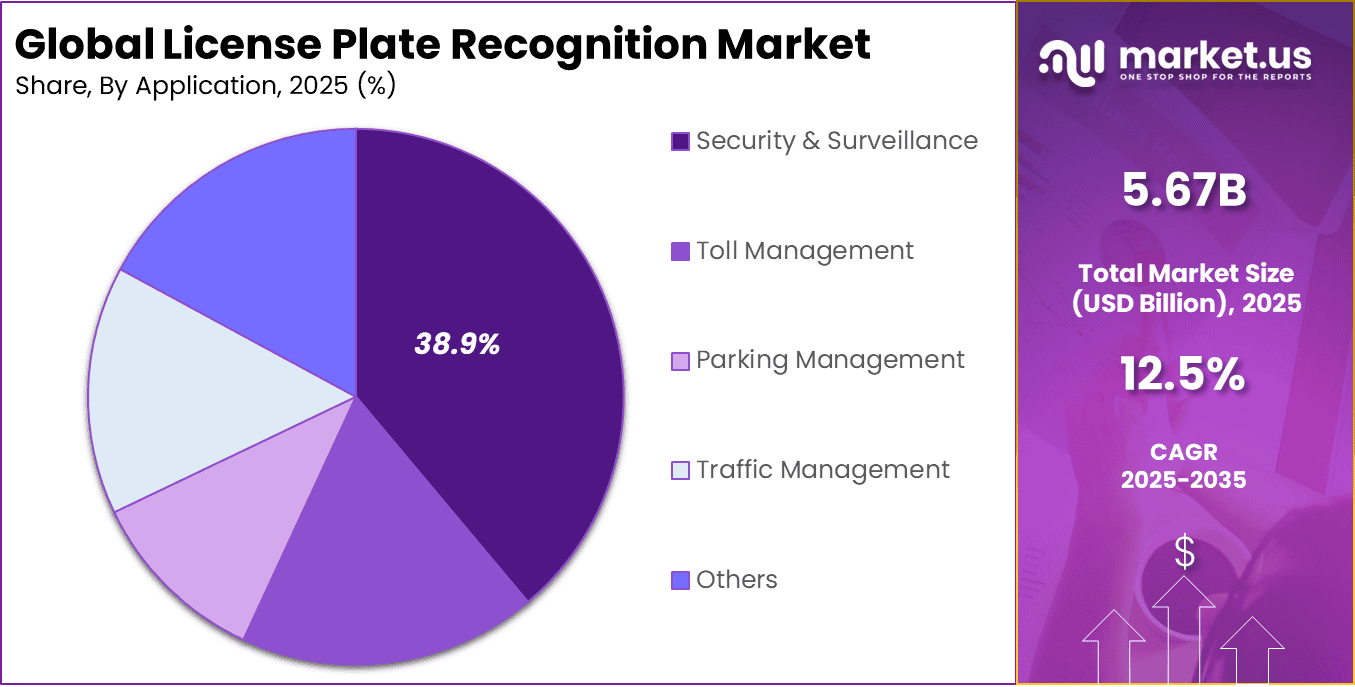
- Security & surveillance led applications with 38.9%, emphasizing its importance in law enforcement and safety monitoring.
- Commercial end-use was the largest segment, holding 67.3% share due to widespread adoption in parking, tolling, and logistics.
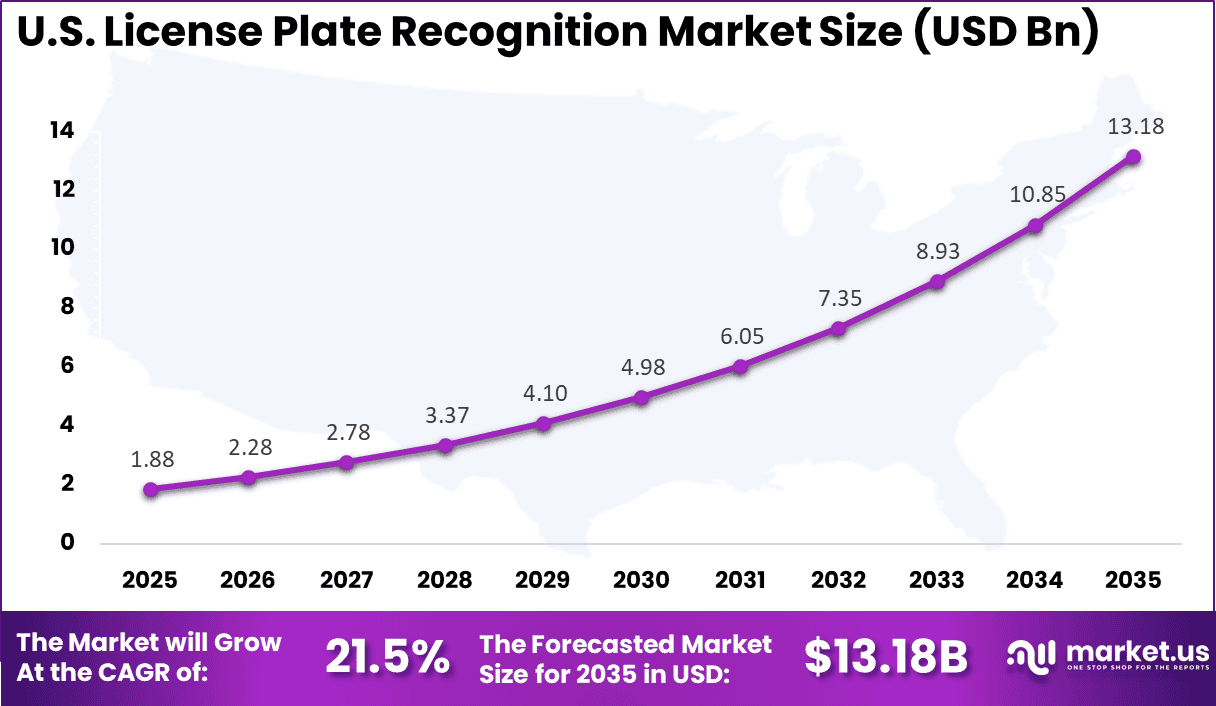
- Regionally, North America captured 39.2% of the market, with the U.S. valued at USD 1.88 billion and a 21.5% CAGR.
Type Analysis
In 2025, The Fixed ANPR Systems segment held a dominant market position, capturing a 67.4% share of the Global License Plate Recognition Market. This dominance is due to the strong need for continuous vehicle monitoring at roads, toll lanes, parking gates, and sensitive public locations. Fixed ANPR systems offer dependable image capture from a stable position, which helps improve reading quality. Their permanent setup also supports round-the-clock operation with fewer interruptions.
Fixed systems also fit well into broader traffic and security networks, making them easier to manage over time. Public authorities and private operators prefer them for sites where regular monitoring matters most. Their ability to support enforcement, access control, and surveillance in one setup strengthens their position in daily operations.
For Instance, in October 2025, Adaptive Recognition enhanced its fixed ANPR software to cover more regional plates without hardware swaps. The tweak sharpens reads in tough lighting at tolls and parking gates, easing upgrades for existing pole-mounted cameras. Operators now get faster processing for high-traffic zones, keeping systems reliable day and night. This keeps fixed types ahead in busy urban flows.
Component Analysis
In 2025, the Hardware segment held a dominant market position, capturing a 54.6% share of the Global License Plate Recognition Market. This dominance is due to the central role of cameras, sensors, and processing devices in capturing and reading license plates correctly. Without strong hardware, even advanced software cannot perform well in low light, fast movement, or poor weather. Reliable physical equipment remains the base for overall system performance.
Buyers also focus on hardware because it directly affects image clarity, recognition consistency, and system lifespan. Improved camera resolution and better infrared support have made modern setups more dependable. As users expect accurate plate capture in real conditions, investment continues to center on durable and efficient hardware solutions.
For instance, in March 2025, Axis Communications launched rugged cameras and processors built for harsh road conditions. These hardware pieces grab clear plate images even at speed or in rain, powering core recognition without lags. The design cuts setup costs for edge deployments, drawing users who need tough gear upfront. It strengthens hardware’s role in real-world reliability.
Application Analysis
In 2025, The Security & Surveillance segment held a dominant market position, capturing a 38.9% share of the Global License Plate Recognition Market. This dominance is due to the rising need to track vehicle movement, prevent unauthorized access, and support public safety efforts. Security and surveillance remain the most practical use cases because plate recognition helps identify suspicious vehicles quickly. It allows faster response across locations where manual checking is often too slow.
Many agencies and facility operators use these systems to strengthen monitoring without depending heavily on manpower. They help create searchable vehicle records, improve investigation support, and raise control over entry points. As safety concerns remain important across cities and restricted zones, this application continues to hold strong market relevance.
For Instance, in June 2025, Genetec updated its platform with deeper ANPR ties for surveillance feeds, linking plates to real-time alerts at public sites. This lets teams track vehicles across cameras without extra staff, boosting response in crowds or borders. The open setup pulls in third-party tools, making security scans sharper and more connected.
End Use Analysis
In 2025, The Commercial segment held a dominant market position, capturing a 67.3% share of the Global License Plate Recognition Market. This dominance is due to the growing use of plate recognition in offices, malls, warehouses, residential complexes, and private parking areas. Commercial users value faster vehicle entry, reduced waiting time, and better control over who enters the premises. These systems also help improve convenience while lowering dependence on manual supervision.
Commercial sites adopt license plate recognition because it supports both efficiency and security in everyday operations. Businesses want smoother traffic flow, easier visitor management, and better protection of property. As customer experience becomes more important, automated vehicle identification offers a practical solution that matches modern commercial infrastructure needs.
For Instance, in September 2025, Tattile rolled out ANPR kits for commercial parking and fleet yards, automating entry with plate scans. Businesses use it for cashless payments and truck logs, slashing wait times at warehouses. The simple install wins over retail and logistics ops looking for daily efficiency boosts without big overhauls.
U.S. License Plate Recognition Market Size
The market for License Plate Recognition within the U.S. is growing tremendously and is currently valued at USD 1.88 billion; the market has a projected CAGR of 21.5%. The market is growing due to rising traffic congestion, increasing vehicle ownership, and strong demand for automated enforcement systems across highways and cities. Law enforcement agencies widely deploy LPR for crime tracking and vehicle identification, while smart transportation programs and toll automation continue to expand adoption across public infrastructure.
For instance, in March 2026, Adaptive Recognition strengthened U.S. dominance in LPR technology from its Clearwater base, launching AI-enhanced cameras for real-time axle counting and free-flow tolling. These innovations boost smart city efficiency and public safety, solidifying North America’s lead in intelligent traffic management solutions.
In 2025, North America held a dominant market position in the Global License Plate Recognition Market, capturing more than a 39.2% share, holding USD 2.22 billion in revenue. This dominance is due to strong investment in intelligent transportation systems and early adoption of automated enforcement tools across cities and highways.
High vehicle density and strict law enforcement practices increase the need for efficient monitoring solutions. Advanced infrastructure, widespread use of digital tolling, and focus on public safety further support the continuous deployment of LPR systems across the region.
For instance, in March 2026, Leonardo US bolstered North America’s LPR supremacy through integrated cybersecurity solutions for border control and urban monitoring. Their advanced recognition systems support nationwide law enforcement networks, maintaining U.S. leadership in scalable, secure plate recognition deployments.

Emerging Trend Analysis
Integration with Intelligent Transportation and Urban Systems
A key emerging trend in the license plate recognition market is the deeper integration of LPR systems with broader intelligent transportation and smart city frameworks. License plate recognition is increasingly being deployed as a core component of traffic management systems, where real‑time vehicle data is used to optimize traffic flows and reduce congestion.
This shift reflects the growing emphasis on building connected urban infrastructures that can dynamically respond to changing traffic conditions and mobility demands. As digital networks and sensor technologies expand within cities, LPR systems are being merged with other detection technologies and analytics platforms to support more coordinated urban mobility solutions.
Advancements in artificial intelligence and machine learning are further enhancing this trend by enabling more accurate and context‑aware recognition capabilities. These technological improvements allow LPR solutions to better distinguish vehicle details under varied environmental conditions and integrate findings into centralized traffic control centers. The result is a more adaptive urban transport ecosystem that leverages vehicle recognition data not only for enforcement but also for optimizing route planning and safety measures.
Growth Factors
The growth of the license plate recognition market is strongly driven by the increasing demand for efficient traffic management and enhanced security solutions. Governments and municipal authorities are investing in systems that can automatically identify vehicles for applications such as toll collection, law enforcement, and secure access control. This demand is heightened by urbanization trends that have increased traffic volumes and the need to monitor vehicle movement more effectively.
Enhanced surveillance capabilities are also motivating adoption, as LPR systems allow authorities to quickly match plates against databases of vehicles of interest and improve response times in emergency situations. Private sector use has grown in sectors such as commercial parking and gated facilities, where automated access and billing processes are operational priorities. The dual focus on safety and operational efficiency has placed LPR technology at the forefront of modern transportation and security strategies.
Key Market Segments
By Type
- Fixed ANPR Systems
- Portable ANPR Systems
By Component
- Hardware
- Software
- Service
By Application
- Security & Surveillance
- Toll Management
- Parking Management
- Traffic Management
- Others
By End Use
- Government
- Commercial
Key Regions and Countries
North America
- US
- Canada
Europe
- Germany
- France
- The UK
- Spain
- Italy
- Russia
- Netherlands
- Rest of Europe
Asia Pacific
- China
- Japan
- South Korea
- India
- Australia
- Singapore
- Thailand
- Vietnam
- Rest of APAC
Latin America
- Brazil
- Mexico
- Rest of Latin America
Middle East & Africa
- South Africa
- Saudi Arabia
- UAE
- Rest of MEA
Drivers
Growing demand for smarter traffic and security systems
Cities are under pressure to manage rising vehicle movement, road congestion, and security risks more effectively. License plate recognition helps authorities monitor traffic flow, identify vehicles quickly, and support faster responses. This makes it a useful solution for transport systems that need better control without adding large manual monitoring teams.
The technology also supports safer entry management in parking areas, gated sites, commercial buildings, and public facilities. Users want systems that can improve traffic handling while strengthening security at the same time. This dual benefit is helping license plate recognition gain stronger acceptance across both public and private environments.
For instance, in February 2025, Genetec rolled out its latest AutoVuSharpV camera line, built for steady spots like city gates and highways. This move speeds up vehicle checks at high-traffic zones, helping police and toll staff spot issues right away. It fits right into the need for quick, reliable tools that keep roads flowing without holdups, making urban life less stressful for drivers everywhere.
Restraint
Privacy and Data Concerns
Privacy concerns continue to slow wider adoption because vehicle monitoring creates questions about how collected information is stored and used. Many users worry about long term tracking and possible misuse of movement data. These concerns become stronger when systems are deployed in public places without clear communication or visible safeguards.
Regulatory pressure also adds complexity for system operators. They need to follow data protection rules, manage retention periods carefully, and show responsible handling of captured records. When trust is weak, projects may face resistance from communities and institutions, which can delay investment and reduce the pace of implementation.
For instance, in January 2025, Adaptive Recognition shared tips on handling tricky red plates at night, but stressed secure data wipes after scans. They faced pushback from groups worried about stored images tracking regular folks on routine trips. The firm now adds opt-in logs to build trust, showing how privacy talks slow big rollouts even for helpful tech.
Opportunities
Expansion in Smart Infrastructure
The spread of smart infrastructure is creating strong room for license plate recognition across transport, parking, and urban management systems. Cities are upgrading roads, tolling points, and access networks with digital tools that support automation. This creates a practical environment where vehicle recognition can deliver value across multiple daily operations.
The opportunity is also growing in airports, logistics hubs, residential complexes, and commercial zones that need better vehicle flow management. When connected with broader infrastructure systems, license plate recognition can improve coordination and reduce manual work. This makes it a strong fit for locations moving toward more connected and efficient operations.
For instance, in September 2025, Axis Communications launched a unified setup blending plate recognition with door controls for new city networks. It plugs into traffic lights and signs for smooth flow, opening doors for widespread use in modern towns. Planners see it as a key piece for linked roads that cut jams and boost green travel.
Challenges
Accuracy in Complex Conditions
Maintaining accurate plate recognition in real world conditions remains a major challenge. Poor lighting, weather changes, and fast moving vehicles can reduce image clarity and affect system performance. Different plate formats and damaged or unclear plates also make recognition more difficult in many everyday situations.
Systems must balance speed and accuracy to deliver reliable results across environments. Any inconsistency can reduce confidence, especially in enforcement and security use cases. Improving performance in challenging conditions requires better algorithms and hardware support, which continues to be a key focus area for developers and system providers.
For instance, in January 2025, Adaptive Recognition tackled night reads on red plates with fresh camera tweaks after tests showed raindrops. Fast cars and dirt still caused skips, so they boosted software for shaky feeds. Field trials proved gains, but real streets keep testing limits in bad light or mud.
Key Players Analysis
In the License Plate Recognition (LPR) market, Adaptive Recognition Inc. and Axis Communications AB are key players, offering advanced solutions for vehicle identification and security. These companies are known for their high-performance recognition technology, used widely in parking management, law enforcement, and tolling systems. Genetec Inc. and Kapsch TrafficCom AG are also prominent, providing scalable and reliable LPR systems that integrate with broader traffic management and security solutions.
Robert Bosch GmbH and Leonardo US Cyber and Security Solutions, LLC contribute significantly with their innovative approaches to LPR, combining robust hardware with intelligent software for real-time vehicle tracking. Their solutions are particularly useful for smart city applications, enhancing public safety and traffic monitoring. Tattile s.r.l. and Siemens AG also offer cutting-edge LPR technologies, ensuring seamless automation and enhanced security for urban infrastructure.
Vaxtor Ltd. and NDI Recognition System further enrich the market with their specialized LPR solutions, tailored to meet the growing demand for efficient, high-accuracy vehicle recognition. Their systems are widely used in various sectors such as security, tolling, and fleet management. These leading players, along with other emerging companies, are shaping the future of the LPR market by improving detection capabilities and expanding their market reach.
Top Key Players in the Market
- Adaptive Recognition Inc.
- Axis Communications AB
- Genetec Inc.
- Kapsch TrafficCom AG
- Robert Bosch GmbH
- Leonardo US Cyber and Security Solutions, LLC
- Tattile s.r.l.
- Siemens AG
- Vaxtor Ltd
- NDI Recognition System
- Others
Recent Developments
- In January 2026, Adaptive Recognition Inc. unveiled its ALPR SDK at CES 2026, showcasing edge AI that reads plates, identifies states, and recognizes vehicle make/model/color in real-time. This embedded vision breakthrough targets intelligent transportation systems, giving North American municipalities powerful tools for traffic enforcement.
- In November 2025, Siemens AG integrated license plate recognition into its Mobility-as-a-Service platform, enabling frictionless parking payments in 15 major U.S. cities. The system combines Bosch cameras with Siemens cloud analytics, processing 500,000 daily transactions with end-to-end encryption.
Report Scope
| Report Features | Description |
|---|---|
| Market Value (2025) | USD 5.6 Bn |
| Forecast Revenue (2035) | USD 18.4 Bn |
| CAGR (2026-2035) | 12.5% |
| Base Year for Estimation | 2025 |
| Historic Period | 2020-2024 |
| Forecast Period | 2026-2035 |
| Report Coverage | Revenue forecast, AI impact on Market trends, Share Insights, Company ranking, competitive landscape, Recent Developments, Market Dynamics and Emerging Trends |
| Segments Covered | By Type (Fixed ANPR Systems, Portable ANPR Systems), By Component (Hardware, Software, Service), By Application (Security & Surveillance, Toll Management, Parking Management, Traffic Management, Others), By End Use (Government, Commercial) |
| Regional Analysis | North America – US, Canada; Europe – Germany, France, The UK, Spain, Italy, Russia, Netherlands, Rest of Europe; Asia Pacific – China, Japan, South Korea, India, New Zealand, Singapore, Thailand, Vietnam, Rest of Latin America; Latin America – Brazil, Mexico, Rest of Latin America; Middle East & Africa – South Africa, Saudi Arabia, UAE, Rest of MEA |
| Competitive Landscape | Adaptive Recognition Inc., Axis Communications AB, Genetec Inc., Kapsch TrafficCom AG, Robert Bosch GmbH, Leonardo US Cyber and Security Solutions, LLC, Tattile s.r.l., Siemens AG, Vaxtor Ltd, NDI Recognition System, Others |
| Customization Scope | Customization for segments, region/country-level will be provided. Moreover, additional customization can be done based on the requirements. |
| Purchase Options | We have three license to opt for: Single User License, Multi-User License (Up to 5 Users), Corporate Use License (Unlimited User and Printable PDF) |