


Report Overview
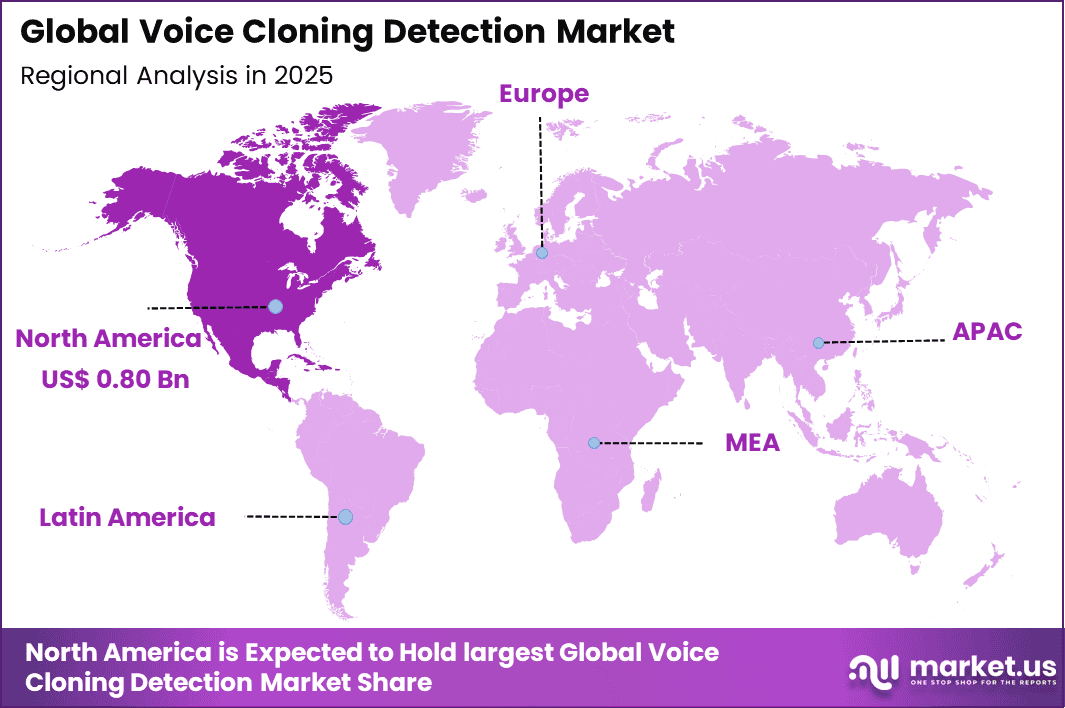
The Global Voice Cloning Detection Market generated USD 2.2 billion in 2025 and is predicted to register growth from USD 2.7 billion in 2026 to about USD 20.0 billion by 2035, recording a CAGR of 25.0% throughout the forecast span. In 2025, North America held a dominant market position, capturing more than a 37.3% share, with USD 0.80 billion in revenue.
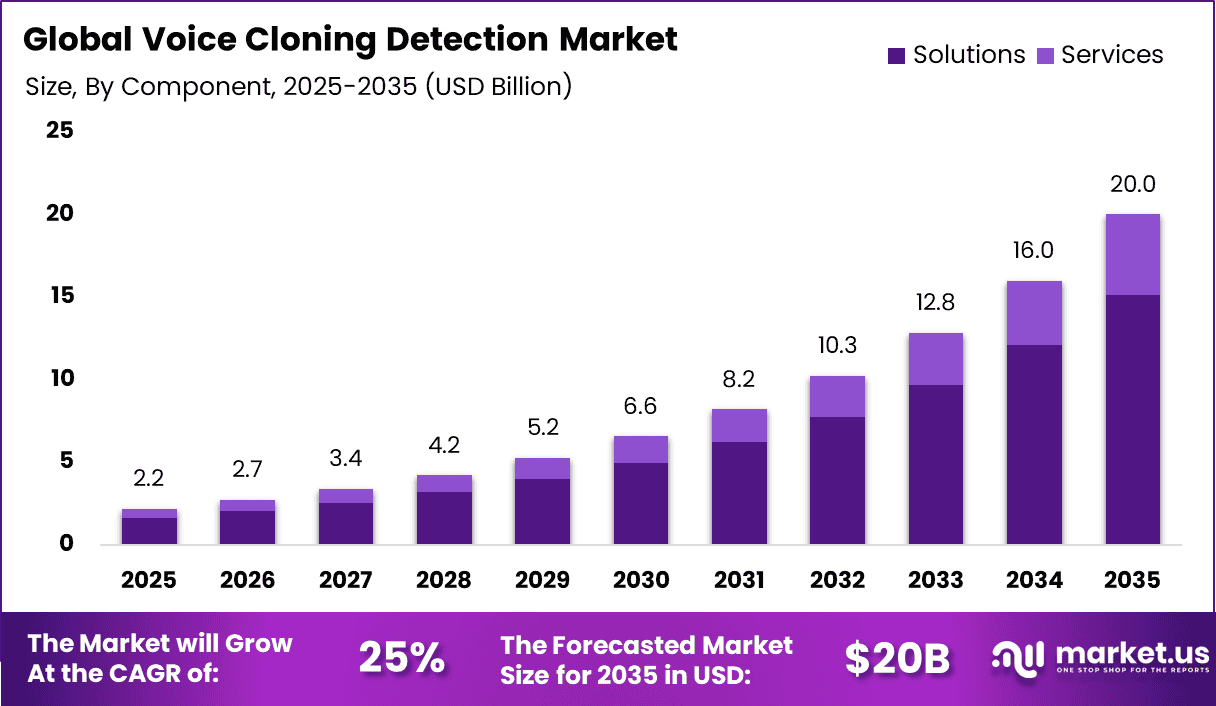
Voice Cloning Detection market refers to technologies that help identify whether a voice recording or live audio is genuine or artificially generated. These solutions are becoming important as synthetic voice tools improve and become easier to access. Businesses, media platforms, financial institutions, and public agencies are showing interest in these systems because fake voice content can create trust issues, security risks, and financial losses.
Demand for voice cloning detection is rising as enterprises look for practical tools to reduce fraud risk and improve trust in digital communication. Large organizations are adopting these solutions to strengthen call security, identity checks, and content screening. Demand is also increasing among online platforms and public sector users as they work to identify fake audio faster and protect users from deceptive voice-based activity.
Top Market Takeaways
- By Component, solutions dominate with a 75.6% share, delivering spectral forensics, voiceprint authentication, and real-time synthetic speech classifiers.
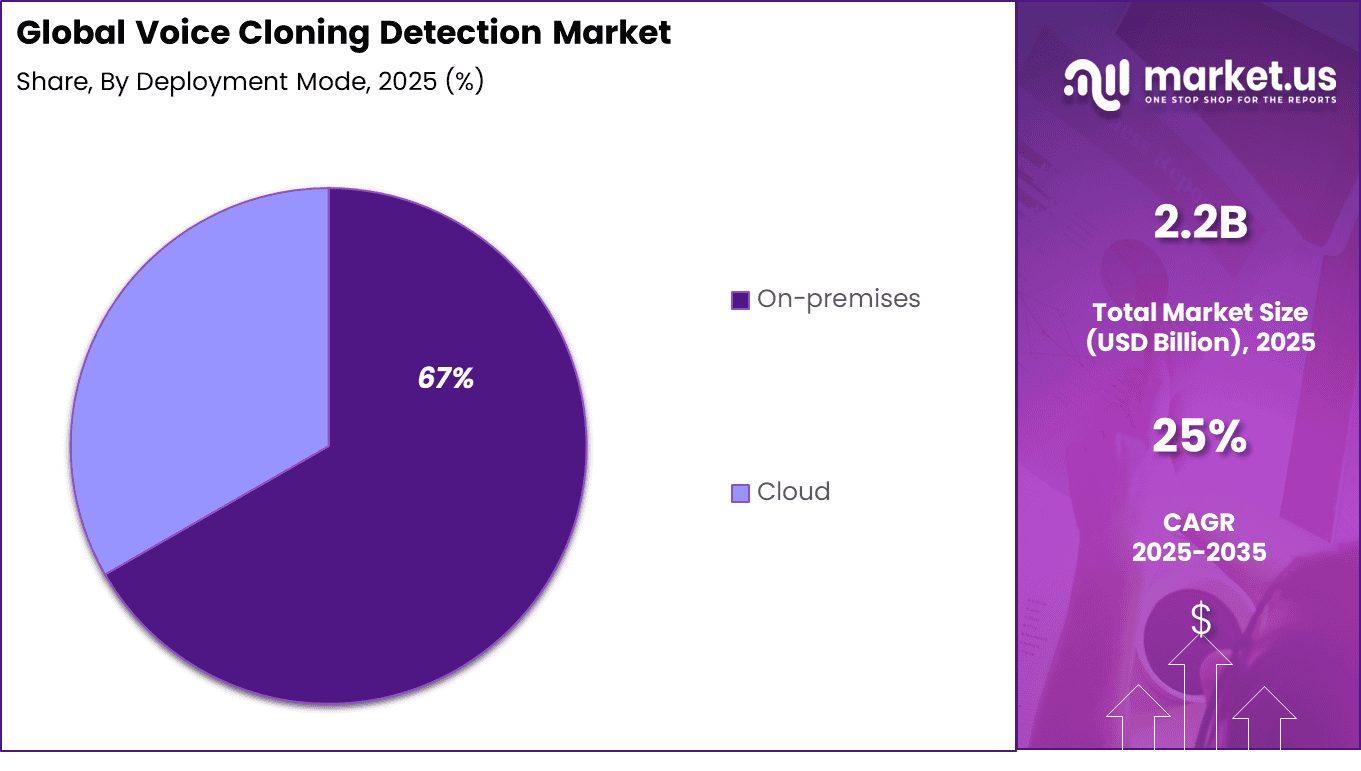
- By Deployment Mode, on-premises captures 66.7%, ensuring low-latency interception, air-gapped processing, and integration with core network elements.
- By End-Use, chatbots and assistants claim 40.2%, securing IVR systems, virtual agents, and conversational AI against impersonation attacks.
- By Application, telecom and tourism lead at 38.7%, protecting call center authentication, booking confirmations, and customer service interactions.
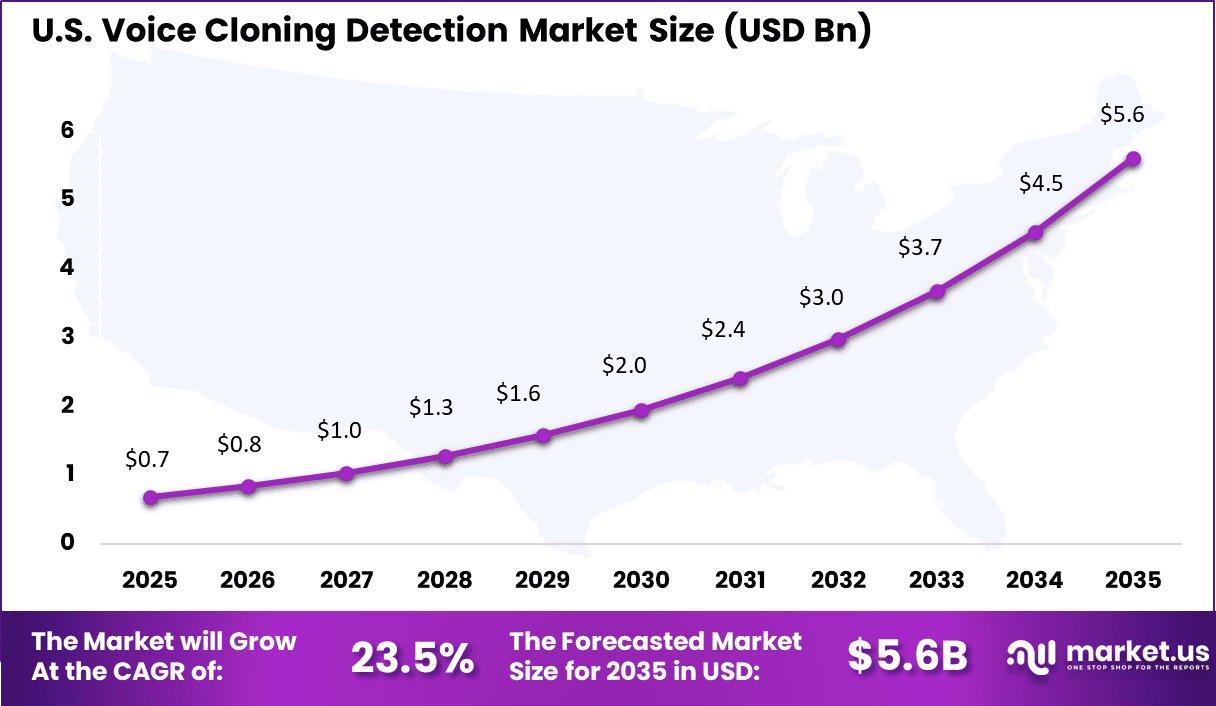
- Regionally, North America accounts for 37.3% global share, with the U.S. market valued at USD 0.68 billion and a CAGR of 23.5%, driven by FCC mandates and contact center security requirements.
By Component Analysis
Solutions accounted for 75.6% of the Voice Cloning Detection Market. This segment leads because enterprises and service providers need ready-to-deploy tools that can identify synthetic voice patterns, flag suspicious audio, and support faster fraud screening. Dedicated solutions give organizations a direct way to strengthen voice authentication and reduce misuse across customer interactions.
The segment also benefits from growing concern around deepfake audio in financial services, contact centers, and digital communication channels. Companies increasingly prefer complete detection platforms over fragmented tools because they offer better integration, faster deployment, and more reliable monitoring in real-time environments.
By Deployment Mode Analysis
On-premises deployment held 67% of the market. Many organizations handling sensitive voice data prefer on-premises systems because they offer greater control over security, storage, and compliance processes. This model is especially important in sectors where voice records contain confidential customer information and strict internal governance is required.
Its strong position is also linked to the need for low-latency processing and tighter control over detection workflows. Enterprises with established IT infrastructure often choose on-premises deployment to keep critical audio analysis within their own environment and reduce external data exposure risks.
By End Use Analysis
Chatbots and assistants represented 40.2% of the Voice Cloning Detection Market. This segment dominates because voice-enabled bots and virtual assistants are now widely used in customer service, banking support, travel assistance, and enterprise communication. As these systems become more common, the risk of synthetic voice misuse also increases, raising demand for reliable detection tools.
Organizations use voice cloning detection in this area to protect user trust and maintain the accuracy of automated interactions. Detection systems help distinguish genuine speech from manipulated audio, which is essential for voice-driven engagement platforms that depend on secure and credible communication.
By Application Analysis
Telecom and tourism accounted for 38.7% of the market. These industries manage high volumes of customer calls, bookings, service requests, and support interactions, which makes them more exposed to impersonation attempts and voice-based fraud. Detection tools help these sectors verify voice authenticity and reduce the risk of manipulated audio entering service channels.
The segment is also growing because both telecom and tourism depend heavily on fast and trusted customer communication. Any misuse of cloned voices can affect service quality, brand reputation, and customer confidence. This is encouraging companies in these fields to strengthen voice security measures across digital and call-based operations.
Key Market Segments
By Component
- Solutions
- Services
By Deployment Mode
- On-Premises
- Cloud
By End-Use
- Chatbot and Assistants
- Accessibility
- Digital Games
- Interactive Games
- Others
By Application
- Telecom and Tourism
- Education and Healthcare
- Media and Entertainment
- Healthcare and Life Sciences
- Banking, Financial Services, and Insurance (BFSI)
- Others
Regional Analysis
North America accounted for 37.3% of the Voice Cloning Detection Market, reflecting strong demand for technologies that identify synthetic or manipulated audio. Organizations across sectors such as banking, telecommunications, media, and public safety increasingly adopt voice authentication and verification tools to prevent fraud and identity misuse.
The growing use of AI-generated voice content in digital platforms has raised concerns about deepfake audio and impersonation attacks. As a result, companies across the region actively deploy advanced detection systems that analyze voice patterns, speech irregularities, and audio signatures to verify authenticity.
The United States generated about USD 0.68 Bn within the regional market and is projected to expand at a CAGR of 23.5%. Businesses in the country increasingly prioritize protection against voice-based fraud, particularly in customer service centers, financial transactions, and digital identity verification systems.
Rapid adoption of generative AI tools has increased the risk of voice impersonation, encouraging enterprises and government agencies to implement voice cloning detection solutions. As digital communication continues to expand across online platforms and remote services, demand for reliable audio verification technologies continues to strengthen across the US market.
Key Regions and Countries
- North America
- US
- Canada
- Europe
- Germany
- France
- The UK
- Spain
- Italy
- Russia
- Netherlands
- Rest of Europe
- Asia Pacific
- China
- Japan
- South Korea
- India
- Australia
- Singapore
- Thailand
- Vietnam
- Rest of APAC
- Latin America
- Brazil
- Mexico
- Rest of Latin America
- Middle East & Africa
- South Africa
- Saudi Arabia
- UAE
- Rest of MEA
Drivers Impact Analysis
| Key Driver | Impact on CAGR Forecast (~%) | Geographic Relevance | Impact Timeline | Strategic Effect |
|---|---|---|---|---|
| Rising deepfake audio fraud cases | +4.4% | North America, Europe, Asia Pacific | Short to Mid Term (2025–2031) | Increases demand for audio verification tools |
| Growing use of synthetic voice in scams and impersonation | +4.0% | US, UK, India, Southeast Asia | Short to Mid Term (2025–2030) | Pushes faster enterprise and consumer adoption |
| Stronger regulatory and compliance focus on digital identity | +3.6% | North America, Europe | Mid to Long Term (2026–2035) | Supports deployment in high-risk sectors |
| Rising adoption in banking, telecom, and media | +3.2% | Global | Mid Term (2026–2032) | Expands use across fraud prevention workflows |
| Growth in AI-driven cybersecurity spending | +2.8% | US, Europe, Japan | Mid to Long Term (2026–2035) | Improves budget support for detection platforms |
Key Restraints
| Key Restraint | Impact on CAGR Forecast (~%) | Geographic Relevance | Impact Timeline | Strategic Effect |
|---|---|---|---|---|
| Rapid improvement in voice cloning quality | -2.8% | Global | Short to Mid Term (2025–2031) | Makes detection more complex |
| Limited availability of diverse training datasets | -2.3% | Global | Mid Term (2026–2032) | Reduces model reliability across accents |
| Integration gaps with legacy security systems | -2.0% | North America, Europe | Mid Term (2026–2032) | Slows enterprise rollout |
| False positives in real-world verification | -2.2% | Global | Short to Mid Term (2025–2030) | Weakens trust in automated screening |
| Privacy and consent concerns in voice analysis | -1.9% | Europe, North America | Mid to Long Term (2026–2035) | Limits adoption in regulated sectors |
Investor Type Impact Analysis
| Investor Type | Growth Sensitivity | Risk Exposure | Geographic Focus | Investment Outlook |
|---|---|---|---|---|
| Venture Capital Firms | Very High | High | US, Europe, Israel | Strong deepfake security opportunity |
| Private Equity Firms | High | Medium | North America, Europe | Good cybersecurity platform play |
| Strategic Technology Investors | Very High | Medium | US, Japan, South Korea | Supports identity security expansion |
| Corporate Venture Arms | High | Medium | Global | Useful for product synergy |
| Government and Innovation Funds | Medium | Low to Medium | US, Europe, Asia Pacific | Selective support for trust tech |
Technology Enablement Analysis
| Technology Enabler | Impact on CAGR Forecast (~%) | Geographic Relevance | Impact Timeline | Implementation Significance |
|---|---|---|---|---|
| Deep learning-based audio forensics | +4.1% | North America, Europe, Asia Pacific | Mid Term (2026–2032) | Improves fake voice detection accuracy |
| Real-time speech pattern analysis | +3.7% | Global | Short to Mid Term (2025–2031) | Enables faster screening during calls |
| Biometric voice authentication integration | +3.3% | US, Europe, Japan | Mid to Long Term (2026–2035) | Strengthens identity verification workflows |
| Cloud-based fraud detection platforms | +2.9% | Global | Short to Mid Term (2025–2030) | Simplifies deployment across enterprises |
| NLP and acoustic anomaly detection | +2.6% | North America, Europe | Mid Term (2026–2032) | Enhances contextual risk detection |
Key Challenges
- Detecting cloned voices accurately is difficult because fake audio tools are improving quickly and can copy tone, pitch, and speaking style very closely.
- Many detection systems struggle when the audio is short, noisy, compressed, or mixed with background sounds, which lowers detection quality.
- The market faces a data challenge because high-quality and diverse voice deepfake samples are still limited for training and testing detection models.
- Integration is another challenge, as organizations need voice cloning detection tools to work smoothly with call centers, banking systems, media platforms, and security workflows.
- False alarms and missed detections remain a major concern because they can either block real users or allow fake voices to pass through the system.
Emerging Trends
A key trend in the Voice Cloning Detection market is the growing development of advanced audio verification technologies that identify synthetic or manipulated speech. As voice generation tools become more realistic, organizations increasingly focus on systems that analyze speech patterns, tone variations, and acoustic signatures to verify authenticity.
These solutions are gradually being incorporated into communication platforms, digital media monitoring, and identity verification processes to help detect artificial voice recordings and reduce the risk of audio-based impersonation.
Growth Factors
The increasing use of voice-driven services across customer support, digital transactions, and remote communication environments is strengthening demand for voice cloning detection solutions. Organizations rely heavily on voice interactions for authentication and service delivery, which raises concerns about fraudulent audio manipulation.
Detection technologies help verify the authenticity of spoken communication and support safer digital interactions. Growing awareness about misinformation and impersonation risks in voice content also encourages institutions to adopt systems that ensure the credibility of audio communication.
Competitive Analysis
The competitive landscape of the Voice Cloning Detection market includes large technology companies and speech solution providers that work across AI, cloud, and voice processing systems. Microsoft, IBM, and Amazon Web Services, Inc. have a strong position because they offer advanced AI infrastructure, speech analytics, and security capabilities that support voice authentication and synthetic speech detection.
Companies such as iSpeech, Inc., ReadSpeaker B.V., CereProc Ltd, Cepstral, Descript, Kata.ai, ALT Creative, Inc., Aristech GmbH, Acapela Group, VocaliD, Inc., CandyVoice, LumenVox, Smartbox Assistive Technology, and Vivotex India Pvt. Ltd. add competition through specialized speech technologies and voice solutions.
These players focus on areas such as voice synthesis, speech recognition, assistive communication, and audio analysis, which support the development of more accurate voice cloning detection systems. Together, these companies create a market shaped by innovation, accuracy, and growing demand for voice security.
Top Key Players in the Market
- Microsoft
- IBM
- Amazon Web Services, Inc.
- iSpeech, Inc.
- ReadSpeaker B.V.
- CereProc Ltd
- Cepstral
- Descript
- Kata.ai
- ALT Creative, Inc.
- Aristech GmbH
- Acapela Group
- VocaliD, Inc.
- CandyVoice
- LumenVox
- Smartbox Assistive Technology
- Vivotex India Pvt. Ltd.
- Others
Future Outlook
The future outlook for the Voice Cloning Detection Market looks promising as concerns about deepfake audio, fraud, and digital identity misuse continue to grow. Businesses, media platforms, financial institutions, and government agencies are expected to invest more in detection tools that can identify synthetic voices and protect trust in digital communication. As voice cloning technology becomes more advanced and widely available, demand for reliable detection solutions is likely to increase steadily across security, compliance, and content verification applications.
Recent Developments
- In December 2025, Reality Defender announced a strategic partnership to integrate its real-time deepfake detection (including cloned voice signals) into 1Kosmos’ blockchain‑based biometric authentication platform, expanding its role in identity and fraud prevention.
- In December 2025, Resemble AI raised 13 million dollars in strategic funding to accelerate development of its voice generation and deepfake detection products, explicitly targeting synthetic and cloned voice abuse scenarios
Report Scope
| Report Features | Description |
|---|---|
| Market Value (2025) | USD 2.2 Billion |
| Forecast Revenue (2035) | USD 20.0 Billion |
| CAGR(2025-2035) | 25.0% |
| Base Year for Estimation | 2024 |
| Historic Period | 2020-2024 |
| Forecast Period | 2025-2035 |
| Report Coverage | Revenue forecast, AI impact on Market trends, Share Insights, Company ranking, competitive landscape, Recent Developments, Market Dynamics and Emerging Trends |
| Segments Covered | By Component (Solutions, Services), By Deployment Mode (On-Premises, Cloud), By End-Use (Chatbot and Assistants, Accessibility, Digital Games, Interactive Games, Others), By Application (Telecom and Tourism, Education and Healthcare, Media and Entertainment, Healthcare and Life Sciences, Banking, Financial Services, and Insurance (BFSI), Others) |
| Regional Analysis | North America – US, Canada; Europe – Germany, France, The UK, Spain, Italy, Russia, Netherlands, Rest of Europe; Asia Pacific – China, Japan, South Korea, India, New Zealand, Singapore, Thailand, Vietnam, Rest of Latin America; Latin America – Brazil, Mexico, Rest of Latin America; Middle East & Africa – South Africa, Saudi Arabia, UAE, Rest of MEA |
| Competitive Landscape | Microsoft, IBM, Amazon Web Services, Inc., iSpeech, Inc., ReadSpeaker B.V., CereProc Ltd, Cepstral, Descript, Kata.ai, ALT Creative, Inc., Aristech GmbH, Acapela Group, VocaliD, Inc., CandyVoice, LumenVox, Smartbox Assistive Technology, Vivotex India Pvt. Ltd., Others |
| Customization Scope | Customization for segments, region/country-level will be provided. Moreover, additional customization can be done based on the requirements. |
| Purchase Options | We have three licenses to opt for: Single User License, Multi-User License (Up to 5 Users), Corporate Use License (Unlimited Users and Printable PDF) |





































