Report Overview
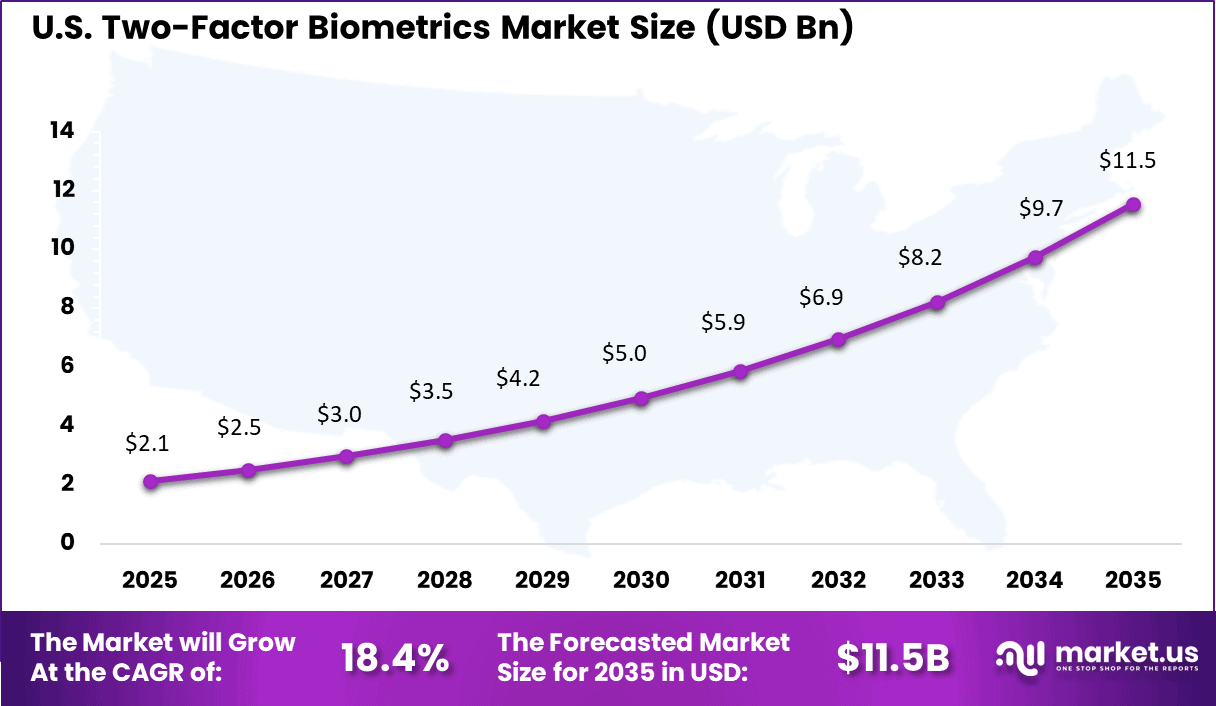
The Global Two-Factor Biometrics Market generated USD 7.2 billion in 2025 and is predicted to register growth from USD 8.9 billion in 2026 to about USD 59.8 billion by 2035, recording a CAGR of 23.5% throughout the forecast span. In 2025, North America held a dominant market position, capturing more than a 33.9% share, holding USD 2.45 billion in revenue.
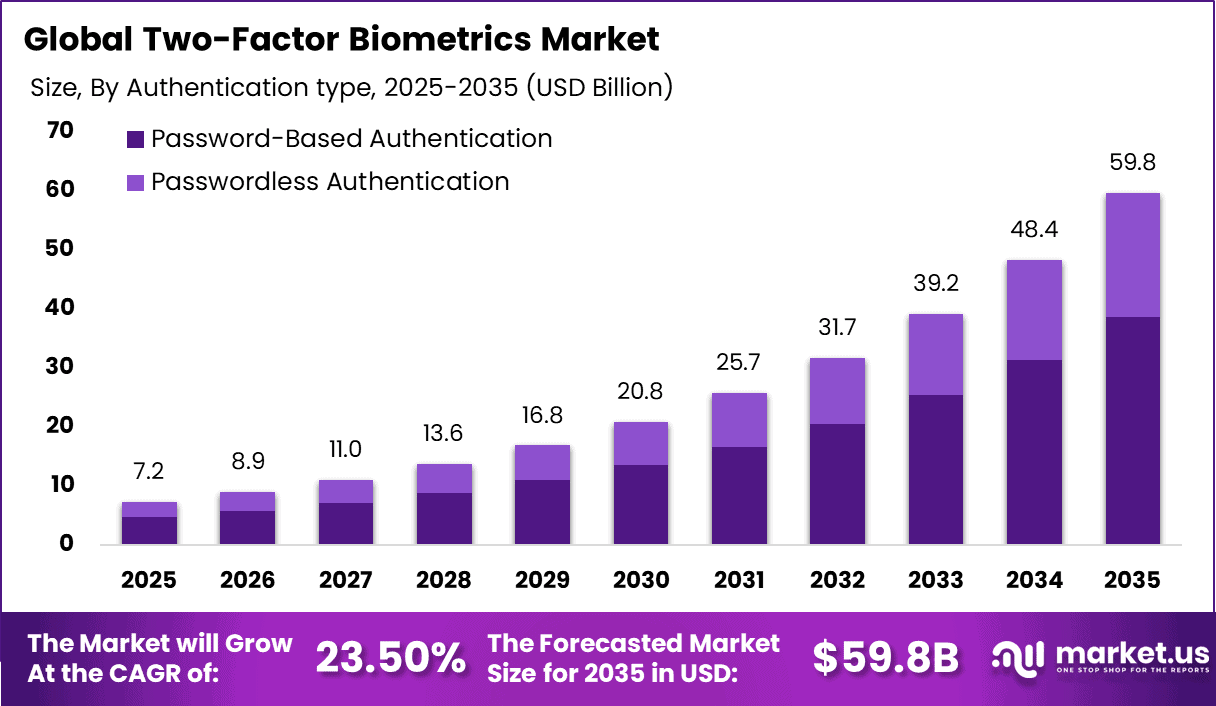
The two-factor biometrics market refers to identity verification systems that require two separate biological traits or a combination of a biometric trait and another verification method to confirm a person’s identity. Examples include fingerprint plus facial recognition, or a biometric scan combined with a PIN or access card. These systems strengthen security by requiring more than one verification step before granting access to devices, systems, or physical locations.
The main driving factors for the two-factor biometrics market are rising concerns about security and the limits of single-factor authentication. Traditional methods such as passwords and PINs are vulnerable to theft, guessing, and reuse across systems. Single biometric factors such as fingerprints or facial images can also be spoofed in some cases.
Top Market Takeaways
- By authentication type, password‑based authentication accounts for 64.8% of the market, making it the dominant method in two‑factor biometric systems.
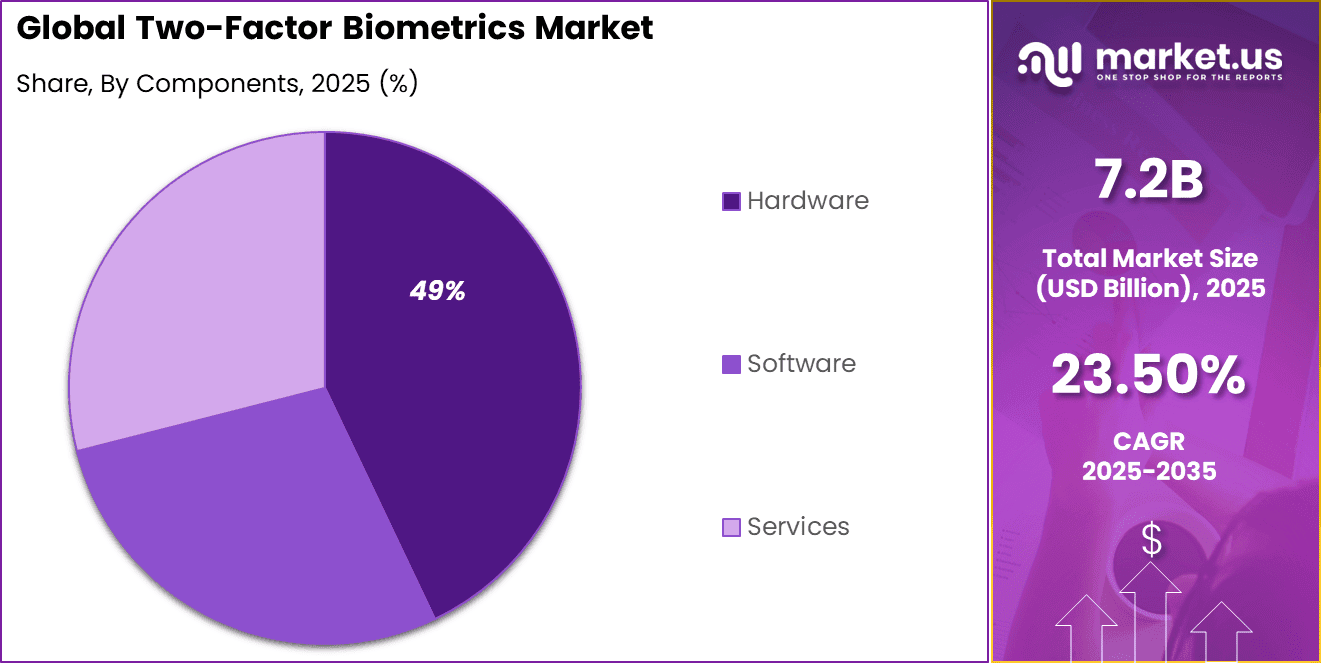
- By components, hardware represents 48.9% of the market, highlighting the central role of physical biometric devices such as fingerprint scanners, facial recognition cameras, and iris readers.
- By end‑user industry, banks, financial services, and insurance (BFSI) hold a 38.6% share, reflecting extensive adoption of two‑factor biometrics for secure transactions, customer onboarding, and fraud prevention.
- North America captures 33.9% of the global market, with the U.S. valued at USD 2.13 billion and projected to grow at a CAGR of 18.4%, driven by regulatory requirements, digital banking, and cybersecurity investments.
Authentication Type Analysis
Password-based authentication combined with biometric verification accounts for 64.8% of the Two-Factor Biometrics market, showing that passwords remain a widely used first authentication layer. In this model, users enter a password and then complete a biometric check such as fingerprint or facial recognition.
From a practical standpoint, password-based two-factor biometrics offers a balance between usability and protection. It reduces the risk of unauthorized access caused by stolen or weak passwords. The strong share of this segment reflects gradual security upgrades where organizations strengthen existing authentication methods rather than replacing them completely.
Component Analysis
Hardware accounts for 48.9% of the Two-Factor Biometrics market, highlighting the importance of physical biometric devices. This hardware includes fingerprint scanners, facial recognition cameras, iris scanners, and secure authentication modules. Reliable hardware is required to capture biometric data accurately and ensure fast authentication during login or transaction approval.
From an operational view, hardware-based biometric components improve authentication accuracy and reduce fraud risk. These devices are deployed across offices, branches, and customer access points. The strong presence of this segment reflects continued reliance on physical biometric equipment to support secure two-factor authentication systems.
End-User Industry Analysis
The BFSI sector represents 38.6% of end-user adoption, making it the largest industry segment in the market. Financial institutions manage sensitive customer data and high-value transactions, which require strong authentication controls. Two-factor biometrics help banks prevent account takeovers and unauthorized access. Secure authentication also supports regulatory compliance.
From a business perspective, biometric-based authentication improves customer trust and reduces fraud-related losses. Banks deploy these systems across digital banking, branch access, and transaction approval processes. The strong share of this segment reflects the BFSI sector’s focus on security, accuracy, and risk management.
Key Market Segments
By Authentication Type
- Password-Based Authentication
- Passwordless Authentication
By Components
- Hardware
- Software
- Services
By End-user Industry
- Banks, Financial Services and Insurance
- Government
- Defense Services
- Consumer Electronics
- Healthcare
- Commercial Safety and Security
- Transport/Visa/Logistics
- Others
Regional Analysis
North America accounted for a 33.9% share, supported by strong adoption of advanced identity security solutions across enterprises, government agencies, and financial institutions. Two-factor biometrics has been increasingly used to combine biometric identifiers with an additional authentication factor to enhance access security.
Demand has been driven by rising cyber threats, stricter compliance requirements, and widespread digital transformation across sectors. The region’s mature cybersecurity ecosystem and high awareness of identity protection have reinforced steady adoption.
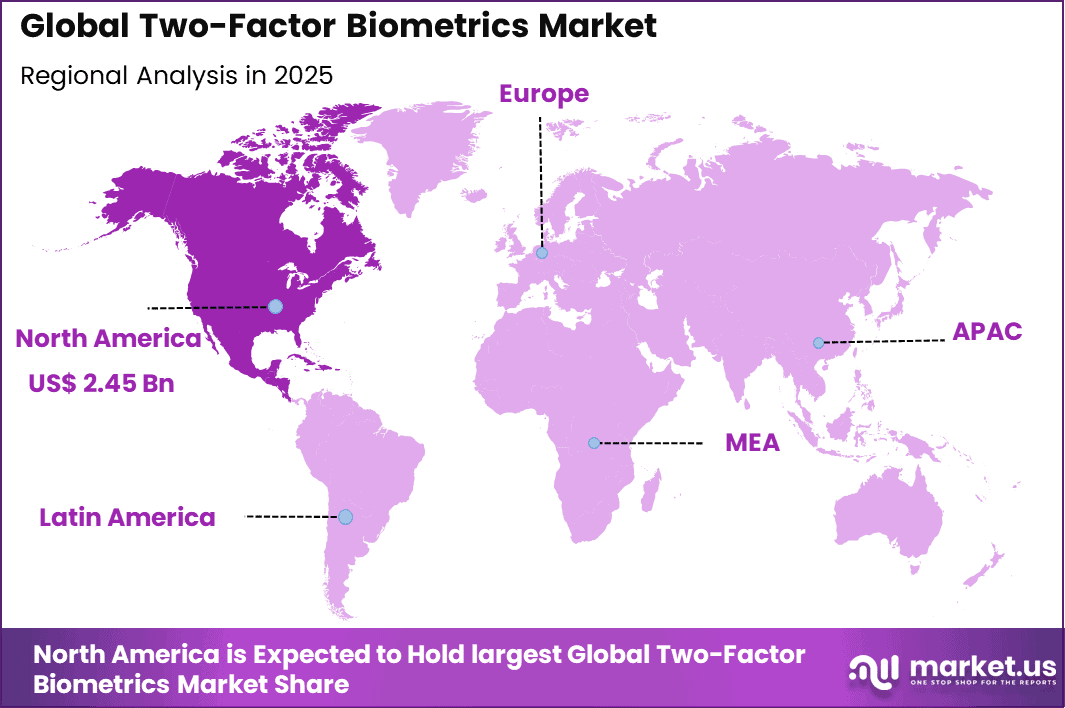
The U.S. market reached USD 2.13 Bn and is projected to grow at an 18.4% CAGR, reflecting strong investment in secure authentication technologies. Adoption has been driven by the need to protect sensitive data, prevent identity fraud, and secure digital transactions. Two-factor biometric solutions have helped U.S. organizations reduce unauthorized access while maintaining efficient user authentication.
Key Regions and Countries
- North America
- US
- Canada
- Europe
- Germany
- France
- The UK
- Spain
- Italy
- Russia
- Netherlands
- Rest of Europe
- Asia Pacific
- China
- Japan
- South Korea
- India
- Australia
- Singapore
- Thailand
- Vietnam
- Rest of APAC
- Latin America
- Brazil
- Mexico
- Rest of Latin America
- Middle East & Africa
- South Africa
- Saudi Arabia
- UAE
- Rest of MEA
Key Reasons for Adoption
- Security risks are increasing with single-factor authentication methods
- Identity fraud incidents are rising across digital and physical systems
- Organizations need stronger access control for sensitive data and systems
- Regulatory requirements are pushing for multi-layer authentication
- User trust depends on secure and reliable identity verification
Benefits
- Authentication security is strengthened through layered biometric verification
- Unauthorized access risk is significantly reduced
- User confidence is improved with stronger identity protection
- Compliance readiness is enhanced for regulated environments
- Access control reliability is improved across platforms
Usage
- Used in enterprise systems for secure employee access
- Applied in banking and financial services for customer authentication
- Deployed in government services for identity verification
- Utilized in healthcare systems to protect patient data
- Integrated into digital platforms for secure login and transaction approval
Emerging Trends
| Key Trend | Description |
|---|---|
| Multimodal biometric fusion | Combining fingerprint, face, iris, or voice in a single flow strengthens identity assurance. |
| Biometric + device binding | Pairing biometrics with trusted devices or tokens enables step-up authentication. |
| Passwordless login adoption | Two-factor flows replace passwords with biometrics plus possession such as phones or security keys. |
| Continuous and behavioral biometrics | Ongoing monitoring of typing, gait, or mouse usage acts as a background second factor. |
| Edge AI biometric processing | Local matching on devices reduces latency and dependence on centralized servers. |
Growth Factors
| Key Factors | Description |
|---|---|
| Rising credential-theft attacks | Phishing and password reuse drive demand for stronger two-factor methods. |
| Regulatory pressure on strong customer authentication | Financial and data-protection rules require multi-factor security. |
| Expansion of digital banking and fintech | High-risk financial transactions need robust identity checks. |
| Remote work and zero-trust adoption | Distributed access to corporate resources requires resilient authentication. |
| User demand for convenience and security | Biometrics as a second factor balances ease of use with stronger protection. |
Market Dynamics
Driver Analysis - Growing Need for Strong Identity Protection
A clear driver of the two-factor biometrics market is the increasing demand for stronger identity protection as cyber threats rise. Organisations and service providers are moving beyond simple password or single biometric checks to require two independent factors of authentication, such as a password combined with a fingerprint or facial scan, to prevent unauthorised access and data breaches. This layered approach delivers more security assurance by requiring more than one proof of identity before access is granted, which is particularly important for sensitive systems and high-value transactions.
This driver is reinforced by the growing volume of online services and mobile transactions that need secure access control. As digital services spread into banking, enterprise systems, healthcare, and government platforms, organisations are compelled to adopt stronger authentication frameworks that balance security with user experience. The trend toward combining biometric traits with another authentication factor reflects a broader move to protect digital identities and reduce fraud.
Restraint Analysis - Cost and Technical Integration Challenges
A major restraint in the two-factor biometrics market arises from the cost and technical complexity involved in deploying systems that combine different authentication factors. Systems that require both biometric sensors and supporting infrastructure for a second factor, such as secure tokens or software applications, can be expensive to implement. The high cost of hardware, development, and maintenance can slow adoption among smaller organisations with limited budgets.
In addition, integrating two-factor biometric solutions with existing IT systems and legacy authentication frameworks poses technical challenges. Organisations may need to adjust workflows, ensure interoperability across applications, and train staff to manage new security layers. This integration complexity can create delays in deployment and temper enthusiasm for two-factor biometric solutions until the return on investment is clearer.
Opportunity Analysis - Enterprise and Mobile Security Expansion
An important opportunity for the two-factor biometrics market lies in its expanding role across enterprise security and mobile platforms. As mobile devices become central to everyday digital interactions, combining biometric verification with another authentication factor creates a seamless and secure user experience. Organisations can use these solutions to protect corporate resources, mobile banking, and employee access, which broadens market reach beyond traditional sectors.
The push to support remote work and cloud-based services also presents openings for two-factor biometric adoption. By offering secure yet convenient authentication methods that reduce reliance on simple passwords, vendors can capture demand from sectors where secure remote access is critical. This trend drives growth in financial services, healthcare, and enterprise IT markets that prioritise both security and usability.
Challenge Analysis - User Acceptance and Privacy Perceptions
A key challenge for the two-factor biometrics market is securing user acceptance amid privacy concerns and perceptions of biometric data usage. While two-factor biometric systems strengthen access security, some users remain wary of how their biometric information is stored, shared, or managed. Concerns about data misuse or breaches can slow acceptance, particularly when clear privacy assurances and policies are not communicated effectively by providers.
Another challenge stems from variability in user experience across devices and environments. Biometrics can be sensitive to lighting, device quality, or physical conditions, and adding a second factor increases complexity. Ensuring smooth, reliable authentication across diverse user conditions and maintaining user comfort with the process requires careful design and testing, which adds time and cost to solution development.
Competitive Analysis
The competitive landscape of the two-factor biometrics market is shaped by a mix of large identity and access management providers and specialized authentication technology companies. Microsoft, Thales, Okta, Broadcom, Cisco, Oracle, Salesforce, RSA Security, Ping Identity, ForgeRock, OneLogin, CyberArk, and HID Global hold strong positions due to their broad enterprise security portfolios and deep integration with identity management, single sign-on, and zero trust architectures.
At the same time, focused authentication and biometric specialists such as OneSpan, Micro Focus, Yubico, SecureAuth, Secret Double Octopus, Silverfort, Trusona, FusionAuth, HYPR, Keyless, Luxchain, and ESET intensify competition by offering passwordless, phishing-resistant, and user-friendly biometric solutions.
Top Key Players in the Market
- Microsoft
- Thales
- Okta
- Broadcom
- OneSpan
- Micro Focus
- HID Global
- Cisco
- Ping Identity
- RSA Security
- ESET
- Yubico
- ForgeRock
- CyberArk
- OneLogin
- SecureAuth
- Oracle
- SalesForce
- Secret Double Octopus
- Silverfort
- Trusona
- FusionAuth
- HYPR
- Keyless
- Luxchain
- Others
Future Outlook
Growth in the Two-Factor Biometrics market is expected to remain strong as organizations strengthen identity security. Combining biometrics with another factor such as a password or device improves protection against unauthorized access.
Rising cyber threats and increased use of digital services are supporting wider adoption across banking, enterprise, and public sector environments. Over time, better biometric accuracy, user-friendly authentication flows, and privacy safeguards are likely to improve acceptance.
Recent Developments
- In December 2025, Okta’s Secure Sign‑in Trends Report 2025 highlighted growing use of biometric‑based two‑factor flows (device‑bound biometrics plus possession factors) across regulated sectors.
- In October 2025, Azure started Phase 2 enforcement of MFA for Azure resource‑management operations via CLI, PowerShell, and APIs, further embedding biometric‑enabled authenticators into cloud‑admin workflows.
Report Scope
| Report Features | Description |
|---|---|
| Market Value (2025) | USD 7.2 Billion |
| Forecast Revenue (2035) | USD 59.8 Billion |
| CAGR(2025-2035) | 23.5% |
| Base Year for Estimation | 2024 |
| Historic Period | 2020-2024 |
| Forecast Period | 2025-2035 |
| Report Coverage | Revenue forecast, AI impact on Market trends, Share Insights, Company ranking, competitive landscape, Recent Developments, Market Dynamics and Emerging Trends |
| Segments Covered | By Authentication Type (Password‑Based Authentication, Passwordless Authentication), By Components (Hardware, Software, Services), By End‑user Industry (Banks, Financial Services and Insurance, Government, Defense Services, Consumer Electronics, Healthcare, Others) |
| Regional Analysis | North America – US, Canada; Europe – Germany, France, The UK, Spain, Italy, Russia, Netherlands, Rest of Europe; Asia Pacific – China, Japan, South Korea, India, New Zealand, Singapore, Thailand, Vietnam, Rest of Latin America; Latin America – Brazil, Mexico, Rest of Latin America; Middle East & Africa – South Africa, Saudi Arabia, UAE, Rest of MEA |
| Competitive Landscape | Microsoft, Thales, Okta, Broadcom, OneSpan, Micro Focus, HID Global, Cisco, Ping Identity, RSA Security, ESET, Yubico, ForgeRock, CyberArk, OneLogin, SecureAuth, Oracle, Salesforce, Secret Double Octopus, Silverfort, Trusona, FusionAuth, HYPR, Keyless, Luxchain, Others |
| Customization Scope | Customization for segments, region/country-level will be provided. Moreover, additional customization can be done based on the requirements. |
| Purchase Options | We have three licenses to opt for: Single User License, Multi-User License (Up to 5 Users), Corporate Use License (Unlimited Users and Printable PDF) |