Report Overview
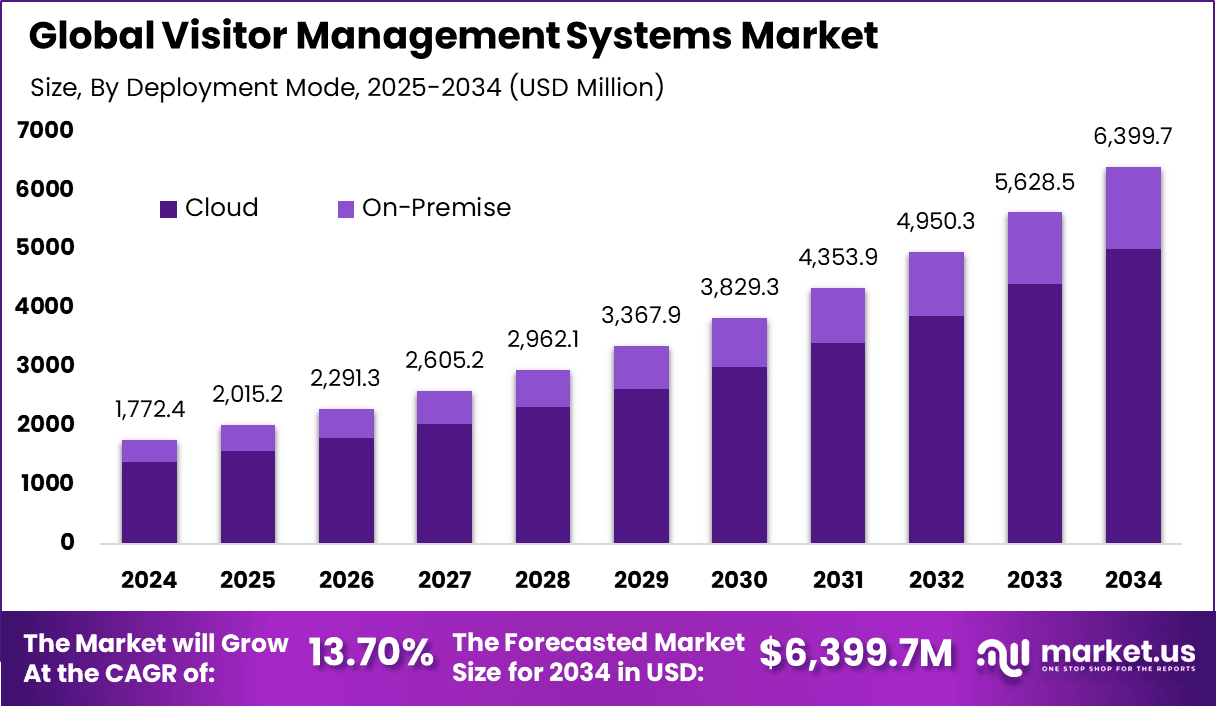
The Global Visitor Management Systems Market generated USD 1,772.4 million in 2024 and is predicted to register growth from USD 2,015.2 million in 2025 to about USD 6,399.7 million by 2034, recording a CAGR of 13.7% throughout the forecast span. In 2024, North America held a dominant market position, capturing more than a 41.7% share, with USD 739.07 million in revenue.
Visitor management systems are digital solutions that help organisations track, register, and manage visitors entering and leaving facilities such as offices, hospitals, schools, factories, and government buildings. These systems replace traditional paper-based logs with features including digital check-in, visitor badges, identity verification, automated notifications, and access tracking to improve security and operational efficiency.
The visitor management systems market is driven by increasing security concerns, workplace safety requirements, and the need for regulatory compliance. Organisations are adopting these solutions to prevent unauthorised access, protect sensitive information, and maintain accurate visitor records through real-time monitoring and audit trails. The growing adoption of contactless check-in, ID scanning, appointment scheduling, and integration with access control systems is further supporting market growth.
Top Market Takeaways
- By component, software took 74.5% of the visitor management systems market, as it handles digital check-ins and tracking.
- By deployment mode, cloud solutions held a 78.3% share, offering easy setup and remote access for buildings.
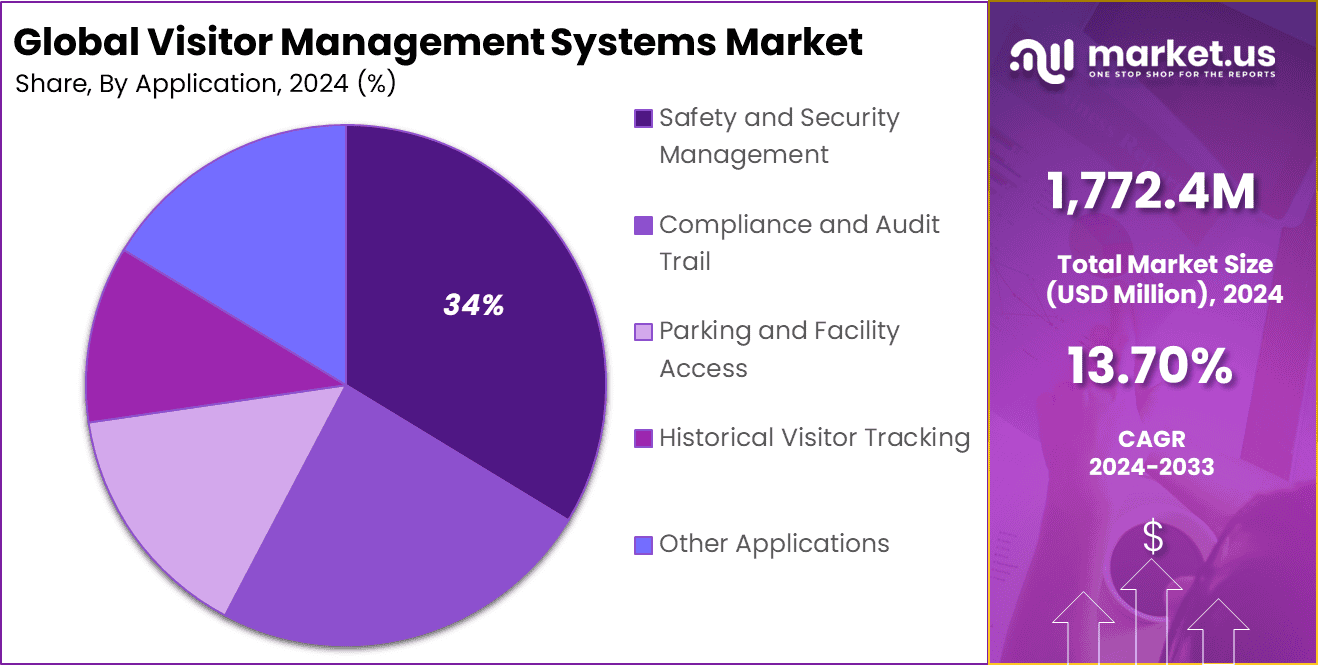
- By application, safety and security management led with 33.7%, used to control access and watch visitors.
- By end-user industry, healthcare captured 21.8%, applying systems to manage patients and staff safely.
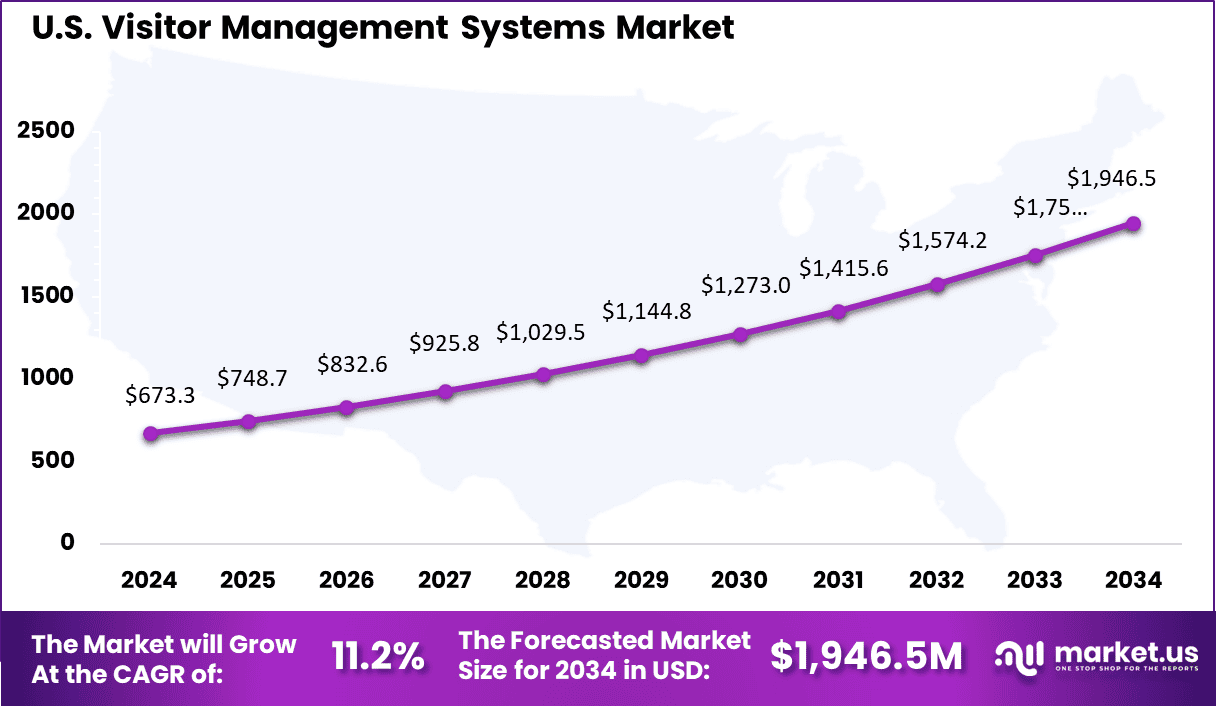
- North America had 41.7% of the global market, with the U.S. at USD 673.3 million in 2025 and growing at a CAGR of 11.2%.
Component Analysis
The software segment accounts for 74.5% of the Visitor Management Systems market, showing that core functionality and value are delivered through digital platforms. Visitor management software is used to register visitors, track entry and exit, manage access permissions, and store visitor data securely. These systems replace manual logbooks and improve accuracy, visibility, and control over visitor movement within facilities.
From an operational perspective, software solutions allow organizations to automate front-desk processes and enforce visitor policies consistently. They also support reporting, audit trails, and integration with access control and security systems. The strong dominance of software reflects growing demand for centralized, efficient, and data-driven visitor management across different industries.
Deployment Mode Analysis
Cloud-based deployment holds 78.3% of the market, driven by its flexibility and ease of implementation. Cloud visitor management systems can be deployed quickly without heavy on-site infrastructure, making them suitable for organizations of all sizes. They enable real-time access to visitor data across multiple locations and support centralized management.
Cloud deployment also simplifies updates, maintenance, and scalability. Organizations can add new sites or features without system disruption. The high share of cloud-based solutions highlights the market’s shift toward flexible and cost-effective deployment models that support modern workplace requirements.
Application Analysis
Safety and security management represents 34% of application demand, making it the largest use case for visitor management systems. These systems help organizations monitor who is on-site at any given time and restrict access to sensitive areas. They also support emergency response by providing real-time visitor data during incidents.
From a risk management standpoint, visitor management tools improve accountability and compliance with safety protocols. Automated check-in processes reduce unauthorized access and human error. The strong presence of this application reflects increasing focus on workplace safety, regulatory compliance, and controlled access in both public and private facilities.
End-User Industry Analysis
The Healthcare sector accounts for 21.8% of end-user adoption, reflecting the need for strict visitor control in hospitals and clinics. Healthcare facilities manage high volumes of patients, visitors, and staff, making controlled access essential. Visitor management systems help track visitor flow and ensure compliance with safety and hygiene protocols.
These systems also support patient privacy and staff safety by limiting access to restricted areas. In healthcare settings, accurate visitor records are critical for audits and emergencies. The strong share of this segment highlights the sector’s reliance on structured visitor management to maintain safe and organized environments.
Key Market Segments
By Component
- Software Type
- Web-Based Solutions
- Mobile-App Solutions
- Service
- Professional Services
- Managed Services
By Deployment Mode
- Cloud
- On-Premise
By Application
- Safety and Security Management
- Compliance and Audit Trail
- Parking and Facility Access
- Historical Visitor Tracking
- Other Applications
By End-User Industry
- Healthcare
- Education
- Government and Public Sector
- Industrial
- Media and Entertainment
- Transportation and Logistics
- Retail
- Other End-User Industries
Key Reasons for Adoption
- The adoption of visitor management systems is driven by the need to improve on-site security and visitor tracking.
- Manual registers are being replaced to reduce errors and improve record accuracy.
- Compliance requirements encourage organizations to maintain digital visitor logs.
- Growing workplace footfall increases the need for structured visitor handling.
- Contactless check-in demand has increased across offices, hospitals, and public facilities.
Benefits
- Security visibility improves through real-time monitoring of visitor movement.
- Administrative workload is reduced by automating check-in and check-out processes.
- Data accuracy improves with centralized and time-stamped visitor records.
- A professional visitor experience is created through streamlined entry processes.
- Emergency response becomes faster with instant access to visitor information.
Usage
- Corporate offices use visitor management systems to control employee and guest access.
- Healthcare facilities rely on these systems to manage patient visitors and staff safety.
- Educational institutions track parents, vendors, and external guests on campus.
- Manufacturing sites use visitor systems to manage contractor access.
- Government buildings apply these solutions to maintain compliance and security standards.
Emerging Trends
| Key Trend | Description |
|---|---|
| AI Threat Detection | AI identifies unusual visitor behavior and flags potential security risks. |
| Touchless Check-In | QR codes and mobile apps allow visitors to sign in without physical contact. |
| Cloud Real-Time Tracking | Cloud platforms monitor visitor movement and activity across multiple locations. |
| Biometric Face Scan | Facial recognition cameras verify visitor identity for enhanced security. |
| IoT Smart Building Link | Visitor systems connect with doors and lighting to automate visitor flow. |
Growth Factors
| Key Factors | Description |
|---|---|
| Hybrid Office Return | Higher office footfall increases the need for digital visitor tracking. |
| Security Rules Tight | Regulations require improved visitor records and access controls. |
| Contactless Post-Virus | Organizations prefer touch-free processes for health, safety, and speed. |
| Cloud Adoption Rise | Cloud-based visitor tools scale easily for large enterprises. |
| Smart Buildings Grow | Modern offices integrate visitor management with building systems. |
Regional Analysis
North America accounted for a 41.7% share, supported by strong emphasis on workplace security, regulatory compliance, and digital facility management. Organizations across corporate offices, healthcare facilities, government buildings, and educational institutions have adopted visitor management systems to improve access control and visitor tracking.
Demand has been driven by the need to replace manual logbooks with secure, auditable digital records. Increasing focus on data privacy and safety has further strengthened adoption across the region.

The U.S. market reached USD 673.3 Mn and is projected to grow at an 11.2% CAGR, reflecting steady demand across commercial and public sector facilities. Adoption has been particularly strong in enterprises managing large workforces and frequent visitor flows. Visitor management systems have helped U.S. organizations improve check-in efficiency, enhance security screening, and maintain compliance with internal and external regulations.
Key Regions and Countries
- North America
- US
- Canada
- Europe
- Germany
- France
- The UK
- Spain
- Italy
- Russia
- Netherlands
- Rest of Europe
- Asia Pacific
- China
- Japan
- South Korea
- India
- Australia
- Singapore
- Thailand
- Vietnam
- Rest of APAC
- Latin America
- Brazil
- Mexico
- Rest of Latin America
- Middle East & Africa
- South Africa
- Saudi Arabia
- UAE
- Rest of MEA
Opportunities & Threats
The Visitor Management Systems market shows strong opportunities as organizations focus more on security, compliance, and controlled access to facilities. Offices, hospitals, schools, and industrial sites are replacing manual visitor logs with digital systems to improve tracking and safety. These systems help verify visitor identity, manage access permissions, and maintain accurate records. Growing demand for contactless check-in and improved workplace experience is also supporting adoption.
More opportunities are emerging from integration with access control, surveillance, and employee management systems. Cloud-based visitor management platforms allow real-time monitoring and centralized control across multiple locations. Mobile apps, QR codes, and biometric options further improve efficiency and reduce front desk workload.
The market faces threats related to budget constraints and perceived necessity. Small organizations may continue using manual processes due to limited visitor volume. In cost-sensitive markets, digital visitor systems may be viewed as optional rather than essential. Dependence on hardware such as kiosks and scanners can also increase maintenance concerns.
Key Challenges
- Protecting visitor data and ensuring privacy compliance
- Integration with existing security and access systems
- Managing hardware maintenance and uptime
- Driving user adoption among staff and visitors
- Balancing security needs with a smooth visitor experience
Competitive Analysis
The competitive landscape of the visitor management systems market is shaped by a mix of cloud-based software providers and established physical security and access control companies. Vendors such as Envoy Inc., Proxyclick SA, Traction Guest under Sign In Enterprise, iLobby Systems Inc., SwipedOn Limited, Greetly Inc., Sharry Inc., Vizitor Technologies Pvt. Ltd., and Lobbytrack focus on intuitive digital check-in, compliance tracking, and seamless integration with workplace tools.
Larger security and building technology players including HID Global from Assa Abloy AB, Robert Bosch GmbH through Bosch Security and Safety Systems, Schneider Electric SE, Johnson Controls plc, Zebra Technologies Corporation, Brivo Inc., Kisi Inc., ACRE Security, Pitney Bowes Inc., Skidata AG, Raptor Technologies LLC, and Splan Inc. compete by combining visitor management with access control, identity management, and facility security systems.
These platforms are widely adopted in offices, corporate campuses, and co-working spaces due to ease of deployment, strong user experience, and support for hybrid work environments. Competition is driven by data security, scalability across multiple sites, regulatory compliance, and integration with broader physical and digital security infrastructure.
Top Key Players in the Market
- Envoy Inc.
- Proxyclick SA
- Traction Guest Corporation (Sign In Enterprise)
- HID Global Corporation (Assa Abloy AB)
- iLobby Systems Inc.
- Robert Bosch GmbH (Bosch Security and Safety Systems)
- Schneider Electric SE
- Johnson Controls plc
- Zebra Technologies Corporation
- Brivo Inc.
- Splan Inc.
- Kisi Inc.
- Raptor Technologies LLC
- ACRE Security (Time Data Security Ltd.)
- Pitney Bowes Inc.
- SwipedOn Limited
- Greetly Inc.
- Skidata AG
- Sharry Inc.
- Vizitor Technologies Pvt. Ltd.
- Lobbytrack (Jolly Technologies Inc.)
- Others
Future Outlook
The future outlook for the Visitor Management Systems market is expected to remain positive as organizations focus on safety, compliance, and better visitor experience. These systems are being adopted across offices, factories, hospitals, schools, and commercial buildings to manage entry, track movement, and maintain accurate visitor records.
Growing awareness of security risks and regulatory requirements is supporting steady demand. In the coming years, wider use of contactless check-in, mobile access, and system integration with security and building management platforms is likely to improve efficiency and control.
Recent Developments
- In March 2025, Motorola Solutions introduced new advanced features in its Avigilon physical security suite, highlighting Avigilon Alta Visitor as part of a unified solution that combines video security, access control, intercom, wireless locks, mailroom management, 24/7 monitoring, and visitor management for enhanced enterprise protection.
- In March 2025, Motorola Solutions showcased Alta SOS and related Avigilon Alta enhancements at ISC West, positioning visitor management (including the integration of InVisit) within a broader emergency response and enterprise security workflow.
- In December 2024, Honeywell promoted Pro‑Watch Visitor Management 3.0 as a consolidated, automated visitor management application that eliminates paper and ad‑hoc processes by streamlining registration and tracking in a single software solution.
Report Scope
| Report Features | Description |
|---|---|
| Market Value (2024) | USD 1,772.4 Million |
| Forecast Revenue (2034) | USD 6,399.7 Million |
| CAGR(2025-2034) | 12.6% |
| Base Year for Estimation | 2024 |
| Historic Period | 2020-2023 |
| Forecast Period | 2025-2034 |
| Report Coverage | Revenue forecast, AI impact on Market trends, Share Insights, Company ranking, competitive landscape, Recent Developments, Market Dynamics and Emerging Trends |
| Segments Covered | By Component (Software Type (Web-Based Solutions, Mobile-App Solutions), Service (Professional Services, Managed Services)), By Deployment Mode (Cloud, On-Premise), By Application (Safety and Security Management, Compliance and Audit Trail, Parking and Facility Access, Other Applications), By End-User Industry (Healthcare, Education, Government and Public Sector, Other End-User Industries) |
| Regional Analysis | North America – US, Canada; Europe – Germany, France, The UK, Spain, Italy, Russia, Netherlands, Rest of Europe; Asia Pacific – China, Japan, South Korea, India, New Zealand, Singapore, Thailand, Vietnam, Rest of Latin America; Latin America – Brazil, Mexico, Rest of Latin America; Middle East & Africa – South Africa, Saudi Arabia, UAE, Rest of MEA |
| Competitive Landscape | Envoy Inc., Proxyclick SA, Traction Guest Corporation (Sign In Enterprise), HID Global Corporation (Assa Abloy AB), iLobby Systems Inc., Robert Bosch GmbH (Bosch Security and Safety Systems), Schneider Electric SE, Johnson Controls plc, Zebra Technologies Corporation, Brivo Inc., Splan Inc., Kisi Inc., Raptor Technologies LLC, ACRE Security (Time Data Security Ltd.), Pitney Bowes Inc., SwipedOn Limited, Greetly Inc., Skidata AG, Sharry Inc., Vizitor Technologies Pvt. Ltd., Lobbytrack (Jolly Technologies Inc.), Others. |
| Customization Scope | Customization for segments, region/country-level will be provided. Moreover, additional customization can be done based on the requirements. |
| Purchase Options | We have three licenses to opt for: Single User License, Multi-User License (Up to 5 Users), Corporate Use License (Unlimited Users and Printable PDF) |