


Report Overview
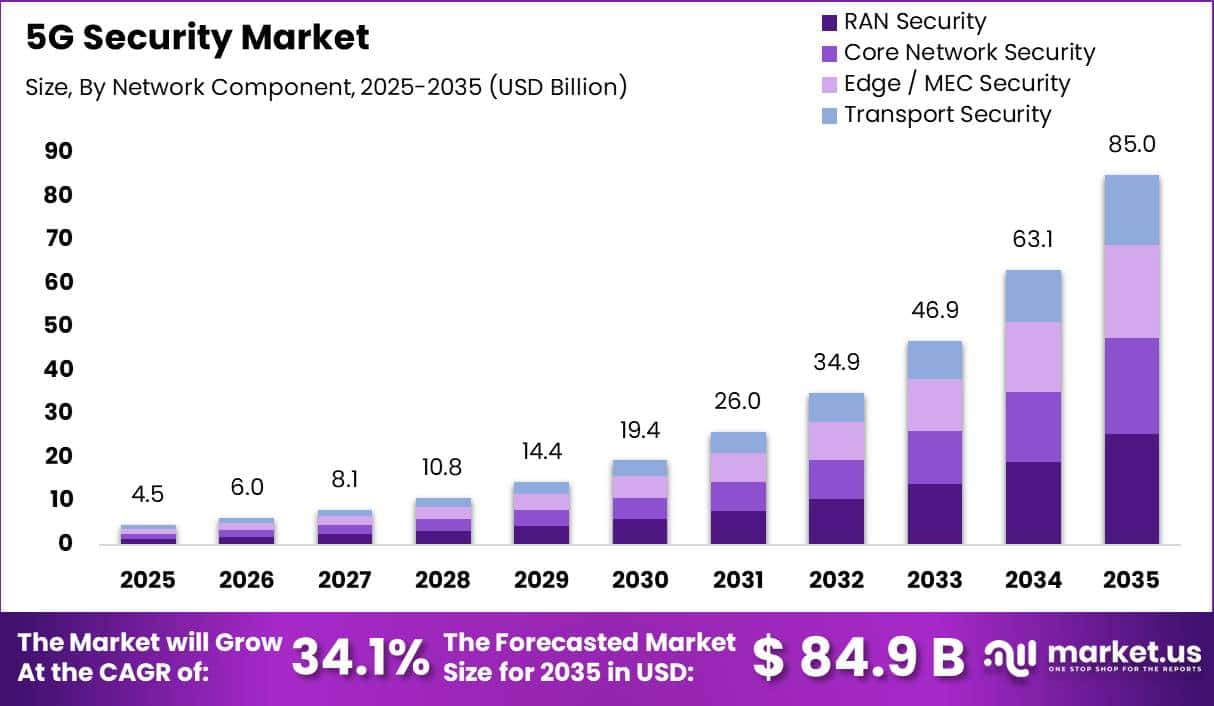
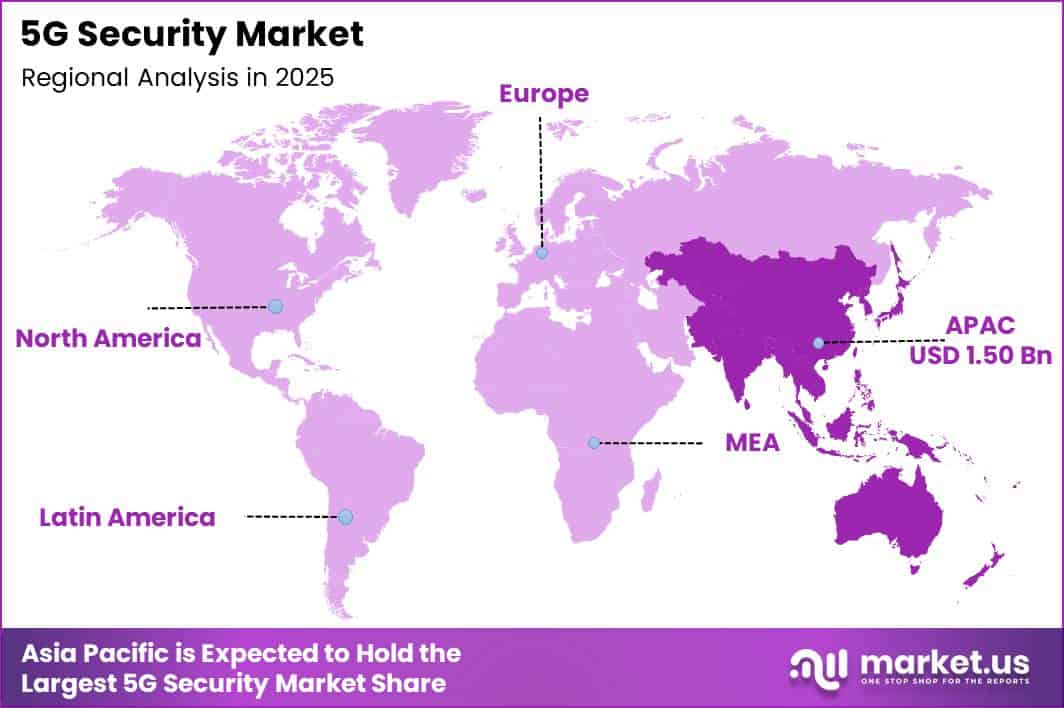
In 2025, the Global 5G Security Market was valued at USD 4.5 billion. The market is projected to grow at a CAGR of 34.1% during 2026–2035, reaching approximately USD 84.9 billion by 2035. Asia Pacific dominated the global market in 2025, accounting for more than 34.0% of the total market share and generating approximately USD 1.5 billion in revenue.
According to the International Telecommunication Union, 5G networks covered 55% of the global population in 2025, while subscriptions exceeded 3 billion and represented nearly one-third of worldwide mobile broadband subscriptions. Data from 5G Americas and Omdia also showed that global 5G connections surpassed 2.6 billion by mid–2025, increasing 37% year over year. GSMA Intelligence expects these connections to approach 9 billion by 2030.
The rising number of towers, network slices and endpoints is creating more cybersecurity risks, increasing demand for firewalls, encryption tools and network security software. Global IoT connections reached 26.1 billion in 2025 and are expected to reach 38.5 billion by 2030, including 5.8 billion licensed cellular connections. Separately, 5G Americas estimated 3.8 billion IoT connections, rising to 5 billion by 2030.
Asia Pacific region had 70% population coverage, compared with 74% in Europe. China exceeded 1 billion 5G connections in 2024, while South Korea and Japan reached approximately 99-100% coverage. These large and mature networks require continuous security upgrades, supporting strong regional spending and long-term market growth.
Key Takeaway
- The 5G Security Market was valued at USD 4.5 billion in 2025 and is projected to reach USD 84.9 billion by 2035.
- The market is projected to grow at a CAGR of 34.1% between 2026 and 2035.
- Global 5G population coverage reached 55% in 2025, with subscriptions surpassing 3 billion.
- Global IoT connections reached 26.1 billion in 2025 and are expected to reach 38.5 billion by 2030.
- The Solutions component held the leading share at 58.0%, driven by demand for software-based protection.
- RAN Security led the Network Component segment with a 30.0% share.
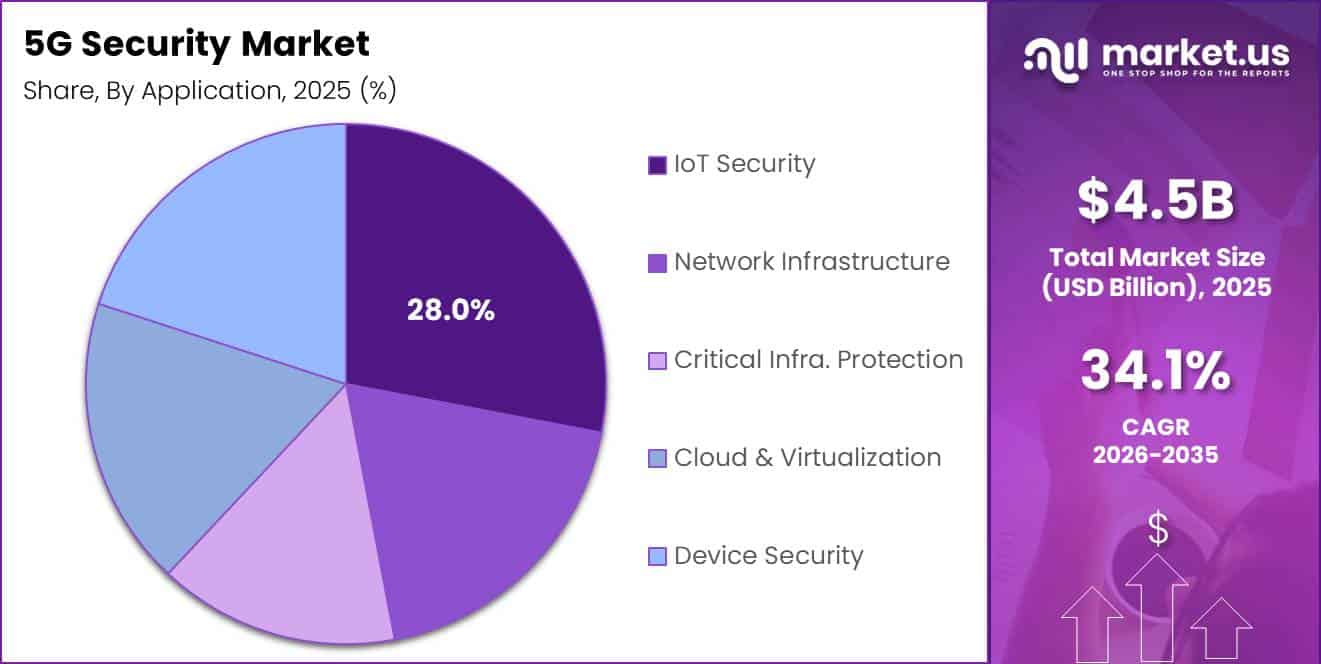
- IoT Security led the Application segment with a 28.0% share.
- Telecom Operators held the dominant End User share at 35.0%.
- Asia Pacific led the market in 2025 with more than 34.0% share and around USD 1.5 billion in revenue.
By Component
The Solutions component held a leading 58.0% share of the 5G Security Market, supported by growing demand for software-based protection such as encryption, firewalls, and network slicing security. These solutions can automatically scale with rising network traffic and cyberattack volumes, making them more suitable for complex 5G environments than manual security processes.
ENISA recorded 4,875 cybersecurity incidents across the European Union between July 2024 and June 2025, with distributed denial-of-service attacks accounting for 77% of reported cases. Such high-volume threats require automated software tools that can detect and respond to attacks in real time.
Telecom-related incidents also increased 20.5% year over year to 188 events in 2024, while malicious activities resulted in 184 million lost user-hours. In addition, GSA reported 1,907 private 5G and LTE deployments worldwide by the third quarter of 2025.
By Network Component
RAN Security held the leading position in the Network Component segment with a 30.0% share. This leadership is mainly supported by the large number of radio access points deployed across 5G networks and their direct exposure to external threats. According to China’s Ministry of Industry and Information Technology, the country operated 4.8 million 5G base stations by the end of 2025.
Each base station acts as a radio-facing network node that may face risks such as spoofing, signal jamming, and unauthorized access. The expansion of Open RAN also increases security requirements because it connects software and equipment from multiple vendors. O-RAN Alliance data indicates that Rakuten Mobile operates 350,000 disaggregated cells, creating a need for strong encryption and continuous protection across each network interface.
By Application
IoT Security held the leading position in the Application segment with a 28.0% share, supported by the rising use of connected devices across 5G networks. Smart sensors, cameras, streaming devices, appliances, and vehicle systems often have limited built-in protection, making them easier targets for cybercriminals.
These compromised devices could be used to gain unauthorized access to residential and enterprise networks. The 2025 IC3 Annual Report recorded more than 1 million cybercrime complaints and total reported losses of USD 20.8 billion, representing a 26% increase from 2024. IoT devices were also identified as an active factor supporting the growth of cyber threats.
By End User
Telecom Operators held the dominant position in the End User segment with a 35.0% share, mainly because they are responsible for securing the complete 5G network infrastructure, including radio towers, transport networks and core systems. According to GSMA Intelligence, mobile operators invested USD 180 billion in global capital expenditure during 2025, with a major portion directed toward 5G deployment.
Every new tower, core node and network connection requires additional spending on encryption, access control, threat monitoring and other security systems. The Mobile Economy 2025 report also estimated that the mobile industry’s total contribution to global GDP could reach USD 11 trillion by 2030. This large economic value increases the need for telecom operators to protect critical networks, customer data and revenue-generating services.
Key Market Segments
By Component
- Solutions
- Network Security
- RAN Security
- Core Network Security
- Cloud Security
- Network Slicing Security
- API Security
- Device / Endpoint Security
- Authentication (IAM)
- Network Security
- Services
- Managed Security Services
- Professional Services
By Network Component
- RAN Security
- Core Network Security
- Network Slicing Security
- SDN / NFV Security
- Edge / MEC Security
- Transport Security
By Application
- IoT Security
- Smart City Security
- Industrial IoT Security
- Network Infrastructure
- Critical Infrastructure Protection
- Utility Grid Security
- Transport Infrastructure
- Cloud & Virtualization
- Device Security
By End User
- Telecom Operators
- Government & Defense
- Enterprises
- Smart Manufacturing
- Healthcare Networks
- Critical Infrastructure
- Healthcare
Geopolitical Impact Analysis
Geopolitical tensions are increasing costs and supply risks across the 5G Security Market. The effective U.S. tariff on Chinese imports reached approximately 33% in 2026 when MFN, Section 301 and IEEPA duties are combined. These tariffs raise the landed cost of network security appliances, firewalls and hardware security modules produced by Chinese contract manufacturers. Supply pressure is also growing because China controls nearly 89% of global rare-earth refining capacity.
Since April 2025, the country has required export licences for seven rare-earth elements and permanent magnets used in base station radios and security hardware. In October 2025, the controls were expanded to cover components containing more than 0.1% Chinese-origin rare earth materials. Although the broadest restrictions were paused for one year in November 2025, licensing rules for key elements remain active.
Shipping disruption is adding further pressure. Red Sea rerouting through the Cape of Good Hope continues to affect more than 85% of container traffic that would normally use the Suez Canal. This diversion adds around 10 to 14 days to Asia-Europe delivery times. As of January 2026, Asia-to-U.S. East Coast shipping increased from approximately 25 to 28 days to more than 35 to 40 days.
These delays affect encrypted routers, security appliances and RAN protection equipment manufactured in Asia. Rising tariffs and longer lead times are encouraging telecom operators and enterprises to adopt dual-sourcing and regional manufacturing, although these strategies may increase equipment costs and extend 5G security deployment schedules.
Regional Analysis
Asia Pacific stands as both the dominant and fastest-growing region in the global 5G Security Market, commanding a 34.0% share and generating approximately USD 1.5 billion in revenue in 2025. This leadership is grounded in the sheer physical scale of the region’s network build-out: India’s Department of Telecommunications reports 518,854 operational 5G base transceiver stations (BTS) nationwide as of December 2025, up from 504,588 in September, reflecting continuous monthly additions across Maharashtra, Uttar Pradesh, and Gujarat.
Nationally, roughly 25 crore (250 million) mobile subscribers now use 5G services in India alone, each connection representing a fresh endpoint requiring active security coverage. Beyond India, ASEAN’s digital economy has expanded from USD 737 billion in 2000 to over USD 4 trillion in 2024, with GSMA highlighting 5G, fibre, and cloud infrastructure investment as the region’s top strategic priority through 2035. Japan adds further density, with the Ministry of Internal Affairs and Communications confirming 98.4% nationwide 5G population coverage by the end of FY2024.
Key Regions and Countries
North America
- US
- Canada
Europe
- Germany
- France
- The UK
- Spain
- Italy
- Rest of Europe
Asia Pacific
- China
- Japan
- South Korea
- India
- Australia
- Rest of APAC
Latin America
- Brazil
- Mexico
- Rest of Latin America
Middle East & Africa
- GCC
- South Africa
- Rest of MEA
Market Dynamics
Drivers
| Driver | (~) % CAGR | Geographic Relevance | Impact Timeline |
|---|---|---|---|
| Regulatory Mandate Acceleration: EU Cyber Resilience Act & NIS-2 Directive | +6.8% | European Union, UK, expanding to APAC via regulatory mirroring | Short term (less than or equal to 2 years) |
| Surge in Nation-State & Ransomware Attacks on 5G-Connected Critical Infrastructure | +5.9% | Global, highest intensity in North America, Western Europe | Short term (less than or equal to 2 years) |
| Mass IoT Device Proliferation Expanding 5G Attack Surface | +5.2% | Global, accelerated adoption in East Asia, North America | Short term (less than or equal to 2 years) |
| Government & Defense Sector 5G Security Procurement Programs | +4.7% | USA, India, South Korea, NATO member states | Medium term (2 to 4 years) |
| Enterprise Zero Trust Architecture Adoption for 5G Core Networks | +4.1% | North America, Western Europe, Japan | Short term (less than or equal to 2 years) |
| Hyperscaler & Telco Cloud-Native Security Platform Investment | +3.4% | Global, led by North America, Germany, Singapore | Medium term (2 to 4 years) |
Regulatory Mandate Acceleration: EU Cyber Resilience Act & NIS-2 Directive
The EU Cyber Resilience Act, Regulation EU 2024/2847, entered into force on 10 December 2024 and establishes the first horizontally applicable binding cybersecurity requirements for all products with digital elements placed on the EU market. Manufacturer vulnerability reporting obligations will apply from 11 September 2026, while full compliance becomes mandatory from 11 December 2027.
Non-compliance carries penalties of up to EUR 15 million or 2.5% of global annual turnover, whichever is higher, compelling hardware and software vendors with EU market exposure to accelerate investment in compliant 5G security stacks.
Requirements to maintain Software Bills of Materials, conduct mandatory third-party conformity assessments for Class II and Critical products, and notify ENISA of exploited vulnerabilities within 24 hours are shifting vendor go-to-market models from reactive patching to continuous compliance-as-a-service subscriptions.
The European Commission has also mandated the development of 41 harmonized standards, comprising 15 horizontal standards and 26 vertical product-category standards. This is expected to create a near-term certification and testing services boom across the compliance ecosystem ahead of the 2027 full-enforcement deadline, while expanding recurring software revenue opportunities and reducing reliance on one-time hardware margins.
Restraints
| Restraint | (~) % CAGR | Geographic Relevance | Impact Timeline |
|---|---|---|---|
| Geopolitical Vendor Exclusion & Rip-and-Replace CapEx Burden | -4.3% | UK, EU, Australia, India, USA | Short term (less than or equal to 2 years) |
| High Interest Rate Environment Compressing Telco Security CapEx Budgets | -3.1% | Emerging markets, South Asia, Latin America, Sub-Saharan Africa | Short term (less than or equal to 2 years) |
| Proprietary Legacy Network Architecture Incompatibility with 5G Security Layers | -2.6% | Global, most acute in Southeast Asia, Middle East | Medium term (2 to 4 years) |
| Absence of Harmonized Global 5G Security Standards Blocking Procurement | -2.2% | Cross-regional, APAC-EU regulatory divergence most acute | Medium term (2 to 4 years) |
| SME Budget Constraints Limiting Mid-Market Segment Penetration | -1.8% | Global, concentrated in South Asia, Eastern Europe | Short term (less than or equal to 2 years) |
Geopolitical Vendor Exclusion & Rip-and-Replace CapEx Burden
Government-mandated exclusions of high-risk vendors from national 5G infrastructure have created a structural procurement bottleneck that directly freezes security hardware upgrade cycles in affected markets.
Independent technical assessments estimate total replacement costs at several billion dollars across the affected Western operator base. This dual CapEx shock—exit costs plus re-procurement—crowds out discretionary security software and monitoring investment in the same budget cycle, as operators must prioritize infrastructure continuity over incremental security-layer deployment.
Internal operator finance models indicate that security software attach rates in rip-and-replace programs are approximately 30% to 40% lower than in greenfield 5G builds because security spending competes directly with unbudgeted hardware line items. The effect is most pronounced among Tier-2 and Tier-3 operators in Europe and the Indo-Pacific, where balance-sheet flexibility is lower, extending the drag through the medium term even as Tier-1 operators absorb the transition faster.
Challenges
| Challenge | (~) % CAGR | Geographic Relevance | Mitigation Horizon |
|---|---|---|---|
| 5G-Specialized Cybersecurity Talent Deficit | -3.8% | Global, deficit concentrated in APAC (more than 56% of global shortfall), South Asia | Long term (greater than or equal to 4 years) |
| O-RAN Multi-Vendor Interoperability Security Gaps | -2.9% | USA, Japan, South Korea, EU O-RAN deployment corridors | Medium term (2 to 4 years) |
| Semiconductor Supply Chain Concentration Risk | -2.4% | Global, most acute for Taiwan-dependent chipset sourcing | Long term (greater than or equal to 4 years) |
| Network Slicing Security Policy Complexity | -2.1% | Global, highest in multi-tenant enterprise deployments in North America & EU | Medium term (2 to 4 years) |
| Evolving AI-Augmented Threat Sophistication | -1.7% | Global, fastest escalation in North America, China, Russia corridors | Short term (less than or equal to 2 years) |
5G-Specialized Cybersecurity Talent Deficit
The global cybersecurity workforce gap stands at approximately 2.8 million unfilled positions as of the most recent workforce study, with the APAC region alone accounting for more than 56% of the global shortage due to the relative immaturity of the security profession in many high-growth markets.
Within 5G security specifically, the talent deficit is structurally more severe than in general cybersecurity because it requires the convergence of telecom protocol expertise (3GPP Release 16 and 17 standards, SBA architecture, network slicing policy), cloud-native security engineering, and OT-IT convergence skills that do not exist as a readily available labor pool: private 5G deployments report that hiring timelines for qualified 5G security architects run 40 to 60% longer than equivalent cloud security roles, materially delaying project commissioning and pushing integration cost overruns of 15 to 25% above initial contract value.
The World Economic Forum estimates the broader tech talent shortfall will reach 85 million workers by 2030, implying the 5G security segment will compete for a shrinking incremental pool of cross-disciplinary candidates.
Opportunities
| Opportunity | (~) % CAGR | Geographic Relevance | Execution Window |
|---|---|---|---|
| Private 5G Network Security as a Managed Service for Verticals | +5.6% | North America, Germany, Japan, India manufacturing corridors | Medium term (2 to 4 years) |
| AI-Native Autonomous Threat Detection & Response Platforms for 5G Core | +4.3% | Global, highest monetization density in North America, Singapore, UAE | Short term (less than or equal to 2 years) |
| 5G Security Embedded in Smart City & Critical Infrastructure Contracts | +3.7% | Gulf Cooperation Council, South Korea, India smart city programs | Medium term (2 to 4 years) |
| Security-as-a-Service Subscription Monetization for MNO Wholesale Channels | +3.1% | Global, MNO wholesale market led by Europe, North America | Medium term (2 to 4 years) |
| Post-Quantum Cryptography Integration into 5G Authentication Protocols | +2.4% | USA (NIST PQC standards), EU, defense-adjacent markets globally | Long term (greater than or equal to 4 years) |
| Cross-Border M&A Roll-Up of Niche 5G Security Vendors in APAC | +1.9% | Japan, South Korea, India, Australia | Long term (greater than or equal to 4 years) |
Private 5G Network Security as a Managed Service for Verticals
This opportunity remains largely untapped because the prevailing 5G security model still relies on point-product licensing sold through telecom channel partners and funded from general enterprise IT budgets. By contrast, outcome-based managed security services co-developed with operators in manufacturing, logistics, energy, and healthcare remain limited.
Security spending also remains underpenetrated relative to connectivity investment. Data from private network deployments indicates that security services currently represent only 8% to 12% of total private 5G contract value, compared with a structurally supportable attach rate of 20% to 25% based on comparable managed security offerings in private LTE and enterprise SD-WAN programs.
This commercial shift could increase gross margin per deployment by an estimated 18 to 22 percentage points versus comparable hardware-bundled deals, while reducing adoption barriers through opex-based pricing. The opportunity is medium-term because industry-specific threat intelligence, vertically certified security operations center capacity, and ecosystem integrations are not yet available at scale.
Key Players Analysis
The 5G Security Market has a tiered competitive structure. Tier-1 leaders include large network infrastructure and cybersecurity companies with the financial strength to integrate security into complete 5G network deployments. Ericsson reported full-year 2025 net sales of SEK 236.7 billion, while its Networks business recorded 6% organic growth. This scale allows the company to bundle security capabilities with RAN and core network equipment.
Nokia generated €7.6 billion from Network Infrastructure and €11.4 billion from Mobile Infrastructure in 2025. These businesses reported operating margins of 10.1% and 13.4%, respectively, supporting continued investment in IP, optical and mobile network security. Palo Alto Networks reported fiscal 2025 revenue of USD 9.2 billion, representing 15% year-over-year growth. Its Next-Generation Security annual recurring revenue increased 32% to USD 5.6 billion, showing strong demand for subscription-based protection across 5G core, cloud and edge environments.
Tier-2 challengers include specialised and regionally focused companies. Fortinet, Trend Micro and A10 Networks compete through DDoS protection and network-layer security solutions for telecom operators. Cisco Systems uses its large networking customer base to expand 5G security sales among enterprises. Huawei Technologies and Samsung Electronics maintain strong positions in Asia Pacific and the Middle East by integrating security into their RAN and core equipment.
Top Key Players in the Market
- Ericsson
- Nokia
- Palo Alto Networks
- Cisco Systems
- Huawei Technologies
- Samsung Electronics
- A10 Networks
- Fortinet
- Trend Micro
- Radisys
- Spirent Communications
- TELIT Communications
Recent Developments
- In February 2026, Palo Alto Networks completed its acquisition of CyberArk for an equity value of approximately USD 25 billion. CyberArk shareholders received USD 45.0 in cash and 2.2005 Palo Alto Networks shares for each CyberArk share. CyberArk stated that machine identities now outnumber human identities by more than 80:1, while nearly 90% of organizations have experienced an identity-related breach.
- In March 2026, Ericsson and Far EasTone signed a 3-year agreement to modernize the operator’s RAN and 5G Core infrastructure in Taiwan. Ericsson will expand the dual-mode 5G Core to additional sites, deploy Ericsson Security Manager, and support network-slicing trials. The modernization is expected to reduce radio-network energy consumption by up to 35% and support Far EasTone’s net-zero target for 2048.
Report Scope
| Report Features | Description |
|---|---|
| Market Value (2025) | USD 4.5 Billion |
| Forecast Revenue (2035) | USD 84.9 Billion |
| CAGR (2026-2035) | 34.1% |
| Base Year for Estimation | 2025 |
| Historic Period | 2020-2024 |
| Forecast Period | 2026-2035 |
| Report Coverage | Revenue Forecast, Market Dynamics, Competitive Landscape, Recent Developments |
| Segments Covered | By Component (Solutions, Network Security, RAN Security, Core Network Security, Cloud Security, Network Slicing Security, API Security, Device / Endpoint Security, Authentication (IAM), Services, Managed Security Services, Professional Services), By Network Component (RAN Security, Core Network Security, Network Slicing Security, SDN / NFV Security, Edge / MEC Security, Transport Security), By Application (IoT Security, Smart City Security, Industrial IoT Security, Network Infrastructure, Critical Infrastructure Protection, Utility Grid Security, Transport Infrastructure, Cloud & Virtualization, Device Security), By End User (Telecom Operators, Government & Defense, Enterprises, Smart Manufacturing, Healthcare Networks, Critical Infrastructure, Healthcare) |
| Regional Analysis | North America – US, Canada; Europe – Germany, France, The UK, Spain, Italy, Rest of Europe; Asia Pacific – China, Japan, South Korea, India, Australia, Singapore, Rest of APAC; Latin America – Brazil, Mexico, Rest of Latin America; Middle East & Africa – GCC, South Africa, Rest of MEA |
| Competitive Landscape | Ericsson, Nokia, Palo Alto Networks, Cisco Systems, Huawei Technologies, Samsung Electronics, A10 Networks, Fortinet, Trend Micro, Radisys, Spirent Communications, TELIT Communications |
| Customization Scope | Customization for segments, region/country-level will be provided. Moreover, additional customization can be done based on the requirements. |
| Purchase Options | We have three licenses to opt for: Single User License, Multi-User License (Up to 5 Users), Corporate Use License (Unlimited Users and Printable PDF) |





























