Report Overview
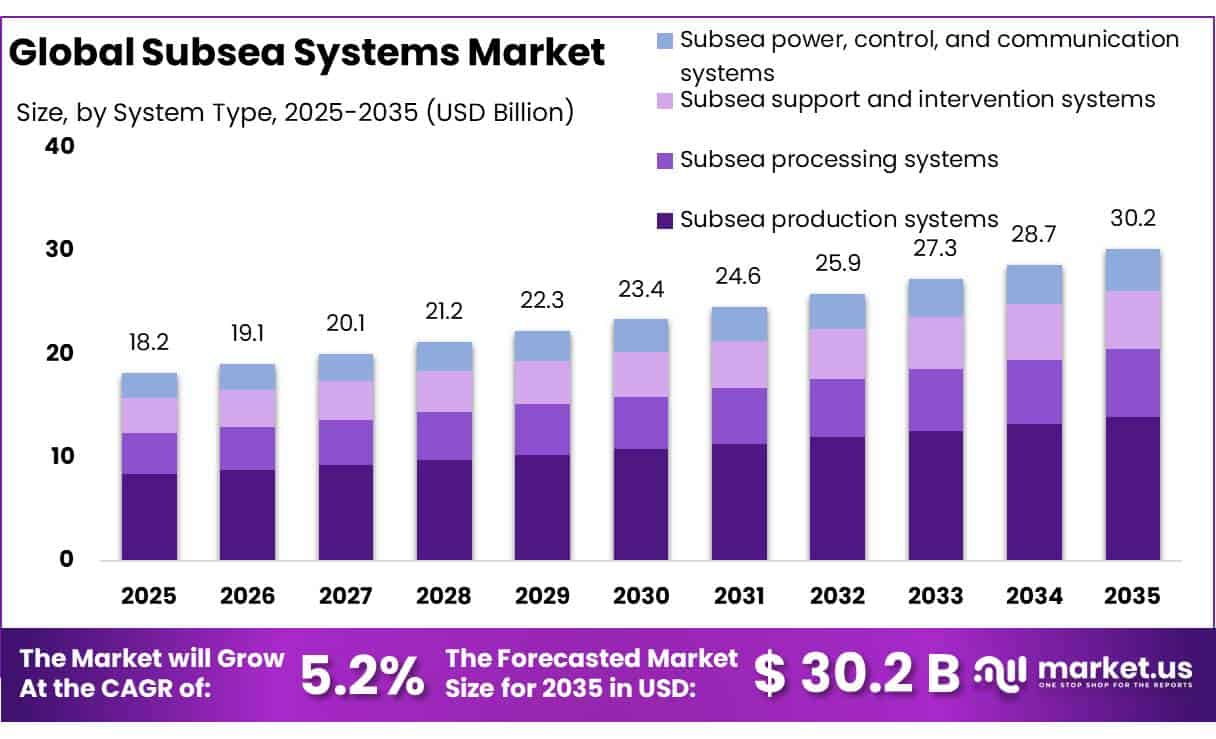
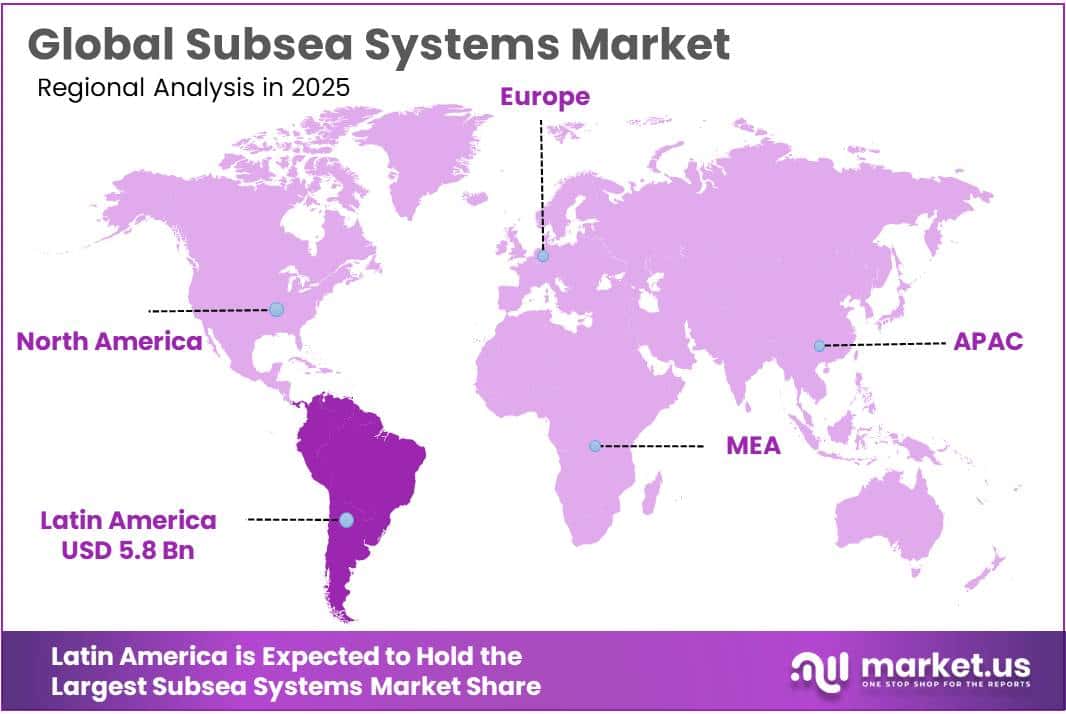
The Global Subsea Systems Market size is expected to be worth around USD 30.2 Billion by 2035, from USD 18.2 Billion in 2025, growing at a CAGR of 5.2% during the forecast period from 2026 to 2035. In 2025, Latin America held a dominant market position, capturing more than a 32.00% share, holding USD 5.8 Billion revenue.
Subsea systems are an important part of offshore oil and gas production. They allow operators to extract hydrocarbons from underwater reservoirs and transfer them to offshore platforms, floating production vessels or onshore processing facilities. These systems include subsea wellheads, trees, manifolds, control systems, umbilicals, flowlines, connectors and subsea processing equipment.
- They are widely used in deepwater and ultra-deepwater projects where fixed offshore platforms may be technically difficult or costly to install. The International Organization for Standardization published ISO 13628-1:2025 in January 2025, providing updated requirements for the design and operation of subsea production and injection systems, covering their development through decommissioning.
The subsea systems industry is supported by continued offshore oil and gas production, new field developments and the need to improve recovery from existing reservoirs. According to the U.S. Bureau of Ocean Energy Management (BOEM), offshore federal production reached approximately 668 million barrels of oil and 700 billion cubic feet of natural gas in fiscal year 2024. This represented around 14% of total U.S. domestic oil production. These activities create demand for underwater production equipment, subsea connections and monitoring technologies.
Norway also remains an important offshore market. The Norwegian Offshore Directorate reported that 97 fields were operating on the Norwegian continental shelf at the end of 2025. It also identified 17 approved field development projects under construction or development, including projects using subsea templates and connections to existing infrastructure. These developments support demand for subsea production systems, installation services and equipment upgrades.
Future opportunities are expected in subsea processing, all-electric production systems, advanced monitoring and high-pressure equipment. Subsea compression and pumping technologies can help maintain production as reservoir pressure declines. Existing offshore infrastructure also creates opportunities for equipment replacement, upgrades and life-extension projects.
In addition, subsea power distribution and cable technologies may support offshore wind development and connections between offshore facilities. The U.S. BOEM estimated that offshore oil and gas activities supported approximately 245,000 jobs and generated USD 58.2 billion in economic output during fiscal year 2025, highlighting the wider industrial importance of offshore development.
Key Takeaways
- Subsea Systems Market size is expected to be worth around USD 30.2 Billion by 2035, from USD 18.2 Billion in 2025, growing at a CAGR of 5.2%.
- Subsea production systems held a dominant market position, capturing more than a 46.00% share.
- Umbilicals, risers, and flowlines held a dominant market position, capturing more than a 31.00% share.
- Offshore oil production held a dominant market position, capturing more than a 43.00% share.
- Offshore oil and gas operators held a dominant market position, capturing more than a 52.00% share.
- Latin America held a dominant position in the Subsea Systems Market, accounting for 32.00% share and reaching a market value of USD 5.8 billion.
By System Type Analysis
Subsea Production Systems: Established Demand Supported by Offshore Field Development
In 2025, “Subsea production systems” held a dominant market position, capturing more than a 46.00% share. The segment benefits from its central role in developing offshore oil and gas fields, particularly in deepwater and ultra-deepwater locations where fixed platforms are not practical. These systems bring hydrocarbons from subsea wells to processing facilities through equipment such as subsea trees, manifolds, control systems, umbilicals and flowlines. Their use also supports tiebacks, allowing new discoveries to connect with existing offshore infrastructure and helping operators make better use of installed facilities.
The Norwegian Offshore Directorate reported 238 million standard cubic metres of oil equivalent in total production in 2025, with 97 fields in operation at year-end. Its 2026 resource report also explains that new developments increasingly use subsea tiebacks to connect discoveries with existing infrastructure. This creates opportunities for subsea processing equipment where operators need to manage production from remote wells and extend the useful life of existing offshore facilities.
In the United States, the Bureau of Ocean Energy Management reported that federal offshore areas produced 668 million barrels of oil and 700 billion cubic feet of natural gas in fiscal year 2024. These production levels demonstrate the continuing importance of offshore infrastructure. As projects move into deeper waters and more complex operating conditions, subsea processing systems can help operators improve flow management, reduce reliance on additional surface facilities and support efficient field development.
By Component Analysis
Umbilicals, Risers, and Flowlines: Essential Infrastructure for Offshore Production
In 2025, “Umbilicals, risers, and flowlines” held a dominant market position, capturing more than a 31.00% share. These components form the main connection between subsea wells and offshore production facilities. Flowlines transport oil, gas and injected fluids between subsea wells, manifolds and processing equipment, while risers carry production fluids between the seabed and floating or fixed facilities.
The Fram Sør development, approved in 2025, was planned with four new subsea templates connected to existing Fram infrastructure and the Troll C platform. Such projects require reliable subsea connections and support continued demand for flowlines, risers and control umbilicals. The Bureau of Safety and Environmental Enforcement also maintains offshore pipeline location data for the Gulf of Mexico, including subsea pipeline infrastructure used to transport oil and gas.
Subsea processing systems help offshore operators manage oil, gas and water directly on the seabed before fluids are transported to surface facilities. These systems include subsea separation, boosting, compression and water-injection equipment. They are used to manage production from remote wells, maintain flow over long distances and improve the recovery of hydrocarbons from offshore reservoirs.
These figures indicate the scale of offshore activity that requires production and processing infrastructure, although they do not represent the number of subsea processing systems installed. In the United States, the Department of the Interior reported that offshore oil production exceeded 714 million barrels in 2025, marking a record annual level.
By Application Analysis
Offshore Oil Production: Subsea Systems Remain Essential to Deepwater Oilfield Development
In 2025, “Offshore oil production” held a dominant market position, capturing more than a 43.00% share. Subsea systems play an important role in offshore oil production by connecting subsea wells with floating platforms and other production facilities. They include subsea trees, manifolds, control systems, umbilicals, risers and flowlines that support the safe extraction and transportation of oil from underwater reservoirs.
- According to the U.S. Bureau of Safety and Environmental Enforcement, offshore oil production on the Outer Continental Shelf reached 714 million barrels in 2025, setting a new annual record.
This high production level reflects the continued importance of offshore operations and the infrastructure required to maintain them. In Norway, the Norwegian Offshore Directorate recorded 106.811 million standard cubic metres of oil production from the continental shelf in 2025, the highest level since 2009. These production activities support the need for dependable subsea equipment that can operate under high pressure, low temperatures and demanding underwater conditions.
The Norwegian Offshore Directorate reported that 121.840 billion standard cubic metres of natural gas were produced from the Norwegian continental shelf in 2025. Norway also supplied approximately 30% of the European Union’s gas consumption, highlighting the importance of its offshore gas infrastructure.
In the United States, the Bureau of Ocean Energy Management reported offshore federal natural gas production of approximately 700 billion cubic feet in fiscal year 2024, with almost all production coming from the Gulf of Mexico. These figures demonstrate the scale of offshore gas operations and the need for equipment that supports production, pressure management and transportation.
By End User Analysis
Offshore Oil and Gas Operators: Direct Investment in Offshore Production Drives Subsea System Demand
In 2025, “Offshore oil and gas operators” held a dominant market position, capturing more than a 52.00% share. These operators represent the main customer group for subsea systems because they invest in offshore exploration, field development, production and infrastructure maintenance. They use subsea trees, manifolds, control systems, umbilicals, risers and flowlines to bring oil and gas from underwater reservoirs to production facilities.
According to the U.S. Bureau of Safety and Environmental Enforcement, offshore oil production on the Outer Continental Shelf reached 714 million barrels in 2025, setting a new annual record. The Bureau of Ocean Energy Management also reported that offshore oil and gas activities supported approximately 245,000 jobs and generated USD 58.2 billion in economic output during fiscal year 2025. These figures highlight the scale of offshore operations and the investment required to support them.
Subsea EPC and EPCI contractors provide engineering, procurement, construction and installation services for offshore subsea projects. They work with operators to design and deliver subsea equipment, pipelines, umbilicals, risers, flowlines and related infrastructure.
The Norwegian Offshore Directorate reported that 17 development projects with approved development plans were under way at the end of 2025. The Fram Sør project, approved in 2025, includes four subsea templates connected to existing infrastructure. In July 2025, Subsea7 announced an EPCI contract for the project covering 53 kilometres of production, gas-lift and water-injection flowlines, along with the umbilical system.
Key Market Segments
By System Type
- Subsea production systems
- Subsea processing systems
- Subsea support and intervention systems
- Subsea power, control, and communication systems
By Component
- Subsea trees and wellheads
- Manifolds and templates
- Umbilicals, risers, and flowlines
- Subsea control modules
- Pumps, compressors, and boosting systems
- Valves, connectors, and power cables
By Application
- Offshore oil production
- Offshore gas production
- Subsea tieback development
- Inspection, maintenance, and repair
- Offshore renewable energy
- Other applications
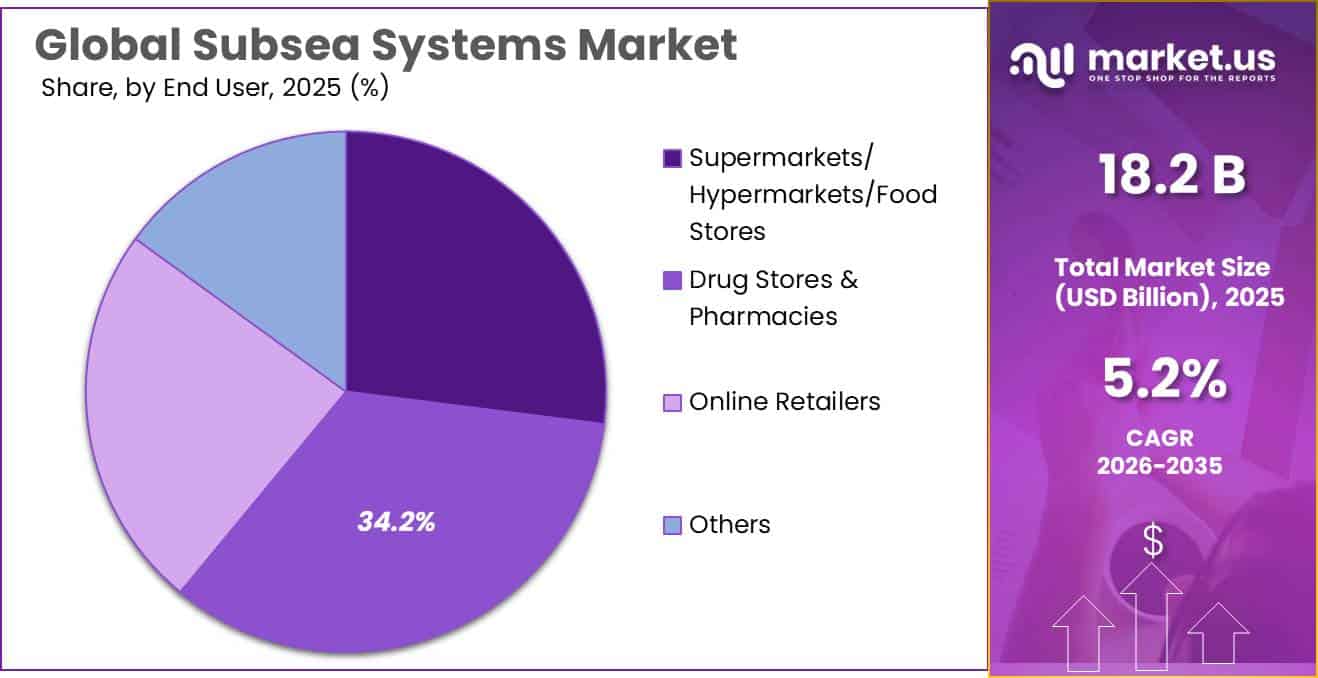
By End User
- Offshore oil and gas operators
- Subsea EPC / EPCI contractors
- Offshore drilling contractors
- FPSO operators
- Offshore renewable-energy developers
Driver Analysis
Funded Deepwater Developments
TechnipFMC’s September 2025 Hammerhead award in Guyana covers trees, manifolds, associated controls and production and water-injection capabilities; the supplier classified the contract at $250–500 million and identified it as its seventh Guyanese greenfield award from ExxonMobil since 2017. Its third-quarter 2026 results also disclose the integrated Limbayong development in Malaysia and flexible-pipe awards supporting Brazilian pre-salt fields and Angola.
Revenue visibility is substantial but not unqualified: TechnipFMC reported $15.487 billion of Subsea backlog at September 2026, alongside quarterly revenue of approximately $2.6 billion, yet quarterly orders of $2.052 billion and a 0.8-times book-to-bill ratio show that execution was temporarily outpacing replenishment. Those figures describe one supplier, not global market growth.
In an illustrative portfolio of five new developments with $400 million of non-overlapping eligible subsea scope each, committed demand totals $2 billion; delivery over four years averages $500 million annually only under a simplified schedule, with actual recognition determined by contract execution. Suppliers capture value through repeatable equipment platforms, early engineering and coordinated delivery, not simply higher well counts.
Drivers Impact Analysis
| Driver | (~) % Impact on CAGR | Geographic Relevance | Impact Timeline |
|---|---|---|---|
| Funded deepwater developments | +1.3 pp | Guyana, Brazil, Malaysia, West Africa | Medium term (2–4 years) |
| Brownfield tieback procurement | +0.9 pp | Norway, UK, Australia, Indonesia | Short term (≤ 2 years) |
| Subsea compression deployment | +0.7 pp | Norway core; gas-basin spill-over | Medium term (2–4 years) |
| Installed-base lifecycle spending | +0.7 pp | North Sea, Brazil, US Gulf, Angola | Short term (≤ 2 years) |
| Offshore CO₂-injection systems | +0.4 pp | Norway, UK | Medium term (2–4 years) |
Restraint Analysis
Unsanctioned Project Deferrals
Large subsea developments can remain outside executable procurement when operators have not completed investment screening, partner alignment or concept optimization, limiting how much announced resource potential becomes equipment and installation revenue during the forecast period. Equinor’s current Bay du Nord disclosure identifies approximately CAD 14 billion of initial investment, a planned 2027 final investment decision and expected first oil in 2031; its key figures remain explicitly subject to project maturation and sanction.
Earlier operator commentary described additional work needed to improve Bay du Nord and Wisting before investment decisions, establishing why announcements should not receive the same weighting as awarded subsea contracts. These disclosures do not establish that Bay du Nord is cancelled or that its entire capital budget belongs to subsea systems.
In an illustrative portfolio of ten prospective developments carrying $400 million of eligible subsea scope each, moving two beyond the 2026–2031 delivery window removes $800 million from forecast-period execution, while engineering already delivered remains revenue. If suppliers expend an assumed $5 million per affected project on unrecovered tendering and preliminary engineering, the two deferrals also create $10 million of commercial exposure before redeployment.
Suppliers should distinguish concepts, funded engineering, conditional awards and binding commitments rather than equate all opportunities with backlog. The −0.6 pp contribution assumes 20% revenue exposure grows three percentage points more slowly through unsanctioned-project deferrals, excluding projects whose principal impediment is missing regulatory consent.
Restraint Impact Analysis
| Restraint | (~) % Impact on CAGR Forecast | Geographic Relevance | Impact Timeline |
|---|---|---|---|
| Unsanctioned project deferrals | −0.6 pp | Canada, Norway, frontier basins | Medium term (2–4 years) |
| Installation-slot constraints | −0.4 pp | Brazil, Norway, Guyana, West Africa | Short term (≤ 2 years) |
| Development-consent delays | −0.4 pp | UK North Sea; selective frontier markets | Medium term (2–4 years) |
| Host-capacity tieback limits | −0.3 pp | UK, Norway, Australia, Southeast Asia | Medium term (2–4 years) |
| Uneconomic intervention campaigns | −0.3 pp | North Sea, US Gulf, West Africa | Short term (≤ 2 years) |
Opportunity Analysis
Electric-Enabled Marginal Developments
All-electric production architectures offer incremental market access where hydraulic infrastructure, host modifications or expansion constraints previously prevented otherwise attractive discoveries from being developed. OneSubsea’s August 2025 Fram Sør award covers four templates and 12 all-electric trees following a year-long engineering phase; eliminating host-supplied hydraulic fluid is intended to minimize topside modifications.
Its October 2026 Brazil joint-industry project separately qualified integrated electric components for applications at depths up to 3,000 metres, building on supplier-reported experience exceeding five million operating hours with electrified systems. These disclosures establish technical progress—not proof that every deepwater project becomes economic or that all-electric equipment necessarily generates more revenue per well.
The opportunity is additional marginal projects enabled by the architecture, not counting the already-awarded Fram Sør package again or relabelling baseline tiebacks. In an illustrative six-project portfolio, assume two developments previously failed investment screening because of host hydraulic-expansion requirements. If electric architecture enables both, each with $250 million of eligible subsea scope, gross incremental orders are $500 million.
Any reductions in umbilical or hydraulic-equipment content elsewhere must be deducted before estimating net market upside. Suppliers need integrated qualification across trees, completion interfaces, controls and power rather than a stand-alone actuator proposition. The +0.40 pp contribution assumes 8% revenue exposure grows five percentage points faster through genuinely enabled developments, excluding equipment substitutions within projects already expected to proceed.
Opportunity Impact Analysis
| Opportunity | (~) % Potential CAGR Upside | Geographic Relevance | Execution Window |
|---|---|---|---|
| Electric-enabled marginal developments | +0.40 pp | Norway, Brazil, UK | Medium term (2–4 years) |
| Resident robotics service platforms | +0.30 pp | Norway, UK, Brazil, US Gulf | Short term (≤ 2 years) |
| Multi-OEM intervention pooling | +0.25 pp | North Sea, West Africa, Southeast Asia | Short term (≤ 2 years) |
| Modular subsea processing | +0.25 pp | Brazil, US Gulf, Norway, West Africa | Medium term (2–4 years) |
| Availability-linked service contracts | +0.20 pp | Norway, UK, Brazil, Gulf of Mexico | Short term (≤ 2 years) |
Challenges Analysis
Cross-System Interface Qualification
Subsea reliability depends on compatible operation across trees, valves, connectors, completion equipment, controls and power systems, making component qualification necessary but insufficient for integrated acceptance. OneSubsea’s October 2026 Brazil joint-industry project qualified integrated all-electric components for applications at depths up to 3,000 metres, following earlier subsystem experience; its 2025 Fram Sør award followed a year-long engineering phase and covers four templates and 12 all-electric trees.
In an illustrative four-package development with six relevant interface pairings, eight operating states and five abnormal-condition scenarios, a simplified test matrix contains 240 checks before configuration variants and regression testing. At an assumed three specialist-hours per check, documented execution requires 720 hours, or $108,000 at $150/hour; if 10% require eight additional hours of investigation, another $28,800 is incurred before test-facility charges. Those are planning assumptions, not mandated test counts.
Suppliers need controlled interface specifications, clear responsibility boundaries, representative integration tests and traceable acceptance evidence rather than assuming that independently qualified equipment forms a qualified system. The −0.35 pp contribution assumes 14% revenue exposure grows 2.5 percentage points more slowly through interface rework and release delays, excluding missing permits and commercially unsanctioned developments.
Challenges Impact Analysis
| Challenge | (~) % CAGR Friction Drag | Geographic Relevance | Mitigation Horizon |
|---|---|---|---|
| Cross-system interface qualification | −0.35 pp | Brazil, Norway, Guyana, US Gulf | Medium term (2–4 years) |
| Transient flow-assurance management | −0.30 pp | North Sea, Brazil, West Africa | Long term (≥ 4 years) |
| Corrosion and fatigue integrity | −0.30 pp | North Sea, Brazil, Gulf, West Africa | Long term (≥ 4 years) |
| Umbilical power-control integration | −0.25 pp | Norway, Brazil, UK, US Gulf | Medium term (2–4 years) |
| Inspection-to-intervention coordination | −0.20 pp | North Sea, Brazil, West Africa, Southeast Asia | Medium term (2–4 years) |
Geopolitical Impact Analysis
Geopolitical Impact of the Middle East War on the Subsea Systems Market
The ongoing Middle East conflict in 2026 is creating uncertainty for the subsea systems market, particularly across offshore oil and gas projects in the Gulf region. Rising security risks around the Strait of Hormuz and nearby shipping routes are affecting the movement of installation vessels, subsea equipment, steel products and other project materials.
On 11 November 2026, the International Maritime Organization reported more than 130 verified attacks on internationally trading commercial vessels in the Strait of Hormuz since 28 February, with at least 25 seafarers killed. These incidents increase shipping insurance costs, delay offshore operations and make project scheduling more difficult.
The International Energy Agency reported that around 20% of global liquefied natural gas supply moved through the Strait in 2025. Disruptions to these energy flows have increased market uncertainty and may cause operators to review investment plans and project timelines. For subsea equipment suppliers and engineering contractors, higher logistics costs and delayed deliveries can affect project budgets and installation schedules.
Regional Insights
Dominating Region: Latin America
In 2025, Latin America held a dominant position in the Subsea Systems Market, accounting for 32.00% share and reaching a market value of USD 5.8 billion. The region benefits from strong offshore oil and gas activity, particularly in Brazil and Guyana. Brazil’s National Agency of Petroleum, Natural Gas and Biofuels (ANP) reported average oil production of 3.8 million barrels per day in 2025, an increase of 12% over 2024. Pre-salt fields contributed approximately 3 million barrels per day, representing nearly 80% of national oil production. This offshore activity supports demand for subsea trees, manifolds, umbilicals, risers and flowlines.
Brazil and Guyana are important growth centres for subsea system deployment. Guyana achieved first oil from its fourth offshore production vessel, ONE GUYANA, in August 2025. The vessel was designed to produce approximately 250,000 barrels per day and uses subsea infrastructure connected to 26 production wells and 25 water-alternating-gas injection wells. Brazil is also expanding offshore output through new production facilities and pre-salt developments. These projects create demand for subsea equipment, installation services and long-term maintenance.
Key Regions and Countries Insights
- North America
- US
- Canada
- Europe
- Germany
- France
- The UK
- Spain
- Italy
- Rest of Europe
- Asia Pacific
- China
- Japan
- South Korea
- India
- Australia
- Rest of APAC
- Latin America
- Brazil
- Mexico
- Rest of Latin America
- Middle East & Africa
- GCC
- South Africa
- Rest of MEA
Key Players Analysis
TechnipFMC plc: TechnipFMC is a major subsea technology and project delivery company, supplying subsea production systems, flexible pipes and integrated engineering services. In 2025, its Subsea business generated USD 8.67 billion in revenue, compared with USD 7.82 billion in 2024. Subsea orders reached USD 10.06 billion, while its year-end subsea backlog stood at USD 15.87 billion.
SLB OneSubsea: SLB OneSubsea is a joint venture focused on subsea production and processing technologies. It combines SLB’s subsea business with Aker Solutions’ subsea operations, while Subsea7 holds a 10% ownership interest. SLB owns 70% and Aker Solutions owns 20%. Its portfolio includes subsea trees, wellheads, manifolds, flowline connectors and control systems. The joint venture was established in 2023 to combine technology, manufacturing capacity and reservoir expertise for offshore customers. SLB reported USD 13.33 billion in 2025 Production Systems revenue, a division that includes its OneSubsea business.
Subsea7 S.A.: Subsea7 provides subsea engineering, construction and installation services for offshore energy projects. In 2025, the company reported total revenue of USD 7.09 billion, up from USD 6.84 billion in 2024. Adjusted EBITDA reached USD 1.48 billion, with a margin of 21%. Its year-end project backlog stood at USD 13.77 billion, including USD 6.9 billion scheduled for execution in 2026. Its Subsea and Conventional business unit generated USD 5.8 billion in revenue, supporting its position in offshore subsea project delivery.
Top Key Players Outlook
- TechnipFMC plc
- SLB OneSubsea
- Subsea 7 S.A.
- Aker Solutions ASA
- Baker Hughes Company
- Saipem S.p.A.
- Oceaneering International, Inc.
- NOV Inc.
- Dril-Quip, Inc.
- Halliburton Company
- Prysmian S.p.A.
- Nexans S.A.
- Kongsberg Gruppen ASA / Kongsberg Maritime
- ABB Ltd.
- Siemens Energy AG
Recent Developments
- February 2026 Aker Solutions recorded NOK 63.2 billion in 2025 revenue, NOK 5.3 billion in EBITDA and NOK 66.4 billion in order intake, while its year-end order backlog reached NOK 64.8 billion. These developments strengthen its position in offshore engineering, subsea tie-ins and long-term field support.
- In January 2026, Baker Hughes completed a joint venture with Cactus for its surface pressure control product line, with Cactus holding 65% and Baker Hughes retaining 35%; this was a portfolio restructuring rather than a subsea acquisition.
Report Scope
| Report Features | Description |
|---|---|
| Market Value (2025) | USD 18.2 Bn |
| Forecast Revenue (2035) | USD 30.2 Bn |
| CAGR (2026-2035) | 5.2% |
| Base Year for Estimation | 2025 |
| Historic Period | 2020-2024 |
| Forecast Period | 2026-2035 |
| Report Coverage | Revenue Forecast, Market Dynamics, Competitive Landscape, Recent Developments |
| Segments Covered | By System Type (Subsea production systems, Subsea processing systems, Subsea support and intervention systems, Subsea power, control, and communication systems), By Component (Subsea trees and wellheads, Manifolds and templates, Umbilicals, risers, and flowlines, Subsea control modules, Pumps, compressors, and boosting systems, Valves, connectors, and power cables), By Application (Offshore oil production, Offshore gas production, Subsea tieback development, Inspection, maintenance, and repair, Offshore renewable energy, Other applications), By End User (Offshore oil and gas operators, Subsea EPC / EPCI contractors, Offshore drilling contractors, FPSO operators, Offshore renewable-energy developers) |
| Regional Analysis | North America – US, Canada; Europe – Germany, France, The UK, Spain, Italy, Rest of Europe; Asia Pacific – China, Japan, South Korea, India, Australia, Singapore, Rest of APAC; Latin America – Brazil, Mexico, Rest of Latin America; Middle East & Africa – GCC, South Africa, Rest of MEA |
| Competitive Landscape | TechnipFMC plc, SLB OneSubsea, Subsea 7 S.A., Aker Solutions ASA, Baker Hughes Company, Saipem S.p.A., Oceaneering International, Inc., NOV Inc., Dril-Quip, Inc., Halliburton Company, Prysmian S.p.A., Nexans S.A., Kongsberg Gruppen ASA / Kongsberg Maritime, ABB Ltd., Siemens Energy AG |
| Customization Scope | Customization for segments, region/country-level will be provided. Moreover, additional customization can be done based on the requirements. |
| Purchase Options | We have three licenses to opt for: Single User License, Multi-User License (Up to 5 Users), Corporate Use License (Unlimited User and Printable PDF) |