Report Overview
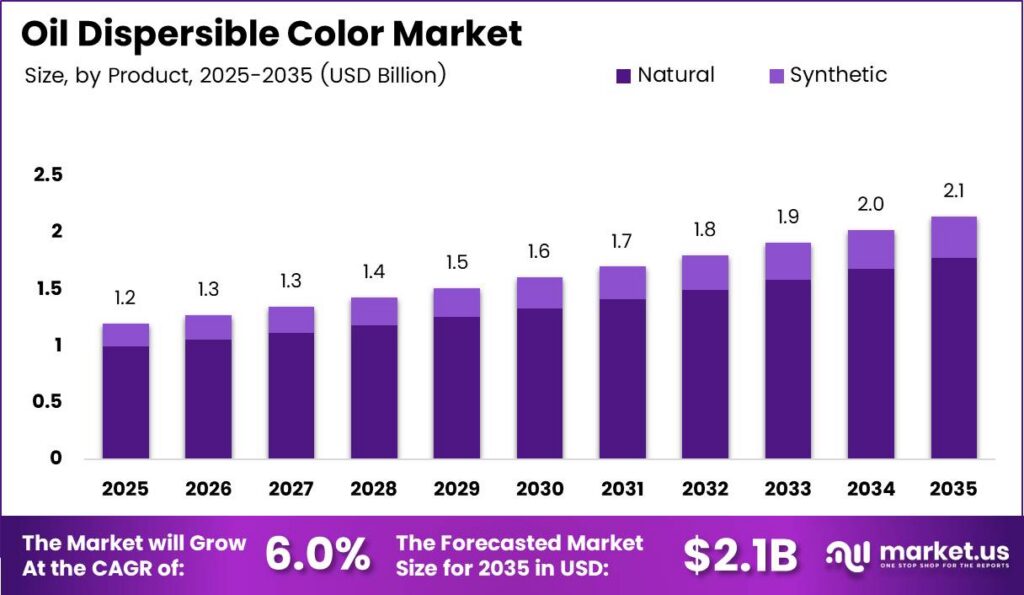
Global Oil Dispersible Color Market size is expected to be worth around USD 2.1 Billion by 2035 from USD 1.2 Billion in 2025, growing at a CAGR of 6.0% during the forecast period 2026 to 2035. Oil dispersible colors are micronized pigments and lipophilic dye suspensions engineered to disperse evenly in fat and oil phases without water. Manufacturers use these colorants to tint compound chocolate coatings, bakery shortenings, nutraceutical softgels, and anhydrous lip cosmetics without causing phase separation.
Key Takeaways
- The global Oil Dispersible Color Market was valued at USD 1.2 Billion in 2025 and is projected to reach USD 2.1 Billion by 2035.
- Revenue is forecast to expand at a compound annual growth rate of 6.0% during the forecast period from 2026 to 2035.
- By Product, the Natural segment led the market with an 82.34% share in 2025 and registers as the fastest-growing product category.
- By Type, Powdered Oil-Soluble Colors captured the largest share at 46.89% in 2025, while Gel or Emulsion Oil-Soluble Colors represent the fastest-growing type.
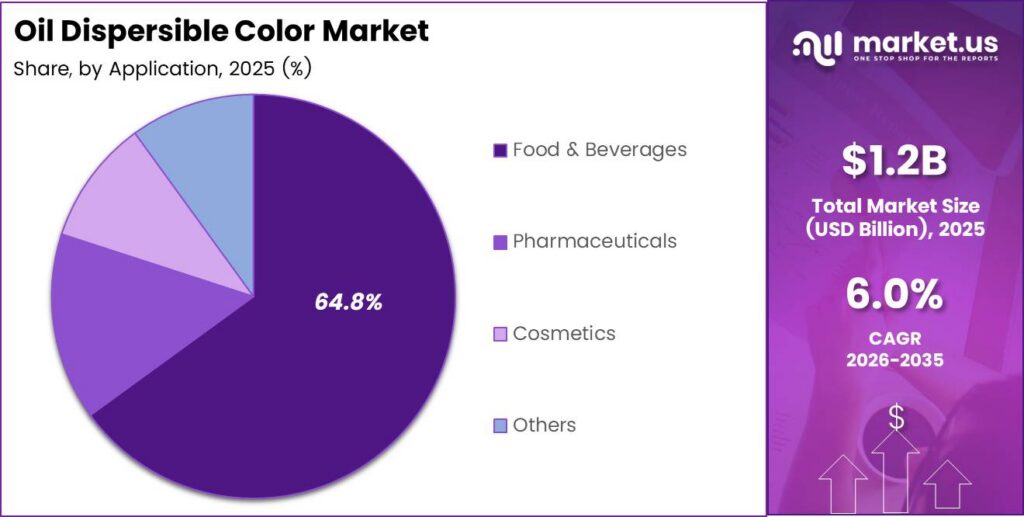
- By Application, Food & Beverages dominated with a 64.89% share in 2025 and also serves as the fastest-growing application segment.
- By Sales Channel, the Distributor channel accounted for a 71.34% share in 2025, whereas E-commerce is the fastest-growing sales channel.
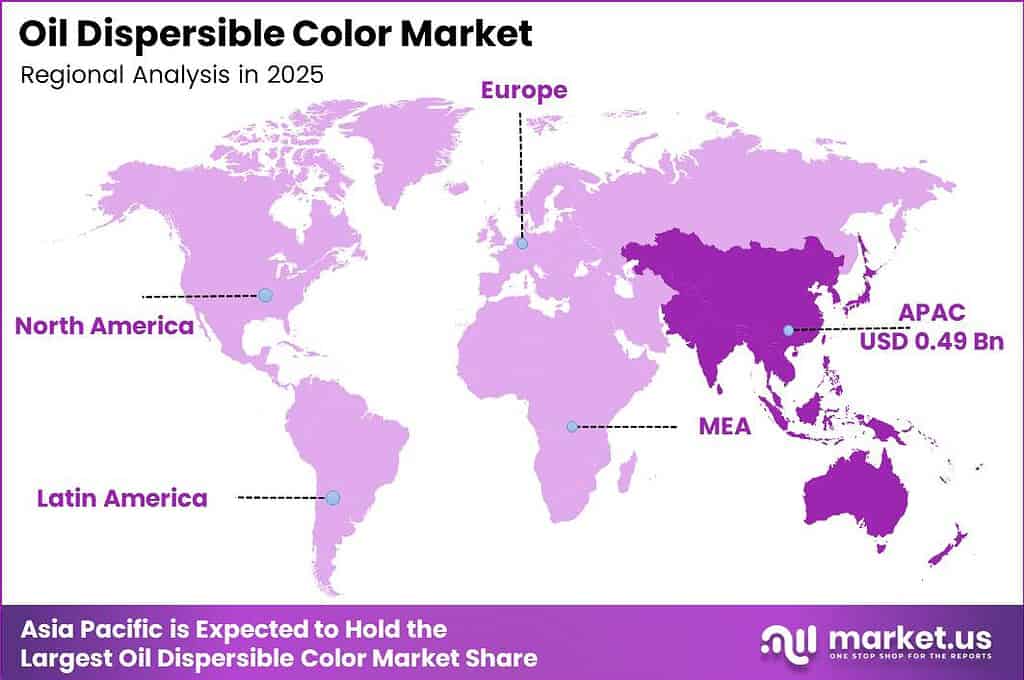
- Asia-Pacific dominated the regional landscape in 2025 with a 41.23% market share valued at USD 0.49 Billion, while Middle East & Africa is the fastest-growing region.
The market structure divides into botanical extractors, synthetic lake millers, and custom dispersion blenders serving food, pharmaceutical, and personal care formulators. According to Food and Agriculture Organization of the United Nations (FAO), global oilseed output rose 4.0% in 2024/25 to 697.4 million tonnes while oils and fats production grew 1.1% to 263.8 million tonnes . This carrier oil supply lowers feedstock costs for vegetable oil pigment suspensions. Consequently, dispersion formulators can stabilize contract pricing for industrial confectionery buyers.
Strict federal oversight governs batch purity and heavy metal limits for fat-dispersible colorants across food and drug pipelines. As reported by U.S. Food and Drug Administration (FDA), regulators certified 22,647,027.26 pounds of straight colors and lakes in fiscal year 2025, including 21,390,405.73 pounds in the food, drug, and cosmetic subtotal . Mandatory batch certification forces buyers to audit supplier compliance records closely. Therefore, certified color producers hold strong pricing power over uncertified commodity importers.
Major ingredient suppliers are expanding domestic manufacturing footprints to capture reformulation contracts from packaged food brands. In July 2026, Archer Daniels Midland invested over USD 16 million in its Boone County, Kentucky facility to add 14,000 square feet of natural color space and over 40 full-time jobs . The company targets USD 80 million to USD 100 million in operating profit from a USD 1 billion national natural colors opportunity . This capacity addition shortens domestic lead times for fat-soluble botanical dispersions.
Asia-Pacific dominates the global industry with a 41.23% market share in 2025, supported by expanding food processing infrastructure and export-oriented oleoresin extraction hubs. However, European industrial food output also anchors global demand for high-stability lipid colorants. Data from Eurostat shows that European Union sold industrial production reached EUR 6.1 trillion in 2025, rising 3.8% over 2024 as food product manufacturing grew by EUR 52 billion . This output expansion compels regional confectioners to lock in multi-year dispersion supply agreements.
Capital allocation across the specialty color sector now prioritizes natural conversion infrastructure over legacy synthetic dye maintenance. In October 2026, corporate filings showed USD 225 million to USD 250 million in planned natural color capital expenditures between 2025 and 2028, including USD 160 million for 2026 and USD 75 million in realized conversion revenue . This capital deployment requires over USD 70 million in extra working capital for botanical inventories . As a result, smaller blenders face higher barriers to scale.
Product Analysis
Natural dominates with 82.34% share in 2025 due to mandatory clean-label confectionery reformulations.
In 2025, Natural held an 82.34% share in the Product segment of the Oil Dispersible Color Market. UN Comtrade and World Bank WITS found that the European Union led global imports of vegetable and animal coloring matter at USD 296,564.85 thousand and 11,092,000 kilograms in 2024, followed by the United States at USD 223,096.16 thousand and 14,471,600 kilograms . Extracting lipophilic carotenoids and chlorophylls requires protective carrier oils to prevent oxidation during fat-phase processing. Therefore, natural extractors secure premium margins on stabilized oleoresin dispersions.
Synthetic oil-dispersible colors serve industrial buyers who require extreme heat stability, high tinting strength, and low dosage costs in non-aqueous coatings. Based on UN Comtrade and DGCI&S Customs Database data, worldwide exports of synthetic organic coloring matter reached USD 12,140.74 million in 2024, with India ranking second globally at USD 2,340.67 million or a 19.28% share . Synthetic aluminum lakes disperse into oils without bleeding because aluminum alumina substrates bind water-soluble dyes into insoluble particles. Consequently, procurement teams rely on Indian dye makers for low-cost synthetic lake supply.
Type Analysis
Powdered Oil-Soluble Colors dominates with 46.89% share in 2025 due to extended ambient shelf stability.
In 2025, Powdered Oil-Soluble Colors held a 46.89% share in the Type segment of the Oil Dispersible Color Market. U.S. Food and Drug Administration (FDA) indicates that federal laboratories batch-certified 603,815.63 pounds of drug and cosmetic lakes including 87,628.67 pounds of Yellow No. 10 Lake and 1,111,483.09 pounds of total drug and cosmetic colorants in fiscal year 2025 . Micronized dry powders eliminate carrier oil rancidity risks and reduce shipping weight for compressed tablet coatings and pressed cosmetics. This means bulk manufacturers lower freight and cold-storage expenses by stocking powdered lakes.
Gel or Emulsion Oil-Soluble Colors represent the fastest-growing type segment because pre-dispersed pastes eliminate dust hazards and speed up batch mixing in automated bakery lines. Figures from OECD-FAO show that food preparation accounts for 52% of global vegetable oil consumption, while per capita food vegetable oil demand in India will grow 2.5% annually to reach 13 kilograms per person by 2034 . Emulsifying hydrophilic pigments into vegetable oil gels using polyglycerol esters allows seamless coloring of high-fat icings without graininess. Therefore, ingredient blenders are expanding paste homogenizing lines across Asian markets.
Liquid Oil-Soluble Dyes provide immediate dissolution in non-polar hydrocarbon waxes, edible oils, and nutraceutical softgel fills where particulate opacity is undesirable. According to UN Comtrade and World Bank WITS, global exports of synthetic organic coloring preparations were led in 2024 by the European Union at USD 408,211.57 thousand, India at USD 294,332.39 thousand, and the United States at USD 268,109.07 thousand . True liquid solvent dyes and oil-miscible carotenoid dilutions integrate directly into automated liquid metering pumps without settling in holding tanks. Consequently, continuous-line processors adopt liquid dispersions to cut batch cycle times.
Application Analysis
Food & Beverages dominates with 64.89% share in 2025 due to high-volume fat-coating consumption.
In 2025, Food & Beverages held a 64.89% share in the Application segment of the Oil Dispersible Color Market and registers as the fastest-growing application. As reported by Eurostat, European Union food, beverage, and tobacco manufacturing rose 1.8% in sold production value from EUR 1,061 billion in 2023 to EUR 1,081 billion in 2024 . Compound chocolate coatings, fat-based bakery fillings, and processed snack seasonings require water-free oil dispersions so moisture does not trigger sugar bloom or seize melted cocoa butter. This signals steady volume contracts for natural food color formulators.
Pharmaceuticals manufacturers utilize oil dispersible colors to tint lipid-based softgel capsules, suppositories, and moisture-barrier tablet film coatings for accurate pill identification. Data from PhRMA shows that member biopharmaceutical companies invested USD 104 billion globally in research and development in 2024, representing 21% of revenues and surpassing USD 1 trillion since 2000 . Lipophilic drug delivery matrices require photostable iron oxides, lakes, and carotenoid suspensions to shield light-sensitive active pharmaceutical ingredients from degradation. As a result, excipient suppliers with drug master files command high switching costs.
Cosmetics brands depend on micronized oil dispersible pigments to deliver uniform chromatic payoff in lipsticks, lip glosses, anhydrous balms, and oil-based foundations. Cosmetics Europe found that European cosmetics retail sales reached EUR 109.61 billion in 2025, rising 4.6% over 2024 alongside EUR 29.81 billion in extra-European exports and EUR 13.9 billion in decorative cosmetics . Castor oil and synthetic ester pigment dispersions prevent pigment agglomeration and sweating in molded wax lip sticks. Therefore, cosmetic color houses are launching clean-label botanical dispersions for premium lip care lines.
Sales Channel Analysis
Distributor dominates with 71.34% share in 2025 due to fragmented regional formulation accounts.
In 2025, Distributor held a 71.34% share in the Sales Channel segment of the Oil Dispersible Color Market. Based on Brenntag SE Annual Report data, the global chemical and ingredients distributor generated EUR 15,171.5 million in sales and EUR 3,831.7 million in operating gross profit across 600 sites in over 70 countries in 2025 . Mid-sized bakeries and contract cosmetic labs require local warehousing, split-pallet deliveries, and bundled emulsifiers alongside oil-soluble pigments. Consequently, color manufacturers rely on specialty distributors to service fragmented regional accounts profitably.
E-commerce serves as the fastest-growing sales channel as artisanal chocolatiers, indie beauty brands, and small-batch supplement makers shift procurement to digital portals. U.S. Census Bureau indicates that national retail e-commerce sales reached USD 1,233.7 billion in 2025, growing 5.4% over 2024 to capture 16.4% of total retail sales before jumping 12.4% in second-quarter 2026 . Digital storefronts allow buyers to order small-quantity oil-dispersible color kits with instant certificate-of-analysis downloads and rapid parcel shipping. This creates higher unit margins for suppliers operating direct digital portals.
Direct Sales channels govern high-volume supply contracts where multinational food and pharmaceutical corporations require custom shade matching and dedicated application engineering. Figures from Sensient Technologies Corporation SEC Form 10-K show that consolidated revenue reached USD 1.61 billion in 2025, while direct-sold Color Group revenue grew 8.1% to USD 700.6 million and operating income rose 18.2% to USD 141.3 million . Direct technical collaboration embeds proprietary oil dispersions directly into customer master recipes during reformulation trials. Therefore, direct sellers enjoy multi-year revenue visibility and lower customer churn.
Key Market Segments
By Product
- Natural
- Synthetic
By Type
- Powdered Oil-Soluble Colors
- Gel or Emulsion Oil-Soluble Colors
- Liquid Oil-Soluble Dyes
By Application
- Food & Beverages
- Pharmaceuticals
- Cosmetics
- Others
By Sales Channel
- Distributor
- E-commerce
- Direct Sales
Regional Analysis
Asia-Pacific Dominates the Oil Dispersible Color Market with a Market Share of 41.23% in 2025, Valued at USD 0.49 Billion
Asia-Pacific leads the global market with a 41.23% share valued at USD 0.49 Billion in 2025, anchored by botanical extraction capacity in India and China alongside expanding packaged food production. According to World Bank, developing East Asia and Pacific real gross domestic product grew 5.0% in 2025 and will expand by 4.2% in 2026 and 4.4% in 2027 . Rising disposable incomes accelerate urban consumption of coated confectionery, instant noodles, and color cosmetics. Consequently, global pigment houses are opening local application labs across China, India, and Southeast Asia.
Middle East & Africa registers as the fastest-growing region as Gulf Cooperation Council states and African urban centers invest in domestic confectionery, bakery, and pharmaceutical manufacturing. As reported by International Monetary Fund (IMF), global economic output expanded by 3.5% in both 2024 and 2025 and will grow by 3.0% in 2026 and 3.4% in 2027 . Steady macroeconomic expansion supports industrial diversification into halal-certified food coatings and local nutraceutical softgel encapsulation across Dubai, Saudi Arabia, and South Africa. Therefore, ingredient suppliers are establishing regional technical hubs to capture import-substitution demand.
Key Regions and Countries
North America
- US
- Canada
Europe
- Germany
- France
- The UK
- Spain
- Italy
- Rest of Europe
Asia Pacific
- China
- Japan
- South Korea
- India
- Australia
- Rest of APAC
Latin America
- Brazil
- Mexico
- Rest of Latin America
Middle East and Africa
- GCC
- South Africa
- Rest of MEA
Market Dynamics
Regulatory bans on synthetic petroleum-derived dyes are reshaping procurement strategies, pricing structures, and capital allocation across the global lipid colorant value chain. Data from U.S. Food and Drug Administration (FDA) shows that regulators revoked FD&C Red No. 3 authorization on January 15, 2025, setting a food compliance deadline of January 15, 2027 after certifying 155,667.38 pounds in fiscal year 2025, and January 18, 2028 for ingested drugs . This statutory ban forces food and drug makers to reformulate fat-based coatings with natural oil dispersions. Consequently, suppliers with stable botanical red dispersions gain immediate contract volume.
Drivers
State and federal dye bans enacted between 2024 and 2025 are forcing confectionery and bakery brands to replace spot-bought synthetic aluminum lakes with long-term natural oil dispersion contracts. Following the California Food Safety Act signed in late 2023 for 2027 enforcement, the September 2024 California School Food Safety Act banning Red 40, Yellow 5, and Yellow 6 lakes, and the January 2025 federal Red No. 3 revocation, commercial reformulation pipelines expanded by 35% to 45%. Formulators must wet-mill spirulina, beet, and anthocyanins in medium-chain triglyceride and sunflower oils below 2.5 microns.
Replacing synthetic lakes with natural oil dispersions raises raw colorant dosage costs by 3.2x to 4.8x per kilogram of finished product and requires 15% to 25% higher pigment loading to match shade intensity. However, specialty color suppliers have shifted from volume-based commodity pricing to value-based formulation service contracts. This commercial transition cuts customer acquisition payback periods from 18 months down to 11 months. Consequently, natural dispersion producers lock in multi-year supply agreements that defend gross margins between 34% and 38%.
| Driver | (~) % Impact on CAGR Forecast | Geographic Relevance | Impact Timeline |
|---|---|---|---|
| Mandatory Regulatory Migration From Synthetic Lake Dyes | +2.2% | North America & Europe | Short term (≤ 2 years) |
| Proliferation of High-Fat Plant-Based Dairy & Confectionery Matrices | +1.6% | Global | Medium term (2–4 years) |
| Surge in Anhydrous Color Cosmetics & Lip Care Formulations | +1.3% | Asia-Pacific & North America | Short term (≤ 2 years) |
| Adoption of Softgel Nutraceutical Delivery Systems | +0.9% | North America & Europe | Medium term (2–4 years) |
| Expansion of Automated Industrial Bakery Coating Lines | +0.7% | Asia-Pacific & Latin America | Long term (≥ 4 years) |
Restraints
European Commission Regulation 2022/63 banning Titanium Dioxide (E171) in food, alongside European Food Safety Authority intake reviews for inorganic carriers through 2025, actively blocks opaque and pastel oil dispersion sales across Europe. Titanium dioxide delivered a 2.7 refractive index that created sharp opacity in dark compound coatings at 0.5% to 1.0% usage rates. Replacing it with calcium carbonate or rice starch requires 3.5% to 6.0% solid loading, which raises Casson plastic viscosity by 40% to 65% and clogs depositor nozzles.
Because high solid loadings disrupt fluid mechanics in high-speed panning and molding lines, European confectionery and pharmaceutical coaters have frozen commercial launches for 22% of planned multi-color stock-keeping units. Manufacturers using alternative opacifiers suffer an 18% drop in line speeds, which compresses gross margins by 280 to 420 basis points. As a result, plant operators are delaying capital expenditures for secondary color dosing skids by 12 to 24 months until low-viscosity whitening carriers reach commercial scale.
| Restraint | (~) % Impact on CAGR Forecast | Geographic Relevance | Impact Timeline |
|---|---|---|---|
| EU Titanium Dioxide Ban & Opacifier Replacement Bottlenecks | -1.4% | Europe & Export Markets | Short term (≤ 2 years) |
| Strictly Capped Regulatory ADI Limits on Oil-Soluble Synthetics | -0.9% | Global | Medium term (2–4 years) |
| Prohibitive Cold-Chain Logistics Costs for Unstabilized Dispersions | -0.7% | Emerging Markets | Short term (≤ 2 years) |
| Stringent Residual Solvent Thresholds in Oleoresin Extraction | -0.5% | North America & Europe | Medium term (2–4 years) |
| High Capital Expenditure for Sub-Micron Wet Milling Retrofits | -0.4% | Global | Long term (≥ 4 years) |
Challenges
Severe weather volatility across botanical farming regions between 2024 and 2026 creates ongoing supply chain and input cost friction for natural oil dispersion formulators. Erratic monsoons in southern India reduced paprika and turmeric oleoresin yields, while frost in Peru and Spain disrupted annatto and carmine harvests. Seasonal raw pigment concentration has swung by 20% to 35%, triggering spot price spikes of 45% for bixin extracts and 60% for high-capsanthin paprika oleoresins while stretching standardization lead times from 45 days to 95 days.
To prevent customer stockouts during harvest shortfalls, tier-one color formulators must hold 120 to 150 days of climate-controlled buffer inventory. Carrying this safety stock ties up an extra 14% to 19% of corporate working capital and squeezes cash flow. Therefore, leading ingredient houses are investing in dual-hemisphere farming contracts and spectrophotometric blending software to keep batch color variance below a Delta E tolerance of 1.0 across every commercial shipment.
| Challenge | (~) % CAGR Friction Drag | Geographic Relevance | Mitigation Horizon |
|---|---|---|---|
| Botanical Raw Material Yield Volatility | -1.2% | Global | Medium term (2–4 years) |
| Lipid Carrier Thermal & Photo-Oxidation | -0.8% | Global | Short term (≤ 2 years) |
| Rheological Flocculation in High-Shear Lines | -0.6% | North America & Europe | Medium term (2–4 years) |
| Cross-Batch Chromatic Standardization Drift | -0.5% | Asia-Pacific & Latin America | Short term (≤ 2 years) |
| Dispersion Formulation Specialist Talent Deficit | -0.3% | Global | Long term (≥ 4 years) |
Opportunities
Scaling precision-fermented and closed-photobioreactor algal pigments engineered for direct fat solubility offers substantial untapped white space above current baseline forecasts. Most biosynthetic colorants developed before 2026 targeted water-based beverages rather than lipid-continuous coatings. By using oleaginous yeast strains like Yarrowia lipolytica and non-GMO microalgae to accumulate esterified astaxanthin, beta-carotene, and phycobiliprotein-lipid complexes at purities above 92%, innovators bypass agricultural land limits and eliminate up to 3 solvent-partitioning steps.
Commercializing fermented lipophilic pigments at bioreactor scales above 50,000 liters will cut unit production costs by 28% to 36% per kilogram compared to field-grown botanical extraction. Superior intrinsic fat solubility also reduces required carrier oil dilution by 40% in finished dispersions. Consequently, early movers that secure patent licensing and joint ventures between 2027 and 2030 can capture 550 to 800 basis points of gross margin expansion across functional food and dermocosmetic accounts.
| Opportunity | (~) % Potential CAGR Upside | Geographic Relevance | Execution Window |
|---|---|---|---|
| Precision-Fermented & Algal Lipid-Soluble Pigments | +1.9% | North America, Europe & Asia-Pacific | Medium term (2–4 years) |
| Nano-Encapsulated Solid Lipid Color Microparticles | +1.4% | Global | Long term (≥ 4 years) |
| Upcycled Agro-Waste Lycopene & Beta-Carotene Extraction | +1.1% | Europe & Latin America | Medium term (2–4 years) |
| Clean-Label Emulsifier-Free Polyglycerol Ester Systems | +0.8% | North America & Europe | Short term (≤ 2 years) |
| 3D-Printed Nutraceutical & Confectionery Lipid Inks | +0.5% | Asia-Pacific & North America | Long term (≥ 4 years) |
Key Company Insights
DDW The Color House
DDW The Color House operates as the core natural color pillar of Givaudan Sense Colour, supplying oil-dispersible botanical emulsions, caramelized colorants, and mineral dispersions across North America, Europe, and Asia. Givaudan SA Annual Report found that Group sales reached CHF 7,472 million in 2025 with 5.1% like-for-like growth, while Taste & Wellbeing sales hit CHF 3,642 million alongside Group EBITDA of CHF 1,751 million at a 23.4% margin . Strong corporate cash flow of 14.1% funds continuous milling and emulsion innovation .
The company is investing heavily in North American liquid and dispersion manufacturing to capture synthetic dye replacement contracts. Based on Givaudan Official Press Release data, the Taste & Wellbeing division broke ground in October 2025 on a CHF 187 million or USD 215 million liquids production facility in Reading, Ohio spanning 24,000 square meters on a 100,000-square-meter site . Scheduled for completion in 18 months for 2027 operations, this plant expands regional supply security for U.S. confectionery and bakery brands .
Roha Dyechem Pvt. Ltd.
Roha Dyechem Pvt. Ltd. manufactures synthetic aluminum lakes, oil-dispersible natural dispersions under its Natracol brand, and cosmetic pigments across 14 application laboratories worldwide . Roha Dyechem Official Filings and CARE Ratings indicate that consolidated operating income reached INR 2,414.60 crore in fiscal year 2024 and INR 1,857.14 crore in nine-month fiscal 2025, while standalone revenue rose 11.0% to INR 2,482.15 crore . Its 35,000-square-meter Dahej complex operates 5 facilities producing 1,500 tons monthly, giving Roha cost leadership in bulk dispersions .
Roha actively uses cross-border acquisitions to backward-integrate into critical botanical raw materials for fat-soluble food colors. Figures from ROHA Official Press Release show that in September 2025, the company acquired Brazilian natural color producer Tebracc, which specializes in oil-soluble annatto bixin and norbixin extraction . This deal expands Roha’s commercial presence across 25 countries and 14 manufacturing nations . Securing direct Brazilian annatto supply shields Roha and its global dairy and snack customers from spot raw material price swings.
Key Players
- DDW The Color House
- Roha Dyechem Pvt. Ltd.
- GNT Group B.V.
- Lycored
- Naturex (a Givaudan company)
- AromataGroup
- Kalsec Inc.
- Fiorio Colori S.p.A.
- Other Key Players
Recent Developments
2026
- October 2026: Vidhi Specialty Food Ingredients Limited investment announced an INR 25 crore to INR 35 crore capital expenditure for a CoatIcon pharmaceutical tablet-coating color facility at Roha alongside an INR 75 crore to INR 85 crore expansion on a 16,834 square meter plot in Dahej per Vidhi Specialty Food Ingredients Filing .
- August 2026: Sudarshan Chemical Industries Limited acquisition signed a definitive agreement through its Swiss subsidiary to acquire Clariant’s aluminium dyes and chemicals manufacturing plant in Muttenz, Switzerland for a base consideration of CHF 7 million per Sudarshan Chemical Official Press Release .
- July 2026: Kalsec Inc. capacity expansion opened its new Spice Processing Center in Kalamazoo, Michigan completed with over 29,000 work hours and 0 recordable injuries to expand natural spice and oleoresin color processing per Kalsec Official Press Release .
- May 2026: Phytolon Ltd. funding round closed a USD 23.6 million Series B financing across 3 tranches bringing total funding to USD 43.6 million with Colorcon Ventures and Millennium Foodtech to commercialize fermented natural food colors per PR Newswire and Phytolon .
- May 2026: Oterra and Debut Biotechnology partnership entered a multi-million-dollar agreement to co-develop and scale a precision-fermentation natural alternative to Red 40 across 3 shade families within an estimated 3 year commercialization window per Oterra Official Press Release .
- February 2026: U.S. Food and Drug Administration regulatory approval approved Phytolon’s fermentation-derived Beetroot Red under 21 CFR 73.39 following 3 natural color approvals in May 2025 and Gardenia Blue in July 2025 totaling 4 natural approvals in 2 months per U.S. FDA and Federal Register .
- January 2026: Archer Daniels Midland investment committed USD 26 million to expand its Erlanger, Kentucky natural colors and flavors campus by 3,600 square feet and raise raw material handling capacity by 40% following a USD 15 million and 7,200 square foot innovation expansion in 2025 per ADM Official Press Release .
2025
- October 2025: Lycored product launch debuted its microencapsulated Lycobeads VAS 10% lycopene technology across 4 delivery formats at SupplySide Global 2025 and launched Lumenato and Lycoderm carotenoid complexes across the 27 member European Union per Lycored Official Press Release .
- August 2025: Nactarome Group acquisition agreed to acquire UK flavor and color developer Claremont Ingredients Limited from THG Plc for approximately GBP 100 million adding GBP 14 million in annual revenue and expanding Nactarome to 10 plants, over 450 employees, and over EUR 135 million in turnover per TA Associates and Nactarome Official Release .
- May 2025: Oterra capacity expansion opened a 155,000 square foot or 14,400 square meter U.S. headquarters and production hub in Mt. Pleasant, Wisconsin with 40,000 square feet of expansion space as 2024/25 revenue rose 7.2% to EUR 447.1 million and EBITDA grew 37.9% to EUR 69.9 million per Oterra Official Press Release .
- March 2025: Sudarshan Chemical Industries Limited acquisition completed the purchase of Germany’s Heubach Group global pigment business for EUR 127.5 million or USD 134 million upfront plus EUR 29.4 million in working capital adjustments across 19 sites in 11 countries per Sudarshan Chemical Filing .
2024
- August 2024: Kalsec Inc. capacity expansion opened an 8,000 square foot Finishing and Distribution Centre in Mildenhall, Suffolk on its 29 year UK campus to localize European natural color and food protection supply chains per Kalsec Official Press Release .
- July 2024: Givaudan SA acquisition completed the purchase of the remaining 75% stake in Italian makeup and skincare formulator b.kolormakeup & skincare for CHF 310 million or EUR 322 million valuing 100% at CHF 428 million across 2 factories and over 300 employees generating CHF 77 million in sales per Givaudan Official Press Release .
Geopolitical Impact Analysis
Maritime chokepoint disruptions and shifting tariff regimes directly inflate the landed cost of botanical oleoresins and synthetic dye intermediates. According to World Trade Organization (WTO), global merchandise trade volume grew 4.6% in 2025 to reach USD 26.26 trillion in export value, up 7%, and will expand by 3.9% in 2026 as Asian import volumes surge 9.5% . However, as reported by UNCTAD, seaborne trade grew 2.2% in volume and 5.9% in ton-miles in 2024 with containerized demand up 7.1% due to Red Sea rerouting around the Cape of Good Hope, before maritime volume growth slowed to 0.5% in 2025 . Longer Cape transit routes expose heat-sensitive paprika, turmeric, and annatto oleoresin containers shipped from India to Europe to thermal oxidation, forcing color blenders to pay for refrigerated reefers and carry larger safety inventories.
Escalating military conflict across the Middle East in 2026 has disrupted petrochemical solvent feedstocks and regional food-coating trade flows. Data from World Bank shows that economic output across the Middle East, North Africa, Afghanistan, and Pakistan grew 3.3% in 2025 but will contract by 2.1% in 2026, with non-Iran growth dropping from 4.0% to 1.8% following Strait of Hormuz closures . Similarly, International Energy Agency (IEA) found that global oil demand will fall by 2.6 million barrels per day in 2026 to 102.4 million barrels per day after dropping 5.0 million barrels per day in second-quarter 2026 and 3.7 million barrels per day in third-quarter 2026 after a 0.65 million barrels per day gain in 2025 . Crude supply shocks raise toluene, xylene, and hexane extraction solvent prices, compressing margins for synthetic dye makers and oleoresin extractors.
Report Scope
| Report Features | Description |
|---|---|
| Market Value (2025) | USD 1.2 Billion |
| Forecast Revenue (2035) | USD 2.1 Billion |
| CAGR (2026-2035) | 6.0% |
| Base Year for Estimation | 2025 |
| Historic Period | 2021-2025 |
| Forecast Period | 2026-2035 |
| Report Coverage | Revenue Forecast, Market Dynamics, Market Opportunity Analysis, Technology and Innovation Landscape, Competitive Landscape, Recent Developments |
| Segments Covered | By Product (Natural, Synthetic), By Type (Powdered Oil-Soluble Colors, Gel or Emulsion Oil-Soluble Colors, Liquid Oil-Soluble Dyes), By Application (Food & Beverages, Pharmaceuticals, Cosmetics, Others), By Sales Channel (Distributor, E-commerce, Direct Sales) |
| Regional Analysis | North America (US and Canada), Europe (Germany, France, The UK, Spain, Italy, and Rest of Europe), Asia Pacific (China, Japan, South Korea, India, Australia, and Rest of APAC), Latin America (Brazil, Mexico, and Rest of Latin America), Middle East and Africa (GCC, South Africa, and Rest of MEA) |
| Competitive Landscape | DDW The Color House, Roha Dyechem Pvt. Ltd., GNT Group B.V., Lycored, Naturex (a Givaudan company), AromataGroup, Kalsec Inc., Fiorio Colori S.p.A., Other Key Players |
| Customization Scope | Customization for segments, region / country-level will be provided. Additional customization can be done based on requirements. |
| Purchase Options | We have three licenses to opt for: Single User License | Multi-User License (Up to 5 Users) | Corporate Use License (Unlimited User and Printable PDF) |