


Report Overview
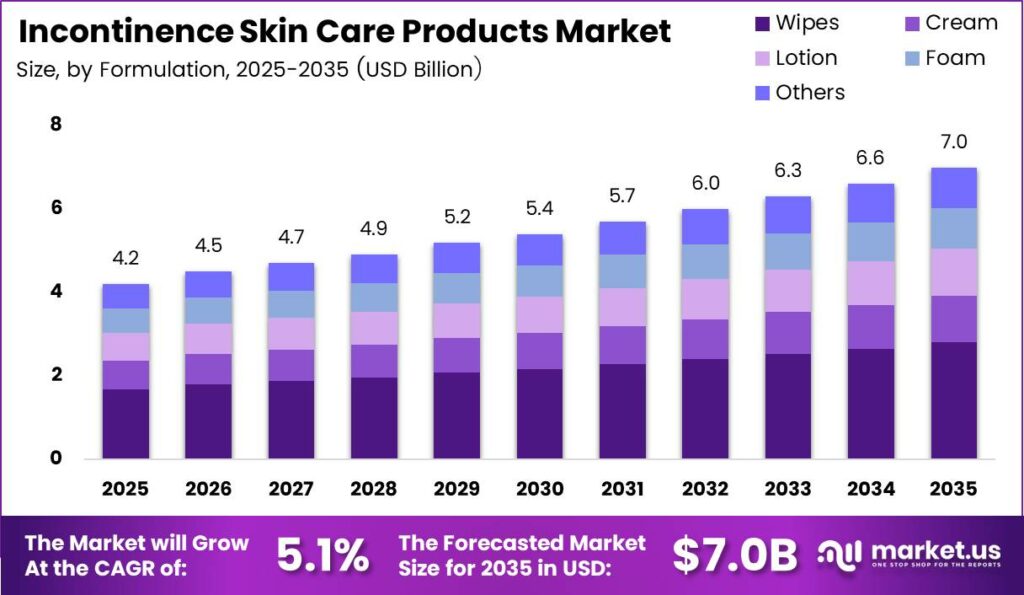
Global Incontinence Skin Care Products Market size is expected to be worth around USD 7.0 Billion by 2035 from USD 4.2 Billion in 2025, growing at a CAGR of 5.1% during the forecast period 2026 to 2035.
The incontinence skin care products market covers cleansers, wipes, barrier creams, repair creams, moisturizers, body wash, gels, and related topical formulations used to protect and restore skin integrity in incontinent patients. These products serve hospital, long-term care, and home-care settings across all age groups and genders.
Key Takeaways
- The Global Incontinence Skin Care Products Market is valued at USD 4.2 Billion in 2025 and is forecast to reach USD 7.0 Billion by 2035, growing at a CAGR of 5.1% during the forecast period 2026 to 2035.
- By Product Type, Cleansing and Deodorizing Wipes dominate with a 24.00% share in 2025, driven by high-frequency use and single-step application efficiency in institutional care settings.
- By Formulation, Wipes lead with a 39.00% share, favored for their no-rinse, low-burden format that supports protocol adherence in understaffed care environments.
- By Packaging, Bottles hold the largest share at 22.00%, owing to their versatility across product viscosity ranges and suitability for both institutional and home-care use.
- By Price Range, Mid-Range products command the dominant position with a 49.00% share, reflecting institutional procurement preference for clinically adequate formulations at manageable cost.
- By End User, Women account for the largest share at 56.00%, reflecting higher anatomical incontinence prevalence and greater per-capita consumption of skin care and protective products.
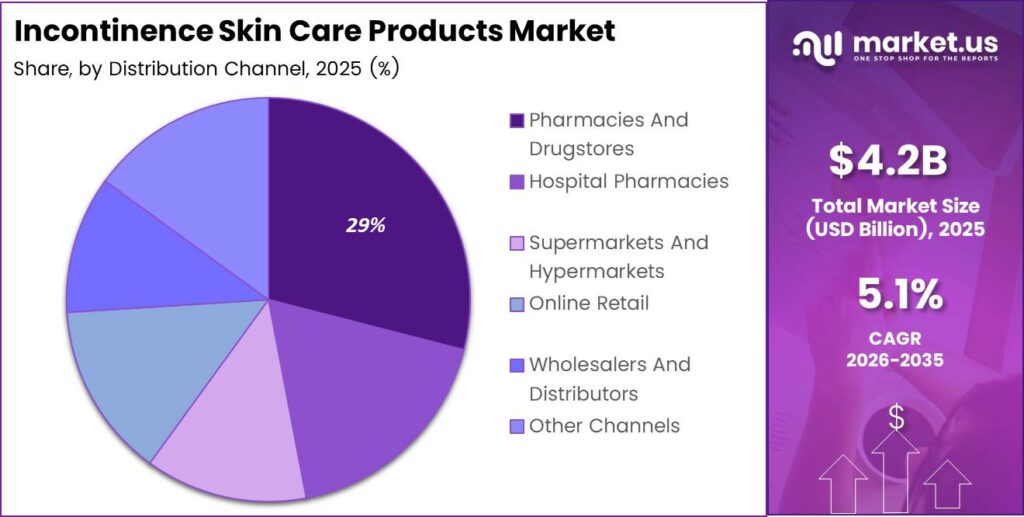
- By Distribution Channel, Pharmacies and Drugstores lead with a 29.00% share, supported by their advisory role in directing caregiver product selection toward tested formulations.
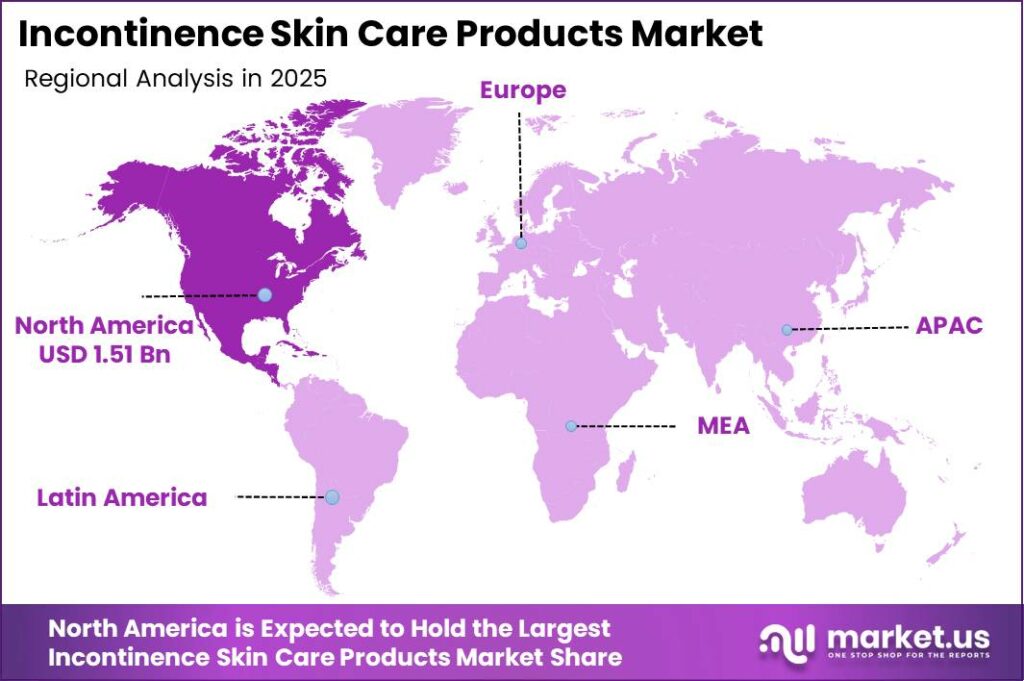
- North America is the dominant region with a 36.00% share, valued at USD 1.51 Billion in 2025, supported by institutionalized skin-care protocols and established clinical procurement infrastructure.
Regulatory tightening around hospital-acquired conditions and institutional skin-integrity protocols is shifting procurement from ad hoc product purchasing toward structured prevention systems. Care bundles that combine cleansing, moisturization, and barrier protection are entering formulary decisions in North America, Western Europe, and Australia, creating recurring contract volumes and more predictable revenue for compliant suppliers.
According to the 2025 Cochrane review, a foam skin cleanser produced an incontinence-associated dermatitis risk ratio of 0.35 versus soap and water across 65 participants. This represents an estimated 65% lower relative risk. This clinical signal supports formulary conversion toward pH-balanced cleansers, which benefits manufacturers whose products carry supporting evidence.
Based on 2025 Cochrane review data, a cleanser-plus-leave-on-product regimen achieved an itching risk ratio of 0.04 versus conventional care across 180 participants, implying a 96% relative reduction. This outcome strengthens the commercial case for combination regimen kits. In February 2026, Essity completed the acquisition of Edgewell Personal Care’s feminine care business, signaling that major players are consolidating adjacent hygiene categories to cross-sell into skin care channels.
Product Type Analysis
Cleansing and Deodorizing Wipes dominates with 24.00% due to high-frequency use in incontinence care.
In 2025, Cleansing and Deodorizing Wipes held a dominant market position in the By Product Type segment of the Incontinence Skin Care Products Market, with a 24.00% share. These wipes address both hygienic and odor-control needs in a single application, reducing the product count per care episode. Institutional buyers favor them for speed-of-use in high-volume care settings, supporting consistent replenishment volumes.
Barrier Creams and Repair Creams serve different clinical stages of skin breakdown. Barrier creams form a protective layer against moisture and irritants during ongoing incontinence exposure, while repair creams target skin already exhibiting damage. Buyers purchasing these products shift from prevention to treatment spend, which carries higher per-unit value and supports gross margin for specialty formulators.
Moisturizers and Lotions maintain skin hydration and elasticity during repeated cleansing cycles. As per our research, a cleanser-plus-leave-on-product approach versus conventional care without a leave-on product yielded a pain risk ratio of 0.33 across 180 participants, and a no-rinse cleanser plus cream versus soap-and-water plus lotion produced a pain risk ratio of 0.58 across 31 participants. These outcomes position moisturizing leave-on products as clinically relevant additions that formulary managers can justify to procurement committees.
Body Wash and Shampoo, Wet and Dry Wipes, Gels and Oils, and Other Products collectively hold the remaining share. These formats meet specific caregiver preferences and patient needs, from waterless bathing solutions to targeted skin treatments, and represent incremental revenue opportunities for suppliers offering full-range portfolios to institutional buyers seeking single-vendor procurement.
Formulation Analysis
Wipes dominates with 39.00% due to single-step application suitability in care settings.
In 2025, Wipes held a dominant market position in the By Formulation segment of the Incontinence Skin Care Products Market, with a 39.00% share. The single-step, no-rinse format reduces caregiver time per care episode, which is critical in understaffed long-term care environments. Clinical guidance recommends checking absorbent continence products every 2 to 3 hours, making low-burden formats like wipes operationally essential for protocol adherence.
Cream formulations offer prolonged skin contact and occlusive barrier properties that wipes and rinse-off products cannot replicate. They are preferred in high-risk patients where liquid or loose faeces exposure produces incontinence-associated dermatitis odds ratios of approximately 2.5 to 5.0 versus formed faeces exposure. This quantifies the clinical environment in which cream-based barrier products deliver the strongest protective argument for institutional buyers.
Lotion, Foam, and Other formulations serve distinct caregiver and patient preferences across care settings. Foam cleansers, in particular, carry clinical data showing a 65% lower relative risk of incontinence-associated dermatitis versus soap and water. As a result, foam formats offer manufacturers a differentiation pathway in institutional procurement decisions where evidence-based justification is required for formulary inclusion.
Packaging Analysis
Bottles dominates with 22.00% due to versatility across product viscosity and care settings.
In 2025, Bottles held a dominant market position in the By Packaging segment of the Incontinence Skin Care Products Market, with a 22.00% share. Bottles accommodate a wide viscosity range, from thin lotions to thicker barrier creams, making them a practical default format for institutional and retail buyers. Their resealability and durability support multi-use protocols in hospital and long-term care environments.
Tubes, Pump Dispensers, and Spray Containers offer controlled dosing and reduced product waste per application. Pump dispensers are particularly suited to high-frequency care protocols because they allow one-handed operation, reducing cross-contamination risk during caregiver-patient contact. These formats attract premium pricing and support margin expansion for manufacturers targeting professional care buyers.
Sachets, Tubs, and Other Packaging formats address single-use, travel, and bulk institutional needs respectively. Sachets support unit-dose hygiene in acute care settings, while tubs favor high-frequency home-care use. Suppliers who offer packaging flexibility across the same formulation line can serve both institutional contract buyers and direct-to-consumer retail channels without reformulating the underlying product.
Price Range Analysis
Mid-Range dominates with 49.00% due to balance of clinical adequacy and affordability.
In 2025, Mid-Range held a dominant market position in the By Price Range segment of the Incontinence Skin Care Products Market, with a 49.00% share. Mid-range products occupy the procurement sweet spot for institutional buyers who require clinically adequate formulations without premium pricing. This segment captures the largest share because facility budgets favor proven efficacy over brand premiums in cost-managed care environments.
The Premium segment targets higher-income households and institutional buyers with advanced formulation requirements. Premium barrier systems, pH-optimized cleansers, and durable film-forming protectants command higher per-unit pricing and support the gross margin structures that fund manufacturer investment in clinical evidence and caregiver education programs. However, their impact ratio of 0.85 between combination and single leave-on products in 74 participants signals that premium combinations do not always demonstrate statistical superiority.
Economy products serve price-sensitive home-care buyers and lower-resource institutional settings where product substitution with soap and generic moisturizers remains common. This segment faces the most direct competition from private-label alternatives and suppresses premium penetration in emerging markets. Suppliers targeting the economy tier must compete on pack-size efficiency and distribution reach rather than formulation differentiation.
End User Analysis
Women dominates with 56.00% due to higher anatomical incontinence prevalence in female populations.
In 2025, Women held a dominant market position in the By End User segment of the Incontinence Skin Care Products Market, with a 56.00% share. Female anatomy and post-partum pelvic floor changes drive higher incontinence prevalence, which translates into higher per-capita consumption of cleansers, protective creams, and wipes. This gender asymmetry makes women the primary commercial target for product development and retail marketing investment.
Men represent a structurally distinct buyer profile, with incontinence commonly associated with post-prostatectomy outcomes and age-related bladder decline. Their product needs lean toward discreet formats and odor control rather than the broader skin-integrity protocols favored in female care regimens. Suppliers who tailor pack sizes and messaging to male caregivers and patients can differentiate in an underserved segment.
Children represent the smallest end-user segment, primarily covering pediatric patients with neurogenic bladder conditions or developmental delays. Care requirements in this cohort emphasize gentle, fragrance-free formulations to minimize sensitization risk. Institutional buyers in pediatric care units require supplier documentation of dermatological safety and low-irritant claims, raising the regulatory preparation burden for product entry.
Distribution Channel Analysis
Pharmacies and Drugstores dominates with 29.00% due to clinical trust and accessibility for caregivers.
In 2025, Pharmacies and Drugstores held a dominant market position in the By Distribution Channel segment of the Incontinence Skin Care Products Market, with a 29.00% share. Pharmacists serve as informal clinical advisors to home caregivers, directing product selection toward tested formulations. This advisory role reinforces brand loyalty and supports consistent replenishment of mid-range and premium SKUs rather than economy substitution.
Hospital Pharmacies and Supermarkets and Hypermarkets serve distinct buyer segments. Hospital pharmacies manage institutional formulary contracts and drive high-volume, protocol-linked purchasing decisions. Supermarkets and hypermarkets reach home-care buyers through convenience-driven shelf placement, making private-label competition most acute in this channel, where price comparison is visible and brand differentiation is harder to sustain.
Online Retail, Wholesalers and Distributors, and Other Channels collectively capture the remaining distribution share. Online retail enables subscription-based replenishment models that reduce churn and increase customer lifetime value for branded suppliers. Wholesalers and distributors remain important for reaching fragmented independent pharmacy and rural retail networks that national brands cannot serve cost-effectively through direct logistics.
Key Market Segments
By Product Type
- Cleansing and Deodorizing Wipes
- Barrier Creams
- Repair Creams
- Moisturizers and Lotions
- Body Wash and Shampoo
- Wet and Dry Wipes
- Gels and Oils
- Other Products
By Formulation
- Wipes
- Cream
- Lotion
- Foam
- Others
By Packaging
- Bottles
- Tubes
- Pump Dispensers
- Spray Containers
- Sachets
- Tubs
- Other Packaging
By Price Range
- Economy
- Mid-Range
- Premium
By End User
- Women
- Men
- Children
By Distribution Channel
- Pharmacies and Drugstores
- Hospital Pharmacies
- Supermarkets and Hypermarkets
- Online Retail
- Wholesalers and Distributors
- Other Channels
Regional Analysis
North America Dominates the Incontinence Skin Care Products Market with a Market Share of 36.00%, Valued at USD 1.51 Billion
North America holds the largest regional share at 36.00%, valued at USD 1.51 Billion in 2025. The region benefits from institutionalized skin-care protocols across hospitals, post-acute care, and long-term care facilities. High reimbursement coverage for medical supplies, established pharmacy distribution networks, and clinical purchasing committees that favor evidence-backed formulations reinforce North America’s revenue leadership in this market.
Asia-Pacific represents the fastest-growing regional opportunity, driven by rapid expansion of elder population cohorts in China, Japan, South Korea, and India, alongside rising institutional care infrastructure investment. Urban middle-class households in this region are shifting from commodity hygiene products toward specialized incontinence skin care, creating early-stage but high-potential retail and institutional demand for both mid-range and premium product tiers.
Europe maintains strong institutional procurement discipline through national health systems in Germany, France, and the UK, which embed skin-care protocols into nursing and hospital care standards. Latin America, the Middle East, and Africa represent earlier-stage markets where affordability constraints and lower clinical awareness limit premium product penetration but create long-term volume opportunities as care infrastructure expands and household income rises.
Key Regions and Countries
North America
- US
- Canada
Europe
- Germany
- France
- The UK
- Spain
- Italy
- Rest of Europe
Asia Pacific
- China
- Japan
- South Korea
- India
- Australia
- Rest of APAC
Latin America
- Brazil
- Mexico
- Rest of Latin America
Middle East and Africa
- GCC
- South Africa
- Rest of MEA
Drivers
Population ageing creates structural demand for incontinence skin care products because rising survival into high-dependency age groups expands the pool of patients requiring repeated cleansing, moisturizing, and barrier protection. The global share of people aged 65 and older reached 10.3% in 2024, and the population aged 60 and above is projected to climb from 1.1 billion in 2023 to 1.4 billion by 2030. This trajectory supports predictable institutional replenishment volumes and strengthens manufacturers’ ability to price pH-balanced, low-irritant systems at a premium.
In long-term care settings, incontinence affects approximately 60 to 80% of older adults, converting product consumption from episodic to routine. This recurrence frequency creates steady institutional purchasing rather than variable retail demand, supporting formulary contracts and enabling manufacturers to invest in caregiver-friendly packaging and durable barrier innovations. Vendors who align product development with this demographic shift gain structural advantages over those relying on general consumer channels.
| Driver | (~) % Impact on CAGR Forecast | Geographic Relevance | Impact Timeline |
|---|---|---|---|
| Population ageing and care dependence | +1.2% | Global; strongest in East Asia, Europe, North America and urban Asia-Pacific | Long term (≥ 4 years) |
| Institutional skin-care protocols | +0.9% | North America, Western Europe, Australia, Japan and Gulf care systems | Short term (≤ 2 years) |
| Chronic incontinence burden | +0.8% | Global; concentrated in long-term care and home-care populations | Medium term (2–4 years) |
| Home-based eldercare expansion | +0.7% | North America, Europe, Japan, China and India | Medium term (2–4 years) |
| Premium barrier formulation adoption | +0.5% | Higher-income urban markets worldwide | Short term (≤ 2 years) |
| Post-acute care standardization | +0.4% | North America, Europe and developed Asia-Pacific | Medium term (2–4 years) |
Restraints
Out-of-pocket affordability limits premium product penetration because incontinence skin care requires repeated purchasing that becomes a recurring household expense without reimbursement support. In constrained markets, caregivers substitute soap, generic moisturizer, or reduced product frequency for clinical-grade cleansers and leave-on protectants. This behavior compresses realized price per unit and pushes suppliers toward smaller pack sizes and promotional pricing, reducing gross margin even as packaging and distribution costs remain fixed.
| Restraint | (~) % Impact on CAGR Forecast | Geographic Relevance | Impact Timeline |
|---|---|---|---|
| Out-of-pocket affordability limits | -1.0% | Emerging markets and uninsured home-care segments globally | Short term (≤ 2 years) |
| Reimbursement coverage gaps | -0.8% | United States, emerging Europe, Latin America and Asia-Pacific | Medium term (2–4 years) |
| Private-label price pressure | -0.7% | North America, Europe and large organized retail markets | Short term (≤ 2 years) |
| Fragmented product classification | -0.6% | Global; especially cross-border consumer-health markets | Medium term (2–4 years) |
| Low diagnosis-linked prescribing | -0.5% | Primary-care and home-care markets worldwide | Medium term (2–4 years) |
| Caregiver awareness shortfall | -0.4% | Rural and lower-resource care settings globally | Short term (≤ 2 years) |
Challenges
Proving clinical differentiation remains the central operational challenge for branded incontinence skin care suppliers. Reported incontinence-associated dermatitis prevalence among older adults spans approximately 3 to 30%, and this heterogeneity across facilities makes cross-setting outcome comparisons unreliable. Suppliers must fund pragmatic trials, develop standardized documentation tools, and build health-economic cases over multiple years before institutional buyers convert trial orders into high-volume standardized contracts.
| Challenge | (~) % CAGR Friction Drag | Geographic Relevance | Mitigation Horizon |
|---|---|---|---|
| Clinical differentiation evidence gap | -0.9% | Global; most acute in institutional procurement | Medium term (2–4 years) |
| Caregiver training variability | -0.8% | Global across home care, hospitals and long-term care | Medium term (2–4 years) |
| Raw-material cost volatility | -0.6% | Global manufacturing and import-dependent markets | Short term (≤ 2 years) |
| Multi-step regimen adherence | -0.6% | Global; especially understaffed care environments | Medium term (2–4 years) |
| Packaging waste requirements | -0.5% | Europe, North America and developed Asia-Pacific | Long term (≥ 4 years) |
| Skin-condition misclassification | -0.5% | Global acute-care and long-term-care settings | Medium term (2–4 years) |
Opportunities
Protocol-led care bundles represent the highest-upside commercial opportunity because most providers still procure cleansers, wipes, moisturizers, and barrier products as separate commodity categories. A structured bundle combining low-pH cleansing, moisturization, and film-based protection can increase revenue per care episode by approximately 15 to 30% and lift gross margin by an estimated 3 to 7 percentage points. Successful execution could add approximately 1.1% above the 5.1% baseline CAGR.
| Opportunity | (~) % Potential CAGR Upside | Geographic Relevance | Execution Window |
|---|---|---|---|
| Protocol-led care bundles | +1.1% | Global institutional, post-acute and home-care channels | Medium term (2–4 years) |
| Subscription home-care replenishment | +0.9% | North America, Europe, Japan, China and urban India | Medium term (2–4 years) |
| Digital caregiver education platforms | +0.7% | Global; scalable in mobile-first markets | Short term (≤ 2 years) |
| Emerging-market localized formats | +0.7% | South Asia, Southeast Asia, Latin America, Africa and Middle East | Medium term (2–4 years) |
| Absorbent-product cross-selling | +0.6% | Global retail, institutional and direct-to-consumer channels | Short term (≤ 2 years) |
| Consolidated specialty distribution | +0.5% | Fragmented European, Asian and Latin American markets | Long term (≥ 4 years) |
Key Company Insights
Coloplast A/S built a strong institutional position in incontinence skin care through its clinical educator network and evidence-based product portfolios across hospital and long-term care channels. However, in December 2024, Coloplast divested its core Skin Care product portfolio as part of a strategic simplification initiative tied to Advanced Wound Care profitability goals. This exit opens formulary positions for competing suppliers across its established institutional accounts.
Essity AB maintains a broad multi-category hygiene platform that enables cross-selling between absorbent continence products and skin care lines. The 2025 Cochrane review included trials with observation windows ranging from short-term follow-up of 7 days or less to longer-term follow-up of more than 1 month up to 3 months, with IAD incidence reaching 6.7% in a 2025 study of 799 patients across 6 Australian hospitals, giving scale players like Essity a data-rich environment to position bundled prevention systems.
Key Players
- Coloplast A/S
- Essity AB
- Kimberly-Clark Corporation
- B. Braun Melsungen AG
- Medline Industries, LP
- Convatec Group Plc
- 3M Company
- Cardinal Health, Inc.
- Mölnlycke Health Care AB
- Paul Hartmann AG
- Abena A/S
- Hollister Incorporated
- Attindas Hygiene Partners
- GAMA Healthcare Ltd.
- Vernacare
Recent Developments
- October 2025 – Essity launched its upgraded TENA Sensitive Care Pads in the United States, enhanced with Aloe, Vitamin E, and an upgraded 5-in-1 SkinComfort Formula designed to be up to 100% irritation-free.
- November 2025 – Essity entered into a definitive agreement to acquire Edgewell Personal Care’s feminine care business in North America, including the Carefree, Stayfree, and o.b. brands, and global rights for the Playtex brand for USD 340 million.
Report Scope
| Report Features | Description |
|---|---|
| Market Value (2025) | USD 4.2 Billion |
| Forecast Revenue (2035) | USD 7.0 Billion |
| CAGR (2026-2035) | 5.1% |
| Base Year for Estimation | 2025 |
| Historic Period | 2020-2024 |
| Forecast Period | 2026-2035 |
| Report Coverage | Revenue Forecast, Market Dynamics, Market Opportunity Analysis, Technology and Innovation Landscape, Competitive Landscape, Recent Developments |
| Segments Covered | By Product Type (Cleansing and Deodorizing Wipes, Barrier Creams, Repair Creams, Moisturizers and Lotions, Body Wash and Shampoo, Wet and Dry Wipes, Gels and Oils, Other Products), By Formulation (Wipes, Cream, Lotion, Foam, Others), By Packaging (Bottles, Tubes, Pump Dispensers, Spray Containers, Sachets, Tubs, Other Packaging), By Price Range (Economy, Mid-Range, Premium), By End User (Women, Men, Children), By Distribution Channel (Pharmacies and Drugstores, Hospital Pharmacies, Supermarkets and Hypermarkets, Online Retail, Wholesalers and Distributors, Other Channels) |
| Regional Analysis | North America (US and Canada), Europe (Germany, France, The UK, Spain, Italy, and Rest of Europe), Asia Pacific (China, Japan, South Korea, India, Australia, and Rest of APAC), Latin America (Brazil, Mexico, and Rest of Latin America), Middle East and Africa (GCC, South Africa, and Rest of MEA) |
| Competitive Landscape | Coloplast A/S, Essity AB, Kimberly-Clark Corporation, B. Braun Melsungen AG, Medline Industries, LP, Convatec Group Plc, 3M Company, Cardinal Health, Inc., Mölnlycke Health Care AB, Paul Hartmann AG, Abena A/S, Hollister Incorporated, Attindas Hygiene Partners, GAMA Healthcare Ltd., Vernacare |
| Customization Scope | Customization for segments, region/country-level will be provided. Additional customization can be done based on requirements. |
| Purchase Options | We have three licenses to opt for: Single User License, Multi-User License (Up to 5 Users), Corporate Use License (Unlimited User and Printable PDF) |





































