


Report Overview
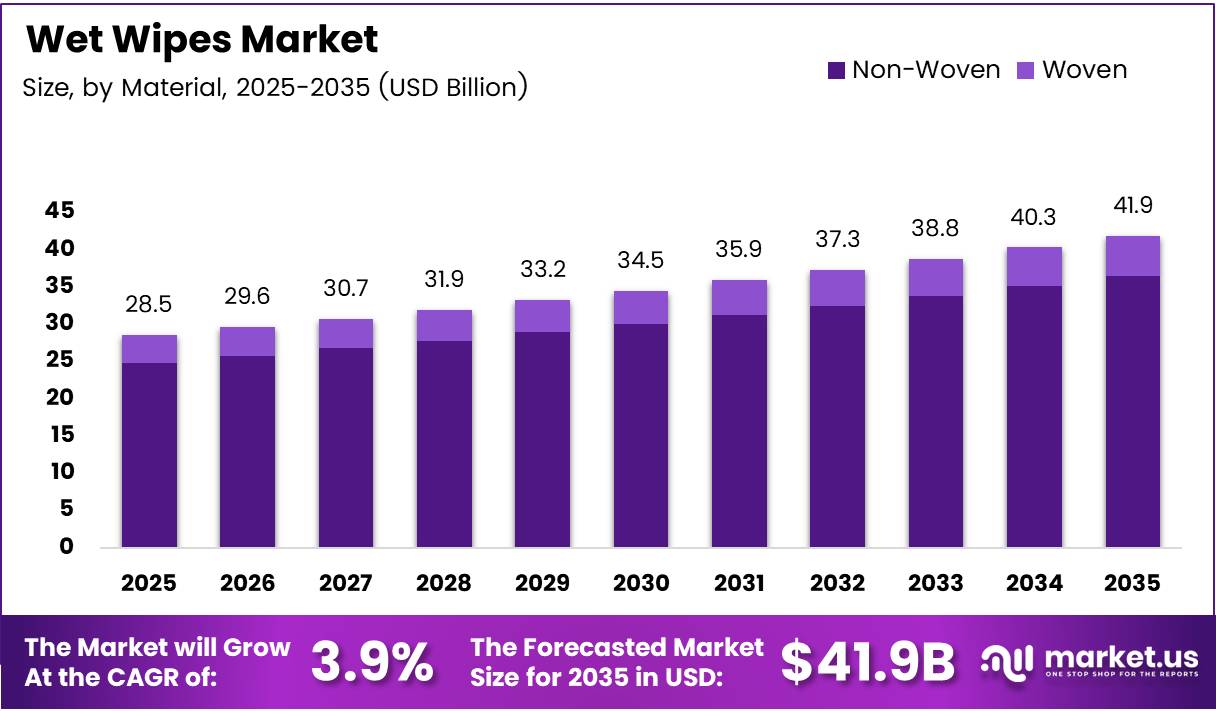
Global Wet Wipes Market size is expected to be worth around USD 41.9 Billion by 2035 from USD 28.5 Billion in 2025, growing at a CAGR of 3.9% during the forecast period 2026 to 2035.
Wet wipes are pre-moistened, single-use or multi-use nonwoven sheets designed for personal care, infant hygiene, household cleaning, and disinfection. They serve consumers across retail, healthcare, and commercial settings. The market spans baby wipes, facial wipes, household disinfectant wipes, intimate wipes, and flushable formats.
Urban consumer lifestyles now prioritize speed and hygiene over traditional cleaning methods. Disposable cleaning and personal care products fit directly into this behavioral shift. Wet wipes occupy a unique position — they bridge personal care and household hygiene, which means demand flows from multiple consumer segments simultaneously.
Infant care remains one of the strongest and most consistent consumption drivers in this market. Parents apply baby wipes multiple times daily, creating a high-frequency repurchase cycle that anchors category volume. This repeat-purchase behavior provides manufacturers with reliable baseline revenue independent of seasonal or economic cycles.
Household disinfectant and cleaning wipes captured 32.5% product share, confirming that hygiene awareness extended well beyond pandemic conditions into permanent consumer habits. Non-woven materials dominate at 87.1% of material usage, reflecting the performance and cost advantages that manufacturing at scale requires for wet wipe substrates.
In June 2025, Dude Wipes secured a strategic growth investment from TSG Consumer Partners to expand retail partnerships and household adoption — signaling that investor confidence in the wet wipes category remains strong and that retail shelf expansion remains a primary growth lever for branded players.
According to Rockline Industries’ 2025 Sustainability Report, the company achieved at least a 49% reduction in absolute Scope 1 and Scope 2 GHG emissions in 2025 compared to the 2022 baseline. This signals that major manufacturers are now embedding sustainability targets into core operations — a shift that will increasingly influence procurement decisions by retail and healthcare buyers.
According to the same report, Rockline Industries recorded a GHG emissions intensity of 0.356 kg CO₂e per 1,000 sheets produced in 2025, improving from 0.369 kg CO₂e in 2024. For buyers and brand owners, this trajectory confirms that large-scale production efficiency and environmental compliance are no longer in conflict — they are converging.
Key Takeaways
- The global wet wipes market is valued at USD 28.5 Billion in 2025 and forecast to reach USD 41.9 Billion by 2035, at a CAGR of 3.9%.
- By Product, Household/Disinfectant/Cleaning Wipes leads with 32.5% share in 2025.
- By Material, Non-Woven dominates with 87.1% share, reflecting manufacturing and performance requirements.
- By Packaging Size, the 50–100 wipes pack segment holds 45.9% share.
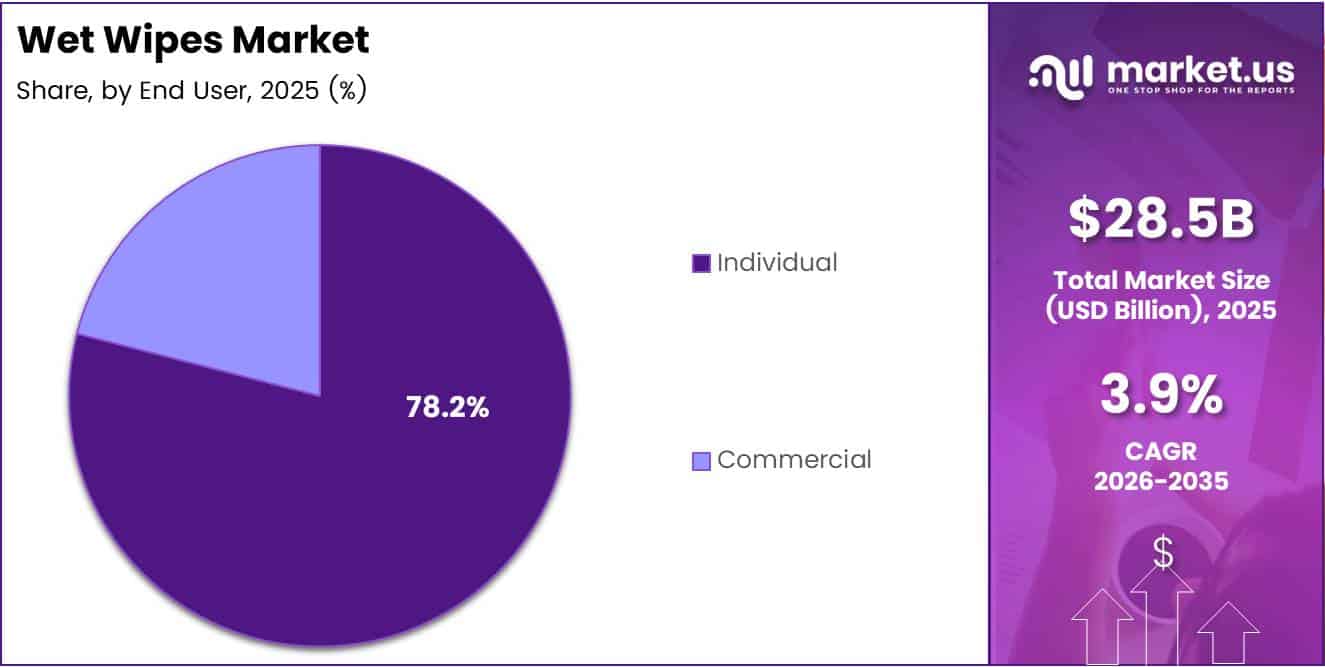
- By End User, Individual consumers account for 78.2% of market consumption.
- By Distribution Channel, Supermarkets and Hypermarkets lead with 39.8% share.
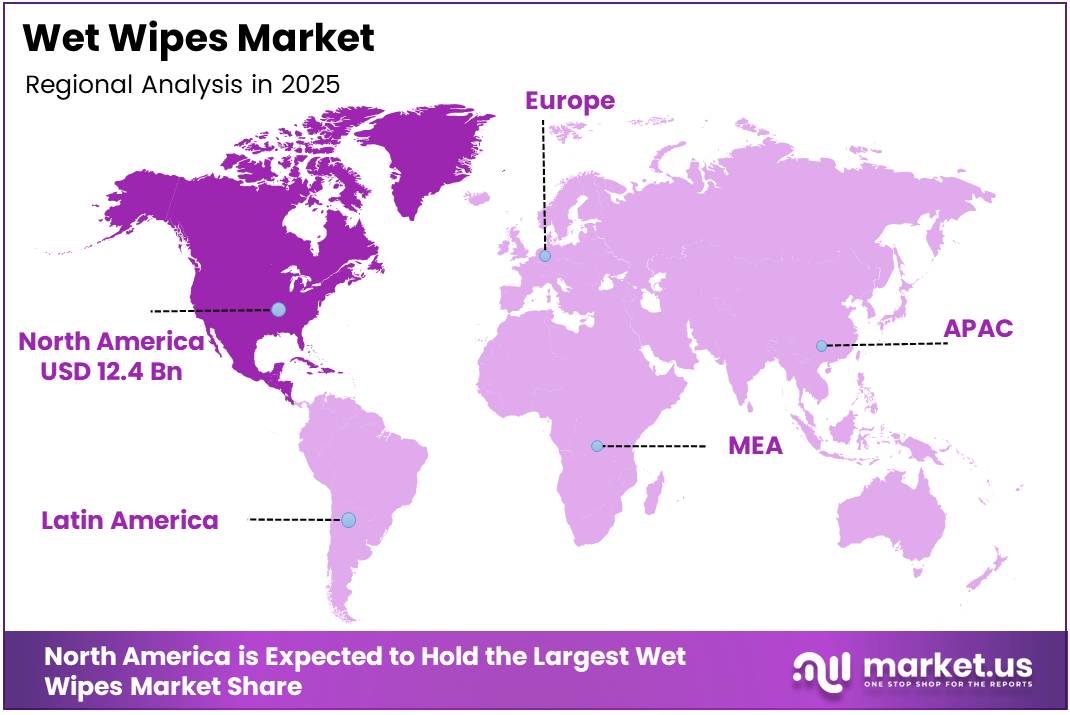
- North America is the leading region with 43.70% market share, valued at USD 12.4 Billion.
Product Analysis
Household/Disinfectant/Cleaning Wipes dominates with 32.5% due to permanent post-pandemic hygiene behavior shift.
In 2025, Household/Disinfectant/Cleaning Wipes held a dominant market position in the By Product segment of the Wet Wipes Market, with a 32.5% share. Consumer hygiene routines adopted during health crises have become permanent fixtures in daily life, locking in recurring purchase cycles across households globally.
Baby Wipes represent the highest-frequency repurchase sub-segment in the entire wet wipes category. Caregivers use them multiple times daily, generating volume that competitors in adult personal care segments cannot easily replicate. This consistent demand makes baby wipes a strategic anchor product for large consumer goods manufacturers.
Facial and Cosmetic Wipes carry above-average margin potential due to their positioning in the personal care and beauty aisle. These products attract younger, urban consumers who prioritize convenience in skincare routines, making them a high-value growth area for brands able to differentiate through dermatological credentials.
Hand and Body Wipes serve as on-the-go hygiene solutions for consumers in transit, sports, and outdoor environments. Their expanding presence in travel retail and gym channels indicates the category is moving beyond grocery and pharmacy into lifestyle and convenience formats.
Intimate Wipes occupy a sensitive but structurally distinct niche within personal hygiene. Product development in this segment focuses on pH-balanced, dermatologically tested formulations, which commands premium pricing and limits direct competition from commodity private-label producers.
Flushable Wet Wipes face a tension between consumer convenience and environmental compliance. Several municipalities and wastewater authorities continue to challenge flushability claims, which constrains brand growth unless manufacturers invest in certified water-dispersible substrates that meet regulated standards. In June 2025, Dude Wipes launched LiL’ Dude Wipes — flushable, kid-friendly wipes made with 99% water and plant-based ingredients — representing an effort to resolve this compliance gap through formulation innovation.
Others in the product category include industrial, automotive, and healthcare-specific wipes. These formats target professional and institutional buyers rather than retail consumers, creating a distinct procurement pathway that requires different channel and pricing strategies.
Material Analysis
Non-Woven dominates with 87.1% due to cost-performance advantages at manufacturing scale.
In 2025, Non-Woven held a dominant market position in the By Material segment of the Wet Wipes Market, with an 87.1% share. Non-woven fabrics offer manufacturers the right balance of absorbency, tensile strength, and cost efficiency that wet wipes production at commercial scale demands.
Woven materials represent a small but premium-oriented segment within wet wipes substrates. Their higher material cost and processing complexity limit mass-market adoption, but they attract specialty and luxury personal care brands that market reusability or superior skin feel as differentiation factors.
Packaging Size Analysis
50–100 Wipes pack dominates with 45.9% due to balanced volume and everyday household utility.
In 2025, the 50–100 Wipes pack size held a dominant market position in the By Packaging Size segment of the Wet Wipes Market, with a 45.9% share. This format aligns with typical household repurchase cycles — large enough to offer value, small enough to fit standard storage — making it the default choice for mainstream retail buyers.
Up to 50 Wipes packs serve trial, travel, and on-the-go consumers who prioritize portability over price-per-unit value. These formats command higher unit margins and perform strongly in convenience and travel retail channels, where shelf space favors compact packaging.
More than 100 Wipes packs address bulk-buying households and commercial end-users who optimize for cost efficiency. Their growth in e-commerce channels reflects that large-format purchasing migrates online, where price comparison and subscription replenishment models lower the friction of high-volume orders.
End User Analysis
Individual consumers dominate with 78.2% due to high daily personal and household hygiene usage.
In 2025, Individual consumers held a dominant market position in the By End User segment of the Wet Wipes Market, with a 78.2% share. This concentration reflects the deeply personal and habitual nature of wet wipe use — from infant care to facial cleansing — where purchase decisions are driven by routine rather than event-based need.
Commercial end-users, including healthcare facilities, hospitality, and foodservice operators, represent a structurally different demand profile. They prioritize bulk procurement, clinical efficacy certifications, and disinfection standards — criteria that differentiate commercial-grade wet wipes from consumer retail products and support higher contract values.
Distribution Channel Analysis
Supermarkets and Hypermarkets dominate with 39.8% due to high footfall and strong category placement.
In 2025, Supermarkets and Hypermarkets held a dominant market position in the By Distribution Channel segment of the Wet Wipes Market, with a 39.8% share. High weekly footfall and dedicated personal care aisles give mass retail formats unmatched visibility and trial potential for new wet wipes launches.
Convenience Stores capture impulse and emergency purchases — formats where portability and single-pack sizes dominate. Their value lies not in volume but in margin capture, as consumers pay a premium for immediate availability without planning a dedicated shopping trip.
Pharmacy channels carry authority in health-adjacent wet wipes categories — baby, intimate, and dermatologically tested products. Pharmacist recommendation and health-focused store environments give brands in these niches credibility that mass retail cannot easily replicate.
E-Commerce reshapes how consumers purchase bulk and subscription wet wipes. Online platforms reduce the cost of variety — consumers can compare formulations, read ingredient lists, and switch brands without physical shelf constraints. This dynamic accelerates private-label growth and challenges incumbent brand loyalty.
Others in distribution channels include direct-to-consumer, institutional supply chains, and specialty retail. These formats serve niche buyer segments with specific performance or certification requirements that standard retail formats rarely stock.
Key Market Segments
By Product
- Household/Disinfectant/Cleaning Wipes
- Baby Wipes
- Facial & Cosmetic Wipes
- Hand & Body Wipes
- Intimate Wipes
- Flushable Wet Wipes
- Others
By Material
- Non-Woven
- Woven
By Packaging Size
- Up to 50 Wipes
- 50–100 Wipes
- More than 100 Wipes
By End User
- Individual
- Commercial
By Distribution Channel
- Supermarkets & Hypermarkets
- Convenience Stores
- Pharmacy
- E-Commerce
- Others
Drivers
Infant Care Growth, Hygiene Awareness, and E-Commerce Access Combine to Sustain Wet Wipes Volume Across Consumer Segments
Baby wipe consumption creates one of the most reliable demand structures in the wet wipes category. Caregivers use these products multiple times daily from birth through toddler years, establishing a repurchase cycle that sustains volume regardless of macroeconomic conditions. This behavioral lock-in makes infant-focused wet wipes a structurally defensive revenue segment for manufacturers.
Household disinfectant and cleaning wipes benefit from a consumer mindset shift that normalized surface hygiene as a daily habit. In January 2024, Accrol acquired Severn Delta — a UK-based manufacturer of wet wipes — signaling that established players are building production capacity to meet sustained household wipe demand across European markets. Capacity investment at this scale reflects confidence in long-term consumption.
E-commerce platforms remove the geographic and shelf-space constraints that previously limited wet wipes availability in smaller markets. Consumers in emerging urban centers and rural areas now access the full product range — including specialty and premium formats — through online channels. According to North America’s market position, the region commands 43.70% share valued at USD 12.4 Billion, built on mature e-commerce infrastructure and well-established retail procurement systems that other regions are now replicating.
Restraints
Environmental Costs of Non-Flushable Wipes and High Production Costs for Eco-Friendly Formats Create Structural Pressure on Manufacturers
Non-flushable wet wipes cause documented sewer blockages that result in regulatory scrutiny and municipal cost claims against manufacturers and retailers. This creates legal exposure and reputational risk for brands that sell wipes without certified flushability standards. The operational and compliance costs associated with these issues slow new product launches in the flushable segment.
Biodegradable and eco-friendly wet wipe formulations require higher-cost substrates — including plant-based, certified organic, and water-dispersible fibers — that compress manufacturer margins. According to Rockline Industries’ 2025 Sustainability Report, water use intensity stood at 4.235 L per 1,000 sheets in 2025. This resource intensity illustrates that even incremental efficiency improvements in sustainable manufacturing require ongoing capital investment, raising the cost barrier for smaller producers.
Clorox EcoClean Disinfecting Wipes achieved 38% less plastic through a 100% plant-based substrate while maintaining 99.9% germ-kill performance — but this level of material innovation demands significant R&D spend. For mid-size and private-label manufacturers, matching these sustainability thresholds without raising consumer prices represents a real competitive constraint that narrows margin flexibility.
Growth Factors
Flushable Technology Innovation, Organic Baby Wipes Demand, and Healthcare Expansion Open New Revenue Channels for Wet Wipes Manufacturers
Water-dispersible and flushable wet wipe technologies address the single largest regulatory and environmental obstacle facing the category. Manufacturers that achieve certified flushability unlock both consumer trust and retail placement in channels — including pharmacy and healthcare — where non-flushable products face restrictions. This technical investment directly translates into shelf access and premium pricing power.
In December 2024, 3i Group invested approximately €145 million in WaterWipes — a premium brand built on 99.9% water formulations for sensitive skin. This investment confirms that organic and chemical-free formats now attract institutional capital, not just niche consumers. It signals a structural shift in how investors view clean-formulation wet wipes: as a scalable category, not a premium afterthought.
According to research published in 2025, banana fiber-based wet wipes achieved antimicrobial inhibition zones ranging from 10.00 ± 1.00 mm to 13.67 ± 1.16 mm against E. coli, S. aureus, and P. aeruginosa. This level of antimicrobial performance using natural fibers shows that healthcare-grade hygiene and sustainable materials are no longer mutually exclusive — opening a credible path to hospital and clinical procurement for bio-based wet wipes.
Emerging Trends
Antimicrobial Formats, Sustainable Fibers, and Dermatological Certification Redefine Product Standards Across the Wet Wipes Category
Antimicrobial and sanitizing wet wipes are moving from a niche pandemic response product into a mainstream personal care format. Retailers now allocate permanent shelf space to sanitizing wipes, and buyers treat antimicrobial certification as a baseline expectation rather than a premium feature. Brands that cannot substantiate efficacy claims risk losing both retail placement and consumer trust.
Bamboo and cotton fiber substrates are entering commercial-scale wet wipe production as manufacturers respond to retailer sustainability mandates and consumer demand for chemical-free alternatives. However, research published in January 2026 found that even certified biodegradable cellulose-based wet wipes persisted for at least 5 weeks in urban river environments. This means sustainability claims require technical validation — not just material sourcing — to withstand regulatory and consumer scrutiny.
Dermatologically tested and hypoallergenic certifications are becoming a minimum entry requirement in pharmacy, baby, and intimate care wet wipe segments. Simultaneously, private-label wet wipe products are gaining retail shelf share as supermarket chains develop their own certified formulations. This dual pressure — rising certification standards and private-label competition — forces branded manufacturers to invest in differentiation beyond ingredients alone.
Regional Analysis
North America Dominates the Wet Wipes Market with a Market Share of 43.70%, Valued at USD 12.4 Billion
North America commands 43.70% of the global wet wipes market, valued at USD 12.4 Billion in 2025. Mature retail infrastructure, high per-capita hygiene spending, and well-established e-commerce channels drive this leadership. The region’s regulatory clarity around product claims and labeling also supports faster new product cycles compared to other geographies.
Europe Wet Wipes Market Trends
Europe holds a significant share driven by strict environmental regulations that are actively reshaping product formulations. The European Union’s single-use plastics directive and labeling requirements for flushable wipes have forced manufacturers to accelerate investment in biodegradable substrates. This regulatory pressure creates both a compliance cost and a product innovation opportunity for manufacturers operating in the region.
Asia Pacific Wet Wipes Market Trends
Asia Pacific represents the fastest-expanding geography for wet wipes consumption, anchored by China, India, and Southeast Asia. Rising urban middle-class populations and improving retail distribution are expanding the consumer base for both baby wipes and personal care formats. Domestic manufacturers in the region are scaling production capacity to compete with multinational brands on price and availability.
Latin America Wet Wipes Market Trends
Latin America shows consistent volume growth in wet wipes, led by Brazil and Mexico where modern retail penetration is increasing. Hygiene awareness campaigns by health authorities, combined with expanding supermarket networks, are bringing wet wipes into households that previously relied on traditional cleaning methods. Private-label products are gaining ground as affordability remains a key purchase decision factor.
Middle East and Africa Wet Wipes Market Trends
The Middle East and Africa market is shaped by distinct demand drivers across two sub-regions. GCC countries show high per-capita wet wipe consumption linked to premium personal care habits and a warm climate that increases daily hygiene frequency. Sub-Saharan Africa and North Africa represent early-stage markets where distribution infrastructure investment will determine the pace of category penetration.
Key Regions and Countries
North America
- US
- Canada
Europe
- Germany
- France
- The UK
- Spain
- Italy
- Rest of Europe
Asia Pacific
- China
- Japan
- South Korea
- India
- Australia
- Rest of APAC
Latin America
- Brazil
- Mexico
- Rest of Latin America
Middle East & Africa
- GCC
- South Africa
- Rest of MEA
Key Company Insights
The Clorox Company anchors its wet wipes strategy on disinfection efficacy — a positioning that commands premium retail placement in household cleaning aisles. Its investment in plant-based substrate innovation, evidenced by the EcoClean line achieving 38% less plastic while maintaining 99.9% germ-kill performance, shows the company is building a dual advantage: regulatory compliance and consumer trust in sustainability claims.
KCWW operates across multiple wet wipes categories under established consumer brand portfolios, giving it distribution breadth that smaller competitors cannot match. Its strength lies in leveraging existing retail relationships and logistics infrastructure to maintain high shelf presence across baby, personal care, and household wipe segments — a scale advantage that is difficult to replicate without significant capital investment.
Reckitt Benckiser Group PLC applies its health and hygiene brand equity directly to the wet wipes category, particularly in disinfectant and antimicrobial formats where professional certification carries weight with both retail buyers and institutional procurement managers. Its ability to cross-sell wet wipes alongside household hygiene product lines gives it a category management advantage in major retail accounts.
Unilever approaches the wet wipes market through its personal care and sustainability brand architecture. Its emphasis on dermatologically tested and environmentally responsible formulations aligns with the direction that pharmacy, premium grocery, and direct-to-consumer channels are heading. In May 2024, Wipemate launched as a new consumer wipes brand offering universal cleaning solutions — illustrating the competitive pressure that new entrants create, which requires established players like Unilever to continuously sharpen their product differentiation.
Key Players
- The Clorox Company
- KCWW
- Reckitt Benckiser Group PLC
- Unilever
- Johnson & Johnson Consumer Inc.
- TLC International
- WipesPlus
- The Honest Company, Inc.
- Procter & Gamble
- Himalaya Wellness Company
Recent Developments
- January 2025 — Diamond Wipes International acquired certain assets from Guy & O’Neill, including undisclosed brands, to expand its contract wet wipes manufacturing capacity and broaden its private-label product offering.
- February 2025 — Harrisons acquired Ecotech (Europe) Ltd, a Coventry-based manufacturer of wet and dry nonwoven wipes, marking its strategic entry into wet wipes production with an established manufacturing footprint.
- June 2025 — Nice-Pak relaunched its iconic Wet-Nap as a single-SKU all-purpose wipe for hands, face, and body cleaning, simplifying the product range while broadening its everyday consumer appeal.
- July 2025 — Emprise Group, via Vivos Holdings, acquired Nice-Pak Products, creating one of the world’s largest private-label hygiene and wet wipes suppliers with a significantly expanded manufacturing and distribution network.
- August 2025 — Vivos Holdings completed its merger with Nice-Pak Products, integrating operations across wet wipes, diapers, and personal care to build a comprehensive private-label hygiene portfolio at scale.
- September 2025 — WaterWipes launched a new line of stronger, thicker, and softer wipes for sensitive skin, maintaining its microbiome-friendly certification while addressing consumer feedback on durability and tactile performance.
Report Scope
| Report Features | Description |
|---|---|
| Market Value (2025) | USD 28.5 Billion |
| Forecast Revenue (2035) | USD 41.9 Billion |
| CAGR (2026-2035) | 3.9% |
| Base Year for Estimation | 2025 |
| Historic Period | 2020-2024 |
| Forecast Period | 2026-2035 |
| Report Coverage | Revenue Forecast, Market Dynamics, Competitive Landscape, Recent Developments |
| Segments Covered | By Product (Household/Disinfectant/Cleaning Wipes, Baby Wipes, Facial & Cosmetic Wipes, Hand & Body Wipes, Intimate Wipes, Flushable Wet Wipes, Others), By Material (Non-Woven, Woven), By Packaging Size (Up to 50 Wipes, 50–100 Wipes, More than 100 Wipes), By End User (Individual, Commercial), By Distribution Channel (Supermarkets & Hypermarkets, Convenience Stores, Pharmacy, E-Commerce, Others) |
| Regional Analysis | North America (US and Canada), Europe (Germany, France, The UK, Spain, Italy, and Rest of Europe), Asia Pacific (China, Japan, South Korea, India, Australia, and Rest of APAC), Latin America (Brazil, Mexico, and Rest of Latin America), Middle East & Africa (GCC, South Africa, and Rest of MEA) |
| Competitive Landscape | The Clorox Company, KCWW, Reckitt Benckiser Group PLC, Unilever, Johnson & Johnson Consumer Inc., TLC International, WipesPlus, The Honest Company Inc., Procter & Gamble, Himalaya Wellness Company |
| Customization Scope | Customization for segments, region/country-level will be provided. Moreover, additional customization can be done based on the requirements. |
| Purchase Options | We have three licenses to opt for: Single User License, Multi-User License (Up to 5 Users), Corporate Use License (Unlimited User and Printable PDF) |





































