Report Overview
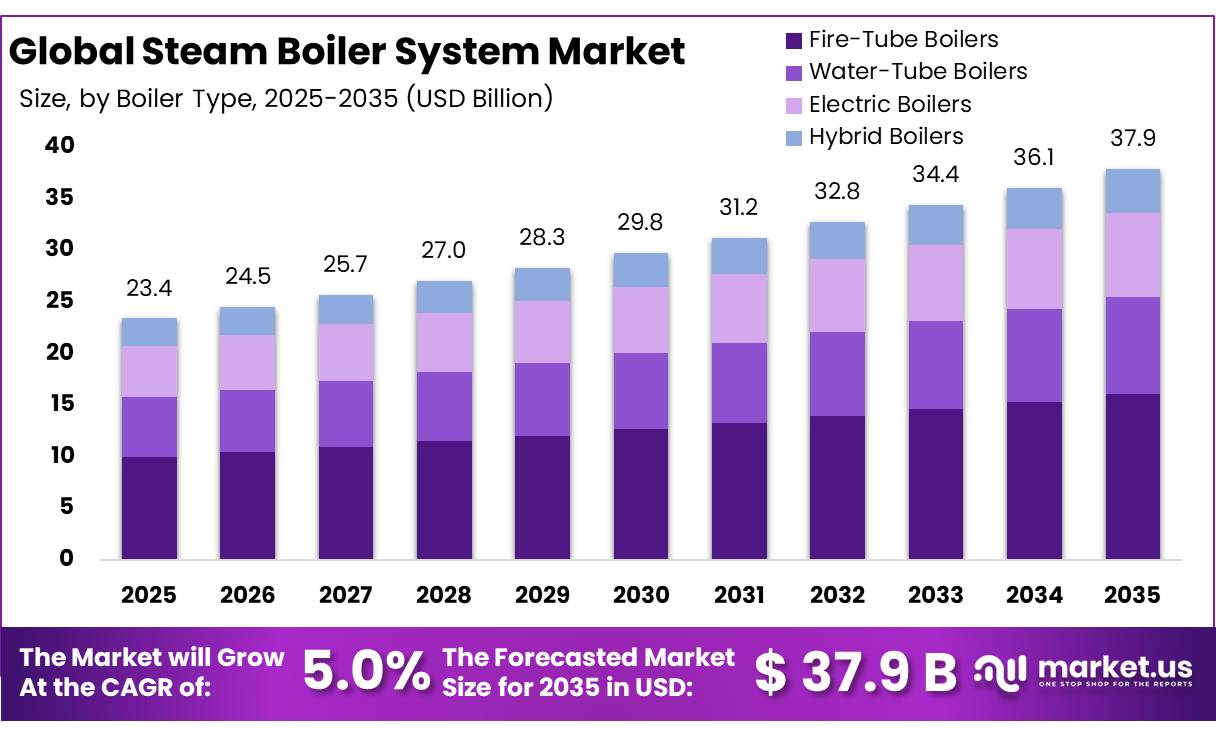
The Global Steam Boiler System Market size is expected to be worth around USD 37.9 Billion by 2035, from USD 23.4 Billion in 2025, growing at a CAGR of 5.0% during the forecast period from 2026 to 2035. In 2025, Asia-Pacific held a dominant market position, capturing more than a 45.00% share, holding USD 10.5 Billion revenue.
Steam boiler systems are essential industrial equipment used to generate steam for heating, power generation, drying, sterilization, and other manufacturing processes. These systems convert water into steam through the application of heat generated by natural gas, coal, oil, biomass, or electricity. They are widely used across chemical processing, food and beverages, pharmaceuticals, pulp and paper, textiles, petroleum refining, and power generation.
- The industrial scenario for steam boiler systems is closely linked to manufacturing energy consumption. According to the U.S. Department of Energy, American manufacturers consumed approximately 3,174 trillion British thermal units (TBtu) of energy as boiler fuel in 2022, representing around 20% of the total energy used in industrial process applications.
The U.S. Energy Information Administration reported that the industrial sector accounted for approximately 33% of total U.S. energy consumption in 2025. This demonstrates the significant role of industrial energy infrastructure and the continued requirement for efficient steam generation equipment.
Several factors are driving demand for steam boiler systems, including expanding manufacturing capacity, increasing demand for industrial process heat, replacement of ageing boiler infrastructure, and the need for improved energy efficiency. The chemical and petrochemical industries require continuous steam for distillation, chemical reactions, and temperature control, while food and pharmaceutical manufacturers use steam for cooking, cleaning, drying, and sterilization.
- According to the U.S. Environmental Protection Agency (EPA), the United States has more than 183,000 area-source boilers, highlighting the extensive use of boiler equipment across industrial, commercial, and institutional facilities. Increasing environmental compliance requirements are also encouraging operators to adopt low-emission burners, improved combustion controls, and advanced monitoring systems.
Energy efficiency and decarbonization are becoming important priorities for boiler manufacturers. The International Energy Agency (IEA) reported that industry accounted for nearly 40% of global final energy consumption in 2024. Its December 2025 report also highlighted that industries relying heavily on low-temperature heat and steam represent approximately 70% of global industrial energy consumption. These figures demonstrate the opportunity for efficient boiler systems, electric steam generation, heat recovery, and renewable energy integration.
Key Takeaways
- Steam Boiler System Market size is expected to be worth around USD 37.9 Billion by 2035, from USD 23.4 Billion in 2025, growing at a CAGR of 5.0%.
- Fire-Tube Boilers held a dominant market position, capturing more than a 42.00% share.
- Natural Gas held a dominant market position, capturing more than a 35.00% share.
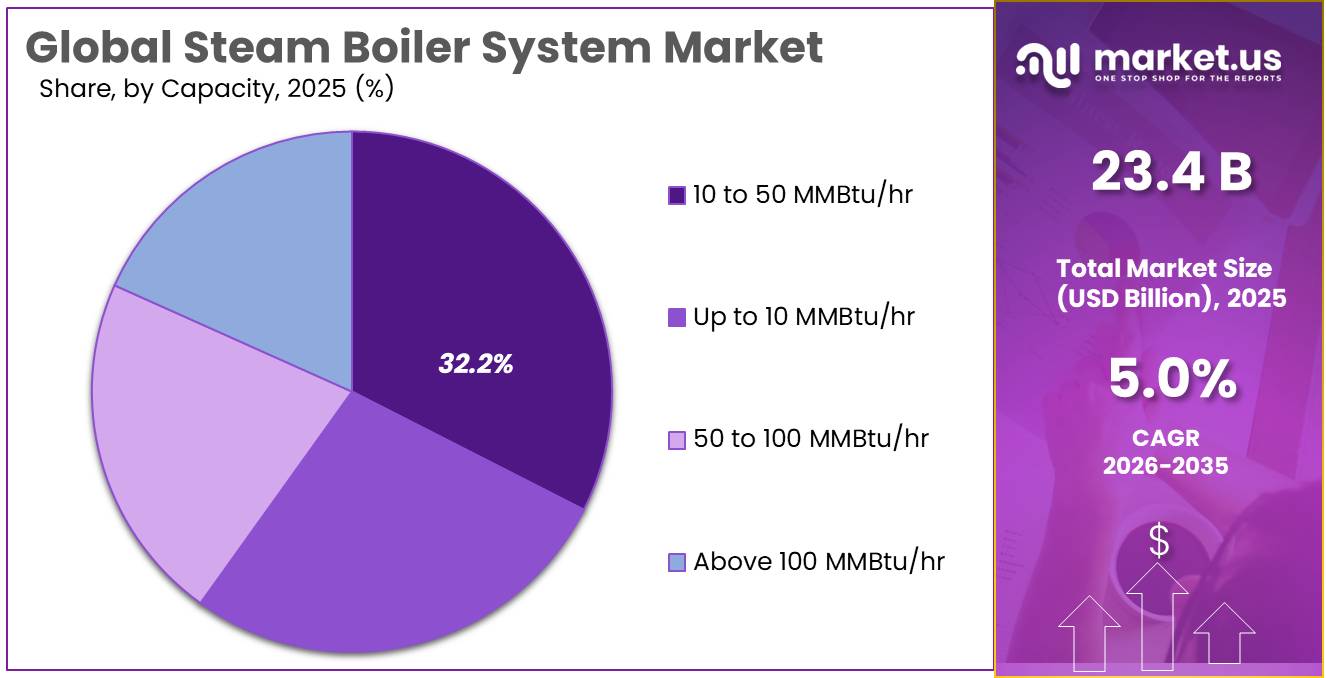
- 10 to 50 MMBtu/hr held a dominant market position, capturing more than a 32.00% share.
- Non-Condensing Boilers held a dominant market position, capturing more than a 46.00% share.
- Power Generation held a dominant market position, capturing more than a 28.00% share.
- Power and Utilities held a dominant market position, capturing more than a 27.00% share.
- Asia-Pacific dominated the Steam Boiler System Market, accounting for 45.00% of the global market, with a value of USD 10.5 billion.
By Boiler Type Analysis
Fire-Tube Boilers lead the segment through their suitability for regular industrial steam requirements and comparatively simple operation.
In 2025, “Fire-Tube Boilers” held a dominant market position, capturing more than a 42.00% share. These boilers are widely used in facilities that require a steady supply of low- to medium-pressure steam for heating and production activities. Their design allows hot combustion gases to pass through tubes surrounded by water, making them suitable for applications where steam demand is relatively stable. Food processing, textiles, paper production, commercial facilities and smaller manufacturing plants are important application areas. Their packaged construction, straightforward installation and manageable maintenance requirements support adoption among industrial users.
Water-Tube Boilers are used in industrial facilities where steam demand is high or operating conditions require higher pressure and temperature. In this design, water flows through tubes while hot combustion gases heat the tubes from the outside. This arrangement supports faster heat transfer and makes the design suitable for large-scale steam generation. Major applications include power generation, chemical processing, refining, paper manufacturing and other energy-intensive industries.
According to the Government of Canada, industrial water-tube boilers in the 2.9 MW to 29 MW capacity range are used for electricity generation, process steam and space heating. The same government classification identifies water-tube boilers above 29 MW for utility applications such as electricity generation. These capacity classifications demonstrate their role in large industrial and utility operations, although they do not establish a specific market share for the segment.
By Fuel Type Analysis
Natural Gas leads the fuel-type segment due to its efficient combustion, convenient fuel supply and suitability for continuous industrial steam generation.
In 2025, “Natural Gas” held a dominant market position, capturing more than a 35.00% share. Natural gas is widely used in steam boiler systems because it provides controlled heat output, supports automated combustion and generally produces lower particulate emissions than coal-fired systems. It is suitable for industries such as food processing, chemicals, textiles, paper manufacturing and refining, where a consistent steam supply is important for daily operations. Its use is also supported by established gas infrastructure and the ability to adjust boiler output according to changing production requirements.
- According to the U.S. Energy Information Administration, industrial natural gas consumption averaged 23.6 billion cubic feet per day in 2025, reaching a record level. The agency forecast further increases of 1.2% in 2026 and 1.7% in 2027, reflecting expected industrial demand. Although this figure covers total industrial natural gas use rather than boiler consumption alone, it highlights the importance of natural gas as an industrial fuel. These factors support its continued use in industrial steam generation.
Coal is used in steam boiler systems across industries that require large volumes of heat for continuous production. It is particularly relevant in facilities with established coal-handling and storage infrastructure, including certain chemical, paper, metal processing and manufacturing operations. Coal-fired boilers can support high steam demand, but their operation requires fuel storage, ash handling and emission-control equipment. Environmental regulations and pressure to reduce carbon emissions are encouraging some industrial operators to consider cleaner alternatives, including natural gas, biomass and electric boilers.
According to the U.S. Energy Information Administration, the U.S. industrial sector consumed 7.88 million short tons of coal in 2025 for electricity generation and useful thermal output. Its data also recorded 130,934 billion British thermal units of industrial-sector coal consumption for useful thermal output in 2025. These figures cover industrial energy use and are not limited exclusively to steam boilers. Nevertheless, they demonstrate that coal continues to contribute to industrial heat and power requirements.
By Capacity Analysis
10 to 50 MMBtu/hr boilers lead the capacity segment by meeting the steam requirements of a wide range of industrial facilities.
In 2025, “10 to 50 MMBtu/hr” held a dominant market position, capturing more than a 32.00% share. This capacity range is suitable for medium-sized industrial operations that need a regular steam supply without investing in very large boiler installations. These systems are used in food processing, chemicals, paper manufacturing, textiles and other production facilities where steam supports heating, drying, cleaning and processing. Their capacity makes them suitable for plants with moderate to high thermal requirements, while allowing operators to match boiler output with production demand.
The U.S. Environmental Protection Agency classifies boilers with a heat input capacity of 10 MMBtu/hr or more as large units under certain major-source boiler regulations. This regulatory threshold highlights the importance of this capacity level in industrial boiler management and emissions compliance.
Up to 10 MMBtu/hr boilers are commonly selected by small and medium-sized businesses with lower or moderate steam requirements. These systems are used in commercial buildings and smaller industrial facilities for space heating, hot water and process-related applications. Their compact design and relatively lower capacity make them suitable for operations that do not require large-scale steam generation. Food production units, laundries, hotels, hospitals and smaller manufacturing facilities are among the potential users.
The U.S. Environmental Protection Agency identifies boilers below 10 MMBtu/hr as small major-source boilers under its regulatory classification. The Government of Canada also places commercial and institutional boilers in a capacity category of 0.5 to 10 MMBtu/hr, covering applications such as space heating. These official classifications show the role of smaller boilers in commercial and institutional operations.
By Technology Analysis
Non-Condensing Boilers lead the technology segment due to their established industrial use, lower initial investment and compatibility with existing boiler infrastructure.
In 2025, “Non-Condensing Boilers” held a dominant market position, capturing more than a 46.00% share. These boilers remain widely used in industrial facilities because they have a conventional design and can operate with existing steam distribution and heating systems. They are commonly selected by plants where high-temperature steam is required and the additional heat recovery offered by condensing technology may not provide sufficient operating benefits.
According to the American Society of Heating, Refrigerating and Air-Conditioning Engineers (ASHRAE), conventional non-condensing boilers generally have combustion efficiency in the range of 75% to 86%. Their continued presence in existing industrial facilities supports demand, although rising energy-efficiency requirements are encouraging operators to consider heat-recovery improvements and alternative boiler technologies.
Condensing Boilers recover additional heat from combustion gases that would otherwise escape through the exhaust system. This process improves thermal efficiency and can reduce fuel consumption when the system operates under suitable return-water temperature conditions. These boilers are particularly useful in low-temperature heating applications and facilities looking to improve energy performance. Their adoption is supported by energy-efficiency programmes and the growing focus on reducing operating costs and emissions.
The U.S. General Services Administration reports that evaluations of condensing boiler installations by national research laboratories found energy savings ranging from 14% to 24% at the evaluated locations. However, the actual savings depend on system design, operating conditions and the existing equipment. Higher equipment costs and the need for corrosion-resistant components can affect installation decisions. Condensing technology therefore offers an efficiency advantage where operating conditions allow effective recovery of heat from exhaust gases.
By Application Analysis
Power Generation leads the application segment as steam boilers support electricity production in conventional thermal power plants.
In 2025, “Power Generation” held a dominant market position, capturing more than a 28.00% share. Steam boilers play an important role in power plants by heating water to produce high-pressure steam, which drives turbines connected to electricity generators. They are used in coal-fired, biomass and certain other thermal power generation facilities. Their ability to provide continuous steam makes them important for large-scale electricity production.
According to the U.S. Energy Information Administration (EIA), utility-scale electricity generation in the United States reached approximately 4,429 billion kilowatt-hours in 2025. The U.S. Environmental Protection Agency also confirms that fuel-based power plants use steam boilers to produce steam for turbine-driven electricity generation. These applications support demand for boilers designed for dependable operation, high steam output and efficient fuel use.
Industrial Processing is a major application area for steam boiler systems because many manufacturing operations depend on controlled heat and a continuous steam supply. Boilers provide steam for heating, drying, sterilization, cleaning, chemical reactions and separation processes. Food and beverage production, chemicals, paper manufacturing, textiles and refining are among the industries that use steam in their operations. The U.S. Department of Energy identifies steam systems as an important part of industrial energy use, supporting process heating, pressure control, mechanical drives and hot-water production.
A recent DOE industrial energy overview estimates that industrial steam systems account for more than 4,750 trillion British thermal units of energy use. This figure highlights the scale of industrial dependence on steam, although it covers steam systems across industrial applications rather than boiler equipment sales alone. Demand for efficient steam generation, heat recovery and improved boiler controls is expected to remain relevant as manufacturers focus on energy costs and production reliability.
By End User Analysis
Power and Utilities lead the end-user segment as thermal power facilities depend on steam generation for reliable electricity production.
In 2025, “Power and Utilities” held a dominant market position, capturing more than a 27.00% share. Steam boiler systems are essential in conventional thermal power plants, where they convert water into high-pressure steam to drive turbines and generate electricity. Utility operators use these systems to support continuous power generation and meet changing electricity demand. Coal-fired, biomass and other steam-based power facilities require boilers designed for high thermal output, dependable operation and effective heat transfer.
According to the U.S. Energy Information Administration, utility-scale electricity generation in the United States reached approximately 4,429 billion kilowatt-hours in 2025. Fossil fuels accounted for about 58% of this generation, while natural gas alone represented approximately 41%. These figures highlight the continued role of thermal power generation in the electricity supply and support the need for reliable steam-generation equipment.
Oil and Gas is an important end-user segment because steam is required across several refining and processing activities. Refineries use steam for distillation, stripping, equipment cleaning, heat exchange, hydrogen production and driving selected pumps and compressors. Steam boilers and heat recovery steam generators help maintain the steady supply needed for these operations.
According to the U.S. Energy Information Administration, U.S. refineries consumed approximately 1,055,352 million cubic feet of natural gas in 2025. The agency also recorded 84,770 million pounds of purchased steam for refinery use during the same year. These figures demonstrate the scale of energy and steam requirements in the refining industry, although purchased steam is not the same as steam generated directly by on-site boilers. Ongoing refinery operations and the need for reliable process heat support demand for industrial boiler systems.
Key Market Segments
By Boiler Type
- Fire-Tube Boilers
- Water-Tube Boilers
- Electric Boilers
- Hybrid Boilers
By Fuel Type
- Natural Gas
- Coal
- Oil
- Biomass
- Electricity
- Other Fuels
By Capacity
- Up to 10 MMBtu/hr
- 10 to 50 MMBtu/hr
- 50 to 100 MMBtu/hr
- Above 100 MMBtu/hr
By Technology
- Condensing Boilers
- Non-Condensing Boilers
- Supercritical Boilers
- Subcritical Boilers
By Application
- Power Generation
- Industrial Processing
- Heating
- Food Processing
- Chemical and Petrochemical Processing
- Pulp and Paper
- Pharmaceuticals
- Other Applications
By End User
- Power and Utilities
- Oil and Gas
- Chemicals and Petrochemicals
- Food and Beverage
- Pulp and Paper
- Pharmaceuticals
- Metals and Mining
- Other Industries
Driver Analysis
Process-Industry Capacity Additions
New production lines in food, dairy, distilling, chemicals and refining create demand for steam used in heating, evaporation, sterilization and other process operations, supporting boiler purchases tied to executable plant projects rather than general manufacturing-value growth. Thermax’s FY2024–25 disclosures provide tangible procurement references: a 26-tonne/hour straw-fired boiler installed at a distillery, a 22-tonne/hour biomass boiler commissioned at a dairy, and two 250-tonne/hour modular gas-fired boilers supplied for a refinery and petrochemical application in Abu Dhabi.
In an illustrative industrial facility requiring 20 tonnes/hour of steam for 7,000 hours annually, production reaches 140,000 tonnes/year. With an assumed feedwater-to-steam enthalpy rise of 2.4 GJ/tonne, useful thermal output is approximately 13.3 MW and annual useful energy approximately 93,333 MWh; actual requirements depend on pressure, temperature, condensate return and load profile. At an assumed $3 million of eligible boiler-system scope, ten genuinely additional funded installations create $30 million of equipment demand—not the value of their entire factories.
Suppliers capture value through integrated feedwater, controls and commissioning packages, while customers must size operating and standby capacity against measured loads. The +0.9 pp contribution assumes 20% revenue exposure grows 4.5 percentage points faster through new industrial capacity, excluding projects primarily undertaken to replace an existing fuel or improve an existing boiler’s efficiency.
Drivers Impact Analysis
| Driver | (~) % Impact on CAGR | Geographic Relevance | Impact Timeline |
|---|---|---|---|
| Process-industry capacity additions | +0.9 pp | India, Southeast Asia, Gulf | Medium term (2–4 years) |
| Installed-base efficiency renewal | +0.8 pp | US, EU, Japan, India | Short term (≤ 2 years) |
| Biomass fuel-transition projects | +0.7 pp | India, Southeast Asia, Brazil | Medium term (2–4 years) |
| Electric process-steam adoption | +0.6 pp | EU, China, US, Japan | Medium term (2–4 years) |
| Emissions-led boiler modernization | +0.4 pp | EU core; UK spill-over | Short term (≤ 2 years) |
Restraint Analysis
Uncompetitive Replacement Payback
Replacing a functioning boiler can fail investment screening when modest efficiency gains do not recover equipment, installation and shutdown costs within the customer’s required horizon, particularly where fuel is inexpensive or the existing boiler already performs reasonably well. The IEA’s industrial-heat assessment emphasizes that recovering waste heat, improving insulation and optimizing controls can reduce fuel consumption at comparatively low cost before major equipment investment, potentially reducing both the required replacement capacity and the value of full replacement.
In an illustrative plant supplying 10 MW of useful steam for 4,000 hours annually, improving efficiency from 84% to 89% reduces fuel input from approximately 47,619 to 44,944 MWh/year, saving about 2,675 MWh. At an assumed $20/MWh fuel price, gross annual savings are only $53,500; subtracting $10,000 of incremental annual operating costs leaves $43,500. An assumed $1 million installed replacement therefore has approximately 23-year simple payback before financing and tax.
At 8,000 hours and $40/MWh fuel, the same efficiency change yields approximately $214,000 of gross savings, demonstrating how strongly utilization and tariffs determine procurement. Suppliers must substantiate installed-system savings and recognize when lower-cost optimization is the customer’s rational choice. The −0.5 pp contribution assumes 20% revenue exposure grows 2.5 percentage points more slowly through rejected conventional replacement proposals, excluding electric operating-cost barriers and industrial expansion projects.
Restraint Impact Analysis
| Restraint | (~) % Impact on CAGR | Geographic Relevance | Impact Timeline |
|---|---|---|---|
| Uncompetitive replacement payback | −0.5 pp | US, Gulf, India | Short term (≤ 2 years) |
| Electric-steam cost disadvantage | −0.4 pp | US, China, EU, Japan | Medium term (2–4 years) |
| Heat-pump displacement | −0.4 pp | EU, Japan, US, China | Medium term (2–4 years) |
| Industrial capacity underutilization | −0.3 pp | EU chemical-production hubs | Short term (≤ 2 years) |
| Grid-connection investment deferrals | −0.3 pp | EU, Indonesia, Thailand, Vietnam | Medium term (2–4 years) |
Opportunity Analysis
Financed Steam-Utility Platforms
Third-party ownership can unlock boiler installations where customers have credible long-term steam demand and viable operating economics but do not prioritize ownership of utility assets. Thermax’s commercial platform demonstrates that the model already exists: its build-own-operate business reports more than 110 green-utility assets across over 50 sites, while its FY2024–25 report identifies eight commissioned projects adding 146 tonnes/hour of biomass-fired boiler capacity. The broader green-solutions portfolio describes contract tenures of 10–25 years; neither the asset count nor contract duration is exclusively attributable to steam boilers.
The opportunity is additional equipment procurement enabled by financing and risk allocation—not another allocation for biomass demand or capitalization of lifetime steam sales as boiler revenue. In an illustrative facility requiring 100,000 tonnes of steam annually, an assumed service tariff of $35/tonne creates $3.5 million of annual operator receipts. If fuel, operating labour, maintenance and other operating costs total $2.7 million, the remaining $800,000 must cover capital recovery, financing, tax and risk; it is not automatically profit.
Where total project investment is $5 million but eligible boiler-system scope is $3 million, ten genuinely enabled projects create $30 million of market orders, not $50 million or the aggregate service-contract value. Suppliers need creditworthy offtake, minimum-load provisions and explicit fuel-price adjustments. The +0.35 pp contribution assumes 7% revenue exposure grows five percentage points faster through otherwise unexecuted financed installations, excluding purchases already approved under conventional ownership.
Opportunity Impact Analysis
| Opportunity | (~) % Potential CAGR Upside | Geographic Relevance | Execution Window |
|---|---|---|---|
| Financed steam-utility platforms | +0.35 pp | India, Southeast Asia, Africa | Short term (≤ 2 years) |
| Dispatchable hybrid-steam packages | +0.30 pp | Germany, Netherlands, UK, Japan | Short term (≤ 2 years) |
| Storage-enabled boiler installations | +0.25 pp | EU, US, Japan, South Korea | Medium term (2–4 years) |
| Standardized distributed-steam modules | +0.20 pp | India, Indonesia, Vietnam, Africa | Medium term (2–4 years) |
| Multi-OEM modernization platforms | +0.20 pp | US, EU, India, Gulf | Short term (≤ 2 years) |
Challenges Analysis
Water Chemistry Control
Bosch identifies inadequate monitoring, misinterpretation of results and insufficient water-analysis expertise as recurring causes of damage and recommends monitoring hardness, conductivity, pH and condensate purity. Its guidance references manufacturer-specific requirements aligned with EN 12953-10 for relevant shell boilers; it does not establish universal chemistry limits for every pressure, material or boiler design.
In an illustrative steady-state installation producing 20 tonnes/hour of steam, blowdown equal to 5% of feedwater requires approximately 21.05 tonnes/hour of feedwater and 1.05 tonnes/hour of blowdown. At 2%, the corresponding values are approximately 20.41 and 0.41 tonnes/hour, reducing discharge by about 0.64 tonnes/hour, or 5,156 tonnes over 8,000 hours. Assuming an unrecovered enthalpy difference of 0.6 GJ/tonne, that represents approximately 859 MWh annually, before installed heat recovery; reducing blowdown is acceptable only where validated chemistry permits it.
Suppliers and owners need calibrated analyzers, representative sampling, treatment-plant maintenance and defined responses to deviations rather than more instrumentation without operational ownership. The −0.30 pp contribution assumes 15% revenue exposure grows two percentage points more slowly through chemistry-related rework, reliability investigations and delayed acceptance. It excludes steam contamination occurring despite otherwise acceptable boiler-water chemistry, allocated separately below.
Challenges Impact Analysis
| Challenge | (~) % CAGR Friction Drag | Geographic Relevance | Mitigation Horizon |
|---|---|---|---|
| Water chemistry control | −0.30 pp | India, Gulf, Southeast Asia, Africa | Medium term (2–4 years) |
| Load-following and cycling fatigue | −0.30 pp | EU, US, Japan, South Korea | Long term (≥ 4 years) |
| Variable-fuel combustion tuning | −0.25 pp | India, Southeast Asia, Brazil, Gulf | Medium term (2–4 years) |
| Steam-purity assurance consistency | −0.25 pp | EU, US, India, China | Medium term (2–4 years) |
| Cross-system commissioning discipline | −0.20 pp | US, EU, India, Middle East | Medium term (2–4 years) |
Geopolitical Impact Analysis
Geopolitical Impact of the Middle East and Russia-Ukraine Wars on the Steam Boiler System Market
The ongoing wars in the Middle East and between Russia and Ukraine are creating uncertainty across global energy markets, directly affecting the steam boiler system industry. Disruptions to oil and natural gas shipments through the Strait of Hormuz have increased fuel supply risks and raised operating cost concerns for industrial boiler users.
The International Energy Agency reports that around 20% of global liquefied natural gas supply passed through the Strait of Hormuz in 2025, making the route important for international energy trade. In its November 2026 outlook, the U.S. Energy Information Administration reported that Brent crude averaged USD 124 per barrel in October 2026, while attacks on tankers in the Middle East and
Black Sea increased shipping risks and freight costs.
These conditions can raise fuel procurement, transportation and boiler operating expenses. Natural gas-dependent industries may also face supply uncertainty, encouraging manufacturers to improve boiler efficiency, recover waste heat and consider alternative fuels. At the same time, delayed equipment deliveries and higher material costs can affect boiler installation and expansion projects. However, the need for reliable industrial heating and energy efficiency investments may support demand for modern steam boiler systems as industries strengthen their energy security.
Regional Insights
Dominating Region: Asia-Pacific | Market Share: 45.00% | Market Value: USD 10.5 Billion
In 2025, Asia-Pacific dominated the Steam Boiler System Market, accounting for 45.00% of the global market, with a value of USD 10.5 billion. The region’s strong position is supported by its large manufacturing base, expanding industrial facilities and growing electricity requirements. China, Japan, South Korea and Southeast Asian countries contribute to demand through chemical processing, food production, paper manufacturing, refining and power generation.
According to the International Energy Agency (IEA), electricity demand in Asia-Pacific increased by 4.1% in 2025, while the region contributed approximately two-thirds of the global increase. This industrial and energy demand supports the installation and replacement of steam boiler systems. Manufacturers are also focusing on fuel efficiency, emission control and improved heat recovery to meet changing operating requirements.
Asia-Pacific is also positioned for strong growth as industrial production and electricity consumption continue to expand. The IEA expects regional electricity demand to increase by an average of 4.7% annually between 2026 and 2030. This growth is likely to support investment in thermal power facilities, industrial heating infrastructure and modern steam generation equipment.
UNIDO reported that manufacturing production in China increased by 6.8% in 2025, while manufacturing across Asia and the Pacific, excluding China, also recorded growth above 4%. These developments indicate continued industrial expansion across the region. Demand for boilers is expected from manufacturing plants seeking reliable process steam, alongside power facilities requiring dependable thermal equipment.
Key Regions and Countries Insights
- North America
- US
- Canada
- Europe
- Germany
- France
- The UK
- Spain
- Italy
- Rest of Europe
- Asia Pacific
- China
- Japan
- South Korea
- India
- Australia
- Rest of APAC
- Latin America
- Brazil
- Mexico
- Rest of Latin America
- Middle East & Africa
- GCC
- South Africa
- Rest of MEA
Key Players Analysis
Bosch Industriekessel GmbH has more than 150 years of experience in industrial boiler manufacturing. The company has commissioned over 120,000 steam, hot water and heating boiler systems across more than 140 countries. Its portfolio serves manufacturing, food processing, chemicals, textiles and other industrial applications. Bosch also develops digital efficiency solutions and systems designed for energy optimisation. At the group level, Bosch reported EUR 91 billion in revenue and 412,800 employees in 2025.
Mitsubishi Heavy Industries, Ltd. supplies industrial and utility-scale boiler systems for thermal power generation. Its technology includes ultra-supercritical pressure boilers with output exceeding 1,000 MW, supporting large electricity generation projects. The company also provides steam turbines, control systems and related power plant equipment. In FY2025, MHI recorded consolidated revenue of JPY 4,974.1 billion, with its Energy Systems business generating JPY 2,062.6 billion. Its focus on efficient thermal power and energy transition technologies supports its position in the global boiler industry.
Babcock & Wilcox Enterprises, Inc. offers steam generation systems, including package boilers, water-tube boilers, fire-tube waste heat boilers and industrial boiler solutions. Its equipment serves power generation, refining, petrochemicals, food processing and other industries. The company reported USD 587.7 million in total revenue for 2025, while parts and services revenue increased by 17% during the year. Its global installed equipment base and aftermarket services support recurring business across utility and industrial applications.
Top Key Players Outlook
- Bosch Industriekessel GmbH
- Mitsubishi Heavy Industries, Ltd.
- Babcock & Wilcox Enterprises, Inc.
- Siemens Energy AG
- Cleaver-Brooks, Inc.
- Fulton Boiler Works, Inc.
- Hurst Boiler & Welding Company, Inc.
- GE Vernova Inc.
- ANDRITZ AG
- Forbes Marshall
- Thermax Limited
- Miura Co., Ltd.
- IHI Corporation
- Johnston Boiler Company
- Harbin Electric Corporation
Recent Developments
- In August 2026, Babcock & Wilcox selected Siemens Energy for 20 SST-300 steam turbine generator sets, representing a combined generating capacity of 1 GW, for data centre power projects.
- In August 2026, Cleaver-Brooks signed an acquisition agreement to purchase R.F. MacDonald Co., a long-standing boiler sales and service representative operating across California and Nevada.
Report Scope
| Report Features | Description |
|---|---|
| Market Value (2025) | USD 23.4 Bn |
| Forecast Revenue (2035) | USD 37.9 Bn |
| CAGR (2026-2035) | 5.0% |
| Base Year for Estimation | 2025 |
| Historic Period | 2020-2024 |
| Forecast Period | 2026-2035 |
| Report Coverage | Revenue Forecast, Market Dynamics, Competitive Landscape, Recent Developments |
| Segments Covered | By Boiler Type (Fire-Tube Boilers, Water-Tube Boilers, Electric Boilers, Hybrid Boilers), By Fuel Type (Natural Gas, Coal, Oil, Biomass, Electricity, Other Fuels), By Capacity (Up to 10 MMBtu/hr, 10 to 50 MMBtu/hr, 50 to 100 MMBtu/hr, Above 100 MMBtu/hr), By Technology (Condensing Boilers, Non-Condensing Boilers, Supercritical Boilers, Subcritical Boilers), By Application (Power Generation, Industrial Processing, Heating, Food Processing, Chemical and Petrochemical Processing, Pulp and Paper, Pharmaceuticals, Other Applications), By End User (Power and Utilities, Oil and Gas, Chemicals and Petrochemicals, Food and Beverage, Pulp and Paper, Pharmaceuticals, Metals and Mining, Other Industries) |
| Regional Analysis | North America – US, Canada; Europe – Germany, France, The UK, Spain, Italy, Rest of Europe; Asia Pacific – China, Japan, South Korea, India, Australia, Singapore, Rest of APAC; Latin America – Brazil, Mexico, Rest of Latin America; Middle East & Africa – GCC, South Africa, Rest of MEA |
| Competitive Landscape | Bosch Industriekessel GmbH, Mitsubishi Heavy Industries, Ltd., Babcock & Wilcox Enterprises, Inc., Siemens Energy AG, Cleaver-Brooks, Inc., Fulton Boiler Works, Inc., Hurst Boiler & Welding Company, Inc., GE Vernova Inc., ANDRITZ AG, Forbes Marshall, Thermax Limited, Miura Co., Ltd., IHI Corporation, Johnston Boiler Company, Harbin Electric Corporation |
| Customization Scope | Customization for segments, region/country-level will be provided. Moreover, additional customization can be done based on the requirements. |
| Purchase Options | We have three licenses to opt for: Single User License, Multi-User License (Up to 5 Users), Corporate Use License (Unlimited User and Printable PDF) |