Report Overview
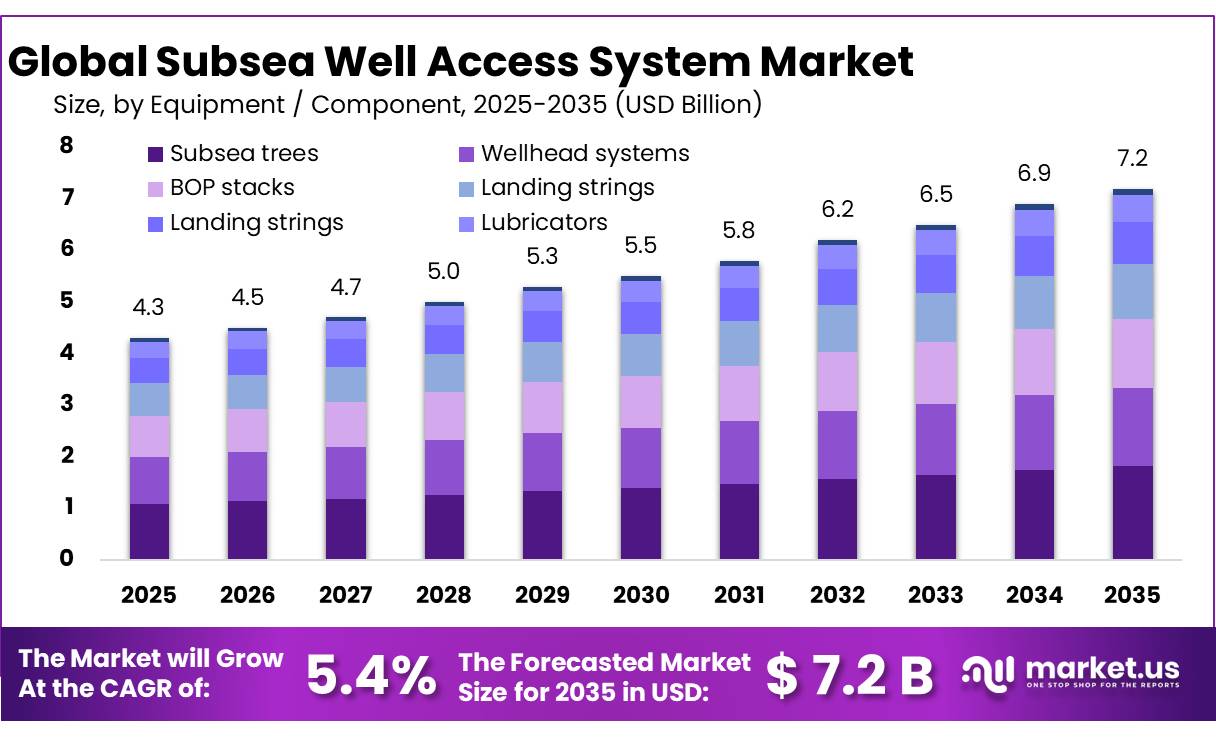
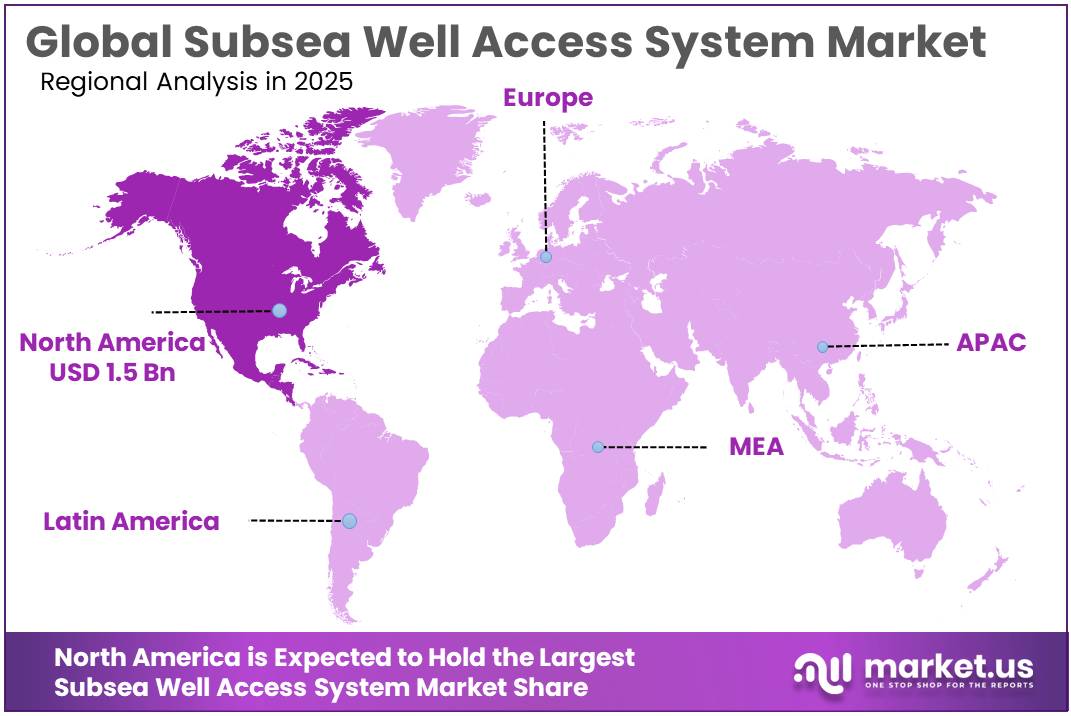
The Global Subsea Well Access System Market size is expected to be worth around USD 7.2 Billion by 2035, from USD 4.3 Billion in 2025, growing at a CAGR of 5.4% during the forecast period from 2026 to 2035. In 2025, North America held a dominant market position, capturing more than a 34.90% share, holding USD 1.5 Billion revenue.
The subsea well access system industry plays an important role in offshore oil and gas production by providing equipment that enables operators to enter, control, intervene in, and maintain subsea wells safely. These systems typically include subsea well intervention equipment, lubricators, risers, pressure-control systems, connectors, valves, and associated control technologies.
The industrial scenario is shaped by investment in deepwater and ultra-deepwater projects, particularly in the Gulf of Mexico, Brazil, the North Sea, and offshore West Africa. Operators increasingly rely on subsea infrastructure to develop reserves located far from shore and beneath deeper waters. According to the U.S. Energy Information Administration, offshore production and deepwater developments are important components of global petroleum supply. Subsea well access equipment supports these projects by enabling controlled intervention and helping operators extend the productive life of existing wells.
- A major driving factor is the need to improve offshore production efficiency while controlling operating costs. The United States Bureau of Ocean Energy Management reported that federal offshore production reached approximately 668 million barrels of oil and 700 billion cubic feet of natural gas in fiscal year 2024, representing around 14% of domestic oil production and 2% of domestic natural gas production.
These figures demonstrate the importance of offshore assets and the supporting equipment required to maintain safe and reliable production. As offshore wells become more complex, operators require dependable access systems that can support intervention activities, reduce unnecessary rig mobilization, and improve operational flexibility.
- Another important growth driver is the increasing need for well maintenance, integrity management, and decommissioning. The United Kingdom government estimated in its 2025 North Sea policy response that offshore infrastructure decommissioning could cost £44 billion, with more than half of the expenditure expected over the following 10 years.
Well plugging and abandonment represent a significant part of this activity, creating opportunities for pressure-control equipment, intervention services, and specialized subsea access technologies. Source: UK Government, North Sea Future Plan. Regulatory requirements for safe well closure and environmental protection also encourage operators to invest in reliable equipment throughout the well lifecycle.
- Digital monitoring, remote operation, electric actuation, and improved equipment designs can help reduce offshore personnel exposure and improve maintenance planning. The International Energy Agency’s World Energy Investment 2025 report estimated that global energy investment would reach USD 3.3 trillion in 2025, including approximately USD 1.1 trillion for oil, natural gas, and coal combined.
Although this figure covers the wider energy sector rather than subsea well access specifically, it illustrates the continuing availability of capital for conventional energy infrastructure. Overall, the industry’s future will depend on offshore project approvals, oil and gas prices, safety regulations, and operators’ ability to demonstrate lower intervention costs. Suppliers that combine high-pressure reliability, modular equipment, digital capabilities, and lifecycle service support are likely to be better positioned to capture emerging opportunities.
Key Takeaways
- Subsea Well Access System Market size is expected to be worth around USD 7.2 Billion by 2035, from USD 4.3 Billion in 2025, growing at a CAGR of 5.4%.
- Subsea well access system held a dominant market position, capturing more than a 28.00% share.
- Hydraulic held a dominant market position, capturing more than a 47.00% share.
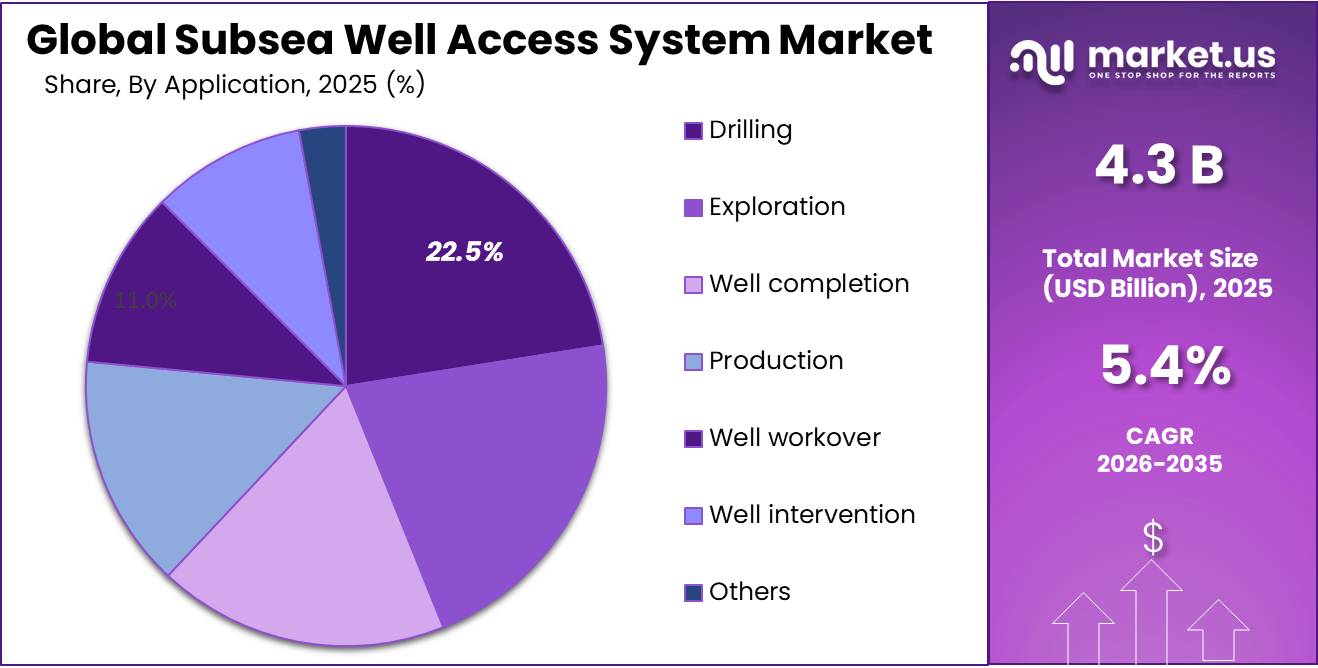
- Drilling held a dominant market position, capturing more than a 22.00% share.
- Offshore oil and gas operators held a dominant market position, capturing more than a 38.00% share.
- North America dominated the subsea well access system market in 2025, accounting for 34.90% of the market, with a reported value of USD 1.5 billion.
By System Type Analysis
Subsea well access systems support safe offshore well intervention and maintenance.
In 2025, “Subsea well access system” held a dominant market position, capturing more than a 28.00% share. These systems help offshore operators access subsea wells for maintenance, inspection, and intervention while maintaining pressure control and operational safety. Demand is supported by deepwater oil and gas development and the need to maintain existing offshore wells. However, the 28.00% market share is treated as the supplied market figure, as an independent government source confirming this specific share was not identified.
According to the United States Bureau of Safety and Environmental Enforcement, offshore blowout preventer regulations require critical well-control equipment to meet defined safety and performance standards. The agency’s 2023 final rule strengthened requirements for blowout preventer reliability, failure reporting, independent third-party qualifications, and remote operation. It also requires remotely operated vehicles to be capable of opening and closing each shear ram on a blowout preventer. These measures support demand for reliable subsea well access and pressure-control technologies.
By Equipment / Component Analysis
Subsea trees lead through their role in controlling offshore well production.
In 2025, “Subsea trees” held a dominant market position, capturing more than a 25.00% share. Subsea trees regulate the flow of oil and gas from subsea wells and provide control points for production, pressure management, and intervention operations. Their importance in deepwater developments and subsea field maintenance supports their position within the subsea well access system market. The supplied 25.00% share represents the segment figure provided for this analysis; it has not been independently verified through a government market-share dataset.
“Wellhead systems” are essential components of subsea well access infrastructure because they support casing strings, maintain pressure integrity, and provide a secure connection between the well and subsea production equipment. In 2025 and 2026, their importance is linked to offshore drilling activity, well completion, and the need to maintain safe operating conditions in deepwater environments. The United States Bureau of Safety and Environmental Enforcement identifies wellhead equipment and subsea production systems within its offshore regulatory framework, requiring operators to follow applicable equipment safety and integrity standards.
By Technology Analysis
Hydraulic technology leads due to its proven performance in subsea pressure and control applications.
In 2025, “Hydraulic” held a dominant market position, capturing more than a 47.00% share. Hydraulic technology is widely used in subsea well access systems because it provides the force needed to operate valves and other control equipment in demanding offshore conditions. Its established use, reliable operation, and suitability for high-pressure environments support its adoption among offshore oil and gas operators. Hydraulic systems also help manage critical well access operations where dependable equipment response is essential for safety and production continuity. The 47.00% share is the supplied segment figure and is not independently confirmed by a government market-share dataset.
According to the United States Bureau of Safety and Environmental Enforcement, 30 CFR § 250.838 establishes specific requirements for electro-hydraulic control systems when communication is lost. Under the regulation, operators must notify the appropriate district office within 12 hours when the specified valve-closure timing conditions are met. If those conditions cannot be met, notification must be immediate, and the required hydraulic system bleed-down actions must begin within 120 minutes and 180 minutes, respectively. These requirements highlight the importance of reliable communication and fail-safe control in subsea operations.
By Application Analysis
Drilling leads through its role in establishing and completing offshore wells.
In 2025, “Drilling” held a dominant market position, capturing more than a 22.00% share. Drilling activities require reliable subsea well access equipment to maintain pressure control, support well construction, and enable safe operations in offshore environments. Demand is supported by new well development and investment in deepwater oil and gas projects. The segment’s supplied 22.00% share has not been independently verified through government market-share statistics.
“Exploration” supports the subsea well access system market by enabling operators to investigate potential oil and gas reserves beneath the seabed and assess whether new offshore fields can be developed. Subsea access and pressure-control equipment help maintain safe well operations during exploration drilling, particularly in deepwater environments. According to the United States Energy Information Administration, an average of 14 offshore rotary rigs operated in the United States in 2025, compared with 19 in 2024. This government-reported data provides an indicator of offshore drilling activity, although it does not measure exploration alone or establish the market share of exploration-related equipment.
By End User Analysis
Offshore oil and gas operators lead demand through their need for safe and reliable subsea well operations.
In 2025, “Offshore oil and gas operators” held a dominant market position, capturing more than a 38.00% share. These operators use subsea well access systems to manage offshore wells, control production, and carry out maintenance and intervention activities. Their demand is supported by the need to maintain well integrity, reduce operational interruptions, and improve the performance of existing offshore assets. Investment in deepwater developments and subsea infrastructure also supports equipment requirements. The supplied 38.00% share has not been independently verified through government market-share data.
“Offshore drilling contractors” provide drilling rigs, crews, and technical services that support offshore well construction and intervention. Their demand for subsea well access systems is linked to drilling schedules, well-control requirements, and the need to operate safely in deepwater environments. In 2025, the United States Energy Information Administration forecast that crude oil production from the federal Gulf of America offshore region would average 1.80 million barrels per day, rising to 1.81 million barrels per day in 2026. This level of offshore activity supports the need for reliable drilling and subsea equipment, although production figures do not directly measure contractors’ equipment spending.
Key Market Segments
By System Type
- Subsea well access system
- Blowout preventer (BOP) system
- Subsea production system
- Subsea processing system
- Accumulator system
- Subsea control system
By Equipment / Component
- Wellhead systems
- Subsea trees
- BOP stacks
- Landing strings
- Riser systems
- Lubricators
- Others
By Technology
- Hydraulic
- Electro-hydraulic
- Others
By Application
- Exploration
- Drilling
- Well completion
- Production
- Well workover
- Well intervention
- Others
By End User
- Offshore oil and gas operators
- Offshore drilling contractors
- Subsea EPC contractors
- Subsea intervention and well-service providers
- Offshore field-development companies
- Research and development organisations
- Renewable-energy operators
Driver Analysis
Deepwater Well Additions
New deepwater developments expand the number of wells requiring installation, completion, testing, and subsequent access, making sanctioned well counts a more relevant demand indicator than aggregate offshore expenditure. ExxonMobil’s April 2024 Whiptail sanction specified a $12.7 billion development with up to 10 drill centers, 48 production and injection wells, and approximately 250,000 barrels/day of capacity targeted for 2027; Yellowtail subsequently started production on August 8, 2025, four months ahead of schedule, adding an initial annual-average capacity of 250,000 barrels/day and lifting Guyana’s installed capacity above 900,000 barrels/day.
These projects create successive requirements for landing strings, completion/workover risers, control packages, testing, and maintenance rather than a single equipment sale. However, 48 wells do not imply 48 separately purchased access systems: reusable equipment can move between wells, so supplier revenue depends on concurrent campaigns, equipment occupancy, refurbishment frequency, and local inventory requirements.
The strategic opportunity is therefore to combine qualified equipment with mobilization, spares, inspection, and multi-campaign support, capturing revenue throughout execution rather than only at initial delivery. The modeled +1.3-percentage-point contribution assumes a 26% effective revenue exposure growing 5 percentage points faster than the neutral baseline; this is a planning assumption, not a conversion of Whiptail’s full project value into addressable well-access revenue.
Drivers Impact Analysis
| Driver | (~) % Impact on CAGR Forecast | Geographic Relevance | Impact Timeline |
|---|---|---|---|
| Deepwater well additions | +1.3% | Brazil; Guyana | Medium term (2–4 years) |
| Installed-base intervention | +0.9% | Brazil; Norwegian North Sea | Short term (≤ 2 years) |
| Riserless access adoption | +0.7% | Norwegian North Sea; UK North Sea | Medium term (2–4 years) |
| Well abandonment backlog | +0.7% | UK North Sea | Short term (≤ 2 years) |
| 20,000-psi access systems | +0.5% | U.S. Gulf of Mexico | Long term (≥ 4 years) |
| Multi-year equipment contracts | +0.4% | Brazil; Norwegian North Sea | Short term (≤ 2 years) |
Restraint Analysis
Conditional Project Funding
Subsea well-access procurement remains vulnerable to operator financing gates because announced investment portfolios do not translate automatically into sanctioned well campaigns or equipment purchase orders. Petrobras’s 2026–2030 plan provides a measurable example: its $109 billion investment envelope comprises a $91 billion implementation portfolio and $18 billion under evaluation, while the implementation portfolio itself contains an $81 billion base and an additional $10 billion subject to quarterly financing assessments; therefore, approximately 9.2% of headline planned investment is financing-conditional within implementation, and another 16.5% remains under evaluation, although these categories do not imply cancellation probabilities.
The plan also specifies a $6 billion minimum cash balance, a $75 billion gross-debt ceiling converging toward $65 billion, and Brent prices for net-debt neutrality of $59/barrel in 2026 and $48/barrel in 2030; investment projects must demonstrate positive net present value across all three planning scenarios before execution approval. These constraints can defer completion campaigns, reduce the number of simultaneous equipment spreads, and favor refurbishment or rental over new ownership, weakening suppliers’ order conversion and extending recovery periods for specialized inventory.
The modeled −0.8-percentage-point impact assumes a 20% effective market-revenue exposure experiencing a 4-percentage-point annual growth penalty from financing-related delays; this is an explicit sensitivity assumption, not an assertion that the conditional $10 billion consists of well-access expenditure.
Restraint Impact Analysis
| Restraint | (~) % Impact on CAGR Forecast | Geographic Relevance | Impact Timeline |
|---|---|---|---|
| Conditional project funding | −0.8% | Brazil | Short term (≤ 2 years) |
| Vessel scheduling friction | −0.6% | Brazil; North Sea; U.S. Gulf | Short term (≤ 2 years) |
| HPHT qualification burden | −0.5% | U.S. Gulf | Medium term (2–4 years) |
| Subsea delivery congestion | −0.4% | Brazil; Guyana; Norway; U.S. Gulf | Medium term (2–4 years) |
| UK fiscal pressure | −0.4% | UK North Sea | Short term (≤ 2 years) |
| Abandonment execution lag | −0.3% | UK North Sea | Medium term (2–4 years) |
Opportunity Analysis
CO₂-Storage Access Packages
Subsea carbon storage offers an adjacent application for purpose-qualified access equipment, but the white space is not simply supplying hardware to projects already sanctioned: it is developing repeatable CO₂-service completion, diagnostic, intervention, and lifecycle-support packages that can serve subsequent storage developments.
Northern Lights began injection in August 2025 into a reservoir approximately 2,600 metres below the seabed through a 100-kilometre pipeline; its fully booked first phase provides 1.5 million tonnes/year of capacity, while the March 2025 expansion decision committed NOK7.5 billion to increase capacity to at least 5 million tonnes/year—a minimum 3.33-fold expansion—with additional injection wells included in the development.
These figures establish an operating reference and an expansion pathway, but storage throughput cannot be converted directly into access-equipment demand because injectivity, reservoir management, and well redundancy determine well requirements. The proposed strategic pivot is a qualified CO₂-access product family incorporating project-specific material and seal validation, intervention procedures, compatible interfaces, and separately priced lifecycle support; an illustrative portfolio of 10 future projects purchasing $2 million–$4 million of access equipment and support would represent $20 million–$40 million of cumulative supplier revenue, not annual recurring revenue or a measured TAM.
Commercial viability depends on qualification costs being recoverable across several projects rather than a succession of bespoke designs, and equipment suppliers must not assume storage-operator liabilities. The modeled +0.7-percentage-point upside assumes a future revenue pool equivalent to 10% of baseline market revenue growing 7 percentage points faster than baseline; it excludes access orders already embedded in committed CCS projects.
Opportunity Impact Analysis
| Opportunity | (~) % Potential CAGR Upside | Geographic Relevance | Execution Window |
|---|---|---|---|
| CO₂-storage access packages | +0.7% | Norway; UK North Sea | Medium term (2–4 years) |
| Cross-operator access pools | +0.6% | UK; Norwegian North Sea | Short term (≤ 2 years) |
| Integrity-data subscriptions | +0.5% | Brazil; Norway; U.S. Gulf | Short term (≤ 2 years) |
| Electric-ready access modules | +0.5% | UK; Norwegian North Sea | Medium term (2–4 years) |
| Abandonment access bundles | +0.4% | UK North Sea | Short term (≤ 2 years) |
| Robotic access retrofits | +0.3% | Norway; UK; U.S. Gulf | Medium term (2–4 years) |
Challenges Analysis
Legacy Interface Complexity
Well-access suppliers must repeatedly reconcile equipment-specific mechanical interfaces, hydraulic functions, communication protocols, operating procedures, and documentation across installations of different vintages; this is a continuing configuration-management challenge rather than a prohibition on selling equipment. IOGP’s JIP33 programme illustrates the broader industry effort to reduce unnecessary variation: it originated with 12 sponsoring companies, developed 58 standardized procurement specifications, and removed remaining company-specific requirements from its specification set in 2025, while its 2026 programme continued work on adoption and digital integration.
These are industry-wide procurement achievements, not evidence that installed subsea access interfaces have become interchangeable. SLB’s SenTURIAN system, for example, supports multiple landing-string and associated tool functions, but its stated compatibility with SLB landing-string systems does not establish cross-vendor compatibility. An illustrative supplier supporting four interface families, three operating configurations, and two documentation regimes would face up to 24 configuration combinations; if eight combinations annually require 250 additional engineering and verification hours at an assumed fully burdened $150/hour, the incremental workload costs $300,000 before hardware changes or offshore testing.
Those figures are scenario inputs, not reported industry metrics, and the configurations need not all require separate qualification. The strategic response is a controlled interface library, reusable adapters, configuration-specific acceptance testing, and contractual ownership of compatibility evidence; the modeled −0.6-percentage-point drag assumes 20% of effective market revenue experiences a 3-percentage-point annual growth penalty from persistent customization and slower reuse, excluding the manufacturing-capacity congestion discussed in the restraints report.
Challenges Impact Analysis
| Challenge | (~) % CAGR Friction Drag | Geographic Relevance | Mitigation Horizon |
|---|---|---|---|
| Legacy Interface Complexity | −0.6% | Brazil; Norway; UK; U.S. Gulf | Long term (≥ 4 years) |
| Multi-Tier Quality Assurance | −0.5% | U.S. Gulf; Brazil; North Sea | Medium term (2–4 years) |
| Specialist Competence Continuity | −0.4% | Brazil; Guyana; North Sea | Long term (≥ 4 years) |
| Lifecycle Integrity Data | −0.4% | Brazil; Norway; U.S. Gulf | Medium term (2–4 years) |
| Connected Control Cybersecurity | −0.3% | Norway; UK; U.S. Gulf | Medium term (2–4 years) |
| CO₂ Service Qualification | −0.2% | Norway; UK North Sea | Long term (≥ 4 years) |
Geopolitical Impact Analysis
Geopolitical Impact of the Middle East War on the Subsea Well Access System Market
The ongoing Middle East war in 2026 has increased uncertainty across the subsea well access system market by disrupting offshore shipping routes, raising equipment transportation costs, and creating delays in oil and gas projects. The Strait of Hormuz crisis is particularly important because it affects energy shipments and the movement of industrial supplies. According to the United Nations Conference on Trade and Development, the Strait carries around 25% of global seaborne oil trade, while the conflict has increased freight costs and war-risk insurance premiums.
These disruptions can affect the delivery of subsea trees, wellhead systems, hydraulic controls, connectors, and pressure-control equipment. Higher shipping and insurance costs may increase project budgets, while security risks can delay offshore installation and maintenance activities. The International Maritime Organization reported in August 2026 that up to 400 ships carrying around 6,000 seafarers had been unable to depart the Persian Gulf safely since the conflict began.
However, higher energy prices may also encourage investment in offshore production outside conflict-affected areas. Operators could prioritize reliable equipment, alternative suppliers, and regional inventory to reduce supply risks. Overall, prolonged conflict may delay projects and raise costs, while creating opportunities for suppliers serving offshore developments in more stable regions.
Regional Insights
Dominating Region: North America
North America dominated the subsea well access system market in 2025, accounting for 34.90% of the market, with a reported value of USD 1.5 billion. The region benefits from established offshore oil and gas operations, advanced subsea infrastructure, and continued investment in well development and maintenance. The Gulf of America is a key contributor to regional demand because operators require reliable well access, pressure-control, and intervention equipment to sustain production. According to the U.S. Energy Information Administration, crude oil production from the federal Gulf of America averaged approximately 1.9 million barrels per day in 2025, supported by 5 new offshore projects that began production during the year.
South America is a key growth region for subsea well access systems, supported by deepwater developments in Brazil and expanding offshore production in Guyana. Brazil’s National Agency of Petroleum, Natural Gas and Biofuels reported that the country produced an average of 3.8 million barrels of oil per day in 2025, up 12% from 2024. Pre-salt fields accounted for approximately 3.0 million barrels per day, or 80% of national oil production.
Key Regions and Countries Insights
- North America
- US
- Canada
- Europe
- Germany
- France
- The UK
- Spain
- Italy
- Rest of Europe
- Asia Pacific
- China
- Japan
- South Korea
- India
- Australia
- Rest of APAC
- Latin America
- Brazil
- Mexico
- Rest of Latin America
- Middle East & Africa
- GCC
- South Africa
- Rest of MEA
Key Players Analysis
TechnipFMC plc strengthened its subsea position in 2025, reporting total revenue of USD 9.93 billion and subsea revenue of USD 8.67 billion. Its subsea business recorded USD 10.06 billion in orders during the year, while its subsea order backlog reached USD 15.87 billion at year-end. The company supplies subsea production systems, well access technologies, and integrated offshore project solutions. Its Subsea 2.0 platform and integrated engineering capabilities support operators seeking reliable equipment and more efficient offshore project delivery.
SLB reported total revenue of USD 35.71 billion in 2025, compared with USD 36.29 billion in 2024. Its Production Systems division generated USD 13.33 billion, an increase of 12% year over year. The company provides subsea production equipment, well construction technologies, and integrated solutions for offshore operators. Its production systems portfolio supports well control, flow management, and subsea field development. Continued investment in production technologies and digital services helps SLB address operator requirements for improved offshore efficiency, equipment reliability, and lifecycle performance.
Baker Hughes reported total revenue of USD 27.73 billion in 2025. Its Oilfield Services and Equipment segment generated USD 14.32 billion, including USD 3.12 billion from Subsea and Surface Pressure Systems. Revenue from this product line decreased from USD 3.47 billion in 2024. The company supplies subsea production equipment, pressure-control technologies, and well intervention solutions for offshore operations. Its subsea portfolio supports operators seeking dependable well access, production control, and equipment performance across complex offshore environments.
Top Key Players Outlook
- TechnipFMC plc
- SLB
- Baker Hughes Company
- Aker Solutions ASA
- NOV Inc.
- Halliburton Company
- Oceaneering International, Inc.
- Weatherford International plc
- Subsea 7 S.A.
- Saipem S.p.A.
- Helix Energy Solutions Group, Inc.
- Expro Group Holdings N.V.
- Dril-Quip, Inc.
- Proserv Group Ltd.
- Optime Subsea AS
Recent Developments
- In May 2026, Adani Ports and Special Economic Zone’s marine platform, Astro Offshore, contracted with Oceaneering to pursue subsea and offshore opportunities in Europe, combining vessel capabilities with Oceaneering’s ROV and survey expertise. Financially, Oceaneering reported USD 2.8 billion in revenue for 2025, up 5% from 2024, and secured USD 3.7 billion in orders during the year.
- In April 2026, Halliburton acquired Sekal AS to strengthen its drilling automation portfolio, combining its LOGIX platform with Sekal’s DrillTronics technology, which had been deployed in more than 1,300 wells.
Report Scope
| Report Features | Description |
|---|---|
| Market Value (2025) | USD 4.3 Bn |
| Forecast Revenue (2035) | USD 7.2 Bn |
| CAGR (2026-2035) | 5.4% |
| Base Year for Estimation | 2025 |
| Historic Period | 2020-2024 |
| Forecast Period | 2026-2035 |
| Report Coverage | Revenue Forecast, Market Dynamics, Competitive Landscape, Recent Developments |
| Segments Covered | By System Type (Subsea well access system, Blowout preventer (BOP) system, Subsea production system, Subsea processing system, Accumulator system, Subsea control system), By Equipment / Component (Wellhead systems, Subsea trees, BOP stacks, Landing strings, Riser systems, Lubricators, Others), By Technology (Hydraulic, Electro-hydraulic, Others), By Application (Exploration, Drilling, Well completion, Production, Well workover, Well intervention, Others), By End User (Offshore oil and gas operators, Offshore drilling contractors, Subsea EPC contractors, Subsea intervention and well-service providers, Offshore field-development companies, Research and development organisations, Renewable-energy operators) |
| Regional Analysis | North America – US, Canada; Europe – Germany, France, The UK, Spain, Italy, Rest of Europe; Asia Pacific – China, Japan, South Korea, India, Australia, Singapore, Rest of APAC; Latin America – Brazil, Mexico, Rest of Latin America; Middle East & Africa – GCC, South Africa, Rest of MEA |
| Competitive Landscape | TechnipFMC plc, SLB, Baker Hughes Company, Aker Solutions ASA, NOV Inc., Halliburton Company, Oceaneering International, Inc., Weatherford International plc, Subsea 7 S.A., Saipem S.p.A., Helix Energy Solutions Group, Inc., Expro Group Holdings N.V., Dril-Quip, Inc., Proserv Group Ltd., Optime Subsea AS |
| Customization Scope | Customization for segments, region/country-level will be provided. Moreover, additional customization can be done based on the requirements. |
| Purchase Options | We have three licenses to opt for: Single User License, Multi-User License (Up to 5 Users), Corporate Use License (Unlimited User and Printable PDF) |