Report Overview
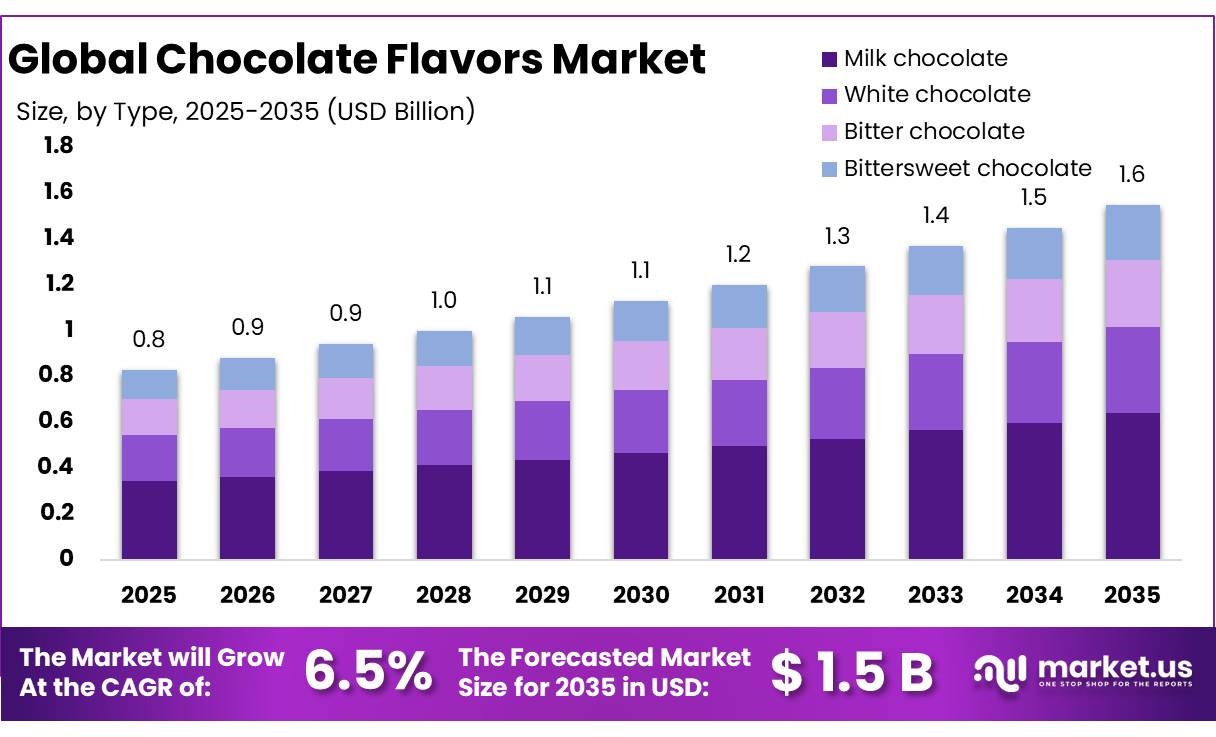
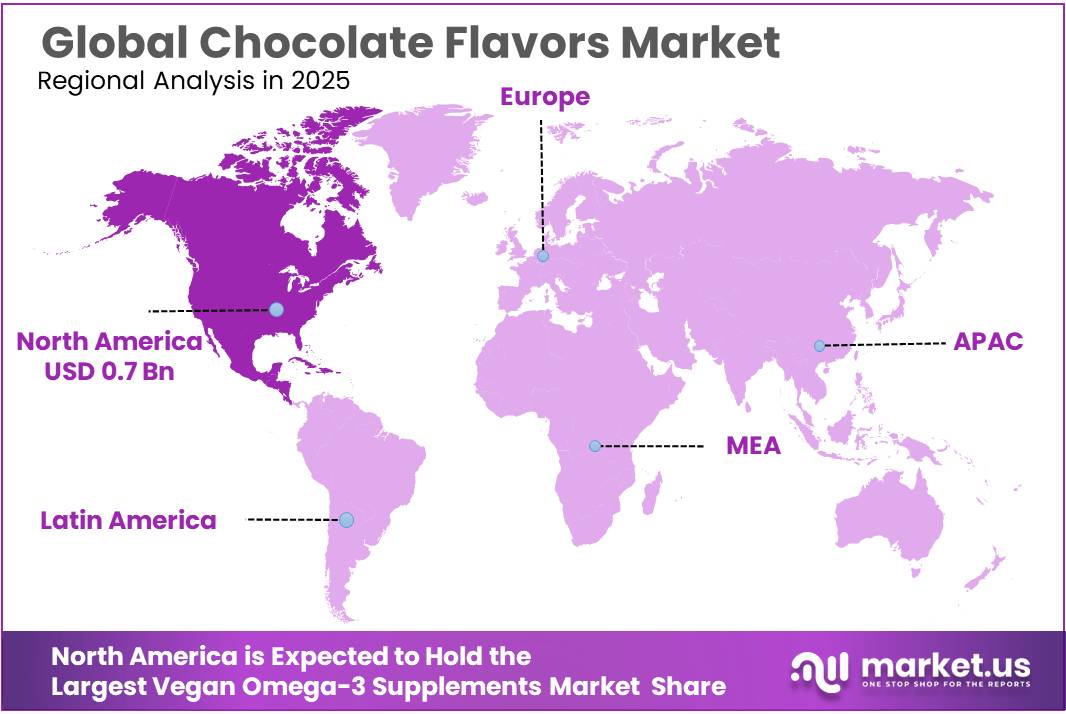
The Global Chocolate Flavors Market size is expected to be worth around USD 1.5 Billion by 2035, from USD 0.8 Billion in 2025, growing at a CAGR of 6.5% during the forecast period from 2026 to 2035. In 2025, Europe held a dominant market position, capturing more than a 35.67% share, holding USD 0.2 Billion revenue.
The chocolate flavors industry supplies ingredients that create or enhance chocolate taste and aroma in confectionery, bakery products, dairy foods, ice cream, desserts, and beverages. Products include milk chocolate, dark chocolate, white chocolate, cocoa, and chocolate fudge profiles, supplied in powder, liquid, and paste forms. Food manufacturers use these flavors to maintain consistent taste across production batches, develop new products, and offer different levels of sweetness and cocoa intensity. The industry serves both large food processing companies and food-service businesses, where reliable flavor performance, ease of use, and compatibility with other ingredients are important purchasing factors.
- According to the International Cocoa Organization (ICCO), its August 2026 bulletin estimated global cocoa production at 4.733 million tonnes for the 2024/2025 cocoa season, while cocoa grindings reached 4.649 million tonnes. Grindings declined by 3.3% year over year, reflecting weaker processing activity amid changing costs and demand conditions.
These figures demonstrate why cocoa availability, ingredient prices, and processing economics matter to chocolate flavor suppliers and their customers. Although cocoa production does not directly measure demand for manufactured chocolate flavors, it provides an important indicator of the raw material environment affecting the wider chocolate industry.
One of the main driving factors is the demand for convenient, indulgent, and differentiated food products. Chocolate flavors allow manufacturers to introduce new products without relying entirely on a single cocoa-based formulation. Powder flavors are useful in dry mixes and packaged foods, while liquid flavors suit beverages, syrups, dairy products, and dessert preparations.
The United States Food and Drug Administration identifies flavors as ingredients used in products such as candies, cake mixes, soft drinks, and ice cream. It also explains that food ingredients must meet applicable safety requirements and labeling rules. These requirements encourage manufacturers to select suitable ingredients and maintain clear product documentation.
- According to the ICCO’s 2024/2025 annual report, the average international cocoa indicator price reached USD 6,612 per tonne, approximately 39% higher than in the previous year. Such price movements can put pressure on chocolate manufacturers and encourage them to improve formulation efficiency, manage sourcing risks, and explore alternative ingredients.
Future growth opportunities include natural flavor development, reduced-sugar product formulations, plant-based desserts, premium confectionery, and chocolate alternatives that do not rely on cocoa. In November 2025, Barry Callebaut and Planet A Foods announced a long-term commercial partnership to develop and expand chocolate alternatives made without cocoa. This development highlights opportunities for flavor manufacturers to create chocolate-like profiles for alternative ingredients, bakery fillings, coatings, and dairy-free products.
Key Takeaways
- Chocolate Flavors Market size is expected to be worth around USD 1.5 Billion by 2035, from USD 0.8 Billion in 2025, growing at a CAGR of 6.5%.
- Milk chocolate held a dominant market position, capturing more than a 41.23% share.
- Powder Flavors held a dominant market position, capturing more than a 53.67% share.
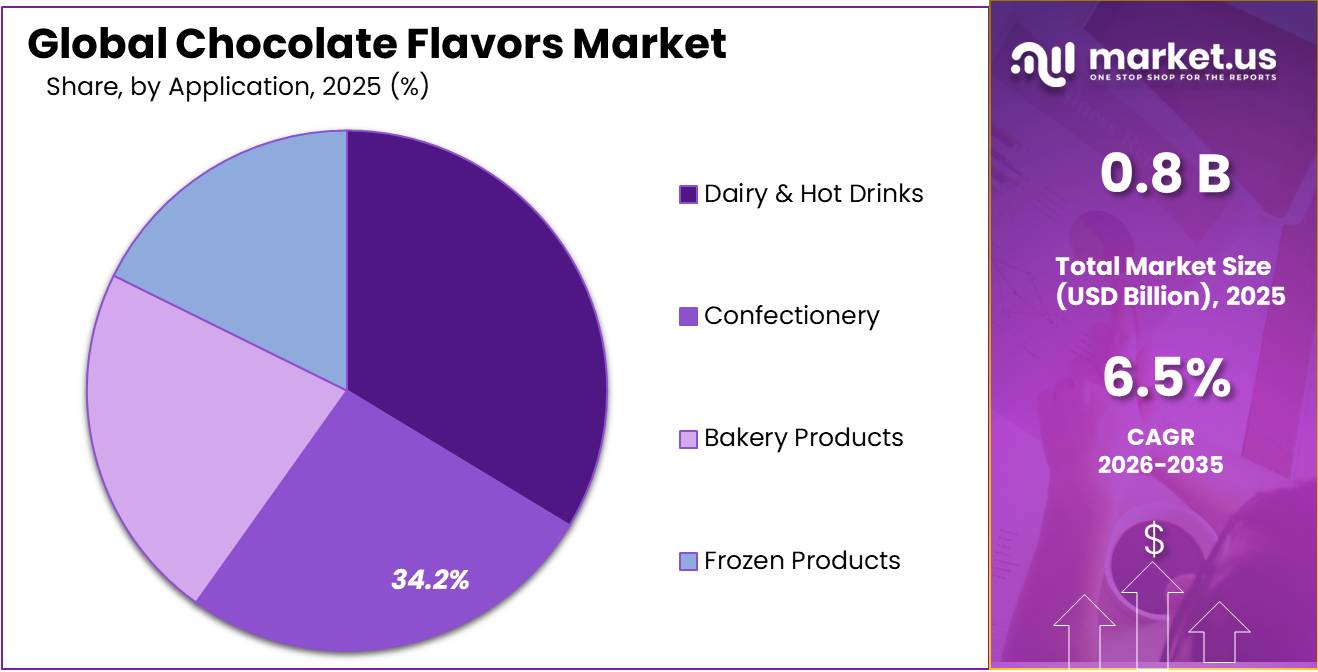
- Dairy & Hot Drinks held a dominant market position, capturing more than a 37.89% share.
- Food and Beverage Manufacturers held a dominant market position, capturing more than a 63.45% share.
- Europe held the dominant position in the Chocolate Flavors Market in 2025, accounting for 35.67% of the market, with a reported value of USD 0.2 billion.
By Type Analysis
Milk Chocolate Segment: Broad Use Across Confectionery and Food Products
In 2025, “Milk chocolate” held a dominant market position, capturing more than a 41.23% share of the Chocolate Flavors Market by type. Its position is supported by its familiar creamy, sweet, and cocoa-rich taste, which makes it suitable for confectionery, bakery products, ice cream, dairy desserts, and flavored beverages. Chocolate flavor manufacturers use milk chocolate profiles to help food producers maintain consistent taste across different product lines and develop fillings, coatings, and seasonal offerings.
White chocolate is an important segment of the Chocolate Flavors Market because its creamy, buttery, and sweet taste is widely suited to confectionery, bakery fillings, ice cream, dessert toppings, and flavored beverages. Its flavor profile allows manufacturers to create distinctive products and combine white chocolate notes with vanilla, caramel, fruit, and other complementary flavors.
According to the United States Food and Drug Administration (FDA), white chocolate must contain at least 20% cocoa butter, 14% total milk solids, and 3.5% milkfat, while nutritive carbohydrate sweeteners must not exceed 55% of the finished product by weight. These official requirements, specified under 21 CFR 163.124, establish the product’s composition and help distinguish genuine white chocolate from alternative confectionery coatings.
By Form Analysis
Powder Flavors Segment: Convenient Handling Supports Wider Food Manufacturing Use
In 2025, “Powder Flavors” held a dominant market position, capturing more than a 53.67% share of the Chocolate Flavors Market by form. Powdered chocolate flavors are used in bakery mixes, confectionery, instant beverages, dessert powders, ice cream preparations, and other processed food products. Their dry form makes them convenient to store, transport, blend with powdered ingredients, and incorporate into manufacturing processes where low moisture content is important. Powder flavors can also provide consistent chocolate taste across large production batches when properly formulated and handled.
Liquid Flavors are used in chocolate-flavored beverages, syrups, dairy products, ice creams, confectionery fillings, and bakery applications where easy mixing and even flavor distribution are important. Their liquid form allows manufacturers to incorporate chocolate notes directly into liquid or semi-liquid formulations and adjust flavor intensity according to the finished product. The segment also benefits from demand for ready-to-drink beverages, dessert sauces, and customized food formulations.
However, manufacturers must consider storage stability, dosage accuracy, and compatibility with other ingredients when selecting liquid flavor systems. The United States Food and Drug Administration identifies flavorings as ingredients used to add specific flavors to products such as soft drinks, candies, cake mixes, and ice cream. Its official food ingredient guidance provides regulatory context for these applications. No independently verified government statistic was identified that establishes the market share of liquid chocolate flavors; therefore, no unsupported numerical value is assigned to this segment.
By Application Analysis
Dairy & Hot Drinks Segment: Chocolate Flavors Meet Demand for Indulgent Beverages
In 2025, “Dairy & Hot Drinks” held a dominant market position, capturing more than a 37.89% share of the Chocolate Flavors Market by application. Chocolate flavors are widely used in milk-based drinks, hot chocolate, milkshakes, dairy desserts, and instant beverage mixes, where they provide a familiar cocoa taste and improve product appeal. Food manufacturers use these flavors to maintain consistent taste across ready-to-drink beverages and powdered preparations while developing new products for different consumer preferences. The segment benefits from demand for convenient beverages and chocolate-based drinks sold through retail and food-service channels.
Confectionery is a key application for chocolate flavors, as manufacturers use them in chocolate bars, candies, truffles, pralines, filled chocolates, and other sweet treats. These flavors help maintain a consistent taste and support product innovation through combinations with caramel, nuts, vanilla, and fruit. In 2025, chocolate and confectionery manufacturers continued to serve a broad consumer base in the United States. The United States Census Bureau reported USD 21,973,654 thousand in shipments from chocolate and chocolate confectionery manufacturing for 2024, equivalent to approximately USD 21.97 billion.
By End User Analysis
Food and Beverage Manufacturers: Large-Scale Production Supports Chocolate Flavor Demand
In 2025, “Food and Beverage Manufacturers” held a dominant market position, capturing more than a 63.45% share of the Chocolate Flavors Market by end user. These manufacturers use chocolate flavors in confectionery, bakery products, dairy desserts, ice cream, ready-to-drink beverages, and powdered drink mixes. Their demand is supported by the need for consistent taste, efficient production, and product differentiation across large product portfolios. Chocolate flavor suppliers can serve this segment through customized formulations, stable flavor profiles, and solutions designed for specific processing conditions.
The scale of this customer base is reflected in official United States data. The U.S. Census Bureau’s 2024 Annual Integrated Economic Survey reported that food manufacturing generated approximately USD 1,054.3 billion in shipment value and employed 1,702,155 people in 2024. Although these figures cover the wider food manufacturing industry rather than chocolate flavors specifically, they demonstrate the scale of the industrial customer base for food ingredients.
Key Market Segments
By Type
- Milk chocolate
- White chocolate
- Bitter chocolate
- Bittersweet chocolate
By Form
- Liquid Flavors
- Oil Soluble Flavors
- Water Soluble Flavors
- Powder Flavors
- Spray Dried Powder
- Encapsulated Powder
- Paste Flavors
- Concentrated Paste
- Ready to Use Paste
By Application
- Confectionery
- Dairy & Hot Drinks
- Bakery Products
- Frozen Products
- Convenience Products
- Others
By End User
- Food and Beverage Manufacturers
- Food Service Industry
Driver Analysis
Cocoa-Saving Reformulation
Manufacturers’ efforts to preserve chocolate taste while lowering cocoa exposure actively increase the value of concentrated flavor systems, making reformulation—not simply higher confectionery sales—the principal demand mechanism. The ICCO’s 2024/25 annual report describes historically volatile cocoa conditions and reports an indicator-price average of $6,612/tonne, approximately 39% above the preceding comparison period; independently, Barry Callebaut reported a 6.8% volume decline to approximately 2.13 million tonnes in fiscal 2024/25, illustrating why cocoa inflation should not be mistaken for expanding physical chocolate consumption.
Kerry’s September 2025 Smart Taste launch commercialized cocoa boosters with supplier-stated potential for up to 50% cocoa reduction and up to 40% cost savings in applicable formulations; its February 2026 bakery guidance identifies chocolate cakes, biscuits, and wafers as relevant applications, while emphasizing formulation and sensory validation. These are supplier-specific maximum claims, not universal performance guarantees. In an illustrative 1,000-kilogram bakery batch containing 40 kilograms of cocoa powder, a 30% reduction removes 12 kilograms; at an assumed delivered powder cost of $8/kilogram, gross savings are $96, leaving $56 if the replacement flavor system costs $40 per batch, before other recipe changes and qualification costs.
Cocoa-bean prices are not used as a proxy for powder procurement costs. The business model shifts from selling flavor by kilogram toward selling a validated sensory-and-cost outcome, with recurring orders linked to the customer’s reformulated production. The modeled +1.1-percentage-point contribution assumes a 22% effective revenue exposure growing 5 percentage points faster annually than the neutral scenario, conditional on savings remaining attractive as cocoa prices change.
Drivers Impact Analysis
| Driver | (~) % Impact on CAGR | Geographic Relevance | Impact Timeline |
|---|---|---|---|
| Cocoa-saving reformulation | +1.1% | North America; Europe; India | Short term (≤ 2 years) |
| Protein-product expansion | +0.8% | U.S.; Europe; India | Short term (≤ 2 years) |
| Sugar-reduction reformulation | +0.6% | UK; Europe; North America | Short term (≤ 2 years) |
| Chocobakery format expansion | +0.5% | U.S.; Europe; Brazil | Medium term (2–4 years) |
| Emerging-market production scale | +0.5% | India; South Asia | Medium term (2–4 years) |
| Process-specific flavor systems | +0.3% | Europe; North America | Medium term (2–4 years) |
Restraint Analysis
Chocolate Identity Restrictions
EU chocolate legislation places a direct boundary around the addressable market for added chocolate-mimicking flavors: Directive 2000/36/EC permits only flavorings that do not mimic chocolate or milk-fat taste in specified legally defined cocoa and chocolate products. Standard chocolate must also contain at least 35% total dry cocoa solids, including at least 18% cocoa butter and 14% dry non-fat cocoa solids; milk chocolate generally requires at least 25% total dry cocoa solids, alongside its separate milk-related compositional requirements.
Consequently, flavor preparations cannot simply replace cocoa solids in a legally defined chocolate product while preserving its existing designation, and meeting the minimum cocoa percentage does not override the separate flavoring restriction. The commercial implication is a smaller legally eligible market than one obtained by applying a flavor dosage to all chocolate production: suppliers must distinguish chocolate-flavored bakery, beverages, desserts, fillings, and eligible compound products from regulated chocolate categories, with product classification assessed individually.
In an illustrative prospect portfolio of €10 million in potential annual flavor sales, excluding 25% because the proposed chocolate-mimicking preparation is unsuitable for the intended legal category reduces accessible sales to €7.5 million; the 25% exclusion is a modeling assumption, not a measured market share.
This restriction also qualifies the previous drivers report: conventional chocolate manufacturing expansion cannot automatically be counted as demand for added chocolate flavors. The modeled −0.7-percentage-point contribution assumes a 14% effective revenue exposure experiencing a 5-percentage-point annual growth penalty from category exclusion and redirection into a narrower set of applications.
Restraint Impact Analysis
| Restraint | (~) % Impact on CAGR | Geographic Relevance | Impact Timeline |
|---|---|---|---|
| Chocolate identity restrictions | −0.7% | EU | Long term (≥ 4 years) |
| Cocoa-substitution repricing | −0.6% | Europe; North America; India | Short term (≤ 2 years) |
| Customer volume weakness | −0.5% | Europe; North America | Short term (≤ 2 years) |
| Natural-source claim limits | −0.5% | EU | Long term (≥ 4 years) |
| HFSS advertising restrictions | −0.4% | UK | Short term (≤ 2 years) |
| Reformulation payback limits | −0.3% | Europe; North America; India | Medium term (2–4 years) |
Opportunity Analysis
Cocoa-Light Performance Licensing
The opportunity is to monetize verified formulation performance through licensing and gain-sharing, rather than merely sell more cocoa boosters: ordinary cocoa reduction already belongs in the baseline, because Kerry’s March 2026 investor presentation documents a commercial bakery application of its Cocoa Booster technology, while Cargill’s NextCoa cocoa-free confectionery alternative was already publicly recognized in April 2026.
The strategic pivot would package proprietary chocolate-aroma reconstruction, application-specific recipes, sensory validation, and manufacturing support into contracts that charge against independently verified savings after flavor, replacement-solid, processing, and quality-control costs.
Illustrative operating case: per $1 billion of 2026 market revenue, qualify 4 million tonnes of annual finished-food production by 2032; reducing cocoa powder from 5.0% to 2.5% removes 25 kg per tonne, which at an assumed $6/kg powder cost saves $150 per tonne before $25 per tonne of replacement and processing costs, leaving $125 per tonne or $500 million annually of customer savings.
Capturing 20% through performance-linked payments produces $100 million of supplier revenue; deducting $20 million of displaced or credited conventional flavor fees leaves $80 million net incremental revenue, supporting approximately +1.0 percentage point of CAGR upside.
The investment gate should therefore require positive savings under both $4/kg and $6/kg cocoa-powder scenarios, blinded sensory non-inferiority, and clear ownership of the resulting formulation IP; these are proposed underwriting tests, not demonstrated market outcomes.
Opportunity Impact Analysis
| Opportunity | (~) % Potential CAGR | Geographic Relevance | Execution Window |
|---|---|---|---|
| Cocoa-light performance licensing | +1.0% | US, EU, India, Brazil | Short term (≤ 2 years) |
| Validated clinical flavor platforms | +0.8% | US, EU, Japan, Australia | Medium term (2–4 years) |
| Microbrand formulation subscriptions | +0.6% | US, UK, India, Southeast Asia | Short term (≤ 2 years) |
| Clear-beverage chocolate systems | +0.5% | US, EU, Japan, South Korea | Medium term (2–4 years) |
| Origin aroma-recovery networks | +0.4% | Ghana, Côte d’Ivoire, Brazil, Ecuador; EU | Medium term (2–4 years) |
| Regional application-platform roll-ups | +0.3% | India, Indonesia, Vietnam, Kenya, Nigeria | Short term (≤ 2 years) |
Challenges Analysis
Cocoa Sourcing Portfolio Instability
The continuing challenge is maintaining dependable flavor-input portfolios through crop-cycle volatility, not an assumption that cocoa scarcity stops chocolate-flavor sales: ICCO’s August 2026 bulletin estimated 2024/25 gross production at 4.733 million tonnes, grindings at 4.649 million tonnes, a net supply surplus of 37,000 tonnes, and end-season stocks of 1.309 million tonnes, equivalent to a 28.2% stocks-to-grindings ratio; importantly, ICCO withheld 2025/26 production and grinding estimates, so these figures describe the latest reported prior-season balance rather than verified 2026 crop availability.
The small surplus relative to annual processing requirements supports continued sourcing-risk management, but it does not establish a specific shortage probability or flavor-market growth penalty. For a representative cocoa-dependent flavor portfolio, the analyst stress case assumes 45–75 days of ingredient coverage, 15–30 additional days during an origin switch, and a 3–6% increase in delivered ingredient cost for smaller replacement lots, extra qualification, and handling; these are planning assumptions, not reported industry averages.
Challenges Impact Analysis
| Challenge | (~) % CAGR Friction | Geographic Relevance | Mitigation Horizon |
|---|---|---|---|
| Cocoa Sourcing Portfolio Instability | −0.8 pp | Côte d’Ivoire–Ghana sourcing; EU/US processors | Long term (≥ 4 years) |
| Origin Driven Sensory Variability | −0.6 pp | West Africa; Ecuador; EU/US flavor hubs | Medium term (2–4 years) |
| Reformulation Application Validation Complexity | −0.7 pp | US; EU; UK; China; India | Medium term (2–4 years) |
| Traceability Data Integration Burden | −0.4 pp | EU; West African/Latin American suppliers | Medium term (2–4 years) |
| Encapsulation Scale Transfer Losses | −0.4 pp | EU/US production; China/India/ASEAN scale-up | Medium term (2–4 years) |
| Specialized Technical Capacity Bottlenecks | −0.3 pp | US/EU laboratories; India/China/ASEAN hubs | Long term (≥ 4 years) |
Geopolitical Impact Analysis
Geopolitical Impact of Ongoing Wars on the Chocolate Flavors Market
Ongoing conflicts in the Middle East, disruptions around the Red Sea, and the Russia-Ukraine war are increasing uncertainty across global trade and food supply chains. For the Chocolate Flavors Market, the main effects are indirect, through higher shipping costs, energy prices, insurance charges, and delays in transporting cocoa ingredients, flavor compounds, packaging materials, and other production inputs. Longer shipping routes can raise delivery costs and make supply planning more difficult for flavor manufacturers. Higher operating expenses may put pressure on profit margins or lead to higher prices for food producers.
In 2026, the United Nations Conference on Trade and Development projected global merchandise trade growth to slow from 4.7% in 2025 to 1.5%–2.5% in 2026, reflecting geopolitical tensions and supply-chain pressures. These figures cover global trade, not the chocolate flavor industry specifically. To manage these risks, manufacturers may diversify suppliers, maintain strategic inventories, and review transport routes and purchasing contracts. Continued conflict could keep costs volatile, while improved shipping conditions could gradually ease supply pressures.
Regional Insights
Europe held the dominant position in the Chocolate Flavors Market in 2025, accounting for 35.67% of the market, with a reported value of USD 0.2 billion. Its position is supported by an established chocolate-making industry, strong demand for confectionery and desserts, and widespread use of chocolate ingredients in bakery and dairy products. European manufacturers also serve export markets, creating demand for flavor formulations that deliver consistent taste across product ranges.
The Netherlands Enterprise Agency’s Centre for the Promotion of Imports from developing countries reported that Europe accounted for 48% of global chocolate consumption in 2024, highlighting the region’s importance to the wider chocolate supply chain. This consumption figure refers to chocolate overall, not chocolate flavors specifically.
Asia-Pacific is positioned as a key growth region as chocolate products gain wider use in packaged snacks, bakery goods, ice cream, and beverages. Growth in these applications creates opportunities for chocolate flavor suppliers serving food manufacturers and beverage producers. The Cocoa Association of Asia reported that regional cocoa grinding volumes increased by an average of 3% annually over the decade leading to 2024, indicating rising cocoa-processing activity. This is an industry indicator rather than a direct measure of chocolate flavor sales.
Key Regions and Countries Insights
- North America
- US
- Canada
- Europe
- Germany
- France
- The UK
- Spain
- Italy
- Rest of Europe
- Asia Pacific
- China
- Japan
- South Korea
- India
- Australia
- Rest of APAC
- Latin America
- Brazil
- Mexico
- Rest of Latin America
- Middle East & Africa
- GCC
- South Africa
- Rest of MEA
Key Players Analysis
Archer Daniels Midland Co. strengthens its position in the Chocolate Flavors Market through its food ingredient and human nutrition business. Its portfolio includes natural flavors, flavor systems, colors, and other ingredients used by food and beverage manufacturers. In 2025, ADM reported total revenue of USD 80.269 billion, while its Nutrition segment generated USD 7.512 billion. This segment serves food, beverage, and nutritional markets, supporting ADM’s role as an ingredient supplier. These figures cover the broader business, not chocolate flavors alone.
Barry Callebaut AG competes through its chocolate, cocoa, and customized ingredient solutions for industrial manufacturers and professional users. In fiscal year 2024/25, the company reported sales revenue of CHF 14.79 billion and total sales volume of 2,125,420 tonnes. Its Global Chocolate business recorded revenue of CHF 10.15 billion, with sales volume of 1,722,781 tonnes. The company also develops chocolate alternatives and customer-focused formulations, supporting product innovation across confectionery, bakery, and beverage applications.
Blommer Chocolate Co. is a major North American cocoa processor and chocolate ingredient supplier, serving confectionery, baking, and dairy manufacturers. Founded in 1939, the company offers cocoa processing, chocolate manufacturing, product development, and commodity risk management services. Its company information identifies 4 manufacturing facilities across the United States and Canada and a workforce of more than 600 employees. Blommer’s research and development capabilities help customers develop tailored chocolate products, coatings, and functional ingredients.
Top Key Players Outlook
- Archer Daniels Midland Co.
- Barry Callebaut AG
- Blommer Chocolate Co.
- Cargill Inc.
- Custom Flavors
- DSM Firmenich AG
- Givaudan SA
- Ingredion Inc.
- International Flavors Inc.
- Kerry Group Plc
- Keva Flavours Pvt Ltd
- Lionel Hitchen Ltd.
- McCormick and Co. Inc.
- Olam Group Ltd.
- Puratos NV SA
- Other Key Players
Recent Developments
- In June 2025, Custom Flavors began a major expansion of its Concord, North Carolina, production facility in partnership with design-build firm A M King. The project covered 53,000 square feet of production and laboratory space, with plans to double production capacity, triple product innovation space, and create 30 jobs over 3 years.
- In February 2026, dsm-firmenich AG reported full-year 2025 sales of €12.521 billion across the total group, while sales from continuing operations reached €9.034 billion. Its merger integration continued to generate synergies, with approximately €350 million in adjusted earnings before interest, taxes, depreciation, and amortization targeted from the combined business.
Report Scope
| Report Features | Description |
|---|---|
| Market Value (2025) | USD 0.8 Bn |
| Forecast Revenue (2035) | USD 1.5 Bn |
| CAGR (2026-2035) | 6.5% |
| Base Year for Estimation | 2025 |
| Historic Period | 2020-2024 |
| Forecast Period | 2026-2035 |
| Report Coverage | Revenue Forecast, Market Dynamics, Competitive Landscape, Recent Developments |
| Segments Covered | By Type (Milk chocolate, White chocolate, Bitter chocolate, Bittersweet chocolate), By Form (Liquid Flavors, Oil Soluble Flavors, Water Soluble Flavors, Powder Flavors, Spray Dried Powder, Encapsulated Powder, Paste Flavors, Concentrated Paste, Ready to Use Paste), By Application ( Confectionery, Dairy & Hot Drinks, Bakery Products, Frozen Products, Convenience Products, Others), By End User (Food and Beverage Manufacturers, Food Service Industry) |
| Regional Analysis | North America – US, Canada; Europe – Germany, France, The UK, Spain, Italy, Rest of Europe; Asia Pacific – China, Japan, South Korea, India, Australia, Singapore, Rest of APAC; Latin America – Brazil, Mexico, Rest of Latin America; Middle East & Africa – GCC, South Africa, Rest of MEA |
| Competitive Landscape | Archer Daniels Midland Co., Barry Callebaut AG, Blommer Chocolate Co., Cargill Inc., Custom Flavors, DSM Firmenich AG, Givaudan SA, Ingredion Inc., International Flavors Inc., Kerry Group Plc, Keva Flavours Pvt Ltd, Lionel Hitchen Ltd., McCormick and Co. Inc., Olam Group Ltd., Puratos NV SA, Other Key Players |
| Customization Scope | Customization for segments, region/country-level will be provided. Moreover, additional customization can be done based on the requirements. |
| Purchase Options | We have three licenses to opt for: Single User License, Multi-User License (Up to 5 Users), Corporate Use License (Unlimited User and Printable PDF) |