


Report Overview
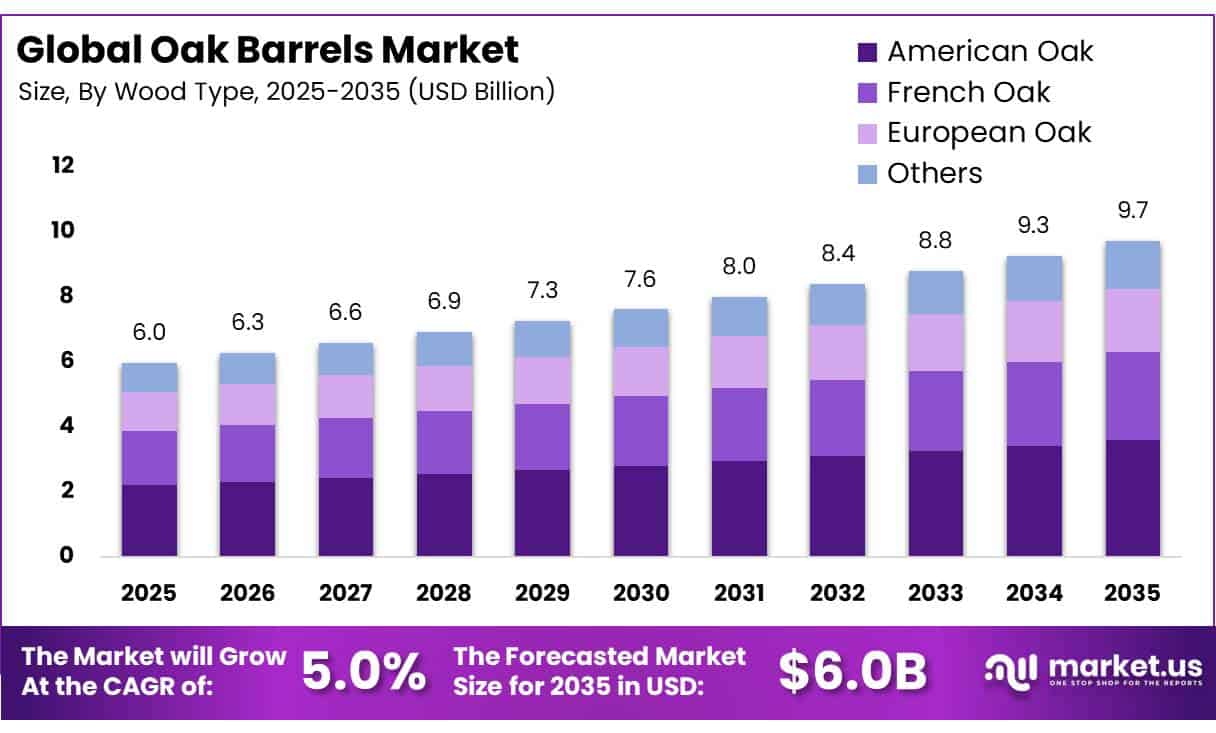
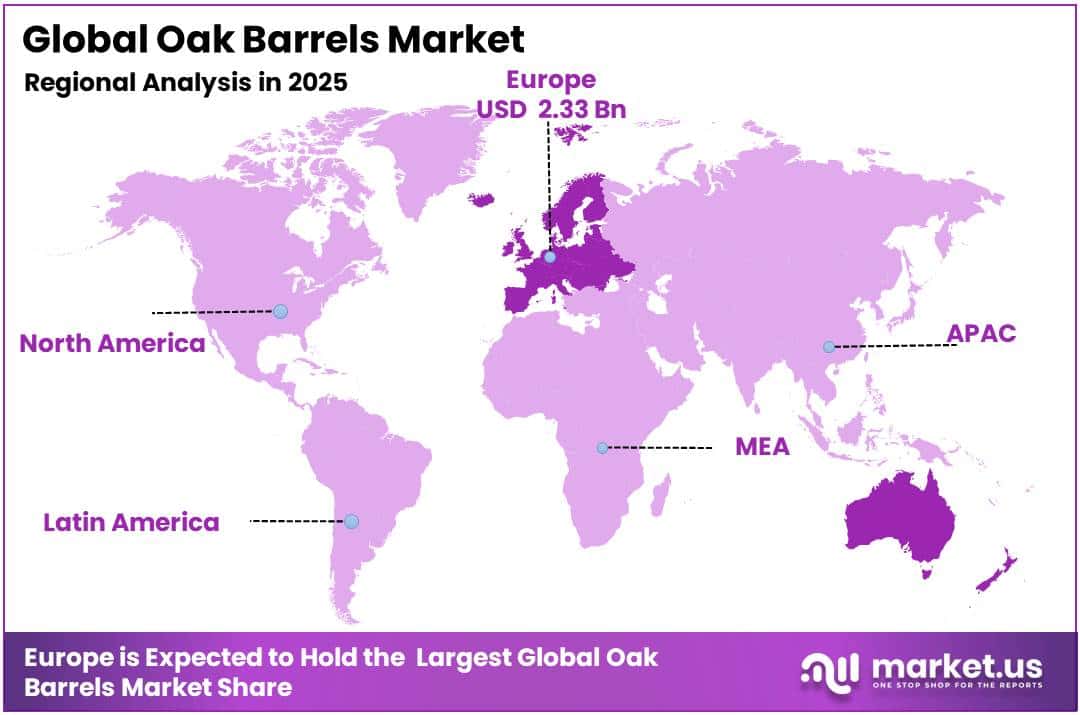
In 2025, the Global Oak Barrels Market was valued at USD 6.0 Billion, and between 2026 and 2035, this market is estimated to register a CAGR of 5.0%, reaching about USD 9.7 Billion by 2035. Europe held a dominant market position, capturing more than a 39.00% share, holding USD 2.33 Billion in revenue.
The oak barrels market encompasses wooden containers manufactured primarily from white oak (Quercus alba) and European oak (Quercus robur), used for aging wine, whisky, and other spirits and food products. In the United States, Alcohol and Tobacco Tax and Trade Bureau (TTB) regulations require that bourbon whisky be stored in charred new oak barrels at 125° proof or less, with straight bourbon whisky requiring charred new oak barrels for a minimum of 2 years, forming a regulatory foundation for continued industrial demand.
- The International Organisation of Vine and Wine (OIV) estimated 2025 global wine production between 228 and 235 million hectolitres, with a mid-range estimate of 232 million hectolitres, representing a 3% increase on the historically low 2024 harvest but still 7% below the five-year average. This pattern of recovering, though still constrained, wine output directly influences cooperage order volumes for beverage aging vessels.
Regulatory requirements for charred new oak barrel aging in whisky production, combined with recovering wine volumes, sustain long-term barrel demand. Growth opportunities for cooperages extend to variations in barrel char levels, alternate wood sourcing strategies, and expansion of wine and spirits production across developing regions, positioning oak barrels as integral to both traditional beverage aging and emerging artisanal spirits segments worldwide, alongside continued consumer and producer preference for oak-aged character over stainless steel or plastic alternatives.
Government-backed sustainability initiatives increasingly shape raw material availability. The United States Department of Agriculture (USDA) Forest Service reports that Forest Inventory and Analysis data shows relatively few seedlings and saplings exist to replace the many mature white oak trees found across US forests today, a decline linked to invasive species competition and reduced active forest management. Such findings have prompted Forest Service partnerships supporting long-term stave timber supply for cooperages dependent on high-quality oak.
Key Takeaways
- The Global Oak Barrels Market was valued at US$6.0 billion in 2025.
- The global market is projected to grow at a CAGR of 0% and is estimated to reach US$9.7 billion by 2035.
- On the basis of wood type, American Oak dominated the market, constituting 0% of the total market share.
- Based on the application, Wine dominated the market, accounting for 0% of the total market share.
- Based on the end user, Wineries dominated the market, accounting for 2% of the total market share.
- Based on the capacity, 200–500 Liters dominated the market, accounting for 0% of the total market share.
- In 2025, Europe was the most dominant region in the oak barrels market, accounting for 0% of the global market.
By Wood Type
American Oak dominates with 37% share due to its broad use in wine and spirits aging.
In 2025, American Oak held a dominant market position, capturing more than a 37% share of the Oak Barrels Market. Its strong position was supported by widespread use across wineries and distilleries because it provides consistent barrel performance and is well suited for aging a variety of wines and spirits. The continued supply of American white oak has supported steady barrel production for the beverage industry, while cooperages have maintained demand by serving wine, whiskey, and other premium beverage producers. The combination of reliable raw material availability and established barrel-making traditions helped American Oak retain its leading market position in 2025.
French Oak is expected to register the fastest growth during the forecast period, supported by rising preference for premium barrel aging in high-value wines and spirits. French oak continues to attract attention because of its long-standing reputation for quality and strict forest management practices overseen by France’s public forestry authorities. The industry is also benefiting from sustained demand from wineries seeking specialized maturation characteristics, while ongoing investments in premium beverage production during 2025 and 2026 are expected to support continued growth in the use of French oak barrels.
By Application
Wine dominates with 46.00% share due to its long-established reliance on oak barrel aging.
In 2025, Wine held a dominant market position, capturing more than a 46.00% share of the Oak Barrels Market. The segment maintained its leading position because oak barrels remain an essential part of wine maturation, helping producers develop flavor, aroma, and texture during the aging process. Many wineries continue to use oak barrels as part of traditional winemaking practices, particularly for premium wines.
Whiskey is expected to witness the fastest growth during the forecast period, supported by increasing production of premium and aged whiskey across several regions. Oak barrels remain a fundamental requirement for whiskey maturation, as aging in wooden casks is an essential part of the production process. In 2025 and 2026, continued investments by distilleries in expanding production capacity and growing consumer interest in premium aged spirits are expected to support higher demand for oak barrels used in whiskey production.
By End User
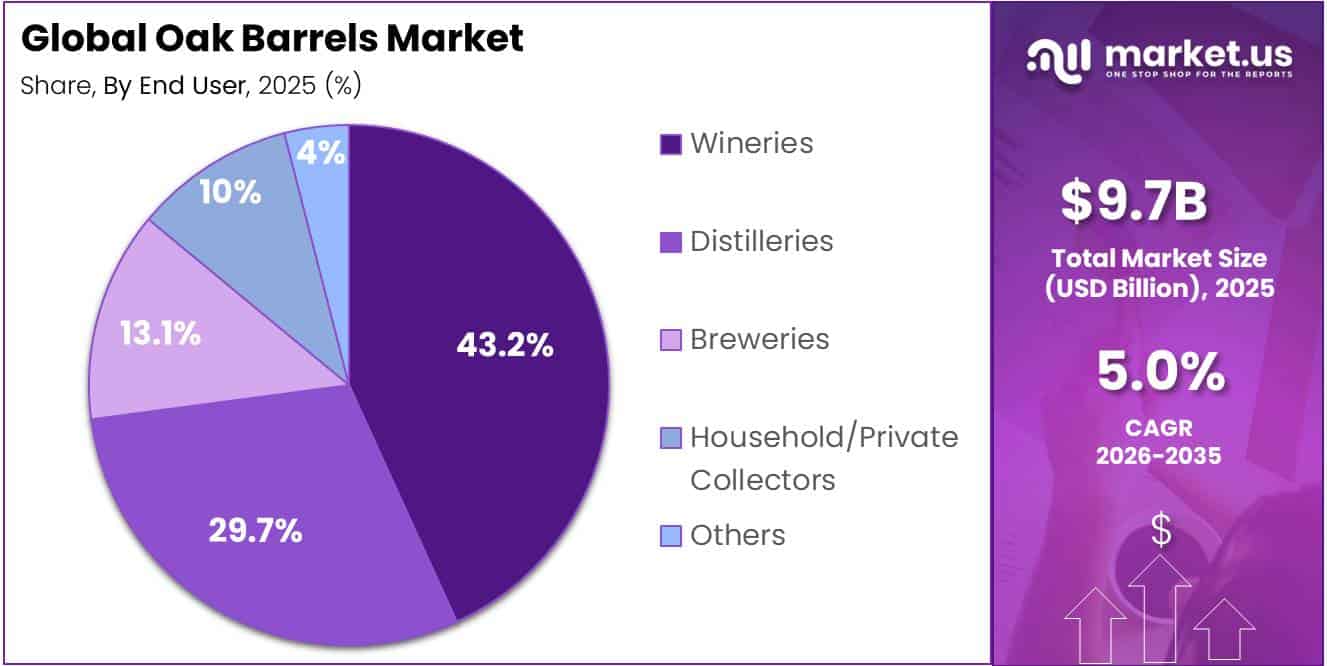
Wineries dominate with 43.2% share as oak barrels remain essential for premium wine aging.
In 2025, Wineries held a dominant market position, capturing more than a 43.2% share of the Oak Barrels Market. The segment led the market because oak barrels continue to be widely used during the maturation of premium wines, where they contribute to flavor development and overall wine quality. Wineries maintain steady demand for new and replacement barrels as part of regular production cycles.
Distilleries are expected to record the fastest growth during the forecast period, supported by rising production of premium aged spirits and continued investment in whiskey and other barrel-aged beverages. Oak barrels are a key part of the maturation process for many distilled spirits, making them an essential asset for distilleries.
By Capacity
200–500 Liters dominates with 57.00% share as it meets the standard aging needs of wineries and distilleries.
In 2025, 200–500 Liters held a dominant market position, capturing more than a 57.00% share of the Oak Barrels Market. This capacity range remained the preferred choice because it provides an effective balance between storage volume and controlled aging for wine and spirits. It is widely used by wineries and distilleries as a standard barrel size for producing consistent product quality while supporting efficient handling and storage.
According to the International Organisation of Vine and Wine, wine production activities continued across major producing regions in 2025, sustaining the demand for standard-sized oak barrels used during the maturation process. The broad acceptance of this capacity range across commercial beverage production helped it maintain its leading position in the market.
Less than 200 Liters is expected to register the fastest growth during the forecast period, driven by increasing interest from craft producers and small-scale beverage manufacturers seeking greater flexibility in production. Smaller barrels are gaining attention because they allow faster maturation and are well suited for limited-batch wines and premium spirits.
Key Market Segments
By Wood Type
- American Oak
- French Oak
- European Oak
- Others
By Application
- Wine
- Whiskey
- Cognac
- Beer
- Other
By End User
- Wineries
- Distilleries
- Breweries
- Household/Private Collectors
- Others
By Capacity
- Less than 200 Liters
- 200–500 Liters
- Above 500 Liters
Driver Analysis
Premium Wine Value Growth
Premium wine value growth is supporting oak barrel demand because wineries facing flat or declining bottle volumes are increasingly protecting profitability through higher-value labels, smaller lot sizes, reserve expressions, vineyard-specific releases, and cellar-aging programs that justify premium retail and on-trade pricing. The U.S. wine market in 2026 is expected to remain broadly flat in volume, with estimates ranging from a 0.5% decline to a 0.5% increase, while dollar sales are expected to rise by approximately 2–4% as consumers purchase fewer bottles but trade up toward higher perceived quality; the USD 15–49.99 price range is expected to be the most resilient segment.
Oak cooperage benefits disproportionately because premium red wines, reserve Chardonnay, structured white wines, and limited-production blends use higher new-oak percentages, longer élevage cycles, and more precise toast selection than entry-level wines; a 225-litre Bordeaux barrel may support roughly 300 standard 750 ml bottles, so a winery raising new-oak use from 20% to 40% across a 10,000-case premium program can require approximately 330 additional barrels per vintage. Barrel procurement can represent 3–10% of total wine-production cost for reserve programs, yet it becomes economically viable when oak aging supports a USD 3–15 increase in ex-cellar bottle realization or enhances distributor acceptance in premium channels.
The business model is shifting toward direct winery–cooper relationships, barrel trials, forest-origin tracking, toast-profile consultation, and multi-vintage supply agreements, allowing cooperages to capture higher revenue per unit than in generic standard-barrel sales. Premium wine demand is therefore estimated to contribute about +1.4 percentage points to Oak Barrels Market CAGR in the U.S., France, Italy, Spain, Australia, Chile, Argentina, and South Africa during the medium term.
Drivers Impact Analysis
| Driver | (~) % Impact on CAGR Forecast | Geographic Relevance | Impact Timeline |
|---|---|---|---|
| Premium Wine Value Growth | +1.4 pp | U.S., France, Italy, Spain, Australia | Medium term (2–4 years) |
| Craft Spirits Barrel Aging | +1.6 pp | North America, Europe, Japan, APAC | Medium term (2–4 years) |
| Toasting Profile Customization | +1.1 pp | France, U.S., Spain, Australia, Chile | Short term (≤ 2 years) |
| Tequila and Rum Expansion | +1.2 pp | Mexico, Caribbean, U.S., Europe, Asia | Medium term (2–4 years) |
| Sustainable Cooperage Demand | +0.9 pp | EU, North America, Australia, Japan | Long term (≥ 4 years) |
| Secondary Barrel Reuse | +1.0 pp | U.S., Scotland, Caribbean, Japan, India | Short term (≤ 2 years) |
Restraint Analysis
Wine Demand and Inventory Correction
U.S. wine sales volume declined by approximately 2% in 2025 and industry revenue fell by about 1.6%, while excessive inventory remained an industry-wide headwind into 2026; the normalization process was not expected to be complete by year-end, meaning wineries continue to prioritize inventory liquidation and reduced crush volumes over new cooperage procurement.
Global wine consumption fell from about 245 million hectolitres in 2017 to approximately 214.2 million hectolitres in 2024, a decline of roughly 12.6%, while U.S. wine inventories expanded from just over USD 18 billion in early 2021 to almost USD 24 billion by late 2024, raising the inventory-to-sales ratio by more than 20%. This creates a direct capex and working-capital response: a winery with 10,000 barrels in use may reduce annual new-oak replacement from a normal 20–30% rate to 10–20%, defer purchases by one to three vintages, increase reuse from three to five fills, shift from French oak to lower-cost American or Central European alternatives, and reduce barrel-aged reserve production in favor of stainless-steel or tank-aged entry-level wines.
The California grape crush decline to approximately 2.6 million tons in 2025, down 8.4% from 2024, confirms that supply correction is already reducing the volume of wine available for barrel maturation. Cooperages therefore face lower order visibility, smaller batch sizes, greater price negotiations, 10–25% distributor destocking risk, and operating leverage pressure from underutilized toasting, assembly, and warehousing capacity, resulting in an estimated -1.8 percentage-point deduction from baseline Oak Barrels Market CAGR across the United States, France, Italy, Spain, Australia, Chile, Argentina, and South Africa through the medium term.
Restraint Impact Analysis
| Restraint | (~) % Impact on CAGR Forecast | Geographic Relevance | Impact Timeline |
|---|---|---|---|
| Wine Demand and Inventory Correction | -1.8 pp | U.S., France, Italy, Spain, Australia | Medium term (2–4 years) |
| Bourbon Production Pullback | -1.5 pp | U.S., Scotland, Canada, global reuse markets | Short term (≤ 2 years) |
| Oak Supply and Cost Inflation | -1.3 pp | France, U.S., Central Europe, global buyers | Long term (≥ 4 years) |
| Alternative Oak Substitution | -1.2 pp | Global wine, beer, spirits markets | Medium term (2–4 years) |
| Trade and Tariff Friction | -1.0 pp | U.S.–EU, U.S.–Australia, global export routes | Short term (≤ 2 years) |
| Cooperage Labor Cost Pressure | -0.9 pp | France, U.S., Spain, Portugal, Hungary | Long term (≥ 4 years) |
Opportunity Analysis
Digital Cask Traceability Platforms
Digital cask traceability is an under-monetized opportunity because most cooperages still treat a barrel as a one-time physical sale, even though its value continues through 3–5 wine fills, 4–12 years of spirit maturation, secondary sales, refill cycles, refurbishment, insurance, and eventual repurposing; it is therefore an opportunity rather than an existing market driver because only a limited share of barrels are tracked with interoperable digital identity from stave origin through final reuse.
A digital system priced at USD 5–20 per barrel for tagging, onboarding, and data capture, followed by USD 1–5 per barrel annually for monitoring, insurance integration, inventory reporting, and lifecycle documentation, can generate 5–15% recurring revenue relative to first-sale barrel value without materially increasing wood consumption. For a distillery holding 50,000 casks, reducing unlocated inventory, recording errors, unnecessary inspections, insurance disputes, and premature write-offs by only 0.5–1.0% can protect USD 250,000–1.5 million of cask and spirit value annually, while predictive rotation and refill planning can reduce avoidable evaporation and mismatch between cask type and maturation plan.
Cooperages that partner with warehouse operators, insurers, brokers, and distillers can turn cask tracking into a high-retention service layer, increase customer stickiness, and create secondary-market transaction revenue; if 15–25% of premium wine and spirit barrels are digitally registered by 2028, this could add approximately +1.3 percentage points above baseline CAGR across Scotland, the United States, France, Japan, India, Australia, and major global aging hubs.
Opportunity Impact Analysis
| Opportunity | (~) % Potential CAGR Upside | Geographic Relevance | Execution Window |
|---|---|---|---|
| Digital Cask Traceability Platforms | +1.3 pp | Scotland, U.S., France, Japan, India | Short term (≤ 2 years) |
| Barrel Lifecycle Refurbishment | +1.5 pp | U.S., Scotland, Caribbean, Europe, Asia | Medium term (2–4 years) |
| Premium Tequila Cask Programs | +1.4 pp | Mexico, U.S., Europe, Japan, Asia-Pacific | Medium term (2–4 years) |
| Small-Format Aging Systems | +1.1 pp | Craft-distilling hubs globally | Short term (≤ 2 years) |
| Cooperage-as-a-Service Contracts | +1.2 pp | U.S., EU, Australia, Chile, Argentina | Medium term (2–4 years) |
| Sustainable Oak Provenance Systems | +1.0 pp | France, U.S., EU, Australia, Japan | Long term (≥ 4 years) |
Challenges Analysis
Forest-to-Stave Traceability
The challenge is operationally complex because one 225-litre barrel may contain roughly 25–32 staves sourced from multiple logs, while an annual cooperage output of 50,000 barrels can require handling data from 1.25–1.60 million individual stave pieces; a missing harvest permit, incorrect species declaration, incomplete forest certification, or undocumented transfer can block access to sustainability-sensitive winery, spirits, retail, or export programs. Fragmented traceability also raises fraud and substitution risk, including misrepresentation of French, American, Hungarian, or Eastern European oak origin, narrow-grain versus wide-grain characteristics, seasoning duration, and toast method, reducing customer willingness to pay for premium barrels.
A digital traceability system based on timber-lot codes, QR or RFID tags, supplier declarations, geolocation, batch-level seasoning logs, and chain-of-custody audits may require USD 0.5–2.0 million in software, data cleansing, audits, tagging, training, and supplier onboarding for a medium-sized cooperage, while recurring compliance and verification can add 0.5–2.0% to annual operating cost.
The strategic response requires integrated forestry partnerships, common material-identification standards, supplier contractual obligations, digital barrel passports, and third-party certification, but implementation spans multiple harvest and seasoning cycles; therefore, traceability fragmentation creates an estimated -1.0 percentage-point friction drag on attainable Oak Barrels Market CAGR across French, U.S., Central European, and export-oriented cooperage supply chains over the long term.
Challenges Impact Analysis
| Challenge | (~) % CAGR Friction Drag | Geographic Relevance | Mitigation Horizon |
|---|---|---|---|
| Forest-to-Stave Traceability | -1.0 pp | France, U.S., Central Europe, global exports | Long term (≥ 4 years) |
| Oak Quality Variability | -1.2 pp | France, U.S., Hungary, Spain, Eastern Europe | Long term (≥ 4 years) |
| Skilled Cooperage Labor Gap | -1.0 pp | France, U.S., Spain, Portugal, Hungary | Long term (≥ 4 years) |
| Long Seasoning Inventory Cycles | -0.9 pp | France, U.S., Europe, global cooperages | Medium term (2–4 years) |
| Secondary Barrel Quality Control | -0.8 pp | U.S., Scotland, Caribbean, Japan, India | Medium term (2–4 years) |
| Climate-Sensitive Maturation Management | -0.9 pp | Scotland, U.S., Caribbean, Australia, India | Long term (≥ 4 years) |
Geopolitical Impact Analysis
Geopolitical tensions raise cost pressure across the Modular Construction Market.
The ongoing conflicts in Eastern Europe and the Middle East continue to influence the Modular Construction Market by disrupting global supplies of steel, construction materials, energy, and shipping services. Modular construction depends heavily on factory manufacturing, making it sensitive to fluctuations in raw material availability and transport costs. The energy situation has become particularly important because manufacturing facilities consume significant amounts of electricity and fuel.
- According to the International Energy Agency (IEA), around 20 million barrels per day of crude oil and oil products moved through the Strait of Hormuz in 2025, representing about 25% of global seaborne oil trade, making any disruption a direct concern for manufacturing industries worldwide.
At the same time, governments and contractors are placing greater emphasis on regional manufacturing capacity and supply chain resilience to reduce dependence on overseas suppliers. This shift is encouraging more localized production of modular building components and stronger inventory planning. Industry bodies and public infrastructure agencies are also prioritizing domestic sourcing where practical to improve project certainty.
While geopolitical uncertainty continues to create short-term cost pressures, the modular construction sector remains supported by its factory-based production model, which offers better scheduling, quality control, and material management than many conventional construction methods. As countries continue investing in housing, healthcare, education, and infrastructure, modular construction is expected to remain an important solution despite ongoing geopolitical challenges.
Regional Analysis
oak barrel Market – Regional Analysis (Asia Pacific).
Europe holds a dominant 39.00% share of the global oak barrels market, valued at approximately €2.33 billion. This leadership is underpinned by the region’s outsized role in wine production, which drives the largest share of downstream demand for oak aging vessels.
- According to the European Commission’s Directorate-General for Agriculture and Rural Development, average annual wine production across the European Union stood at 157 million hectolitres between 2020 and 2025, accounting for over 60% of global wine production and 48% of global wine consumption in 2023, while also representing 44% of the world’s wine-growing areas that same year.
Beyond production volume, the European Union’s trade dominance further reinforces its position in the oak barrels market. The European Commission reports that in 2024, the EU remained the world’s leading wine exporter in volume, accounting for half of total global wine exports, compared with 13.5% for Chile and 11.43% for Australia, with the total exported value of EU wines accounting for two thirds of the global wine trade. This export leadership requires consistent cooperage output to supply barrels for aging wines destined for both domestic and international markets.
Key Regions and Countries Covered
- North America
- The US
- Canada
- Europe
- Germany
- France
- The UK
- Spain
- Italy
- Russia & CIS
- Rest of Europe
- APAC
- China
- Japan
- South Korea
- India
- ASEAN
- Rest of APAC
- Latin America
- Brazil
- Mexico
- Rest of Latin America
- Middle East & Africa
- GCC
- South Africa
- Rest of MEA
Key Players Analysis
Oak barrel manufacturers focus on strengthening product quality, sustainable wood sourcing, and traditional cooperage expertise to remain competitive in the global market. A major priority is securing a stable supply of high-quality American and French oak from responsibly managed forests while maintaining strict seasoning and toasting processes that influence the flavor and aroma of wines and spirits.
They also invest in production efficiency, modern drying facilities, and precision manufacturing while preserving traditional barrel-making techniques that are valued in premium beverage production. Consistent quality, traceable raw materials, and long service life remain important factors that help manufacturers strengthen their position in domestic and international markets.
Leading companies are also expanding their global presence through strategic partnerships with wineries and distilleries, broader distribution networks, and customized barrel solutions for different beverage styles. Many producers offer multiple toast levels, barrel sizes, and oak origins to meet changing customer preferences while improving after-sales support and technical guidance.
Sustainability has become a key competitive strategy, with manufacturers increasing the use of certified timber, responsible forest management practices, and efficient wood utilization throughout production. Several companies are modernizing cooperage operations through selective automation without compromising handcrafted quality.
The Major Players in The Industry
- Seguin Moreau
- Tonnellerie Radoux
- Demptos
- Nadalie
- Taransaud
- Tonnellerie Sylvain
- Arsenal Cuvée
- Boutes
- Oeneo Group / Chêne & Cie
- Kelvin Cooperage
- Independent Stave Company
- World Cooperage
- Canton Cooperage
- The Barrel Mill.
Key Development
- In March 2026, TFF Group – parent company of cooperage brands Radoux and Demptos – finalized the acquisition of the remaining 45% stake in Tonnellerie Rémond, giving it full 100% ownership. The transaction, completed on March 31, 2026, was carried out under a shareholders’ agreement originally signed in 2022 and strengthens TFF Group’s offering of French oak barrels for wine aging.
- In May 2026, Oeneo Group – parent company of cooperage brand Seguin Moreau – published its 2025-2026 annual turnover of €275.5 million, a decline of 9.7% compared with the prior year, with the group’s Winemaking division (which includes Seguin Moreau) posting a full-year current operating margin of 13.7%.
- In July 2026, TFF Group published its full-year 2025/2026 results, reporting consolidated revenue of €312.75 million, down 26.5% from €425.43 million in 2024/2025, and EBITDA of €48.24 million, representing 15.4% of revenue. The results were announced on July 8, 2026, alongside a reduction in net debt to €285.2 million.
Report Scope
| Report Features | Description |
|---|---|
| Market Value (2025) | US$6.0 Bn |
| Forecast Revenue (2035) | US$9.7 Bn |
| CAGR (2026 2035) | 5.0% |
| Base Year for Estimation | 2025 |
| Historic Period | 2020-2024 |
| Forecast Period | 2026-2035 |
| Report Coverage | Revenue Forecast, Market Dynamics, Competitive Landscape, Recent Developments |
| Segments Covered | By Wood Type (American Oak, French Oak, European Oak, Others), By Application (Wine, Whiskey, Cognac, Beer, Other), By End User (Wineries, Distilleries, Breweries, Household/Private Collectors, Others), By Capacity (Less than 200 Liters, 200–500 Liters, Above 500 Liters) |
| Regional Analysis | North America The US & Canada; Europe Germany, France, The UK, Spain, Italy, Russia & CIS, Rest of Europe; APAC China, Japan, South Korea, India, ASEAN & Rest of APAC; Latin America Brazil, Mexico & Rest of Latin America; Middle East & Africa GCC, South Africa, & Rest of MEA |
| Competitive Landscape | Seguin Moreau, Tonnellerie Radoux, Demptos, Nadalie, Taransaud, Tonnellerie Sylvain, Arsenal Cuvée, Boutes, Oeneo Group / Chêne & Cie, Kelvin Cooperage, Independent Stave Company, World Cooperage, Canton Cooperage, and The Barrel Mill. |
| Customization Scope | Customization for segments, region/country level will be provided. Moreover, additional customization can be done based on the requirements. |
| Purchase Options | We have three licenses to opt for: Single User License, Multi User License (Up to 5 Users), Corporate Use License (Unlimited Users and Printable PDF) |





































