Report Overview
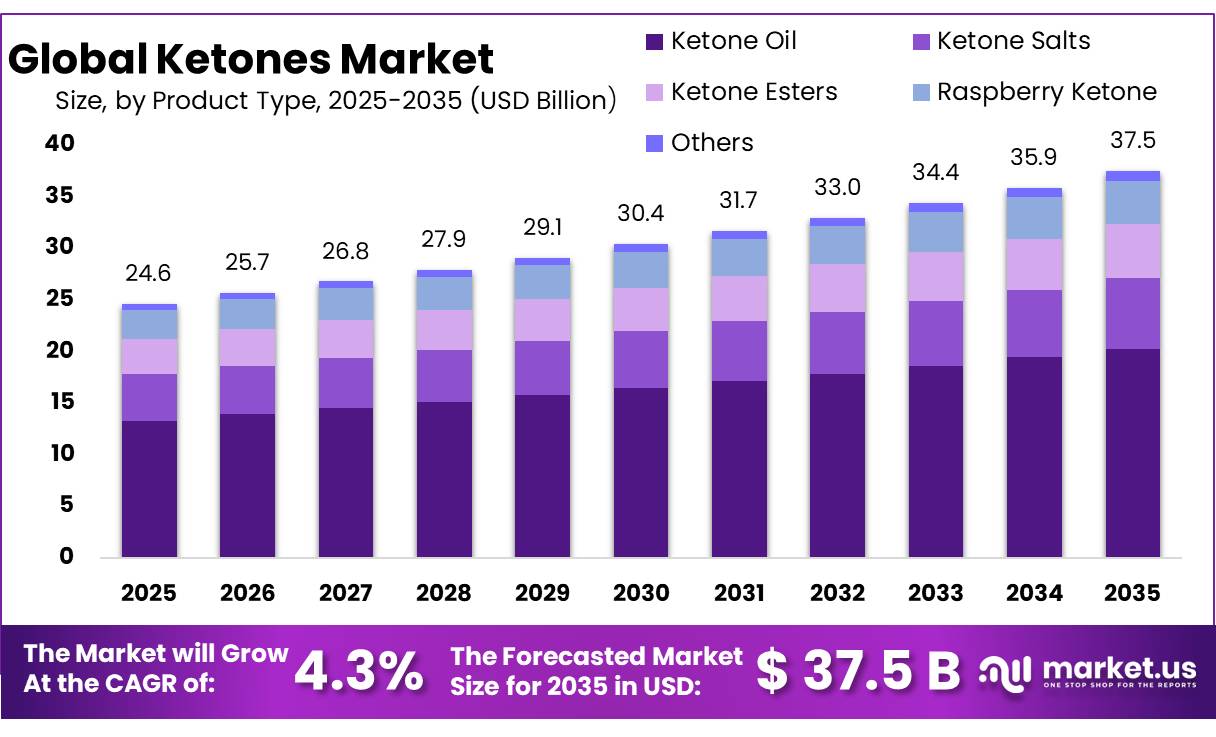
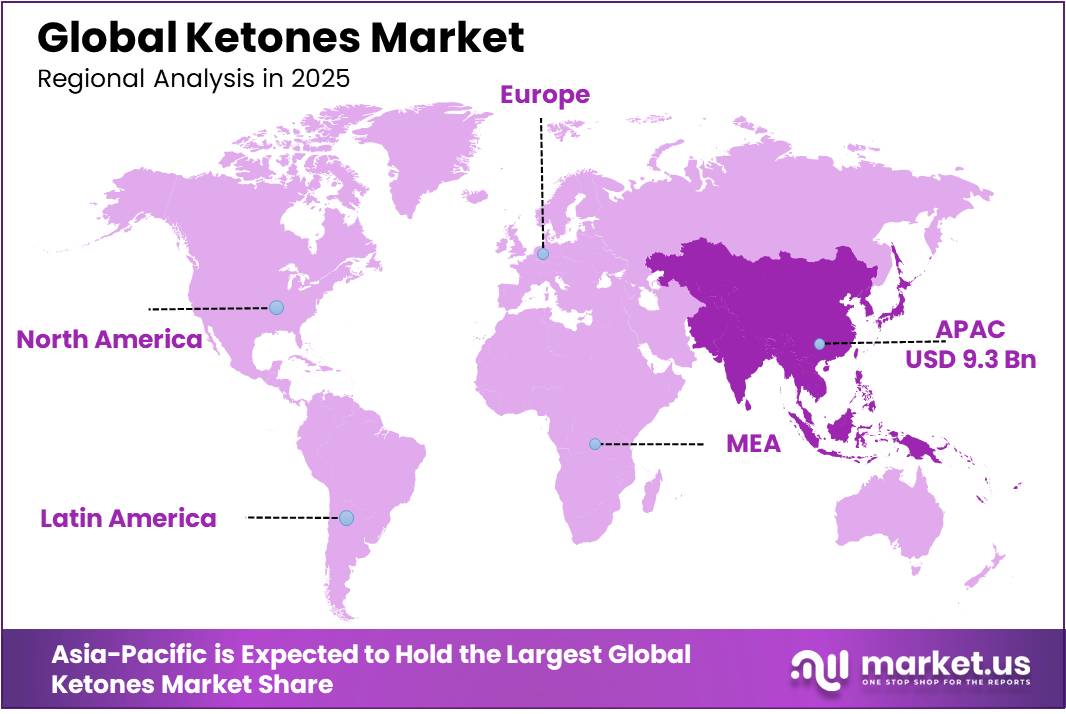
The Global Ketones Market size is expected to be worth around USD 37.5 Billion by 2035, from USD 24.6 Billion in 2025, growing at a CAGR of 4.3% during the forecast period from 2026 to 2035. In 2025, Asia-Pacific held a dominant market position, capturing more than a 38.21% share, holding USD 9.3 Billion revenue.
Ketones are an important class of organic chemicals used as industrial solvents, chemical intermediates, and processing agents across coatings, adhesives, plastics, pharmaceuticals, cosmetics, and specialty chemicals. Major commercial ketones include acetone, methyl ethyl ketone (MEK), and methyl isobutyl ketone (MIBK).
Their strong solvent properties, ability to dissolve natural and synthetic resins, and suitability for various industrial formulations support their continued use in manufacturing. According to the UK government, acetone is produced in large quantities for paints, plastics, adhesives, and other chemical products. UK Government, Acetone General Information. Shell also identifies ketones as high-purity solvents used in formulations requiring effective resin dissolution and low-viscosity processing.
The industrial scenario is closely linked to petrochemical production, solvent demand, and downstream chemical manufacturing. Acetone is commonly produced alongside phenol through the cumene process, connecting its availability and production economics with the wider phenol industry.
- INEOS Phenol reports annual acetone production capacities of 335 kilotonnes in the United States, 830 kilotonnes in Europe, and 185 kilotonnes in Singapore, demonstrating its established industrial supply base. These figures represent the company’s stated regional capacities, not total regional production. Acetone is further used to manufacture methyl methacrylate, bisphenol A, and other chemical intermediates.
Demand for ketones is driven by the expansion of paints and coatings, printing inks, industrial cleaning, adhesives, and resin processing. MEK is widely used in solvent-based adhesives, polyurethane slurries, printing inks, and surface coatings, while MIBK serves as a solvent and chemical intermediate in applications such as metal extraction and specialty chemical production. Sasol supplies acetone, MEK, and MIBK for inks, paints, coatings, adhesives, and cleaning products.
Future growth opportunities are likely to come from high-purity solvents, specialty chemical intermediates, improved manufacturing efficiency, and formulations designed for demanding industrial applications. INEOS Phenol reports a global nameplate capacity of 1.35 million tonnes per year for acetone, supported by manufacturing facilities across Europe, the Americas, and Asia.
This established production base demonstrates the scale of the industrial supply chain and the importance of reliable feedstock availability. Opportunities also exist in developing more efficient production processes, recovering and reusing solvents, and improving product quality for pharmaceutical, electronics, and specialty coating applications.
Key Takeaways
- Ketones Market size is expected to be worth around USD 37.5 Billion by 2035, from USD 24.6 Billion in 2025, growing at a CAGR of 4.3%.
- Ketone Oil held a dominant market position, capturing more than a 54.12% share.
- Paints & Coatings held a dominant market position, capturing more than a 44.53% share.
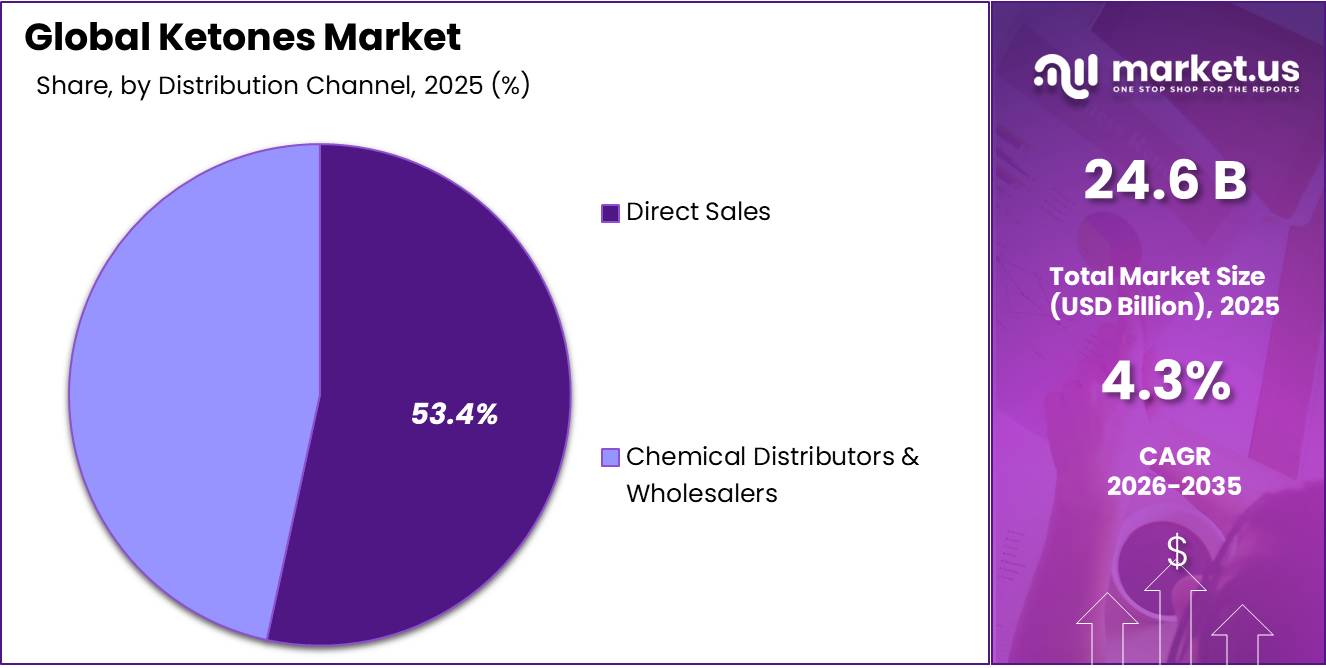
- Direct Sales held a dominant market position, capturing more than a 53.45% share.
- Asia-Pacific held a dominant position in the ketones market, accounting for a supplied market share of 38.21%, with a reported market value of USD 9.3 billion.
By Product Type Analysis
Ketone Oil leads the segment due to its established use in energy-related products and specialized formulations.
In 2025, “Ketone Oil” held a dominant market position, capturing more than a 54.12% share. Its position reflects demand for oil-based ketone products in applications associated with nutritional formulations and specialty ingredients. However, the market-share figure is the supplied market estimate, and a directly comparable government statistic confirming this exact share is not available in the cited information. Government sources generally report chemical production, safety, and industrial use rather than market shares for this specific product category.
“Ketone Salts” are used in dietary supplements to provide beta-hydroxybutyrate (BHB) bound to minerals such as sodium, magnesium, or calcium. In 2025, demand for this segment was supported by interest in sports nutrition and products designed to increase circulating ketone levels. The Australian Institute of Sport identifies ketone salts as one of the available forms of ketone supplements, while research reviewed by the University of California, Davis, notes that these products can raise blood BHB levels, although responses vary.
By Application Analysis
Paints & Coatings leads the application segment due to the role of ketones in solvent-based formulations and resin processing.
In 2025, “Paints & Coatings” held a dominant market position, capturing more than a 44.53% share. Ketones such as acetone and methyl ethyl ketone are used in selected coating formulations because they dissolve resins, support application performance, and help control drying rates.
Demand is linked to construction, automotive finishing, industrial maintenance, and protective coatings. The US Environmental Protection Agency identifies paints and coatings as an important source of volatile organic compound emissions, encouraging manufacturers to adopt lower-emission formulations and improve solvent management. The supplied market-share figure is a market estimate, not a government-reported statistic.
In 2025, the Adhesives & Sealants segment benefited from the use of ketones in selected adhesive formulations, where their solvent properties help dissolve resins and support application performance. These chemicals are used in products serving packaging, construction, automotive, and industrial manufacturing.
As an indicator of the wider industry’s scale, the US Census Bureau reported USD 49.779 billion in shipments for the combined paints, coatings, and adhesives category in its 2025 reporting data. This figure covers the combined industry and does not represent ketone-based adhesives alone. Demand for ketones in this segment will depend on industrial production, formulation requirements, and environmental rules governing solvent emissions.
By Distribution Channel Analysis
Direct Sales leads distribution by enabling chemical producers to supply industrial customers through established business relationships.
In 2025, “Direct Sales” held a dominant market position, capturing more than a 53.45% share. This channel supports ketone suppliers by allowing them to work directly with paints and coatings manufacturers, adhesive producers, pharmaceutical companies, and other industrial buyers. Direct transactions can help customers secure consistent product specifications, bulk quantities, technical support, and reliable delivery schedules.
The channel is particularly relevant for industrial-grade acetone, methyl ethyl ketone, and other specialty ketones, where supply reliability and product quality influence purchasing decisions. The 53.45% figure is the supplied market estimate and should not be interpreted as a government-verified statistic.
In 2025, adhesives and sealants remained relevant applications for ketones such as methyl ethyl ketone, which can help dissolve resins and support bonding performance in selected formulations. Demand is linked to construction, automotive manufacturing, packaging, and industrial assembly.
The US Environmental Protection Agency provides numerical volatile organic compound limits for adhesive and sealant products, including 200 grams per liter for multipurpose construction adhesives and 250 grams per liter for architectural sealants under the cited regulatory framework. These limits highlight the importance of formulation and emissions compliance, although they do not measure ketone demand or market share directly.
Key Market Segments
By Product Type
- Ketone Salts
- Ketone Esters
- Ketone Oil
- Raspberry Ketone
- Others
By Application
- Paints & Coatings
- Adhesives & Sealants
- Pharmaceuticals & Nutraceuticals
- Personal Care & Cosmetics
- Personal Care & Cosmetics
- Others
By Distribution Channel
- Direct Sales
- Chemical Distributors & Wholesalers
Driver Analysis
Coatings and Adhesive Demand — +0.7 Percentage Points
Established consumption in coatings, inks, sealants and adhesives provides a direct demand mechanism because ketones are already used as formulation solvents rather than requiring the creation of a new commercial application; industry materials identify MEK, MIBK and related ketones as solvents for coatings, adhesives and inks, while INEOS documents acetone use in spray adhesives, footwear bonding, paints and varnishes. A current downstream indicator is Asian Paints’ FY2025–26 disclosure of approximately 2.29 million kilolitres of installed Indian decorative-paint capacity and 4.3% growth in revenue from products and services, although neither figure establishes ketone consumption: decorative portfolios include water-based formulations, and revenue changes are not equivalent to solvent-volume growth.
The original operating scenario therefore focuses narrowly on qualifying solvent-borne industrial formulations: a customer producing 100,000 tonnes annually with a 5% ketone content purchases 5,000 tonnes of ketones; 4% output growth adds 200 tonnes, but a simultaneous 1% relative reduction in ketone intensity lowers net consumption growth to approximately 3%. At an assumed $1,000-per-tonne selling price, that represents approximately $150,000 of incremental annual supplier revenue, demonstrating why industrial coating mix matters more than headline paint sales.
The +0.7-point sensitivity assumes that 30% of counterfactual terminal revenue is exposed to relevant coatings and adhesive applications and that their cumulative outperformance contributes approximately 11.7% within that exposure, equivalent to 3.5% across the market. Commercial value capture shifts toward formulation-specific supply contracts, delivery reliability and solvent-blend consistency; the modeled uplift excludes general decorative-paint growth that does not translate into ketone purchases and allows for waterborne and high-solids substitution.
Drivers Impact Analysis
| Driver | (~) % Impact on CAGR Forecast | Geographic Relevance | Impact Timeline |
|---|---|---|---|
| Coatings and adhesive demand | +0.7 pp | India, China, ASEAN, US | Medium term (2–4 years) |
| Automotive materials consumption | +0.6 pp | China, India, Japan, EU, US | Medium term (2–4 years) |
| Pharmaceutical processing growth | +0.5 pp | India, China, US, EU | Short term (≤ 2 years) |
| Electronics materials demand | +0.5 pp | China, Taiwan, South Korea, Japan, US | Medium term (2–4 years) |
| Established acrylics consumption | +0.4 pp | China, India, EU, US | Long term (≥ 4 years) |
| Asian manufacturing expansion | +0.4 pp | China, India, ASEAN | Medium term (2–4 years) |
Restraint Analysis
Lower-Solvent Formulation Substitution — −0.5 Percentage Points
The structural restraint is declining ketone consumption per unit of finished coating or adhesive as customers adopt waterborne, high-solids and other lower-solvent formulations, allowing downstream output to increase without proportionate solvent purchases. Eastman already markets waterborne additives that reduce volatile-organic-compound content and solventborne additives designed for high-solids coatings, establishing that these are commercially available substitution pathways rather than hypothetical technologies.
An illustrative coating portfolio producing 100,000 tonnes annually at 8% ketone intensity purchases 8,000 tonnes of ketones; if finished-product output grows 3% annually but ketone intensity declines 2% annually, five-year purchases reach approximately 8,383 tonnes rather than the 9,274 tonnes implied by unchanged intensity—a 9.6% shortfall, or approximately 891 tonnes in year five. At an assumed constant selling price of $1,000 per tonne, that represents approximately $891,000 of annual revenue foregone within the modeled portfolio.
This pressure is not uniform across ketones: acetone’s US VOC-exempt status can support substitution toward acetone from other solvents, while EPA emphasizes that VOC exemption does not remove other regulatory obligations; consequently, switching from MEK to acetone is not counted as a complete loss to the ketones market. The −0.5-point sensitivity assumes 25% of terminal counterfactual revenue faces an approximately 9.6% net loss after accounting for such intra-category substitution, producing about 2.4% market-wide terminal revenue erosion. The strategic consequence is reduced commodity-solvent volume leverage and a stronger requirement to defend application-specific value; this deduction captures net movement out of ketones, not solvent recovery, which is assessed separately.
Restraint Impact Analysis
| Restraint | (~) % Impact on CAGR Forecast | Geographic Relevance | Impact Timeline |
|---|---|---|---|
| Lower-solvent formulation substitution | −0.5 pp | EU, UK, US, China | Long term (≥ 4 years) |
| Acetone-free MMA routes | −0.4 pp | US; EU, Asian acetone exporters | Long term (≥ 4 years) |
| European production-cost disadvantage | −0.4 pp | Germany, Belgium, Netherlands | Medium term (2–4 years) |
| BPA application restrictions | −0.3 pp | EU; China, South Korea, Taiwan exporters | Short term (≤ 2 years) |
| Closed-loop solvent recovery | −0.3 pp | India, China, EU, US | Medium term (2–4 years) |
| MEK/MIBK product substitution | −0.2 pp | Canada; exporters serving Canada | Medium term (2–4 years) |
Opportunity Analysis
Qualified High-Purity Portfolios — +0.6 Percentage Points
The white space is not general semiconductor growth, which already belongs in the baseline, but converting commodity ketone output into customer-qualified grades with controlled impurities, segregated handling and repeatable packaging quality for applications not presently served by the supplier. Existing commercial products establish feasibility without proving an uncontested market: Thermo Fisher lists semiconductor-grade acetone at 99.5% minimum assay with maximum evaporation residue of 5 ppm, chloride of 0.2 ppm and phosphate of 0.1 ppm; these are specifications for that particular product, not universal leading-edge fabrication requirements.
In the constructed project case, a purification and packaging operation selling 5,000 tonnes annually at $1,700 per tonne against a $1,050-per-tonne commodity reference generates $3.25 million of annual premium revenue; if incremental purification, testing, packaging and yield-loss costs equal $400 per saleable tonne, the remaining incremental contribution is $1.25 million annually. Against an assumed $6 million investment, simple payback is approximately 4.8 years after reaching the modeled sales volume, before financing, tax and continuing technical-service expense.
A 90% saleable yield requires approximately 5,556 tonnes of input to deliver 5,000 tonnes, so off-spec disposition and recovery economics must be included in the $400 cost allowance rather than ignored. The +0.6-point upside assumes that new qualifications and realized premiums add approximately 2.9% to baseline terminal market revenue, net of commodity-grade sales displaced. Execution requires anchor-customer qualification before full investment, impurity-specific specifications rather than assay alone, and evidence that the premium survives customer negotiation; this is an upgrade in monetization and application access, not a proportional extrapolation from chip sales.
Opportunity Impact Analysis
| Opportunity | (~) % Potential CAGR Upside | Geographic Relevance | Execution Window |
|---|---|---|---|
| Qualified high-purity portfolios | +0.6 pp | Taiwan, South Korea, Japan, US | Medium term (2–4 years) |
| Certified low-carbon contracts | +0.4 pp | EU, UK, Japan, South Korea | Medium term (2–4 years) |
| Merchant reclaimed-ketone supply | +0.4 pp | India, China, EU, US | Medium term (2–4 years) |
| Application-specific ketone systems | +0.5 pp | India, China, Germany, US | Short term (≤ 2 years) |
| Regional supply-service platforms | +0.3 pp | India, Indonesia, Vietnam, Thailand | Medium term (2–4 years) |
| Capability-led acquisition platforms | +0.3 pp | US, Germany, Benelux, Singapore | Short term (≤ 2 years) |
Challenges Analysis
Co-Product Production Balancing — −0.5 Percentage Points
The central operating challenge in acetone is synchronizing sales and production with phenol because the predominant cumene route produces both chemicals together, followed by purification through a series of distillation columns; consequently, acetone output cannot be independently optimized across the whole asset base in response to acetone orders alone. This is an ongoing coordination problem—not a claim that co-production stops current sales—and its relevance remains substantial: INEOS lists approximately 2.180 million tonnes of annual phenol capacity and 1.345 million tonnes of acetone capacity across its business.
The ideal reaction produces approximately 0.617 tonnes of acetone per tonne of phenol; for a modeled plant with 500,000 tonnes of annual phenol capacity, an operating-rate reduction from 90% to 80% therefore lowers associated acetone output by approximately 30,850 tonnes annually, before plant-specific yields and losses. If customer acetone commitments remain unchanged, replacing that volume at an assumed $80-per-tonne delivered premium creates approximately $2.47 million of annual procurement exposure; if the demand imbalance reverses, producers instead face excess inventory, discounted placement or lower integrated operating rates.
These costs do not automatically translate into market contraction because another producer may supply the same demand, so the −0.5-point sensitivity counts only delayed deliveries, missed new contracts and unrealized premium-grade sales: it assumes 30% of opportunity-enabled terminal revenue is exposed and experiences an 8% realization shortfall, equivalent to approximately 2.4% across the market. Sustaining growth requires integrated phenol–acetone sales planning, alternative supply agreements, coordinated maintenance and inventory policies based on joint-product economics rather than standalone acetone margins.
Challenges Impact Analysis
| Challenge | (~) % CAGR Friction Drag | Geographic Relevance | Mitigation Horizon |
|---|---|---|---|
| Co-Product Production Balancing | −0.5 pp | US, China, Germany, Belgium | Long term (≥ 4 years) |
| Hazardous-Cargo Transit Variability | −0.4 pp | China–EU, India–EU, Asia–US | Medium term (2–4 years) |
| High-Purity Contamination Control | −0.4 pp | Taiwan, South Korea, Japan, US | Medium term (2–4 years) |
| Process-Safety Competency Renewal | −0.3 pp | US, Germany, China, India | Long term (≥ 4 years) |
| Multi-Grade Campaign Scheduling | −0.2 pp | US, Germany, India, Singapore | Medium term (2–4 years) |
| Certified-Feedstock Data Reconciliation | −0.2 pp | EU, UK, Japan, South Korea | Short term (≤ 2 years) |
Geopolitical Impact Analysis
Geopolitical Impact of the Ongoing Middle East War on the Ketones Market
The ongoing Middle East conflict in 2026 is putting pressure on the global ketones market through higher energy costs, shipping disruptions, and uncertainty in petrochemical supply chains. Ketones such as acetone and methyl ethyl ketone depend on chemical feedstocks and energy-intensive manufacturing processes, making production costs sensitive to changes in oil prices and transportation expenses.
According to the US Energy Information Administration, Brent crude oil averaged USD 114 per barrel in September 2026, increasing by USD 23 per barrel from August as attacks on regional oil infrastructure and tankers affected supply routes. These conditions can increase feedstock, freight, insurance, and operating costs for ketone manufacturers and distributors. The International Energy Agency also reports that the conflict has disrupted important maritime trade routes, creating additional uncertainty for energy and commodity shipments. As a result, manufacturers may face tighter margins, longer delivery schedules, and changing procurement costs.
Buyers in paints, coatings, adhesives, and chemical processing may respond by securing alternative suppliers, increasing inventories, or negotiating longer-term supply agreements. The overall impact will depend on the duration of the conflict, the recovery of shipping routes, and the stability of energy supplies.
Regional Insights
In 2025, Asia-Pacific held a dominant position in the ketones market, accounting for a supplied market share of 38.21%, with a reported market value of USD 9.3 billion. The region benefits from its established chemical manufacturing base, strong demand for solvents, and extensive production of paints, coatings, adhesives, plastics, and industrial intermediates. China, Japan, and South Korea contribute to regional chemical production and downstream manufacturing.
China’s National Bureau of Statistics reported that value added by large-scale chemical raw-material and chemical-product manufacturers increased by 7.8% in 2025, supporting the region’s broader industrial demand environment. This figure reflects China’s chemical manufacturing sector overall rather than ketones alone.
Growth opportunities are also emerging in Southeast Asia and other developing chemical manufacturing hubs, where expanding industrial activity can increase demand for solvents and chemical intermediates. Vietnam is a notable opportunity within Asia-Pacific, supported by rising manufacturing activity and regional trade in chemical products.
Across the wider Asia-Pacific ketones and quinones industry, consumption reached approximately 2 million tonnes in 2024, with the market valued at USD 3.2 billion, according to published trade analysis. The industry outlook points to continued expansion, with regional consumption projected to reach 2.4 million tonnes by 2035. These figures cover ketones and quinones collectively, rather than the narrower ketones market definition used in the supplied estimate.
Key Regions and Countries Insights
- North America
- US
- Canada
- Europe
- Germany
- France
- The UK
- Spain
- Italy
- Rest of Europe
- Asia Pacific
- China
- Japan
- South Korea
- India
- Australia
- Rest of APAC
- Latin America
- Brazil
- Mexico
- Rest of Latin America
- Middle East & Africa
- GCC
- South Africa
- Rest of MEA
Key Players Analysis
Sasol Limited is an established ketones supplier, offering acetone, methyl ethyl ketone (MEK), and methyl isobutyl ketone (MIBK) for industrial applications. Its acetone grade has a reported purity of 99.90%, while MEK and MIBK grades have purities of 99.75% and 99.5%, respectively. These products serve paints, coatings, adhesives, cleaning products, pharmaceuticals, and specialty chemical manufacturing.
Eastman Chemical Company participates in the ketones market through its specialty chemical and solvent portfolio, including ketones used in coatings and industrial formulations. In 2025, its Additives & Functional Products segment generated USD 2.88 billion in sales revenue and reported USD 516 million in adjusted earnings before interest and taxes. Its portfolio includes coating additives and ketones that serve industrial customers.
Shell Chemicals supplies ketones for industrial applications, including paints, coatings, printing inks, and adhesives. Its portfolio includes acetone and methyl ethyl ketone (MEK), which are valued for their solvent strength and ability to dissolve natural and synthetic resins. Shell lists MEK availability across 3 broad markets: Europe and Africa, the Americas, and Asia-Pacific. Acetone is also offered in the Americas. These products support industrial customers requiring consistent solvent performance and reliable chemical supply.
Top Key Players Outlook
- Sasol Limited
- Eastman Chemical Company
- Shell Chemicals
- Dow Chemical Company
- ExxonMobil Chemical Company
- BASF SE
- Huntsman Corporation
- LG Chem Ltd.
- CEPSA SA
- Mitsui Chemicals Inc.
- Arkema SA
- Celanese Corporation
- Mitsubishi Chemical Corporation
- Other Key Players
Recent Developments
- In June 2026, Huntsman signed a definitive agreement with Olin Corporation for an all-stock merger of equals, with the combined company expected to generate approximately USD 12.5 billion in annual revenue based on 2025 results and more than USD 400 million in identified cost synergies; completion was expected in the first half of 2027, subject to approvals.
- In February 2026, BASF reported €59.7 billion in 2025 sales and €6.6 billion in EBITDA before special items, while planning €3.4 billion in capital expenditure for 2026.
Report Scope
| Report Features | Description |
|---|---|
| Market Value (2025) | USD 24.6 Bn |
| Forecast Revenue (2035) | USD 37.5 Bn |
| CAGR (2026-2035) | 4.3% |
| Base Year for Estimation | 2025 |
| Historic Period | 2020-2024 |
| Forecast Period | 2026-2035 |
| Report Coverage | Revenue Forecast, Market Dynamics, Competitive Landscape, Recent Developments |
| Segments Covered | By Product Type (Ketone Salts, Ketone Esters, Ketone Oil, Raspberry Ketone, Others), By Application (Paints & Coatings, Adhesives & Sealants, Pharmaceuticals & Nutraceuticals, Personal Care & Cosmetics, Personal Care & Cosmetics, Others), By Distribution Channel (Direct Sales, Chemical Distributors & Wholesalers) |
| Regional Analysis | North America – US, Canada; Europe – Germany, France, The UK, Spain, Italy, Rest of Europe; Asia Pacific – China, Japan, South Korea, India, Australia, Singapore, Rest of APAC; Latin America – Brazil, Mexico, Rest of Latin America; Middle East & Africa – GCC, South Africa, Rest of MEA |
| Competitive Landscape | Sasol Limited, Eastman Chemical Company, Shell Chemicals, Dow Chemical Company, ExxonMobil Chemical Company, BASF SE, Huntsman Corporation, LG Chem Ltd., CEPSA SA, Mitsui Chemicals Inc., Arkema SA, Celanese Corporation, Mitsubishi Chemical Corporation, Other Key Players |
| Customization Scope | Customization for segments, region/country-level will be provided. Moreover, additional customization can be done based on the requirements. |
| Purchase Options | We have three licenses to opt for: Single User License, Multi-User License (Up to 5 Users), Corporate Use License (Unlimited User and Printable PDF) |