


Report Overview
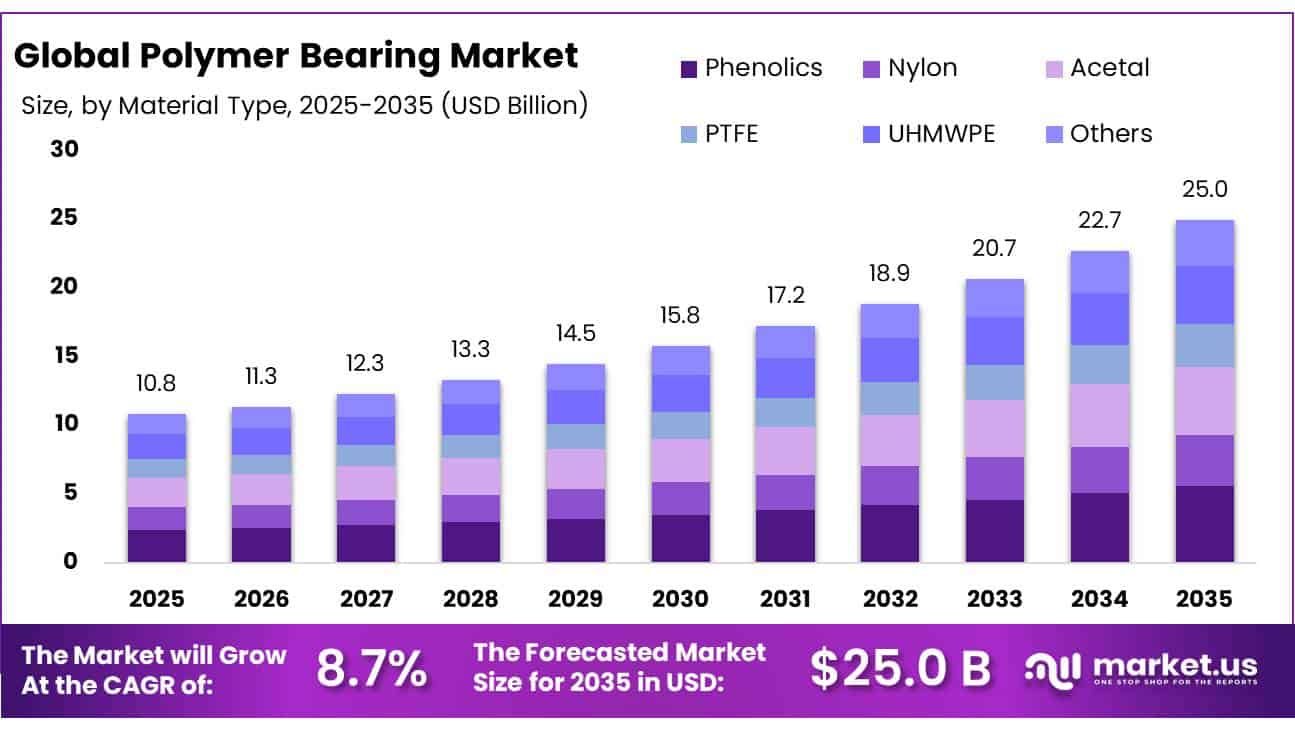
Global Polymer Bearing Market size is expected to be worth around USD 25.0 Billion by 2034, from USD 10.8 Billion in 2024, growing at a CAGR of 8.7% during the forecast period from 2025 to 2034. In 2024 Asia Pacific held a dominant market position, capturing more than a 48.9% share, holding USD 8.2 Billion in revenue.
The polymer bearings market is characterized by rising adoption of advanced engineering polymers in applications requiring low friction, corrosion resistance, electrical insulation, and reduced lubrication dependency. Demand is strongly influenced by electrified mobility systems, where inverter-driven electric motors introduce bearing current risks and higher operating speeds, increasing the use of polymer cages and composite bearing elements for electrical isolation and wear reduction.
Key Takeaways
- The global polymer bearing market was valued at USD 10.8 billion in 2025.
- The global polymer bearing market is projected to grow at a CAGR of 8.7% and is estimated to reach USD 25.0 billion by 2035.
- On the basis of material type, phenolic polymer bearing dominated the market, constituting 22.3% of the total market share.
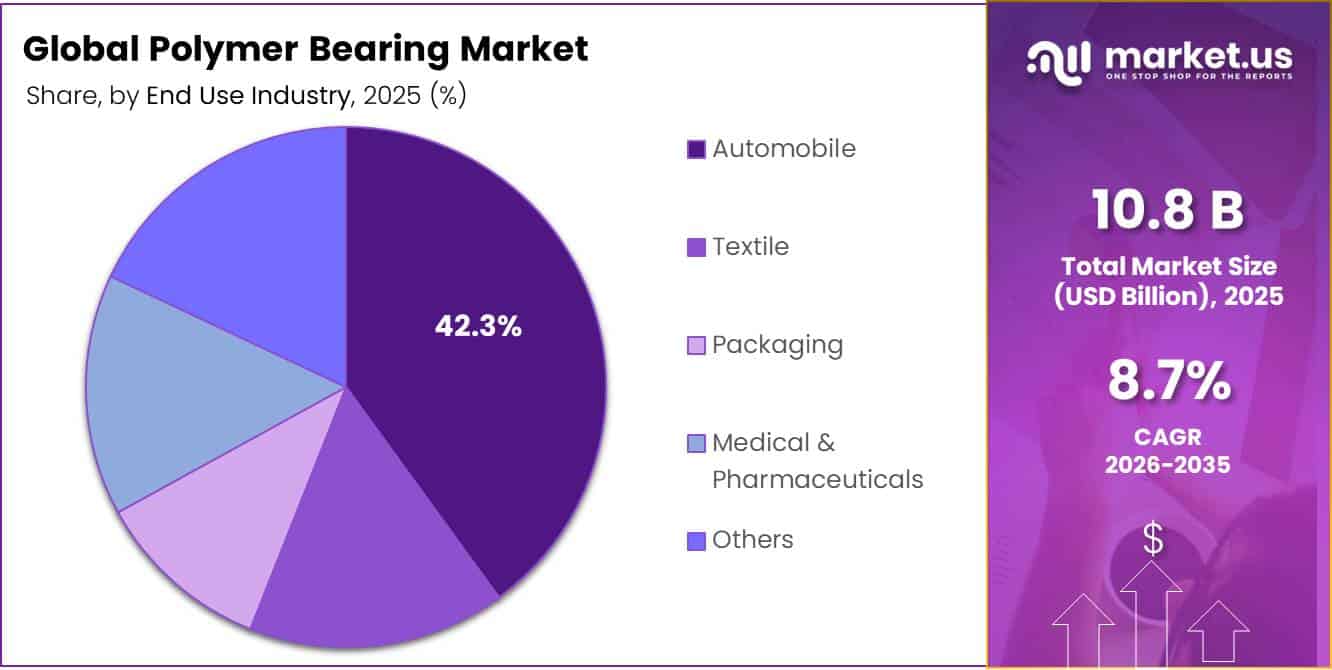
- Among the end-use industries, the automobile sector held a major share in the polymer bearing market, 42.3% of the market share.
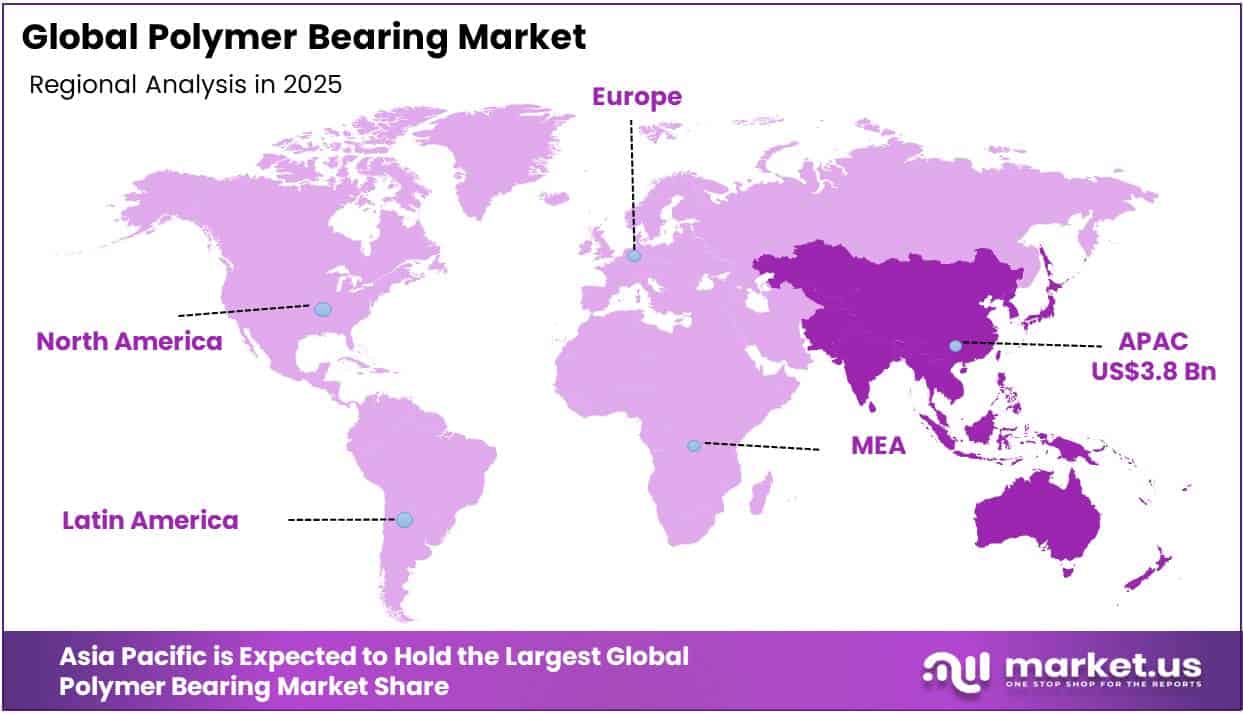
- In 2025, the Asia Pacific was the most dominant region in the polymer bearing market, accounting for 35.6% of the total global consumption.
Industrial automation and clean manufacturing systems further support adoption due to requirements for maintenance-free and lightweight components. Material innovation is a defining feature, with fiber-reinforced thermoplastics, self-lubricating composites, and carbon- or glass-filled polymers enhancing load-bearing capacity and thermal stability. Integration of composite structures has enabled the substitution of metallic bearings in corrosion-prone and high-cycle environments.
Regionally, the Asia Pacific is the dominant manufacturing and consumption hub, supported by dense automotive production networks and electronics manufacturing ecosystems. Geopolitical supply chain fragmentation and feedstock volatility are encouraging localized sourcing and diversified polymer supply bases. The market is evolving toward high-performance, application-specific bearing solutions aligned with electrification, energy efficiency, and industrial reliability requirements.
Material Type Analysis
Phenolic Polymer Bearing Held a Major Share of the Polymer Bearing Market.
Phenolic-based materials account for approximately 22.3% share of the polymer bearings material segment, making them one of the leading material types in the market. Their strong position is primarily driven by high mechanical strength, excellent dimensional stability, and superior resistance to creep under sustained loads. These characteristics make phenolics suitable for heavy-duty applications such as industrial machinery, material handling systems, and rotating equipment where consistent performance under high stress is required.
Additionally, phenolic composites offer strong thermal resistance, enabling stable operation in elevated temperature environments without significant deformation. Their compatibility with reinforcing media such as fabrics and fibers further enhances fatigue resistance and load distribution, extending operational life. The ability to function effectively under low-lubrication or dry-running conditions also contributes to their adoption in maintenance-sensitive systems.
End-Use Industry Analysis
Polymer Bearing Are Mostly Utilized in the Automobile Sector.
The automobile segment dominates the end-use industry landscape for polymer bearings, accounting for approximately 42.3% share. This dominance is driven by the extensive use of polymer bearings in vehicle subsystems such as electric drivetrains, steering assemblies, braking systems, HVAC units, and seat mechanisms. In modern vehicles, particularly electric and hybrid models, polymer bearings are increasingly preferred due to their low-friction characteristics, electrical insulation properties, and ability to operate without or with minimal lubrication.
Their lightweight nature supports overall vehicle weight reduction, contributing to improved energy efficiency and lower emissions compliance requirements. Additionally, polymer bearings offer corrosion resistance and reduced noise, vibration, and harshness (NVH), enhancing passenger comfort and component durability.
The shift toward electrification and higher precision automotive engineering has further strengthened adoption, as polymer-based solutions help manage higher rotational speeds and variable load conditions while extending service life and reducing maintenance requirements in complex automotive systems.
Key Market Segments
By Material Type
- Phenolics
- Nylon
- Acetal
- PTFE (Teflon)
- UHMWPE (Ultra-High Molecular Weight Polyethylene)
- Others
By End-Use Industry
- Automobile
- Textile
- Packaging
- Medical & Pharmaceuticals
- Others
Driver Analysis
Factory Automation and Robotics
Automation is the largest modeled driver because each new robot, cobot, conveyor, autonomous material-handling platform, packaging cell, and pick-and-place system creates multiple low-to-medium-load oscillating or linear bearing points where dry-running polymers can displace greased metal bushings. Global factories installed 542,000 industrial robots in 2024—more than twice the level ten years earlier—while the operating stock reached 4.664 million units, up 9%; Asia captured 74% of installations, including roughly 295,000 units in China, versus 16% in Europe and 9% in the Americas.
IFR expected installations to rise to about 575,000 in 2025 and exceed 700,000 by 2028, implying a widening installed base that generates both OEM-fit and replacement demand. Polymer bearings capture value through compact geometry, low noise, corrosion resistance and elimination of lubrication hardware, while digitally validated service-life tools reduce the engineering risk of replacing metal; one supplier reports a 5,500 m² laboratory performing more than 15,000 tests annually and using those results in online life calculations.
The commercial shift is therefore from catalogue-part selling toward application engineering, downloadable CAD/configuration, service-life prediction and multi-year OEM platform nominations, supporting a modeled +1.6 percentage-point CAGR contribution concentrated in Asian automation corridors but increasingly relevant to reshoring-led investment in Europe and North America.
Drivers Impact Analysis
| Driver | (~) % Impact on CAGR Forecast | Geographic Relevance | Impact Timeline |
|---|---|---|---|
| Factory automation and robotics | +1.6 pp | China/Japan/Korea core; EU/US follow-on | Short term (≤2 years) |
| EV lightweighting and electrification | +1.3 pp | China/EU core; US/India/SEA scale-up | Short term (≤2 years) |
| Lubrication-free lifecycle economics | +1.1 pp | Global; high-wage and remote assets lead | Medium term (2–4 years) |
| Renewable, water and agri infrastructure | +0.9 pp | APAC/MENA/EU core; Americas spill-over | Medium term (2–4 years) |
| Hygienic and corrosion-resistant motion | +0.8 pp | North America/EU/Japan; APAC exports | Medium term (2–4 years) |
| PFAS-free and circular material innovation | +0.6 pp | EU-led; North America/Japan follow-on | Long term (≥4 years) |
Restraint Analysis
Load-Speed-Temperature Limits
Published product data illustrate the constraint: a food-grade polymer grade is rated for a maximum recommended surface pressure of 2,175 psi at 20°C, continuous rotary speed of 98 ft/min and long-term temperature of 194°F, while another low-cost grade reaches 6,670 psi and 157 ft/min but also carries a 194°F continuous-temperature ceiling; manufacturers explicitly state that maximum speed is achievable only at very low pressure and that wear rises with temperature.
Even a higher-temperature grade rated to 248°F long term shows declining pressure resistance as temperature rises, requires additional axial retention above 158°F and exhibits up to 2.6% deformation at its maximum recommended pressure. Moisture and heat further alter clearance because polymers expand, while viscoelastic creep accumulates under sustained load; comparative engineering evidence indicates creep strain may rise about 2.15 times when temperature increases from 20°C to 50°C and 3.93 times at 80°C, making average-condition sizing inadequate for safety-critical duty.
Steel alternatives preserve an advantage in heat dissipation, stiffness, shock loading and dimensional stability, and steel/steel spherical plain bearings can operate from -50°C to +200°C, with special designs available to 300°C. Consequently, polymer suppliers must spend on application testing, conservative derating and engineered shaft/housing interfaces, while OEMs retain metal for the most valuable high-load positions; the modeled -1.4 percentage-point CAGR deduction is therefore persistent through 2031 rather than a temporary adoption delay.
Restraint Impact Analysis
| Restraint | (~) % Impact on CAGR Forecast | Geographic Relevance | Impact Timeline |
|---|---|---|---|
| Load-speed-temperature limits | -1.4 pp | Global; heavy industry core | Long term (≥4 years) |
| OEM qualification inertia | -1.1 pp | EU/US/Japan core; China follow-on | Medium term (2–4 years) |
| PFAS regulatory uncertainty | -1.0 pp | EU core; global export chains | Medium term (2–4 years) |
| Specialty-resin supply risk | -0.9 pp | EU/US/Japan; China-linked supply | Short term (≤2 years) |
| Weak industrial CapEx cycle | -0.7 pp | EU core; Americas/APAC spill-over | Short term (≤2 years) |
| Energy, freight and trade costs | -0.6 pp | EU core; transcontinental corridors | Short term (≤2 years) |
Opportunity Analysis
Smart-Bearing Subscriptions
Sensorized polymer plain bearings can already signal approaching wear limits, monitor travel distances up to 800 m at speeds above 5 m/s, and be manufactured through two-material 3D printing with a conductive sensing layer and no minimum order quantity. Related predictive-maintenance platforms combine sensor data and software to dynamically calculate remaining service life and recommend maintenance timing, while miniature sensors can report percentage abrasion rather than only binary failure.
The commercial opening is to bundle the bushing, gateway, dashboard, API, replacement inventory and uptime service under a three-to-five-year contract: an analyst execution case assumes that converting 8–12% of premium, hard-to-access bearing positions to annual monitoring fees equal to 25–40% of the initial hardware value could lift supplier recurring revenue by 3–5% and raise gross margin on participating accounts by approximately 4–7 percentage points because software and analytics require little incremental material.
This is not a baseline driver because most polymer-bearing revenue remains transactional and the sensor layer is presently concentrated in harsh or critical applications; successful scaling requires standardized retrofit kits, machine-protocol integration, cybersecurity assurance and outcome-based service-level agreements. Packaging, wind, ports, intralogistics and agriculture provide the strongest beachheads, supporting a modeled +1.4-point CAGR upside if vendors monetize avoided downtime rather than surrendering the economic value entirely through longer component life.
Opportunity Impact Analysis
| Opportunity | (~) % Potential CAGR Upside | Geographic Relevance | Execution Window |
|---|---|---|---|
| Smart-bearing subscriptions | +1.4 pp | EU/US/Japan core; China scale-up | Short term (≤2 years) |
| On-demand digital spares | +1.2 pp | EU/US core; remote global sites | Short term (≤2 years) |
| Service and medical robotics | +1.1 pp | APAC core; EU/US premium | Medium term (2–4 years) |
| AI data-center cooling motion | +0.9 pp | North America/APAC/EU hubs | Medium term (2–4 years) |
| PFAS-free certified platforms | +0.9 pp | EU core; global exporters | Medium term (2–4 years) |
| Circular take-back compounds | +0.7 pp | EU core; North America/Japan | Long term (≥4 years) |
Challenges Analysis
Tribology Prediction Variance
A 2026 tribology review identifies thermal softening, matrix smearing, abrasive wear, fiber crushing, interfacial damage and transfer-film formation as interacting failure modes, while noting that humidity and elevated temperature can reverse friction-versus-wear trade-offs; up to 90–95% of sliding mechanical energy may convert into heat, making local contact temperature decisive even when ambient temperature appears safe. ISO 7148-2:2026 responds by standardizing six principal test configurations and controlling fiber orientation, surface preparation, moisture conditioning, load, speed, temperature and lubrication, but its outputs remain comparative under defined conditions rather than universal life guarantees.
The scale of the evidence burden is visible at a leading supplier, whose bearing laboratory runs more than 300 tests in parallel and approximately 11,300 tribological examinations across about 250 newly developed compounds each year. An analyst operating model indicates that reproducing only 20 combinations of four loads, five speeds, three temperatures and two shaft finishes already requires 240 condition cells before humidity, duty cycle or replication; at three specimens per cell, one formulation consumes 720 test runs, potentially delaying a complex OEM recommendation by 8–16 weeks.
The resulting overdesign, field-trial expense and warranty reserve can absorb an estimated 2–4% of program revenue, supporting a -1.2-point long-term friction drag; mitigation requires physics-informed wear models, standardized digital twins, field telemetry, common failure taxonomies and pooled application data, not merely a larger catalogue.
Challenges Impact Analysis
| Challenge | (~) % CAGR Friction | Geographic Relevance | Mitigation Horizon |
|---|---|---|---|
| Tribology prediction variance | -1.2 pp | Global; safety-critical OEMs | Long term (≥4 years) |
| Skilled workforce attrition | -1.0 pp | EU/US/Japan core | Long term (≥4 years) |
| SKU complexity overload | -0.9 pp | Global; multi-industry suppliers | Medium term (2–4 years) |
| Material traceability burden | -0.8 pp | EU hubs; global exporters | Medium term (2–4 years) |
| Circularity-performance conflict | -0.6 pp | EU core; US/Japan follow-on | Long term (≥4 years) |
| Network resilience balancing | -0.5 pp | APAC–EU/US corridors | Medium term (2–4 years) |
Geopolitical Impact Analysis
Geopolitical Friction and Supply Chain Reconfiguration in Polymer Bearing Value Networks.
Geopolitical tensions, particularly US-China trade restrictions, Middle East conflict risks, and sanctions regimes, are materially reshaping supply chain continuity in the polymer bearings ecosystem through feedstock, additives, and precision-component channels.
Sanctions and export controls are increasingly affecting upstream polymer inputs such as polyethylene and polypropylene, which are foundational for polymer bearing cages and composite structures. Middle East disruptions have caused temporary production curtailments and withdrawals in the polymer trade, with halts and reduced operating rates across downstream petrochemical facilities in Qatar and Indonesia, alongside constrained feedstock availability in regional supply chains. Additional petrochemical routing disruptions around the Strait of Hormuz have triggered force majeure declarations and shipment delays affecting monomers and plastics supply into Asian manufacturing hubs.
The geopolitical fragmentation is accelerating the regionalization of manufacturing footprints, with tariff and export-control regimes reshaping sourcing decisions for machinery and automotive supply chains, sectors where polymer bearings are widely embedded in EV drivetrains and precision equipment. Automotive OEMs have explicitly begun restructuring supplier bases to reduce dependence on geopolitically sensitive regions, reflecting broader supply-chain de-risking trends. These shifts are increasing material substitution pressure toward diversified polymer chemistries and reinforcing demand for localized, resilient bearing component manufacturing networks.
Regional Analysis
Asia Pacific Held the Largest Share of the Global Polymer Bearing Market.
In 2025, the Asia Pacific dominated the global polymer bearing market, holding about 35.6% of the total global consumption. Asia Pacific remains the dominant production and consumption base for polymer bearings due to its concentrated automotive, electronics, and industrial manufacturing ecosystem. The region accounts for a major share of global industrial output, supported by large-scale manufacturing integration across China, India, Japan, and South Korea, which collectively form high-density automotive and machinery supply networks.
Asia Pacific’s manufacturing intensity underpins demand for engineering polymers and high-performance components used in low-friction applications such as bearings, gears, and rotating assemblies. There is a strong inter-sectoral linkage between manufacturing subsectors, indicating embedded demand for precision components across automotive and industrial machinery value chains.
Within automotive production systems, policy-backed electrification, such as India’s Production Linked Incentive scheme with an allocation of approximately US$3.16 billion for electric mobility, has accelerated localized component manufacturing, increasing the use of advanced polymer-based bearing systems in EV drivetrains and auxiliaries.
Key Regions and Countries
- North America
- The US
- Canada
- Europe
- Germany
- France
- The UK
- Spain
- Italy
- Russia & CIS
- Rest of Europe
- APAC
- China
- Japan
- South Korea
- India
- ASEAN
- Rest of APAC
- Latin America
- Brazil
- Mexico
- Rest of Latin America
- Middle East & Africa
- GCC
- South Africa
- Rest of MEA
Key Players Analysis
Manufacturers of polymer bearings focus on materials engineering, application-specific customization, and manufacturing precision to strengthen competitiveness. A key priority is the development of advanced polymer formulations, such as fiber-reinforced thermoplastics and self-lubricating composites, to improve wear resistance, reduce friction, and enhance performance under dry or boundary lubrication conditions. Companies invest in R&D for electrically insulating and high-temperature-stable grades to meet requirements in electrified mobility and high-speed industrial machinery.
The manufacturers emphasize precision molding and automated machining to ensure tight dimensional tolerances for high-load and high-speed applications. Strategic collaboration with automotive OEMs and industrial equipment producers supports the co-development of application-specific bearing solutions. Additionally, expansion of regional production footprints helps reduce lead times and align with localized supply chain requirements.
The Major Players in The Industry
- igus GmbH
- AB SKFs
- The Timken Company
- Saint-Gobain
- Altra Industrial Motion Corp.
- Oiles Corporation
- Daido Metal Co., Ltd.
- GGB Bearing Technology
- Waukesha Bearings
- BNL (UK) Ltd.
- ISB Industries
- Kashima Bearings, Inc.
- Dotmar Engineering Plastics
- TriStar Plastics Corp.
- AST Bearings LLC
- CSB Bearing Technologies
- Other Key Players
Key Developments
- In April 2025, Coinciding with Hannover Messe, igus unveiled PTFE-free versions of its popular iglide G, X, and H polymer plain bearings. Developed at its Cologne facility, these advanced bearings serve industries such as mechanical engineering, plant construction, and automotive manufacturing worldwide.
Report Scope
| Report Features | Description |
| Market Value (2025) | US$10.8 Bn |
| Forecast Revenue (2035) | US$25.0 Bn |
| CAGR (2026-2035) | 8.7% |
| Base Year for Estimation | 2025 |
| Historic Period | 2020-2024 |
| Forecast Period | 2026-2035 |
| Report Coverage | Revenue Forecast, Market Dynamics, Competitive Landscape, Recent Developments |
| Segments Covered | By Material Type (Phenolics, Nylon, Acetal, PTFE (Teflon), UHMWPE (Ultra-High Molecular Weight Polyethylene), and Others), By End-Use Industry (Automobile, Textile, Packaging, Medical & Pharmaceuticals, and Others) |
| Regional Analysis | North America – The US & Canada; Europe – Germany, France, The UK, Spain, Italy, Russia & CIS, Rest of Europe; APAC– China, Japan, South Korea, India, ASEAN & Rest of APAC; Latin America– Brazil, Mexico & Rest of Latin America; Middle East & Africa– GCC, South Africa, & Rest of MEA |
| Competitive Landscape | igus GmbH, AB SKF, The Timken Company, Saint-Gobain, Altra Industrial Motion Corp., Oiles Corporation, Daido Metal Co., Ltd., GGB Bearing Technology, Waukesha Bearings, BNL (UK) Ltd., ISB Industries, Kashima Bearings, Inc., Dotmar Engineering Plastics, TriStar Plastics Corp., AST Bearings LLC, CSB Bearing Technologies, and Other Players. |
| Customization Scope | Customization for segments, region/country-level will be provided. Moreover, additional customization can be done based on the requirements. |
| Purchase Options | We have three licenses to opt for: Single User License, Multi-User License (Up to 5 Users), Corporate Use License (Unlimited Users and Printable PDF) |





































