


Report Overview
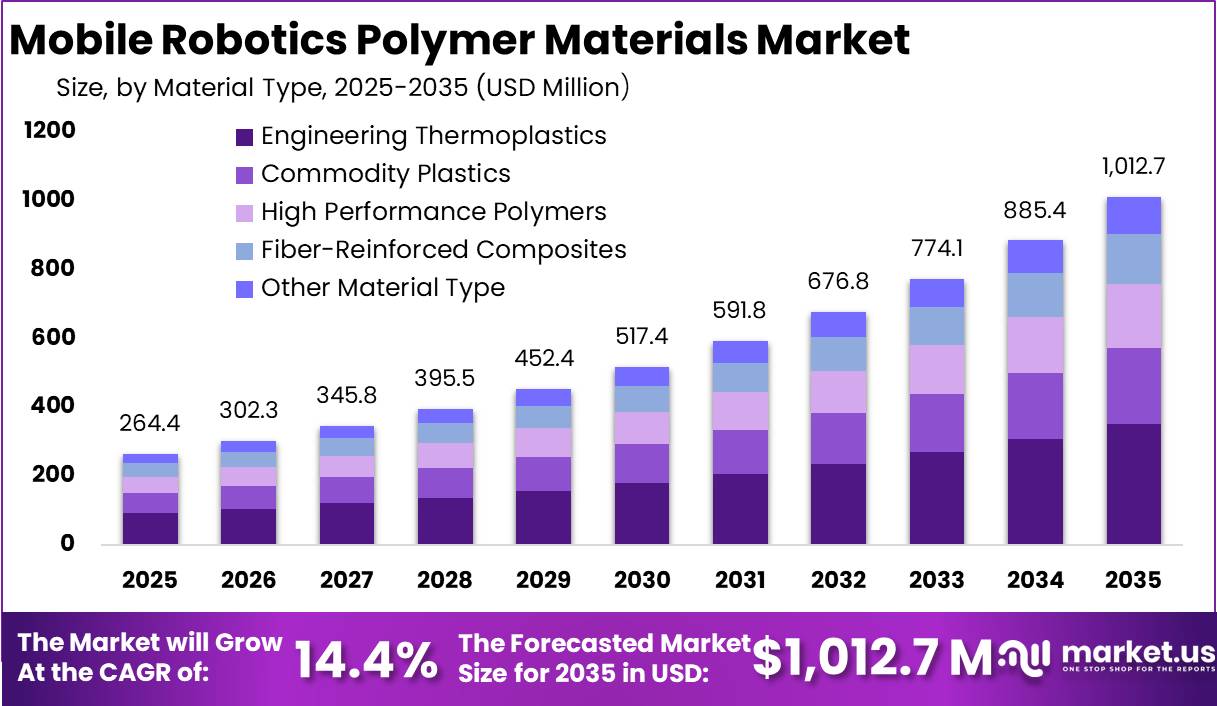
The Global Mobile Robotics Polymer Materials Market size is expected to be worth around USD 1,012.7 Million by 2035, from USD 264.4 Million in 2025, growing at a CAGR of 14.4% during the forecast period from 2026 to 2035. In 2025, Asia-Pacific held a dominant market position, capturing more than a 46.3% share, holding USD 122.2 Million revenue.
Mobile robotics polymer materials are gaining industrial relevance as robots require lightweight housings, wheels, gears, cable insulation, sensor enclosures, battery protection, and chemically resistant structural parts. Demand is being driven by factory automation: IFR reported 542,000 industrial robot installations in 2024, with Asia holding 74%, Europe 16%, and the Americas 9% of new deployments, while professional service robot sales reached almost 200,000 units, up 9%. Transportation and logistics led with 102,900 units, including about 81,800 intralogistics mobile robots.
Key Takeaways
- Mobile Robotics Polymer Materials Market size is expected to be worth around USD 1,012.7 Million by 2035, from USD 264.4 Million in 2025, growing at a CAGR of 14.4%.
- Engineering Thermoplastics held a dominant market position, capturing more than a 34.7% share in the mobile robotics polymer materials market.
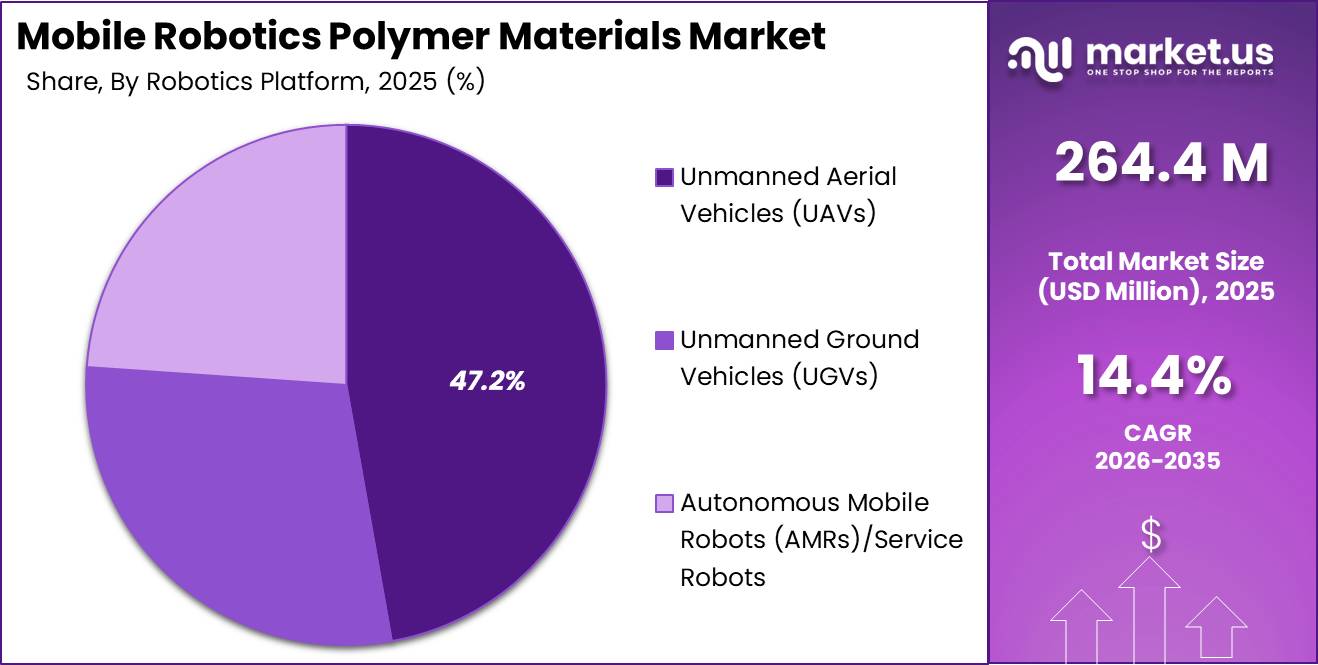
- Unmanned Aerial Vehicles (UAVs) held a dominant market position, capturing more than a 47.2% share in the mobile robotics polymer materials market.
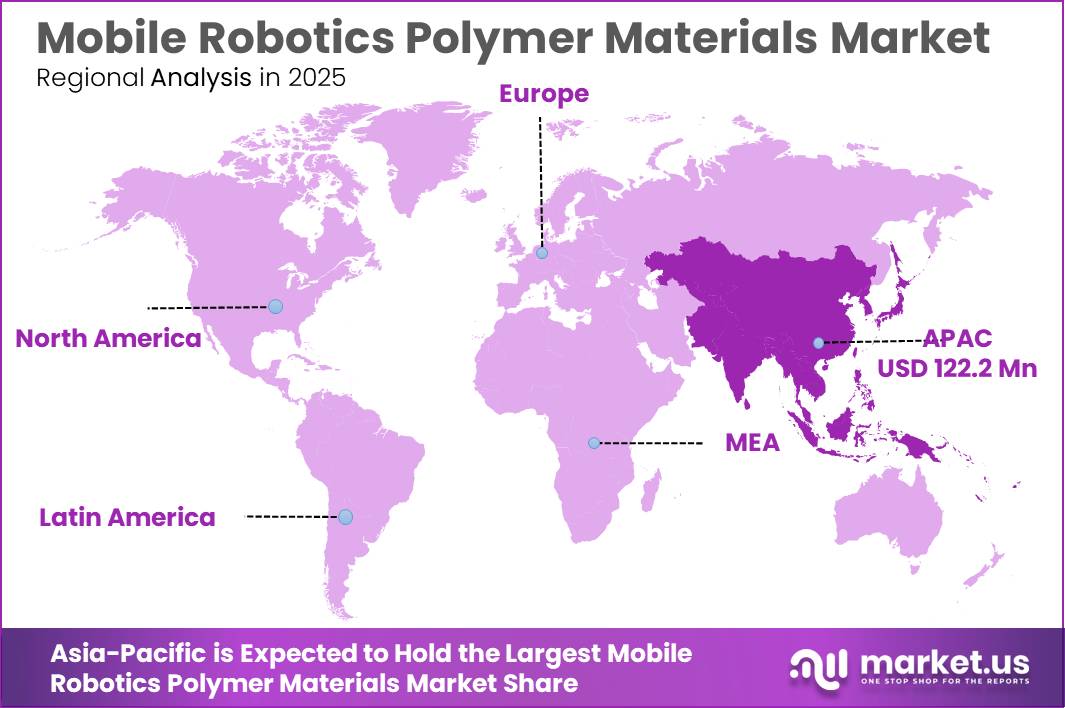
- Asia-Pacific held a dominant position in the global mobile robotics polymer materials market, accounting for 46.3% of the total market share and reaching a value of USD 122.2 million.
The automation, electrification, and energy-efficient manufacturing. The IEA reported 1.2 TWh of EV battery deployment in 2025, up nearly 30% from 2024, supporting wider demand for thermoplastics, elastomers, silicones, polyurethanes, and engineered polymers used in mobile robotic power, thermal, and protection systems.
Key driving factors include labor shortages, warehouse automation, safety-focused human–robot collaboration, and the shift toward embodied AI. Government support is also strengthening the ecosystem. The EU’s April 2025 AI Continent Action Plan supports AI factories, gigafactories, skills development, and AI adoption in strategic sectors, while EU-level Horizon Europe and Digital Europe programs target €1 billion per year in AI investment and aim to mobilize €20 billion annually over the digital decade.
In the United States, the NSF-led National Robotics Initiative 3.0 supports robot integration research for human safety, independence, and industry collaboration, with participation from NSF, USDA, NASA, DOT, NIH, and NIOSH. This supports long-term demand for advanced materials used in safer, lighter, and more adaptive robotic systems.
Government and institutional support remains strong outside India. IFR reported the European Commission provided USD 183.5 million / EUR 174 million for robotics-related work programs during 2023–2025. The European Commission’s April 2025 AI Continent Action Plan also targets industrial AI adoption, supporting future demand for AI-enabled robotics and advanced material systems.
BASF SE is positioned as a key materials participant. In August 2025, BASF and Shanghai Fourier Intelligence signed an MoU to develop material solutions for robot applications, covering engineering plastics, polyurethanes, and thermoplastic polyurethane for robot components. Fourier’s robots serve over 3,000 institutions across 40 countries, giving the partnership strong commercialization relevance. BASF also reported €65.3 billion in 2024 sales and about 112,000 employees.
By Material Type Analysis
Engineering Thermoplastics dominates with 34.7% share due to its high strength, lightweight nature, and growing use in advanced mobile robotics applications.
In 2025, Engineering Thermoplastics held a dominant market position, capturing more than a 34.7% share in the mobile robotics polymer materials market. The segment witnessed strong demand as robotics manufacturers increasingly focused on lightweight and durable materials that can improve robot mobility, efficiency, and operational life. Engineering thermoplastics gained wider acceptance because they offer excellent mechanical strength, heat resistance, and chemical stability, making them suitable for robotic arms, sensor housings, gears, connectors, and structural parts used in industrial and service robots.
By Robotics Platform Analysis
Unmanned Aerial Vehicles (UAVs) dominate with 47.2% share driven by rising demand for lightweight and high-performance robotic systems.
In 2025, Unmanned Aerial Vehicles (UAVs) held a dominant market position, capturing more than a 47.2% share in the mobile robotics polymer materials market. The segment experienced strong growth due to increasing deployment of UAVs across defense, agriculture, logistics, surveillance, and industrial inspection activities. Polymer materials became highly important in UAV manufacturing because they help reduce overall aircraft weight while maintaining structural strength and durability. Manufacturers widely used advanced polymers in drone frames, propeller components, battery casings, and protective housings to improve flight efficiency, payload capacity, and operational performance.
Key Market Segments
By Material Type
- Engineering Thermoplastics
- PA
- PC
- POM
- PBT
- PET
- Commodity Plastics
- PE
- PP
- ABS
- High Performance Polymers
- PEEK
- PPS
- PEI
- Fiber-Reinforced Composites
- Other Material Type
By Robotics Platform
- Unmanned Aerial Vehicles (UAVs)
- Unmanned Ground Vehicles (UGVs)
- Autonomous Mobile Robots (AMRs)/Service Robots
Emerging Trends
Sustainable and Lightweight Polymer Materials are Emerging as a Key Trend in Mobile Robotics
One of the latest trends in the mobile robotics polymer materials market is the growing shift toward sustainable and lightweight polymer solutions. Robotics manufacturers are increasingly using recyclable and bio-based engineering plastics to reduce environmental impact while improving robot efficiency. Lightweight polymer materials help mobile robots consume less energy, extend battery life, and improve movement speed in warehouses, food processing facilities, and logistics centers.
According to the International Energy Agency (IEA), electric motor-driven systems account for nearly 45% of global electricity consumption, which is encouraging industries to adopt energy-efficient robotic technologies. In food logistics and cold storage facilities, companies are replacing heavier metal parts with advanced thermoplastics to lower maintenance and improve operational flexibility. Governments in Europe and Asia are also promoting sustainable manufacturing through green industrial policies and circular economy initiatives.
Rising Use of Autonomous Agricultural Robots is Driving Material Innovation
Another important trend shaping the market is the increasing use of autonomous agricultural robots and drones equipped with advanced polymer components. Agricultural industries are rapidly adopting robotic technologies to improve productivity, monitor crops, and reduce labor shortages. According to the Food and Agriculture Organization (FAO), the global population is expected to reach nearly 9.7 billion by 2050, increasing pressure on the agriculture sector to improve food production efficiency.
As a result, farmers are adopting lightweight robotic systems that can operate for longer periods with lower energy use. Polymer materials are becoming essential in drone bodies, robotic spraying systems, sensor covers, and navigation equipment because they provide weather resistance and reduce total equipment weight. Governments in countries such as Japan, China, and the United States are supporting smart farming programs and precision agriculture initiatives to encourage automation adoption.
Drivers
Rising Automation in Warehouses is Increasing Demand for Advanced Polymer Materials
The fast growth of warehouse automation is becoming one of the biggest drivers for the mobile robotics polymer materials market. Companies in logistics, e-commerce, and manufacturing are rapidly deploying autonomous mobile robots and robotic transport systems to improve speed and reduce labor dependency. These robots require lightweight and durable polymer materials that can support continuous movement, lower energy consumption, and handle demanding industrial environments.
- According to the International Federation of Robotics (IFR), the number of robots operating in factories worldwide reached 4.28 million units in 2023, showing a 10% increase from the previous year.
In addition, annual robot installations crossed 542,000 units in 2024, highlighting the growing shift toward automation across industries. Lightweight engineering polymers are becoming essential in robotic frames, wheels, covers, connectors, and battery housings because they help reduce overall robot weight while improving durability and efficiency. Governments are also encouraging smart manufacturing and automation through Industry 4.0 initiatives, especially in Asia, Europe, and North America, which is further supporting the use of advanced polymer materials in robotics manufacturing.
Growing Use of Agricultural and Service Robots is Supporting Polymer Material Consumption
The increasing use of drones and service robots in agriculture is also driving strong demand for polymer materials in mobile robotics. Agricultural robots and drones need materials that are lightweight, weather-resistant, and capable of handling rough outdoor conditions. Polymer materials are widely used in drone frames, spraying systems, sensor casings, and protective structures because they improve flight efficiency and lower maintenance needs.
According to the USDA Economic Research Service, around 68% of large-scale crop farms in the United States are already using precision agriculture technologies, while drone adoption continues to rise steadily among large farms. In another agriculture update, more than 120,000 drones were used for spraying operations across over 175.5 million acres of farmland in 2021.
Restraints
High Cost of Advanced Polymer Materials is Limiting Wider Adoption in Mobile Robotics
One of the major restraining factors in the mobile robotics polymer materials market is the high cost of advanced engineering polymers and composite materials. Mobile robots require lightweight, heat-resistant, and impact-resistant materials to improve efficiency and durability, but these specialized polymers are often expensive compared to conventional plastics and metals. Small and medium-sized robotics manufacturers face challenges in adopting high-performance polymers because material costs directly affect overall production expenses.
According to the International Energy Agency (IEA), prices of several industrial materials and petrochemical feedstocks increased sharply between 2021 and 2023 due to supply chain disruptions and energy market volatility. Since many engineering polymers are derived from petroleum-based chemicals, fluctuations in crude oil and energy prices continue to influence manufacturing costs. Industries such as food processing and warehouse automation, where cost-sensitive robotic systems are widely used, often delay upgrades because of rising raw material expenses.
Recycling and Sustainability Challenges are Creating Pressure on Manufacturers
Environmental concerns related to plastic waste and recycling limitations are also slowing the growth of polymer material adoption in mobile robotics. Many advanced polymers used in robotic components are difficult to recycle because they contain mixed materials, additives, or reinforced fibers. Governments worldwide are tightening regulations around industrial plastic usage and waste management, increasing compliance pressure on manufacturers.
- According to the United Nations Environment Programme (UNEP), the world generates more than 400 million tonnes of plastic waste every year, while less than 10% is successfully recycled.
This growing environmental burden is pushing industries, including robotics and automated food handling systems, to search for sustainable alternatives. Food logistics and warehouse operators are increasingly demanding recyclable robotic components to support sustainability goals. However, developing eco-friendly polymers with the same strength, thermal resistance, and durability remains costly and technically challenging.
Opportunity
Expansion of Smart Warehouses and Food Logistics is Creating Strong Growth Opportunities for Polymer-Based Mobile Robotics
The rapid expansion of smart warehouses and automated food logistics systems is creating major growth opportunities for the mobile robotics polymer materials market. Food companies and logistics providers are increasingly investing in autonomous mobile robots to improve delivery speed, inventory handling, and warehouse productivity. These robotic systems require lightweight and durable polymer materials to support continuous movement and energy efficiency.
- According to the Food and Agriculture Organization (FAO), nearly 14% of food produced globally is lost between harvest and retail, pushing industries to adopt automation technologies that improve storage and transportation efficiency.
Mobile robots equipped with advanced polymer components help reduce operational delays and improve product handling in temperature-controlled food facilities. Governments in countries such as the United States, China, and Germany are also supporting warehouse automation and smart manufacturing initiatives through digital transformation programs. The growing focus on faster food supply chains and automated distribution centers is increasing demand for engineering plastics and high-performance polymers used in robotic wheels, frames, battery casings, and protective housings.
Rising Adoption of Agricultural Drones is Supporting New Material Innovation
The increasing use of agricultural drones and autonomous farming equipment is opening new opportunities for polymer material manufacturers. Modern farming operations are using drones for crop monitoring, pesticide spraying, soil analysis, and irrigation management, which is creating strong demand for lightweight robotic structures.
According to the United States Department of Agriculture (USDA), precision agriculture technologies are now used on more than 60% of large U.S. farms, while drone-based applications continue to expand every year. High-performance polymers are becoming important in these robotic systems because they provide corrosion resistance, flexibility, and lower fuel or battery consumption compared to traditional metal materials. Governments are also supporting smart farming through subsidy programs and digital agriculture initiatives aimed at improving productivity and reducing labor shortages.
Regional Insights
Asia-Pacific dominates the Mobile Robotics Polymer Materials Market with a 46.3% share valued at USD 122.2 Mn, supported by rapid industrial automation and robotics manufacturing growth.
In 2025, Asia-Pacific held a dominant position in the global mobile robotics polymer materials market, accounting for 46.3% of the total market share and reaching a value of USD 122.2 million. The region’s leadership is strongly supported by the rapid expansion of industrial automation, electronics manufacturing, warehouse robotics, and smart logistics infrastructure across countries such as China, Japan, South Korea, and India.
Japan and South Korea are also contributing strongly to regional growth due to their advanced robotics industries and continuous focus on precision manufacturing. According to the International Federation of Robotics (IFR), Asia accounted for nearly 70% of newly installed industrial robots globally in recent years, reflecting the region’s strong automation momentum. In addition, rising labor costs and increasing demand for operational efficiency are encouraging industries to deploy mobile robots across manufacturing plants, healthcare facilities, and agriculture sectors.
Key Regions and Countries Insights
- North America
- US
- Canada
- Europe
- Germany
- France
- The UK
- Spain
- Italy
- Rest of Europe
- Asia Pacific
- China
- Japan
- South Korea
- India
- Australia
- Rest of APAC
- Latin America
- Brazil
- Mexico
- Rest of Latin America
- Middle East & Africa
- GCC
- South Africa
- Rest of MEA
Key Players Analysis
BASF SE remains a major supplier of engineering plastics, polyurethanes, and specialty polymer compounds used in mobile robotics housings, lightweight structures, and automation components. The company reported €65.3 billion in sales during 2024 and employed approximately 111,822 people globally. BASF’s robotics material strategy focuses on TPU, Ultramid®, and Ultradur® solutions that improve durability, thermal resistance, and weight reduction for autonomous robots and industrial automation systems.
Dow Inc. plays a significant role in robotics polymer materials through elastomers, silicones, and specialty plastics used in robotic mobility systems, cable insulation, sensors, and lightweight assemblies. Dow generated approximately US$43 billion in 2024 sales and operates manufacturing facilities in 30 countries with around 36,000 employees worldwide. The company supports robotics innovation through advanced material technologies that enhance flexibility, impact resistance, and energy efficiency.
Covestro AG is strengthening its position in mobile robotics polymers through polycarbonates, TPU materials, and sustainable circular-material technologies for robotic applications. The company recorded €14.18 billion in 2024 sales and employed approximately 17,503 employees globally. Covestro’s Makrolon® polycarbonate and Desmopan® TPU materials are increasingly adopted in robotic covers, sensor protection, and lightweight automation systems.
Top Key Players Outlook
- BASF SE
- Dow Inc.
- Covestro AG
- Solvay S.A.
- LG Chem Ltd.
- Evonik Industries AG
- SABIC
- DuPont de Nemours Inc
- Celanese Corporation
- Mitsubishi Chemical Group Corporation
Recent Industry Developments
For investment and expansion, LG Chem’s 2025 interim filing showed major joint-venture investments, including US$1.802 billion with Honda, US$1.464 billion with Stellantis, and US$1.108 billion with HMG Global. In company scale, LG Chem reported KRW 45.93 trillion revenue and KRW 1.18 trillion operating profit in 2025, with 18,750 employees listed on its company profile.
Evonik partnered with 3DChimera in March 2025 to distribute its INFINAM® SLS PA12 powders in America, which supports faster adoption of 3D-printed robotic and automation parts. For new product development, Evonik showcased its latest INFINAM® PA12 polymer-based 3D-printing materials at K 2025, while its PA12 portfolio is promoted for durability, low moisture absorption, solvent resistance, low creep, high impact strength, and wide temperature use. For investment and expansion, Evonik continued to benefit from its earlier €400 million PA12 complex in Marl, Germany, strengthening supply for high-performance polymer applications.
Report Scope
| Report Features | Description |
|---|---|
| Market Value (2025) | USD 264.4 Mn |
| Forecast Revenue (2035) | USD 1,012.7 Mn |
| CAGR (2026-2035) | 14.4% |
| Base Year for Estimation | 2025 |
| Historic Period | 2020-2024 |
| Forecast Period | 2026-2035 |
| Report Coverage | Revenue Forecast, Market Dynamics, Competitive Landscape, Recent Developments |
| Segments Covered | By Material Type (Engineering Thermoplastics, Commodity Plastics, High Performance Polymers, Fiber-Reinforced Composites, Other Material Type), By Robotics Platform (Unmanned Aerial Vehicles, Unmanned Ground Vehicles, Autonomous Mobile Robots) |
| Regional Analysis | North America – US, Canada; Europe – Germany, France, The UK, Spain, Italy, Rest of Europe; Asia Pacific – China, Japan, South Korea, India, Australia, Singapore, Rest of APAC; Latin America – Brazil, Mexico, Rest of Latin America; Middle East & Africa – GCC, South Africa, Rest of MEA |
| Competitive Landscape | BASF SE, Dow Inc., Covestro AG, Solvay S.A., LG Chem Ltd., Evonik Industries AG, SABIC, DuPont de Nemours Inc, Celanese Corporation, Mitsubishi Chemical Group Corporation |
| Customization Scope | Customization for segments, region/country-level will be provided. Moreover, additional customization can be done based on the requirements. |
| Purchase Options | We have three licenses to opt for: Single User License, Multi-User License (Up to 5 Users), Corporate Use License (Unlimited User and Printable PDF) |





































