


Report Overview
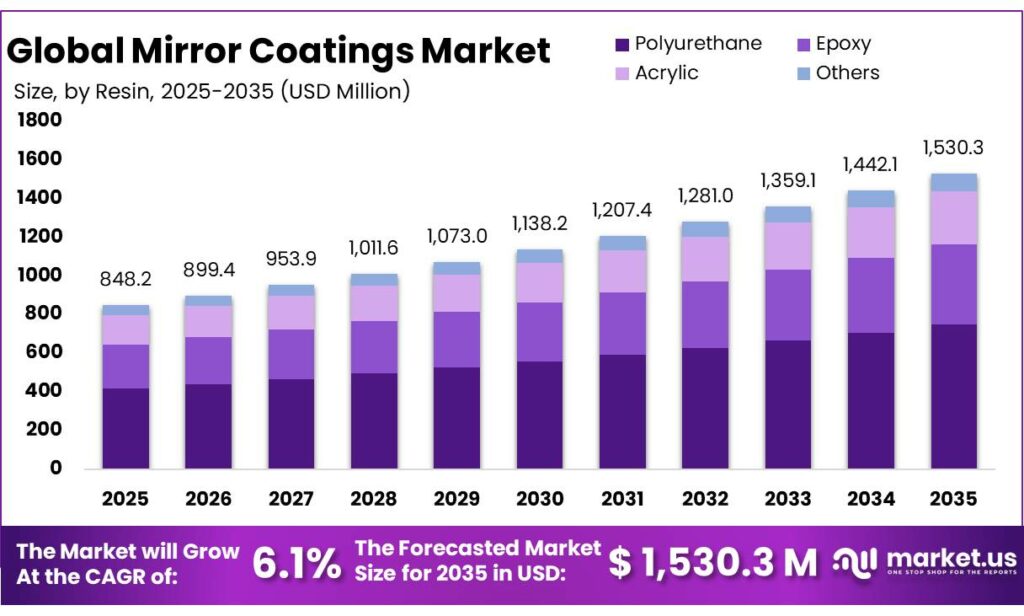
The Global Mirror Coatings Market size is expected to be worth around USD 1,530.3 Million by 2035, from USD 848.2 Million in 2025, growing at a CAGR of 6.1% during the forecast period from 2026 to 2035. In 2025, Asia Pacific held a dominant market position, capturing more than a 44.6% share, holding USD 378.2 Million revenue.
Mirror coatings represent a specialized coatings segment used to create highly reflective, durable surfaces on glass and other substrates for architectural mirrors, automotive components, solar reflectors, retail interiors, and selected industrial applications. From an industry standpoint, the segment is being shaped less by speculative market sizing and more by measurable activity in downstream sectors that consume coated glass and reflective surfaces.
In construction, the U.S. Census Bureau reported total construction spending at a seasonally adjusted annual rate of $2.19 trillion in January 2026, up from $2.17 trillion a year earlier, while manufacturing construction was still running at $196.2 billion SAAR in January 2026 after reaching $200.3 billion in December 2025. That level of built-environment investment supports demand for mirrors, decorative glass, and performance-coated interior surfaces in commercial, residential, hospitality, and industrial projects.
The current industrial scenario is also supported by transportation and energy demand. According to ACEA, global car production rose 4.2% to 78.7 million units in 2025, with Asia accounting for 62.1% of output and the EU contributing 14.6%. Because mirror coatings are used in rear-view mirror assemblies and selected reflective automotive components, this production base remains a direct volume driver.
In parallel, the IEA stated that global annual renewable capacity additions are expected to rise from 666 GW in 2024 to nearly 935 GW by 2030, and utility-scale plus distributed solar is forecast to account for almost 80% of renewable electricity expansion over 2024-2030. This matters because reflective coatings and mirror technologies remain relevant in solar thermal and broader reflective-energy applications.
A notable demand catalyst also comes from food and beverage value chains, where hygienic, easy-clean, chemically resistant coated systems are increasingly important in processing, cold storage, and premium retail presentation environments. Sherwin-Williams states that its Poly-Crete flooring systems are used in bottling, food processing, commercial kitchens, breweries, and distilleries, illustrating how adjacent coating technologies are being positioned around hygiene-led industrial infrastructure.
On the macro side, USDA reported U.S. refrigerated warehouse capacity of 3.99 billion cubic feet in 2025, including 3.25 billion cubic feet of usable capacity across 931 warehouses. In Europe, FEVE reported that products using glass as packaging accounted for more than €140 billion in exports in 2023, representing 5.7% of all EU exports. That scale of food, beverage, and cold-chain activity indirectly strengthens long-term demand for durable coated glass and protective surfacing systems in production and merchandising environments.
The European Commission says the EU solar strategy under REPowerEU set a target of more than 380 GW of solar PV by 2025 and at least 700 GW by 2030, while the U.S. Department of Energy notes that the IRS allocated about $6 billion of Section 48C tax credits on 10 January 2025 for more than 140 projects across about 30 states, including about $2.5 billion in energy communities. Such policy-led capital formation improves the outlook for reflective and specialty coating technologies tied to buildings, energy equipment, and advanced manufacturing.
Key Takeaways
- Mirror Coatings Market size is expected to be worth around USD 1,530.3 Million by 2035, from USD 848.2 Million in 2025, growing at a CAGR of 6.1%.
- Polyurethane held a dominant market position, capturing more than a 49.3% share in the mirror coatings market.
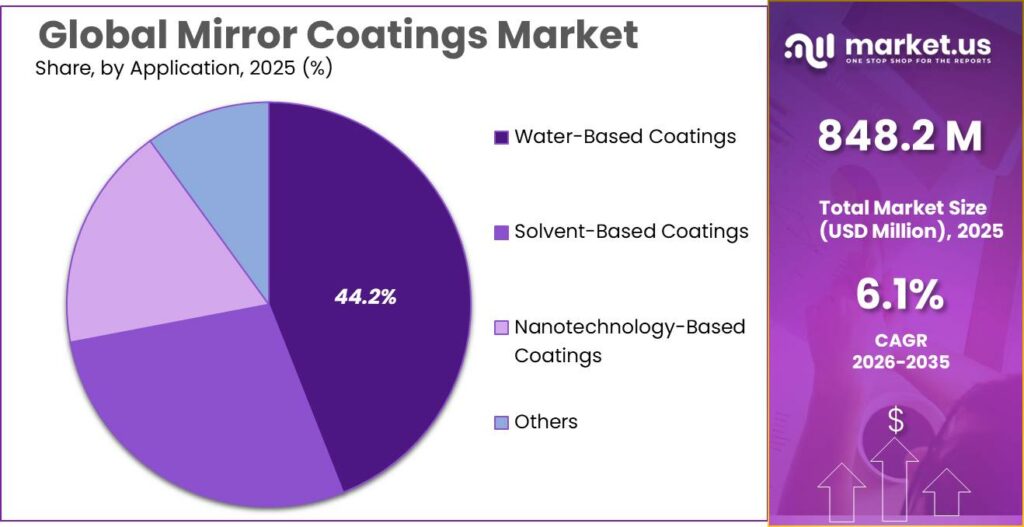
- Water-Based Coatings held a dominant market position, capturing more than a 44.2% share in the mirror coatings market.
- Architectural held a dominant market position, capturing more than a 47.9% share in the mirror coatings market.
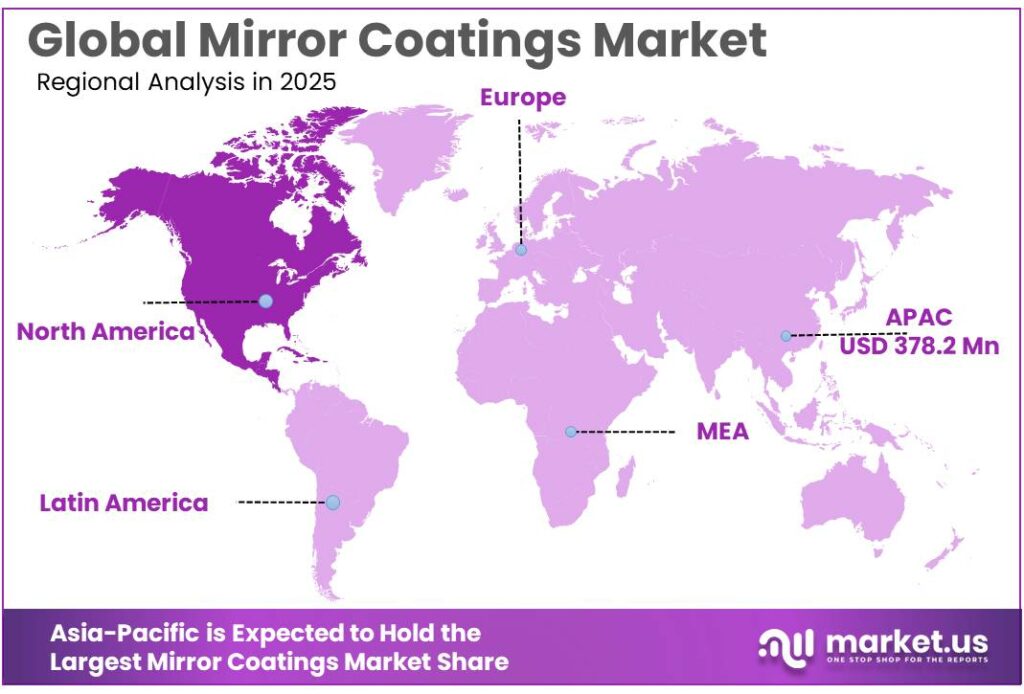
- Asia-Pacific held the leading position in the mirror coatings market, accounting for a dominant 44.6% share, valued at USD 378.2 million.
By Resin Analysis
Polyurethane dominates with 49.3% due to its strong durability and high reflectivity performance
In 2025, Polyurethane held a dominant market position, capturing more than a 49.3% share in the mirror coatings market by resin segment. This strong position was mainly driven by its excellent durability, resistance to moisture, and ability to maintain high reflectivity over time, which made it a preferred choice for both automotive and architectural mirrors. Manufacturers leaned toward polyurethane coatings because they offered a good balance between performance and cost, especially in environments exposed to humidity and temperature variations.
By Application Analysis
Water-Based Coatings lead with 44.2% as industries shift toward safer and eco-friendly solutions
In 2025, Water-Based Coatings held a dominant market position, capturing more than a 44.2% share in the mirror coatings market by application. This growth was largely supported by increasing environmental awareness and stricter regulations around solvent-based products. Many manufacturers preferred water-based coatings because they release fewer harmful emissions and are easier to handle during production. They also provide good clarity and adhesion, making them suitable for mirrors used in homes, vehicles, and commercial spaces.
By End Use Analysis
Architectural leads with 47.9% as modern buildings rely more on mirrors for design and function
In 2025, Architectural held a dominant market position, capturing more than a 47.9% share in the mirror coatings market by end-use. This strong share came from the rising use of mirrors in residential and commercial buildings for both decorative and practical purposes. Mirrors are widely used in interiors to improve lighting, create a sense of space, and enhance overall aesthetics, which pushed demand for high-quality coatings. Builders and designers preferred durable coatings that could handle humidity and temperature changes, especially in bathrooms, elevators, and large commercial spaces.
Key Market Segments
By Resin
- Polyurethane
- Epoxy
- Acrylic
- Others
By Application
- Water-Based Coatings
- Solvent-Based Coatings
- Nanotechnology-Based Coatings
- Others
By End Use
- Architectural
- Automotive & Transportation
- Decorative
- Solar Power
- Others
Emerging Trends
Shift toward eco-friendly and smart coatings shaping the future of mirror coatings
One of the most noticeable trends in mirror coatings is the growing shift toward eco-friendly and advanced functional coatings. In 2025, the global mirror coatings market reached around USD 900.2 million and continued to grow into 2026, showing strong demand for improved and sustainable solutions. Many manufacturers are now focusing on low-VOC, water-based, and environmentally safe coatings as regulations become stricter. This trend is also influenced by industries like food processing, where safety and cleanliness are critical.
For example, India’s food processing sector is expected to reach nearly ₹4,584,415 crore by FY26, showing rapid expansion of facilities that need safer materials. These environments require coatings that do not release harmful substances and can handle frequent cleaning. As a result, eco-friendly mirror coatings are gaining more attention. In 2026, companies are also improving formulations to make these coatings more durable while keeping them safe for sensitive environments like food plants and cold storage units.
Rising adoption of nano and self-cleaning coatings improving efficiency
Another important trend is the increasing use of nano and self-cleaning coatings in mirror applications. These advanced coatings offer features like anti-corrosion, anti-bacterial surfaces, and improved reflectivity, which are highly useful in industries such as food processing. The India nano coatings market reached about USD 511.20 million in 2024 and is expected to grow significantly by 2032, showing how fast this technology is being adopted.
In food-related industries, where hygiene and visibility are critical, these coatings help reduce maintenance efforts and improve safety. With India losing an estimated USD 8–15 billion worth of food every year due to storage and handling issues, better infrastructure and technology are becoming necessary. Advanced mirror coatings can support this by improving monitoring systems and maintaining cleaner surfaces in storage and processing areas.
Drivers
Rising demand from processed food industry pushing need for durable mirror coatings
One of the biggest drivers for mirror coatings is the fast growth of the food processing and packaging industry. In 2024, India’s food processing market reached around ₹30,49,800 crore and is expected to grow further to nearly ₹4,584,415 crore by FY26, showing how quickly this sector is expanding. This growth directly increases the need for mirrors and reflective surfaces used in food factories, cold storage units, and inspection systems.
Also, processed food exports touched about USD 10.09 billion in 2024–2025, showing strong global demand. This pushes manufacturers to upgrade facilities, which again supports demand for high-performance mirror coatings. The more the industry grows, the more it needs durable coatings that can handle harsh conditions. This link between food processing expansion and industrial infrastructure makes mirror coatings an important supporting material in the value chain, especially in large-scale food manufacturing environments.
Government support and infrastructure projects increasing coating demand
Government initiatives are another strong factor driving mirror coatings demand. Programs like the Pradhan Mantri Kisan Sampada Yojana have approved 41 Mega Food Parks and 399 cold chain projects across India. These projects require large-scale infrastructure where reflective surfaces are used for safety, monitoring, and lighting efficiency. As new facilities are built, demand for mirror coatings naturally increases.
At the same time, the government is pushing schemes to support small food businesses and processing units, which has expanded the sector further. The industry has also attracted over USD 13.01 billion in foreign investment up to 2024, showing strong confidence in its future growth. With more factories, storage units, and logistics centers being developed, the need for protective and long-lasting coatings is rising steadily.
Restraints
High compliance and safety standards in food industry limiting coating adoption
One major restraining factor for mirror coatings is the strict safety and hygiene regulations followed in the food processing industry. Food facilities require materials that do not release harmful chemicals or react with cleaning agents. In India, the Food Safety and Standards Authority of India has set detailed guidelines for surfaces used in food environments, making it harder for some coating types to get approval. Because of this, manufacturers often avoid certain mirror coatings that may contain solvents or additives considered unsafe.
The food processing sector itself is growing fast, contributing nearly 13% to India’s exports and reaching about USD 10.09 billion in processed food exports in 2024–2025. This scale means even small compliance issues can impact large operations. Many companies prefer stainless steel or untreated surfaces over coated mirrors to reduce regulatory risks. As a result, mirror coatings sometimes lose demand in sensitive areas like dairy plants or meat processing units. The need to meet both international and domestic safety norms increases testing costs and slows down adoption, making it a clear barrier for wider use.
Rising operational costs and cleaning challenges affecting usage
Another limiting factor is the high maintenance and operational cost linked with mirror coatings in food environments. Food factories require frequent cleaning using strong chemicals and high-pressure washing systems. According to the Ministry of Food Processing Industries, India has approved over 399 cold chain projects and multiple processing units under government schemes, all of which operate under strict sanitation rules. These environments can damage coatings faster, leading to higher replacement costs.
The food processing industry in India is expected to reach around ₹4,584,415 crore by FY26, showing rapid expansion. With such large-scale operations, even small increases in maintenance cost can affect profitability. Many facility managers avoid coated mirrors because scratches or peeling can trap dirt and bacteria, which is a serious issue in food safety. Instead, they go for materials that are easier to clean and last longer without surface damage.
Opportunity
Expansion of cold chain and food infrastructure creating new demand for advanced mirror coatings
One strong growth opportunity for mirror coatings comes from the rapid expansion of cold chain and food storage infrastructure. In 2025, India’s cold chain market was valued at around INR 2,535.87 billion and is expected to grow steadily in the coming years, driven by rising demand for fresh and processed food. This growth directly increases the need for reflective and protective surfaces inside storage units, warehouses, and processing plants.
At the same time, food wastage in India has been estimated between USD 8 to 15 billion annually due to gaps in storage and logistics. This has pushed both government and private players to invest in better infrastructure. As more temperature-controlled warehouses and processing units are built, there is a growing need for coatings that can handle moisture, temperature variation, and chemical exposure.
Government-backed food processing growth opening new application areas
Another major opportunity lies in the strong push from government initiatives supporting food processing and infrastructure. The Ministry of Food Processing Industries has been actively promoting schemes like PM Kisan SAMPADA Yojana and PMFME, which have already supported over 1,72,707 micro food processing enterprises by the end of 2025. This expansion means more small and medium processing units are being set up across the country, each requiring basic infrastructure including reflective surfaces for safety and operations.
Along with this, the overall food processing market in India reached around ₹30,49,800 crore in 2024 and is expected to rise to nearly ₹4,584,415 crore by FY26. This steady growth shows how fast the industry is scaling. As new plants, packaging units, and storage facilities are developed, the demand for protective coatings, including mirror coatings, is likely to increase. These coatings help improve visibility, maintain hygiene, and extend the life of equipment.
Regional Insights
Asia-Pacific dominates with 44.6% share valued at USD 378.2 Mn driven by rapid construction and industrial growth
Asia-Pacific held the leading position in the mirror coatings market, accounting for a dominant 44.6% share, valued at USD 378.2 million. The region’s strong presence is mainly supported by rapid urbanization, expanding construction activities, and a growing automotive sector across key countries like China, India, and Southeast Asia. In 2025, the region continued to lead globally, with overall market share estimates in similar ranges, supported by rising demand for architectural glass, decorative mirrors, and automotive applications.
The automotive and solar energy sectors also contribute notably to regional growth. Increasing vehicle production and the adoption of advanced mirror technologies in automobiles are supporting coating demand. At the same time, the region’s leadership in solar power installations is boosting the use of reflective coatings in energy applications. With continuous industrial expansion and technological improvements, Asia-Pacific is expected to maintain its leading position into 2026, supported by strong manufacturing capabilities and rising investments across multiple end-use industries.
Key Regions and Countries Insights
- North America
- US
- Canada
- Europe
- Germany
- France
- The UK
- Spain
- Italy
- Rest of Europe
- Asia Pacific
- China
- Japan
- South Korea
- India
- Australia
- Rest of APAC
- Latin America
- Brazil
- Mexico
- Rest of Latin America
- Middle East & Africa
- GCC
- South Africa
- Rest of MEA
Key Players Analysis
Arkema is a global leader in specialty chemicals, operating in over 55 countries with around 21,000 employees. The company offers advanced resin solutions used in mirror coatings, especially for durability and environmental performance. Arkema’s materials play a role in coatings that support construction and automotive sectors, which are key drivers of the market. With global mirror coatings demand expected to reach over USD 1.3 billion by 2033, Arkema continues to invest in sustainable and high-performance coating technologies.
Diamon-Fusion International focuses on protective coatings that enhance glass durability and cleanliness. Its technology is used in mirrors, shower glass, and automotive applications, offering benefits like water resistance and easier maintenance. The company operates in over 35 countries and supports a wide partner network. As industries look for coatings that reduce maintenance costs and improve lifespan, Diamon-Fusion gains traction. This aligns with the mirror coatings market, which is expected to exceed USD 0.9 billion in 2025, showing steady growth opportunities.
Top Key Players Outlook
- Abrisa Technologies
- AccuCoat inc.
- Arkema
- CASIX, Inc
- Diamon-Fusion International, Inc.
- Dynasil Corporation
- Edmund Optics Inc.
- FENZI S.p.A.
- General Optics (Asia) Limited
- Guardian Industries
- JENOPTIK AG
- North America Coating Laboratories
- Pearl Nano
- SHERWIN-WILLIAMS
Recent Industry Developments
In 2025, AccuCoat continued to support mirror coating demand through metallic and dielectric coatings, including aluminum, gold, and silver layers, with some dielectric coatings achieving over 99% reflectivity, which is critical for high-performance optical systems.
By 2026, with the market estimated to cross USD 963.5 million, Abrisa’s focus on multi-layer dielectric coatings capable of handling temperatures above 400°C and offering durability positions it well in niche, high-value segments.
Report Scope
| Report Features | Description |
|---|---|
| Market Value (2025) | USD 848.2 Mn |
| Forecast Revenue (2035) | USD 1,530.3 Mn |
| CAGR (2026-2035) | 6.1% |
| Base Year for Estimation | 2025 |
| Historic Period | 2020-2024 |
| Forecast Period | 2026-2035 |
| Report Coverage | Revenue Forecast, Market Dynamics, Competitive Landscape, Recent Developments |
| Segments Covered | By Resin (Polyurethane, Epoxy, Acrylic, Others), By Application (Water-Based Coatings, Solvent-Based Coatings, Nanotechnology-Based Coatings, Others), By End Use (Architectural, Automotive And Transportation, Decorative, Solar Power, Others) |
| Regional Analysis | North America – US, Canada; Europe – Germany, France, The UK, Spain, Italy, Rest of Europe; Asia Pacific – China, Japan, South Korea, India, Australia, Singapore, Rest of APAC; Latin America – Brazil, Mexico, Rest of Latin America; Middle East & Africa – GCC, South Africa, Rest of MEA |
| Competitive Landscape | Abrisa Technologies, AccuCoat inc., Arkema, CASIX, Inc, Diamon-Fusion International, Inc., Dynasil Corporation, Edmund Optics Inc., FENZI S.p.A., General Optics (Asia) Limited, Guardian Industries, JENOPTIK AG, North America Coating Laboratories, Pearl Nano, SHERWIN-WILLIAMS |
| Customization Scope | Customization for segments, region/country-level will be provided. Moreover, additional customization can be done based on the requirements. |
| Purchase Options | We have three licenses to opt for: Single User License, Multi-User License (Up to 5 Users), Corporate Use License (Unlimited User and Printable PDF) |





































