


Report Overview
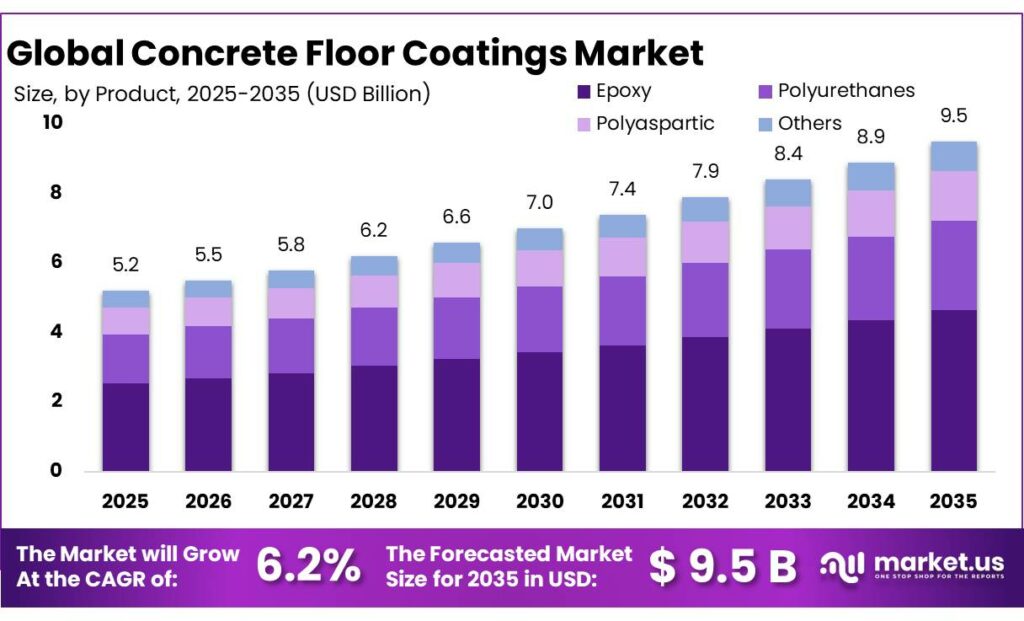
The Global Concrete Floor Coatings Market size is expected to be worth around USD 9.5 Billion by 2035, from USD 5.2 Billion in 2025, growing at a CAGR of 6.2% during the forecast period from 2026 to 2035. In 2025, Asia Pacific held a dominant market position, capturing more than a 44.8% share, holding USD 2.3 Billion revenue.
Concrete floor coatings represent a critical performance layer in industrial buildings because they extend slab life, improve cleanability, and help facilities manage abrasion, chemical exposure, impact, and slip risk. In food and beverage environments, the category is especially relevant because flooring is exposed to washdowns, thermal cycling, fats, sugars, acids, and frequent forklift traffic, making coating selection a plant-efficiency decision rather than only a finishing choice.
The U.S. food and beverage manufacturing sector employed 1.7 million people in 2021, while meat processing alone accounted for 26.2% of sector sales, ahead of dairy at 12.8%, beverages at 11.3%, and grain and oilseeds at 10.4%. That scale supports recurring demand for durable, hygienic, easy-to-maintain floor protection systems across processing, packaging, cold storage, and logistics areas.
The industrial scenario remains favorable because the addressable end-use base is large and operationally demanding. In the United States, food and beverage processing establishments employed 1.7 million workers in 2021, equal to about 15.4% of total manufacturing employment and just over 1.1% of all nonfarm employment, according to USDA ERS. Meat processing alone accounted for 30.6% of food and beverage manufacturing employment, while bakeries and tortilla producers represented 14.7%.
Europe also supports a strong industrial outlook for concrete floor coatings. FoodDrinkEurope reports that the EU food and drink industry employs 4.7 million people, generates €1.2 trillion in turnover, and produces €250 billion in value added, making it the EU’s largest manufacturing industry. Such a large installed base of hygienic manufacturing and storage infrastructure supports continued demand for epoxy, polyurethane, polyaspartic, and other resin-rich concrete coating systems that can withstand aggressive cleaning regimes and continuous production.
The primary growth drivers are compliance, water management, and lifecycle economics. Food processors are under sustained pressure to reduce downtime while maintaining cleanable, seamless, non-porous surfaces. Government-backed sustainability initiatives also strengthen the investment case. The U.S. EPA’s WRAP 2.0, released on April 16, 2026, builds on a framework involving more than 200 partner organizations and includes a specific action to establish a decision-making framework for water reuse within food and beverage production facilities.
Key Takeaways
- Concrete Floor Coatings Market size is expected to be worth around USD 9.5 Billion by 2035, from USD 5.2 Billion in 2025, growing at a CAGR of 6.2%.
- Epoxy held a dominant market position, capturing more than a 49.7% share.
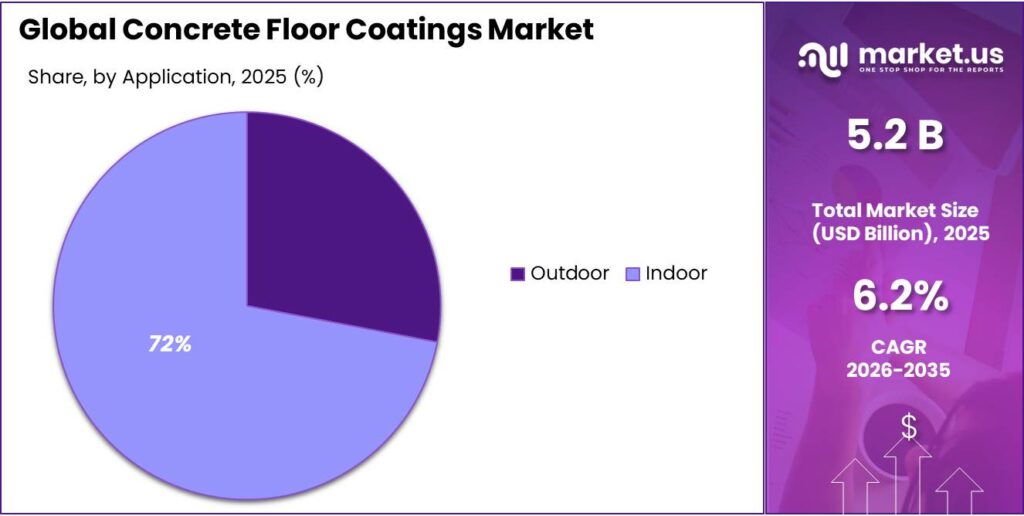
- Indoor held a dominant market position, capturing more than a 72.4% share.
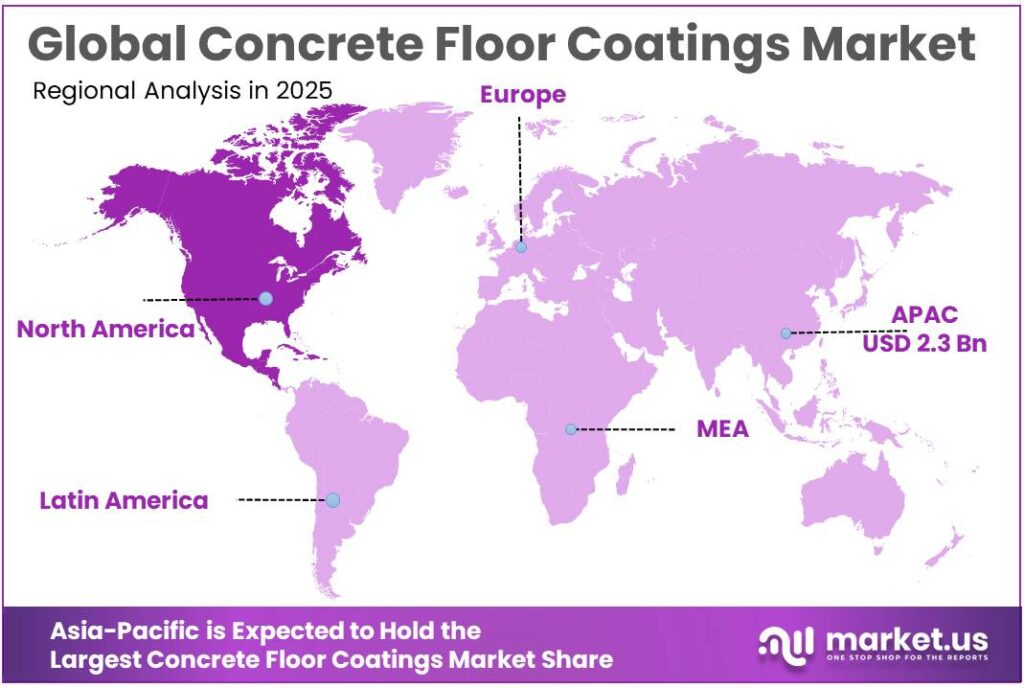
- Asia-Pacific held the dominant position in the concrete floor coatings market, accounting for 44.8% share and valued at around USD 2.3 billion.
By Product Analysis
Epoxy dominates with 49.7% due to its strong durability and wide industrial use
In 2025, Epoxy held a dominant market position, capturing more than a 49.7% share. This leadership was mainly driven by its high strength, excellent adhesion, and resistance to chemicals and moisture, making it a preferred choice across industrial, commercial, and residential flooring applications. Epoxy coatings continued to see strong demand in manufacturing units, warehouses, and garages where long-lasting performance is critical. Moving into 2026, the segment maintained its leading position as users increasingly prioritized low-maintenance and cost-efficient flooring solutions.
By Application Analysis
Indoor applications dominate with 72.4% as demand stays strong across homes and commercial spaces
In 2025, Indoor held a dominant market position, capturing more than a 72.4% share. This strong hold came from the growing use of concrete floor coatings in residential buildings, shopping areas, offices, and industrial interiors where clean, durable, and easy-to-maintain surfaces are needed. Indoor environments benefit more from coatings due to controlled conditions, which help extend product life and maintain appearance. Moving into 2026, the segment continued to lead as renovation activities and new construction projects increased, especially in urban areas. People also preferred coated indoor floors for their smooth finish, dust resistance, and better visual appeal.
Key Market Segments
By Product
- Epoxy
- Polyurethanes
- Polyaspartic
- Others
By Application
- Outdoor
- Indoor
Emerging Trends
Shift toward science-based hygiene flooring in food industries
One of the latest trends in concrete floor coatings is the growing shift toward science-driven hygiene solutions, especially in food processing environments. Companies are no longer choosing flooring just for durability; they now want surfaces that actively support cleanliness and safety. This change is strongly influenced by global food safety concerns. According to the World Health Organization, around 600 million people fall sick every year due to contaminated food, leading to 420,000 deaths.
Because of this, industries are focusing on coatings that are seamless, antimicrobial, and easy to sanitize. In 2025, this trend became more visible as awareness campaigns like World Food Safety Day highlighted that nearly 1.6 million people fall ill every day from unsafe food. Governments and organizations are pushing industries to adopt science-backed materials that reduce contamination risks.
Growing use of data and compliance-driven flooring upgrades
Another important trend is the rising use of data and strict compliance checks to improve infrastructure, including flooring. Governments and food safety authorities are now relying more on inspections, testing, and real-time monitoring to ensure standards are followed. This is changing how industries approach flooring decisions.
For example, global campaigns led by organizations like WHO and FAO emphasize that food safety must be based on scientific evidence and proper systems. The economic impact is also significant, with unsafe food costing low- and middle-income countries around US$ 110 billion every year. Because of these financial and health risks, companies are investing in long-lasting coated floors that meet regulatory expectations and reduce maintenance issues.
Drivers
Rising food safety concerns pushing demand for hygienic coated flooring
One of the biggest driving factors for concrete floor coatings is the growing concern around food safety and contamination control. Across the world, food industries are under pressure to maintain cleaner and more hygienic production environments. According to the World Health Organization, around 600 million people fall sick every year due to contaminated food, and about 420,000 deaths occur annually.
Concrete floor coatings, especially seamless ones, help reduce cracks and joints where dirt and microbes can hide. Governments are also tightening food safety rules, making it necessary for industries to upgrade their infrastructure. As we move into 2026, stricter inspections and hygiene audits are expected to increase further, pushing more facilities to adopt coated floors as a standard requirement rather than an option.
Strong regulations and industry standards increasing coating adoption
Another key driver is the rise in strict regulations and standards set by food safety authorities and governments. Agencies like the Centers for Disease Control and Prevention report that 48 million people get sick from foodborne illnesses each year in the United States alone. Such numbers have led to stronger monitoring of food manufacturing environments.
Governments are encouraging industries to follow better sanitation practices, and flooring plays a big role in that. Coated concrete floors are preferred because they can handle heavy cleaning, chemical exposure, and high foot traffic without damage. In 2025 and continuing into 2026, many countries are also promoting better infrastructure in food and beverage industries through safety programs and compliance checks. This is making businesses more aware that poor flooring can lead to contamination risks.
Restraints
High initial cost and maintenance challenges slowing adoption
One major restraining factor for concrete floor coatings is the high upfront cost and ongoing maintenance requirements, especially for industries that operate under tight margins like food processing. While coated floors offer hygiene benefits, the installation process involves surface preparation, labor, and downtime, which can be expensive for small and mid-sized facilities.
Many food businesses hesitate to invest heavily unless regulations force them to upgrade. This becomes more visible when we look at the scale of food safety issues globally. According to the World Health Organization, around 600 million people fall ill and 420,000 die every year due to unsafe food.
Operational downtime and compliance pressure creating hesitation
Another key restraint is the operational disruption during installation and repair of coated flooring. Food industries cannot easily shut down production lines, and even a few days of downtime can lead to losses. This makes companies delay or avoid upgrading their flooring systems. In the United States alone, the Centers for Disease Control and Prevention estimates that 48 million people get sick from foodborne illness each year, with 128,000 hospitalizations and 3,000 deaths.
These numbers show the importance of maintaining proper hygiene infrastructure, yet the process of upgrading flooring is not always simple. Many facilities prefer temporary fixes instead of full coating applications to avoid interruptions. In 2026, even with stricter food safety inspections and government guidelines, businesses are balancing compliance with operational continuity.
Opportunity
Growing demand for safer food environments creating new opportunities
One of the biggest growth opportunities for concrete floor coatings comes from the rising global focus on food safety and hygiene. Food industries are under constant pressure to improve cleanliness standards, and flooring plays a direct role in that. According to the World Health Organization, around 600 million people fall sick every year due to unsafe food, with 420,000 deaths globally.
This is pushing food manufacturers to rethink their production environments. Coated concrete floors, which are seamless and easy to clean, are becoming a preferred choice in processing plants and storage units. In 2025 and moving into 2026, many governments are actively promoting food safety awareness through programs like World Food Safety Day, which highlights that nearly 1.6 million people fall ill every day from unsafe food.
Government regulations and modernization of food facilities driving adoption
Another strong opportunity lies in the tightening of food safety regulations and the push toward modern food processing infrastructure. Governments and regulatory bodies are making it clear that maintaining proper hygiene standards is no longer optional. For example, large-scale inspection systems like those under the U.S. food safety programs carried out over 8.1 million inspection procedures in a year across thousands of facilities.
Such large numbers show how closely food environments are being monitored. In India and other developing regions, authorities are also encouraging upgrades in food facilities through structured guidelines and compliance checks. As rules become stricter, businesses are being pushed to adopt materials that can withstand heavy cleaning, chemical exposure, and high traffic.
Regional Insights
Asia-Pacific dominates with 44.8% share driven by strong industrial and construction growth
Asia-Pacific held the dominant position in the concrete floor coatings market, accounting for 44.8% share and valued at around USD 2.3 billion, making it the leading regional market in 2025. The region’s growth is largely supported by rapid urbanization, expanding industrial bases, and large-scale infrastructure investments across countries like China, India, and Southeast Asia.
The construction sector remains a key contributor, with the broader Asia-Pacific construction chemicals market reaching USD 36.27 billion in 2026, reflecting strong demand for materials including flooring coatings.
Key Regions and Countries Insights
- North America
- US
- Canada
- Europe
- Germany
- France
- The UK
- Spain
- Italy
- Rest of Europe
- Asia Pacific
- China
- Japan
- South Korea
- India
- Australia
- Rest of APAC
- Latin America
- Brazil
- Mexico
- Rest of Latin America
- Middle East & Africa
- GCC
- South Africa
- Rest of MEA
Key Players Analysis
Trucrete Surfacing Systems operates as a specialized player in the concrete coatings space, mainly focusing on industrial and commercial flooring services. The company works on project-based revenue models, typically handling mid-sized contracts ranging between USD 50,000 to USD 500,000 per project depending on scope. Its workforce is relatively small, estimated under 100 employees, allowing flexibility and customization in projects.
The Sherwin-Williams Company stands as one of the largest players in the coatings industry, with 64,249 employees and operations in over 120 countries. The company reported net income of USD 2.57 billion in 2025, supported by a wide portfolio including industrial and floor coatings. It also operates around 4,853 stores globally, giving it a strong distribution network.
Vanguard Concrete Coating operates primarily in residential and light commercial flooring, offering decorative and protective coating solutions. The company handles projects typically between USD 5,000 to USD 50,000, making it accessible to smaller clients. With a workforce estimated below 50 employees, it focuses on localized service delivery.
Top Key Players Outlook
- Trucrete Surfacing Systems
- The Sherwin-Williams Company
- North American Coating Solutions
- BASF SE
- Vanguard Concrete Coating
- Tennant Coatings
- Jotun
- Axalta Coating Systems
- Elite Crete Systems
- Stonhard
- PPG Pittsburgh Paints
- Key Resin Company
- BEHR Process Corp.
- Epmar Corp.
- Pratt & Lambert.
Recent Industry Developments
In 2025, Trucrete Surfacing Systems continues to operate on a project-driven model, typically handling small to mid-scale contracts ranging from USD 50,000 to USD 500,000 per installation, especially in commercial and residential flooring.
In 2025, Tennant Company reported USD 1,203.5 million in full-year net sales, while its Asia Pacific sales reached USD 76.9 million and its worldwide workforce stood at 4,484 employees as of December 31, 2025.
Report Scope
| Report Features | Description |
|---|---|
| Market Value (2025) | USD 5.2 Bn |
| Forecast Revenue (2035) | USD 9.5 Bn |
| CAGR (2026-2035) | 6.2% |
| Base Year for Estimation | 2025 |
| Historic Period | 2020-2024 |
| Forecast Period | 2026-2035 |
| Report Coverage | Revenue Forecast, Market Dynamics, Competitive Landscape, Recent Developments |
| Segments Covered | By Product (Epoxy, Polyurethanes, Polyaspartic, Others), By Application (Outdoor, Indoor) |
| Regional Analysis | North America – US, Canada; Europe – Germany, France, The UK, Spain, Italy, Rest of Europe; Asia Pacific – China, Japan, South Korea, India, Australia, Singapore, Rest of APAC; Latin America – Brazil, Mexico, Rest of Latin America; Middle East & Africa – GCC, South Africa, Rest of MEA |
| Competitive Landscape | Trucrete Surfacing Systems, The Sherwin-Williams Company, North American Coating Solutions, BASF SE, Vanguard Concrete Coating, Tennant Coatings, Jotun, Axalta Coating Systems, Elite Crete Systems, Stonhard, PPG Pittsburgh Paints, Key Resin Company, BEHR Process Corp., Epmar Corp., Pratt & Lambert. |
| Customization Scope | Customization for segments, region/country-level will be provided. Moreover, additional customization can be done based on the requirements. |
| Purchase Options | We have three licenses to opt for: Single User License, Multi-User License (Up to 5 Users), Corporate Use License (Unlimited User and Printable PDF) |





































