


Report Overview
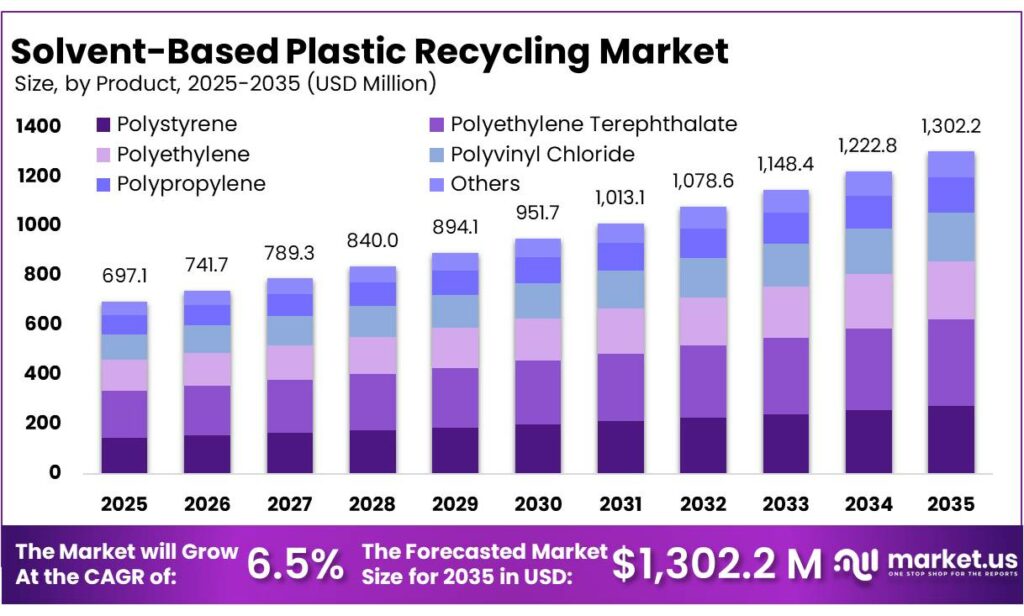
The Global Solvent-Based Plastic Recycling Market size is expected to be worth around USD 1,302.2 Million by 2035, from USD 697.1 Million in 2025, growing at a CAGR of 6.5% during the forecast period from 2026 to 2035. In 2025, Asia Pacific held a dominant market position, capturing more than a 47.5% share, holding USD 331.0 Million revenue.
Solvent-based plastic recycling is emerging as a high-value route for recovering polymers that are difficult to upgrade through conventional mechanical recycling, especially in multilayer, printed, contaminated, or odor-sensitive packaging streams. In industrial terms, the process selectively dissolves a target polymer, removes inks, additives, odors, and non-target materials, and then re-precipitates a purified resin suitable for higher-end reuse.
The model is gaining traction because packaging remains the largest short-life plastic application: the OECD states that around 31% of plastics produced are for packaging, while 40% of plastic waste in 2019 came from packaging. The same OECD work shows global plastics production and use reached 435 million tonnes in 2020, versus 234 million tonnes in 2000, underscoring why advanced recovery routes are becoming strategically important.
The industrial scenario is strongest where food and consumer packaging volumes are high and where policy is pushing higher-quality recyclate. In Europe, Eurostat reports 79.7 million tonnes of packaging waste were generated in 2023, equal to 177.8 kg per person. This matters for solvent-based recycling because food-contact and flexible packaging waste often contains inks, adhesives, and multilayer structures that reduce mechanical recycling yields.
Food-linked demand is also material: FoodDrinkEurope describes the EU food and drink industry as the bloc’s largest manufacturing industry, with about €1.1 trillion in turnover and 4.7 million employees, which reinforces the scale of packaging dependence across the food value chain. In parallel, Fraunhofer IVV notes solvent-based processing is especially suited to composite and contaminated post-consumer plastics where high-purity outputs are required.
Regulation is becoming a major accelerator. In Europe, the Packaging and Packaging Waste Regulation (PPWR) 2025/40 entered into force on 11 February 2025 and will generally apply from 12 August 2026. The framework aims to make all packaging on the EU market recyclable by 2030, while also increasing recycled content requirements for plastic packaging over 2030 and 2040.
For food-contact uses, the commercialization pathway is especially dependent on safety validation: the FDA’s recycled-plastics guidance emphasizes contaminant migration risk, and EFSA notes that in 2025 it adopted the first opinion of a plastic recycling process under Regulation (EU) 2022/1616. This combination of packaging rules and food-contact scrutiny favors solvent-based systems that can demonstrate high-purity output and traceable decontamination.
Government and regulatory momentum is now one of the clearest growth drivers. The European Commission’s Packaging and Packaging Waste Regulation requires all packaging on the EU market to be recyclable by 2030, while also aiming to increase recycled plastic use and reduce virgin material demand on the path to climate neutrality by 2050.
Key Takeaways
- Solvent-Based Plastic Recycling Market size is expected to be worth around USD 1,302.2 Million by 2035, from USD 697.1 Million in 2025, growing at a CAGR of 6.5%.
- Polyethylene Terephthalate held a dominant market position, capturing more than a 27.8% share.
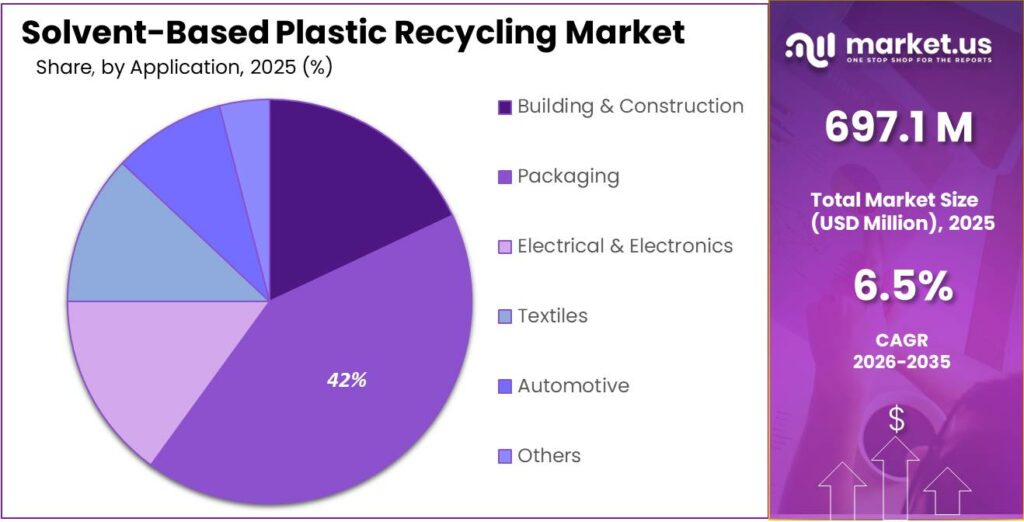
- Packaging held a dominant market position, capturing more than a 42.3% share.
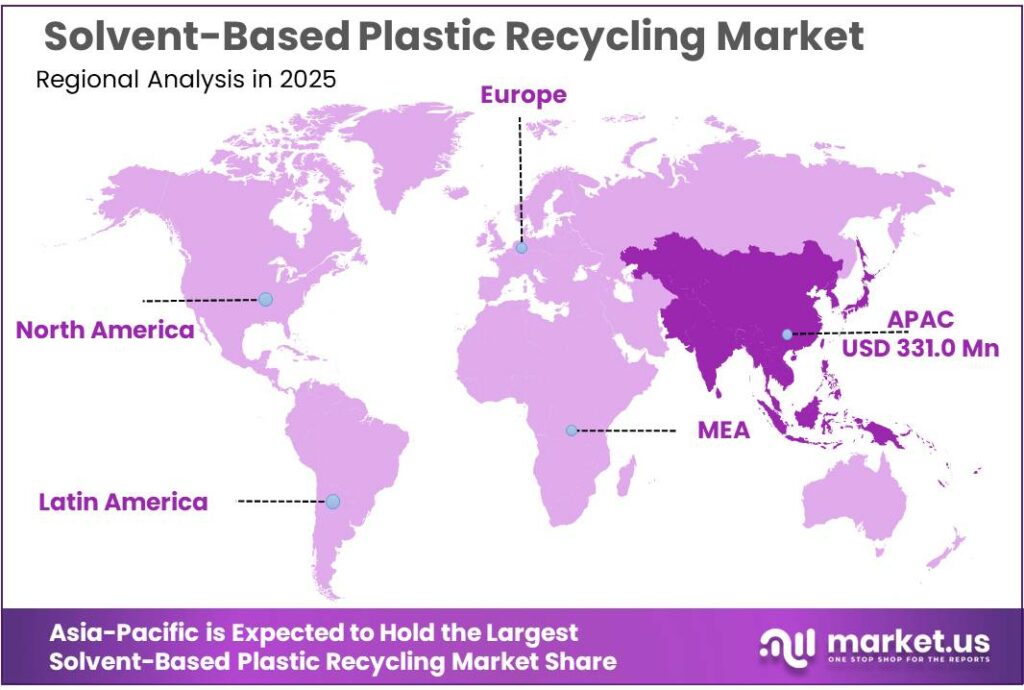
- Asia-Pacific holds the leading position in the solvent-based plastic recycling market, accounting for a dominant 47.5% share, valued at USD 331.0 Mn.
By Product Analysis
Polyethylene Terephthalate leads the segment with 27.8% driven by strong recycling demand in packaging and textiles
In 2025, Polyethylene Terephthalate held a dominant market position, capturing more than a 27.8% share. This leadership mainly comes from its wide use in beverage bottles, food packaging, and synthetic fibers, where recycling demand continues to rise. Solvent-based recycling methods are particularly effective for PET because they help maintain material quality, making it suitable for repeated reuse without significant degradation. Moving into 2026, the segment is expected to remain strong as industries focus more on producing high-purity recycled PET for food-grade applications.
By Application Analysis
Packaging leads the application segment with 42.3% supported by rising demand for recycled materials
In 2025, Packaging held a dominant market position, capturing more than a 42.3% share. This strong position is mainly due to the heavy use of plastics in food containers, bottles, and flexible packaging, where recycling has become a top priority. Solvent-based recycling is gaining attention in this space because it can produce cleaner and higher-quality recycled material, which is important for packaging that comes in contact with food. By 2026, the segment continues to show steady progress as companies focus on using more recycled content to meet sustainability goals. Increasing pressure from environmental regulations and consumer awareness is also pushing brands to adopt advanced recycling methods.
Key Market Segments
By Product
- Polystyrene
- Polyethylene Terephthalate
- Polyethylene
- Polyvinyl Chloride
- Polypropylene
- Others
By Application
- Building & Construction
- Packaging
- Electrical & Electronics
- Textiles
- Automotive
- Others
Emerging Trends
Shift toward food-grade recycled plastics is shaping next phase of recycling
One of the most visible trends in solvent-based plastic recycling is the growing focus on producing food-grade recycled materials. This is not just a technical shift, but a response to real demand from the food and packaging industry. Reports show that brand owners in the food and beverage sector account for nearly 51% of demand for solvent-based recycled materials, showing how strongly this industry is driving change.
Food packaging needs very high purity and safety standards, which traditional recycling methods often struggle to meet. That is why solvent-based recycling is gaining attention—it can remove contaminants and produce near-virgin quality plastic suitable for reuse in packaging. Governments are also supporting this shift. In Europe and other regions, regulations are pushing companies to increase recycled content in food packaging while maintaining safety standards.
Integration of smart sorting and cleaner materials improving recycling quality
Another important trend is the use of smarter technologies and better material design to improve recycling outcomes. In 2025, recycling systems are increasingly using AI-driven sorting technologies, which help separate plastic waste more accurately and improve the overall quality of recycled material. This is especially important for solvent-based recycling, where input quality directly affects performance.
Governments and industry groups are encouraging these improvements through stricter design guidelines and recycling targets. By 2026, the focus is not only on recycling more plastic, but on recycling it better. Cleaner input streams, combined with advanced processing like solvent-based methods, are helping produce higher-quality recycled plastics that can be reused in demanding applications.
Drivers
Rising packaging waste from food industry is pushing advanced recycling demand
One of the biggest drivers for solvent-based plastic recycling is the huge amount of plastic waste coming from food packaging. According to the United Nations Environment Programme, around 36% of all plastics produced are used in packaging, and most of this is single-use items like food containers and bottles. At the same time, packaging alone makes up nearly 50% of total plastic waste globally, showing how dominant this segment has become.
This creates a serious pressure on waste systems. Food companies rely heavily on plastic for safety and shelf life, but once used, most of it is discarded quickly. Traditional recycling struggles to handle contaminated or mixed plastic waste from food applications. This is where solvent-based recycling becomes important, as it can separate polymers and remove impurities more effectively. Governments are also stepping in with stricter rules on packaging waste and recycled content targets, especially in food-grade materials.
Global food waste and resource loss increasing need for better plastic recovery
Another strong factor comes from the scale of food waste itself and its connection with packaging systems. The Food and Agriculture Organization estimates that about one-third of the world’s food is lost or wasted every year, which equals nearly 1.3 billion tonnes. Alongside this, the United Nations Environment Programme reported that 1.05 billion tonnes of food were wasted in 2022, showing how large the problem has become.
This matters because food packaging plays a key role in both protecting and contributing to waste. Poor packaging leads to spoilage, while excessive plastic adds to environmental burden. Governments and global organizations are now promoting better packaging design and circular solutions, where materials are reused instead of discarded. Solvent-based recycling fits well here because it can recover high-quality plastic suitable for reuse in food packaging again.
Restraints
High contamination levels in food-related plastic waste limiting recycling efficiency
One of the biggest restraining factors for solvent-based plastic recycling is contamination, especially from food packaging waste. In real-world conditions, plastic rarely comes clean and sorted. According to data from the U.S. Environmental Protection Agency, plastic contamination in food waste streams can reach up to 2.8% by weight, and in many cases, it is even higher when mixed with other materials.
Food residues, oils, adhesives, and mixed polymers make it difficult for solvent-based systems to work efficiently. These processes depend on clean separation of materials, but contamination interferes with solvent performance and reduces the quality of the final recycled plastic. Studies also show that around 300,000 microplastic particles per kilogram of food waste have been found in some streams, adding another layer of complexity.
Low recycling efficiency and material losses reducing process viability
Another major restraint comes from the low efficiency of plastic recycling systems overall. According to global estimates, only about 9% of all plastic waste ever produced has been recycled, showing how limited current systems still are. Even when plastics are collected for recycling, a large portion is lost during sorting and processing. For example, studies indicate that around 27% of PET plastic collected for recycling is lost across sorting and processing stages.
Governments are promoting circular economy goals and higher recycling targets, but the gap between policy and actual recycling performance remains wide. By 2026, industries are still working to improve collection systems and sorting technologies, but until these upstream issues are solved, solvent-based recycling faces limits in scaling effectively.
Opportunity
Growing plastic waste volumes creating need for advanced recycling solutions
One of the biggest growth opportunities for solvent-based plastic recycling comes from the sheer scale of plastic waste being generated, especially from packaging linked to food and daily-use products. Globally, plastic production has crossed 400 million tonnes every year, and a large part of this quickly turns into waste after short use. At the same time, around 40% of all plastic produced is used for packaging, making it the largest application area and the fastest-growing waste stream.
The challenge is even clearer when we look at disposal. Only about 9% of plastic waste is actually recycled, while the rest ends up in landfills, incineration, or the environment. This gap between usage and recycling is opening a strong opportunity for better technologies. Solvent-based recycling fits well here because it can handle mixed and contaminated plastic waste better than traditional methods, especially from food packaging.
Strong policy push and circular economy goals supporting technology adoption
Another major opportunity is coming from government actions and global sustainability targets. Many countries are now setting clear goals to reduce plastic waste and improve recycling efficiency. For example, reports show that around 50% of plastic waste globally comes from packaging, highlighting why governments are focusing heavily on this segment.
In countries like India, the scale is even more visible, with about 26,000 tonnes of plastic waste generated every day, pushing policymakers to look for better recycling solutions. To deal with this, governments are promoting circular economy roadmaps, encouraging technologies that can recover high-quality materials instead of downcycling them.
Regional Insights
Asia-Pacific dominates the solvent-based plastic recycling market with 47.5% share valued at USD 331.0 Mn driven by strong industrial base and policy push
Asia-Pacific holds the leading position in the solvent-based plastic recycling market, accounting for a dominant 47.5% share, valued at USD 331.0 Mn. The region’s strength mainly comes from its massive plastic consumption and manufacturing ecosystem, especially in countries like China, India, Japan, and South Korea. In 2025, Asia-Pacific continued to lead the global plastics industry with more than 45% share, supported by rapid urbanization, population growth, and expanding packaging demand.
By 2026, the region is seeing steady growth in recycling investments, supported by government-led initiatives like extended producer responsibility (EPR), plastic bans, and circular economy policies. Countries across Southeast Asia and India are tightening regulations on plastic waste management, encouraging industries to adopt cleaner recycling technologies. In addition, Asia-Pacific already leads the global recycled plastics market with shares close to 49% in 2025, showing its strong base for further expansion.
Key Regions and Countries Insights
- North America
- US
- Canada
- Europe
- Germany
- France
- The UK
- Spain
- Italy
- Rest of Europe
- Asia Pacific
- China
- Japan
- South Korea
- India
- Australia
- Rest of APAC
- Latin America
- Brazil
- Mexico
- Rest of Latin America
- Middle East & Africa
- GCC
- South Africa
- Rest of MEA
Key Players Analysis
Solvay is one of the key players supporting solvent-based recycling through its strong chemical processing expertise and sustainability focus. In 2025, the company reported €4.3 billion in net sales, with an EBITDA of €881 million, showing stable operational strength despite market pressure. The company operates in over 40 countries with around 9,000 employees, which helps it scale recycling solutions globally.
Sulzer Ltd plays an important role in solvent-based recycling through its chemical processing and separation technologies. In 2025, the company achieved CHF 3,555 million in sales with an EBITDA of CHF 556 million, reflecting strong demand for its engineering solutions. The company operates across 160 production and service sites worldwide, supporting large-scale industrial applications.
Trinseo is a global materials company actively involved in plastics innovation and recycling solutions. The company has reported historical revenues of around $5.5 billion, supported by operations across North America, Europe, and Asia-Pacific. With approximately 3,400 employees, Trinseo focuses on engineered materials and sustainable plastics.
Top Key Players Outlook
- Solvay
- Sulzer Ltd
- Trinseo
- Procter & Gamble
- APK AG
- Fraunhofer
- PolystyreneLoop
- PureCycle Technologies Inc
- Saperatec GmbH
Recent Industry Developments
Solvay has been steadily building its position in the solvent-based plastic recycling space by focusing on circular chemistry and advanced material recovery. In 2025, the company reported €4.3 billion in net sales and €881 million in EBITDA, showing strong financial capacity to invest in sustainable technologies.
Sulzer’s approach is practical and industry-focused, helping reduce operational costs (CAPEX and OPEX) while improving output consistency, which is critical for solvent-based recycling adoption. As the market grows from USD 701.3 million in 2025 to USD 743.1 million in 2026, Sulzer is positioned as a key technology provider enabling scalable and efficient recycling solutions across industries.
Report Scope
| Report Features | Description |
|---|---|
| Market Value (2025) | USD 697.1 Mn |
| Forecast Revenue (2035) | USD 1,302.2 Mn |
| CAGR (2026-2035) | 6.5% |
| Base Year for Estimation | 2025 |
| Historic Period | 2020-2024 |
| Forecast Period | 2026-2035 |
| Report Coverage | Revenue Forecast, Market Dynamics, Competitive Landscape, Recent Developments |
| Segments Covered | By Product (Polystyrene, Polyethylene Terephthalate, Polyethylene, Polyvinyl Chloride, Polypropylene, Others), By Application (Building And Construction, Packaging, Electrical And Electronics, Textiles, Automotive, Others) |
| Regional Analysis | North America – US, Canada; Europe – Germany, France, The UK, Spain, Italy, Rest of Europe; Asia Pacific – China, Japan, South Korea, India, Australia, Singapore, Rest of APAC; Latin America – Brazil, Mexico, Rest of Latin America; Middle East & Africa – GCC, South Africa, Rest of MEA |
| Competitive Landscape | Solvay, Sulzer Ltd, Trinseo, Procter & Gamble, APK AG, Fraunhofer, PolystyreneLoop, PureCycle Technologies Inc, Saperatec GmbH |
| Customization Scope | Customization for segments, region/country-level will be provided. Moreover, additional customization can be done based on the requirements. |
| Purchase Options | We have three licenses to opt for: Single User License, Multi-User License (Up to 5 Users), Corporate Use License (Unlimited User and Printable PDF) |





































