Report Overview
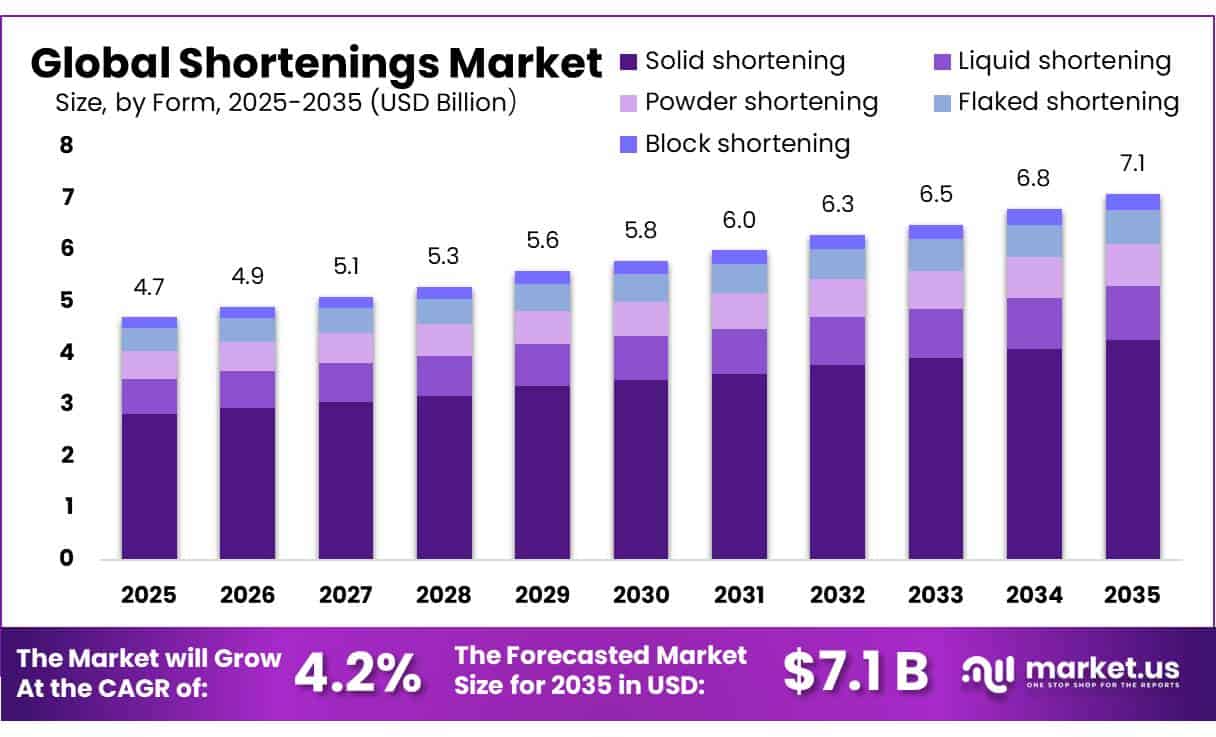
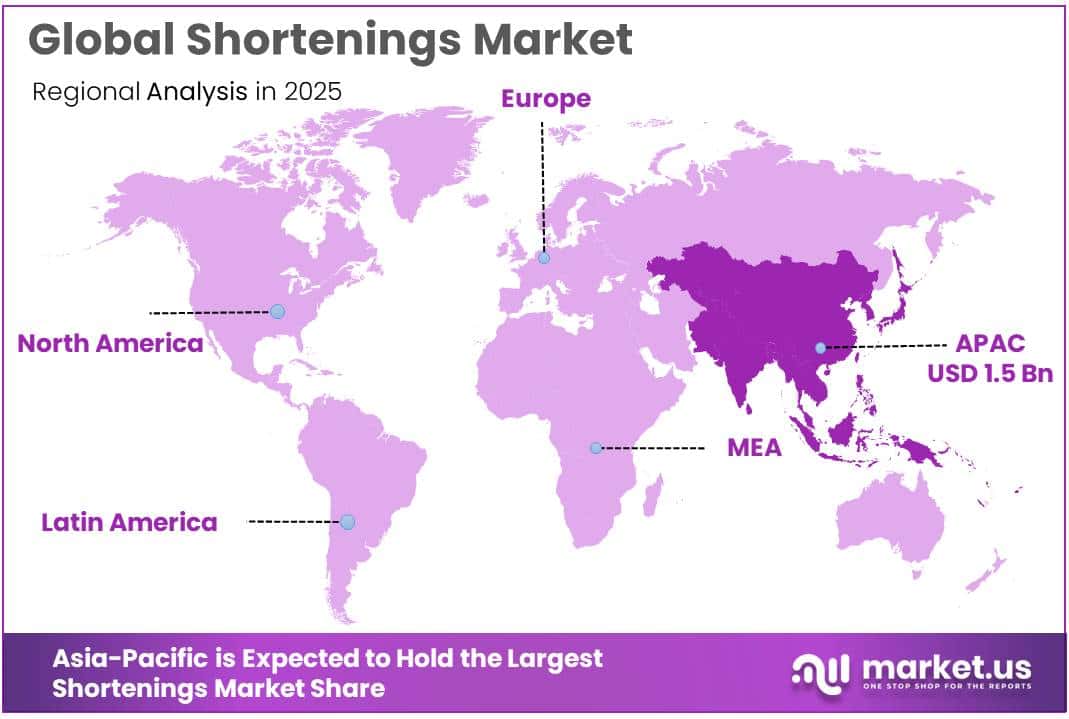
The Global Shortenings Market size is expected to be worth around USD 7.1 Billion by 2035, from USD 4.7 Billion in 2025, growing at a CAGR of 4.2% during the forecast period from 2026 to 2035. In 2025, Asia-Pacific held a dominant market position, capturing more than a 32.40% share, holding USD 1.5 Billion revenue.
Shortenings are semi-solid or solid fats widely used in the food processing industry to improve texture, softness, moisture retention, and product stability. They are primarily manufactured from vegetable oils such as soybean, palm, canola, sunflower, and cottonseed oils through processes such as hydrogenation, fractionation, and blending. Shortenings play an important role in bakery products, confectionery, snacks, ready-to-eat meals, and commercial food preparation.
- The industrial scenario is closely connected to the global availability of oilseeds and edible oils. According to the United States Department of Agriculture (USDA), global soybean oil production is projected to reach 74.7 million metric tons in 2026/27, representing an increase of 2.9 million metric tons from the previous marketing year. Global soybean oil consumption is also forecast to increase by approximately 3%, reaching nearly 73 million metric tons. This expanding supply and consumption base supports the availability of essential raw materials for shortening manufacturers.
Another important development is the increasing focus on healthier fat formulations. Regulatory changes have encouraged manufacturers to move away from partially hydrogenated oils and develop alternatives with improved nutritional profiles. The United States Food and Drug Administration (FDA) determined in 2015 that partially hydrogenated oils were no longer generally recognized as safe for use in human food. The compliance deadline for most uses was June 18, 2018, while the final compliance period for certain products extended to January 1, 2021.
Raw-material price fluctuations remain a major consideration for shortening producers. Changes in soybean, palm, sunflower, and canola oil availability can influence production costs, pricing strategies, and profit margins. The OECD and Food and Agriculture Organization (FAO) reported that global soybean production in 2025/26 was expected to remain close to a record 430 million metric tons, supported by higher production in Brazil. However, vegetable oil prices remained firm because of relatively tight supply conditions.
Leading agricultural ingredient companies are also strengthening their capabilities in oilseed processing, refining, and specialty ingredients. In its 2025 Annual Report, Bunge reported that its business combination with Viterra generated more than USD 70 million in cost synergies by the end of 2025. The company also reported 95.7% global palm oil traceability to plantation, reflecting increasing attention to supply-chain transparency and sustainable sourcing.
Key Takeaways
- Shortenings Market size is expected to be worth around USD 7.1 Billion by 2035, from USD 4.7 Billion in 2025, growing at a CAGR of 4.2%.
- Vegetable-based held a dominant market position, capturing more than a 72.40% share.
- Solid shortening held a dominant market position, capturing more than a 60.00% share.
- Fractionation held a dominant market position, capturing more than a 28.00% share.
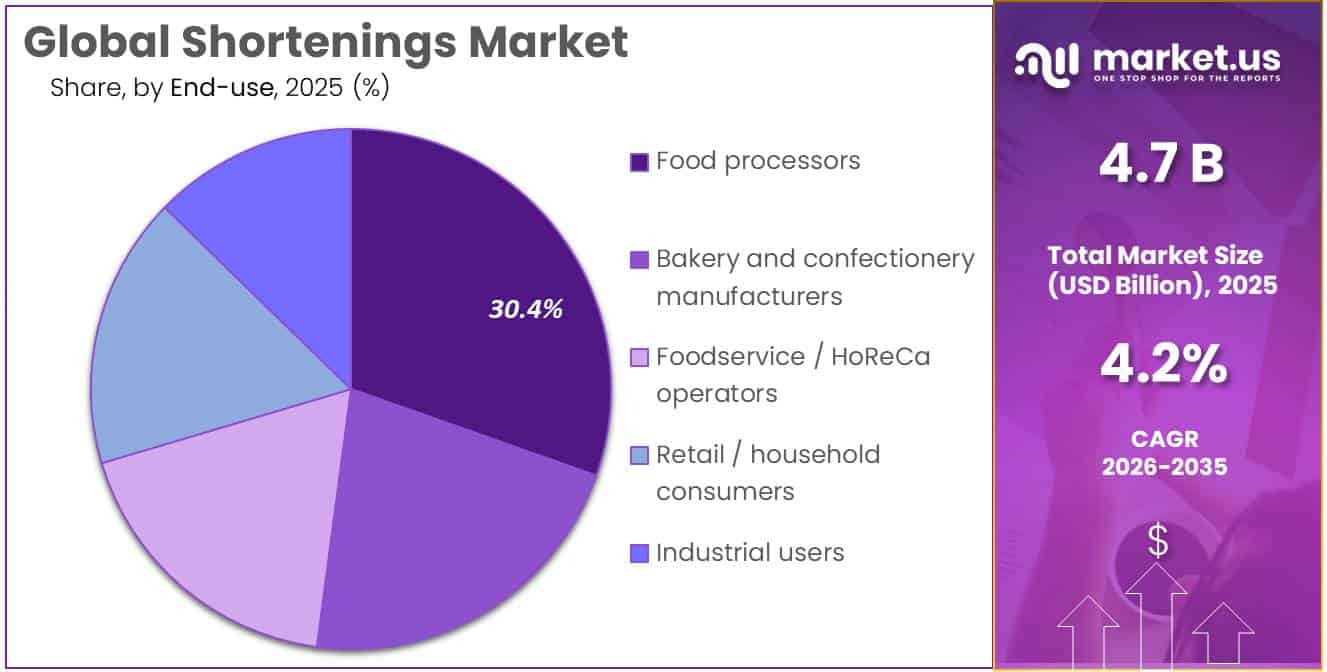
- Food processors held a dominant market position, capturing more than a 30.00% share.
- Direct sales / B2B held a dominant market position, capturing more than a 32.00% share.
- Asia-Pacific held the dominant position in the global shortenings market in 2025, accounting for 32.40% of the market, with a reported value of USD 1.5 billion.
By Source Analysis
Vegetable-Based Shortenings Dominate Due to Their Wide Application in Commercial Baking and Processed Food Manufacturing
In 2025, “Vegetable-based” held a dominant market position, capturing more than a 72.40% share. This dominance was supported by the wide use of vegetable oils in bakery products, confectionery, packaged snacks, and commercial food preparation. Vegetable-based shortenings are commonly produced using palm, soybean, canola, sunflower, and other edible oils. Their ability to provide consistent texture, plasticity, moisture retention, and baking performance makes them suitable for large-scale food manufacturing. Food processors also prefer these formulations because they can be customized for different applications, including cakes, biscuits, pastries, and fried products.
Raw-material availability also supports this segment’s position. According to the USDA Economic Research Service, global soybean oil production for the 2026/27 marketing year is forecast to increase by 2.9 million metric tons, reaching 74.7 million metric tons. Global soybean oil consumption is projected to rise by 3%, reaching nearly 73 million metric tons. These developments support the supply of vegetable oils used in shortening production and provide manufacturers with opportunities to expand food-grade specialty fat formulations.
According to the USDA National Agricultural Statistics Service, U.S. edible tallow production reached 1,069.394 million pounds in 2025, while lard production stood at 311.576 million pounds. These figures demonstrate the continued availability of animal-derived fats for food and processing applications. However, demand for animal-based shortenings remains influenced by dietary preferences, raw-material costs, and the growing use of vegetable-based alternatives.
By Form Analysis
Solid Shortening Dominates Due to Its Stability, Texture, and Wide Use in Bakery Applications
In 2025, “Solid shortening” held a dominant market position, capturing more than a 60.00% share. Its leading position is supported by its extensive use in commercial baking, confectionery, biscuits, cookies, pastries, and other processed food products. Solid shortening provides the plasticity and structure required to produce flaky pastry layers, soft baked goods, and consistent product textures. Its ability to retain shape at room temperature also makes it suitable for storage, handling, and large-scale food manufacturing.
Liquid shortening is widely used in commercial food manufacturing, particularly in frying operations, bakery production, foodservice kitchens, and packaged food processing. Its fluid consistency allows easy pumping, mixing, storage, and automated handling, making it suitable for high-volume manufacturing facilities. Food processors use liquid shortening in applications where consistent fat distribution and smooth blending are important. It also helps reduce handling requirements compared with solid fat formats, supporting operational efficiency in industrial production.
According to the USDA Economic Research Service, U.S. vegetable oil production is projected to reach 42,464 million pounds in 2026/27, compared with 40,253 million pounds in 2025/26. This expanding vegetable oil supply supports the availability of raw materials for liquid shortening manufacturers. However, these figures represent vegetable oil production and do not measure liquid shortening output directly.
By Processing Method Analysis
Fractionation Dominates Through Its Ability to Produce Stable Fats with Application-Specific Melting Properties
In 2025, “Fractionation” held a dominant market position, capturing more than a 28.00% share. Its leading position is supported by its ability to separate vegetable oils and fats into fractions with different melting points and functional properties. This process allows shortening manufacturers to develop fats suited to specific food applications, including biscuits, pastries, cakes, confectionery, and commercial frying. Fractionation is particularly useful in producing solid and semi-solid fat ingredients without relying entirely on chemical modification. Food manufacturers value this method because it helps achieve the required texture, consistency, and performance in finished products.
The segment also benefits from food manufacturers’ efforts to improve fat stability and develop products with specific melting characteristics. Fractionation allows processors to separate oils into different components without necessarily changing their chemical structure. This makes it useful for producing specialized fats for bakery fillings, creams, coatings, and other food applications. The U.S. Food and Drug Administration’s regulatory assessment of changes involving partially hydrogenated oils estimated benefits of USD 652 million over a 20-year period, based on a reduction in potential coronary heart disease cases.
In 2015, the U.S. FDA determined that partially hydrogenated oils were no longer generally recognized as safe for use in human food. The final compliance deadline for affected products was January 1, 2021. This regulatory change encouraged shortening producers to reformulate products and adopt improved fat-processing methods. Importantly, the restriction applies to partially hydrogenated oils, not all hydrogenation processes.
By End User Analysis
Food Processors Lead Demand Through Large-Scale Production of Packaged and Convenience Foods
In 2025, “Food processors” held a dominant market position, capturing more than a 30.00% share. The segment’s leading position is supported by the extensive use of shortenings in packaged foods, ready-to-eat products, snacks, bakery ingredients, and other processed food applications. Food processors use shortenings to improve product texture, maintain moisture, support consistent processing, and extend the functional stability of finished products.
Bakery and confectionery manufacturers represent an important end-user group for shortenings because these ingredients directly influence the texture, softness, flakiness, and overall quality of finished products. Shortenings are widely used in cakes, biscuits, cookies, pastries, doughnuts, pie crusts, chocolates, and confectionery fillings. They help improve dough handling, provide a smooth mouthfeel, and maintain consistency during large-scale production. The increasing demand for packaged bakery products, frozen desserts, and ready-to-eat confectionery products supports the use of specialized shortening formulations.
According to the U.S. Census Bureau’s 2024 Annual Integrated Economic Survey, the bakeries and tortilla manufacturing industry recorded approximately USD 90.33 billion in sales, value of shipments, or revenue. The sugar and confectionery product manufacturing industry recorded approximately USD 47.08 billion during the same year. These figures demonstrate the substantial industrial activity across bakery and confectionery manufacturing, supporting the demand for functional ingredients such as shortenings.
By Distribution Channel Analysis
Direct Sales / B2B Leads Distribution Through Bulk Supply and Strong Relationships with Food Manufacturers
In 2025, “Direct sales / B2B” held a dominant market position, capturing more than a 32.00% share. Its leading position is supported by the regular procurement of shortenings by large food processors, commercial bakeries, confectionery manufacturers, and industrial food production facilities. Direct sales allow shortening manufacturers to supply products in bulk quantities while maintaining control over pricing, product specifications, delivery schedules, and customer requirements. This channel also supports long-term supply agreements and customized formulations for specific food applications.
Distributors and wholesalers play an important role in the shortenings market by connecting manufacturers with commercial bakeries, food processors, restaurants, confectionery producers, and smaller food businesses. They purchase shortening products in bulk and supply them in different packaging formats according to customer requirements. This channel helps manufacturers expand their geographical reach without establishing direct sales operations in every market. Distributors also support product storage, inventory management, transportation, and timely deliveries.
The importance of wholesale distribution is also reflected in official U.S. trade statistics. According to the U.S. Census Bureau, merchant wholesalers recorded USD 698.5 billion in sales in June 2025, representing a 5.5% increase compared with June 2024. This indicates continued activity across wholesale distribution networks and highlights the importance of bulk procurement and inventory management. For shortening suppliers, established distributors and wholesalers provide opportunities to reach a wider customer base, improve regional product availability, and support regular deliveries to food manufacturing businesses.
Key Market Segments
By Source
- Vegetable-based
- Animal-based
- Blended / mixed-source
By Form
- Solid shortening
- Liquid shortening
- Powder shortening
- Flaked shortening
- Block shortening
By Processing Method
- Fractionation
- Hydrogenation
- Interesterification
- Edible-oil blending / processing
By End User
- Food processors
- Bakery and confectionery manufacturers
- Foodservice / HoReCa operators
- Retail / household consumers
- Industrial users
By Distribution Channel
- Direct sales / B2B
- Distributors and wholesalers
- Supermarkets and hypermarkets
- Convenience stores
- Speciality stores
- Online retail
- Other retail channels
Driver Analysis
Emerging-Market Bakery Throughput
Additional production of biscuits, cookies and other shortening-using baked foods increases ingredient demand through a direct relationship between output and recipe inclusion, particularly where branded manufacturers expand distribution and manufacturing utilization. Recent evidence supports a geographically differentiated case rather than a universal bakery boom: Mondelēz’s November 2026 reporting showed third-quarter Asia, Middle East and Africa growth supported by a 5.5-percentage-point volume/mix contribution, with India and Southeast Asia among the stronger contributors.
However, volume/mix is not physical tonnage, the company sells products beyond bakery, and its full-year 2025 biscuits-and-baked-snacks revenue growth was only 0.8%, with soft US biscuit consumption. These disclosures therefore indicate selected demand momentum—not an equivalent growth rate for shortenings.
In an illustrative biscuit manufacturing portfolio producing 100,000 tonnes annually, a 12% shortening inclusion rate requires 12,000 tonnes of shortening; increasing finished-product output by 5% adds 600 tonnes if recipes remain unchanged. At an assumed constant $1,500/tonne, that represents $900,000 of additional ingredient revenue, excluding price inflation. Suppliers capture value through reliable plant supply, approved recipe performance and distribution coverage rather than finished-product sales growth alone.
The +0.8 pp contribution assumes 20% revenue exposure grows 4 percentage points faster through additional shortening-using bakery output; it excludes recipe conversions and specialty premiums assigned to the following drivers.
Drivers Impact Analysis
| Driver | (~) % Impact on CAGR Forecast | Geographic Relevance | Impact Timeline |
|---|---|---|---|
| Emerging-market bakery throughput | +0.8 pp | India, China, Southeast Asia, Brazil | Medium term (2–4 years) |
| Trans-fat-compliant reformulation | +0.6 pp | South Asia, Middle East, Latin America | Short term (≤ 2 years) |
| Butter-replacement formulations | +0.5 pp | EU, UK, US, Middle East | Short term (≤ 2 years) |
| Production-line performance upgrades | +0.5 pp | US, EU, China, India | Short term (≤ 2 years) |
| Lower-saturated-fat specialty blends | +0.4 pp | EU, UK, US, Australia | Medium term (2–4 years) |
Restraint Analysis
Feedstock Affordability Squeeze
Elevated vegetable-oil costs constrain shortening purchases when bakeries cannot pass ingredient inflation through to consumers and instead reduce production, simplify recipes or draw down inventories. FAO’s November 2026 release places its October Vegetable Oil Price Index at 199.2 points, up 0.3% month on month and 16.7% year on year; soybean-oil quotations reached their highest levels since late 2022, supported partly by biofuel demand, while palm-oil prices remained well above year-earlier levels. These are international commodity indicators, not equivalent increases in every shortening supplier’s delivered cost or selling price.
In an illustrative producer’s cost structure, feedstock represents 80% of a $1,200/tonne manufacturing cost. A hypothetical 15% increase in feedstock cost adds $144/tonne; if a fixed customer price remains $1,400/tonne, gross contribution before other expenses falls from $200 to $56/tonne, a 72% reduction. Full pass-through would instead raise the selling price by approximately 10.3%, potentially reducing customer purchases, but that demand response requires evidence rather than assuming a universal elasticity.
Suppliers therefore face a choice between margin compression and volume risk, making indexed contracts and tighter credit allocation commercially important. The −0.5 pp deduction assumes 20% revenue exposure grows 2.5 percentage points more slowly through affordability-driven purchasing reductions and rejected orders—not simply because oil prices rise. Routine procurement volatility and hedging execution are ongoing challenges and are excluded from this restraint.
Restraint Impact Analysis
| Restraint | (~) % Impact on CAGR Forecast | Geographic Relevance | Impact Timeline |
|---|---|---|---|
| Feedstock affordability squeeze | −0.5 pp | India, Southeast Asia, Middle East, Africa | Short term (≤ 2 years) |
| Mature-market bakery weakness | −0.4 pp | US core; Canada spill-over | Short term (≤ 2 years) |
| Lower-fat recipe reformulation | −0.3 pp | EU, UK, US, Australia | Medium term (2–4 years) |
| Liquid-oil substitution | −0.3 pp | EU, US, Japan, South Korea | Medium term (2–4 years) |
| Specialty-premium rejection | −0.2 pp | India, Southeast Asia, Latin America | Short term (≤ 2 years) |
Opportunity Analysis
Flaked-Fat Adjacent Applications
Flaked shortening can expand supplier participation in pizza, refrigerated dough and dry-mix applications where conventional shortening formats are inconvenient or where current recipes rely on other fat systems. AAK’s November 2024 application guidance describes replacing an 8% solid-fat inclusion with 5% conventional solid fat and 3% flaked fat, incorporating flakes near the end of mixing, and using different flake characteristics for thick- and thin-crust pizza. Its claimed shrinkage reduction of up to 43% is a supplier application result—not a universal improvement or an assumed market adoption rate.
The opportunity is incremental qualification in previously unserved applications and separately valuable formats, not routine bakery-volume growth or relabelling existing shortening sales. In an illustrative 50,000-tonne annual pizza-dough program, a 3% flake inclusion creates 1,500 tonnes of flaked-product demand. If all of it replaces an existing shortening, physical market volume does not increase; at an assumed sustainable $150/tonne format premium, incremental mix value is $225,000.
If instead 30% displaces an out-of-scope fat and meets the shortening definition, only 450 tonnes qualify as additional shortening volume. Suppliers need validated flake size, melting behaviour, handling stability and production trials, especially where distribution temperature can damage the format. The +0.30 pp contribution assumes 6% revenue exposure grows 5 percentage points faster through net-new applications and defensible product-mix value, excluding already adopted flaked-fat programs.
Opportunity Impact Analysis
| Opportunity | (~) % Potential CAGR Upside | Geographic Relevance | Execution Window |
|---|---|---|---|
| Flaked-fat adjacent applications | +0.30 pp | US, EU, Japan, South Korea | Short term (≤ 2 years) |
| Commercial oleogel shortenings | +0.25 pp | EU, US, India, Japan | Medium term (2–4 years) |
| Gluten-free formulation platforms | +0.25 pp | US, EU, Australia | Medium term (2–4 years) |
| Regional application partnerships | +0.20 pp | India, Indonesia, Vietnam, Africa | Short term (≤ 2 years) |
| Outcome-priced supply contracts | +0.20 pp | EU, US, India, Latin America | Short term (≤ 2 years) |
Challenges Analysis
Crystallization and Tempering Consistency
Shortening performance depends on the crystal network created during cooling, mechanical working and maturation, meaning an acceptable oil-blend composition does not by itself guarantee repeatable plasticity or aeration. SPX FLOW’s process guidance describes rapid crystallization in scraped-surface heat exchangers followed by pin-rotor working and, for its illustrated in-house configuration, two to four hours of tempering; Alfa Laval separately identifies temperature stability of approximately ±1–2°C as important for smooth processing in yellow-fat production.
In an illustrative line producing five tonnes/hour, a three-hour maturation requirement implies approximately 15 tonnes of working inventory before allowances for tank segregation and operating reserve. Increasing throughput to six tonnes/hour without increasing that inventory reduces nominal residence time to 2.5 hours, potentially changing consistency unless validated. If a hypothetical 50,000-tonne annual producer reduces off-spec output from 2% to 1%, it avoids reprocessing 500 tonnes; at an assumed $100/tonne incremental rework cost, direct savings are $50,000 before capacity and customer-service effects.
Suppliers need blend-specific cooling curves, monitored working conditions and release tests linked to functional performance rather than melting point alone. The −0.30 pp contribution assumes 15% revenue exposure grows two percentage points more slowly through rework, inconsistent qualification results and reduced effective capacity; reprocessed product is not automatically treated as permanently lost sales.
Challenges Impact Analysis
| Challenge | (~) % CAGR Friction | Geographic Relevance | Mitigation Horizon |
|---|---|---|---|
| Crystallization and tempering consistency | −0.30 pp | US, EU, India, China | Medium term (2–4 years) |
| Distribution-temperature texture drift | −0.25 pp | South Asia, Southeast Asia, Gulf, Africa | Medium term (2–4 years) |
| Oxidative shelf-life validation | −0.20 pp | US, EU, Japan, Australia | Long term (≥ 4 years) |
| Cross-line application transfer | −0.20 pp | EU, US, India, Latin America | Medium term (2–4 years) |
| Multi-SKU production scheduling | −0.15 pp | US, EU, China, Southeast Asia | Medium term (2–4 years) |
Geopolitical Impact Analysis
Geopolitical Impact of Ongoing Wars on the Shortenings Market
The ongoing Russia-Ukraine conflict and tensions in the Middle East continue to create uncertainty for the global shortenings market, particularly through their effects on vegetable oil supplies, energy costs, and international shipping. Russia and Ukraine are important suppliers of sunflower oil, while disruptions in Black Sea trade routes can affect export availability and increase procurement costs for food ingredient manufacturers. Higher freight, fuel, insurance, and packaging expenses can also raise shortening production costs.
The impact is also visible in energy and transportation costs. According to the U.S. Energy Information Administration (EIA), Brent crude oil averaged USD 124 per barrel in October 2026, increasing by USD 10 per barrel compared with September. The EIA linked the increase partly to attacks on oil tankers and disruptions to shipping routes. Higher energy and freight expenses can increase the cost of transporting vegetable oils, operating processing facilities, and distributing finished shortening products.
As a result, shortening manufacturers may focus on diversifying oil suppliers, maintaining larger raw-material inventories, and developing alternative vegetable oil blends. These measures can help reduce supply risks, control production costs, and maintain consistent deliveries. Continued geopolitical uncertainty is likely to make procurement planning and supply-chain flexibility important factors for the industry’s performance.
Regional Insights
Asia-Pacific: Dominating Region with a 32.40% Market Share
Asia-Pacific held the dominant position in the global shortenings market in 2025, accounting for 32.40% of the market, with a reported value of USD 1.5 billion. The region’s position is supported by its large food processing base, growing commercial bakery sector, and strong availability of vegetable oil raw materials. China, Japan, Indonesia, Malaysia, and other regional economies contribute to demand through packaged bakery products, confectionery, snacks, and industrial food manufacturing.
According to the USDA’s May 2026 Oil Crops Outlook, global palm oil production was forecast at approximately 80 million metric tons for 2025/26, with Indonesia and Malaysia supporting production growth. The availability of palm and soybean oils provides an important raw-material base for regional shortening manufacturers.
According to the USDA Foreign Agricultural Service, China’s vegetable oil production for the 2025/26 marketing year was forecast to reach 31.9 million metric tons, representing an increase of nearly 6% from 30.1 million metric tons in 2024/25. Its food consumption of vegetable oils was projected to reach 36.0 million metric tons, increasing by 1.7% year over year. These developments support opportunities for shortening manufacturers supplying bakery, confectionery, and packaged food producers.
Key Regions and Countries Insights
- North America
- US
- Canada
- Europe
- Germany
- France
- The UK
- Spain
- Italy
- Rest of Europe
- Asia Pacific
- China
- Japan
- South Korea
- India
- Australia
- Rest of APAC
- Latin America
- Brazil
- Mexico
- Rest of Latin America
- Middle East & Africa
- GCC
- South Africa
- Rest of MEA
Key Players Analysis
Cargill maintains a strong position in the shortenings market through its edible oils, specialty fats, and food ingredient businesses. The company supplies fat solutions for bakery, confectionery, and food processing applications, with a focus on product consistency and improved nutritional profiles. In its 2025 annual report, Cargill reported revenue of USD 154 billion. It also highlighted that it had removed industrially produced trans-fatty acids from its entire edible oils portfolio, strengthening its focus on reformulated fat ingredients and customer requirements.
ADM strengthens its position in the shortenings market through its oilseed processing, edible oils, and specialty food ingredient operations. Its products support bakery, confectionery, and industrial food manufacturing applications. In 2025, ADM reported total revenue of USD 80.269 billion, while its Ag Services and Oilseeds segment generated USD 61.571 billion in revenue. The company also processed 36.324 million metric tons of oilseeds during the year, demonstrating its large-scale raw-material processing capabilities. These operations support its ability to serve global food ingredient customers.
Bunge Limited maintains a significant presence in the shortenings market through its oilseed processing, edible oils, refining, and specialty fats operations. The company supplies vegetable oil ingredients used across bakery, confectionery, and food manufacturing applications. In 2025, Bunge’s Other Oilseeds Processing and Refining segment recorded net sales of USD 4.633 billion, with processed volumes of 2.467 million metric tons. Its segment earnings before interest and taxes reached USD 118 million. These operations strengthen its position in vegetable oil sourcing, refining, and specialty fat supply for food manufacturers.
Top Key Players Outlook
- Cargill, Incorporated
- Archer Daniels Midland Company (ADM)
- Bunge Limited
- Wilmar International Limited
- AAK AB
- IFFCO Group
- Fuji Oil Holdings Inc.
- Olenex Sàrl
- Manildra Group
- Ventura Foods, LLC
- Associated British Foods plc (ABF)
- Conagra Brands, Inc. / Conagra Foodservice
- COFCO Group Co., Ltd.
- Namchow Holdings Co., Ltd.
- Palsgaard A/S
Recent Developments
- In March 2026, Wilmar reported FY2025 revenue of USD 70.416 billion and net profit of USD 1.411 billion. Its Food Products segment generated USD 30.89 billion in revenue, supported by vegetable oils, specialty fats, bakery, and other food products.
- IFFCO also benefits from an integrated vegetable oil supply chain with annual refining capacity exceeding 600,000 tonnes and storage capacity of 35,000 tonnes.
Report Scope
| Report Features | Description |
|---|---|
| Market Value (2025) | USD 4.7 Bn |
| Forecast Revenue (2035) | USD 7.1 Bn |
| CAGR (2026-2035) | 4.2% |
| Base Year for Estimation | 2025 |
| Historic Period | 2020-2024 |
| Forecast Period | 2026-2035 |
| Report Coverage | Revenue Forecast, Market Dynamics, Competitive Landscape, Recent Developments |
| Segments Covered | By Source (Vegetable-based, Animal-based, Blended / mixed-source), By Form (Solid shortening, Liquid shortening, Powder shortening, Flaked shortening, Block shortening), By Processing Method (Fractionation, Hydrogenation, Interesterification, Edible-oil blending / processing), By End User (Food processors, Bakery and confectionery manufacturers, Foodservice / HoReCa operators, Retail / household consumers, Industrial users), By Distribution Channel (Direct sales / B2B, Distributors and wholesalers, Supermarkets and hypermarkets, Convenience stores, Speciality stores, Online retail, Other retail channels) |
| Regional Analysis | North America – US, Canada; Europe – Germany, France, The UK, Spain, Italy, Rest of Europe; Asia Pacific – China, Japan, South Korea, India, Australia, Singapore, Rest of APAC; Latin America – Brazil, Mexico, Rest of Latin America; Middle East & Africa – GCC, South Africa, Rest of MEA |
| Competitive Landscape | Cargill, Incorporated, Archer Daniels Midland Company (ADM), Bunge Limited, Wilmar International Limited, AAK AB, IFFCO Group, Fuji Oil Holdings Inc., Olenex Sàrl, Manildra Group, Ventura Foods, LLC, Associated British Foods plc (ABF), Conagra Brands, Inc. / Conagra Foodservice, COFCO Group Co., Ltd., Namchow Holdings Co., Ltd., Palsgaard A/S |
| Customization Scope | Customization for segments, region/country-level will be provided. Moreover, additional customization can be done based on the requirements. |
| Purchase Options | We have three licenses to opt for: Single User License, Multi-User License (Up to 5 Users), Corporate Use License (Unlimited User and Printable PDF) |