


Report Overview
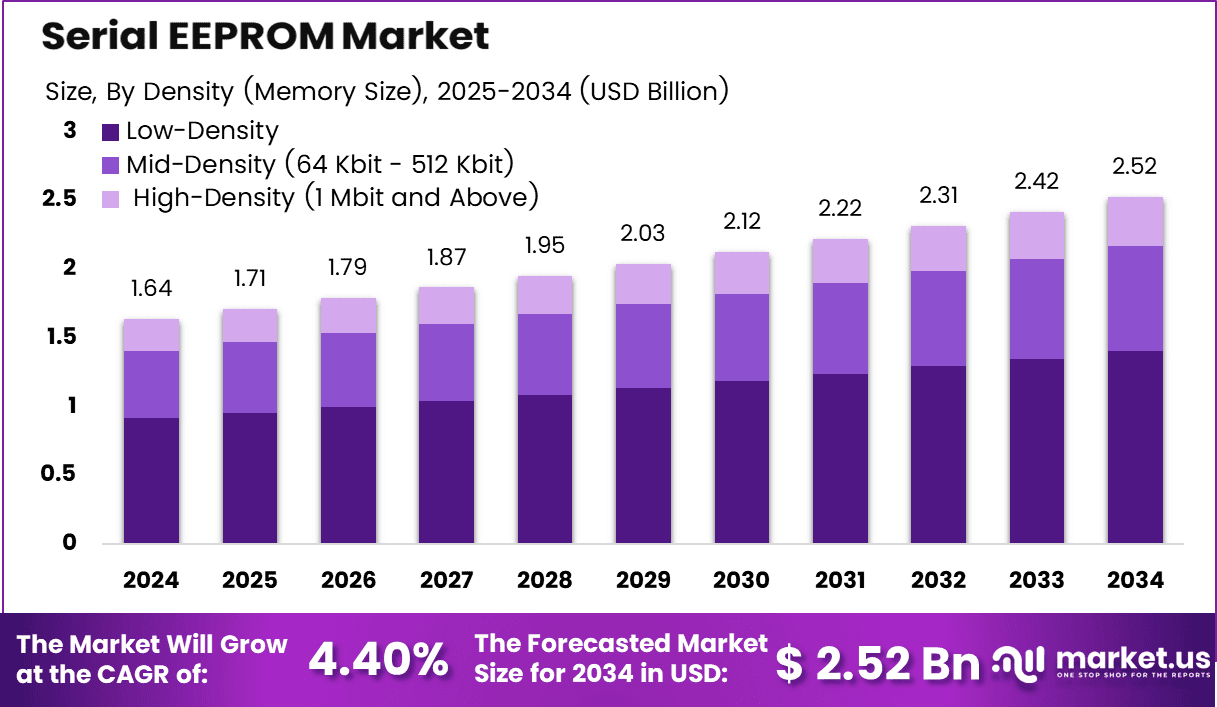
In 2024, the Global Serial EEPROM Market was valued at USD 1.6 billion. The market is projected to grow at a CAGR of 4.4% during 2025–2034, reaching approximately USD 2.5 billion by 2034. Asia-Pacific dominated the global market in 2024, accounting for the total market share and generating approximately USD 0.63 billion in revenue.
Automotive and factory automation are major demand drivers. Global vehicle production reached 92.7 million units in 2024, while 542,000 new industrial robots were installed worldwide in 2024. Vehicles, robot controllers, motor drives, sensors, and machine tools all require memory devices that retain operating data after shutdown.
Asia accounted for 74% of new industrial robot deployments in 2024. China installed 295,000 robots, Japan added 44,500, South Korea installed 30,600, and India reached a record 9,100 installations. This strong automation base supports steady Serial EEPROM demand across consumer and industrial applications.
Key Takeaways
- The Global Serial EEPROM Market is valued at USD 1.64 billion in 2024 and is projected to reach USD 2.52 billion by 2034, growing at a CAGR of 4.4%, indicating stable long-term expansion.
- Low-density EEPROMs (1 Kbit–64 Kbit) lead the market with a 55.8% share, primarily used in portable devices, wearables, and embedded systems requiring minimal data storage.
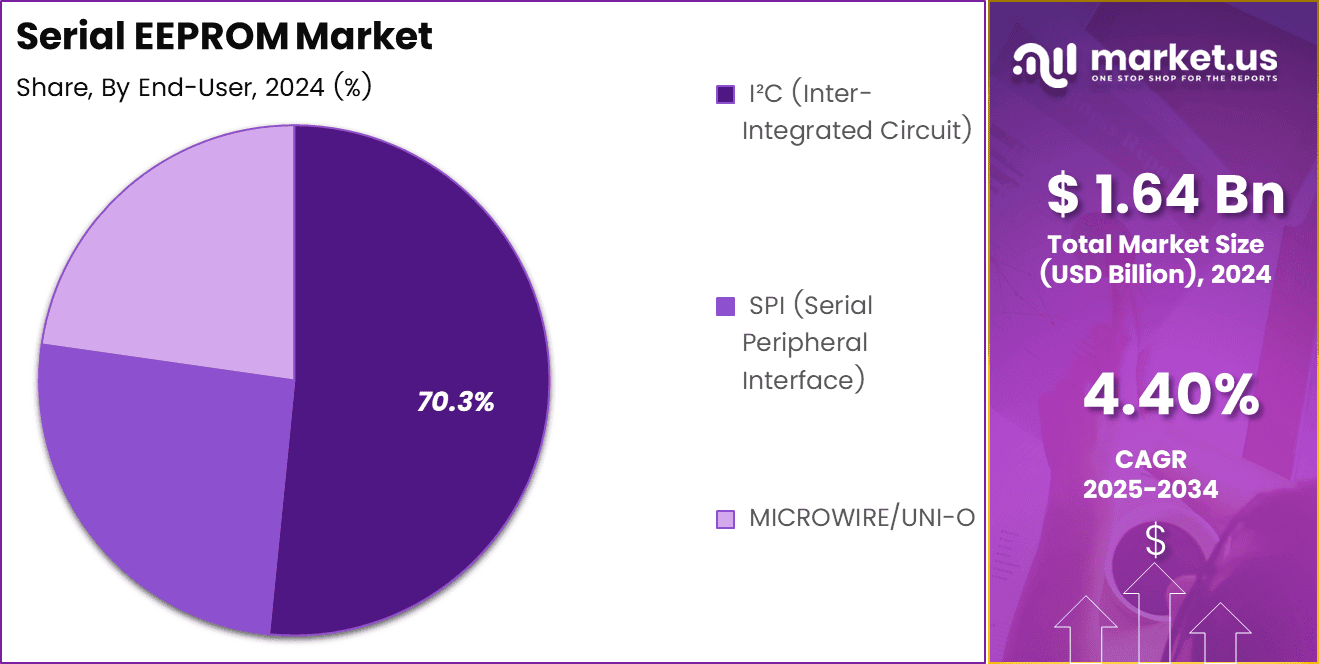
- I²C interface accounts for 70.3% of total adoption, attributed to its two-wire simplicity and compatibility with multi-controller embedded applications.
- Consumer electronics represent the largest end-use segment, 30.1%, driven by increasing use in smart home devices, TVs, and wearable gadgets.
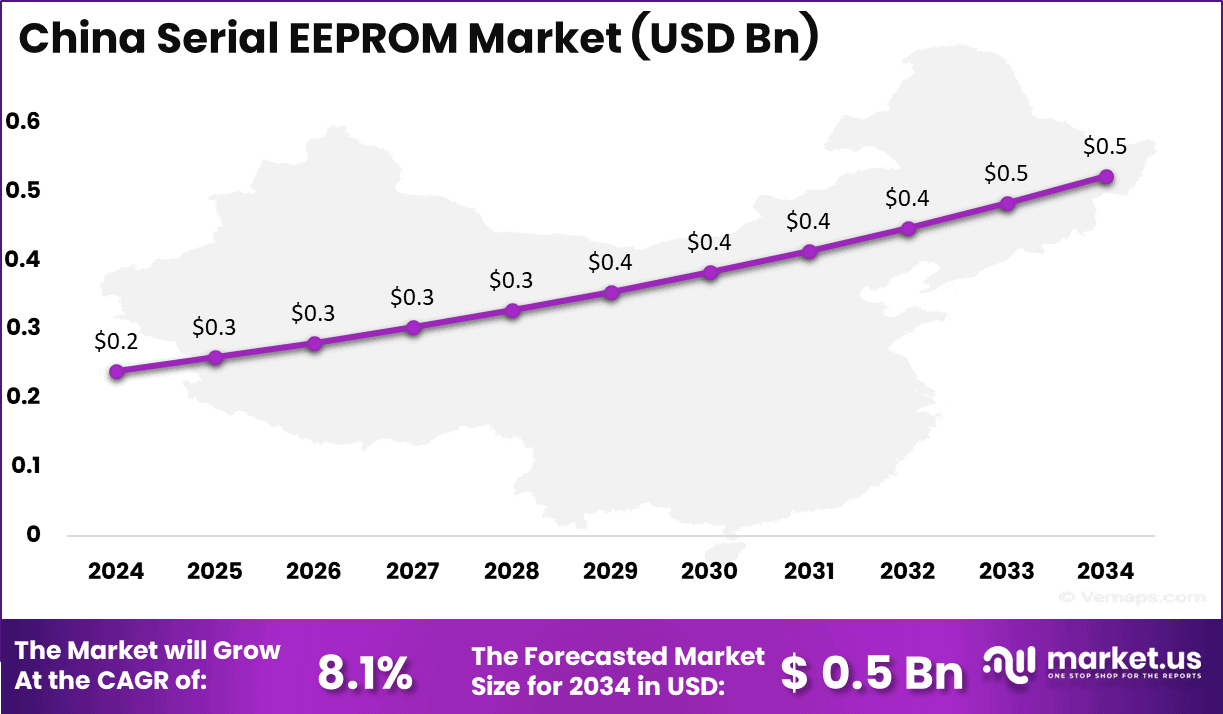
- In China, the market is expected to increase from USD 0.2 billion in 2024 to USD 0.5 billion by 2034, with a strong 8.1% CAGR, driven by its expanding semiconductor ecosystem and automotive electronics demand.
Role of Generative AI
Generative AI is playing an emerging role in optimizing the Serial EEPROM market across design, manufacturing, and supply chain operations. In product development, AI-driven simulation tools accelerate chip architecture design by predicting power consumption, endurance, and failure probabilities, reducing development time by nearly 25–30%.
Generative algorithms assist engineers in exploring multiple design iterations, improving data retention and performance consistency. In manufacturing, AI models enhance yield optimization by detecting micro-defects in wafers and predicting process deviations, improving production efficiency by around 18%. Generative AI also supports predictive maintenance in semiconductor fabs and automates data-driven quality testing.
Moreover, in market forecasting, AI-driven analytics evaluate demand patterns across industries like automotive and IoT, enabling manufacturers to align output with emerging requirements. Overall, Generative AI strengthens operational agility, design precision, and sustainability within the evolving Serial EEPROM ecosystem.
By Density (Memory Size)
Low-Density (1 Kbit – 64 Kbit) dominates with 55.8% due to cheap, mature-node storage for simple settings.
Low-density parts win because most electronic products only need to store a few small settings, such as calibration values, serial numbers, or user preferences. Chip makers build these tiny devices on mature process lines, so prices stay very low and supply stays steady even when demand jumps.
Scale helps too: global chip sales reached $791.7 billion in 2025, a 25.6% rise over 2024, and that broad build-out pulls millions of cheap 1 Kbit to 64 Kbit parts into printers, chargers, sensors, and small appliances.
High-density options above 1 Mbit now grow fastest because equipment must log far more data than before. Utility grids show the shift clearly, with the worldwide smart power meter base passing 1 billion units in 2022, ten times the 2010 level. Each meter keeps long usage records, tamper logs, and firmware settings, so designers pick larger memory.
By Interface
I²C dominates with 70.3% due to two-wire buses saving processor pins.
Designers reach for I²C first because two wires carry both clock and data, and one bus can hold many chips at different addresses. That saves pins on the main processor, shrinks the board, and lowers wiring cost, a big deal in phones, set-top boxes, and hearables shipping in huge numbers.
Demand scale is visible in telecom data: the world counted 9.1 billion mobile-cellular subscriptions in 2024, roughly 112 for every 100 people, and each handset, router, and camera module carries small configuration memory on an I²C line. SPI now climbs faster because engineers need speed, not just simplicity.
SPI moves data on separate lines, so it writes and reads far quicker, which suits code storage, sensor fusion, and safety logs. Supplier mix supports this trend, as Microchip earned 51.1% of fiscal 2025 net sales from mixed-signal microcontrollers, the exact hosts that pair with fast SPI memory. Automotive and industrial teams also value simple SPI timing and clear error checks.
By End-Use Industry
Consumer Electronics dominates with 30.1% due to constant household device replacement cycles.
Consumer gadgets stay ahead simply because households buy and replace them constantly, and every unit hides a small memory chip for settings, pairing keys, or display calibration. The scale of that turnover appears in waste data: the world threw away a record 62 million tonnes of electronic waste in 2022, 82% more than in 2010, which mirrors how many televisions, laptops, earbuds, and kitchen machines reach buyers each year.
Price pressure also fits this space, since brands want the cheapest reliable storage they can solder. Automotive demand rises quickest, though. Carmakers built 96.4 million vehicles in 2025, and new-energy models jumped 29% to 16.6 million units, each one packing many electronic modules, from battery packs and cameras to lighting and charging ports, that store trim data and fault records.
Key Market Segments
By Density (Memory Size)
- Low-Density (1 Kbit – 64 Kbit)
- Mid-Density (64 Kbit – 512 Kbit)
- High-Density (1 Mbit and Above)
By Interface
- I²C (Inter-Integrated Circuit)
- SPI (Serial Peripheral Interface)
- MICROWIRE/UNI-O
By End-Use Industry
- Consumer Electronics
- Automotive
- Industrial
- Telecommunications & Networking
- Medical
- Others
Investment and Business Benefit
The Serial EEPROM market presents a balanced investment opportunity with a return potential of 21–25% over the medium term, supported by consistent demand from automotive, industrial, and consumer electronics sectors. Around 38% of business value currently stems from Asia Pacific manufacturing clusters, where low-cost production and strong component integration drive profitability.
North America contributes 27% of overall investment attractiveness, driven by high-end industrial automation and EV expansion, while Europe accounts for 22%, benefiting from strong automotive OEM networks and digital factory initiatives.
From a business perspective, approximately 41% of new investments are directed toward high-endurance and temperature-tolerant EEPROMs used in electric vehicles and industrial systems. Consumer electronics applications represent 33% of value creation due to mass-market device integration.
Meanwhile, telecom and medical applications collectively generate around 14% of the market’s emerging value potential. Overall, investors see Serial EEPROM as a moderate-risk, high-stability segment, offering solid long-term returns through product innovation and automotive-linked growth momentum.
Regional Analysis
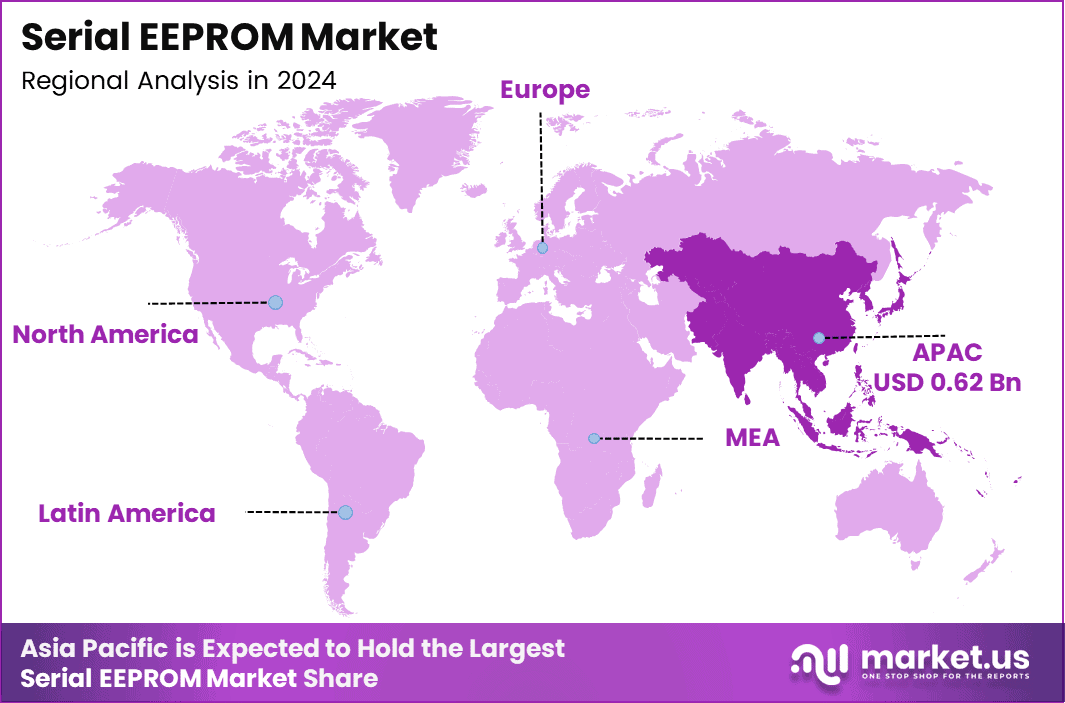
Asia Pacific (APAC) dominates the Serial EEPROM market, valued at USD 0.62 billion in 2024, primarily driven by rapid expansion in semiconductor manufacturing and consumer electronics production across China, Japan, South Korea, and Taiwan.
The region’s strong presence of OEMs, coupled with rising demand for IoT and automotive electronic components, contributes to sustained growth. Supportive government programs aimed at developing domestic chip production, such as China’s IC industry initiatives, are further accelerating market development.
North America holds a significant market share owing to the widespread integration of Serial EEPROMs in automotive, aerospace, and industrial control systems. The region benefits from established semiconductor design houses and the growing trend toward electric and connected vehicles.
US Market Size
In China, the Serial EEPROM market is projected to grow significantly from USD 0.2 billion in 2024 to USD 0.5 billion by 2034, expanding at a CAGR of 8.1%. The growth is primarily driven by the country’s expanding semiconductor manufacturing capacity, rising production of IoT-enabled consumer devices, and increasing adoption of smart automotive electronics.
A serial EEPROM is a non-volatile memory chip that retains stored data even when power is turned off. It is widely used in electronic systems for storing configuration parameters, identification codes, and calibration data, particularly in automotive, industrial automation, and consumer electronics sectors. The technology’s low power consumption, durability, and ability to perform byte-level erasing and reprogramming make it a preferred solution across embedded applications.
Key Regions and Countries
- North America
- US
- Canada
- Europe
- Germany
- France
- The UK
- Spain
- Italy
- Rest of Europe
- Asia Pacific
- China
- Japan
- South Korea
- India
- Australia
- Singapore
- Rest of Asia Pacific
- Latin America
- Brazil
- Mexico
- Rest of Latin America
- Middle East & Africa
- South Africa
- Saudi Arabia
- UAE
- Rest of MEA
Market Dynamics
Drivers
| Driver | (~) % Impact on CAGR Forecast | Geographic Relevance | Impact Timeline |
|---|---|---|---|
| Zonal automotive E/E architecture rollout | +1.2% | Global; led by China, Germany, Japan, US | Short term (2 years or less) |
| Smart utility endpoint and submetering deployment | +0.7% | EU, India, Brazil, US | Medium term (2 to 4 years) |
| Industrial sensor node and drive configuration storage | +0.6% | China, Japan, South Korea, Germany | Medium term (2 to 4 years) |
| Optical module and small-cell identity data | +0.4% | North America, APAC | Short term (2 years or less) |
| Battery pack and consumable authentication | +0.3% | China, EU, Southeast Asia | Short term (2 years or less) |
| Appliance firmware personalization at line-end | +0.3% | APAC, Latin America | Long term (4 years or more) |
Zonal automotive E/E architecture rollout
Vehicle electronics have moved from dozens of isolated ECUs to a small set of zonal controllers with many satellite modules, and each satellite still needs its own non-volatile store for trim data, pairing keys, and fault counters, which increases serial EEPROM sockets per vehicle rather than reducing them.
Global light and commercial vehicle output rose from roughly 92.7 million units in 2024 to about 96.4 million in 2025 per OICA production reporting, while new-energy vehicles expanded by nearly 29% to about 16.6 million units, and electrified platforms carry 2 to 3 times the module count of comparable combustion models according to ICCT registration and powertrain tracking.
The commercial consequence is a business-model shift from catalogue part supply to qualified long-life programs: AEC-Q100 Grade 0 and Grade 1 devices command roughly 25% to 40% price premiums over commercial grades, and multi-year LTA structures disclosed in analog and microcontroller suppliers’ annual reports and earnings calls convert what was spot demand into contracted revenue with visibility beyond 12 months, protecting gross margin during consumer cycle troughs.
Restraints
| Restraint | (~) % Impact on CAGR Forecast | Geographic Relevance | Impact Timeline |
|---|---|---|---|
| Section 232 semiconductor import duties | -0.9% | United States; import-dependent OEMs | Short term (2 years or less) |
| Embedded flash displacement inside MCUs | -0.7% | Global | Long term (4 years or more) |
| Elevated borrowing costs freezing OEM CapEx | -0.5% | EU, Latin America, Sub-Saharan Africa | Short term (2 years or less) |
| Distributor inventory overhang and price erosion | -0.4% | Greater China, Southeast Asia | Short term (2 years or less) |
| Export-control friction on cross-border design wins | -0.3% | US-China trade corridor | Medium term (2 to 4 years) |
Section 232 semiconductor import duties
The proclamation issued 14 January 2026 and effective 15 January 2026 applies a 25% ad valorem duty to defined semiconductor articles and derivative parts entering the United States, with duty drawback unavailable and foreign-trade-zone admissions forced into privileged foreign status, per US Customs and Border Protection filing guidance and the underlying Federal Register text.
The bottleneck is landed-cost arithmetic on low-ASP memory: a serial EEPROM selling for cents absorbs tariff, brokerage, and end-use certification overhead that can add 3 to 6 percentage points of fully loaded cost at the board level once derivative-parts scope captures populated assemblies, while the Commerce Department’s staged second phase signals further rate escalation.
Modelling from the Information Technology and Innovation Foundation places the first-year GDP drag of a blanket 25% semiconductor duty near 0.2%, and IMF trade-cost elasticities imply demand destruction concentrated in price-sensitive appliance and accessory programs.
Strategically, US-bound OEMs defer line requalification, freeze open orders for 2 to 3 quarters, and shift final assembly to exempt corridors, compressing distributor margins and reversing near-term unit sales rather than merely slowing them.
Challenges
| Challenge | (~) % CAGR Friction Drag | Geographic Relevance | Mitigation Horizon |
|---|---|---|---|
| Constrained 200mm mature-node capacity | -0.8% | Global; Taiwan, Japan, China fabs | Medium term (2 to 4 years) |
| Automotive qualification cycle length | -0.6% | Germany, Japan, US, Korea | Medium term (2 to 4 years) |
| Analog and test engineering shortage | -0.5% | US, EU, Japan | Long term (4 years or more) |
| Legacy package and substrate obsolescence | -0.4% | Global | Short term (2 years or less) |
| Counterfeit and gray-market device leakage | -0.3% | Southeast Asia, MEA, Latin America | Long term (4 years or more) |
Constrained 200mm mature-node capacity
Serial EEPROM is built almost entirely on 110 nm to 180 nm floating-gate flows running on 200 mm lines, and that installed base competes for the same tool sets as power discretes, analog, and display drivers, so incremental wafer starts arrive in small increments rather than step changes.
SEMI fab-capacity tracking shows 8-inch equivalent supply broadly flat to slightly lower into 2026 even as edge-AI, EV, and industrial demand accelerates, and refurbished 200 mm lithography and implant tools carry lead times of 12 to 18 months, per equipment-maker order-backlog disclosures in investor materials.
The quantitative friction is allocation: when utilization sits above 90%, foundries prioritize higher-margin power and BCD wafers, pushing memory lead times from roughly 10 weeks toward 26 weeks and forcing buffer stock equal to one quarter of demand.
Long-run corporate adjustments visible in annual reports include dual-sourcing across at least 2 foundries, internal capacity reservation deposits, migration of high-density parts to 300 mm platforms, and NCNR contracting that transfers cancellation risk to customers while keeping working capital under control.
Opportunities
| Opportunity | (~) % Potential CAGR Upside | Geographic Relevance | Execution Window |
|---|---|---|---|
| Cyber Resilience Act secure-identity memory upgrade | +1.1% | EU plus all exporters to EU market | Short term (2 years or less) |
| Disposable medical device data logging | +0.7% | US, EU, Japan | Medium term (2 to 4 years) |
| Digital product passport traceability sockets | +0.6% | EU, exporting APAC manufacturers | Medium term (2 to 4 years) |
| Roll-up of legacy analog memory portfolios | +0.5% | Global; Japan and EU targets | Long term (4 years or more) |
| Programming-as-a-service and code licensing | +0.4% | North America, EU | Long term (4 years or more) |
Cyber Resilience Act secure-identity memory upgrade
This remains white space rather than an active driver because Regulation (EU) 2024/2847 only begins to bite commercially ahead of its full application on 11 December 2027, with manufacturer vulnerability-reporting duties starting 11 September 2026 and notified-body designation due by 11 June 2026, per European Commission implementation guidance, so most connected-product BOMs still specify plain unauthenticated memory.
The uncaptured revenue sits in replacing commodity two-wire parts with cryptographic-authentication variants that hold device certificates, secure boot hashes, and rollback counters, addressing a significant portion of unmet demand across radio and IoT categories where Delegated Regulation (EU) 2022/30 conformity routes lapse on the same 2027 date.
The unit-economic shift is material: authenticated devices typically carry ASPs 3 to 5 times commodity equivalents on near-identical die area, supporting gross-margin expansion of 10 to 20 percentage points, while non-compliance exposure reaching 2.5% of worldwide turnover gives OEMs a hard willingness-to-pay anchor.
Key Players Analysis
Tier-1 leadership includes Microchip Technology, STMicroelectronics, and Giantec. Microchip reported fiscal 2025 net sales of USD 4.402 billion and R&D spending of USD 983.8 million, equal to 22.4% of sales, supporting product development and reliability testing.
STMicroelectronics generated USD 11.80 billion in 2025 revenue and invested USD 1.713 billion in R&D. Its scale in automotive and industrial electronics strengthens its position in Serial EEPROM applications requiring reliable non-volatile memory.
Giantec has a more focused memory portfolio. Its Hong Kong listing document identifies the company as the world’s third-largest EEPROM supplier by revenue in 2023, 2024, and 2025, reflecting its strong position in the global EEPROM market.
Tier-2 challengers include ABLIC, ROHM, onsemi, Hua Hong Semiconductor, Puya Semiconductor, and other China-based suppliers. ABLIC recorded FY2025 sales of JPY 39.961 billion and employed 943 people as of March 2025. Its EEPROM products support up to 1 million rewrite cycles and 100 years of data retention. onsemi reported USD 5.995 billion in 2025 revenue and USD 583.6 million in R&D spending.
Top Key Players
- Microchip Technology
- STMicroelectronics
- ON Semiconductor
- Rohm Semiconductor
- NXP Semiconductors
- Infineon Technologies
- ABLIC Inc.
- Adesto Technologies
- Puyuan Microelectronics
- FMD
- Giantec Semiconductor Corporation
- Puya Semiconductor
- Hua Hong Semiconductor
- FMSH
- Others
Recent Developments
- In October 2024, STMicroelectronics launched its Page EEPROM series designed for ultra-low-power remote IoT modules. The devices support densities up to 32 Mbit, byte-level writes, and page/sector operations—addressing firmware-update and edge-AI memory demands.
- In April 2025, STMicroelectronics released a related series of serial EEPROMs geared toward broader embedded system demands, focusing on identification and device tracking via the integrated UID feature.
Report Scope
| Report Features | Description |
|---|---|
| Market Value (2024) | USD 1.6 Bn |
| Forecast Revenue (2034) | USD 2.5 Bn |
| CAGR(2025-2034) | 4.4% |
| Base Year for Estimation | 2024 |
| Historic Period | 2020-2023 |
| Forecast Period | 2025-2034 |
| Report Coverage | Revenue forecast, AI impact on Market trends, Share Insights, Company ranking, competitive landscape, Recent Developments, Market Dynamics, nd Emerging Trends |
| Segments Covered | By Density (Memory Size) (Low-Density (1 Kbit – 64 Kbit), Mid-Density (64 Kbit – 512 Kbit), High-Density (1 Mbit and Above)), By Interface (I²C (Inter-Integrated Circuit), SPI (Serial Peripheral Interface), MICROWIRE/UNI-O), By End-Use Industry (Automotive, Consumer Electronics, Industrial, Telecommunications & Networking, Medical, Others), |
| Regional Analysis | North America – US, Canada; Europe – Germany, France, The UK, Spain, Italy, Russia, Netherlands, Rest of Europe; Asia Pacific – China, Japan, South Korea, India, New Zealand, Singapore, Thailand, Vietnam, Rest of Latin America; Latin America – Brazil, Mexico, Rest of Latin America; Middle East & Africa – South Africa, Saudi Arabia, UAE, Rest of MEA |
| Competitive Landscape | Microchip Technology, STMicroelectronics, ON Semiconductor, Rohm Semiconductor, NXP Semiconductors, Infineon Technologies, ABLIC Inc., Adesto Technologies, Puyuan Microelectronics, FMD, Giantec Semiconductor Corporation, Puya Semiconductor, Hua Hong Semiconductor, FMSH, Others |
| Customization Scope | Customization for segments, region/country-level will be provided. Moreover, additional customization can be done based on the requirements. |
| Purchase Options | We have three licenses to choose from: Single User License, Multi-User License (Up to 5 Users), Corporate Use License (Unlimited Users, Printable PDF) |





































