


Report Overview
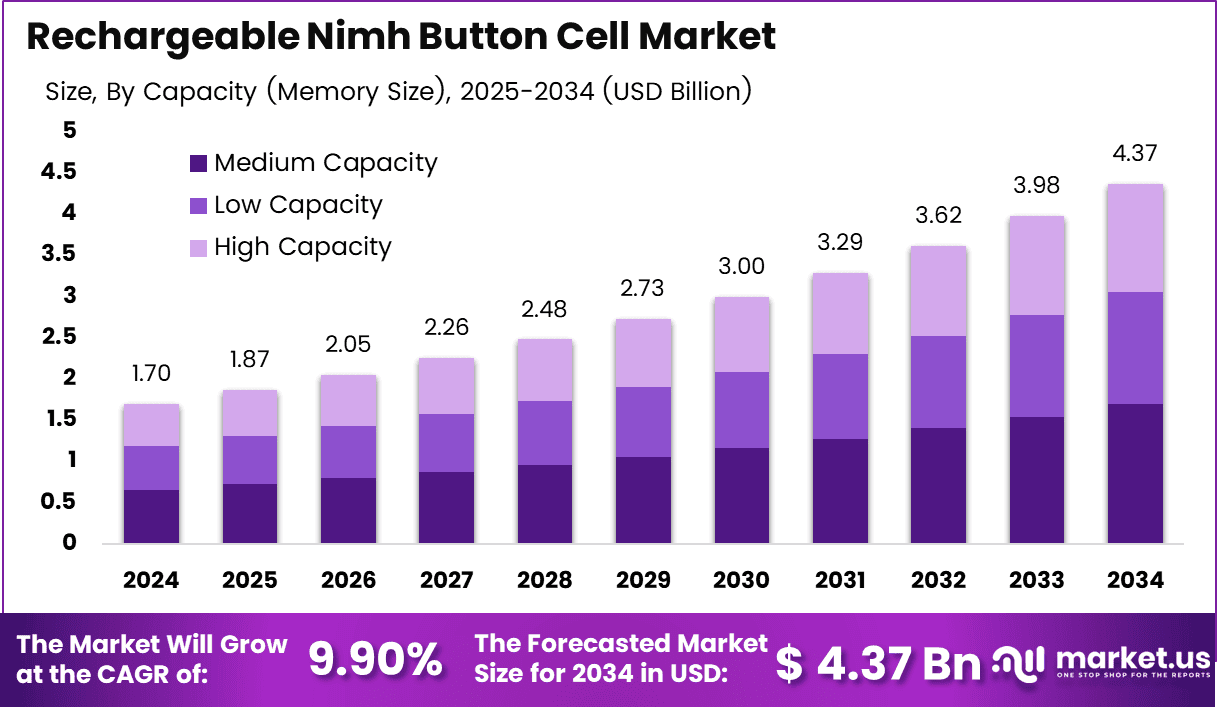
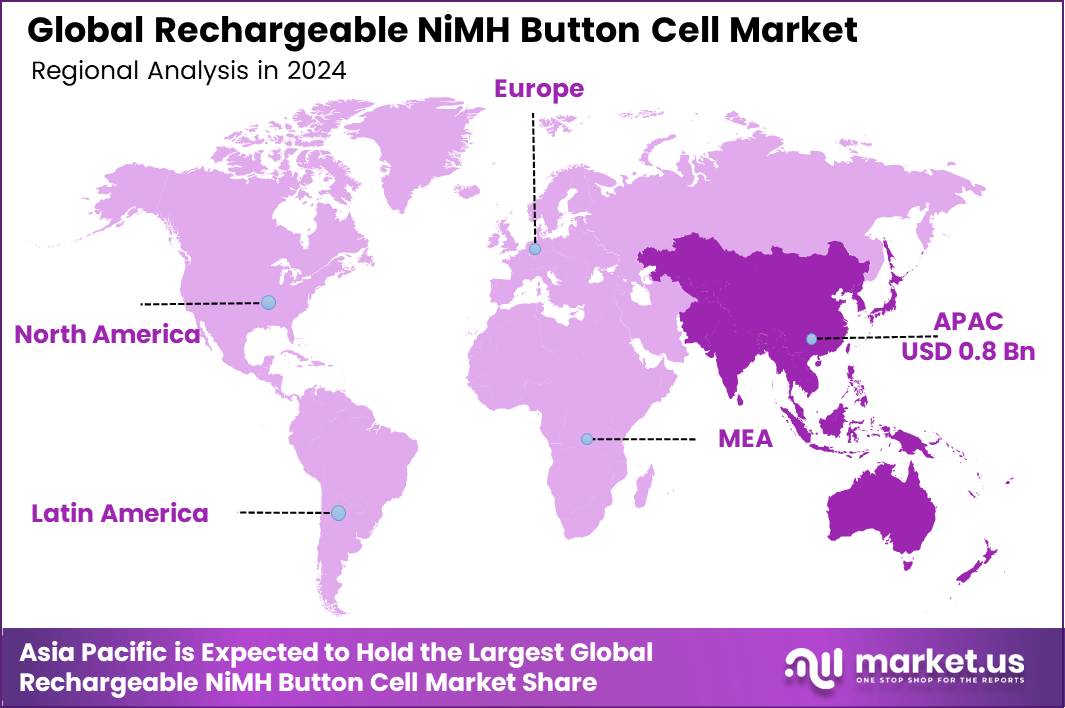
In 2024, the Global Rechargeable NiMH Button Cell Market was valued at USD 1.7 billion. The market is projected to grow at a CAGR of 9.9% during 2024–2034, reaching approximately USD 4.37 billion by 2034. Asia Pacific dominated the global market in 2024, accounting for 48.3% of the total market share and generating approximately USD 0.8 billion in revenue.
Hearing aids are a direct demand base for small rechargeable cells: each additional rechargeable device requires an embedded battery or a rechargeable battery system, while replacement and upgrade cycles add repeat demand. Wider digital access adds another layer of demand.
The International Telecommunication Union (ITU) reports that 5.5 billion people were online in 2024, up by 227 million from the prior year; Asia-Pacific alone had 66% of its population online. This expanding connected base supports sales of compact, battery-powered devices and related accessories, where rechargeable NiMH button cells can be selected for their reusability, safety profile, and suitability for low-power applications.
Asia Pacific’s reported 48.3% share is commercially reasonable because the region combines a large digital user base with growing healthcare needs and strong electronics supply chains. The United Nations expects the share of people aged 65 and above in Eastern and South-Eastern Asia to double from about 13% in 2022 to 26% by 2050.
Key Takeaways
- The global Rechargeable NiMH Button Cell Market was valued at USD 1.7 billion in 2024.
- The global Rechargeable NiMH Button Cell Market is projected to grow at a CAGR of 9.9% and is estimated to reach USD 4.37 billion by 2034.
- On the basis of capacity, the Medium Capacity segment dominated the market, accounting for 38.8% of the total market share.
- By application, the Consumer Electronics segment dominated the market, accounting for 29.8% of the total market share.
- Based on distribution channel, the Offline Retailers segment dominated the market, accounting for 66.4% of the total market share.
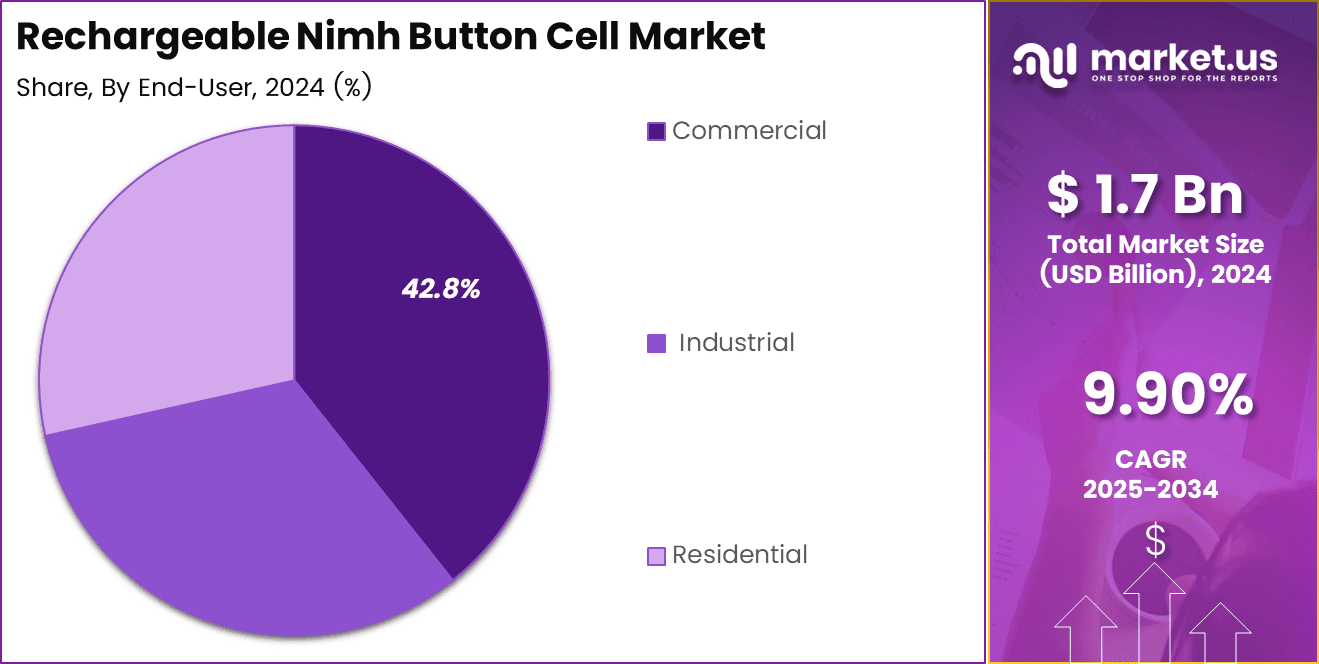
- By end-user, the Commercial segment dominated the market, accounting for 42.8% of the total market share.
- In 2024, Asia Pacific was the most dominant region in the Rechargeable NiMH Button Cell Market, accounting for 48.3% of the total market share and generating approximately USD 0.8 billion in revenue.
Role of generative AI
Generative AI plays a growing role in the rechargeable NiMH button cell market by enhancing material design, production efficiency, and demand forecasting. AI-driven models simulate chemical interactions to optimize electrode compositions, improving energy density and battery lifespan. Manufacturers use generative algorithms to automate product design and accelerate R&D cycles.
Predictive AI also supports supply chain planning by analyzing consumption patterns and anticipating future market shifts. In addition, AI-based quality control detects micro-defects in production lines, reducing waste and cost. Overall, generative AI is transforming the industry toward smarter, faster, and more sustainable manufacturing processes.
By Capacity
The medium-capacity segment accounted for 38.8% of the global market share in 2024, making it the leading capacity category. These batteries strike an ideal balance between storage efficiency and energy density, making them suitable for portable consumer devices and industrial control systems. Their consistent discharge rates and long cycle life support stable performance across varying temperature conditions.
The segment’s demand is expected to rise due to its widespread use in wireless sensors, cameras, and handheld electronics, where space optimization is key. Low-capacity cells remain popular in low-drain devices such as calculators and clocks, while high-capacity cells are witnessing fast adoption in electric mobility, robotics, and medical equipment.
By Application
The consumer electronics segment dominated the market with a 29.8% share in 2024. This segment benefits from the strong penetration of rechargeable NiMH button cells in digital cameras, wireless peripherals, hearing aids, and gaming controllers. These batteries are valued for their long recharge cycles, stability, and eco-friendly profile compared to disposable alkaline variants. Growing demand for miniaturized power solutions in wearables and IoT-enabled home devices is expected to enhance adoption over the coming years.
Medical devices such as glucose monitors and hearing aids also represent a fast-growing category, supported by advancements in compact battery architecture. Industrial and automotive applications are anticipated to expand steadily, driven by automation and the rise in electric component integration. Collectively, these applications highlight a diversified adoption landscape where energy efficiency and sustainability remain key purchase criteria.
By Distribution Channel
Offline retailers held a significant 66.4% share in 2024, making them the primary distribution channel for rechargeable NiMH button cells. Traditional electronics stores, specialty battery outlets, and industrial suppliers remain preferred channels due to their reliability, immediate product availability, and after-sales support.
However, the online store segment is growing rapidly due to the expanding e-commerce infrastructure and increasing consumer preference for convenience and pricing transparency. Manufacturers are also leveraging omnichannel strategies to combine the reach of online sales with the service depth of physical stores.
By End-User
The commercial sector accounted for 42.8% of the total market share in 2024, representing the largest end-user segment. Businesses in retail electronics, communication devices, and automation heavily depend on NiMH button cells for consistent, rechargeable power sources.
Industrial users follow closely, with growing demand in robotics, IoT sensor nodes, and automated production equipment. The residential sector, though smaller, is projected to expand due to rising awareness of rechargeable household devices and energy-efficient gadgets.
By Industry
The Banking, Financial Services, and Insurance (BFSI) segment held the largest share of 36.8%, followed by Media & Entertainment at 22.4%, Healthcare at 16.7%, Government & Education at 13.1%, Travel & Hospitality at 7.2%, and Others at 3.8%. The BFSI sector’s dominance is fueled by the automation of insurance premiums, EMIs, and subscription-based banking services.
Media & Entertainment continues rapid adoption due to the proliferation of subscription streaming and gaming platforms. Healthcare is transitioning to digital payment cycles for telehealth and insurance-linked services. Government agencies and educational institutions are deploying recurring billing for tax collections, tuition payments, and service renewals.
Key Market Segment
By Capacity
- Low Capacity
- Medium Capacity
- High Capacity
By Application
- Consumer Electronics
- Medical Devices
- Industrial Applications
- Automotive
- Others
By Distribution Channel
- Online Stores
- Offline Retailers
By End-User
- Residential
- Commercial
- Industrial
Regional Analysis
Asia Pacific dominates the global rechargeable NiMH button cell market, accounting for the largest share with around USD 0.8 billion in 2024. Countries such as China, Japan, and South Korea lead due to strong manufacturing capabilities, government incentives for green energy, and growing consumer electronics production. The region benefits from a well-developed supply chain for nickel and rare earth metals, boosting local output and exports.
The region benefits from abundant raw materials, government support for clean energy production, and expanding demand in electronics and automotive applications. North America follows with steady growth, particularly in healthcare and industrial automation, supported by technological advancements and strong research infrastructure.
Europe’s growth is driven by sustainability goals and recycling mandates that favor rechargeable battery use. Meanwhile, Latin America and the Middle East & Africa are emerging markets, gradually adopting NiMH technology in industrial and consumer electronic sectors.
Key Regions and Countries
- North America
- US
- Canada
- Europe
- Germany
- France
- The UK
- Spain
- Italy
- Rest of Europe
- Asia Pacific
- China
- Japan
- South Korea
- India
- Australia
- Singapore
- Rest of Asia Pacific
- Latin America
- Brazil
- Mexico
- Rest of Latin America
- Middle East & Africa
- South Africa
- Saudi Arabia
- UAE
- Rest of MEA
Drivers
| Driver | (~) % Impact on CAGR Forecast | Geographic Relevance | Impact Timeline |
|---|---|---|---|
| Hearing aid rechargeability shift | +2.8% | North America, Western Europe | Short term (≤ 2 years) |
| Cordless power tool backup cell demand | +1.6% | Asia Pacific, North America | Medium term (2–4 years) |
| Medical device miniaturization | +1.4% | Global | Medium term (2–4 years) |
| IoT sensor and wearable proliferation | +1.2% | Asia Pacific | Short term (≤ 2 years) |
| Nickel-based chemistry safety preference over lithium in confined form factors | +0.9% | Europe, Japan | Long term (≥ 4 years) |
Hearing Aid Rechargeability Shift
The pivot away from disposable zinc-air cells toward integrated rechargeable NiMH button cells accelerated between 2022 and 2024 as major hearing aid manufacturers redesigned devices around sealed, non-removable power packs, a transition that directly displaces recurring zinc-air unit sales with fewer, higher-margin rechargeable cell placements per device lifecycle.
This mechanism adds an estimated +2.8% to the Baseline CAGR of 9.9% because each rechargeable NiMH button cell replaces roughly 150 to 200 disposable cells over a typical 3 to 4 year device life, compressing per-unit cell revenue for OEMs by an estimated 15% to 20% even as device-level average selling prices rise; capacity points in the sub-23 mAh to 600 mAh range documented by leading cell producers reflect this design consolidation.
Restraints
| Restraint | (~) % Impact on CAGR Forecast | Geographic Relevance | Impact Timeline |
|---|---|---|---|
| Child-safety packaging mandate compliance costs | -1.8% | United States | Short term (≤ 2 years) |
| Lithium-ion substitution in high-drain applications | -1.5% | Global | Medium term (2–4 years) |
| Capacity ceiling versus energy density needs | -1.1% | Global | Short term (≤ 2 years) |
| Restricted retail channel access post-ingestion law | -0.7% | United States, Canada | Short term (≤ 2 years) |
Child-Safety Packaging Mandate Compliance Costs
Reese’s Law, enacted in August 2022 under Public Law 117-171 and enforced by the U.S. Consumer Product Safety Commission with binding packaging requirements effective for button cells packaged after September 2023, mandates child-resistant packaging and explicit warning labeling on every single-cell battery unit sold at retail.
This directly freezes near-term sales velocity because compliant blister and resealable packaging redesigns raise per-unit packaging cost by an estimated 8% to 12% and require manufacturers to halt shipment of non-compliant inventory, creating a documented distribution gap for hearing aid users accustomed to easily opened packs.
The strategic impact is a near-term margin compression of roughly 1.5 to 2 percentage points for cell packagers absorbing tooling and re-certification CapEx, alongside delayed retail restocking cycles that this analysis estimates shave approximately -1.8% off the Baseline CAGR of 9.9% until compliant packaging fully cycles through distributor inventory by 2026.
Challenges
| Challenge | (~) % CAGR Friction Drag | Geographic Relevance | Mitigation Horizon |
|---|---|---|---|
| Critical raw material price volatility | -1.3% | Global | Long term (≥ 4 years) |
| Spent cell recycling infrastructure gaps | -0.9% | Asia Pacific, Africa | Long term (≥ 4 years) |
| Precision micro-assembly talent shortage | -0.7% | Japan, South Korea, China | Medium term (2–4 years) |
| Fragmented sub-scale supplier base | -0.5% | Europe | Medium term (2–4 years) |
Critical Raw Material Price Volatility
Nickel and cobalt, the core active-material inputs for NiMH electrode chemistry, experienced pronounced price swings through 2022 to 2024 as electric vehicle battery demand competed for the same upstream nickel sulfate and cobalt refining capacity tracked in national customs and trade association shipment data.
This structural vulnerability manifests as a quantitative friction because a 10% swing in London Metal Exchange nickel pricing translates into an estimated 3% to 5% shift in button cell bill-of-materials cost, given nickel hydroxide typically represents 25% to 35% of a NiMH cell’s direct material cost base.
Long-term corporate adjustment requires manufacturers to lock in multi-year offtake agreements, diversify refining sources beyond concentrated Asia-Pacific supply, and pursue closed-loop recycling of spent cells to recover nickel and rare earths, actions that this analysis estimates create a persistent -1.3% drag on the market’s maximum growth ceiling versus the 9.9% baseline unless hedging and recycling capacity scale meaningfully by 2028.
Opportunities
| Opportunity | (~) % Potential CAGR Upside | Geographic Relevance | Execution Window |
|---|---|---|---|
| Closed-loop nickel-cobalt recycling monetization | +2.1% | Asia Pacific, Europe | Long term (≥ 4 years) |
| Emerging-market hearing healthcare penetration | +1.7% | India, Southeast Asia, Latin America | Medium term (2–4 years) |
| High-drain industrial backup roll-up consolidation | +1.3% | North America, Europe | Medium term (2–4 years) |
| Next-generation high-capacity electrode formulations | +1.0% | Japan, South Korea | Long term (≥ 4 years) |
| Private-label OEM direct supply agreements | +0.6% | Global | Short term (≤ 2 years) |
Closed-Loop Nickel-Cobalt Recycling Monetization
Unlike the reactive recycling infrastructure buildout addressed under Challenges, this opportunity represents deliberate, forward-looking vertical integration into spent-cell material recovery as a distinct revenue and margin lever rather than a defensive cost mitigation, since most current NiMH button cell producers still treat end-of-life recovery as a compliance obligation rather than a monetized input stream.
Capturing this would allow producers to reduce virgin raw-material procurement dependency by an estimated 20% to 30% of nickel input over a full recycling loop, expand gross margins by an estimated 2 to 4 percentage points through lower cost-per-unit active material sourcing, and add an incremental +2.1% upside on top of the 9.9% Baseline CAGR for players who build dedicated collection-and-refining partnerships with hearing aid OEMs and power tool distributors ahead of competitors by 2030
Key Players Analysis
FDK is a leading rechargeable NiMH button-cell specialist, with FY2024 battery-business revenue of ¥48.96 billion within ¥63.17 billion consolidated sales. Its nine-month FY2025 battery sales reached ¥35.98 billion.
Panasonic remains the financially strongest participant, with Energy segment sales of ¥430.4 billion in the first half of FY2025 and group R&D spending of ¥254.6 billion. VARTA spent €37.9 million on R&D in 2024. Together, FDK, Panasonic, and VARTA are estimated to represent 50–65% of qualified rechargeable NiMH button-cell supply, with respective estimated shares of 20–30%, 15–25%, and 10–15%.
GP Batteries/GP Industries has weakened after transferring its NiMH rechargeable-battery manufacturing business in January 2024. FY2025 rechargeable-battery sales fell to S$26.3 million from S$78.8 million in FY2024, while its broader Batteries Business generated S$833.3 million. GP is estimated to hold 5–10% of button-cell supply, mainly through brand and distribution.
Top Key Players
- Panasonic Corporation
- Energizer Holdings, Inc.
- GP Batteries International Limited
- Fujitsu Limited
- VARTA AG
- Duracell Inc.
- Sanyo Electric Co., Ltd.
- Sony Corporation
- Maxell Holdings, Ltd.
- BYD Company Limited
- EVE Energy Co., Ltd.
- FDK Corporation
- Saft Groupe S.A.
- Spectrum Brands Holdings, Inc.
- Camelion Battery Co., Ltd.
- Shenzhen Grepow Battery Co., Ltd.
- Shenzhen PKCELL Battery Co., Ltd.
- Powerex, Inc.
- Uniross Batteries (Pty) Ltd.
- Zhongyin (Ningbo) Battery Co., Ltd.
- Others
Recent Developments
- In April 2025, Evergreen Energy & Power Corporation launched eco-friendly NiMH button cells using partially recycled nickel alloys, achieving a 15% reduction in production waste and supporting China’s circular economy goals.
- In July 2024, FDK Corporation introduced a new line of compact NiMH button cells optimized for medical wearables. The design improved volumetric efficiency by 12%, enabling longer operational time in devices like hearing aids and glucose monitors.
Report Scope
| Report Features | Description |
|---|---|
| Market Value (2024) | USD 1.7 Bn |
| Forecast Revenue (2034) | USD 4.37 Bn |
| CAGR(2025-2034) | 9.9% |
| Base Year for Estimation | 2024 |
| Historic Period | 2020-2023 |
| Forecast Period | 2025-2034 |
| Report Coverage | Revenue forecast, AI impact on Market trends, Share Insights, Company ranking, competitive landscape, Recent Developments, Market Dynamics, nd Emerging Trends |
| Segments Covered | By Capacity (Low Capacity, Medium Capacity, High Capacity), By Application (Consumer Electronics, Medical Devices, Industrial Applications, Automotive, Others), By Distribution Channel (Online Stores, Offline Retailers), By End-User (Residential, Commercial, Industrial) |
| Regional Analysis | North America – US, Canada; Europe – Germany, France, The UK, Spain, Italy, Russia, Netherlands, Rest of Europe; Asia Pacific – China, Japan, South Korea, India, New Zealand, Singapore, Thailand, Vietnam, Rest of Latin America; Latin America – Brazil, Mexico, Rest of Latin America; Middle East & Africa – South Africa, Saudi Arabia, UAE, Rest of MEA |
| Competitive Landscape | Panasonic Corporation, Energizer Holdings, Inc., GP Batteries International Limited, Fujitsu Limited, VARTA AG, Duracell Inc., Sanyo Electric Co., Ltd., Sony Corporation, Maxell Holdings, Ltd., BYD Company Limited, EVE Energy Co., Ltd., FDK Corporation, Saft Groupe S.A., Spectrum Brands Holdings, Inc., Camelion Battery Co., Ltd., Shenzhen Grepow Battery Co., Ltd., Shenzhen PKCELL Battery Co., Ltd., Powerex, Inc., Uniross Batteries (Pty) Ltd., Zhongyin (Ningbo) Battery Co., Ltd., Others |
| Customization Scope | Customization for segments, region/country-level will be provided. Moreover, additional customization can be done based on the requirements. |
| Purchase Options | We have three licenses to choose from: Single User License, Multi-User License (Up to 5 Users), Corporate Use License (Unlimited Users, Printable PDF) |





































