


Report Overview
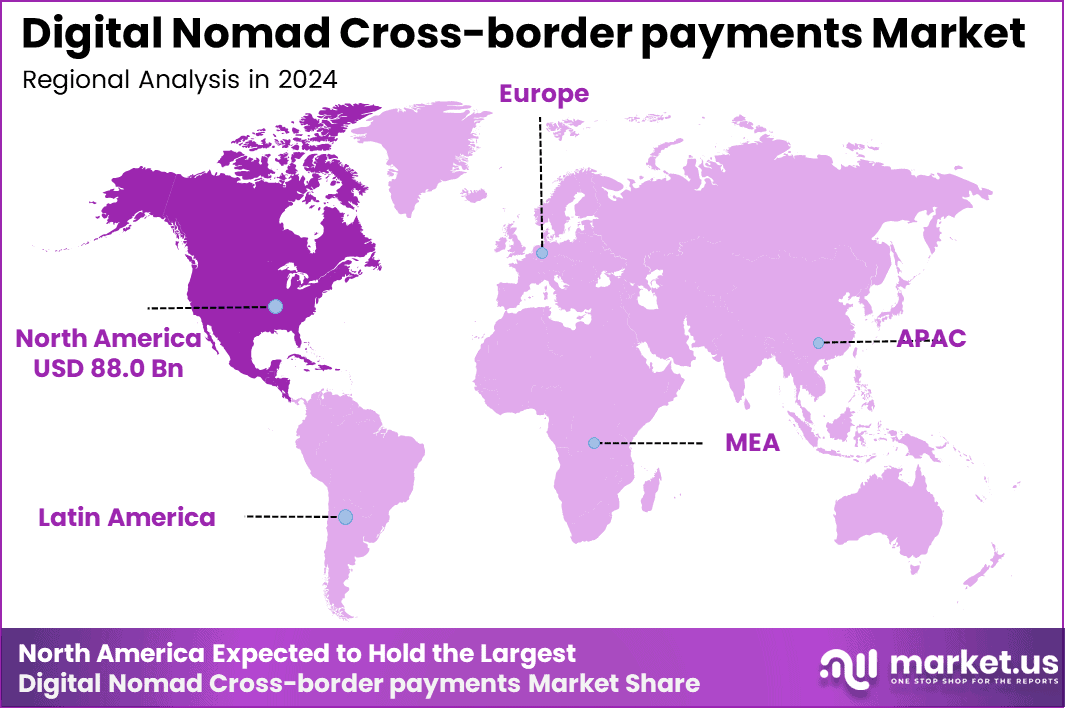
The Global Digital Nomad Cross-Border Payments Market is projected to witness robust growth over the next decade, expanding from USD 245.2 billion in 2024 to USD 554.4 billion by 2034, at a CAGR of 8.5%. North America dominated the global market in 2024, generating approximately USD 88.0 billion in revenue.
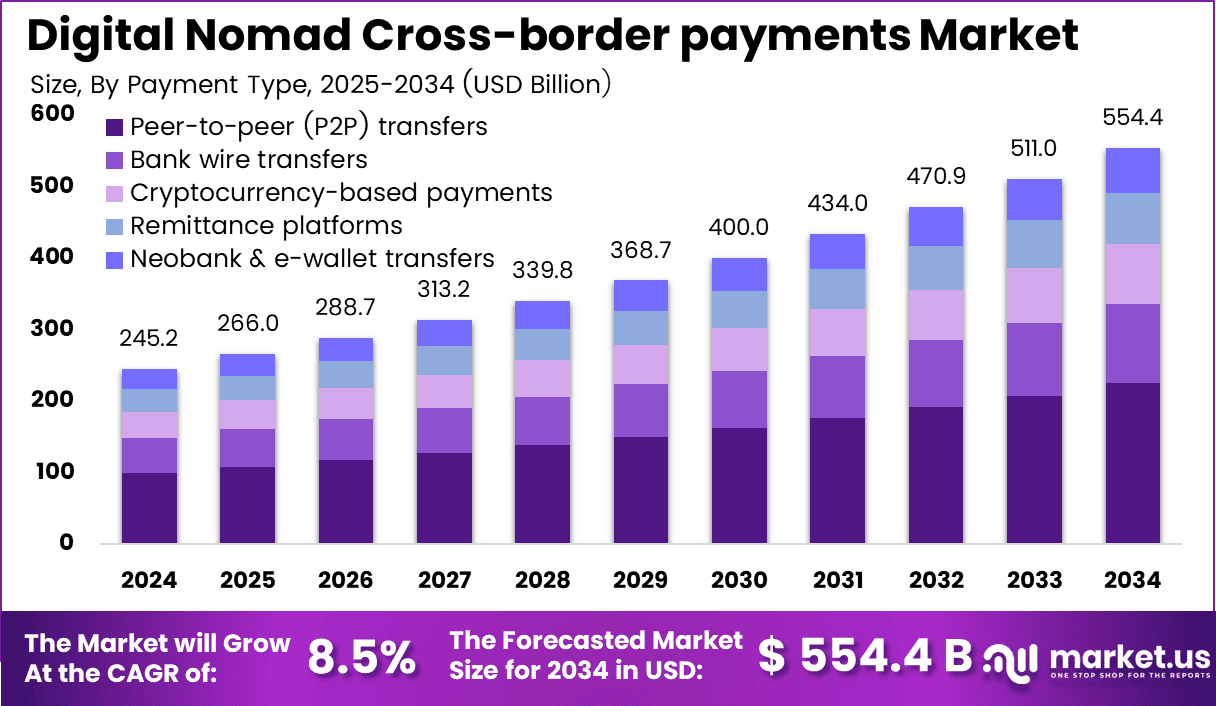
The Digital Nomad Cross-border payments Market Size growth is primarily supported by rising smartphone penetration, leading to a 40–45% increase in digital wallet usage among mobile professionals. Open banking and API integrations are another key driver, enabling faster, low-cost, and transparent transactions that enhance interoperability among global payment systems.
These integrations are projected to improve transaction processing volumes by 18–20% annually. Furthermore, blockchain and central bank digital currencies (CBDCs) are increasingly being adopted, helping reduce transaction costs and delays while adding 0.8% points to the CAGR. The rapid expansion of remote work and freelance opportunities globally continues to accelerate the demand for instant and low-fee cross-border payment services tailored to digital nomads’ needs.
Key Takeaways
- The global Digital Nomad Cross-Border Payments Market was valued at USD 245.2 billion in 2024 and is projected to reach USD 554.4 billion by 2034, expanding at a CAGR of 8.5% during 2025–2034.
- Peer-to-peer (P2P) transfers dominated the market by payment type, accounting for a 40.6% share, driven by increasing adoption of instant, low-cost international money transfer apps.
- Among user types, freelancers and gig workers led the market with a 38.8% share, fueled by the global rise in remote work, digital freelancing platforms, and self-employed professionals seeking seamless payment options.
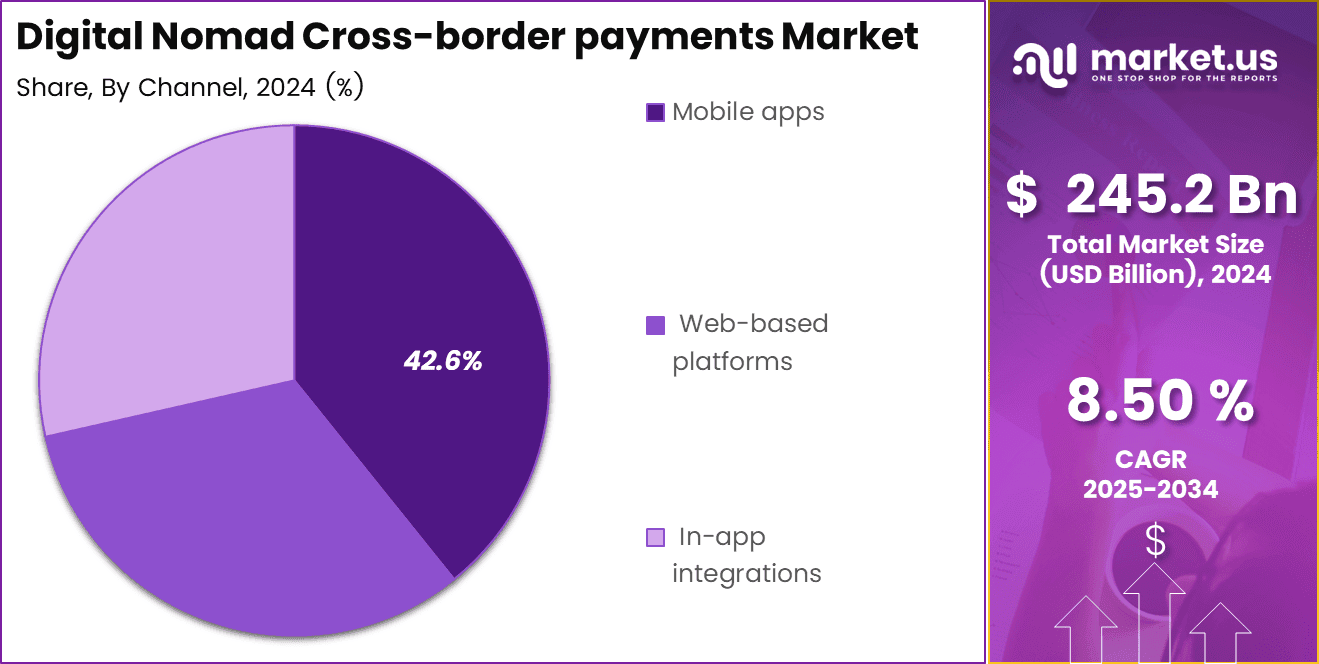
- By channel, mobile apps held the largest share at 42.6%, attributed to higher smartphone penetration, user-friendly interfaces, and biometric-secured payment solutions.
- North America emerged as the leading region with a market size of USD 88.0 billion in 2024, supported by advanced fintech infrastructure, digital banking adoption, and a large population of remote workers.
Role of Generative AI
Generative AI is anticipated to transform the Digital Nomad Cross-border payments Market Sizecross-border payments ecosystem by contributing around 1.2 % points to the market’s annual growth rate between 2025 and 2034. It automates crucial processes such as compliance verification, transaction validation, and fraud detection, improving overall efficiency and transparency.
Additionally, AI-driven onboarding and KYC systems are streamlining user verification, reducing processing time by 45–50% and enabling faster access to digital banking tools for freelancers and gig workers worldwide. Gen AI also enhances currency forecasting and liquidity management, improving real-time conversion rate accuracy by 30–35%, which reduces transaction costs for users.
Moreover, personalized AI algorithms are reshaping financial experiences by offering tailored multi-currency management and expenditure tracking, improving user engagement and retention by nearly 22–25% across neobanking and fintech platforms.
By Payment Type
Peer-to-peer (P2P) transfers dominate with 40.6% due to direct client-to-worker cross-border payouts.
Peer-to-peer transfers lead payment type use among digital nomads because they match how freelancers and gig workers get paid today: small, frequent amounts sent straight from client to worker.
World Bank payment behavior data shows that in many economies over 35% of adults who receive income or remittances do so through digital channels, and mobile money studies report more than 1.35 billion registered mobile money accounts across 98 countries by 2021, which supports strong user comfort with direct digital transfers for cross-border work.
P2P tools let nomads avoid bank wire fees that can reach USD 20–40 per transaction and instead pay flat fees in the range of USD 2–5 or a percentage cut below 3%, which materially improves take-home pay and supports the 40.6% share. Cryptocurrency-based payments now grow fastest because they help nomads bypass capital controls and slow banking routes in parts of Latin America and Africa.
By User Type
Freelancers & gig workers dominate with 38.8% due to many small invoices from global platforms.
Freelancers and gig workers hold the largest user share because they form the bulk of workers who live abroad and earn from multiple foreign clients at once. Global gig economy analysis suggests that hundreds of millions of people now earn at least part of their income from freelance or platform work, and some studies estimate gig participation around 10–15% of the global labor force, with a sizeable slice active online and mobile.
This population often sends 10–20 cross-border payment requests per month at ticket sizes near USD 50–300, which makes low-fee digital transfers and wallet-based payouts essential and supports a 38.8% share in this market. Remote employees of global companies grow fastest as firms normalize “work from anywhere” contracts.
OECD digitalization work shows that in several member economies remote work rates rose into the 20–30% range at the peak of the pandemic and then settled into high single-digit to low double-digit shares of total employment by 2023–2024. As more employers integrate cross-border payroll APIs, use employer-of-record services, and support multi-currency salary accounts, cross-border payment flows linked to formal remote employment expand quickly, pushing this user segment to the highest growth rate.
By Channel
Mobile apps dominate with 42.6% due to always-on smartphone access in low-bank regions.
Mobile apps dominate as the main channel because digital nomads rely on smartphones in locations where branch access is limited but mobile data is strong. ITU mobile connectivity tracking reports global mobile broadband penetration above 75% of the population by the mid‑2020s, and mobile money literature shows over 300 mobile money services active in nearly 100 countries, with registered accounts exceeding 1.35 billion, which confirms deep user familiarity with phone-based payments.
UN ESCAP and Asia-Pacific ICT case studies note that embedding mobile payment functions into service platforms can cut transaction costs by 30–40% relative to cash or bank-based flows and reduce payment processing times from days to minutes. As more SaaS products, marketplaces, and social platforms add built-in cross-border payout modules rather than redirecting users to third-party sites, digital nomads increasingly trigger payments from inside work apps, making in-app channels the fastest-growing part of the stack.
Key Market Segments
By Payment Type
- Peer-to-peer (P2P) transfers
- Bank wire transfers
- Cryptocurrency-based payments
- Remittance platforms
- Neobank & e-wallet transfers
By User Type
- Freelancers & gig workers
- Remote employees of global companies
- Content creators/influencers
- Entrepreneurs running offshore businesses
By Channel
- Mobile apps
- Web-based platforms
- In-app integrations
Investment And Business Benefit
Investment opportunities are highlighted by evidence that adoption of advanced digital-payment infrastructure and AI-enabled fintech models is linked to growth rates of up to 43.9% in the volume of cross-border transactions, according to a recent study in the journal The Adoption of Cross-Border Payment.
From a business-strategy perspective, the journal The Impact of Digital Finance on the Development of Cross-Border E-Commerce reports that digital finance has a measurable effect and that firms in more digitised regions achieve stronger cross-border e-commerce growth.
For a company designing business models, this translates into building multi-currency wallets powered by AI, integrating open-banking APIs and blockchain rails, and targeting remote-work talent across jurisdictions. By doing so, the business taps into the high-growth segment of global mobility and frictionless payments, aligning with empirically supported drivers of cross-border finance expansion.
Regional Analysis
North America continues to be the leading contributor to the global digital nomad payments landscape, accounting for a market value of USD 88.0 billion in 2024, reflecting the strong penetration of mobile apps, real-time payment systems, and AI-enabled remittance platforms that simplify global financial mobility for US-based nomads.
The increasing integration of blockchain-based payment channels and neobank solutions has further reduced transfer times and transaction costs, fostering wider adoption among global freelancers and remote professionals.
US Market Size
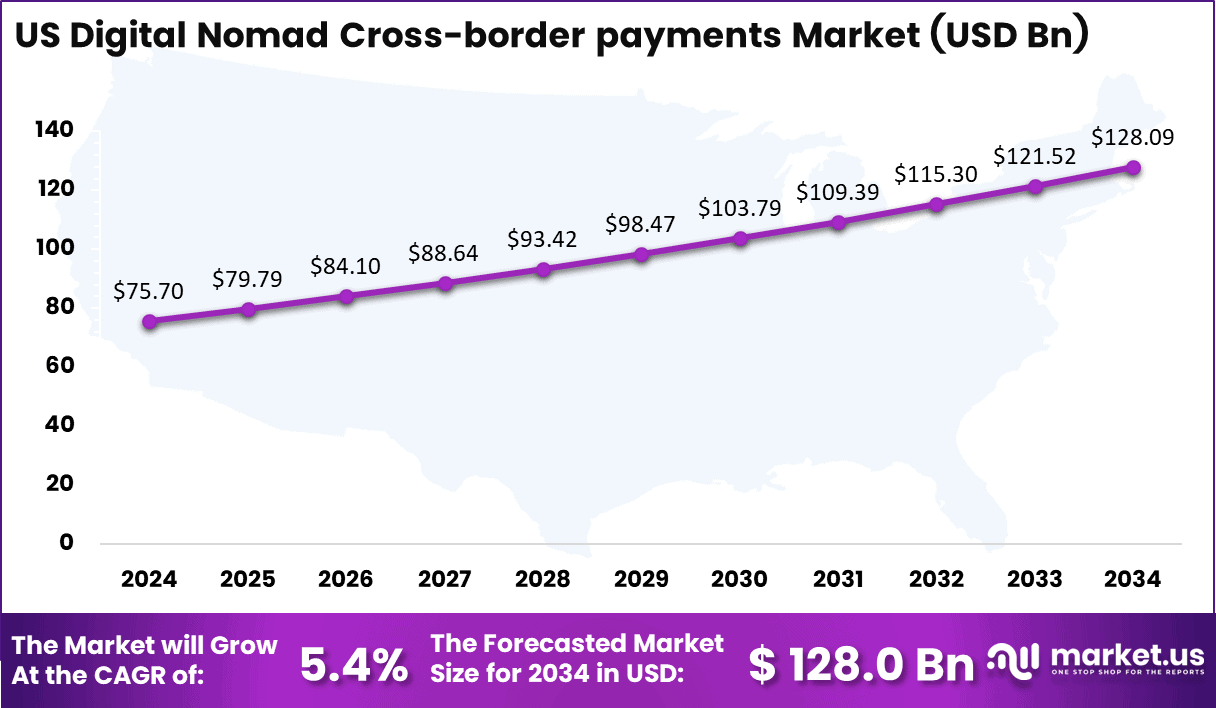
The US Digital Nomad Cross-Border Payments Market was valued at USD 75.7 billion in 2024 and is projected to reach USD 128.0 billion by 2034, expanding at a CAGR of 5.4% during the forecast period (2025–2034). Growth is primarily driven by the increasing number of remote workers, freelancers, and digital entrepreneurs who require seamless international payment systems.
The adoption of mobile-first banking platforms and digital wallets is rising rapidly, supported by greater trust in fintech-driven payment ecosystems and regulatory improvements in cross-border remittance frameworks.
Key Regions and Countries
- North America
- US
- Canada
- Europe
- Germany
- France
- The UK
- Spain
- Italy
- Rest of Europe
- Asia Pacific
- China
- Japan
- South Korea
- India
- Australia
- Rest of APAC
- Latin America
- Brazil
- Mexico
- Rest of Latin America
- Middle East & Africa
- GCC
- South Africa
- Rest of MEA
Market Dynamics
Drivers
| Driver | (~) % Impact on CAGR Forecast | Geographic Relevance | Impact Timeline |
|---|---|---|---|
| Neobank multi-currency wallet adoption | +2.1% | Global, concentrated in Europe and Southeast Asia | Short term (2 years or less) |
| Digital nomad visa proliferation | +1.6% | Europe, Latin America, Southeast Asia | Short term (2 years or less) |
| Gig platform embedded payouts | +1.4% | North America, Europe | Medium term (2 to 4 years) |
| Real-time payment rail interoperability | +1.1% | Asia Pacific, Europe | Medium term (2 to 4 years) |
| Smartphone and mobile broadband penetration growth | +0.8% | Africa, Latin America, South Asia | Short term (2 years or less) |
| Employer-of-record remote payroll expansion | +0.6% | Global | Medium term (2 to 4 years) |
Neobank multi-currency wallet adoption
Neobank multi-currency wallets are changing how digital nomads receive and transfer earnings across borders. Between 2024 and 2025, several EU-licensed e-money institutions expanded passporting rights, while multi-currency wallet account openings increased at double-digit annual rates. Same-day settlement also became more common for retail cross-border payments through 2025, supporting a continuous customer relationship based on recurring foreign exchange revenue rather than one-time wire fees.
Wallet providers can generate foreign exchange spreads of approximately 0.5% to 1.5% per transaction, while reducing settlement times from the traditional 2 to 3 days to near-instant processing. This lowers customer acquisition costs and reduces the minimum transaction value required for profitability. Traditional banks are responding by offering bundled foreign exchange hedging and related services to protect wire-transfer margins.
Restraints
| Restraint | (~) % Impact on CAGR Forecast | Geographic Relevance | Impact Timeline |
|---|---|---|---|
| Anti-money laundering & KYC transaction freezes | -1.3% | Global, acute in offshore hubs | Short term (2 years or less) |
| Cross-border tax residency reporting gaps | -0.9% | EU, North America | Short term (2 years or less) |
| Correspondent banking de-risking exits | -0.7% | Africa, Latin America, Caribbean | Short term (2 years or less) |
| Capital control restrictions on outbound transfers | -0.5% | South Asia, parts of Sub-Saharan Africa | Medium term (2 to 4 years) |
Anti-money laundering & KYC transaction freezes
Anti-money laundering and know-your-customer transaction freezes directly stop active transfers and therefore represent an immediate sales barrier. Tighter Financial Action Task Force requirements pushed licensed payment institutions to strengthen transaction monitoring through 2025.
Flagged cross-border transactions involving customers without fixed-address documents may face delays of 3 to 7 business days, while account-freeze rates for frequent low-value senders remain several percentage points above the general retail payments average.
Payment providers also face higher compliance costs, with staffing and monitoring activities consuming an estimated 15% to 20% of operating expense budgets. These costs reduce margins and extend customer-acquisition payback periods, while address-verification requirements increase onboarding abandonment among remote workers, digital nomads, and other non-resident applicants.
Challenges
| Challenge | (~) % CAGR | Geographic Relevance | Mitigation Horizon |
|---|---|---|---|
| Fragmented multi-jurisdiction licensing burden | -0.8% | Global, acute across EU and ASEAN | Long term (4 years or more) |
| Stablecoin settlement volatility exposure | -0.6% | Latin America, Africa | Medium term (2 to 4 years) |
| Compliance talent shortage in fintech ops | -0.5% | Global | Medium term (2 to 4 years) |
| Interbank settlement interoperability gaps | -0.4% | Asia Pacific, Middle East | Long term (4 years or more) |
Fragmented multi-jurisdiction licensing burden
Fragmented licensing across multiple jurisdictions creates a structural weakness rather than an immediate barrier to sales. Existing customers continue to transact, but providers face higher compliance costs when entering new payment corridors because regulators such as the UK Financial Conduct Authority and the Monetary Authority of Singapore maintained separate authorization regimes without full mutual recognition through 2025.
Licensing and legal expenses can represent 2% to 4% of new-market revenue during the first 18 months of entry. Regulatory approval also takes an average of 6 to 12 months in each jurisdiction. To manage this burden, providers are adopting modular compliance systems, regulatory passporting, agent-banking arrangements, and correspondent partnerships instead of seeking direct licenses in every market.
Opportunities
| Opportunity | (~) % Potential CAGR Upside | Geographic Relevance | Execution Window |
|---|---|---|---|
| Embedded finance white space in creator platforms | +1.8% | North America, Southeast Asia | Medium term (2 to 4 years) |
| Cross-border micro-lending for nomad entrepreneurs | +1.2% | Latin America, Africa | Long term (4 years or more) |
| B2B payroll roll-up consolidation via M&A | +0.9% | Global | Long term (4 years or more) |
| Nomad-focused credit scoring & insurance bundling | +0.7% | Europe, Asia Pacific | Medium term (2 to 4 years) |
Embedded finance white space in creator platforms
Embedded finance remains an untapped opportunity for creator platforms because most influencer and content-monetization platforms still rely on third-party processors for payouts. As of 2025, native multi-currency payments, tax withholding, and instant-liquidity tools remain limited.
Direct ownership of payment rails could allow platforms to capture an estimated 1% to 2% take rate on payout volume while reducing transaction costs by approximately 30% to 40% compared with outsourced processing.
Several OECD jurisdictions also permit payment-facilitator activities below specific licensing thresholds, creating a temporary opportunity for margin expansion before regulations become stricter. However, this opportunity requires an active build-or-buy strategy, as no major creator platform had fully integrated these financial capabilities by the 2026 baseline year.
Key Player Analysis
The digital nomad cross-border payments market is divided between Tier-1 fintech providers, including Wise, Payoneer, and Revolut, and Tier-2 platforms such as Deel, Remote, N26, WorldRemit, Remitly, OFX, and crypto-based services. Tier-1 companies are estimated to control 55–65% of payment volumes linked to freelancers and remote workers.
Wise generated £1.21 billion in FY2025 revenue, up 15% YoY, including £840.4 million from cross-border services. Personal users accounted for 74% of cross-border volume, while business clients contributed around 23% of revenue and £39 billion in payment flows.
Payoneer recorded more than $1.05 billion in 2025 revenue from $87.5 billion in payment volume, representing growth of 9% YoY. Its SMB customer revenue reached $742 million, including $237 million from B2B SMBs, up 28%, and $35 million from Checkout, up 55%. Revolut generated £4.5 billion in 2025 revenue, an increase of 46%, and reported profit before tax of £1.7 billion. It operated across 6 revenue streams and invested £198 million in research and development.
Tier-2 providers compete through payroll, compliance, employer-of-record services, and specialized payment corridors. OFX focuses on higher-value transfers and is estimated to hold a mid-single-digit share of digital nomad volumes, while crypto and Web3 solutions may account for a high-single-digit share of payment value.
Top Key Players
- Wise
- Payoneer Global Inc.
- Revolut Group Holdings Ltd
- Deel, Inc.
- N26 Bank SE
- OzForex Limited. OzForex Limited
- Remote Technology, Inc.
- WorldRemit & Remitly
- Crypto & Web3 Solutions
- Other Major Players
Recent Development
- In March 2026, Revolut announced the acquisition of a minority stake in an undisclosed Latin American cross-border payments fintech for a reported valuation of approximately $600 million, structured as a $120 million cash-and-equity investment to accelerate FX and card-based payout capabilities for freelancers and remote workers across Brazil, Mexico, and Colombia, adding more than 5 million potential new users to its existing 40+ million retail customer base and increasing its addressable annual cross-border transaction volume by an estimated $15–20 billion.
- In April 2025, Circle Internet Group Inc. formally disclosed plans to build a stablecoin-based cross-border payments network targeting banks, payment service providers, and digital wallet companies, with an initial rollout budget reportedly exceeding $100 million and design capacity to support real-time settlement for hundreds of billions of dollars in annual cross-border flows; early documentation highlighted potential 70% reductions in settlement time and up to 40% transaction cost savings for freelancers and SMEs using regulated on-chain rails.
- In November 2025, Wise launched an infrastructure-as-a-service product enabling banks and fintechs to white-label its FX engine and instant cross-border rails, onboarding 12 European challenger banks in the first phase; internal projections indicated that each partner could route hundreds of millions of euros annually through Wise’s APIs, collectively adding several billion euros of incremental cross-border volumes, with instant settlement in more than 50 currencies and transparent FX spreads often 50–80 basis points below traditional bank wire fees.
Report Scope
| Report Features | Description |
|---|---|
| Market Value (2024) | USD 245.2 Bn |
| Forecast Revenue (2034) | USD 554.4 Bn |
| CAGR(2025-2034) | 8.5% |
| Base Year for Estimation | 2024 |
| Historic Period | 2020-2023 |
| Forecast Period | 2025-2034 |
| Report Coverage | Revenue forecast, AI impact on Market trends, Share Insights, Company ranking, competitive landscape, Recent Developments, Market Dynamics, nd Emerging Trends |
| Segments Covered | By Payment Type (Peer-to-peer (P2P) transfers, Bank wire transfers, Cryptocurrency-based payments, Remittance platforms, Neobank & e-wallet transfers), By User Type (Freelancers & gig workers, Remote employees of global companies, Content creators/influencers, Entrepreneurs running offshore businesses), By Channel (Mobile apps, Web-based platforms, In-app integrations) |
| Regional Analysis | North America – US, Canada; Europe – Germany, France, The UK, Spain, Italy, Russia, Netherlands, Rest of Europe; Asia Pacific – China, Japan, South Korea, India, New Zealand, Singapore, Thailand, Vietnam, Rest of Latin America; Latin America – Brazil, Mexico, Rest of Latin America; Middle East & Africa – South Africa, Saudi Arabia, UAE, Rest of MEA |
| Competitive Landscape | Wise, Payoneer Global Inc., Revolut Group Holdings Ltd, Deel, Inc., N26 Bank SE, OzForex Limited. OzForex Limited , Remote Technology, Inc., WorldRemit & Remitly, Crypto & Web3 Solutions, Other Major Players |
| Customization Scope | Customization for segments, region/country-level will be provided. Moreover, additional customization can be done based on the requirements. |
| Purchase Options | We have three licenses to choose from: Single User License, Multi-User License (Up to 5 Users), Corporate Use License (Unlimited Users, Printable PDF) |





































