Report Overview
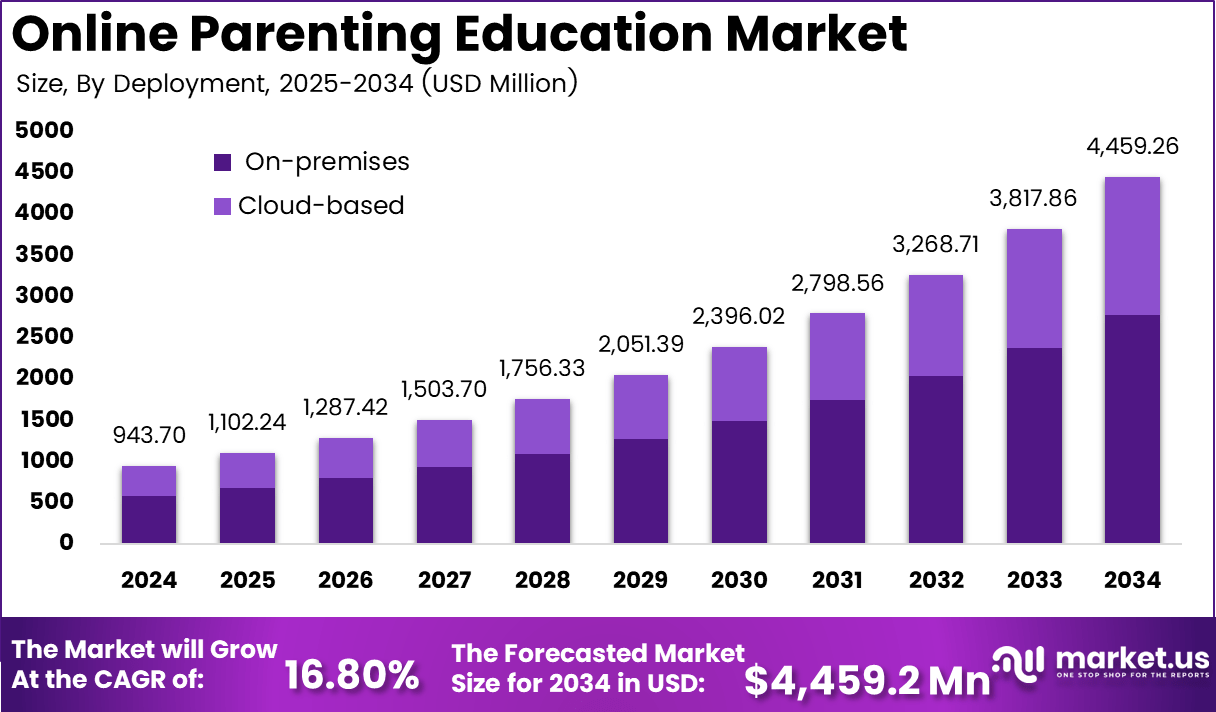
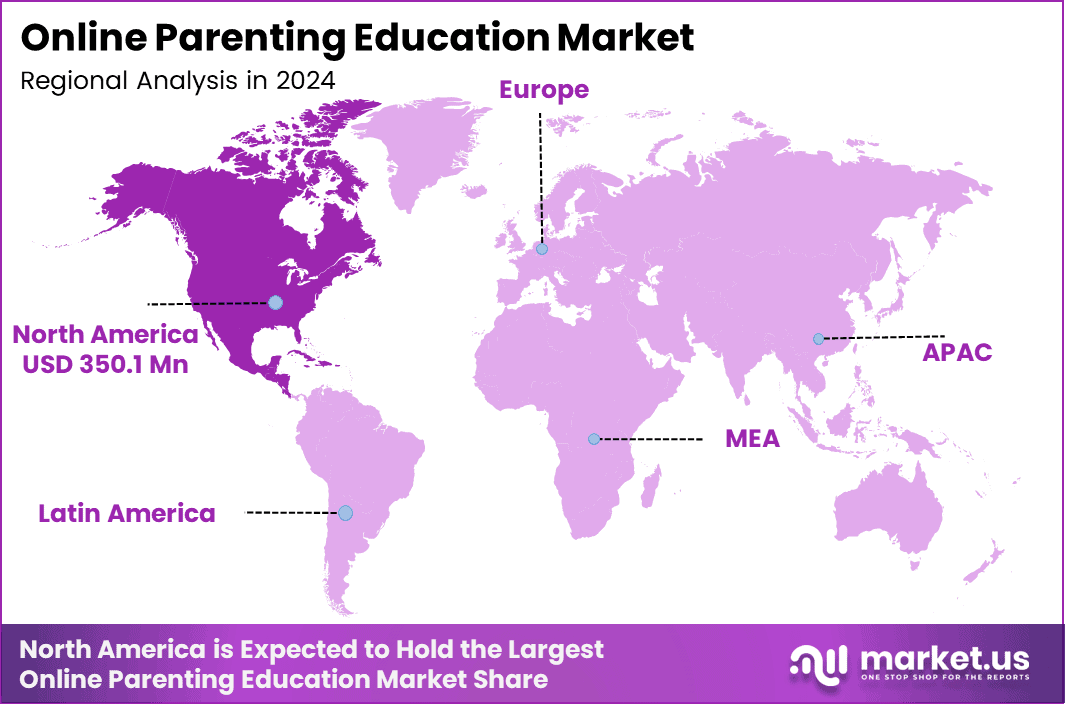
In 2024, the Global Online Parenting Education Market was valued at USD 943.7 million. The market is projected to grow at a CAGR of 16.8% during the forecast period, reaching approximately USD 4,459.2 million by 2034. North America dominated the global market in 2024, accounting for 37.1% of the total market share and generating approximately USD 350.1 million in revenue.
Online Parenting Education platforms are specialized digital applications that provide parents with structured guidance, resources, and tools to support child development and family well-being. These platforms are widely used for tracking child routines, accessing educational content, monitoring growth and health, and sharing information with communities, offering convenience and accessibility beyond traditional parenting methods.
Common categories include tracking apps for sleep, feeding, and milestones, information apps for expert advice and tips, and photo-sharing apps that enable secure family engagement. Functionality varies, with entry-level applications offering basic record-keeping and reminders, while advanced platforms provide interactive learning modules, real-time notifications, and integration with healthcare or educational resources.
Key Takeaways
- The Online Parenting Education Market was valued at USD 943.7 million in 2024 and is projected to reach USD 4,459.2 million by 2034, expanding at a CAGR of 16.8%.
- By type, Tracking Apps accounted for 41.2% of global sales, driven by increasing adoption for monitoring child health, routines, and milestones.
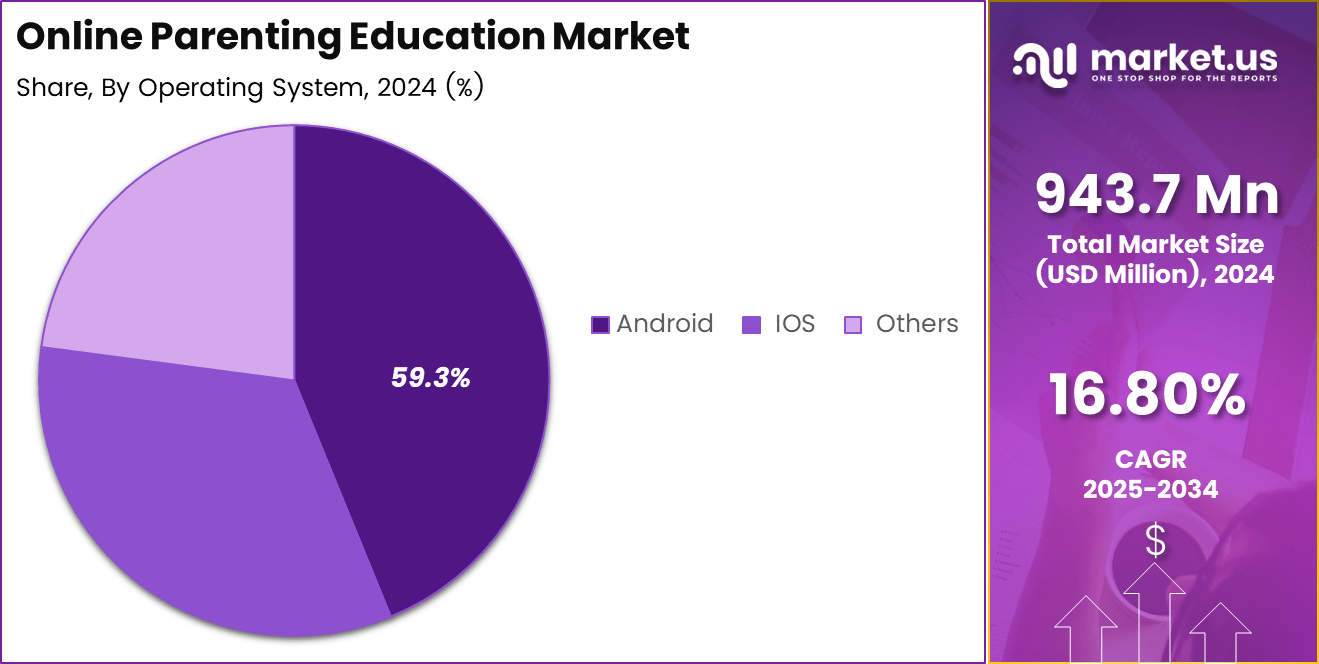
- By operating system, Android platforms held the largest share at 59.3%, benefiting from affordability and wider global reach compared to iOS.
- By deployment, Cloud-based solutions captured 62.3% of the market, reflecting demand for scalability, seamless updates, and secure storage.
- North America dominated with a 37.1% share in 2024, generating USD 350.1 million, with the US alone forecasted to reach USD 1,188 million by 2034 at a CAGR of 14.2%.
By Type
Tracking apps dominate the market with a 41.2% share, reflecting their strong appeal to parents seeking tools to monitor sleep, feeding, and developmental milestones. Their dominance is reinforced by user demand for convenience and personalization.
By 2034, tracking apps are projected to maintain leadership with a share of around 42–44%, supported by continuous feature upgrades and integration with healthcare providers. Information apps are expected to grow moderately, while photo-sharing and other categories will remain niche. Tracking apps will continue to capture the largest portion of revenues due to their recurring subscription-driven business models and high engagement levels.
By Operating System
Android leads with a 59.3% market share, driven by its affordability, broad device availability, and strong penetration across both developed and emerging economies. This dominance comes from its ability to reach cost-sensitive parents globally, ensuring higher adoption rates compared to iOS.
By 2034, Android is expected to sustain leadership with a projected share of 58–60%, while iOS will maintain strength in premium segments, reaching about 36–38%. The “Others” category will stay marginal, with no significant growth predicted. Android’s mass appeal and flexible ecosystem make it the most reliable operating system for parenting education platforms.
By Deployment
Cloud-based platforms dominate deployment with a 62.3% share, reflecting their scalability, seamless updates, and secure storage features. Parents prefer cloud deployment for real-time access across devices and reliable data protection, while businesses benefit from reduced infrastructure costs and steady subscription revenues.
By 2034, cloud-based solutions are expected to strengthen their dominance further, reaching a 65–67% share, as more platforms shift away from on-premises models. On-premises deployment is forecasted to decline to 33–35%, primarily limited to specialized or offline use cases. Cloud-based platforms will remain the backbone of digital parenting services due to their flexibility and long-term sustainability.
Key Market Segments
By Type
- Tracking Apps
- Information Apps
- Photo Sharing Apps
- Others
By Operating System
- Android
- IOS
- Others
By Deployment
- Cloud-based
- On-premises
Investment and Business Benefits
Investment in the Online Parenting Education Market is appealing due to its strong revenue potential, scalability, and recurring subscription models. Investors benefit from low infrastructure requirements with cloud-based platforms and high adaptability across global regions through Android and iOS ecosystems. Profit margins for subscription services average between 25 and 30%, offering predictable returns, while diversified models that combine premium content and healthcare integration reduce risk exposure.
The Online Parenting Education Market offers advantages through product differentiation, brand building, and strong customer engagement. Cloud-based solutions reduce operational costs by 12-15% while improving user experience, which supports higher retention rates. Companies that offer value-added services, such as developmental tracking, community features, and content libraries, enjoy stronger customer loyalty and reduced loss ratios of 6–8%.
Android platforms provide access to larger audiences in cost-sensitive markets, while iOS enables premium pricing with profit margins 5–7% higher. Strategic partnerships with educators, healthcare providers, and child development specialists further enhance credibility, unlocking additional revenue opportunities and sustained market leadership.
Regional Analysis
In 2024, North America dominated the Online Parenting Education Market with a value of USD 350.1 million, representing about 37% of the global share. The region benefits from high internet penetration, strong consumer readiness for digital solutions, and the popularity of subscription-based parenting apps. The U.S. is the key contributor within this region, supported by advanced technological infrastructure and rising awareness of child development platforms.
By 2034, North America is projected to maintain a significant position with an estimated 35–36% share of the global market, reaching close to USD 1.18 Bn, reflecting steady growth fueled by continuous product innovation and adoption of cloud-based platforms.
U.S Market Size
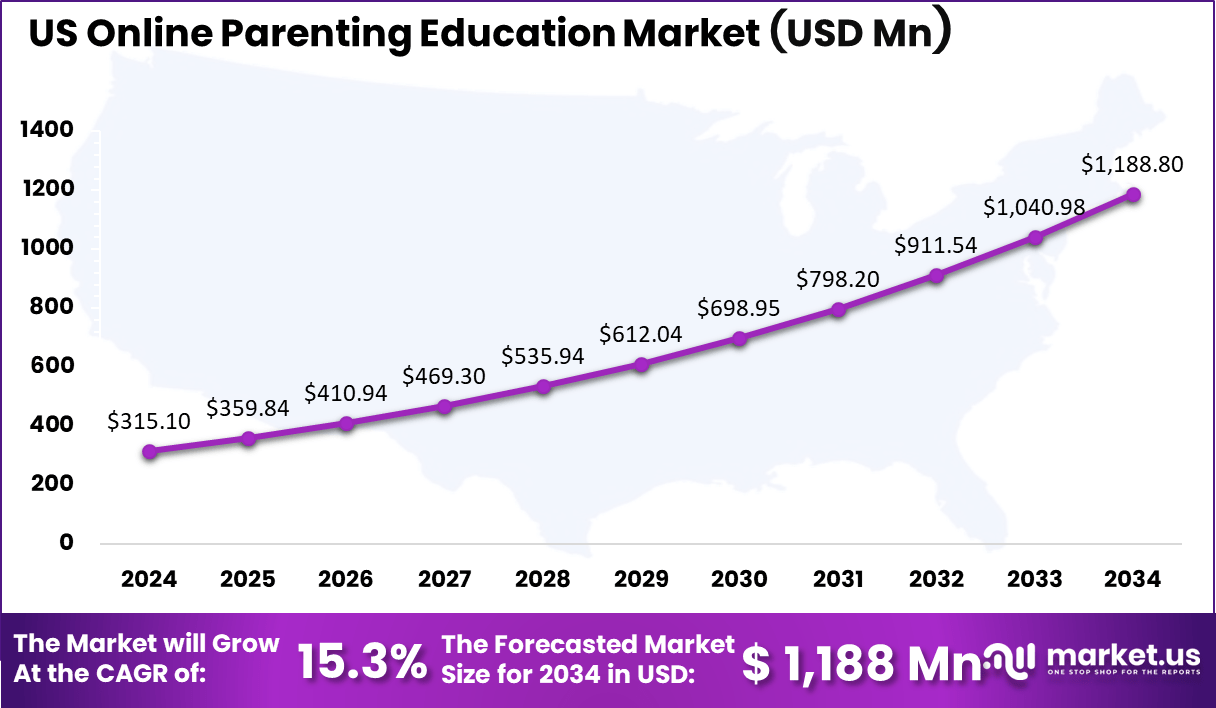
The U.S. Online Parenting Education Market shows a strong upward trajectory, beginning at USD 315.10 million in 2024 and projected to reach USD 1,188.80 million by 2034, reflecting a CAGR of 15.3%. Growth is largely supported by increasing adoption of parenting applications that simplify childcare and enhance parental decision-making.
Among product categories, tracking apps are forecasted to retain dominance with over 40% share, supported by rising demand for monitoring child routines, sleep, and nutrition. Information apps are anticipated to capture around 30% share, as parents increasingly turn to expert-backed content and learning modules.
Photo-sharing and other community-based apps are expected to collectively account for about 25–28%, reflecting growing interest in secure family engagement and social connectivity. This product segmentation underscores the shift toward multifunctional platforms, with tracking and information apps driving the highest sales momentum, while niche offerings continue to diversify the market and attract specialized user groups.
Key Regions and Countries
- North America
- US
- Canada
- Europe
- Germany
- France
- The UK
- Spain
- Italy
- Rest of Europe
- Asia Pacific
- China
- Japan
- South Korea
- India
- Australia
- Singapore
- Rest of Asia Pacific
- Latin America
- Brazil
- Mexico
- Rest of Latin America
- Middle East & Africa
- South Africa
- Saudi Arabia
- UAE
- Rest of MEA
Drivers
| Driver | (~) % Impact on CAGR Forecast | Geographic Relevance | Impact Timeline |
|---|---|---|---|
| Shift to flexible online learning | +4.0% | North America, Europe, Asia-Pacific | Short term (≤ 2 years) |
| Rising parental focus on early childhood | +3.2% | Global | Medium term (2–4 years) |
| High smartphone & broadband penetration | +2.6% | Global (urban & peri-urban) | Short term (≤ 2 years) |
| Integration of interactive & AI-driven content | +2.4% | North America, Europe, selected Asia-Pacific markets | Medium term (2–4 years) |
| Normalisation of remote/virtual education post-COVID | +2.0% | Global | Short term (≤ 2 years) |
| Growing acceptance of paid digital parenting resources | +1.8% | North America, Western Europe | Medium term (2–4 years) |
Shift to flexible online learning
Root cause is the acceleration of flexible, remote learning models between 2020 and 2024, as broadband penetration surpassed roughly 60% globally and online education CAGRs in adjacent segments reached low double digits, pushing parents to seek asynchronous, mobile-first parenting courses rather than in-person workshops.
This driver translates into a quantifiable mechanism where completion rates for structured online parenting programs often exceed 70% when delivered via mobile apps with micro-lessons of 5–10 minutes, compared with sub-40% completion in traditional multi-hour seminars, improving effective revenue per acquired parent household by an estimated 20–30% through reduced churn and higher cross-enrollment.
Strategically, this enables business-model migration from one-time licensing or workshop fees to subscription SaaS-like offerings at monthly price points in the low tens of currency units, with gross margins frequently above 60% given digital content reusability, while lowering customer acquisition costs by 15–25% via always-on digital funnels and partnerships with schools and healthcare providers that onboard hundreds to thousands of parents per institution.
Restraints
| Restraint | (~) % Impact on CAGR Forecast | Geographic Relevance | Impact Timeline |
|---|---|---|---|
| Low willingness to pay for parenting content | –3.5% | Global (especially emerging markets) | Short term (≤ 2 years) |
| Trust & accreditation concerns for online providers | –2.8% | Global | Medium term (2–4 years) |
| Stringent child data protection regulations | –2.5% | Europe, India, selected Asia-Pacific markets | Medium term (2–4 years) |
| Digital divide for lower-income households | –2.2% | Sub-Saharan Africa, South Asia, rural Latin America | Long term (≥ 4 years) |
| Content localization & language fragmentation | –1.9% | Asia-Pacific, Middle East, Africa | Medium term (2–4 years) |
| Competition from free social media content | –1.7% | Global | Short term (≤ 2 years) |
Low willingness to pay for parenting content
The root cause is household budget prioritization that places paid parenting education behind immediate necessities and core education spend, with household education outlays in many emerging markets allocating less than 5% to ancillary services such as parenting support, and survey data in the 2022–2024 window showing over 50% of parents expecting such content to be free or bundled with schools or healthcare services.
Quantitatively, this restraint depresses conversion rates from free to paid tiers to often below 3% in broad consumer funnels, compared with typical consumer edtech benchmarks in the 5–10% range, and caps average revenue per user at single-digit monthly currency values, compressing gross margins by an estimated 10–15 percentage points versus a scenario where at least one in five parents upgrades to structured programs.
Strategically, this forces providers to delay larger platform and content CapEx, shift towards freemium models reliant on institutional contracts or sponsorships, and maintain higher marketing spend, potentially 20–30% of revenue to overcome price sensitivity, directly subtracting several percentage points from the baseline CAGR that would otherwise be achievable if willingness to pay rose materially.
Challenges
| Challenge | (~) % CAGR Friction Drag | Geographic Relevance | Mitigation Horizon |
|---|---|---|---|
| Fragmented digital parenting needs | –3.0% | Global | Long term (≥ 4 years) |
| Limited evidence-based outcome measurement | –2.7% | Global | Medium term (2–4 years) |
| High content development & refresh costs | –2.4% | Global | Medium term (2–4 years) |
| Difficulty integrating with schools & health systems | –2.1% | Global, especially emerging markets | Long term (≥ 4 years) |
| Talent gap in child psychology & digital design | –2.0% | Global | Medium term (2–4 years) |
| Platform discoverability & user engagement | –1.8% | Global | Short term (≤ 2 years) |
Fragmented digital parenting needs
Structurally, the market faces fragmentation because parenting needs vary sharply by child age, culture, and digital exposure, with research between 2022 and 2024 showing multiple distinct mediation styles and priorities across segments, making it difficult to standardize curricula beyond narrowly defined cohorts of a few hundred to a few thousand parents per program.
Quantitatively, this drives higher product and curriculum complexity, with some platforms needing to maintain dozens of course tracks and refresh more than 20% of content annually, raising content production and instructional design costs to as much as 25–35% of operating expenses and lowering scalability..
Over the long term, firms must adjust by investing in modular content architectures, personalization engines, and data-driven segment prioritization—redirecting potentially 10–15% of planned growth capital into infrastructure rather than pure user acquisition, which drags on the maximum attainable CAGR and necessitates tighter focus on fewer high-value segments to maintain sustainable margins.
Opportunities
| Opportunity | (~) % Potential CAGR Upside | Geographic Relevance | Execution Window |
|---|---|---|---|
| B2B2C partnerships with schools & pediatric providers | +3.3% | Global | Medium term (2–4 years) |
| Multi-language localized platforms | +2.9% | Asia-Pacific, Middle East, Africa, Latin America | Long term (≥ 4 years) |
| Outcome-linked subscription & employer benefits | +2.6% | North America, Europe | Medium term (2–4 years) |
| Data-informed personalized parenting journeys | +2.4% | Global (digitally mature markets) | Long term (≥ 4 years) |
| Adjacency into digital safety & mental wellness modules | +2.2% | Global | Medium term (2–4 years) |
| M&A roll-ups of niche parenting communities | +2.0% | North America, Europe | Long term (≥ 4 years) |
B2C partnerships with schools & pediatric providers
This is a future, untapped opportunity because most online parenting education platforms still reach parents through direct-to-consumer channels, while structured partnerships with schools, early childhood centers, and pediatric practices that already touch tens of millions of families remain underpenetrated, with only a small fraction of institutions globally bundling formal digital parenting programs as of 2024.
Quantitatively, embedding parenting modules into institutional ecosystems can lift parent participation rates from low single digits to potentially above 30% within enrolled populations, converting each institution into a channel for hundreds or thousands of parents at acquisition costs that may be 50–70% lower per parent than standard digital advertising; this supports margin expansion of an estimated 15–20 percentage points versus purely direct models.
Key Players Analysis
The online parenting education market is highly fragmented, with no single pure-play public leader. Tier-1 is dominated by diversified edtech and consumer-health platforms such as WebMD/Internet Brands, Ovia Health/XO Group, Coursera, Udemy, and Pearson, which integrate parenting and family-learning content into broader platforms.
These Tier-1 players likely account for 55–65% of global online parenting education revenues, while Tier-2 specialists such as Kinedu, AppClose, BabyCenter, Cozi, Winnie, and Baby Connect capture the remaining share. The broader online education market reached USD 29.87 billion in 2021 and is projected to reach USD 180.29 billion by 2030, highlighting the scalability of large platforms.
Health-focused platforms benefit from established pregnancy and parenting ecosystems, while specialist providers compete through mobile-first delivery, targeted content, subscriptions, and B2B2C partnerships. The parenting apps market was valued at USD 717.3 million in 2026 and is projected to reach USD 1.23 billion by 2033 at an 8.0% CAGR. Meanwhile, the broader parenting apps market is expected to grow from USD 1.72 billion in 2025 to USD 4.91 billion by 2035 at an 11.4% CAGR.
As online parenting education expands from approximately USD 2.48 billion in 2024 to USD 5.0 billion by 2035 at a 6.6% CAGR, Tier-1 platforms are expected to strengthen their position through cross-selling and ecosystem bundling, while Tier-2 specialists compete through deeper curricula, localization, and community-focused features.
Top Key Players
- AppClose Inc.
- BabySparks LLC
- Community Brands Intermediate LLC
- Edsys Pvt. Ltd.
- Hello Belly Inc.
- Huckleberry Labs Inc.
- Kinedu Inc.
- Med ART Studios LLC
- Nexus Software Platforms Ltd.
- Ovuline Inc.
- Owlet Inc.
- Paniya Technologies P Ltd.
- Parent ApS
- Proparent Solutions Pvt. Ltd.
- Qoria Ltd.
- Simfler Inc.
- TappyTaps s.r.o.
- The Miles Foundation Inc.
- Others
Recent Developments
- In January 2025, a U.S.-based platform launched a subscription bundle that combined tracking, nutrition guidance, and telehealth consultations. This bundled approach is expected to drive subscription revenues by 18–20%, as parents seek all-in-one solutions for childcare, health monitoring, and professional consultation through a single platform.
- In December 2024, a European provider introduced a secure photo-sharing feature with encrypted cloud storage to address rising data privacy concerns. This development is anticipated to reduce user churn by 8–10% while boosting user trust and retention by nearly 12%, as secure storage becomes a critical factor for parents sharing sensitive family information.
Report Scope
| Report Features | Description |
|---|---|
| Market Value (2024) | USD 943.7 Mn |
| Forecast Revenue (2034) | USD 4,459.2 Mn |
| CAGR(2025-2034) | 16.8% |
| Base Year for Estimation | 2024 |
| Historic Period | 2020-2023 |
| Forecast Period | 2025-2034 |
| Report Coverage | Revenue forecast, AI impact on Market trends, Share Insights, Company ranking, competitive landscape, Recent Developments, Market Dynamics, and Emerging Trends |
| Segments Covered | By Type (Tracking Apps, Information Apps, Photo Sharing Apps, Others) By Operating System (Android, IOS, Others), By Deployment (Cloud-based, On-premises) |
| Regional Analysis | North America – US, Canada; Europe – Germany, France, The UK, Spain, Italy, Russia, Netherlands, Rest of Europe; Asia Pacific – China, Japan, South Korea, India, New Zealand, Singapore, Thailand, Vietnam, Rest of Latin America; Latin America – Brazil, Mexico, Rest of Latin America; Middle East & Africa – South Africa, Saudi Arabia, UAE, Rest of MEA |
| Competitive Landscape | AppClose Inc., BabySparks LLC, Community Brands Intermediate LLC, Edsys Pvt. Ltd., Hello Belly Inc., Huckleberry Labs Inc., Kinedu Inc., Med ART Studios LLC, Nexus Software Platforms Ltd., Ovuline Inc., Owlet Inc., Paniya Technologies P Ltd., Parent ApS, Proparent Solutions Pvt. Ltd., Qoria Ltd., Simfler Inc., TappyTaps s.r.o., The Miles Foundation Inc., Others |
| Customization Scope | Customization for segments, region/country-level will be provided. Moreover, additional customization can be done based on the requirements. |
| Purchase Options | We have three licenses to opt for: Single User License, Multi-User License (Up to 5 Users), Corporate Use License (Unlimited Users and Printable PDF) |