Report Overview
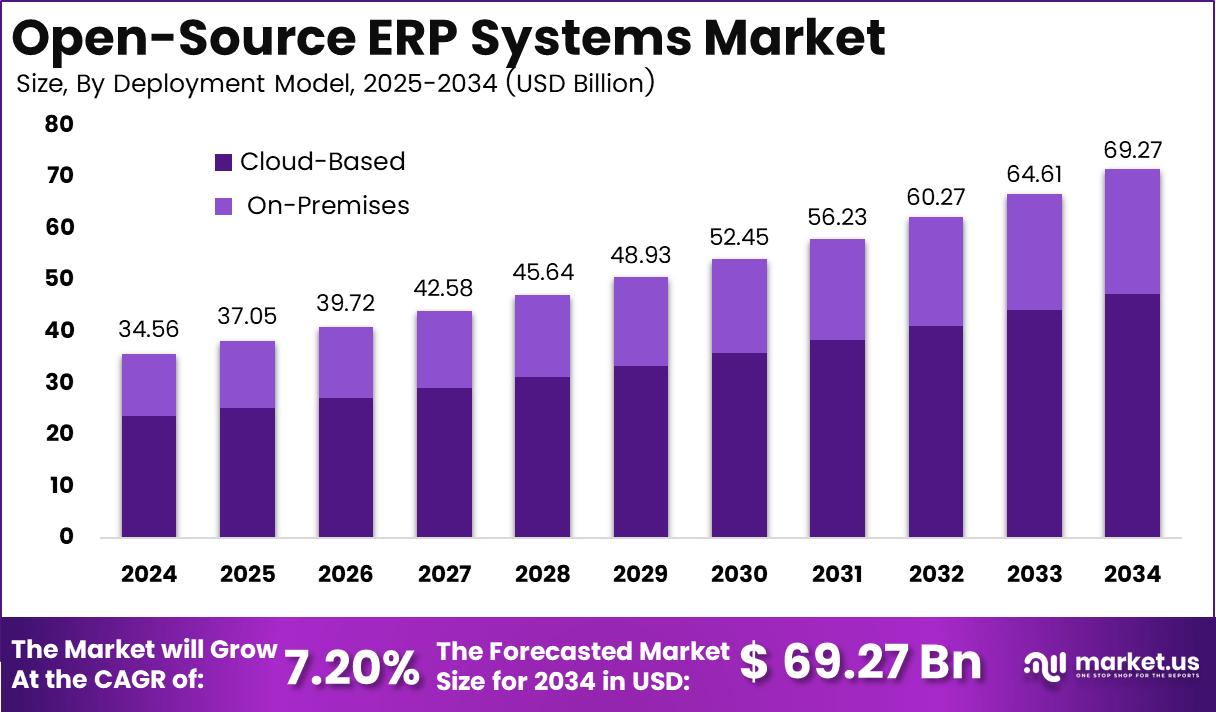
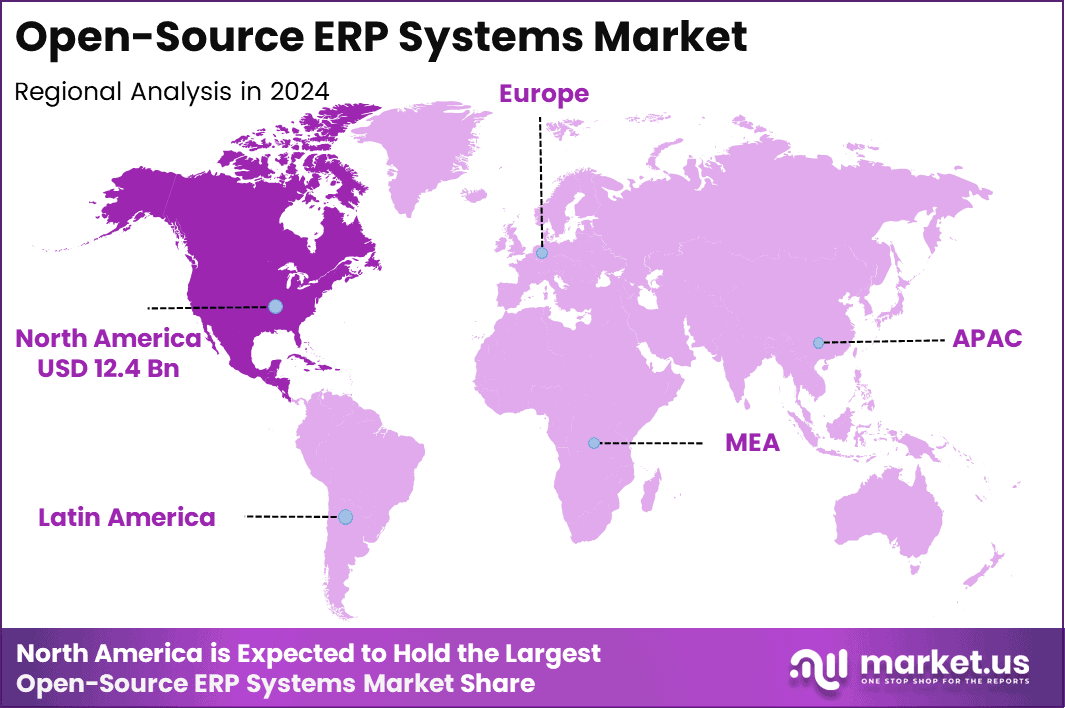
In 2024, the Global Open-Source ERP Systems Market was valued at USD 34.56 billion. The market is projected to grow at a CAGR of 7.2% during 2024–2034, reaching approximately USD 69.27 billion by 2034. North America dominated the global market in 2024, accounting for 36.14% of the total market share and generating approximately USD 12.4 billion in revenue.
According to the World Bank, global fixed broadband subscriptions increased from roughly 1.2 billion in 2015 to more than 1.7 billion by 2023, while mobile broadband connections exceeded 6.7 billion, giving millions of firms always-on connectivity for cloud ERP and remote operations.
UNCTAD reports that global e-commerce sales passed USD 5.8 trillion in 2023 and continue to rise as online retail, digital payments, and cross-border trade expand. This surge in digital transactions, inventory movements, and financial flows directly drives the use of ERP modules for order management, warehousing, accounting, and procurement.
Macro IT spending data also supports long-term growth from 2024 to 2035. The U.S. Bureau of Economic Analysis shows that the U.S. information sector GDP, which includes software and cloud services, rose from about USD 1.38 trillion in 2015 to over USD 2.1 trillion by 2024, a gain of more than USD 700 billion in less than a decade.
Key Takeaways
- The global Open-Source ERP Systems Market was valued at USD 34.56 billion in 2024.
- The global Open-Source ERP Systems Market is projected to grow at a CAGR of 7.2% and is estimated to reach USD 69.27 billion by 2034.
- On the basis of deployment model, the Cloud-Based segment dominated the market, accounting for 68.4% of the total market share.
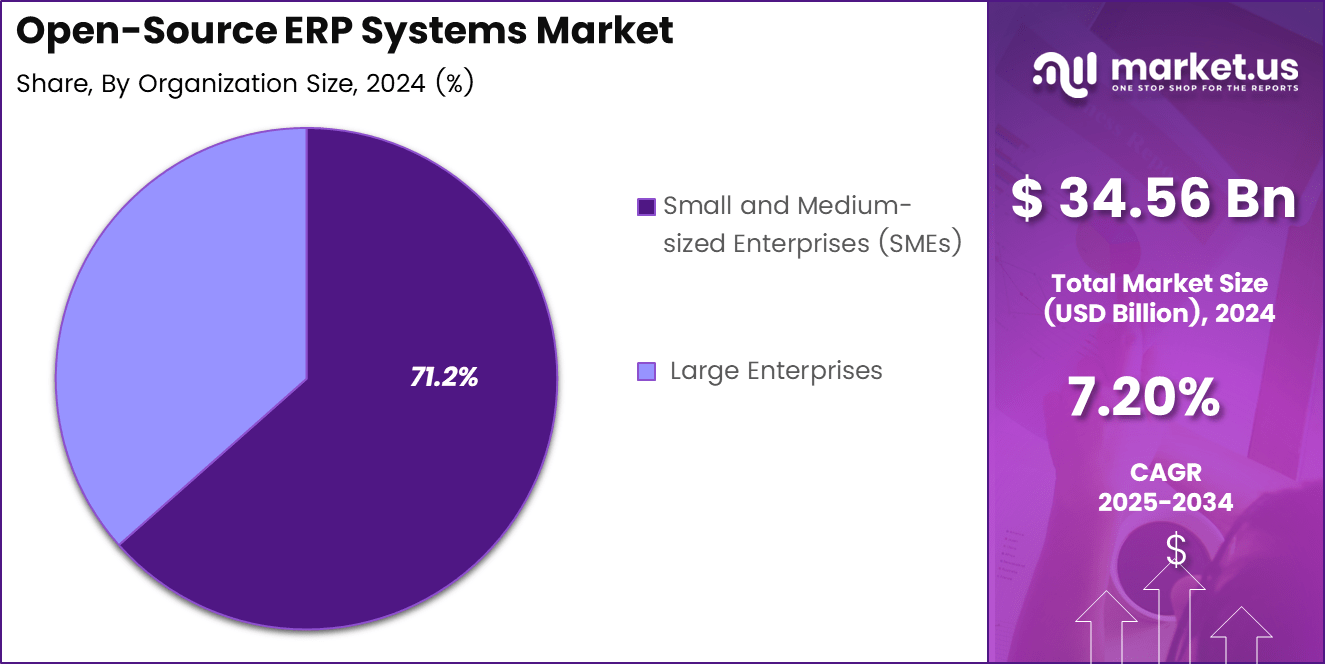
- Based on organization size, Small and Medium-Sized Enterprises (SMEs) dominated the market, accounting for 71.2% of the total market share.
- By functionality, the Financial Management segment dominated the market, accounting for 31.5% of the total market share.
- On the basis of end-user industry, the Manufacturing segment dominated the market, accounting for 23.7% of the total market share.
- In 2024, North America was the most dominant region in the Open-Source ERP Systems Market, accounting for 36.14% of the total market share, equivalent to approximately USD 12.4 billion.
Analysts’ Viewpoint
The increasing adoption of cloud-based ERP systems holds a substantial market share of approximately 58.3% in 2024. Small and Medium-sized Enterprises (SMEs), which dominate the market with a share of 71.2%, are adopting these systems due to their affordability and scalability. This trend is expected to continue as cloud-based solutions increase their footprint due to flexibility and reduced infrastructure costs.
In terms of sales, cloud deployment models accounted for 70% of sales in 2024, surpassing on-premises ERP systems, which make up around 30% of the total product value sales. This demonstrates a strong shift towards cloud adoption, which is projected to drive market growth at an accelerated pace.
North America, which holds the largest share of 45.3%, continues to be the key revenue-generating region, largely due to the high adoption of advanced technologies across industries. Sales in this region are expected to generate over USD 5 billion in 2024.
This rapid transition to cloud-based solutions, especially among SMEs, is expected to drive the market toward its forecasted growth, emphasizing the pivotal role of open-source ERP systems in digital transformations.
By Deployment Model
In 2024, Cloud-Based solutions are projected to capture a dominant share of the Open-Source ERP Systems market, with an anticipated 68.4% market share. The sales value ratio for cloud-based deployment is expected to surpass on-premises systems, with an estimated growth of 42% in value over the next few years.
Given the flexibility cloud offers, its adoption is expected to continue expanding, with predictive models suggesting it will account for an even larger market share by 2026. The growth in sales value correlates with the increased preference for cloud solutions across small, medium, and large enterprises, further reinforcing the cloud’s position as the dominant deployment model.
By Organization Size
In 2024, Small and Medium-Sized Enterprises (SMEs) are projected to dominate the By Organization Size segment, holding an estimated 71.2% share. The sales value ratio for SMEs adopting cloud-based solutions is expected to increase by 39% in the coming years. SMEs are increasingly turning to digital solutions for cost efficiency and scalability, allowing them to streamline their operations without the need for significant capital investment.
With the global trend toward digital transformation, the need for affordable, flexible software is expected to drive sales growth in this segment. SMEs will continue to capitalize on cloud technologies to remain competitive in the market. As more SMEs embrace these solutions, the market for cloud-based deployment and business management tools is anticipated to see continued expansion, driving a higher sales value ratio for this sector.
By Functionality
In 2024, Financial Management is expected to dominate the By Functionality segment with a projected 31.5% market share. The predictive survey indicates that the sales value ratio for financial management solutions is expected to increase by 27%. This is due to their critical role in helping businesses streamline their financial processes, improve compliance, and enhance decision-making.
As companies face greater complexity in managing financial data, the demand for efficient and robust financial management tools is expected to grow. These solutions offer significant value through real-time data insights, improved transparency, and automation of financial tasks.
By End-User Industry
Manufacturing is projected to maintain its lead in the By End-User Industry segment, with a forecasted 23.7% market share in 2024. The sales value ratio for manufacturing software solutions is expected to increase by 36% in the next few years due to the industry’s growing reliance on automation, digital transformation, and data analytics.
Manufacturers are adopting integrated software solutions to optimize supply chains, production processes, and inventory management. These tools offer significant advantages by improving efficiency, reducing costs, and enhancing real-time visibility into operations.
Key Market Segments
By Deployment Model
- Cloud-Based
- On-Premises
By Organization Size
- Large Enterprises
- Small and Medium-Sized Enterprises (SMEs)
By Functionality
- Financial Management
- Supply Chain Management
- Customer Relationship Management (CRM)
- Project Management
- Others
By End-User Industry
- Manufacturing
- Retail
- Healthcare
- Education
Investment and Business Benefits
The US Open-Source ERP Systems Market offers significant investment opportunities driven by the rising demand for cost-effective, scalable, and customizable solutions. Open-source ERP systems, particularly cloud-based solutions, are rapidly growing in popularity due to their flexibility, ease of integration, and reduced infrastructure costs.
For businesses, implementing open-source ERP systems delivers substantial benefits, particularly in terms of cost savings and operational efficiency. Small and Medium-sized Enterprises (SMEs), which account for approximately 71% of market adoption, are increasingly turning to these systems to minimize upfront costs and avoid high licensing fees associated with proprietary ERP systems.
Open-source ERP systems significantly lower the Total Cost of Ownership (TCO), allowing businesses to reinvest savings into core functions and strategic growth areas. The shift toward cloud-based ERP solutions provides businesses with enhanced operational agility.
Cloud deployments represent a significant portion of the Open-Source ERP Systems market and are expected to continue growing, accounting for around 70% of total sales. By leveraging cloud ERP systems, businesses can access real-time data, improve interdepartmental collaboration, and make faster, data-driven decisions.
Regional Analysis
North America will continue to be the dominating region in the global Open-Source ERP Systems market over 2024–2035, supported by strong enterprise digitization, high IT spending, and a mature SaaS and cloud ecosystem. Various forecasts for open-source ERP and related ERP software segments indicate that North America sustains the largest regional share.
Globally, the open-source ERP market itself is estimated at around USD 40–42 billion in 2024–2025 and projected to reach about USD 70 billion by 2035, corresponding to a CAGR of about 5–10% depending on the study and scope.
Asia Pacific stands out as the fastest‑growing region, with multiple market assessments reporting double‑digit CAGR (around 10–13%) for ERP and open-source ERP solutions driven by cloud migration, rapid industrialization, and widespread digital transformation initiatives across China, India, Japan, and Southeast Asia.
Asia Pacific’s accelerated growth trajectory is expected to substantially increase its share of global open-source ERP revenues, narrowing the gap with North America while reinforcing a two‑pole structure in which North America remains the largest market by value and Asia Pacific the primary engine of incremental volume and growth.
U.S Market Size
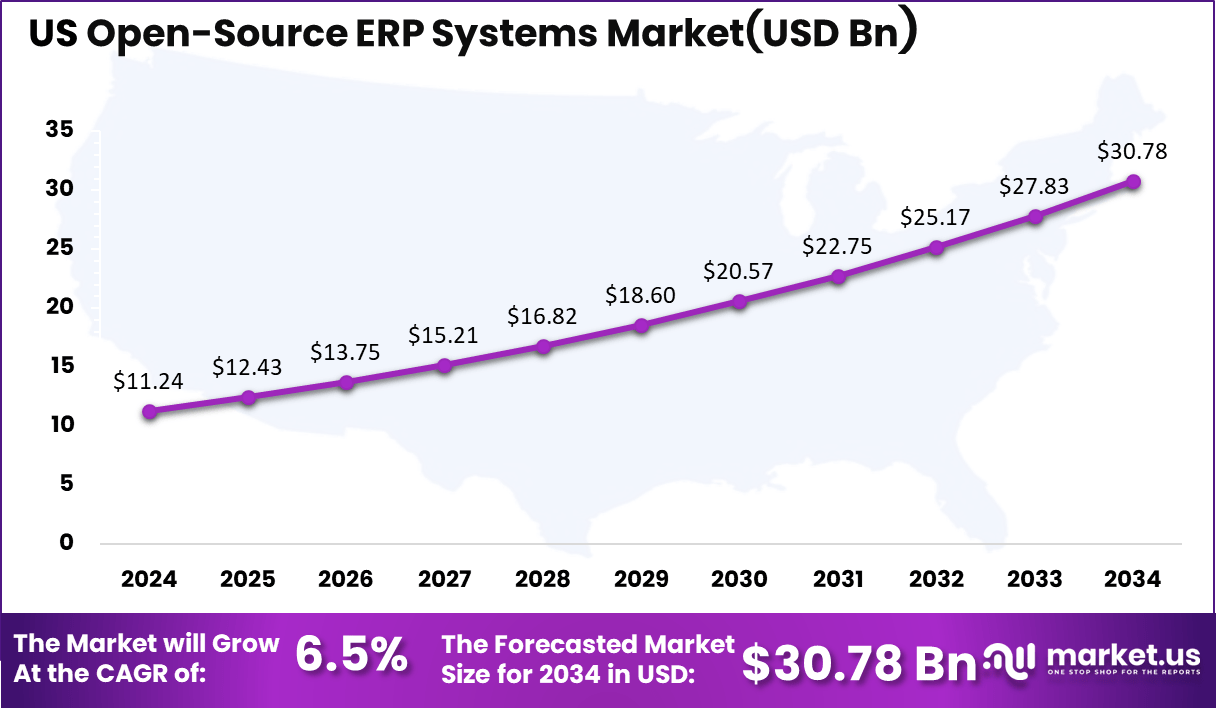
The U.S. Open-Source ERP Systems Market is experiencing robust growth, with the market valued at approximately USD 11.24 billion in 2024 and expected to reach USD 30.78 billion by 2034, reflecting a compound annual growth rate (CAGR) of around 6.5%.
The Open-Source ERP Systems market’s expansion is driven by the increasing adoption of open-source ERP solutions, especially among small and medium-sized enterprises (SMEs), which are expected to represent around 72% of the market adoption by 2034. SMEs are particularly attracted to these solutions due to their cost-effectiveness, scalability, and flexibility.
Key Regions and Countries
- North America
- US
- Canada
- Europe
- Germany
- France
- The UK
- Spain
- Italy
- Rest of Europe
- Asia Pacific
- China
- Japan
- South Korea
- India
- Australia
- Singapore
- Rest of Asia Pacific
- Latin America
- Brazil
- Mexico
- Rest of Latin America
- Middle East & Africa
- South Africa
- Saudi Arabia
- UAE
- Rest of MEA
Market Dynamics
Drivers
| Driver | (~) % Impact on CAGR Forecast | Geographic Relevance | Impact Timeline |
|---|---|---|---|
| SME cloud-first ERP adoption | +2.1% | North America, Europe, Asia-Pacific | Medium term (2–4 years) |
| Lower license TCO vs proprietary ERP | +1.6% | Asia-Pacific, Latin America, Middle East&Africa | Long term (≥ 4 years) |
| Demand for flexible customization | +1.4% | Global | Medium term (2–4 years) |
| Digitalization of mid-market manufacturing | +1.3% | United States, Germany, China, India | Medium term (2–4 years) |
| Community-driven innovation velocity | +0.8% | Global | Long term (≥ 4 years) |
| Shift to subscription implementation services | +0.7% | North America, Europe | Short term (≤ 2 years) |
SME cloud-first ERP adoption
Root cause is the migration of small and mid-sized enterprises from on-premise stacks with upfront capital expenditure of typically 20–30% of annual IT budgets to cloud-hosted, open-source ERP where initial cash outlay can fall by 25–40% and deployment lead times shrink from around 9–12 months to 3–6 months, catalyzing faster go-live and multi-module rollouts as observed in 2022–2024 adoption waves across manufacturing, retail, and services.
Quantitatively, cloud ERP is frequently reported as delivering roughly 30% lower total operating cost versus traditional on-premise ERP over a 5-year horizon, while open-source licensing further removes per-seat fees that can run at USD 500–1,500 per user annually in proprietary environments, redirecting this spend to integration and customization services.
Strategically, this pressure on proprietary vendors’ license margins enables open-source ERP providers and ecosystems to pursue subscription implementation bundles at gross margins in the high-teens to low-20% range, while SMEs gain the ability to phase module adoption (finance, inventory, CRM) without locking into 5–7-year contracts, reinforcing the baseline CAGR of 7.2% through reduced customer acquisition friction, lower churn risk, and higher attach rates for ancillary support and hosting services.
Restraints
| Restraint | (~) % Impact on CAGR Forecast | Geographic Relevance | Impact Timeline |
|---|---|---|---|
| Enterprise-grade support capacity gaps | -1.9% | North America, Europe, Asia-Pacific | Short term (≤ 2 years) |
| Conservative CIO risk perception | -1.5% | Global, strongest in regulated sectors | Medium term (2–4 years) |
| Complex legacy integration landscapes | -1.3% | United States, Western Europe, Japan | Medium term (2–4 years) |
| Data residency & compliance constraints | -1.1% | EU, Middle East, financial hubs | Short term (≤ 2 years) |
| Limited financing for large-scale migrations | -0.9% | Emerging markets | Medium term (2–4 years) |
| Vendor lock-in penalties in existing contracts | -0.8% | Global | Short term (≤ 2 years) |
Enterprise-grade support capacity gaps
The root restraint is the limited availability of enterprise-scale, 24/7, multi-region support capacity in many open-source ERP ecosystems, where certified partner networks may number in the low hundreds globally versus several thousand for incumbent proprietary ERP vendors, leaving large organizations with mission-critical uptime requirements of 99.9% or higher reluctant to switch core systems.
Quantitatively, this translates into higher perceived outage risk; downtime of even 4–6 hours can incur direct operational losses of USD 50,000–250,000 for mid-sized manufacturers, alongside SLA shortfalls, which pushes CIOs to discount open-source ERP options in RFP scoring models by 10–20% relative to proprietary bids and leads to project deferrals of 12–24 months.
Strategically, these support gaps compress the realized revenue run-rate for open-source ERP providers by holding back multi-country rollouts, delaying CapEx reallocation from proprietary maintenance lines that can account for 60–70% of ERP-related spend, and forcing ecosystem participants to invest heavily often 10–15% of annual revenues in building support centers and partner enablement before they can fully capture large-enterprise demand, resulting in an estimated drag of -1.9% on the otherwise higher organic growth trajectory.
Challenges
| Challenge | (~) % CAGR Friction Drag | Geographic Relevance | Mitigation Horizon |
|---|---|---|---|
| Skilled open-source ERP talent shortage | -1.7% | Global | Long term (≥ 4 years) |
| Fragmented community release governance | -1.4% | Global | Medium term (2–4 years) |
| Complex multi-tenant customization management | -1.2% | North America, Europe | Medium term (2–4 years) |
| Security hardening for regulated industries | -1.1% | Financial services, healthcare, public sector | Long term (≥ 4 years) |
| Scaling composable architectures | -0.9% | Global | Medium term (2–4 years) |
| Partner ecosystem business model alignment | -0.8% | Global | Medium term (2–4 years) |
Skilled open-source ERP talent shortage
The structural vulnerability lies in the global shortage of developers and functional consultants proficient in open-source ERP stacks, where available certified professionals can be fewer than 1,000–2,000 per major platform worldwide compared to tens of thousands for incumbent proprietary systems, creating bottlenecks in project delivery and post-go-live optimization.
This manifests quantitatively as day rates for experienced open-source ERP consultants increasing by 15–25% between 2022 and 2024, utilization levels consistently above 80%, and implementation timelines stretching by an additional 3–6 months for complex multi-country deployments, effectively raising the real cost-per-module deployed by 10–20% versus theoretical models that assume abundant talent.
Corporates respond by instituting long-term adjustments building in-house centers of excellence that can cost USD 1–3 million in initial setup, investing 5–10% of annual IT training budgets in upskilling, and selectively limiting scope to finance and inventory modules rather than full-suite rollouts which constrains the market’s maximum achievable CAGR by an estimated -1.7% even though baseline sales continue, as talent scarcity caps implementation throughput and slows innovation cycles.
Opportunities
| Opportunity | (~) % Potential CAGR Upside | Geographic Relevance | Execution Window |
|---|---|---|---|
| Verticalized open-source ERP bundles for regulated industries | +2.3% | North America, Europe, Asia-Pacific | Medium term (2–4 years) |
| AI-driven automation add-ons | +1.8% | Global | Long term (≥ 4 years) |
| Usage-based monetization for micro-SMEs | +1.5% | Asia-Pacific, Africa, Latin America | Medium term (2–4 years) |
| M&A roll-ups of regional service integrators | +1.3% | Global | Long term (≥ 4 years) |
| Industry app marketplaces around core ERP | +1.1% | Global | Medium term (2–4 years) |
| Local-language ERP distributions in emerging markets | +0.9% | Asia, Africa, Latin America | Medium term (2–4 years) |
Verticalized open-source ERP bundles for regulated industries
This opportunity is untapped because most open-source ERP deployments to date have focused on general-purpose modules for SMEs, leaving regulated sectors such as healthcare, financial services, and public administration, where compliance overhead can reach 10–15% of total IT spend, largely served by proprietary systems that bundle certification, audit trails, and security features.
By investing in pre-packaged, verticalized bundles (for example, healthcare ERP with built-in consent management, or banking ERP with standardized reporting packs), open-source ecosystems can reduce implementation effort by 20–30%, cut custom compliance development costs that often add USD 0.5–2 million per deployment, and deliver margin expansion of 5–8 percentage points on services through standardized, repeatable templates rather than one-off projects.
Unit economics shift favorably: recurring subscription or support fees per regulated-industry customer can be 1.5–2.0x those for generic SME deployments due to higher complexity, while the cost-per-feature delivered falls by 15–25% thanks to reuse of certified components, enabling total market CAGR upside of around +2.3% above the baseline 7.2% if even a modest share of currently locked-in proprietary deployments migrate to compliant open-source alternatives over the 2–4-year execution window.
Key Players Analysis
The open-source ERP systems market is highly fragmented, with a few commercially scaled vendors leading Tier-1 and numerous community-driven projects forming Tier-2. Tier-1 is led by Odoo S.A., which reported €282.9 million in 2024 revenue, up 39% year-on-year, and a user base exceeding 7 million. Its revenue primarily comes from subscriptions and implementation services built around its open-source core, giving it a low-double-digit share of the global open-source ERP segment.
With more than 900 R&D engineers, Odoo remains the commercial standard for SME-focused open-source ERP, particularly across EMEA and LATAM. ERPNext by Frappe Technologies and Dolibarr are smaller Tier-1 challengers, with deployment data indicating mid-single-digit shares each across SME open-source ERP.
Tier-2 includes iDempiere, VIENNA Advantage/Onfinity ERP, and Scipio ERP, which rely largely on community development and regional integrators. Individual project stewards generally generate low-single-digit millions in annual services revenue and hold below 3% of the open-source ERP installed base, while maintaining relevance in industrial distribution, public-sector, and localized tax environments.
Proprietary ERP majors such as SAP, Oracle, and Microsoft collectively control over 15% of the broader ERP software market. Oracle’s ERP-related revenue reached an estimated $8.7 billion in 2025, representing about 6.63% of global ERP share. However, their open capabilities mainly involve APIs and extensibility rather than true open-source licensing, making them competitive pressure rather than direct open-source ERP participants.
Top Key Players
- Odoo S.A.
- Frappe Technologies Pvt. Ltd.
- Dolibarr ERP & CRM
- Metasfresh GmbH
- iDempiere
- xTuple
- Compiere
- ERP5
- Tryton
- Axelor
- Others
Recent Developments
- In April 2025, Mythics, LLC acquired Smart ERP Solutions, Inc. to strengthen Oracle-focused ERP implementation and managed services. The deal was estimated at USD 75–80 million, combining Smart ERP’s 400+ consultants with Mythics’ 600-person services organization to create a ~1,000-person Oracle ERP unit supporting more than 250 concurrent ERP projects annually, including hybrid deployments with open-source ERP modules.
- In July 2025, Odoo SA partnered with South Korea-based Wishket Co. Ltd. to expand open-source ERP adoption among SMEs. The partnership targeted 10,000 new Korean SME customers over three years, leveraging Wishket’s 13,000+ registered IT professionals. Implementations were valued at KRW 5–20 million per client, with projected subscription revenue exceeding EUR 50 million by 2028.
Report Scope
| Report Features | Description |
|---|---|
| Market Value (2024) | USD 34.56 Bn |
| Forecast Revenue (2034) | USD 69.27 Bn |
| CAGR(2025-2034) | 7.2% |
| Base Year for Estimation | 2024 |
| Historic Period | 2020-2023 |
| Forecast Period | 2025-2034 |
| Report Coverage | Revenue forecast, AI impact on Market trends, Share Insights, Company ranking, competitive landscape, Recent Developments, Market Dynamics and Emerging Trends |
| Segments Covered | By Deployment Model (Cloud-Based, On-Premises), By Organization Size (Large Enterprises, Small and Medium-Sized Enterprises (SMEs)), By Functionality (Financial Management, Supply Chain Management, Customer Relationship Management (CRM), Project Management, Others), By End-User Industry (Manufacturing, Retail, Healthcare, Education, Others) |
| Regional Analysis | North America – US, Canada; Europe – Germany, France, The UK, Spain, Italy, Russia, Netherlands, Rest of Europe; Asia Pacific – China, Japan, South Korea, India, New Zealand, Singapore, Thailand, Vietnam, Rest of Latin America; Latin America – Brazil, Mexico, Rest of Latin America; Middle East & Africa – South Africa, Saudi Arabia, UAE, Rest of MEA |
| Competitive Landscape | Odoo S.A., Frappe Technologies Pvt. Ltd., Dolibarr ERP & CRM, Metasfresh GmbH, iDempiere, xTuple, Compiere, ERP5, Tryton, Axelor, Others |
| Customization Scope | Customization for segments, region/country-level will be provided. Moreover, additional customization can be done based on the requirements. |
| Purchase Options | We have three licenses to opt for: Single User License, Multi-User License (Up to 5 Users), Corporate Use License (Unlimited Users and Printable PDF) |